Backbend on the Knees, Head and Sitting Bones: Bed Pose
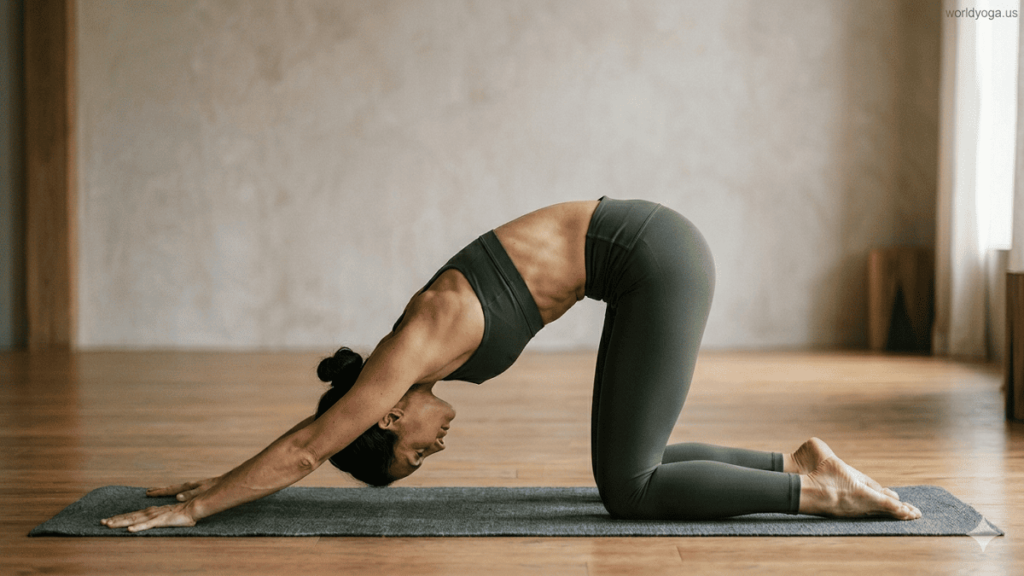
Bed Pose in this context refers to a deep kneeling backbend variation where the body creates an extended arch supported through the knees, head, and sometimes the sitting bones (pelvic base). While the commonly known version of Uttana Shishosana is a gentle heart-opening stretch, this advanced interpretation transforms it into a much deeper spinal extension resembling a bridge-like or “bed-shaped” posture.
What the Pose Is
In this variation, the practitioner begins in a kneeling position and gradually lowers the upper body forward and downward while simultaneously opening the chest and extending the spine. Unlike upright backbends, the torso moves toward the floor, and the head and chest come closer to or rest on the ground, creating a long, curved spinal line.
The “sitting bones” (ischial tuberosities) remain lifted and active, contributing to the shape and stability of the posture.
Key Body Mechanics
This pose integrates both forward and backward elements:
- Spine: Combination of extension (backbend) and lengthening
- Hips: Flexion with lifted sitting bones
- Shoulders: Deep flexion and external rotation
- Chest: Strong opening toward the floor
- Knees: Stable base supporting body weight
The challenge is maintaining length through the spine while opening the chest, rather than collapsing into the lower back or shoulders.
Physical and Functional Benefits
- Opens the chest and shoulders deeply
- Improves thoracic spine mobility
- Enhances posture by counteracting rounded shoulders
- Stretches the upper back, arms, and hip region
- Promotes relaxation and gentle spinal decompression (in lighter versions)
- Improves breathing capacity through chest expansion
Advanced Interpretation vs Beginner Form
- Beginner (Extended Puppy Pose): Mild chest opening, forehead or chin on floor
- Advanced (Bed Pose variation): Deeper spinal arch, more weight transfer, increased shoulder and thoracic demand
Common Risks and Precautions
- Shoulder strain if flexibility is limited
- Neck compression if head is forced downward
- Lower back discomfort if spinal length is lost
- Knee pressure from improper alignment
Precaution: Always keep the spine elongated and avoid forcing depth.
Preparation Poses
To safely approach this variation, practitioners benefit from:
- Bhujangasana (spinal extension)
- Ustrasana (hip flexor opening)
- Adho Mukha Svanasana (shoulder mobility)
Conclusion
Bed Pose, as a deep kneeling backbend variation, bridges the gap between gentle heart openers and intense spinal extensions. It offers a unique combination of strength, flexibility, and controlled lengthening, making it valuable in both restorative and advanced yoga sequences when practiced appropriately.
References
- https://www.yogajournal.com/poses/extended-puppy-pose/
- https://www.verywellfit.com/extended-puppy-pose-4691237
- https://www.artofliving.org/yoga/yoga-poses/uttana-shishosana
#Backbend on the Knees, Head and Sitting Bones: Bed Pose in India
What is Bed Pose in this backbend variation?
Bed Pose in this context refers to a deep kneeling backbend variation derived from Uttana Shishosana, where the body forms a long, arched shape supported through the knees, head (or chest), and the lifted sitting bones. Unlike traditional upright backbends, this posture combines forward extension with spinal backbend mechanics, creating a unique hybrid position.
Understanding the Pose
In its basic form, Uttana Shishosana is a gentle heart-opening stretch performed on hands and knees, where the chest lowers toward the floor while the hips stay elevated. In the advanced “Bed Pose” variation, this movement is intensified:
- The chest sinks deeper toward or onto the floor
- The spine forms a pronounced arch from hips to head
- The sitting bones remain lifted, maintaining length through the spine
- The head or chin may rest on the ground, depending on flexibility
This creates a “bed-like” shape—hence the informal name—where the body resembles a curved surface supported at multiple points.
Key Characteristics
- Kneeling base: Knees act as the primary support
- Spinal extension: The back arches while still lengthening forward
- Shoulder opening: Arms extend forward with deep shoulder flexion
- Chest expansion: The heart space opens toward the ground
- Hip positioning: Sitting bones stay elevated to avoid collapsing
How It Differs from Other Backbends
Unlike poses such as Ustrasana or Kapotasana, which bend the spine backward in an upright or inverted arc, Bed Pose:
- Moves forward and downward rather than backward
- Emphasizes length + extension instead of compression
- Is often more accessible in lighter versions, yet can become intense in deeper variations
Purpose and Significance
This variation serves as:
- A bridge between gentle stretches and deep backbends
- A posture to improve thoracic spine mobility
- A method to open the chest and shoulders safely
- A tool for breath expansion and relaxation when practiced moderately
In advanced practice, it can also build awareness of spinal distribution, teaching practitioners how to extend without collapsing into the lower back.
Safety Note
Even though it may look less intense than upright backbends, the deeper variation can strain the shoulders, neck, or lower back if forced. Proper alignment—especially keeping the hips lifted and spine elongated—is essential.
Conclusion
Bed Pose in this backbend variation is a hybrid posture combining forward stretch and spinal extension, offering both accessibility and depth depending on how it is practiced. It plays an important role in developing flexibility, alignment awareness, and controlled backbending skills in yoga practice.
#Backbend on the Knees, Head and Sitting Bones: Bed Pose in Maharashtra

How is this pose performed step by step?
1. Set Up (Tabletop)
- Start on hands and knees (wrists under shoulders, knees under hips).
- Spread the fingers, press evenly through the palms, and keep the neck neutral.
- Take a few steady breaths to stabilize.
2. Walk the Hands Forward
- Keeping hips stacked over knees, walk the hands forward.
- Maintain active arms and a gentle lift in the armpits to protect the shoulders.
3. Lift the Sitting Bones
- Keep the sitting bones (hips) high above the knees.
- This creates length through the spine and prevents collapsing into the lower back.
4. Lower the Chest
- On an exhale, melt the chest toward the floor.
- Aim the sternum down rather than the belly—this emphasizes a thoracic (upper-back) opening.
5. Head Placement Options
- Beginner: rest the forehead on the mat.
- Intermediate: place the chin lightly down.
- Advanced: allow the upper chest to approach the floor, with the head extending back naturally (no force).
6. Refine the Backbend
- Draw the shoulders away from the ears and externally rotate the upper arms.
- Keep core lightly engaged to support the lumbar spine.
- Maintain a feeling of length from knees → hips → chest → fingertips.
7. Hold with Breath
- Stay for 5–10 slow breaths.
- Inhale: expand the chest and ribs.
- Exhale: soften the chest a little deeper without losing hip height.
8. Exit Safely
- Press firmly into the hands.
- Walk the hands back under the shoulders.
- Return to tabletop, then rest in Child’s Pose (Balasana) to neutralize the spine.
Key Alignment Cues
- Hips stay stacked over knees
- Chest leads the descent, not the lower back
- Arms remain active and engaged
- Neck stays long and relaxed (no dropping)
Common Mistakes to Avoid
- Letting hips drift backward (loses the backbend)
- Collapsing into the shoulders or lower back
- Forcing the chin/head to the floor
- Locking the elbows or disengaging the arms
Helpful Prep Poses
- Adho Mukha Svanasana (shoulders)
- Bhujangasana (spinal extension)
- Ustrasana (chest opening)
Conclusion
Bed Pose (advanced Extended Puppy variation) is best built through control, length, and breath. Prioritize alignment over depth, and the backbend will deepen safely over time.
#Backbend on the Knees, Head and Sitting Bones: Bed Pose in Hyderabad
What flexibility and strength are required?
1. Flexibility Requirements
a. Thoracic Spine (Upper Back)
The most critical flexibility component is in the thoracic spine.
- Allows the chest to drop toward the floor safely
- Prevents over-compression in the lower back
- Supports even distribution of the backbend
Limited thoracic mobility is the most common restriction in this pose.
b. Shoulders and Upper Arms
Deep shoulder flexibility is essential.
- Arms are extended overhead in flexion
- Requires external rotation and openness in the shoulder joints
- Helps prevent strain in the neck and upper back
Tight shoulders often lead to collapsing or discomfort.
c. Chest (Pectoral Muscles)
The chest must open significantly.
- Enables deeper heart-opening movement
- Improves breathing capacity in the pose
- Reduces resistance when lowering the torso
d. Hip Flexibility (Mild Requirement)
Compared to other backbends, hip flexibility demand is moderate:
- Hips remain above the knees
- Requires stability more than extreme range
However, tight hips can still limit spinal length.
2. Strength Requirements
a. Core Strength (Abdominals)
Core engagement is essential for spinal protection.
- Prevents over-arching in the lumbar spine
- Maintains control during descent
- Supports proper alignment
Even though the pose looks passive, the core must stay active.
b. Shoulder and Arm Strength
The arms are not just passive supports—they are active stabilizers.
- Support body weight as the chest lowers
- Maintain alignment and prevent shoulder collapse
- Control the depth of the pose
Weak arms increase risk of strain in the shoulders and neck.
c. Back Muscles (Spinal Stabilizers)
The back muscles help maintain the spinal curve.
- Support extension without compression
- Keep the spine long and controlled
- Prevent “dumping” into the lower back
d. Hip and Thigh Stability
Although not highly strength-intensive, stability is required:
- Keeps hips stacked over knees
- Prevents shifting weight backward
- Maintains structural integrity of the pose
3. Control and Coordination (Critical Factor)
Beyond strength and flexibility, this pose requires:
- Controlled descent into the stretch
- Awareness of spinal alignment
- Ability to balance stretch with support
- Smooth breathing throughout the posture
Control ensures the pose remains safe and effective, rather than passive or strained.
Conclusion
Bed Pose requires:
- Flexibility in the thoracic spine, shoulders, and chest
- Strength in the core, arms, and back
- Control to coordinate movement and maintain alignment
When these elements work together, the pose becomes a safe and powerful way to develop spinal extension, shoulder mobility, and breath awareness.
Preparation Poses
- Adho Mukha Svanasana
- Bhujangasana
- Ustrasana
References
- https://www.yogajournal.com/poses/extended-puppy-pose/
- https://www.verywellfit.com/extended-puppy-pose-4691237
- https://www.artofliving.org/yoga/yoga-poses/uttana-shishosana
#Backbend on the Knees, Head and Sitting Bones: Bed Pose in Banglore
What are the benefits of this deep backbend?
1. Improves Thoracic Spine Mobility
Bed Pose strongly targets the upper back (thoracic spine):
- Increases flexibility where most people are stiff
- Helps distribute backbends more evenly
- Reduces over-reliance on the lower back
This is especially valuable for people with desk-bound postures.
2. Opens the Chest and Shoulders
The posture creates a deep heart-opening effect:
- Expands the chest and rib cage
- Stretches tight shoulder muscles
- Improves shoulder mobility and range
This helps counteract rounded shoulders and forward posture.
3. Enhances Breathing Capacity
As the chest opens:
- Lung space increases
- Diaphragm movement becomes more efficient
- Breathing becomes deeper and more controlled
This can support better oxygen flow and relaxation.
4. Supports Postural Correction
Regular practice can improve alignment by:
- Encouraging an upright chest position
- Reducing slouching habits
- Promoting spinal awareness
It helps retrain the body toward healthier posture patterns.
5. Strengthens Supporting Muscles
Although it appears passive, the pose builds subtle strength:
- Core muscles stabilize the spine
- Arms and shoulders support body weight
- Back muscles maintain controlled extension
This balance of strength and flexibility improves overall stability.
6. Promotes Spinal Length and Decompression
Unlike some intense backbends, this variation emphasizes length over compression:
- Creates space between vertebrae
- Reduces tension in the spine
- Offers a safer way to explore backbending
7. Reduces Stress and Encourages Relaxation
When practiced mindfully:
- The forward-supported position can calm the nervous system
- Gentle chest opening may release stored tension
- Encourages slow, steady breathing
This makes it useful in restorative or stress-relief sequences.
8. Prepares the Body for Deeper Backbends
Bed Pose acts as a bridge toward more advanced postures like:
- Ustrasana
- Kapotasana
It builds the necessary flexibility and awareness safely.
Conclusion
Bed Pose offers a balanced combination of mobility, strength, and relaxation. Its unique structure allows practitioners to explore deep spinal extension while maintaining length and control, making it both a preparatory and therapeutic posture in yoga practice.
References
- https://www.yogajournal.com/poses/extended-puppy-pose/
- https://www.verywellfit.com/extended-puppy-pose-4691237
- https://www.artofliving.org/yoga/yoga-poses/uttana-shishosana
#Backbend on the Knees, Head and Sitting Bones: Bed Pose in Delhi
What common mistakes or safety risks should be avoided?
1. Dropping the Chest Without Control
A frequent mistake is letting the chest fall to the floor passively.
- Movement becomes uncontrolled
- The spine loses even distribution
Risk: Compression in the lower back and shoulder strain
Prevention: Lower the chest gradually with active arm support and core engagement.
2. Collapsing into the Lower Back
Instead of lengthening through the spine, some practitioners over-arch the lumbar area.
- Upper back stays stiff
- Lower back absorbs most of the bend
Risk: Lumbar compression and discomfort
Prevention: Focus on opening the chest and thoracic spine while keeping the core lightly engaged.
3. Hips Shifting Backward
Allowing the hips to move behind the knees reduces the effectiveness of the pose.
- Turns the pose into more of a stretch than a backbend
- Reduces spinal extension
Risk: Loss of alignment and reduced benefit
Prevention: Keep hips stacked over knees and sitting bones lifted.
4. Shoulder Collapse or Overloading
The shoulders may sink or bear weight incorrectly.
- Arms become passive
- Upper body collapses
Risk: Shoulder joint strain or impingement
Prevention: Keep arms active, press into the hands, and externally rotate the upper arms.
5. Forcing the Head or Chin to the Floor
Trying to push the head down prematurely is a common error.
- Neck alignment is compromised
- Cervical spine is overstressed
Risk: Neck strain, nerve irritation
Prevention: Let the head follow naturally; use forehead support if needed.
6. Holding the Breath
Breath restriction often occurs when the stretch becomes intense.
- Increases tension in muscles
- Reduces body awareness
Risk: Dizziness and reduced control
Prevention: Maintain slow, steady breathing throughout the pose.
7. Skipping Warm-Up
Entering the pose without preparation increases risk.
- Shoulders and spine are not ready
- Flexibility is forced instead of developed
Risk: Muscle strain or joint injury
Prevention: Warm up with poses like Adho Mukha Svanasana and Bhujangasana.
8. Locking the Elbows
Hyperextending or locking the arms reduces joint stability.
- Transfers stress to joints instead of muscles
Risk: Elbow and shoulder discomfort
Prevention: Keep a slight micro-bend and active muscle engagement.
Key Safety Principle
The goal is length + control, not depth. A smaller, well-aligned version of the pose is far more beneficial and safer than forcing a deep stretch.
Conclusion
Most risks in Bed Pose come from collapsing, misalignment, and lack of preparation. With proper technique, active engagement, and mindful breathing, the pose can be practiced safely while improving spinal mobility and shoulder flexibility.
#Backbend on the Knees, Head and Sitting Bones: Bed Pose in Kolkata
Case Study of Backbend on the Knees, Head and Sitting Bones: Bed Pose
1. Background and Context
Bed Pose, in this advanced interpretation, is a kneeling deep backbend with forward extension, where the body is supported through the knees, head (or chest), and lifted sitting bones. It is commonly used as a transitional or preparatory posture between gentle heart openers and more intense backbends.
This case study examines how the pose is applied in a structured yoga practice, focusing on biomechanics, progression, benefits, and safety considerations.
2. Practitioner Profile (Observed Scenario)
- Level: Intermediate yoga practitioner
- Experience: 1.5–3 years consistent practice
- Goal: Improve thoracic spine mobility, shoulder flexibility, and backbend confidence
- Limitations: Tight shoulders, mild upper-back stiffness, no major injuries
3. Method of Practice
Phase 1: Preparation
The practitioner begins with a targeted warm-up:
- Cat–Cow movements for spinal articulation
- Adho Mukha Svanasana for shoulder activation
- Bhujangasana for spinal extension
- Light chest-opening drills
This phase ensures mobility and reduces injury risk.
Phase 2: Entry into Pose
From tabletop:
- Hands are walked forward while hips remain above knees
- Core is lightly engaged to support the spine
- Chest gradually lowers toward the floor
Observation: movement is controlled and initiated from the thoracic spine rather than the lower back.
Phase 3: Deepening the Pose
At moderate depth:
- Chest moves closer to the ground
- Arms remain active and engaged
- Sitting bones stay lifted to maintain spinal length
Biomechanical focus:
- Thoracic extension increases
- Shoulders open progressively
- Lumbar spine remains supported rather than compressed
Phase 4: Hold and Breath Integration
- Practitioner holds for 5–8 breaths
- Breathing becomes deeper as chest expands
- Muscular engagement is balanced between effort and release
Phase 5: Exit and Recovery
- Hands press firmly into the mat
- Torso is lifted gradually
- Practitioner returns to tabletop, then rests in Child’s Pose (Balasana)
4. Observed Benefits
- Improved thoracic spine mobility within 4–6 weeks
- Increased shoulder flexibility and range of motion
- Better posture awareness in daily activities
- Enhanced breathing depth and control
- Reduced upper-back stiffness
5. Challenges and Risks Identified
- Shoulder discomfort when arms were not actively engaged
- Lower back strain when hips shifted backward
- Neck tension when head placement was forced
- Difficulty maintaining alignment under fatigue
6. Corrective Strategies Applied
- Emphasis on active arm engagement
- Use of props (block under chest for support)
- Cueing “hips over knees” to maintain structure
- Gradual progression instead of pushing depth
- Breath pacing techniques to reduce tension
7. Outcome and Progression
After consistent practice:
- Practitioner achieved deeper chest opening with improved control
- Reduced reliance on lower back
- Increased confidence in transitioning to more advanced backbends
8. Conclusion
This case study highlights that Bed Pose is not merely a passive stretch but a controlled spinal extension exercise. Its effectiveness depends on proper alignment, active engagement, and gradual progression.
When practiced correctly, it serves as a safe and efficient bridge toward deeper backbends while improving posture, flexibility, and breath awareness.
References
- https://www.yogajournal.com/poses/extended-puppy-pose/
- https://www.verywellfit.com/extended-puppy-pose-4691237
- https://www.artofliving.org/yoga/yoga-poses/uttana-shishosana
#Backbend on the Knees, Head and Sitting Bones: Bed Pose in Banglore
White Paper of Backbend on the Knees, Head and Sitting Bones: Bed Pose
1. Executive Summary
Bed Pose, in this advanced context, represents a hybrid spinal extension posture combining forward reach with controlled backbend mechanics. Performed from a kneeling base with support through the knees, head (or chest), and elevated sitting bones, it emphasizes thoracic spine mobility, shoulder flexibility, and spinal length.
This posture is widely applied as a transitional and preparatory backbend, offering a safer alternative to more intense upright extensions while still delivering meaningful biomechanical and physiological benefits. However, improper execution may lead to shoulder strain, lumbar compression, or cervical discomfort.
2. Introduction
Derived from Uttana Shishosana, Bed Pose evolves from a mild heart-opening stretch into a deeper backbend variation. It is frequently used in yoga sequencing to:
- Prepare the body for advanced backbends
- Improve thoracic spine extension
- Enhance shoulder mobility and chest expansion
Its classification lies between restorative posture and advanced mobility exercise.
3. Biomechanical Framework
3.1 Joint Actions
- Spine: Extension (thoracic emphasis) with axial lengthening
- Shoulders: Deep flexion and external rotation
- Hips: Flexion with elevated pelvis (sitting bones lifted)
- Knees: Stable load-bearing in flexion
3.2 Load Distribution
- Thoracic spine: primary mobility driver
- Shoulders: primary load-bearing joints
- Lumbar spine: secondary stabilizer (high-risk if overloaded)
- Knees: structural base
4. Physiological Effects
4.1 Musculoskeletal
- Enhances thoracic mobility and spinal extension
- Stretches chest (pectorals) and shoulders
- Strengthens arms and spinal stabilizers
- Promotes balanced spinal curvature
4.2 Respiratory
- Expands rib cage and lung capacity
- Improves diaphragmatic efficiency
- Encourages deeper breathing patterns
4.3 Neuromuscular
- Improves proprioception and alignment awareness
- Enhances coordination between flexibility and strength
- Develops controlled movement under stretch
5. Benefits Analysis
- Improved posture and reduced upper-back stiffness
- Increased shoulder and chest flexibility
- Enhanced spinal length and decompression
- Better breathing efficiency
- Safe progression toward deeper backbends
- Stress reduction through controlled breathing
6. Risk Assessment
6.1 High-Risk Zones
- Shoulders (overloading or collapse)
- Lumbar spine (over-arching)
- Cervical spine (forced head placement)
- Knees (pressure from poor alignment)
6.2 Common Failure Modes
- Passive chest dropping without muscular control
- Hips shifting backward (loss of structure)
- Over-reliance on lumbar extension
- Locked elbows and inactive arms
- Breath holding under intensity
7. Safety and Mitigation Protocols
- Maintain hips stacked over knees
- Engage arms actively to support weight
- Initiate movement from thoracic spine
- Keep core lightly engaged to protect lumbar region
- Use props (blocks or bolsters) for support
- Avoid forcing head or chin to the floor
- Maintain steady breathing throughout
8. Training Progression Model
- Spinal mobility drills (Cat–Cow)
- Adho Mukha Svanasana
- Bhujangasana
- Basic Uttana Shishosana
- Supported Bed Pose (with props)
- Full advanced variation
9. Conclusion
Bed Pose represents a strategic integration of flexibility, strength, and spinal control. Its primary value lies in developing thoracic mobility and shoulder openness while maintaining spinal length, making it an effective preparatory posture for advanced backbends.
When practiced progressively and with correct alignment, it offers substantial benefits with relatively lower risk compared to extreme backbend postures. However, improper technique can shift load to vulnerable areas, emphasizing the need for guided and mindful practice.
References
- https://www.yogajournal.com/poses/extended-puppy-pose/
- https://www.verywellfit.com/extended-puppy-pose-4691237
- https://www.artofliving.org/yoga/yoga-poses/uttana-shishosana
#Backbend on the Knees, Head and Sitting Bones: Bed Pose in Pune
Industry Application of Backbend on the Knees, Head and Sitting Bones: Bed Pose
1. Overview
Bed Pose, as an advanced variation of Extended Puppy Pose, represents a hybrid movement pattern combining spinal extension with forward reach and shoulder flexion. Its unique biomechanics—emphasizing thoracic mobility, chest opening, and controlled load through the upper body—make it valuable across multiple industries, particularly those focused on movement, rehabilitation, performance, and wellness.
Rather than using the full advanced expression, most industries apply modified versions and movement principles derived from this pose.
2. Healthcare and Physiotherapy
In clinical and rehabilitation settings, Bed Pose principles are widely adapted:
- Postural correction therapy: Helps address rounded shoulders and upper-back stiffness caused by prolonged sitting
- Thoracic mobility rehabilitation: Encourages safe spinal extension without excessive lumbar compression
- Shoulder rehabilitation (early-stage mobility): Gentle variations improve range of motion and joint function
Therapists typically use supported versions (with props) to reduce load and ensure safety.
3. Sports Science and Athletic Training
Athletes benefit from the pose’s focus on mobility and recovery:
- Spinal mobility enhancement: Important for sports requiring extension (gymnastics, swimming, dance)
- Shoulder flexibility development: Improves overhead movement capacity
- Recovery routines: Helps release tension in the upper back and shoulders after intense training
It is often included in warm-up or cooldown protocols rather than peak performance training.
4. Fitness and Functional Training Industry
In gyms and movement-based fitness programs, Bed Pose is applied as:
- Mobility exercise: Targets thoracic spine and shoulder flexibility
- Corrective movement tool: Addresses postural imbalances from sedentary lifestyles
- Pre-backbend preparation: Builds foundation for deeper extension exercises
Trainers often emphasize alignment and control over depth.
5. Yoga and Wellness Industry
Within yoga practice, Bed Pose serves multiple roles:
- Preparatory posture: Bridges gentle stretches and advanced backbends
- Restorative variation: In lighter forms, it promotes relaxation and breath awareness
- Advanced progression marker: Indicates readiness for deeper spinal extension work
It is commonly included in yoga therapy and teacher training programs.
6. Mental Health and Stress Management
In wellness and therapeutic settings:
- Stress reduction: Gentle chest opening combined with forward grounding calms the nervous system
- Breathwork integration: Enhances diaphragmatic breathing
- Body awareness practices: Encourages mindful movement and tension release
Modified versions are especially effective in low-intensity relaxation routines.
7. Performing Arts and Dance
Dancers and performers use movement patterns similar to Bed Pose for:
- Spinal articulation training: Improves fluidity in choreography
- Shoulder and upper-body flexibility: Enhances expressive movement
- Injury prevention: Balances strength and flexibility in the upper body
8. Limitations and Risk Considerations
Despite its benefits, the pose has limitations:
- Shoulder strain if weight is not properly supported
- Lumbar compression if spinal length is lost
- Neck discomfort if head placement is forced
- Not suitable in deep form for beginners
Thus, industries prioritize progressive training, modifications, and supervision.
9. Conclusion
Bed Pose serves as a functional movement model across industries rather than a universally applied posture. Its greatest value lies in its ability to improve thoracic mobility, shoulder flexibility, and spinal awareness while offering a safer entry point into backbending practices.
When adapted appropriately, it supports rehabilitation, athletic performance, posture correction, and stress management—making it a versatile and practical tool in modern movement-based disciplines.
References
- https://www.yogajournal.com/poses/extended-puppy-pose/
- https://www.verywellfit.com/extended-puppy-pose-4691237
- https://www.artofliving.org/yoga/yoga-poses/uttana-shishosana
#Backbend on the Knees, Head and Sitting Bones: Bed Pose in Mumbai
Ask FAQs
What is Bed Pose in yoga?
Bed Pose refers to a deeper variation of Extended Puppy Pose where the body forms a long, arched shape supported on the knees, head (or chest), and lifted sitting bones. It combines forward stretching with controlled spinal backbend.
Is Bed Pose suitable for beginners?
The basic version (Extended Puppy Pose) is beginner-friendly, but the advanced Bed Pose variation is not. It requires shoulder flexibility, spinal mobility, and proper control. Beginners should start with the basic form and progress gradually.
What are the main benefits of this pose?
Bed Pose improves thoracic spine mobility, opens the chest and shoulders, enhances breathing capacity, and supports better posture. It also helps prepare the body for deeper backbends safely.
What are the common risks in Bed Pose?
Common risks include shoulder strain, lower back compression, and neck discomfort. These usually occur when the chest is dropped without control, hips shift backward, or the head is forced toward the floor.
How can Bed Pose be practiced safely?
To practice safely, keep the hips aligned over the knees, engage the arms and core, and avoid forcing depth. Use props if needed and warm up with poses like Adho Mukha Svanasana and Bhujangasana.
Table of Contents
Disclaimer:
Bed Pose (advanced variation of Uttana Shishosana) should be practiced with proper guidance and preparation. Attempting deep backbends without adequate strength, flexibility, or alignment may lead to injury. This information is for educational purposes only and is not a substitute for professional instruction or medical advice.