Backbend on the Knees and Head: Pigeon Pose
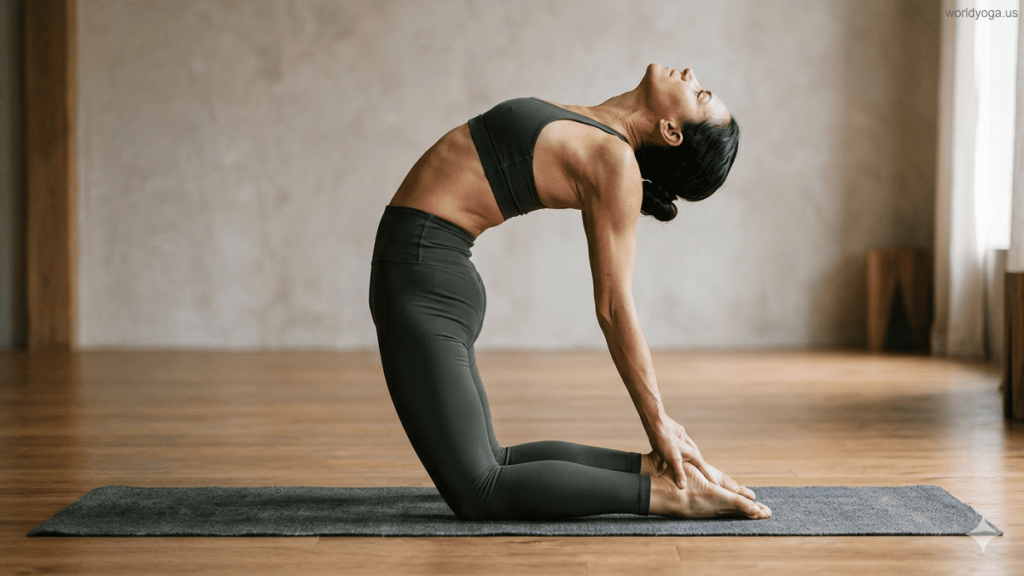
Pigeon Pose (Kapotasana) is a deep and advanced yoga backbend that involves strong spinal extension while the body remains grounded through the knees. Despite its name, it is different from the common “Pigeon Pose” hip opener (Eka Pada Rajakapotasana). Kapotasana is a powerful heart-opening posture where the spine arches deeply backward, often with the head moving toward or touching the floor, creating a dramatic kneeling backbend shape.
What the Pose Is
In Kapotasana, the practitioner starts from a kneeling position and gradually moves into a deep backbend. The thighs remain engaged, the chest lifts upward, and the spine forms a strong arc. The hands may reach for the heels for support, and in advanced expressions, the head may move toward the floor while maintaining control and alignment.
This posture is part of traditional Hatha yoga and is often considered a peak pose in advanced backbend sequences.
Physical Demands
Kapotasana requires a high level of:
- Spinal flexibility (especially thoracic extension)
- Hip flexor lengthening
- Quadriceps flexibility
- Core and lower back strength
- Shoulder and chest opening
Without these foundations, the pose can place excessive pressure on the lumbar spine and knees.
Key Benefits
- Deep opening of the chest and shoulders
- Improved spinal mobility and posture
- Strengthening of back muscles and core stability
- Increased lung capacity through chest expansion
- Enhanced body awareness and balance
- Emotional release due to intense heart opening
Safety Considerations
Kapotasana is an advanced posture and should not be attempted without preparation. Common risks include:
- Lower back strain from over-arching the lumbar spine
- Knee discomfort from prolonged kneeling pressure
- Neck compression if the head is dropped incorrectly
- Breathing restriction if the chest collapses
Preparation Poses
To safely approach Kapotasana, practitioners typically build up through:
- Camel Pose (Ustrasana)
- Bridge Pose (Setu Bandhasana)
- Cobra Pose (Bhujangasana)
- Wheel Pose (Urdhva Dhanurasana)
These poses develop the required flexibility and strength gradually.
Conclusion
Kapotasana is not just a physical backbend but a full-body expression of strength, flexibility, and control. When practiced with proper progression, it becomes a transformative posture that enhances spinal health, emotional openness, and overall body awareness.
References
- https://www.yogajournal.com/poses/pigeon-pose-kapotasana/
- https://www.verywellfit.com/how-to-do-the-pigeon-pose-3567102
- https://www.artofliving.org/yoga/yoga-poses/kapotasana
#Backbend on the Knees and Head: Pigeon Pose in India
What is the Knees-and-Head Backbend Pigeon Pose?
The Knees-and-Head Backbend Pigeon Pose, known in Sanskrit as Kapotasana, is an advanced yoga backbend where the body forms a deep arch from a kneeling base, often bringing the head close to or toward the floor. Despite the name “Pigeon Pose,” it is very different from the commonly practiced hip-opening variation seen in beginner yoga classes.
Kapotasana is part of traditional Hatha yoga and is considered a peak posture in deep backbend progressions. It emphasizes spinal extension, chest opening, and full-body integration of strength and flexibility.
How the Pose Looks and Works
In this posture, the practitioner begins in a kneeling position. From there:
- The spine gradually bends backward into a deep arc
- The chest lifts and expands upward
- The hands may reach for the heels or feet for support
- The head may extend backward, sometimes nearing or touching the ground in advanced forms
The knees remain grounded, acting as a stable base while the upper body moves into deep extension.
Key Body Mechanics
Kapotasana involves multiple joint actions working together:
- Spine: deep global extension (especially thoracic spine)
- Hips: strong extension with hip flexor lengthening
- Shoulders: deep opening and external rotation
- Core: active engagement to protect the lower back
- Knees: stable weight-bearing in deep flexion
The challenge is to distribute the backbend evenly instead of collapsing into the lower back.
Purpose and Significance
Kapotasana is not just a flexibility pose; it is a controlled backbend integration posture. It trains the body to:
- Open the front body (chest, abdomen, hips)
- Strengthen the back body (spine and glutes)
- Improve breath expansion through chest lift
- Develop emotional awareness and release tension
In yogic tradition, deep backbends like Kapotasana are also associated with opening the heart energy center (Anahata chakra), symbolizing emotional openness and courage.
Why It Is Advanced
This pose is considered advanced because it requires:
- High spinal mobility without compression
- Strong core support to protect the lower back
- Flexible hip flexors and quadriceps
- Shoulder openness for safe backbend depth
- Breath control under deep extension
Without these, the risk of strain in the lumbar spine or neck increases significantly.
Safety Note
Kapotasana should only be practiced after proper preparation with poses like Camel Pose, Cobra Pose, and Wheel Pose. It is best learned under supervision to ensure safe alignment and progression.
References
- https://www.yogajournal.com/poses/pigeon-pose-kapotasana/
- https://www.verywellfit.com/how-to-do-the-pigeon-pose-3567102
- https://www.artofliving.org/yoga/yoga-poses/kapotasana
#Backbend on the Knees and Head: Pigeon Pose in Maharashtra
How is this backbend performed step by step?
1. Preparation and Warm-Up
Before entering the pose, the body must be fully prepared. Practitioners typically warm up with:
- Cat–Cow stretches (spinal mobility)
- Cobra Pose (Bhujangasana)
- Camel Pose (Ustrasana)
- Bridge or Wheel Pose (Setu Bandhasana / Urdhva Dhanurasana)
This prepares the spine, hip flexors, and shoulders for deep extension.
2. Starting Position (Kneeling Base)
Begin by kneeling on the mat:
- Knees hip-width apart or slightly narrower depending on comfort
- Thighs engaged and stable
- Spine upright in a neutral position
- Hands resting on hips or thighs
Take slow, steady breaths to center the body.
3. Initial Backbend Entry
On an inhale:
- Lift the chest upward
- Begin gently arching the upper spine backward
- Keep the movement controlled and avoid collapsing into the lower back
- Engage the core lightly to support the spine
The bend should start in the upper back (thoracic region), not the lower back.
4. Deepening the Arch
As flexibility allows:
- Continue lowering the torso backward
- Open the chest further and draw shoulders back
- Maintain steady breathing
- Keep thighs active to stabilize the base
This is where spinal extension becomes more pronounced.
5. Reaching for Support (Heels or Feet)
In deeper stages:
- Extend the hands backward toward the heels or ankles
- If reachable, gently hold the heels for support
- This helps stabilize and deepen the backbend safely
Avoid forcing the reach if the body is not ready.
6. Head Positioning
In advanced expression:
- The head naturally tilts backward
- The throat remains open without strain
- In extreme flexibility cases, the crown may approach the floor
- The neck should stay long and relaxed, not compressed
7. Holding the Pose
Once stable:
- Maintain steady breathing
- Keep chest lifted and open
- Engage thighs and core lightly for support
- Hold for a few breaths without strain
The focus should be on expansion, not depth.
8. Exiting the Pose Safely
To release:
- Engage the core muscles first
- Slowly lift the chest upward using abdominal and thigh strength
- Return gradually to a kneeling upright position
- Rest in Child’s Pose (Balasana) to relax the spine
Key Safety Principle
Movement should always be controlled, gradual, and pain-free. The goal is spinal extension distribution, not maximum bending.
References
- https://www.yogajournal.com/poses/pigeon-pose-kapotasana/
- https://www.verywellfit.com/how-to-do-the-pigeon-pose-3567102
- https://www.artofliving.org/yoga/yoga-poses/kapotasana
#Backbend on the Knees and Head: Pigeon Pose in Pune

What strength and flexibility are required?
1. Strength Requirements
Core Strength (Abdominals and Deep Core Muscles)
A strong core is essential to protect the lower back during deep spinal extension.
- Prevents excessive compression in the lumbar spine
- Helps control the descent into the backbend
- Supports safe exit from the pose
Weak core engagement often leads to collapsing into the lower back, which is a major risk factor.
Back Strength (Erector Spinae and Upper Back)
The muscles along the spine must be strong enough to support deep extension.
- Maintains spinal alignment under load
- Helps distribute the backbend evenly across the spine
- Prevents strain in the lumbar region
A strong upper and mid-back is especially important to avoid overloading the lower back.
Leg Strength (Quadriceps and Glutes)
Even though it is a backbend, the legs play a stabilizing role.
- Quadriceps control knee flexion in the kneeling position
- Glutes help stabilize the pelvis
- Legs provide grounding and balance during the arch
Without leg engagement, stability is lost.
Shoulder and Arm Strength
The shoulders and arms assist in deepening and supporting the posture.
- Shoulder extension is required to reach the heels
- Upper body strength helps control descent
- Prevents collapse in the chest and shoulders
2. Flexibility Requirements
Spinal Flexibility (Thoracic and Lumbar Spine)
This is the most critical flexibility requirement.
- Thoracic spine must open deeply for safe backbend distribution
- Lumbar spine must extend without compression
- Overall spinal mobility must be smooth and segmental
Hip Flexor Flexibility
Tight hip flexors are one of the biggest limitations in Kapotasana.
- Iliopsoas must lengthen significantly
- Allows pelvis to tilt safely into extension
- Prevents lower back overuse
Quadriceps Flexibility
Since the knees are deeply bent:
- Front thigh muscles must be long and open
- Reduces strain on knee joints
- Allows deeper pelvic movement
Chest and Shoulder Flexibility
Kapotasana requires a fully open front body:
- Chest expansion allows deeper breathing in the pose
- Shoulder flexibility enables reaching for heels
- Prevents rounding or collapsing in upper spine
3. Control (The Missing Link Between Strength and Flexibility)
Even with strength and flexibility, Kapotasana requires:
- Controlled spinal descent (no sudden dropping)
- Breath coordination with movement
- Awareness of safe depth limits
- Ability to stop before strain occurs
Control ensures the pose is safe, stable, and sustainable, not forced.
Conclusion
Kapotasana requires a rare balance:
- Strength to support and protect
- Flexibility to allow deep extension
- Control to coordinate movement safely
Without all three working together, the pose becomes high-risk. With proper development, however, it becomes a powerful expression of spinal mobility, strength, and breath expansion.
References
- https://www.yogajournal.com/poses/pigeon-pose-kapotasana/
- https://www.verywellfit.com/how-to-do-the-pigeon-pose-3567102
- https://www.artofliving.org/yoga/yoga-poses/kapotasana
#Backbend on the Knees and Head: Pigeon Pose in Banglore
What are the benefits of this deep backbend?
1. Improves Spinal Flexibility and Mobility
One of the primary benefits of Kapotasana is its effect on the spine.
- Increases flexibility in the thoracic and lumbar regions
- Improves overall spinal articulation and range of motion
- Helps counter stiffness caused by prolonged sitting or poor posture
This makes the spine more adaptable and resilient over time.
2. Opens the Chest, Shoulders, and Front Body
Kapotasana is a deep “heart-opening” posture.
- Expands the chest and rib cage
- Stretches shoulder muscles and improves shoulder mobility
- Releases tightness in the abdomen and hip flexors
This opening can help correct rounded shoulders and forward-head posture.
3. Strengthens Back and Core Muscles
Although it appears flexible, the pose requires significant strength.
- Strengthens spinal extensors (erector spinae)
- Engages abdominal muscles for stability
- Builds endurance in the posterior chain (back of the body)
This balance of strength and flexibility improves overall spinal support.
4. Enhances Breathing Capacity
Because the chest is deeply expanded:
- Lung capacity may improve over time
- Diaphragmatic movement becomes more efficient
- Breath awareness increases during and after practice
This can support better oxygen intake and calmer breathing patterns.
5. Improves Posture and Body Alignment
Regular practice (with proper progression) can help:
- Reduce slouching and kyphotic posture
- Encourage upright spinal alignment
- Improve awareness of body positioning in daily life
It retrains the body to maintain an open and lifted chest posture.
6. Emotional Release and Mental Benefits
Deep backbends like Kapotasana are often associated with emotional effects in yoga tradition.
- May help release stored tension in the chest and shoulders
- Encourages feelings of openness and vulnerability
- Can improve mental clarity and reduce stress when practiced mindfully
It is often linked to increased emotional awareness and resilience.
7. Builds Focus, Discipline, and Confidence
Because the pose is challenging:
- It requires concentration and patience
- Builds discipline through progressive practice
- Enhances confidence when safely achieved over time
Overcoming fear of deep backbends is often considered mentally empowering.
Safety Note
Despite its benefits, Kapotasana is not suitable for beginners and must be approached gradually. Improper practice can strain the lower back, neck, or knees.
References
- https://www.yogajournal.com/poses/pigeon-pose-kapotasana/
- https://www.verywellfit.com/how-to-do-the-pigeon-pose-3567102
- https://www.artofliving.org/yoga/yoga-poses/kapotasana
#Backbend on the Knees and Head: Pigeon Pose in Hyderabad
What common mistakes or risks should be avoided?
1. Forcing the Depth of the Backbend
One of the most common mistakes is trying to go “deeper” too quickly.
- Practitioners may drop backward aggressively instead of controlling the descent
- The spine loses even distribution of the curve
Risk: Compression in the lower back and spinal strain
Prevention: Enter the pose slowly and prioritize control over depth.
2. Overloading the Lower Back (Lumbar Spine)
Many people mistakenly rely on the lower back instead of distributing the bend.
- The lumbar spine becomes the main hinge point
- Thoracic spine remains underutilized
Risk: Lumbar compression, long-term back pain
Prevention: Focus on opening the chest and upper spine first.
3. Collapsing the Neck or Head Dropping Too Early
Letting the head fall backward without control is dangerous.
- Neck loses alignment with spine
- Cervical vertebrae become compressed
Risk: Neck strain, nerve irritation, dizziness
Prevention: Keep the neck long and allow it to follow the spine naturally.
4. Ignoring Hip Flexor Tightness
Tight hip flexors are often overlooked in backbends.
- Restricts pelvic movement
- Forces compensation in the lower back
Risk: Uneven spinal curve and lower back stress
Prevention: Proper hip-opening preparation is essential.
5. Weak Core Engagement
Without core activation, the spine is unsupported.
- Abdomen relaxes completely during backbend
- Control over movement is lost
Risk: Spinal instability and overextension
Prevention: Maintain gentle but active core engagement throughout.
6. Skipping Warm-Up and Preparatory Poses
Attempting Kapotasana without preparation is a major risk factor.
- Muscles and joints are not ready for deep extension
- Flexibility is forced rather than developed
Risk: Muscle strain or joint injury
Prevention: Practice Camel Pose, Cobra Pose, and Bridge Pose beforehand.
7. Breath Holding Under Strain
Holding breath during intensity is a common unconscious habit.
- Increases internal tension
- Reduces body awareness
Risk: Dizziness, loss of control, muscular tightness
Prevention: Maintain slow, steady breathing throughout the pose.
8. Misaligned Knees and Pelvis
Incorrect knee positioning can affect stability.
- Knees too wide or collapsing inward
- Uneven weight distribution
Risk: Knee stress or joint discomfort
Prevention: Keep knees stable and aligned with hips.
Conclusion
Most risks in Kapotasana come from force, imbalance, and lack of preparation. Safe practice depends on gradual progression, even spinal distribution, and mindful breathing. Depth is secondary to alignment and control.
References
- https://www.yogajournal.com/poses/pigeon-pose-kapotasana/
- https://www.verywellfit.com/how-to-do-the-pigeon-pose-3567102
- https://www.artofliving.org/yoga/yoga-poses/kapotasana
#Backbend on the Knees and Head: Pigeon Pose in Ahemadabad
Case Study of Backbend on the Knees and Head: Pigeon Pose
1. Background and Context
Kapotasana is an advanced yoga backbend derived from traditional Hatha yoga systems. It is classified as a peak spinal extension posture, typically practiced by experienced yoga practitioners after years of progressive backbend training. This case study examines its application in a structured yoga practice setting, focusing on biomechanics, adaptation strategies, benefits, and risk management.
2. Practitioner Profile (Observed Scenario)
- Level: Advanced yoga practitioner (3–7 years consistent practice)
- Goal: Improve spinal flexibility, deepen backbend capacity, enhance breath control and emotional release
- Physical condition: Moderate thoracic stiffness, flexible hips, developing shoulder mobility
- Training history: Regular practice of Camel Pose, Bridge Pose, and Wheel Pose
3. Method of Practice
Phase 1: Preparation Phase
The practitioner begins with structured warm-ups:
- Cat–Cow spinal mobilization
- Cobra Pose for controlled extension
- Camel Pose for hip flexor opening
- Bridge Pose for spinal activation
This phase ensures the spine and hips are prepared for deep extension.
Phase 2: Entry Phase
From a kneeling position:
- The practitioner engages the core lightly
- Initiates spinal extension from the upper back
- Gradually leans backward in a controlled arc
- Maintains steady breathing to avoid tension buildup
Key observation: movement is segmented rather than forced.
Phase 3: Deep Backbend Expression
At peak depth:
- Chest is fully expanded
- Spine forms a deep, continuous arch
- Hands may reach heels for support
- Head extends backward in alignment with the spine
Biomechanical focus:
- Thoracic spine bears primary extension load
- Lumbar spine remains stabilized through core engagement
- Hip flexors lengthen significantly
Phase 4: Stabilization and Hold
- Breath remains slow and controlled
- Muscular engagement is balanced between effort and release
- Hold duration is short initially (3–6 breaths)
- Focus remains on spinal evenness rather than maximum depth
Phase 5: Exit Strategy
To safely exit:
- Core muscles are activated first
- Chest is lifted gradually upward
- Spine returns to neutral in reverse sequence
- Practitioner rests in Child’s Pose (Balasana) for recovery
4. Observed Benefits
- Increased thoracic spine mobility
- Improved chest expansion and respiratory capacity
- Enhanced hip flexor flexibility over time
- Greater body awareness and postural control
- Emotional release and mental clarity reported post-practice
5. Risks and Challenges Identified
- Lumbar compression when thoracic mobility is limited
- Neck strain from uncontrolled head drop
- Knee discomfort due to prolonged kneeling pressure
- Breath holding during peak intensity
6. Corrective Measures Implemented
- Emphasis on thoracic-first spinal extension
- Use of props (bolsters for early-stage support)
- Reduced depth focus, prioritizing alignment
- Breath synchronization training
- Gradual progression model over multiple sessions
7. Conclusion
This case study shows that Kapotasana is not merely a flexibility posture but a complex neuromuscular coordination skill. Safe execution depends on progressive conditioning, balanced spinal engagement, and controlled breathing. When properly trained, the pose enhances spinal health, respiratory efficiency, and mental focus, but without preparation, it carries a high risk of spinal and joint strain.
References
- https://www.yogajournal.com/poses/pigeon-pose-kapotasana/
- https://www.verywellfit.com/how-to-do-the-pigeon-pose-3567102
- https://www.artofliving.org/yoga/yoga-poses/kapotasana
#Backbend on the Knees and Head: Pigeon Pose in Kolkata
White Paper of Backbend on the Knees and Head: Pigeon Pose
1. Executive Summary
Kapotasana is an advanced yoga backbend characterized by deep spinal extension from a kneeling base, often culminating in the chest lifting fully upward and the head extending backward toward or near the floor. This posture is biomechanically complex, requiring integrated spinal mobility, hip flexor length, shoulder flexibility, and core stability. While it offers significant benefits for posture, respiration, and musculoskeletal balance, it also presents elevated risk for lumbar and cervical strain if performed without progressive conditioning and proper alignment control.
2. Introduction
Kapotasana originates from classical Hatha yoga traditions and is categorized as a peak backbending posture. It is typically practiced by advanced practitioners after mastering foundational extensions such as Camel Pose (Ustrasana) and Wheel Pose (Urdhva Dhanurasana). The pose is often used as a benchmark for spinal extension capacity and neuromuscular control.
3. Biomechanical Framework
3.1 Joint Actions
- Spine: Global extension (cervical, thoracic, lumbar)
- Hips: Deep extension with anterior pelvic tilt
- Knees: Sustained flexion under load
- Shoulders: Extension and external rotation (in deeper variations)
3.2 Load Distribution
- Thoracic spine: primary mobility driver
- Lumbar spine: high-risk compensation zone
- Hip flexors: key limiting factor
- Knees: static load-bearing base
4. Physiological Effects
4.1 Musculoskeletal Impact
- Increases spinal extensibility
- Lengthens hip flexors and quadriceps
- Strengthens spinal extensors and posterior chain
- Enhances shoulder and chest mobility
4.2 Respiratory Impact
- Expands thoracic cavity
- Improves diaphragmatic excursion
- Encourages deeper inhalation patterns
4.3 Neuromuscular Impact
- Enhances proprioception and body awareness
- Requires coordinated segmental spinal control
- Strengthens breath–movement synchronization
5. Benefits Analysis
- Improved posture and spinal alignment
- Increased chest and lung capacity
- Enhanced flexibility in anterior kinetic chain
- Strengthened back and core stability
- Emotional release through chest opening mechanics
- Increased focus, discipline, and mental resilience
6. Risk Assessment
6.1 High-Risk Areas
- Lumbar spine (hyperextension compression)
- Cervical spine (forced neck extension)
- Knees (prolonged flexion stress)
6.2 Common Failure Modes
- Overuse of lumbar spine instead of thoracic extension
- Breath retention during deep extension
- Insufficient hip flexor preparation
- Premature head drop without spinal control
7. Safety and Mitigation Protocols
- Progressive sequencing from foundational backbends
- Strong core engagement before and during entry
- Thoracic mobility training as prerequisite conditioning
- Controlled breathing (no breath holding under strain)
- Use of props for early-stage support
- Emphasis on alignment over depth
8. Training Progression Model
- Spinal mobility drills (Cat–Cow, gentle extensions)
- Cobra Pose (Bhujangasana)
- Bridge Pose (Setu Bandhasana)
- Camel Pose (Ustrasana)
- Assisted Kapotasana variations
- Full expression under supervision
9. Conclusion
Kapotasana is a high-complexity spinal extension posture that integrates flexibility, strength, and neuromuscular coordination. Its benefits are significant when introduced progressively, particularly in improving spinal mobility, respiratory function, and postural alignment. However, due to its intensity, it must be practiced with structured progression, strict alignment awareness, and controlled breathing to mitigate injury risk.
References
- https://www.yogajournal.com/poses/pigeon-pose-kapotasana/
- https://www.verywellfit.com/how-to-do-the-pigeon-pose-3567102
- https://www.artofliving.org/yoga/yoga-poses/kapotasana
#Backbend on the Knees and Head: Pigeon Pose in Pune
Industry Application of Backbend on the Knees and Head: Pigeon Pose
1. Overview
Kapotasana is an advanced yoga backbend that combines deep spinal extension, chest opening, hip flexor lengthening, and high neuromuscular control. While traditionally rooted in yogic practice, its movement mechanics and physiological effects have influenced several modern industries, especially those focused on movement therapy, sports performance, rehabilitation, wellness, and performing arts.
Importantly, most industries do not use the full expression of the pose in general populations. Instead, they apply modified versions and biomechanical principles derived from Kapotasana.
2. Healthcare and Physiotherapy Applications
In physiotherapy and rehabilitation science, Kapotasana principles are adapted for controlled therapeutic use:
- Spinal mobility restoration: Modified backbend patterns help improve thoracic extension in patients with stiffness or postural kyphosis.
- Postural correction programs: Used indirectly to address rounded shoulders and forward-head posture.
- Respiratory rehabilitation: Chest-opening mechanics support breathing improvement in restricted lung function cases.
Clinically, therapists avoid full-depth Kapotasana and instead use supported variations.
3. Sports Science and Athletic Performance
In sports training environments, Kapotasana contributes to mobility and injury prevention frameworks:
- Flexibility enhancement: Beneficial for gymnasts, dancers, swimmers, and martial artists requiring spinal extension.
- Injury prevention: Balanced hip flexor and spinal extensor training reduces lower back strain risks.
- Recovery protocols: Gentle backbend variations assist in post-training muscle release and recovery.
It is often used as a mobility benchmark rather than a performance goal pose.
4. Fitness and Yoga Industry
Within yoga studios and functional fitness systems, Kapotasana is applied as:
- Advanced progression milestone: Indicates readiness for peak backbending sequences.
- Spinal extension assessment tool: Used to evaluate thoracic mobility and hip flexibility.
- Teacher training component: Included in advanced yoga certification programs for posture analysis and safety education.
It is rarely taught to beginners due to high biomechanical demands.
5. Mental Health and Wellness Industry
In yoga therapy and wellness programs, Kapotasana principles support psychological and emotional well-being:
- Stress release mechanisms: Chest opening is associated with tension release patterns.
- Trauma-informed movement (modified forms): Gentle backbends help reintroduce safe openness in body awareness.
- Breathwork integration: Enhances pranayama-based anxiety reduction practices.
These applications prioritize safety over depth.
6. Performing Arts and Dance Industry
Kapotasana influences movement aesthetics and training in performance fields:
- Stage expression and flexibility: Enhances dramatic body lines in choreography.
- Spinal articulation training: Improves fluidity in extreme extension movements.
- Body control development: Builds precision in transitions requiring deep backbending.
Dancers typically use progressive variations rather than full Kapotasana.
7. Limitations and Risk Management
Despite its applications, Kapotasana carries significant risks:
- Lumbar and cervical strain if performed incorrectly
- Not suitable for untrained populations
- Requires long-term progressive conditioning
Therefore, industries emphasize adapted forms, support tools, and gradual progression models.
8. Conclusion
Kapotasana serves as a high-level reference model in multiple industries rather than a universally applied exercise. Its greatest value lies in its biomechanical principles—spinal extension, chest opening, and hip flexor lengthening—which are widely adapted in rehabilitation, athletic training, wellness therapy, and performing arts conditioning.
Safe industry use depends on modification, progression, and clinical or professional supervision.
References
- https://www.yogajournal.com/poses/pigeon-pose-kapotasana/
- https://www.verywellfit.com/how-to-do-the-pigeon-pose-3567102
- https://www.artofliving.org/yoga/yoga-poses/kapotasana
#Backbend on the Knees and Head: Pigeon Pose in Mumbai
Ask FAQs
What is Kapotasana?
Kapotasana is an advanced yoga backbend where the body moves into a deep spinal extension from a kneeling position. The chest lifts upward dramatically, and in advanced forms the head moves backward toward or near the floor while maintaining controlled alignment.
Is Kapotasana suitable for beginners?
No. Kapotasana is an advanced posture and is not recommended for beginners. It requires strong preparation through poses like Camel Pose, Bridge Pose, and Wheel Pose, along with good spinal flexibility and core strength.
What are the main benefits of Kapotasana?
Kapotasana helps improve spinal flexibility, opens the chest and shoulders, strengthens the back and core muscles, and enhances breathing capacity. It is also associated with improved posture and emotional release when practiced safely.
What are the common risks of this pose?
Common risks include lower back strain, neck compression, and knee discomfort. These usually occur when the pose is forced, the spine is not properly aligned, or when adequate warm-up and preparation are skipped.
How can Kapotasana be practiced safely?
Safe practice requires gradual progression, proper warm-up, and strong foundational backbends. Keeping the movement slow, engaging the core, and avoiding forced depth are essential. Practicing under the guidance of an experienced instructor is strongly recommended.
Table of Contents
Disclaimer:
Kapotasana is an advanced yoga backbend that should only be practiced after proper training and preparation. Attempting this pose without adequate flexibility, strength, and guidance may result in injury to the spine, neck, or knees. This content is for educational purposes only and is not a substitute for professional yoga instruction or medical advice.