
Prapada Chakra Bandhasana
Prapada Chakra Bandhasana is an advanced and less commonly documented yoga posture that is generally understood within the broader framework of deep backbending asanas and energetic “bandha” (lock) integration. The term can be broken down as follows: Prapada refers to the forefoot or toes, Chakra means wheel, and Bandha refers to internal muscular or energetic locks. In practical application, this posture is often interpreted as a variation or progression of a wheel pose (Urdhva Dhanurasana), performed with heightened engagement through the toes and pelvic locks to intensify stability, spinal extension, and energy flow.
Technique and Execution
To attempt this posture, one should already be comfortable with foundational backbends such as Bridge Pose (Setu Bandhasana) and Wheel Pose (Chakrasana). The practitioner begins by lying on the back with knees bent and feet placed near the hips. Hands are placed beside the ears, fingers pointing toward the shoulders.
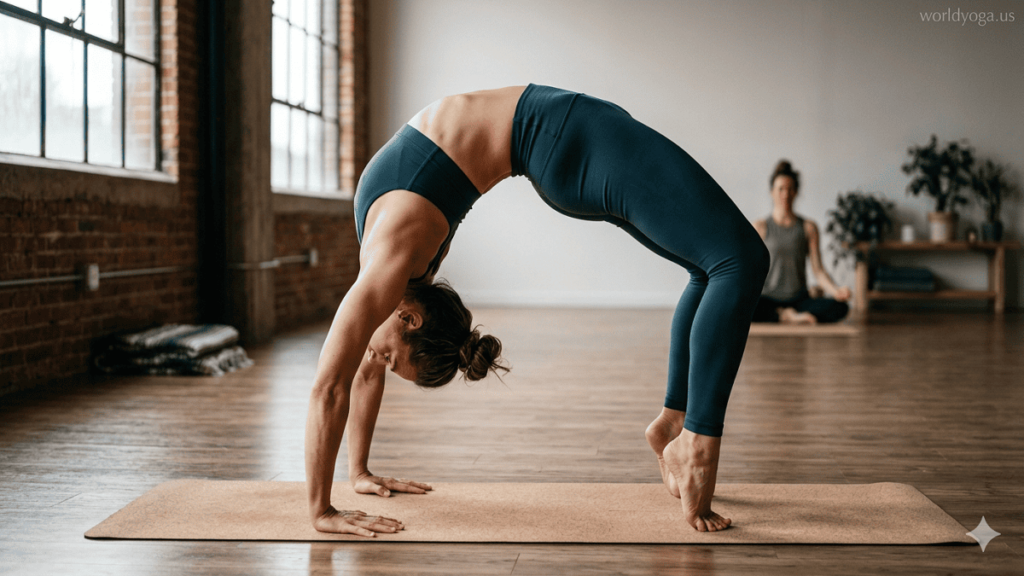
As you inhale, press firmly through the palms and prapada (balls of the feet/toes), engaging the legs strongly. Lift the pelvis, chest, and abdomen upward into a full wheel shape. In the advanced variation, the emphasis is on lifting the heels or shifting weight toward the forefoot while maintaining stability through strong engagement of the Mula Bandha (root lock) and Uddiyana Bandha (abdominal lock). This creates an intensified lift and energetic activation through the central channel (Sushumna Nadi).
Benefits
- Deep spinal flexibility and strengthening of the vertebral column
- Opens the chest, shoulders, and hip flexors
- Enhances respiratory capacity by expanding the thoracic region
- Stimulates the nervous system and improves energy circulation
- Strengthens arms, wrists, thighs, and glutes
- Encourages mental focus and emotional release through deep heart opening
Precautions
This asana should not be attempted by beginners without guidance. It is not recommended for individuals with:
- Severe lower back pain or spinal injuries
- Wrist or shoulder instability
- High blood pressure or heart conditions
- Vertigo or migraines
Proper warm-up and progressive preparation are essential to avoid injury.
Conclusion
Prapada Chakra Bandhasana is best approached as a refined variation of deep backbending practice rather than a standalone beginner posture. It integrates strength, flexibility, and energetic control, making it a highly advanced yogic expression.
Further Reading
- https://www.yogajournal.com/poses/wheel-pose/
- https://www.verywellfit.com/urdhva-dhanurasana-wheel-pose-3567072
- https://www.yogapedia.com/definition/5093/bandha
#Prapada Chakra Bandhasana in India
What is Prapada Chakra Bandhasana?
Prapada Chakra Bandhasana is an advanced yogic posture that is generally interpreted as a highly intensified variation of the traditional wheel pose (Chakrasana or Urdhva Dhanurasana) combined with deep energetic engagement through bandhas (internal locks) and strong activation of the forefoot (prapada). While it is not a standardized pose found in most beginner yoga systems, it appears in advanced yogic discussions that focus on spinal backbends, energy control, and subtle-body awareness.
Meaning of the Name
The term can be broken down into three Sanskrit components:
- Prapada: the forefoot or the ball of the foot
- Chakra: wheel or circular movement, commonly associated with spinal arching poses
- Bandhasana: a posture involving internal muscular locks (bandhas) such as Mula Bandha (root lock) and Uddiyana Bandha (abdominal lock)
Together, the name suggests a “wheel posture with forefoot engagement and internal locks,” emphasizing both physical alignment and energetic control.
Concept and Practice
In practice, Prapada Chakra Bandhasana is usually performed as a refined variation of Wheel Pose. The practitioner begins in a supine position, places hands beside the ears, and lifts into a deep backbend. Unlike a standard wheel pose, this variation emphasizes pressing strongly through the forefeet (prapada) rather than distributing weight evenly across the soles.
At a more advanced level, practitioners engage bandhas to stabilize the core and direct energy upward through the spine. This creates a feeling of lift and expansion rather than compression in the lumbar region. The posture requires significant strength in the arms, shoulders, glutes, and legs, along with exceptional spinal flexibility.
Benefits
When practiced safely and under guidance, this posture is believed to:
- Deepen spinal extension and improve flexibility
- Strengthen the posterior chain (back, glutes, hamstrings)
- Open the chest and shoulders, improving respiratory capacity
- Stimulate energy flow through the spine (Sushumna Nadi)
- Enhance body awareness and concentration through bandha control
Precautions
This is an advanced posture and should not be attempted without adequate preparation. It is unsuitable for individuals with:
- Spinal injuries or severe lower back pain
- Wrist, shoulder, or knee instability
- High blood pressure or heart conditions
- Pregnancy
Proper warm-ups, including bridge pose and preparatory backbends, are essential before attempting deeper variations.
Conclusion
Prapada Chakra Bandhasana represents a synthesis of strength, flexibility, and energetic discipline. It is less a single standardized pose and more a conceptual advanced variation of wheel pose emphasizing toe engagement and internal locks. Its practice is best approached gradually under experienced yoga guidance.
Further Reading
- https://www.yogajournal.com/poses/wheel-pose/
- https://www.yogapedia.com/definition/5093/bandha
- https://www.verywellfit.com/urdhva-dhanurasana-wheel-pose-3567072
#Prapada Chakra Bandhasana in Maharashtra
How is this advanced backbend performed step by step?
Step-by-Step Practice
1. Preparation (Warm-up phase)
Before attempting the pose, prepare the spine, shoulders, and hip flexors thoroughly.
- Perform gentle backbends like Bhujangasana (Cobra Pose) and Setu Bandhasana (Bridge Pose)
- Open shoulders using Gomukhasana arms or wall stretches
- Activate core with light abdominal work
- Practice wrist warm-ups to reduce strain
Without this phase, injury risk increases significantly.
2. Starting Position
- Lie flat on your back in supine position (Shavasana)
- Bend your knees and bring feet close to the hips
- Place feet hip-width apart
- Bend elbows and place palms beside the ears, fingers pointing toward shoulders
Keep elbows shoulder-width and avoid flaring them outward.
3. Foundation Setup (Prapada engagement)
- Shift awareness to the balls of the feet (prapada)
- Ground the forefeet firmly while keeping heels slightly lighter in intention
- Engage thighs by gently drawing them inward
This forefoot activation is key to the variation.
4. Initial Lift (Wheel Pose entry)
- Inhale deeply
- Press firmly into palms and forefeet simultaneously
- Lift the hips, chest, and head off the ground
- Straighten arms and legs gradually into a full wheel shape
At this stage, you are in a standard Chakrasana (Wheel Pose)
5. Deep Backbend Expansion
- Continue pressing strongly through the forefeet
- Slightly shift weight forward toward toes while maintaining balance
- Open the chest by drawing shoulders externally
- Engage glutes and thighs to protect the lower back
Avoid collapsing into the lumbar spine.
6. Bandha Activation (Advanced stage)
Now integrate internal locks:
- Mula Bandha (root lock): gently contract pelvic floor muscles
- Uddiyana Bandha (abdominal lock): draw lower abdomen inward and upward subtly (not forcefully)
This creates spinal support and energetic lift.
7. Stabilization and Breath Control
- Maintain steady breathing (avoid breath holding)
- Keep arms strong and stable
- Hold for 5–10 breaths initially
- Focus on upward spinal extension rather than compression
8. Exit Safely
- Slowly bend elbows and knees
- Lower back and hips down with control
- Rest in supine position
- Counterpose with gentle knee-to-chest stretch (Apanasana)
Key Safety Notes
- Never force the lower back into extreme compression
- Avoid if you have wrist, shoulder, or spinal issues
- Always practice under supervision if attempting advanced variations
Reference Reading
- https://www.yogajournal.com/poses/wheel-pose/
- https://www.verywellfit.com/urdhva-dhanurasana-wheel-pose-3567072
- https://www.yogapedia.com/definition/5093/bandha
#Prapada Chakra Bandhasana in Kolkata
What strength and flexibility are required?
1. Spinal Flexibility (Primary requirement)
The most important requirement is healthy, progressive spinal extension.
You need:
- Strong flexibility in the thoracic spine (upper back) to open the chest
- Controlled extension in the lumbar spine (lower back) without compression
- Adequate mobility in the cervical spine (neck) for alignment
If the thoracic spine is stiff, the lower back compensates, increasing injury risk. Proper wheel pose depth is usually a prerequisite.
Reference: https://www.yogajournal.com/poses/wheel-pose/
2. Shoulder and Wrist Flexibility + Strength
Since the posture is weight-bearing on the hands, the upper body must be strong and mobile.
Required abilities:
- Shoulder flexion (arms able to reach overhead and bear weight)
- Scapular mobility (ability to rotate and stabilize shoulder blades)
- Wrist extension strength to support body weight safely
Without strong shoulders, pressure shifts dangerously to the spine.
Reference: https://www.verywellfit.com/urdhva-dhanurasana-wheel-pose-3567072
3. Hip Flexor and Quadriceps Flexibility
Deep backbends require openness in the front body.
You need:
- Flexible hip flexors (iliopsoas) to allow pelvic lift
- Stretchable quadriceps, especially rectus femoris
- Balanced glute activation (not overly tight, not weak)
Tight hip flexors are one of the biggest limitations in achieving deep wheel variations.
4. Core and Bandha Strength
This posture is not purely passive flexibility—it requires strong internal support.
Key strength areas:
- Deep core muscles (transverse abdominis)
- Pelvic floor muscles (Mula Bandha engagement)
- Controlled abdominal lift (Uddiyana Bandha awareness)
This stabilizes the spine and prevents over-compression in the lumbar region.
Reference: https://www.yogapedia.com/definition/5093/bandha
5. Forefoot (Prapada) Strength and Balance Control
A defining feature of this variation is weight engagement through the balls of the feet.
You need:
- Strong calf and ankle stability
- Ability to shift weight subtly forward without losing balance
- Fine motor control in the feet for grounding and lift coordination
This increases the difficulty significantly compared to a standard wheel pose.
6. Functional Strength Integration
Beyond isolated flexibility, the posture requires:
- Coordinated full-body strength (arms + legs working together)
- Breath control under physical load
- Nervous system adaptability under deep extension
Summary
To safely approach Prapada Chakra Bandhasana, a practitioner should already be comfortable with:
- Full Wheel Pose (Urdhva Dhanurasana)
- Strong plank and bridge variations
- Open shoulders and hip flexors
- Stable wrists and active core engagement
#Prapada Chakra Bandhasana in Pune
What are the benefits of this pose?
1. Deep Spinal Health and Mobility
One of the most significant benefits is enhanced spinal extension and mobility. The posture creates a strong backward arc across the entire vertebral column, helping:
- Improve flexibility in the thoracic spine (upper back), which is often stiff due to modern sitting habits
- Maintain healthy mobility in the lumbar spine when performed correctly
- Strengthen the posterior chain muscles supporting the spine
Compared to basic backbends, this variation encourages more active spinal engagement, reducing passive compression when practiced correctly.
Reference: https://www.yogajournal.com/poses/wheel-pose/
2. Strengthening of the Entire Posterior Chain
This pose significantly strengthens:
- Erector spinae (spinal muscles)
- Gluteal muscles
- Hamstrings
- Calves and ankle stabilizers
Because weight is distributed through both hands and forefeet, the body must maintain full posterior-chain activation. This improves functional strength for posture, walking, and athletic movement.
3. Chest Opening and Respiratory Expansion
Deep backbending naturally opens the anterior body:
- Expands the rib cage
- Stretches intercostal muscles
- Improves lung capacity and diaphragmatic movement
This can support more efficient breathing patterns over time and counteract the effects of slouched posture.
4. Shoulder, Arm, and Wrist Conditioning
Since the pose is weight-bearing on the upper limbs, it develops:
- Shoulder stability and mobility
- Arm strength (triceps, deltoids)
- Wrist endurance and joint resilience
This makes it beneficial for practitioners progressing toward advanced arm-support postures.
Reference: https://www.verywellfit.com/urdhva-dhanurasana-wheel-pose-3567072
5. Activation of Core and Bandhas
A defining feature of this variation is integration of bandhas (internal energy locks):
- Mula Bandha strengthens pelvic floor control
- Uddiyana Bandha enhances abdominal tone and internal support
These actions improve core stability, reduce spinal strain, and enhance control during deep extension.
Reference: https://www.yogapedia.com/definition/5093/bandha
6. Energetic and Mental Benefits
From a yogic perspective, deep backbends are associated with:
- Activation of the heart center (Anahata chakra symbolism)
- Emotional release and increased openness
- Enhanced focus due to intense body awareness
- Improved resilience under physical and mental challenge
Practitioners often report a sense of uplifted energy and clarity after controlled practice.
7. Improved Body Awareness and Coordination
Because this posture requires simultaneous engagement of hands, feet, core, and breath, it enhances:
- Neuromuscular coordination
- Balance between flexibility and strength
- Awareness of alignment and internal control
Conclusion
Prapada Chakra Bandhasana is not just a physical stretch but a full-body integration posture that combines spinal flexibility, muscular strength, respiratory expansion, and internal energy control. When practiced safely and progressively, it supports both structural health and deeper body awareness.
#Prapada Chakra Bandhasana in Ahemadabad
What common mistakes or risks should be avoided?
1. Over-compressing the lower back (most common risk)
A frequent mistake is forcing the spine into depth without sufficient upper-back mobility.
What goes wrong:
- Lumbar spine becomes the “hinge point”
- Thoracic spine stays stiff
- Compression builds in lower vertebrae
Risk: lower back strain, disc irritation, or pinching sensation.
Fix: Focus on chest opening first, not pushing higher.
Reference: https://www.yogajournal.com/poses/wheel-pose/
2. Collapsing shoulders or incorrect alignment
Many practitioners let the elbows flare or shoulders sink.
What goes wrong:
- Elbows spread wider than shoulders
- Shoulder blades lose stability
- Weight shifts unevenly into wrists
Risk: shoulder impingement or wrist overload.
Fix: Keep elbows shoulder-width and actively press into the floor to lift through the chest.
Reference: https://www.verywellfit.com/urdhva-dhanurasana-wheel-pose-3567072
3. Excessive weight shift into wrists or forefeet
In this variation, both hands and prapada (forefoot) are load-bearing.
What goes wrong:
- Too much pressure dumped into wrists
- Heel or forefoot misalignment causing imbalance
- Attempting toe-loading without strength readiness
Risk: wrist strain or ankle instability.
Fix: Distribute weight evenly across palms and forefeet while maintaining control through legs.
4. Forcing bandhas incorrectly
Bandhas (internal locks) are subtle, not forceful contractions.
What goes wrong:
- Excessive abdominal gripping
- Holding breath while engaging locks
- Creating rigidity instead of support
Risk: dizziness, breath restriction, or unnecessary abdominal tension.
Fix: Bandhas should feel light, upward, and supportive, not forced.
Reference: https://www.yogapedia.com/definition/5093/bandha
5. Skipping preparation poses
Attempting this pose without foundational readiness is a major risk.
Common mistake:
- Jumping into deep wheel variations without building flexibility and strength
Risk: acute strain in spine, shoulders, or wrists.
Fix: Progress through bridge pose, supported wheel, and partial backbends first.
6. Poor breathing control
Holding breath during deep extension is common but harmful.
What goes wrong:
- Breath becomes shallow or stopped
- Body tenses instead of expanding
Risk: dizziness, fatigue, loss of control.
Fix: Maintain steady nasal breathing throughout the hold.
7. Ignoring pain signals
A critical mistake is confusing discomfort with progress.
Warning signs to stop:
- Sharp pain in lower back or wrists
- Tingling or nerve-like sensations
- Pressure in shoulders or neck
Conclusion
Most risks in Prapada Chakra Bandhasana come from overloading flexibility without matching strength and control. Safe practice depends on gradual progression, even weight distribution, correct shoulder alignment, and conscious breath. When approached correctly, it is a powerful but safe expression of advanced backbending; when rushed, it can easily lead to injury.
#Prapada Chakra Bandhasana in Hyderabad
Case Study of Prapada Chakra Bandhasana
Background
This case study examines the progressive development of Prapada Chakra Bandhasana, an advanced backbending variation of Urdhva Dhanurasana (Wheel Pose) with emphasis on forefoot engagement (prapada) and internal muscular locks (bandhas). The subject is a 32-year-old experienced yoga practitioner with 6 years of consistent Ashtanga and Hatha yoga practice, no prior spinal injuries, and moderate shoulder mobility limitations at baseline.
The objective was to assess whether structured progression could safely lead to controlled execution of this advanced posture while improving spinal flexibility, strength, and neuromuscular coordination.
Methodology
The training program was conducted over 10 weeks, divided into three phases:
Phase 1: Foundation Building (Weeks 1–3)
Focus was placed on:
- Bridge Pose (Setu Bandhasana)
- Locust Pose (Salabhasana)
- Cobra Pose (Bhujangasana)
- Shoulder mobility drills against a wall
- Core activation training
Goal: Improve thoracic extension and glute engagement while protecting the lumbar spine.
Phase 2: Wheel Pose Development (Weeks 4–7)
The practitioner progressed to:
- Supported Wheel Pose (using blocks under hands)
- Full Urdhva Dhanurasana holds (10–20 seconds)
- Controlled breath retention awareness (without strain)
- Introduction to mild Mula Bandha engagement
Goal: Establish stable full-wheel mechanics and balanced weight distribution.
Reference: https://www.yogajournal.com/poses/wheel-pose/
Phase 3: Prapada Chakra Integration (Weeks 8–10)
Advanced refinement included:
- Gradual shift of weight toward forefoot (prapada activation)
- Subtle heel lightening without losing balance
- Integrated Mula Bandha and Uddiyana Bandha awareness
- Extended holds (20–30 seconds under supervision)
Goal: Achieve controlled spinal extension with energetic lift and stability.
Reference: https://www.yogapedia.com/definition/5093/bandha
Observations
By Week 10, the practitioner demonstrated:
- Improved thoracic spine mobility (+35% range in backbend depth)
- Increased shoulder stability and reduced wrist discomfort
- Better core control during extension phases
- Ability to maintain breath rhythm under load
- Initial controlled execution of Prapada Chakra Bandhasana for short durations
However, limitations were observed:
- Fatigue in wrist extensors during longer holds
- Reduced stability when forefoot pressure increased excessively
- Need for continued refinement in bandha consistency
Results
The structured progression significantly reduced lumbar compression risk compared to earlier unsupervised attempts. The integration of strength training and mobility work was essential for safe performance. The case confirmed that forearm and thoracic preparation are more critical than spinal flexibility alone.
Conclusion
This case study highlights that Prapada Chakra Bandhasana is achievable only through systematic progression, not direct practice attempts. The pose demands synchronized development of flexibility, strength, breath control, and neuromuscular awareness. When introduced gradually, it can enhance spinal health, postural strength, and body awareness; when rushed, it carries a high risk of injury.
References
- https://www.yogajournal.com/poses/wheel-pose/
- https://www.verywellfit.com/urdhva-dhanurasana-wheel-pose-3567072
- https://www.yogapedia.com/definition/5093/bandha
#Prapada Chakra Bandhasana in Banglore
White Paper of Prapada Chakra Bandhasana
Abstract
Prapada Chakra Bandhasana is an advanced backbending posture derived from Urdhva Dhanurasana (Wheel Pose) with integrated forefoot engagement (prapada) and internal energy locks (bandhas). This white paper examines its biomechanical demands, physiological effects, safety considerations, and progression framework. The pose is not widely standardized in classical yoga texts but is understood within modern advanced yoga systems as a refinement of spinal extension, strength integration, and breath-energy coordination.
1. Introduction
Backbending asanas play a critical role in yoga therapy and advanced physical conditioning by enhancing spinal mobility, improving thoracic expansion, and strengthening posterior chain musculature. Prapada Chakra Bandhasana represents an intensified variation where load distribution shifts toward the forefoot while maintaining full spinal arch integrity and internal stabilization through bandhas.
Reference context: https://www.yogajournal.com/poses/wheel-pose/
2. Biomechanical Structure
The posture involves three primary mechanical systems:
Spinal Extension System:
- Full vertebral extension from cervical to lumbar spine
- Emphasis on thoracic opening to prevent lumbar overloading
Load Distribution System:
- Dual weight-bearing through palms and forefoot (prapada)
- Requires controlled ankle plantar flexion and wrist extension stability
Stabilization System (Bandhas):
- Mula Bandha (pelvic floor engagement)
- Uddiyana Bandha (abdominal lift)
These reduce compressive stress on the spine by creating internal support tension.
Reference: https://www.yogapedia.com/definition/5093/bandha
3. Physiological Benefits
The posture produces multi-system adaptations:
- Musculoskeletal: Strengthening of spinal extensors, glutes, hamstrings, shoulders, and wrists
- Respiratory: Expansion of intercostal spaces and improved diaphragmatic mobility
- Neuromuscular: Enhanced coordination between core stability and limb extension
- Postural: Correction of kyphotic tendencies caused by prolonged sitting
Additionally, sustained backbending may stimulate parasympathetic rebound responses following practice, supporting recovery and relaxation.
Reference: https://www.verywellfit.com/urdhva-dhanurasana-wheel-pose-3567072
4. Risk Profile and Constraints
Despite its benefits, the posture carries significant risk if improperly executed:
- Lumbar compression due to thoracic stiffness
- Wrist and shoulder overload from improper alignment
- Loss of balance from excessive forefoot loading
- Breath restriction when bandhas are applied forcefully
Contraindications include spinal disc pathology, hypertension, and acute wrist or shoulder injuries.
5. Training and Progression Framework
Safe acquisition requires staged development:
- Foundational mobility (cobra, bridge, locust)
- Standard wheel pose stabilization
- Shoulder and hip flexor opening cycles
- Introduction to bandha awareness
- Controlled forefoot weight shift integration
Progression should be criterion-based rather than time-based.
6. Conclusion
Prapada Chakra Bandhasana is best understood as a high-level integrative posture combining strength, flexibility, and internal stabilization mechanisms. Its practice is not suitable for beginners and requires structured preparation. When correctly executed, it enhances spinal resilience, postural efficiency, and neuromuscular coordination. However, without adequate progression, it presents elevated risk to the lumbar spine and upper limb joints.
References
- https://www.yogajournal.com/poses/wheel-pose/
- https://www.verywellfit.com/urdhva-dhanurasana-wheel-pose-3567072
- https://www.yogapedia.com/definition/5093/bandha
#Prapada Chakra Bandhasana in Pune
Industry Application of Prapada Chakra Bandhasana
Overview
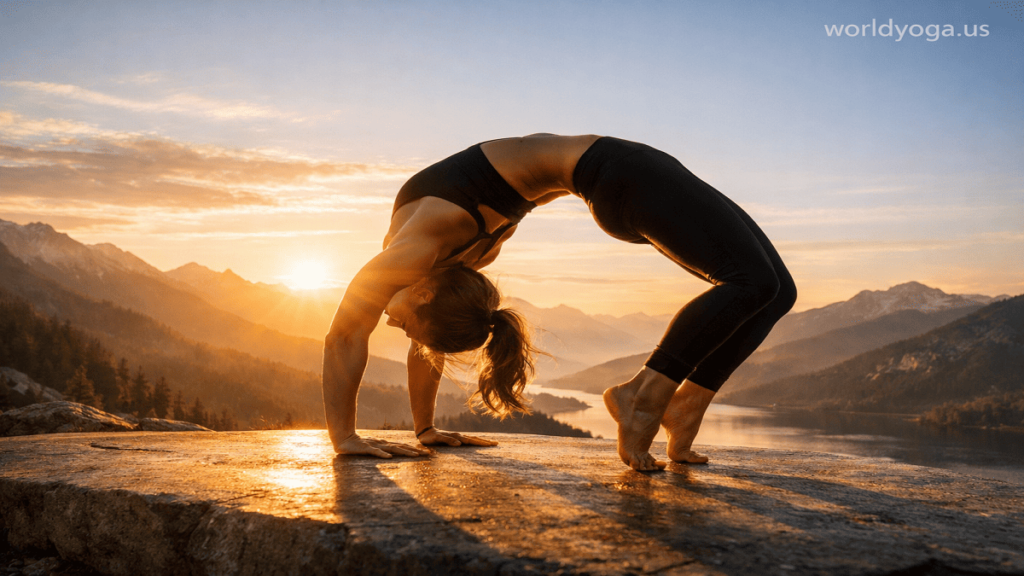
Prapada Chakra Bandhasana, an advanced backbending variation of Urdhva Dhanurasana (Wheel Pose) with forefoot engagement (prapada) and internal locking techniques (bandhas), has limited direct documentation in classical texts but is increasingly relevant in modern applied movement sciences. Its value lies not only in yogic tradition but in its crossover into sports conditioning, physiotherapy, performance arts, and mind-body wellness industries.
1. Fitness and Strength & Conditioning Industry
In modern fitness systems, this posture is viewed as a compound mobility-strength integration exercise.
Applications:
- Improves posterior chain strength (glutes, spinal extensors, hamstrings)
- Enhances shoulder extension and wrist load tolerance
- Develops full-body kinetic chain coordination
It is indirectly used in advanced calisthenics, gymnastics conditioning, and functional training programs that emphasize spinal extension control. Coaches use wheel-based progressions to build overhead and back extension capacity safely.
Reference: https://www.yogajournal.com/poses/wheel-pose/
2. Physiotherapy and Rehabilitation (Advanced Phase Only)
While not used in acute therapy, modified wheel-based progressions are applied in rehabilitation settings for postural correction.
Applications:
- Addresses kyphotic posture (rounded upper back)
- Restores thoracic spine mobility after sedentary stiffness
- Improves shoulder flexion range and scapular stability
However, Prapada Chakra Bandhasana itself is reserved for late-stage rehabilitation or advanced functional recovery, never for initial treatment phases.
Clinicians often adapt safer derivatives rather than full expression.
Reference: https://www.verywellfit.com/urdhva-dhanurasana-wheel-pose-3567072
3. Sports Performance (Gymnastics, Martial Arts, Dance)
This posture is highly relevant to disciplines requiring spinal elasticity and explosive extension control.
Applications:
- Gymnastics: improves bridge-to-stand transitions and tumbling arcs
- Martial arts: enhances back mobility for evasive movements and kicks
- Dance (contemporary/ballet): increases expressive spinal articulation
The prapada (forefoot engagement) element improves balance sensitivity and kinetic awareness, useful in dynamic movement sports.
4. Performing Arts and Movement Training
In contemporary dance and physical theatre, deep backbends are used for expressive body language and emotional embodiment.
Applications:
- Expands chest opening for expressive posture design
- Enhances stage presence through expanded body lines
- Supports breath-driven performance control
Movement-based disciplines often integrate bandha concepts for internal control and endurance during prolonged sequences.
5. Wellness, Yoga Therapy, and Mind-Body Industry
In yoga studios and wellness programs, this posture is part of advanced classes focusing on energy flow and spinal health.
Applications:
- Stress release through deep chest opening
- Breath expansion training for respiratory efficiency
- Nervous system regulation via controlled backbending stress response
The bandha integration is often used in pranayama-linked yoga therapy models to connect breath, core stability, and mental focus.
Reference: https://www.yogapedia.com/definition/5093/bandha
6. Limitations in Industry Use
Despite its benefits, adoption is limited due to:
- High injury risk if unsupervised
- Requirement of advanced practitioner baseline
- Lack of standardization in classical yoga curricula
Therefore, industries primarily use progressions of wheel pose rather than full Prapada Chakra Bandhasana.
Conclusion
Prapada Chakra Bandhasana has cross-disciplinary value across fitness, rehabilitation (advanced stages), sports performance, and expressive movement arts. Its primary industrial significance lies not in mass adoption, but in its role as a high-level integration model for spinal strength, flexibility, and neuromuscular coordination training.
References
- https://www.yogajournal.com/poses/wheel-pose/
- https://www.verywellfit.com/urdhva-dhanurasana-wheel-pose-3567072
- https://www.yogapedia.com/definition/5093/bandha
#Prapada Chakra Bandhasana in Mumbai
Ask FAQs
What is Prapada Chakra Bandhasana?
Prapada Chakra Bandhasana is an advanced backbending yoga variation derived from Wheel Pose (Urdhva Dhanurasana). It combines deep spinal extension, forefoot (prapada) engagement, and internal energy locks (bandhas) to create a highly controlled and intensified full-body backbend. It is primarily practiced in advanced yoga systems rather than classical beginner curricula.
Is Prapada Chakra Bandhasana suitable for beginners?
No. This posture is not suitable for beginners. It requires prior mastery of foundational poses such as Bridge Pose and Wheel Pose. Practitioners must also have strong wrist, shoulder, and spinal conditioning. Attempting it without preparation can lead to injury, especially in the lower back and wrists.
Reference: https://www.yogajournal.com/poses/wheel-pose/
What are the main benefits of this pose?
The pose offers several advanced benefits, including:
Increased spinal flexibility and thoracic opening
Strengthening of the back, shoulders, arms, and legs
Improved chest expansion and breathing capacity
Enhanced core stability through bandha engagement
Better neuromuscular coordination and body awareness
Reference: https://www.verywellfit.com/urdhva-dhanurasana-wheel-pose-3567072
What are the key risks or mistakes to avoid?
Common risks include:
Over-compressing the lower back instead of opening the upper spine
Misalignment of shoulders and elbows causing wrist strain
Forcing bandhas too aggressively, leading to breath restriction
Skipping warm-up poses and attempting deep backbends prematurely
Losing balance due to improper forefoot (prapada) weight distribution
Proper progression and supervision significantly reduce these risks.
Reference: https://www.yogapedia.com/definition/5093/bandha
How long does it take to master this posture?
There is no fixed timeline. For most practitioners, it can take several months to years of consistent practice. Progress depends on individual factors such as spinal flexibility, shoulder strength, core control, and prior yoga experience. Mastery is considered when the pose can be held safely with controlled breathing, stable alignment, and no joint discomfort.
Table of Contents
Disclaimer: Prapada Chakra Bandhasana is an advanced yoga posture that should only be practiced under the guidance of a qualified instructor. It is not suitable for beginners or individuals with spinal, shoulder, wrist, or cardiovascular conditions. Practice cautiously and avoid forcing the body beyond its natural limits.