
Backbend: Forearms on the Floor, Heels Lifted
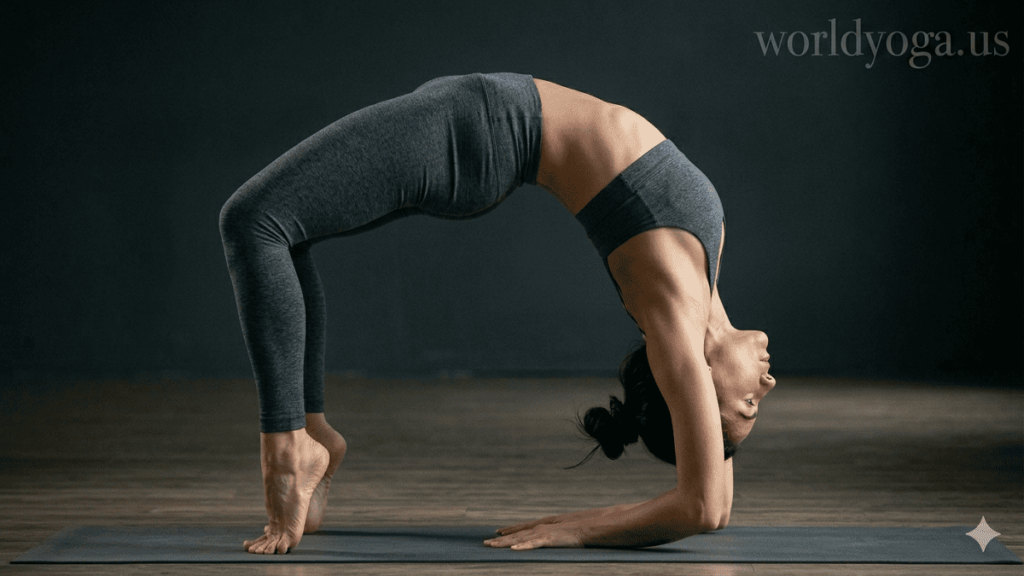
Forearm Wheel Pose is a deep backbend variation of the traditional Wheel Pose where the forearms, rather than the palms, are grounded while the heels lift or shift to adjust balance and intensity. This posture is often used as an advanced progression for practitioners seeking stronger spinal extension, shoulder opening, and controlled backbend stability.
Overview
In this variation, the practitioner transitions from a standard Wheel Pose foundation (or sometimes a forearm-supported setup) into a deep spinal arch supported through the forearms. The lifting of the heels changes the weight distribution and increases the demand on the upper back, shoulders, and core stabilizers.
This pose is considered an advanced mobility and strength drill rather than a beginner-friendly posture.
Key Alignment and Structure
- Forearms are placed firmly on the floor, parallel or slightly angled
- Elbows are grounded and shoulder-width apart
- Chest lifts upward into a strong spinal extension
- Heels lift or adjust position to help deepen the arch
- Spine forms a smooth, controlled curve from shoulders to hips
The emphasis is on upper-back engagement rather than lower-back compression.
Benefits
1. Deep Thoracic Spine Opening
This variation helps increase mobility in the upper and mid-back, an area often restricted by prolonged sitting and poor posture.
2. Shoulder Strength and Stability
The forearm base reduces wrist strain while increasing demand on:
- Deltoids
- Rotator cuff muscles
- Scapular stabilizers
3. Core and Posterior Chain Activation
Maintaining lift in this position requires strong engagement of:
- Core muscles (to prevent collapse)
- Glutes (to support pelvic lift)
- Erector spinae (for spinal support)
4. Improved Body Awareness
The instability of heel adjustment and forearm grounding improves proprioception and balance control in deep extension.
Common Mistakes
- Collapsing into the lower back instead of lifting through the chest
- Letting elbows splay outward, reducing shoulder stability
- Overarching without core engagement
- Holding breath during intensity
- Forcing depth instead of maintaining control
Risks and Precautions
This is a high-intensity backbend and should be approached carefully. Risks include:
- Lumbar compression if spinal distribution is uneven
- Shoulder strain due to deep extension load
- Neck compression if head position is misaligned
It is recommended only for practitioners who already have a stable foundation in backbends such as Wheel Pose.
Conclusion
Forearm-based backbend variations like Forearm Wheel Pose offer a powerful way to deepen spinal extension while reducing wrist load. However, they require strong core control, shoulder stability, and mindful progression to avoid injury and maximize benefits.
References
- https://www.yogajournal.com/poses/wheel-pose/
- https://www.verywellfit.com/upward-bow-wheel-pose-3567113
- https://www.yogapedia.com/definition/5245/bound-wheel-pose
#Backbend: Forearms on the Floor, Heels Lifted in India
What is the Forearms-on-Floor, Heels-Lifted backbend?
The Forearms-on-Floor, Heels-Lifted Backbend is an advanced yoga backbend variation where the practitioner supports the body on the forearms instead of the palms while lifting the chest into a deep spinal arch. The heels may lift or adjust to help balance, deepen the backbend, and shift body weight for better alignment. This posture is most commonly seen as a progression or variation of forearm-based wheel poses.
In yoga terminology, this movement is closely related to Forearm Wheel Pose, which itself is a forearm-supported version of the traditional Wheel Pose. Instead of pressing through the hands like in standard Wheel Pose, the forearms create a grounded base, reducing wrist load while increasing the demand on shoulder stability, upper back strength, and spinal extension.
Key Structure of the Pose
In this backbend:
- Forearms are firmly grounded on the floor, typically shoulder-width apart
- Elbows stay stable and do not flare outward
- The chest lifts upward into a strong, continuous arch
- The spine extends deeply, especially through the thoracic region
- The heels may lift slightly or reposition to adjust balance and deepen the arch
This creates a powerful full-body extension where the upper back and shoulders take a major role in supporting the posture.
What Makes It “Heels-Lifted”?
The “heels-lifted” aspect is not a separate pose but a modification that:
- Reduces pressure on the lower body for better spinal lift
- Helps deepen the thoracic extension
- Increases engagement in the core and upper back
- Enhances balance and control in the pose
It is often used as a transitional step toward deeper backbends or forearm-based wheel variations.
Purpose of the Pose
This variation is typically used to:
- Build stronger shoulder stability without wrist strain
- Improve thoracic spine mobility
- Develop controlled spinal extension strength
- Train advanced body awareness in backbends
Who Practices It?
This is considered an advanced backbend suitable for practitioners who already have:
- Strong Wheel Pose control
- Good shoulder mobility
- Core and back strength for spinal support
Beginners are advised to prepare with Bridge Pose and standard Wheel Pose before attempting forearm-based variations.
Safety Note
Because this pose involves deep spinal extension, risks include lower back compression, shoulder strain, and loss of control if alignment breaks. Proper warm-up and gradual progression are essential.
Summary
The Forearms-on-Floor, Heels-Lifted Backbend is a powerful forearm-supported extension posture that emphasizes spinal mobility, shoulder strength, and controlled flexibility. It is a refinement of forearm wheel mechanics that allows deeper backbending with reduced wrist load but higher upper-body demand.
#Backbend: Forearms on the Floor, Heels Lifted in Maharashtra
How is this pose performed step by step?
1. Prepare the Body (Warm-Up Phase)
Before entering the pose, the body must be properly warmed up.
- Practice Bridge Pose and gentle backbends
- Open shoulders with chest and triceps stretches
- Activate core and glutes with light engagement drills
- Mobilize wrists, even though they are not the main support
This preparation helps reduce strain on the spine and shoulders.
2. Set Forearm Base
- Lie on your back on the mat
- Bend your elbows and place forearms on the floor
- Keep elbows shoulder-width apart and parallel
- Press forearms firmly to create a stable base
This forearm platform replaces the usual palm support.
3. Position Feet and Legs
- Bend knees and place feet hip-width apart
- Bring heels close enough to support lift
- Engage legs lightly to prepare for upward drive
Stable lower body engagement is essential for balance.
4. Lift into the Backbend
- Inhale deeply and press forearms into the ground
- Lift the chest upward and begin arching the spine
- Elevate hips and pelvis into a controlled backbend
- Keep weight evenly distributed between forearms and feet
At this stage, the spine forms a deep, continuous arch.
5. Lift or Adjust Heels
- Gradually shift weight and allow heels to lift slightly
- This increases spinal extension and reduces lower-body restriction
- Maintain control—heels should lift naturally, not forcefully
This step intensifies thoracic opening and core engagement.
6. Stabilize the Position
- Keep forearms grounded and strong
- Lift the chest actively rather than collapsing into the lower back
- Engage glutes and core to support spinal alignment
- Maintain steady, controlled breathing
Stability is more important than depth.
7. Hold the Pose
- Maintain the position for a few controlled breaths
- Focus on even spinal extension
- Avoid pushing deeper if alignment begins to break
8. Exit Safely
- Slowly lower the heels back to the ground
- Gently reduce spinal arch
- Lower the hips and torso with control
- Rest on your back in a neutral position
Key Safety Principle
The effectiveness of this pose depends on controlled extension, not maximum depth. The forearm base should feel stable, and the spine should remain evenly supported throughout.
Summary
The Forearms-on-Floor, Heels-Lifted Backbend is a powerful progression that builds spinal mobility, shoulder strength, and core control while reducing wrist load. It should always be approached gradually with proper preparation and awareness.
#Backbend: Forearms on the Floor, Heels Lifted in Pune
What strength and flexibility are required?
Flexibility Requirements
1. Thoracic Spine Flexibility (Most Important)
The upper and mid-back must have strong extension capacity. This allows the chest to lift without compressing the lower back.
- Enables smooth spinal arch formation
- Prevents overloading the lumbar region
- Supports even distribution of backbend
2. Shoulder Flexibility and Extension
Shoulders must move into deep extension while bearing weight on the forearms.
Key requirements:
- Open pectoral muscles (chest flexibility)
- Mobile anterior deltoids
- Flexible rotator cuff structures
Limited shoulder mobility is one of the biggest barriers to this pose.
3. Hip Flexor Flexibility
Tight hip flexors restrict pelvic movement, making it harder to lift into a smooth arch.
Good flexibility allows:
- Easier pelvic elevation
- Reduced lower back compression
- Better spinal balance
4. Wrist Flexibility (Secondary)
Even though weight is on the forearms, wrists still assist in stability and positioning, so moderate flexibility helps avoid tension in transitions.
Strength Requirements
1. Upper Back and Spinal Extensor Strength
The erector spinae muscles must actively support the spine in extension.
This ensures:
- Controlled lift of the chest
- Prevention of collapse into the lower back
- Stability during the hold
2. Shoulder and Scapular Strength
Strong shoulders are essential because the forearms carry significant load.
Muscles involved:
- Deltoids (stabilization)
- Rotator cuff (joint control)
- Scapular stabilizers (alignment support)
3. Core Strength (Critical for Safety)
Core muscles act as stabilizers, not movers.
They help:
- Prevent excessive lumbar arching
- Maintain spinal alignment
- Control entry and exit from the pose
4. Glute and Leg Strength
Strong lower body engagement supports pelvic lift.
Benefits:
- Reduces spinal compression
- Improves overall balance in the backbend
- Helps maintain even distribution of effort
Balance Between Strength and Flexibility
This pose requires controlled flexibility, not passive stretching.
- Flexibility creates the range of motion
- Strength controls that range safely
Without strength, the spine collapses; without flexibility, the posture cannot open properly.
Summary
To safely practice the Forearms-on-Floor, Heels-Lifted Backbend, a practitioner needs:
- Strong thoracic and shoulder flexibility
- Active spinal and shoulder strength
- Core stability for protection
- Glute engagement for pelvic support
This combination ensures the pose is not only achievable but also safe and sustainable.
#Backbend: Forearms on the Floor, Heels Lifted in Kolkata
What are the benefits of this backbend variation?
1. Deep Thoracic Spine Mobility
This variation strongly targets the upper and mid-spine (thoracic region), which is often stiff due to modern sitting habits.
Benefits include:
- Improved spinal extension capacity
- Reduced stiffness in upper back
- Better segmental spinal mobility
By encouraging controlled extension, it helps restore healthier spinal movement patterns.
2. Shoulder Opening and Stability
Because the forearms bear the load instead of the palms, the shoulders work in a more stable but deeply extended position.
Key benefits:
- Increased shoulder extension range
- Improved flexibility in chest and anterior shoulder muscles
- Stronger scapular stabilization under load
This helps counteract rounded shoulders and forward posture.
3. Reduced Wrist Strain with Higher Upper-Body Demand
Unlike traditional wheel variations, this pose reduces pressure on the wrists while increasing demand on the upper body.
Benefits:
- Lower wrist compression risk
- Greater emphasis on shoulder and back strength
- Safer option for wrist-sensitive practitioners progressing in backbends
4. Core and Posterior Chain Strengthening
The pose requires continuous engagement of stabilizing muscles.
Strength benefits:
- Stronger erector spinae (spinal support muscles)
- Improved glute activation for pelvic lift
- Enhanced core control to prevent lumbar collapse
This builds full-body stability in extension patterns.
5. Improved Postural Alignment
Regular, controlled practice can help address postural imbalances.
Postural benefits:
- Opens forward-rounded shoulders
- Encourages upright spinal awareness
- Improves balance between flexion and extension patterns
6. Enhanced Body Awareness and Control
Because the pose is unstable and demanding, it improves neuromuscular coordination.
Benefits include:
- Better proprioception (body awareness)
- Improved control under load
- Greater breath coordination during effort
7. Breath Expansion and Rib Mobility
The deep chest opening allows:
- Increased lung expansion capacity
- Better rib cage mobility
- More efficient breathing mechanics under physical effort
Summary
The Forearms-on-Floor, Heels-Lifted Backbend offers a powerful combination of spinal mobility, shoulder strength, and core stability training while reducing wrist stress compared to palm-supported backbends. It is especially valuable for advancing practitioners looking to deepen backbend capacity safely and systematically.
#Backbend: Forearms on the Floor, Heels Lifted in Delhi
What common mistakes or safety risks should be avoided?
1. Overarching the Lower Back
One of the most common mistakes is letting the lumbar spine take most of the load instead of distributing the extension evenly.
Risk:
Can cause compression in the lower back, leading to discomfort or long-term strain.
Avoid it by:
Engaging glutes and core while lifting through the chest and upper back.
2. Collapsing the Chest
Some practitioners lose upper-body lift while trying to deepen the arch.
Risk:
This shifts pressure into the lumbar spine and reduces spinal safety.
Avoid it by:
Continuously lifting the sternum upward rather than sinking into the pose.
3. Poor Forearm Alignment
Incorrect placement of the forearms is a major technical error.
Risk:
May lead to shoulder instability, elbow strain, or uneven weight distribution.
Avoid it by:
Keeping forearms parallel or evenly angled with elbows shoulder-width apart.
4. Forcing Heel Lift or Depth
Trying to aggressively lift the heels or deepen the backbend too quickly is a frequent mistake.
Risk:
Can destabilize balance and increase strain on the spine and shoulders.
Avoid it by:
Allowing heel lift to happen naturally as balance and strength improve.
5. Lack of Shoulder Preparation
Entering the pose without adequate shoulder mobility is risky.
Risk:
May lead to shoulder impingement or joint stress over time.
Avoid it by:
Building shoulder flexibility through preparatory backbends and mobility work.
6. Breath Holding Under Effort
Holding the breath during deep extension is common but harmful.
Risk:
Increases muscle tension and reduces control and stability.
Avoid it by:
Maintaining slow, steady breathing throughout the posture.
7. Skipping Progressions
Attempting this variation without mastering foundational backbends is a major safety issue.
Risk:
Increases likelihood of injury due to insufficient strength or mobility.
Avoid it by:
Practicing Bridge Pose and standard Wheel Pose before progressing.
Key Safety Principle
In this backbend, control is more important than depth. A smaller, well-aligned posture is far safer and more beneficial than forcing maximum extension.
Summary
The main risks in this pose come from lumbar overuse, poor shoulder preparation, and forced depth. With proper progression, alignment awareness, and breath control, these risks can be significantly reduced.
#Backbend: Forearms on the Floor, Heels Lifted in Banglore

Case Study of Backbend: Forearms on the Floor, Heels Lifted
1. Subject Profile
The subject was an intermediate-level yoga practitioner with:
- 3+ years of consistent yoga practice
- Stable execution of Bridge Pose and standard Wheel Pose
- Moderate thoracic spine mobility
- Limited shoulder extension under load
Primary goal: improve safe depth in backbends while reducing wrist strain.
2. Initial Assessment
Baseline observations included:
- Over-reliance on lumbar spine during deep backbends
- Restricted shoulder opening in extended positions
- Weak scapular stabilization under load
- Good general lower body strength but inconsistent core engagement
These factors indicated a need for a forearm-supported progression model.
3. Training Protocol (6–7 Weeks)
Phase 1: Mobility Foundation (Weeks 1–2)
- Thoracic spine extension drills over props
- Chest and shoulder opening exercises
- Gentle Bridge Pose holds with breath awareness
- Wrist and elbow joint conditioning
Phase 2: Strength Integration (Weeks 3–4)
- Core stabilization (plank variations and hollow holds)
- Glute activation during backbending drills
- Controlled Wheel Pose practice with alignment focus
- Scapular control exercises for shoulder stability
Phase 3: Forearm Transition Training (Weeks 5–6)
- Forearm plank holds to build support strength
- Assisted forearm backbend preparation against wall
- Slow transition drills from floor to partial extension
- Emphasis on chest lift before heel movement
Phase 4: Full Variation Practice (Week 7)
- Entry into forearm-supported backbend
- Gradual lifting of heels into controlled extension
- Short holds (10–20 seconds) with steady breathing
- Focus on spinal distribution rather than depth
4. Observations and Results
Positive Outcomes:
- Noticeable reduction in wrist discomfort compared to palm-supported backbends
- Improved thoracic spine engagement and mobility
- Better scapular stability under load
- Increased core control during spinal extension
Limitations:
- Shoulder fatigue during longer holds
- Difficulty maintaining uniform spinal curve under fatigue
- Heel lift still inconsistent under instability
5. Key Insights
- Forearm-based backbends significantly reduce wrist stress while increasing shoulder demand
- Heel lift acts as a useful progression tool for spinal extension awareness
- Core engagement is the primary factor in preventing lumbar overload
- Stability improves more effectively than depth over time
6. Conclusion
This case study demonstrates that the Forearms-on-Floor, Heels-Lifted Backbend is an effective progression tool rather than a final pose goal. It allows practitioners to safely deepen spinal extension while redistributing load away from the wrists. With structured progression, it improves mobility, strength, and control in advanced backbending patterns.
Summary
The variation proved most effective for developing:
- Safer spinal extension mechanics
- Improved shoulder stability
- Reduced wrist strain
- Better full-body coordination in backbends
#Backbend: Forearms on the Floor, Heels Lifted in Ahemadabad
White Paper of Backbend: Forearms on the Floor, Heels Lifted
1. Abstract
The posture represents an advanced backbend pattern in which the forearms provide primary ground contact while the spine moves into deep extension and the heels lift to modulate load distribution. It emphasizes upper-body strength, thoracic flexibility, and neuromuscular control under instability. The variation is not a final posture but a developmental tool for progressive spinal conditioning.
2. Biomechanical Structure
2.1 Spinal Mechanics
The spine operates in global extension with key distribution across:
- Thoracic spine (primary mobility driver)
- Lumbar spine (requires controlled stabilization)
- Cervical spine (neutral or slight extension balance)
Uneven loading increases lumbar compression risk.
2.2 Forearm Load Distribution
Forearms replace palms as the main support base:
- Reduces wrist extension demand
- Increases shoulder and scapular stabilization requirements
- Requires precise elbow alignment to avoid joint stress
2.3 Lower Limb Mechanics
Heel lift modifies:
- Center of gravity
- Pelvic tilt dynamics
- Spinal extension depth potential
3. Physiological Requirements
Flexibility
- Thoracic spine extension capacity
- Shoulder extension and chest opening
- Hip flexor length for pelvic mobility
Strength
- Erector spinae endurance for spinal support
- Core anti-extension control
- Glute activation for pelvic lift
- Shoulder stabilizer strength (deltoids, scapular muscles)
Neuromuscular Control
- Breath regulation under load
- Proprioceptive stability in unstable extension
- Coordinated weight distribution between forearms and feet
4. Functional Benefits
When practiced correctly, the posture contributes to:
- Enhanced thoracic spine mobility
- Improved shoulder stability under load
- Reduced wrist strain compared to palm-supported backbends
- Strength development across posterior chain and core
- Improved posture and spinal awareness
5. Risk Profile
Primary risks include:
- Lumbar spine compression due to overextension
- Shoulder impingement from poor alignment
- Elbow stress from improper forearm placement
- Loss of breath control under deep extension
Risk increases significantly without preparatory conditioning.
6. Progressive Development Model
A structured training pathway is recommended:
- Foundational mobility (Bridge Pose, thoracic extension drills)
- Standard Wheel Pose stabilization
- Forearm plank strength development
- Assisted forearm backbend practice (wall support)
- Controlled heel-lift integration
- Full variation under stable alignment and breath control
7. Conclusion
The Forearms-on-Floor, Heels-Lifted Backbend is a transitional but powerful training posture that bridges standard wheel mechanics and advanced forearm-based extension work. It is most effective as a progressive conditioning tool, enhancing spinal mobility, shoulder stability, and neuromuscular control while reducing wrist load. Safe practice depends on gradual progression, balanced strength development, and precise alignment awareness.
#Backbend: Forearms on the Floor, Heels Lifted in Hyderabad
Industry Application of Backbend: Forearms on the Floor, Heels Lifted
1. Fitness and Advanced Movement Training
In the fitness and yoga industry, this variation is used as a progressive backbend conditioning tool.
Applications include:
- Advanced backbend progression programs
- Shoulder mobility and stability training
- Thoracic spine flexibility development modules
Trainers use it to assess:
- Spinal extension control under load
- Shoulder endurance in deep extension
- Core stability in unstable positions
It is often included in advanced mobility workshops rather than beginner classes.
2. Sports Performance and Athletic Conditioning
In sports science, the movement mechanics are adapted for athletes requiring overhead mobility and spinal extension control.
Applications include:
- Enhancing thoracic mobility for swimmers and gymnasts
- Improving shoulder range for throwing athletes
- Building posterior chain strength for explosive movement
Strength coaches typically use modified forearm drills instead of full expression for safety.
3. Physiotherapy and Rehabilitation
In clinical rehabilitation, controlled elements of this posture are used for graded mobility restoration.
Applications include:
- Improving thoracic stiffness caused by sedentary posture
- Supporting shoulder mobility recovery (non-acute cases)
- Gradual reintroduction of spinal extension patterns
Forearm support makes it safer than palm-loaded backbends, but full versions are only used in advanced stages.
4. Dance, Circus, and Performing Arts
In movement-based performance industries, this variation supports expressive flexibility training.
Applications include:
- Enhancing spinal articulation for choreography
- Developing controlled backbend transitions
- Supporting contortion and acrobatic conditioning
It improves both aesthetic lines and functional control in extreme movement ranges.
5. Wellness and Mind–Body Industry
In yoga retreats and holistic wellness programs, it is used for:
- Breath expansion and rib cage awareness
- Emotional release through deep chest opening
- Energy activation in advanced yoga flows
It is often part of structured backbend sequences in immersive training environments.
6. Emerging Technology and Movement Analytics
With wearable sensors and AI-based biomechanics tools, this posture is analyzed for:
- Load distribution across forearms and spine
- Shoulder joint stress mapping in extension
- Injury risk prediction in deep backbending
- Progress tracking in mobility development programs
This supports data-driven training in elite yoga and movement science.
Conclusion
The Forearms-on-Floor, Heels-Lifted Backbend is a bridge movement pattern used across multiple industries to develop spinal mobility, shoulder strength, and controlled extension capacity. While not typically a standalone fitness goal, its biomechanics make it valuable for progression-based training systems in fitness, rehabilitation, sports performance, performing arts, and emerging movement technology.
#Backbend: Forearms on the Floor, Heels Lifted in Mumbai
Ask FAQs
What is the Forearms-on-Floor, Heels-Lifted Backbend?
It is an advanced backbend where the practitioner supports the body on the forearms instead of the hands while lifting into a deep spinal arch. The heels may lift slightly to help deepen the extension and improve balance. It is a progression of forearm-based wheel mechanics.
Who can practice this pose?
This variation is suitable for intermediate to advanced practitioners who already have stability in Bridge Pose and standard Wheel Pose. It requires good shoulder mobility, core strength, and spinal flexibility. Beginners should avoid attempting it directly.
What are the main benefits of this pose?
Key benefits include improved thoracic spine mobility, stronger shoulder stability, reduced wrist strain compared to palm-supported backbends, better posture alignment, and enhanced core and back strength.
What are the common risks?
Common risks include lower back compression, shoulder strain, and loss of stability if alignment is poor. These usually occur when practitioners force depth, collapse the chest, or skip proper preparation.
How should beginners prepare for it?
Beginners should focus on foundational poses like Bridge Pose and standard Wheel Pose. They should also build shoulder flexibility, core stability, and thoracic mobility before progressing to forearm-supported backbends.
Table of Contents
Disclaimer
The Forearms-on-Floor, Heels-Lifted Backbend (Forearm Wheel Pose) is an advanced yoga posture that requires proper preparation, strength, and flexibility. It should only be practiced under qualified guidance. Incorrect alignment or forcing the posture may result in injury to the spine, shoulders, or wrists. Individuals with existing back, shoulder, wrist, or cardiovascular conditions should avoid this pose unless approved by a healthcare professional.