
Prapada Baddha Pada Eka Pada Viparita Dandasana
1. Prapada (Tiptoe Position in Yoga Practice)
Prapada refers to a preparatory alignment where the practitioner balances or stabilizes on the tips of the toes (“prapada” = front of the foot). It is commonly used in transitions such as entering squats, arm balances, or backbends. This position demands strong engagement of the intrinsic foot muscles, ankles, and calves.
From a biomechanical perspective, Prapada enhances proprioception and strengthens stabilizing structures in the lower limb. It is often used in Ashtanga and Vinyasa transitions to cultivate lightness and control. Practitioners should ensure even weight distribution across all toes to avoid strain on the big toe joint.
More on foot biomechanics in yoga:
https://www.yogajournal.com/practice/the-feet-in-yoga/
2. Baddha Pada (Bound Foot Position / Seated Binding Variation)
Baddha Pada generally refers to a “bound feet” position, most commonly seen in seated postures such as Baddha Konasana (Bound Angle Pose) variations. In this configuration, the soles of the feet are brought together while the knees drop outward, often with a binding or clasping of the feet or toes.
This posture is highly effective for opening the hips, groin, and inner thighs. It also stimulates blood circulation in the pelvic region and is often recommended for improving flexibility in preparation for deeper meditative seated postures.
Key benefits include:
- Hip joint mobility improvement
- Relief from lower back stiffness
- Calming effect on the nervous system
However, practitioners should avoid forcing the knees downward, as the movement depends on hip flexibility rather than external pressure.
Reference:
https://www.verywellfit.com/bound-angle-pose-baddha-konasana-3567074
3. Eka Pada Viparita Dandasana (One-Legged Inverted Staff Pose)
Eka Pada Viparita Dandasana is an advanced backbend and inversion combining spinal extension, shoulder flexibility, and core control. In this posture, the practitioner typically transitions from a wheel pose variation (Urdhva Dhanurasana) and extends one leg upward while maintaining a deep arch in the spine.
This asana requires significant preparation, including:
- Strong shoulder opening
- Flexible thoracic spine
- Stable glutes and hamstrings
- Controlled breathing under inversion
Benefits include enhanced spinal flexibility, improved lung capacity due to chest expansion, and stimulation of the endocrine and nervous systems.
Because of its intensity, it is generally practiced under expert supervision.
More details:
https://www.yogajournal.com/poses/one-legged-inverted-staff-pose/
Conclusion
These postures represent different layers of yogic progression—from foundational foot engagement (Prapada), to hip opening (Baddha Pada), to advanced spinal inversion (Eka Pada Viparita Dandasana). Together, they highlight the integration of strength, flexibility, and control essential in advanced yoga practice.
#Prapada Baddha Pada Eka Pada Viparita Dandasana in India
How is Prapada Baddha Pada Eka Pada Viparita Dandasana performed correctly?
1. Preparation (Essential Foundation)
Before attempting the full sequence, the practitioner should be comfortable with:
- Wheel Pose (Urdhva Dhanurasana)
- Forearm balance or deep backbends
- Hip flexor and shoulder opening practices
- Core stabilization work
Warm-ups such as low lunges, bridge variations, and shoulder openers are critical to prevent spinal or wrist strain.
2. Prapada Engagement (Toe Activation Phase)
The sequence often begins with Prapada engagement, meaning the practitioner shifts awareness and sometimes partial weight into the balls of the feet and toes during transitional positioning.
Key points:
- Press evenly through all toes (avoid collapsing big toe joints)
- Engage calves and lift arches slightly
- Maintain controlled grounding before lifting into backbend or inversion
- This phase helps develop stability and spring-like control for lift-off
This micro-action is especially important in Ashtanga-style transitions.
Reference:
https://www.yogajournal.com/practice/the-feet-in-yoga/
3. Baddha Pada Alignment (Hip and Leg Integration)
In the transitional backbend setup, Baddha Pada alignment refers to maintaining controlled hip external rotation and stable leg positioning, often with feet grounded or actively engaged.
Execution cues:
- Feet may remain hip-width or slightly turned for stability
- Inner thighs engage toward each other
- Pelvis stays active to protect the lower back
- Avoid knee collapse outward unless intentionally in a bound variation
This ensures the spine extends safely rather than compressing.
Reference:
https://www.verywellfit.com/bound-angle-pose-baddha-konasana-3567074
4. Eka Pada Viparita Dandasana (Main Expression)
From a stable wheel or forearm-supported backbend:
Step-by-step:
- Enter a stable Wheel Pose (Urdhva Dhanurasana) or forearm variation
- Ground evenly through hands/forearms and feet (Prapada engagement active)
- Shift weight into a strong arch through the spine and chest
- Slowly extend one leg upward toward the ceiling
- Keep hips square as much as possible
- Maintain breath control and avoid collapsing shoulders
Key alignment principles:
- Chest lifts higher than hips
- Standing foot remains strongly grounded
- Extended leg is active (not loose)
- Neck stays neutral or gently released
5. Exit and Recovery
- Slowly return the raised leg to the floor
- Lower spine vertebra by vertebra
- Rest in supine position (Savasana or gentle hug-knees)
- Neutralize the spine with forward folds afterward
Safety Notes
This sequence should only be practiced under guidance if:
- You have lower back sensitivity
- Shoulder instability exists
- You are new to deep backbends or inversions
Overloading the spine without preparation can cause compression injuries.
Further Reading
- https://www.yogajournal.com/poses/one-legged-inverted-staff-pose/
- https://www.verywellfit.com/yoga-backbends-benefits-3567077
#Prapada Baddha Pada Eka Pada Viparita Dandasana in Banglore
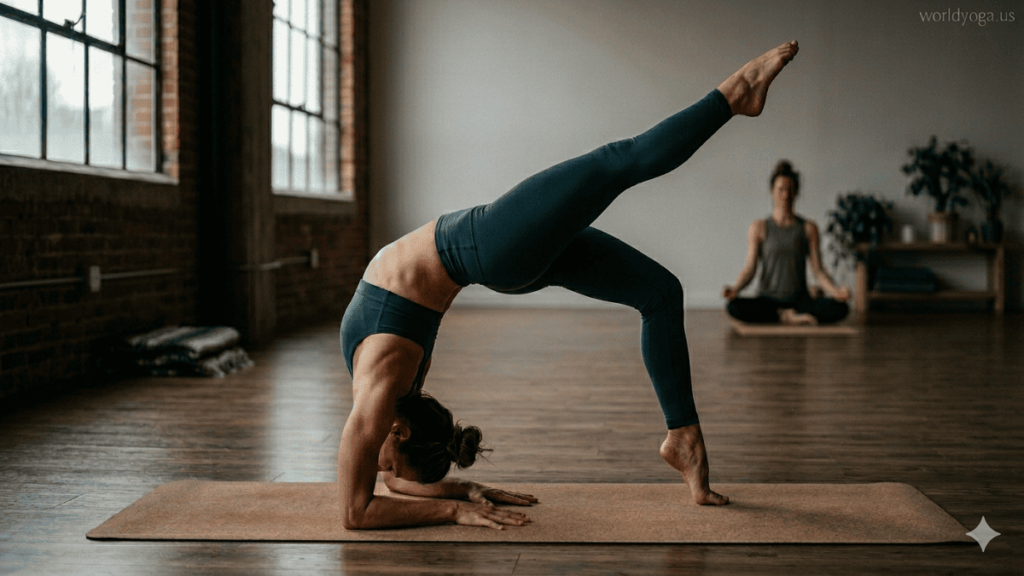
Which muscles are activated in this pose?
1. Feet and Lower Legs (Prapada Activation)
Even though the posture is dominated by a backbend, the foundation begins in the feet.
Activated muscles:
- Intrinsic foot muscles (flexor hallucis brevis, interossei, lumbricals)
- Gastrocnemius and soleus (calf muscles)
- Tibialis anterior and posterior (arch control and stability)
Function:
In the prapada phase (toe/ball-of-foot engagement), these muscles stabilize the arches and regulate pressure distribution. This improves balance and supports lift into the backbend without collapsing the ankles.
2. Thighs and Hip Region (Baddha Pada Stability Layer)
The pelvis and legs must remain strong and organized to protect the lumbar spine.
Activated muscles:
- Quadriceps femoris (especially rectus femoris for knee extension stability)
- Hamstrings (eccentric control during extension)
- Gluteus maximus (hip extension support)
- Gluteus medius/minimus (pelvic stabilization)
- Adductor group (inner thigh engagement for midline control)
- Iliopsoas (hip flexor complex) (lengthened but still active for control)
Function:
These muscles prevent the knees from collapsing and ensure the pelvis does not over-tilt, which is crucial in deep backbends like this.
Reference:
https://www.kenhub.com/en/library/anatomy/muscles-of-the-hip
3. Spine and Core (Primary Stabilizing Engine)
This is the most demanding region in Eka Pada Viparita Dandasana.
Activated muscles:
- Erector spinae group (spinal extension)
- Multifidus (segmental spinal stability)
- Rectus abdominis (eccentric control against over-compression)
- Transverse abdominis (deep core stabilization)
- Obliques (rotational and anti-rotational balance during single-leg lift)
Function:
These muscles create controlled spinal extension while preventing lumbar compression. The core does not “relax” in backbends—it actively resists collapse.
4. Shoulders, Arms, and Chest (Load-Bearing Expansion System)
Because the arms support body weight, this region is highly engaged.
Activated muscles:
- Deltoids (especially anterior fibers)
- Pectoralis major (sternal and clavicular heads)
- Triceps brachii (elbow extension stability)
- Serratus anterior (scapular protraction and rib expansion)
- Latissimus dorsi (eccentric control in shoulder flexion)
- Rhomboids and trapezius (scapular stabilization)
Function:
These muscles maintain shoulder integrity while allowing chest opening and spinal arching.
5. Neck and Extended Leg (Eka Pada Element)
Neck:
- Deep cervical flexors and extensors stabilize the cervical spine
Raised leg:
- Hamstrings and gluteus maximus (supporting side)
- Quadriceps (extended leg)
- Hip flexors (to lift the leg upward)
Function:
The lifted leg introduces asymmetry, requiring fine neuromuscular control to prevent twisting of the pelvis.
Summary
This posture is essentially a full-body neuromuscular chain activation:
- Feet → stability and grounding
- Legs → pelvic control
- Core → spinal protection
- Shoulders → weight-bearing support
- Spine → controlled extension
- One leg → dynamic balance challenge
Reference Links
- https://www.kenhub.com/en/library/anatomy/muscles-of-the-back
- https://www.yogajournal.com/poses/one-legged-inverted-staff-pose/
- https://www.physio-pedia.com/Back_Pain_and_Yoga
#Prapada Baddha Pada Eka Pada Viparita Dandasana in Maharashtra
What preparatory poses are needed?
1. Wrist and Shoulder Preparation (Load Tolerance)
Since the final posture involves strong weight-bearing through the arms, shoulder readiness is essential.
Key preparatory poses:
- Adho Mukha Svanasana (Downward Dog) – builds shoulder endurance
- Dolphin Pose (Ardha Pincha Mayurasana) – strengthens shoulder girdle
- Chaturanga Dandasana drills – trains controlled elbow flexion
- Gomukhasana arms / Eagle arms – improves shoulder mobility
- Wall-supported shoulder flexion stretches
Purpose:
These poses prepare the deltoids, rotator cuff, serratus anterior, and triceps for sustained load and alignment under inversion.
Reference:
https://www.yogajournal.com/poses/dolphin-pose/
2. Spinal Extension Preparation (Backbend Foundation)
The spine must gradually adapt to deep extension to avoid compression in Viparita Dandasana.
Key preparatory poses:
- Bhujangasana (Cobra Pose) – gentle lumbar activation
- Salabhasana (Locust Pose) – strengthens posterior chain
- Ustrasana (Camel Pose) – opens thoracic spine and hip flexors
- Dhanurasana (Bow Pose) – integrates full backbend pattern
- Setu Bandhasana (Bridge Pose) – controlled spinal lift
Purpose:
These develop erector spinae strength, thoracic mobility, and safe lumbar extension capacity.
Reference:
https://www.yogajournal.com/poses/cobra-pose/
3. Hip Flexor and Quadriceps Opening (Baddha Pada Support)
Tight hip flexors are one of the biggest limitations in deep backbends.
Key preparatory poses:
- Anjaneyasana (Low Lunge) – targets iliopsoas
- Virabhadrasana I (Warrior I) – builds hip extension strength
- Ardha Bhekasana (Half Frog Pose) – deep quad opening
- Supta Virasana (Reclined Hero Pose) – intense quad stretch
- Baddha Konasana (Bound Angle Pose) – pelvic opening and release
Purpose:
These reduce restriction in the iliopsoas and rectus femoris, allowing safer spinal arching without lumbar strain.
Reference:
https://www.verywellfit.com/low-lunge-anjaneyasana-3567080
4. Core Activation and Control (Anti-Compression Stability)
A strong core prevents collapse into the lower back during inversion.
Key preparatory poses:
- Phalakasana (Plank Pose) – full-core engagement
- Vasisthasana (Side Plank) – lateral stability
- Navasana (Boat Pose) – deep abdominal activation
- Setu Bandha variations with core engagement
Purpose:
These strengthen the transverse abdominis, obliques, and rectus abdominis, which stabilize spinal extension.
Reference:
https://www.yogajournal.com/poses/boat-pose/
5. Backbend Integration Poses (Direct Preparation for Final Shape)
These are the closest functional patterns to Eka Pada Viparita Dandasana.
Key preparatory poses:
- Wheel Pose (Urdhva Dhanurasana) – primary foundation pose
- Forearm Wheel (Dwi Pada Viparita Dandasana prep)
- One-leg bridge variations (Eka Pada Setu Bandha)
- Supported backbends using blocks or wall
Purpose:
They train shoulder extension under load + spinal arch control, which directly translates into the final posture.
Reference:
https://www.yogajournal.com/poses/upward-facing-bow-pose/
6. Neuromuscular Integration (Final Stage Prep)
Before attempting the full pose:
- Practice wheel pose holds (30–60 seconds)
- Add one-leg lifts in bridge or wheel variations
- Focus on breath control in full spinal extension
Summary
To prepare for this advanced posture, the body must progressively develop:
- Shoulder strength (load-bearing stability)
- Spinal flexibility (safe extension range)
- Hip opening (freedom of pelvis)
- Core control (anti-collapse mechanism)
- Backbend integration (wheel-based transitions)
#Prapada Baddha Pada Eka Pada Viparita Dandasana in Ahemadabad
What are common mistakes in this pose?
1. Collapsing into the Lower Back (Lumbar Overload)
One of the most common and risky mistakes.
What happens:
- The bend is forced mainly into the lumbar spine instead of spreading through the thoracic spine
- The lower back “hinges” instead of forming a smooth arch
Why it’s a problem:
This can compress lumbar discs and strain the facet joints.
Correction:
- Actively lift through the chest and upper back (thoracic extension)
- Engage glutes and core lightly to support spinal length
- Think “backbend through the whole spine, not just the lower back”
Reference:
https://www.yogajournal.com/practice/yoga-for-back-pain/
2. Over-Loading the Shoulders and Wrists
Because the pose is arm-supported, misalignment often shifts excessive load into joints.
What happens:
- Elbows flare out or hyperextend
- Shoulders collapse inward
- Wrists take uneven pressure
Why it’s a problem:
Can lead to shoulder impingement or wrist strain.
Correction:
- Keep elbows shoulder-width and stable
- Actively engage serratus anterior to lift the chest
- Distribute weight evenly through palms or forearms
Reference:
https://www.yogajournal.com/poses/upward-facing-bow-pose/
3. Losing Core Engagement (Midline Instability)
In deep backbends, many practitioners relax the core completely.
What happens:
- Rib cage flares excessively
- Lower ribs push outward
- Pelvis becomes unstable
Why it’s a problem:
Reduces spinal support and increases compression risk.
Correction:
- Engage transverse abdominis gently
- Maintain “rib control” (avoid flaring)
- Keep a subtle inward support without restricting breath
4. Misaligned Hips in Eka Pada Extension
When one leg lifts, pelvic stability is often lost.
What happens:
- Hips rotate or open unevenly
- Standing leg collapses or shifts outward
- Raised leg becomes passive instead of active
Why it’s a problem:
Creates torsion in the lower spine and sacroiliac joint.
Correction:
- Keep hips as square as possible
- Engage glute of standing leg strongly
- Actively lengthen the lifted leg rather than “dropping it back”
5. Neglecting Foot Activation (Prapada Instability)
Foot engagement is often ignored in advanced backbends.
What happens:
- Feet roll outward or inward unevenly
- Loss of grounding through toes/arches
- Instability in lift and balance
Why it’s a problem:
Weak foundation reduces overall control of the pose.
Correction:
- Press evenly through all five toes
- Maintain active arch lift and ankle stability
- Avoid collapsing into the inner or outer edges of feet
Reference:
https://www.verywellfit.com/yoga-feet-alignment-3567080
6. Rushing Into Full Expression
A major mistake in advanced practice.
What happens:
- Attempting one-leg extension before stable wheel or forearm backbend
- Skipping preparatory strength work
- Holding breath under strain
Why it’s a problem:
Leads to poor alignment patterns and increases injury risk.
Correction:
- Master Wheel Pose holds first
- Add gradual one-leg lifts in supported backbends
- Maintain steady nasal breathing throughout
7. Neck Compression or Overextension
What happens:
- Head hangs too heavily or neck collapses
- Chin lifts excessively, compressing cervical spine
Correction:
- Keep neck long and neutral
- Distribute arch evenly rather than dumping into cervical area
Summary
Most mistakes in this pose come from:
- Overemphasis on flexibility instead of strength
- Loss of spinal distribution (especially lumbar overload)
- Weak shoulder and core integration
- Poor grounding through feet in Prapada phase
#Prapada Baddha Pada Eka Pada Viparita Dandasana in Hyderabad
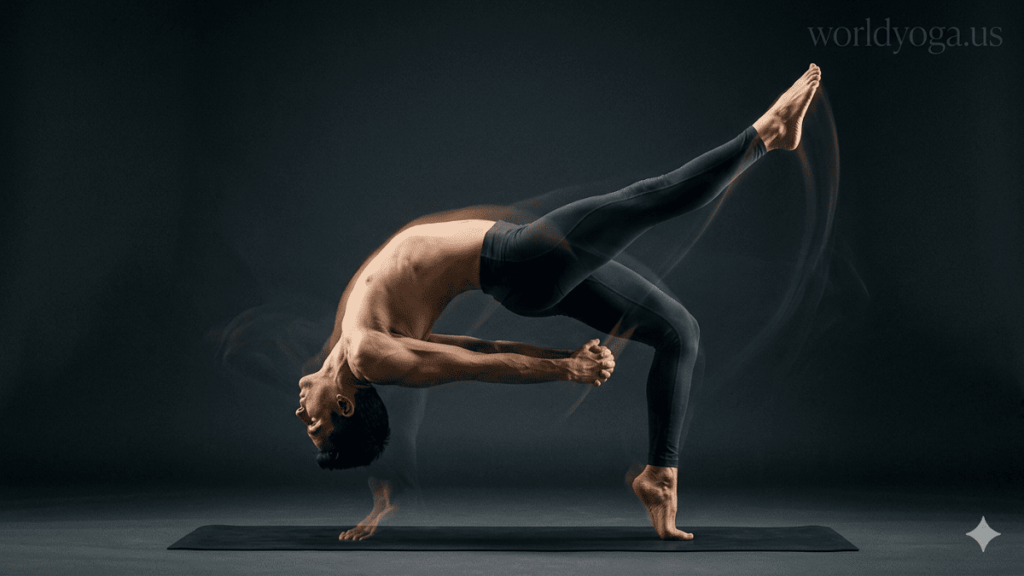
What are the benefits of this asana?
1. Spinal Strength and Flexibility
This asana deeply engages the entire spinal column in controlled extension.
Benefits:
- Increases thoracic and lumbar spine mobility
- Strengthens erector spinae and deep stabilizing muscles (multifidus)
- Improves overall postural alignment
- Reduces stiffness from prolonged sitting (when practiced correctly)
Because the spine is extended under load, it develops both strength and elasticity, which is essential for healthy back function.
Reference:
https://www.yogajournal.com/poses/upward-facing-bow-pose/
2. Shoulder and Upper Body Strength
Since the posture involves arm support in deep extension or inversion:
Benefits:
- Strengthens deltoids, triceps, and serratus anterior
- Improves shoulder joint stability and range of motion
- Enhances scapular control and upper back engagement
- Builds endurance in weight-bearing arm positions
This makes it highly beneficial for advanced yoga transitions and arm balances.
3. Hip Flexibility and Pelvic Mobility (Baddha Pada Influence)
The Baddha Pada alignment component influences the lower body mechanics.
Benefits:
- Opens hip flexors (iliopsoas)
- Improves pelvic mobility and alignment
- Enhances groin and inner thigh flexibility
- Reduces tightness from prolonged sitting or athletic stiffness
This helps balance lower-body tension created by modern sedentary lifestyles.
Reference:
https://www.verywellfit.com/bound-angle-pose-baddha-konasana-3567074
4. Core Strength and Stability
The asymmetrical nature of Eka Pada variation demands strong core control.
Benefits:
- Strengthens transverse abdominis and obliques
- Improves spinal stabilization under extension
- Enhances ability to control asymmetrical movement (one-leg lift)
- Reduces risk of lower back collapse in backbends
This core engagement is not superficial—it is deeply stabilizing.
5. Nervous System Activation and Energy Effects
Deep backbends and inversions strongly influence the nervous system.
Benefits:
- Stimulates the sympathetic nervous system (energizing effect)
- Later promotes parasympathetic rebound (calming after release)
- Improves body awareness and neuromuscular coordination
- May reduce mental fatigue through controlled breath and focus
Practitioners often report a sense of alertness and emotional release after practice.
6. Respiratory Expansion
The chest-opening nature of the pose directly affects breathing capacity.
Benefits:
- Expands rib cage and intercostal muscles
- Improves lung capacity and diaphragmatic mobility
- Encourages deeper, more controlled breathing patterns
- Supports better oxygen intake during physical effort
7. Balance, Coordination, and Proprioception
Because of the one-legged variation:
Benefits:
- Enhances neuromuscular coordination
- Improves pelvic stability under asymmetrical load
- Develops fine balance control in inversion and extension
- Strengthens mind-body awareness
8. Emotional and Energetic Effects (Traditional Yoga Perspective)
In classical yoga interpretations:
- Deep backbends are associated with heart-opening qualities
- May help release stored tension in chest and hips
- Encourages feelings of expansion, courage, and emotional openness
Summary
This advanced posture delivers a combined effect of:
- Strong, flexible spine
- Open hips and shoulders
- Powerful core stability
- Enhanced breathing capacity
- Nervous system stimulation and recovery balance
- Improved coordination and body awareness
#Prapada Baddha Pada Eka Pada Viparita Dandasana in Kolkata
Case Study of Prapada Baddha Pada Eka Pada Viparita Dandasana
1. Subject Profile
- Age: 32 years
- Experience: 7 years of consistent Ashtanga/Vinyasa practice
- Primary background: Strong in standing postures and basic backbends
- Limitations noted: Moderate shoulder tightness, mild lumbar sensitivity after deep backbends, limited thoracic extension
The practitioner is advanced but not yet fully adapted to deep inversion-backbend combinations.
2. Objective of Study
To evaluate:
- Readiness for Eka Pada Viparita Dandasana integration
- Ability to maintain Prapada grounding stability
- Control of Baddha Pada pelvic alignment
- Safe execution of one-leg extension in deep spinal arch
3. Preparatory Phase (4–6 Weeks)
Focus areas:
- Shoulder loading tolerance
- Thoracic spine mobility
- Hip flexor release
- Core stabilization under extension
Key preparatory practices:
- Wheel Pose (Urdhva Dhanurasana) holds (20–45 sec)
- Forearm-supported backbends
- Anjaneyasana and Ustrasana for hip opening
- Dolphin Pose for shoulder endurance
- Navasana for core control
Observations:
- Shoulder endurance improved significantly
- Lumbar discomfort reduced with better thoracic engagement
- Breath control became more stable in backbends
Reference for backbend preparation principles:
https://www.yogajournal.com/poses/upward-facing-bow-pose/
4. Execution Phase
Step-by-step attempt:
- Entered Wheel Pose (baseline stability achieved)
- Engaged Prapada activation through feet for grounding and lift control
- Maintained Baddha Pada alignment cues (inner thighs engaged, pelvis neutralized within extension)
- Shifted weight into hands and shoulders
- Extended one leg upward into Eka Pada variation
5. Key Biomechanical Findings
A. Prapada Engagement (Foot Stability)
- Improved micro-stability in lift phase
- Reduced ankle collapse tendency
- Increased control during weight shift
B. Baddha Pada Influence (Pelvic Control)
- Prevented excessive hip rotation
- Helped maintain midline awareness
- Reduced sacroiliac strain during one-leg extension
C. Eka Pada Extension (Asymmetry Challenge)
- Noted pelvic rotation tendency when fatigued
- Standing leg glute engagement critical for stability
- Core engagement prevented lumbar over-compression
6. Common Difficulties Observed
- Overextension in lumbar spine during leg lift
- Shoulder fatigue leading to collapse in chest lift
- Loss of hip symmetry during Eka Pada transition
- Breath holding during peak effort phase
These are typical for practitioners transitioning from bilateral backbends to asymmetrical inversion backbends.
7. Adaptations Used
- Block support under hands in early attempts
- Partial Eka Pada lifts instead of full extension
- Wall-assisted wheel variations
- Reduced hold time (10–15 seconds initially)
These modifications improved neuromuscular control and reduced strain.
Reference on safe backbend progression:
https://www.verywellfit.com/yoga-backbends-benefits-3567077
8. Outcomes After Practice Cycle
After 6 weeks:
- Improved spinal load distribution
- Increased shoulder stability in extension
- Better core-pelvis coordination
- Reduced lumbar discomfort in deep backbends
- Partial mastery of controlled Eka Pada lift (without collapse)
9. Conclusion
This case demonstrates that Prapada Baddha Pada Eka Pada Viparita Dandasana is not a single strength or flexibility pose, but a multi-system integration challenge involving:
- Foot grounding (Prapada)
- Pelvic organization (Baddha Pada)
- Spinal extension control
- Asymmetrical leg lift stability (Eka Pada)
- Shoulder load-bearing endurance
Successful progression depends more on neuromuscular coordination and spinal intelligence than raw flexibility.
#Prapada Baddha Pada Eka Pada Viparita Dandasana in Banglore
White Paper of Prapada Baddha Pada Eka Pada Viparita Dandasana
Abstract
Prapada Baddha Pada Eka Pada Viparita Dandasana is a composite advanced yoga posture combining toe-based grounding (Prapada), pelvic alignment principles (Baddha Pada), and unilateral spinal inversion extension (Eka Pada Viparita Dandasana). This white paper examines the posture from anatomical, biomechanical, and neuromuscular perspectives, emphasizing load distribution, mobility requirements, injury risks, and functional benefits. The posture is characterized by extreme spinal extension under load and requires integrated control of the feet, hips, core, shoulders, and cervical spine.
1. Introduction
Viparita Dandasana-based postures are advanced backbends traditionally used in Hatha and modern Ashtanga-derived systems. The inclusion of Prapada and Baddha Pada elements introduces additional layers of stability and alignment control.
This hybrid posture represents:
- A closed-chain kinetic backbend
- A unilateral inversion variation
- A full-body neuromuscular integration task
2. Anatomical Framework
2.1 Primary Systems Involved
- Spinal column (cervical, thoracic, lumbar segments)
- Glenohumeral (shoulder) joint complex
- Pelvic girdle (sacroiliac stability)
- Lower limb kinetic chain (feet → ankles → knees → hips)
2.2 Key Muscle Groups
- Spine: erector spinae, multifidus
- Core: transverse abdominis, obliques, rectus abdominis (eccentric control)
- Shoulders: deltoids, triceps, serratus anterior
- Hips: iliopsoas, gluteus maximus, adductors
- Feet: intrinsic foot muscles, gastrocnemius-soleus complex
Reference:
https://www.kenhub.com/en/library/anatomy/muscles-of-the-back
3. Biomechanical Analysis
3.1 Load Distribution Model
The posture distributes load across:
- Upper limbs (primary support system)
- Posterior spinal chain (extension generator)
- Lower limbs (grounding and stability via Prapada engagement)
3.2 Kinetic Chain Behavior
- Closed-chain foot engagement stabilizes upward force transmission
- Thoracic extension reduces lumbar compression risk
- Unilateral leg lift introduces rotational torque requiring core compensation
3.3 Prapada Function
- Enhances proprioceptive feedback in distal lower limb
- Stabilizes arch mechanics under dynamic extension
- Improves lift efficiency during transition phases
4. Neuromuscular Coordination Requirements
Primary coordination demands:
- Shoulder flexion under load + scapular stabilization
- Spinal segmentation control during deep extension
- Pelvic neutrality during unilateral lift
- Breath regulation under thoracic expansion
Key challenge:
Maintaining symmetrical spinal extension under asymmetrical lower limb movement
5. Physiological Effects
5.1 Musculoskeletal Benefits
- Increased spinal extension range
- Enhanced shoulder stability
- Improved hip flexor elasticity
- Strengthened posterior chain musculature
5.2 Cardiopulmonary Effects
- Rib cage expansion improves ventilatory capacity
- Increased intercostal muscle engagement
- Temporary sympathetic nervous system activation
5.3 Neurological Effects
- Increased proprioceptive input
- Enhanced motor control integration
- Postural awareness refinement
Reference:
https://www.yogajournal.com/poses/upward-facing-bow-pose/
6. Risk Assessment
6.1 Primary Risk Zones
- Lumbar spine (compression due to poor thoracic extension)
- Shoulder joints (overload or impingement)
- Cervical spine (hyperextension risk)
- Sacroiliac joint (torsional stress in Eka Pada variation)
6.2 Common Failure Patterns
- Lumbar-dominant backbend collapse
- Rib flare with loss of core control
- Pelvic rotation during one-leg lift
- Wrist/shoulder overloading
7. Contraindications
This posture is not recommended for individuals with:
- Acute lower back pain or disc pathology
- Shoulder instability or rotator cuff injury
- Cervical spine disorders
- Hypertension (due to inversion and exertion load)
8. Progressive Training Model
Phase 1: Foundational Strength
- Plank variations
- Bridge Pose (Setu Bandhasana)
- Cobra and Locust poses
Phase 2: Mobility Development
- Camel Pose (Ustrasana)
- Low Lunge hip openers
- Shoulder flexibility drills
Phase 3: Integration
- Wheel Pose holds
- Forearm backbends
- One-leg bridge variations
Phase 4: Advanced Expression
- Eka Pada Viparita Dandasana transitions
- Controlled unilateral leg lifts in wheel
9. Conclusion
Prapada Baddha Pada Eka Pada Viparita Dandasana is best understood as a high-complexity neuromechanical integration system rather than a single posture. Its execution demands coordinated activation of distal grounding (feet), central stabilization (core and spine), and proximal load-bearing structures (shoulders and hips). When properly trained, it enhances spinal mobility, muscular control, and full-body proprioception. However, improper execution significantly increases risk of spinal and shoulder overload.
10. References
- https://www.yogajournal.com/poses/upward-facing-bow-pose/
- https://www.kenhub.com/en/library/anatomy/muscles-of-the-back
- https://www.verywellfit.com/yoga-backbends-benefits-3567077
#Prapada Baddha Pada Eka Pada Viparita Dandasana in Pune
Industry Application of Prapada Baddha Pada Eka Pada Viparita Dandasana
1. Executive Overview
Prapada Baddha Pada Eka Pada Viparita Dandasana is an advanced composite yoga posture combining toe engagement (Prapada), pelvic alignment control (Baddha Pada), and unilateral inverted spinal extension (Eka Pada Viparita Dandasana). While rarely used in mainstream fitness settings as a full expression, its components are widely applied in professional movement, rehabilitation, and performance training systems.
The industry value of this posture lies not in mass accessibility, but in its training principles: spinal extension control, shoulder load management, and asymmetrical core stabilization.
2. Yoga Education and Teacher Training Industry
Application
- Used in advanced 200/300/500-hour yoga teacher training programs
- Serves as a peak posture for sequencing methodology
- Demonstrates integration of bandha control, alignment, and breath mechanics
Functional role
- Teaches progression from basic backbends → wheel variations → inversion backbends
- Used for assessment of student readiness and spinal awareness
- Helps instructors understand risk management in extreme extension postures
Reference:
https://www.yogajournal.com/poses/upward-facing-bow-pose/
3. Physiotherapy & Rehabilitation Adjacent Application
(Not used as a treatment posture, but its principles inform rehab design.)
Key transferable concepts
- Thoracic extension training without lumbar overload
- Shoulder weight-bearing progression
- Controlled asymmetrical limb loading (Eka Pada mechanics)
- Proprioceptive retraining in closed kinetic chains
Clinical relevance
- Influences spinal decompression exercise design
- Informs shoulder rehabilitation loading progressions
- Used conceptually in movement therapy for postural dysfunction
Important: The full posture itself is not used clinically, only its segmented mechanics.
Reference:
https://www.physio-pedia.com/Back_Pain_and_Yoga
4. Sports Performance & Athletic Conditioning
Application areas
- Gymnastics and artistic movement training
- Dance and contemporary performance conditioning
- Combat sports mobility programs (indirect use)
- Calisthenics and bodyweight control systems
Transferable benefits
- Improved spinal extension strength under load
- Enhanced shoulder stability in overhead and inverted positions
- Development of unilateral control and anti-rotation strength
- Increased foot-to-core kinetic chain efficiency
Why it matters in sport
Athletes benefit not from the pose itself, but from:
- Controlled backbend mechanics
- Injury-resistant spinal extension patterns
- Improved neuromuscular coordination under asymmetry
5. Fitness and Movement Training Industry
Application
- Used in advanced mobility programs
- Incorporated into functional flexibility systems
- Adapted into:
- wall-supported backbends
- bridge progressions
- unilateral leg lift drills
Training value
- Enhances full-body coordination under load
- Builds joint resilience in shoulders and spine
- Improves movement quality in overhead extension patterns
6. Wellness, Mind–Body, and Corporate Yoga Sector
Application
Rarely taught in full form, but its principles are used in:
- Stress-reduction movement flows (modified backbends)
- Postural correction programs for desk workers
- Breath-focused extension sequences
Corporate wellness relevance
- Helps counteract kyphotic posture from prolonged sitting
- Encourages thoracic mobility and breathing expansion
- Supports energy regulation via controlled backbend exposure
7. Biomechanics & Movement Research Industry
Application
Used as a case model for studying:
- Spinal load distribution under extension
- Shoulder joint compression in weight-bearing flexion
- Asymmetrical lower limb influence on pelvic rotation
- Proprioceptive response in inverted extension states
Research value
- Demonstrates how closed-chain extension behaves under asymmetry
- Useful for modeling injury risk in deep backbends
- Helps design safer progressive mobility algorithms
8. Digital Yoga & AI-Based Training Platforms
Application
- Used in pose progression mapping systems
- Serves as a “peak difficulty node” in AI yoga sequencing models
- Helps classify:
- readiness levels
- injury risk thresholds
- mobility prerequisites
9. Limitations in Industry Use
- Too advanced for mainstream fitness populations
- High injury risk if unsupervised
- Requires long-term progressive training
- Not suitable as a primary rehabilitation tool
10. Conclusion
In industry terms, Prapada Baddha Pada Eka Pada Viparita Dandasana is not a mass-market exercise but a high-complexity reference model used to inform:
- Advanced yoga pedagogy
- Movement therapy design principles
- Athletic mobility and control systems
- Biomechanical research into spinal extension and asymmetry
Its greatest value lies in its underlying mechanics rather than its full physical execution.
Key References
- https://www.yogajournal.com/poses/upward-facing-bow-pose/
- https://www.physio-pedia.com/Back_Pain_and_Yoga
- https://www.kenhub.com/en/library/anatomy/muscles-of-the-back
#Prapada Baddha Pada Eka Pada Viparita Dandasana in Mumbai
Ask FAQs
What is Prapada Baddha Pada Eka Pada Viparita Dandasana?
It is an advanced composite yoga posture combining toe-based grounding (Prapada), pelvic alignment principles (Baddha Pada), and a one-legged inverted backbend (Eka Pada Viparita Dandasana). It is not a single beginner pose but a high-level integration of spinal extension, shoulder support, and asymmetrical balance.
Who can safely practice this pose?
This posture is suitable only for advanced yoga practitioners with strong experience in deep backbends and inversions such as Wheel Pose (Urdhva Dhanurasana) and forearm backbends. Beginners or individuals with spinal, shoulder, or wrist injuries should avoid it or practice only preparatory variations under supervision.
Reference: https://www.yogajournal.com/poses/upward-facing-bow-pose/
What are the main benefits of this posture?
The pose improves:
Spinal flexibility and strength
Shoulder stability and endurance
Hip opening and pelvic mobility
Core control and balance
Breath expansion due to chest opening
It also enhances overall body coordination and neuromuscular awareness.
What are the most common mistakes in this pose?
Common errors include:
Overarching the lower back instead of distributing extension through the spine
Collapsing shoulders or wrists under body weight
Losing hip alignment during the one-leg extension
Neglecting core engagement
Forcing the posture without adequate preparation
These mistakes increase the risk of injury, especially in the lumbar spine and shoulders.
What are the best preparatory poses before attempting it?
Key preparatory poses include:
Wheel Pose (Urdhva Dhanurasana)
Cobra and Locust Pose (Bhujangasana, Salabhasana)
Camel Pose (Ustrasana)
Low Lunge (Anjaneyasana)
Dolphin Pose for shoulder strength
These build the required flexibility, strength, and stability needed for safe progression.
Reference: https://www.verywellfit.com/yoga-backbends-benefits-3567077
Table of Contents
Disclaimer:
This advanced yoga posture is intended for experienced practitioners only. It should be practiced under the guidance of a qualified instructor. Improper execution may lead to injury, especially to the spine, shoulders, or wrists. Always progress gradually and avoid forcing the pose beyond your current ability.