
Eka Pada Viparita Dandasana
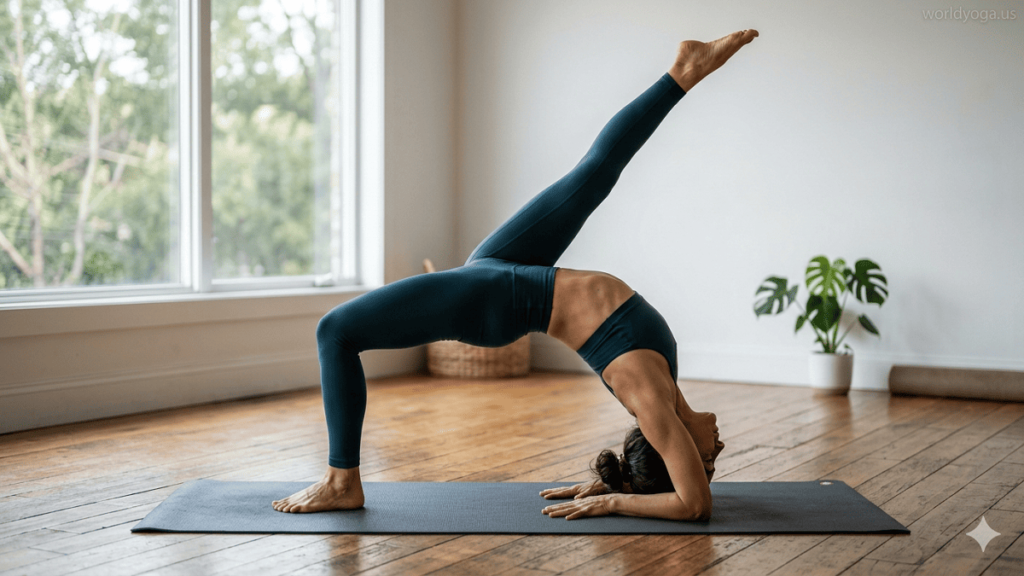
Eka Pada Viparita Dandasana (One-Legged Inverted Staff Pose) is an advanced backbend in modern yoga practice that combines spinal extension, balance, and hip opening. The Sanskrit name breaks down as: eka (one), pada (foot/leg), viparita (inverted), and danda (staff or stick). This posture is a variation of Viparita Dandasana, performed with one leg lifted, which increases both the physical and mental demands of the pose.
This asana is typically approached from a strong foundation in backbending postures such as Urdhva Dhanurasana or Kapotasana. From a supported inverted staff position—often with forearms or hands grounded—the practitioner gradually lifts one leg upward while maintaining stability through the shoulders, spine, and grounded leg. Proper alignment is critical: the chest should remain open, the spine evenly extended, and the neck protected by avoiding excessive compression.
The benefits of Eka Pada Viparita Dandasana are extensive. Physically, it enhances spinal flexibility, strengthens the shoulders, arms, and legs, and deeply stretches the hip flexors and abdominal region. The asymmetrical nature of the pose challenges core stability and proprioception, making it particularly valuable for developing balance and coordination. Additionally, as an intense heart-opening posture, it may stimulate energy and counteract the effects of prolonged sitting or poor posture.
From a physiological perspective, backbends like this are often associated with improved lung capacity and circulation due to the expansion of the chest cavity. Practitioners also report increased energy levels and a sense of emotional release, although such effects vary individually. Because of its intensity, this pose should be practiced with adequate warm-up and under the guidance of a qualified instructor, especially for those new to advanced yoga techniques.
There are important precautions to consider. Individuals with spinal injuries, shoulder instability, or conditions such as Herniated disc should avoid or modify this posture. It is also not recommended during pregnancy or for those with uncontrolled high blood pressure unless cleared by a healthcare professional. Using props like blocks or bolsters can make preparatory stages safer and more accessible.
For further reading and visual guidance, you may find these resources useful:
- Yoga Journal pose breakdown: https://www.yogajournal.com/poses/one-legged-inverted-staff-pose/
- Detailed tutorial on advanced backbends: https://www.doyou.com/eka-pada-viparita-dandasana/
In summary, Eka Pada Viparita Dandasana is a powerful and demanding yoga posture that integrates strength, flexibility, and concentration. When practiced mindfully and progressively, it can be a valuable addition to an advanced yoga routine, promoting both physical resilience and deeper body awareness.
#Eka Pada Viparita Dandasana in India
How is Eka Pada Viparita Dandasana performed correctly?
Step-by-step execution:
Begin with a thorough warm-up that includes spinal extensions, shoulder openers, and hip flexor stretches. Once prepared, lie on your back with your knees bent and feet hip-width apart, close to your hips. Place your hands beside your ears, fingers pointing toward your shoulders. Press firmly into your palms and feet as you lift into Urdhva Dhanurasana.
From here, transition into Viparita Dandasana by carefully lowering your forearms to the ground one at a time, placing them parallel with elbows shoulder-width apart. Interlace your fingers or keep palms flat depending on your variation. Ensure your chest moves toward your head, creating a deep arch through the thoracic spine rather than collapsing into the lower back.
Once stable, shift your weight evenly through both feet and forearms. Engage your core and thighs to maintain pelvic stability. Slowly lift one leg off the ground, extending it upward toward the ceiling. Keep the raised leg active, with the toes pointed or flexed, and avoid letting the hips twist—both hips should remain as level as possible.
Alignment and breathing cues:
Maintain steady, controlled breathing throughout the pose. Inhale to lengthen and expand the chest; exhale to stabilize and engage the core. Your shoulders should remain strong and supportive, with minimal strain on the neck. Avoid dumping weight into the head—most of the load should be distributed through the forearms and grounded foot.
Hold the position for a few breaths, then gently lower the lifted leg back down. Return to the base pose before carefully exiting by lowering your upper body to the floor with control.
Common mistakes to avoid:
A frequent error is over-compressing the lumbar spine instead of distributing the backbend evenly. Another is allowing the elbows to splay outward, which destabilizes the shoulders. Lifting the leg too quickly or without core engagement can also lead to imbalance or strain.
Safety considerations:
This pose is not suitable for beginners and should ideally be practiced under supervision. Those with shoulder injuries, spinal issues, or conditions like Herniated disc should avoid it unless guided by a professional. Using props such as blocks under the forearms or practicing near a wall can provide additional support.
#Eka Pada Viparita Dandasana in Maharashtra
Which muscles are engaged in this pose?
Primary muscle groups engaged:
The spinal extensors (erector spinae) are heavily activated to create and sustain the deep backbend. These muscles run along the spine and are responsible for lifting and arching the torso. Supporting this action, the gluteus maximus and hamstrings of the grounded leg engage to stabilize the pelvis and prevent excessive compression in the lower back.
The quadriceps, particularly in the grounded leg, work to maintain knee extension and provide a strong base. In the lifted leg, both the quadriceps and hip flexors coordinate to keep the leg extended and elevated without destabilizing the hips.
Core and stabilizing muscles:
A significant portion of the effort comes from the core musculature, including the transverse abdominis and obliques. These muscles act as stabilizers, preventing the pelvis from tilting or rotating as one leg lifts. Without strong core engagement, the asymmetry of the pose can lead to imbalance or strain.
The hip stabilizers, including the gluteus medius and minimus, are particularly important for maintaining level hips. This becomes more pronounced in the one-legged variation, where lateral stability is challenged.
Upper body involvement:
The shoulders and arms play a crucial role, especially in the forearm-supported variation of Viparita Dandasana. The deltoids, triceps, and muscles of the rotator cuff work together to support body weight and protect the shoulder joints. The pectoralis major and latissimus dorsi contribute to chest opening and upper body strength, helping maintain the lifted position.
The forearms and wrists (if hands are used instead of interlaced fingers) provide grounding and stability, while the scapular stabilizers (such as the serratus anterior) help keep the shoulder blades properly positioned.
Secondary effects:
Although not “engaged” in a strengthening sense, the hip flexors, abdominals, and chest muscles experience a deep stretch. This combination of contraction and extension across different muscle groups is what makes the pose both challenging and effective.
Functional integration:
What distinguishes this pose is not just the number of muscles involved, but how they coordinate. Strength in isolation is not enough—Eka Pada Viparita Dandasana demands neuromuscular control, meaning muscles must activate in a balanced, synchronized way to maintain alignment and breath.
#Eka Pada Viparita Dandasana in Kolkata
What are the essential preparatory poses?
1. Foundational backbends
Start with gentle spinal warm-ups such as Bhujangasana and Salabhasana. These poses activate the spinal extensors and help you learn to distribute the backbend לאורך the entire spine rather than compressing the lower back. As you progress, Ustrasana introduces a deeper thoracic opening and begins to engage the hip flexors.
2. Intermediate backbends
A crucial step is mastering Urdhva Dhanurasana, which closely resembles the structural demands of the final pose. This posture builds strength in the arms, shoulders, and legs while increasing spinal flexibility. Another valuable preparation is Setu Bandha Sarvangasana, which helps develop controlled backbending with support and is especially useful for learning pelvic stability.
3. Shoulder and chest openers
Since Eka Pada Viparita Dandasana requires strong shoulder engagement and openness, poses like Gomukhasana (arm variation) and Anahatasana are highly effective. These improve flexibility in the deltoids, chest, and upper back, reducing strain when weight is placed on the forearms or hands.
4. Hip flexor and quadriceps stretches
Tight hip flexors can restrict the depth and safety of backbends. Poses such as Anjaneyasana and Eka Pada Rajakapotasana help release the front body, allowing for a more even spinal curve. These stretches are essential for lifting one leg without destabilizing the pelvis.
5. Core and stability work
Strong core engagement is critical for maintaining alignment, especially in the one-legged variation. Plank-based exercises and poses like Phalakasana build the necessary strength in the abdominal and stabilizing muscles. This prevents excessive arching in the lower back and supports controlled movement.
6. Inversions and forearm balance preparation
Since the pose often involves forearm support, practicing Pincha Mayurasana or dolphin pose can improve shoulder strength and familiarity with weight-bearing through the upper body.
Summary
The key to safely approaching Eka Pada Viparita Dandasana lies in gradual preparation. By combining backbends, shoulder openers, hip stretches, and core strengthening, practitioners can build the mobility and control required for this demanding posture. Skipping these preparatory stages increases the risk of strain, whereas consistent practice creates the foundation for a stable, balanced, and confident execution.
#Eka Pada Viparita Dandasana in Pune
What common mistakes should be avoided?
1. Over-compressing the lower back
One of the most frequent issues is forcing the backbend primarily into the lumbar spine. This creates excessive pressure in the lower back instead of distributing the curve לאורך the entire spine. Proper execution should emphasize opening the chest and thoracic spine, supported by engagement in the legs and core.
2. Insufficient shoulder engagement
Weak or passive shoulders can cause instability and strain, especially when transitioning from Urdhva Dhanurasana into the forearm-supported variation. Letting the elbows splay outward reduces structural support and may overload the neck and upper back. Keeping the shoulders active and aligned is essential.
3. Dumping weight into the head or neck
Another critical mistake is placing too much weight on the head rather than distributing it through the forearms, hands, and feet. This can compress the cervical spine and increase injury risk. The neck should remain long and relatively free of pressure.
4. Lifting the leg without pelvic stability
In the one-legged variation, many practitioners lift the leg too quickly or without engaging the core. This often leads to tilting or rotating the hips, which destabilizes the pose. Both hips should stay as level as possible, supported by strong activation of the core and hip stabilizers.
5. Neglecting core engagement
Without proper activation of the abdominal muscles, the pose becomes overly reliant on passive flexibility. This not only reduces control but also increases the likelihood of strain in the lower back. The core should remain subtly engaged to support spinal integrity.
6. Forcing depth over control
Attempting to achieve a deeper backbend before building sufficient strength and flexibility is a common error. This “pushing” approach can lead to poor alignment and potential injury. It’s more effective to prioritize steady, controlled progression using preparatory poses.
7. Skipping proper warm-up
Entering such an advanced pose without adequately preparing the spine, shoulders, and hips significantly increases risk. Foundational poses and gradual progression are essential for safe practice.
8. Holding the breath
Breath restriction often occurs when the pose feels intense. However, steady breathing is crucial—it helps maintain focus, supports muscle engagement, and prevents unnecessary tension.
Summary
Avoiding these mistakes ensures that Eka Pada Viparita Dandasana remains both safe and effective. The key principles are balanced spinal extension, active shoulder and core engagement, and controlled movement. When practiced with awareness rather than force, the pose becomes a powerful tool for building strength, flexibility, and refined body control.
#Eka Pada Viparita Dandasana in Banglore
What are the key benefits of this pose?
1. Enhances spinal flexibility and mobility
This pose creates a deep, controlled arch through the spine, particularly targeting the thoracic region (upper and mid-back). Regular practice helps counteract stiffness caused by sedentary lifestyles, improving overall posture and spinal health.
2. Strengthens the entire posterior chain
The muscles along the back body—including the spinal extensors, glutes, and hamstrings—are actively engaged to support the backbend. This builds strength and endurance, which are essential for maintaining healthy movement patterns and preventing injury.
3. Develops shoulder and upper body strength
Supporting the body weight through the arms and shoulders requires strong engagement of the deltoids, triceps, and stabilizing muscles. Compared to poses like Urdhva Dhanurasana, this variation places even greater demand on shoulder stability and control.
4. Improves core stability and balance
Lifting one leg introduces an element of asymmetry, requiring significant core activation to keep the pelvis stable. This enhances coordination, balance, and neuromuscular control—key components of advanced yoga practice.
5. Opens the chest and improves breathing capacity
The expansive nature of the pose stretches the chest, lungs, and ribcage. This can support deeper, more efficient breathing and may contribute to improved respiratory function over time.
6. Stimulates energy and circulation
Backbends are often described as energizing because they promote blood flow and stimulate the nervous system. Practitioners frequently report feeling more alert and invigorated after practicing such poses.
7. Stretches the front body deeply
The hip flexors, quadriceps, and abdominal muscles experience an intense stretch. This is particularly beneficial for individuals who spend long hours sitting, as it helps release tension in the front body.
8. Builds mental focus and confidence
Due to its complexity and intensity, Eka Pada Viparita Dandasana demands concentration, controlled breathing, and body awareness. Successfully practicing the pose can enhance confidence and cultivate a deeper mind-body connection.
Summary
The key benefits of Eka Pada Viparita Dandasana extend beyond flexibility—it is a full-body integrative posture that develops strength, balance, and control while opening the chest and energizing the system. When practiced consistently and mindfully, it becomes a powerful tool for advancing both the physical and mental aspects of yoga practice.
#Eka Pada Viparita Dandasana in Hyderabad
Case Study of Eka Pada Viparita Dandasana
Background:
This case study examines the integration of Eka Pada Viparita Dandasana (One-Legged Inverted Staff Pose) into the practice of a 35-year-old intermediate-to-advanced yoga practitioner with a sedentary professional lifestyle. The individual reported mild lower back stiffness, reduced shoulder mobility, and postural fatigue due to prolonged desk work. Over a 12-week period, the practitioner incorporated this pose progressively, building on foundational postures such as Urdhva Dhanurasana and Viparita Dandasana.
Methodology:
The program involved practicing 4–5 times per week under guided supervision. The initial phase (weeks 1–4) focused on preparatory poses—backbends, hip openers, and shoulder mobility drills. The intermediate phase (weeks 5–8) emphasized mastering Viparita Dandasana with stable forearm support. In the final phase (weeks 9–12), the practitioner gradually introduced the one-legged variation, holding the posture for 3–5 controlled breaths on each side.
Observations and Results:
By the end of the study, several measurable and subjective improvements were noted:
- Spinal flexibility: The practitioner demonstrated increased thoracic extension and reduced reliance on lumbar compression during backbends. Reports of lower back stiffness decreased significantly.
- Shoulder strength and mobility: There was a visible improvement in shoulder stability, with better alignment and reduced fatigue during weight-bearing poses.
- Core engagement and balance: The asymmetrical nature of the pose enhanced neuromuscular coordination. The practitioner developed greater control in maintaining level hips while lifting one leg.
- Postural correction: Daily posture improved, with reduced forward rounding of the shoulders and better spinal alignment during seated work.
- Energy and mental focus: The practitioner reported increased alertness and reduced stress levels, consistent with the energizing effects often associated with deep backbends.
Challenges encountered:
During early attempts, the practitioner experienced difficulty maintaining pelvic stability and tended to over-arch the lower back. These issues were addressed through targeted core strengthening and cues to distribute the backbend evenly. Occasional wrist and shoulder discomfort highlighted the importance of proper warm-up and alignment.
Conclusion:
This case study demonstrates that Eka Pada Viparita Dandasana, when practiced progressively and with proper guidance, can significantly enhance flexibility, strength, and postural awareness. It also highlights the importance of preparatory work and controlled execution to avoid common pitfalls.
Reference for further reading:
- https://www.yogajournal.com/poses/one-legged-inverted-staff-pose/
- https://www.doyou.com/eka-pada-viparita-dandasana/
Overall insight:
Eka Pada Viparita Dandasana is not merely a display of flexibility but a comprehensive practice that integrates strength, balance, and mindfulness. Its structured inclusion in a yoga routine can yield both physical rehabilitation benefits and improved mental clarity when approached with discipline and consistency.
#Eka Pada Viparita Dandasana in Ahemadabad

White Paper of Eka Pada Viparita Dandasana
Abstract
Eka Pada Viparita Dandasana is an advanced backbend in modern yoga that integrates spinal extension, unilateral stability, and upper-body strength. As a variation of Viparita Dandasana, this posture introduces asymmetrical loading through a single-leg lift, thereby increasing neuromuscular demand. This white paper explores its biomechanical foundations, physiological effects, training methodology, and practical applications within advanced yoga practice.
1. Introduction
Backbending postures play a critical role in counteracting sedentary lifestyles and promoting spinal health. Eka Pada Viparita Dandasana represents a progression from foundational poses such as Urdhva Dhanurasana, requiring a synthesis of flexibility, strength, and motor control. Its complexity makes it suitable for experienced practitioners under guided conditions.
2. Biomechanical Analysis
The pose involves deep spinal extension distributed across the cervical, thoracic, and lumbar regions. Optimal execution emphasizes thoracic expansion while minimizing lumbar compression. The grounded leg generates force through the quadriceps and gluteal muscles, while the lifted leg introduces asymmetrical loading, challenging pelvic stability. The shoulder girdle, supported by the deltoids, triceps, and scapular stabilizers, bears significant weight, particularly in forearm-supported variations.
3. Physiological Benefits
Regular practice contributes to improved spinal mobility, enhanced muscular strength, and increased flexibility in the anterior body. The expansion of the chest cavity may support respiratory efficiency, while the activation of large muscle groups promotes circulation. Additionally, backbends are often associated with heightened alertness due to stimulation of the nervous system.
4. Training Methodology
A structured progression is essential for safe practice. Preparatory phases include spinal warm-ups, hip flexor stretches, and shoulder-opening exercises. Intermediate stages focus on mastering Viparita Dandasana with stable alignment. The final stage introduces unilateral variation, emphasizing controlled leg lift, core engagement, and balanced weight distribution.
5. Risk Management and Safety
Improper technique can lead to excessive lumbar strain, shoulder instability, or cervical compression. Individuals with conditions such as Herniated disc or shoulder injuries should avoid or modify the pose. Supervised instruction, adequate warm-up, and the use of props are recommended to mitigate risks.
6. Applications
Eka Pada Viparita Dandasana is utilized in advanced yoga sequences, flexibility training, and posture correction programs. It is particularly beneficial for individuals seeking to improve spinal extension and counteract the effects of prolonged sitting. Additionally, its emphasis on balance and coordination makes it valuable for enhancing neuromuscular efficiency.
7. Conclusion
Eka Pada Viparita Dandasana represents a sophisticated integration of strength, flexibility, and balance. When practiced with precision and progression, it offers significant physical and functional benefits. However, due to its complexity, it should be approached with caution and professional guidance.
References
- Yoga Journal. One-Legged Inverted Staff Pose. https://www.yogajournal.com/poses/one-legged-inverted-staff-pose/
- DoYouYoga. Eka Pada Viparita Dandasana Guide. https://www.doyou.com/eka-pada-viparita-dandasana/
Key Insight
This posture exemplifies the evolution of yoga practice from static flexibility toward dynamic, integrated movement systems, highlighting the importance of alignment, control, and mindful progression.
#Eka Pada Viparita Dandasana in Delhi
Industry Application of Eka Pada Viparita Dandasana
Overview
Eka Pada Viparita Dandasana is not only an advanced yoga posture but also a functional movement with growing relevance across multiple wellness and performance industries. As a progression of Viparita Dandasana, it integrates flexibility, strength, and neuromuscular coordination—qualities increasingly valued in modern health, fitness, and rehabilitation sectors.
1. Fitness and Wellness Industry
In high-end fitness studios and yoga institutions, Eka Pada Viparita Dandasana is used as a benchmark for advanced mobility and strength. It is incorporated into premium yoga programs, power yoga sessions, and mobility training modules. The pose supports goals such as improving spinal extension, enhancing posture, and building total-body strength. Compared to foundational poses like Urdhva Dhanurasana, it offers a more sophisticated challenge, making it attractive in specialized classes targeting experienced practitioners.
2. Physiotherapy and Rehabilitation
Although not typically prescribed in its full expression, modified variations of this pose are used in physiotherapy to restore spinal mobility and shoulder function. Controlled backbending movements inspired by Viparita Dandasana can aid in postural correction and recovery from sedentary strain. However, clinical use requires strict supervision, especially for individuals with conditions such as Herniated disc, where deep extension must be carefully managed.
3. Corporate Wellness Programs
With the rise of workplace wellness initiatives, advanced yoga practices are increasingly adapted into corporate settings. While Eka Pada Viparita Dandasana itself may be too advanced for general employees, its preparatory components—such as chest opening and spinal extension—are widely used to counteract prolonged sitting. These adaptations help reduce musculoskeletal discomfort and improve employee productivity and well-being.
4. Sports Performance and Athletic Training
Athletes in disciplines requiring flexibility and body control—such as gymnastics, dance, and martial arts—benefit from the movement patterns developed through this pose. It enhances posterior chain strength, hip mobility, and coordination, all of which contribute to improved athletic performance. The unilateral aspect (one-leg lift) is particularly valuable for correcting imbalances and enhancing stability.
5. Yoga Teacher Training and Certification
In advanced teacher training programs, Eka Pada Viparita Dandasana is studied as part of higher-level asana practice. It serves as a teaching model for understanding biomechanics, alignment principles, and safe progression. Trainees learn how to break down the pose, use props, and guide students through preparatory stages effectively.
6. Digital Fitness and Online Coaching
With the expansion of digital wellness platforms, this pose is often featured in advanced-level online yoga courses and tutorials. It is used to demonstrate progression pathways and to engage experienced users seeking challenging content. Visual instruction and guided sequencing make it accessible to a global audience, though proper disclaimers about safety are essential.
Conclusion
Eka Pada Viparita Dandasana has evolved beyond a traditional yoga posture into a valuable tool across multiple industries. Its applications range from elite fitness training to rehabilitation and education. While its full expression is reserved for advanced practitioners, its underlying principles—spinal mobility, strength, and balance—have broad and practical relevance in today’s health and performance landscape.
#Eka Pada Viparita Dandasana in Mumbai
Ask FAQs
What is Eka Pada Viparita Dandasana?
Eka Pada Viparita Dandasana is an advanced yoga backbend that combines spinal extension, shoulder strength, and balance. It is a one-legged variation of Viparita Dandasana, where one leg is lifted while the body is supported on the forearms or hands. This increases the intensity by introducing asymmetrical balance and greater core engagement.
Who can practice this pose?
This pose is best suited for advanced practitioners with a strong foundation in backbending and shoulder stability. Individuals should already be comfortable with poses like Urdhva Dhanurasana before attempting it. Beginners or those with injuries should avoid it or practice only under expert supervision.
What are the main benefits of this pose?
Eka Pada Viparita Dandasana improves spinal flexibility, strengthens the back body, enhances shoulder stability, and develops core control. It also opens the chest and hip flexors, which can help counteract poor posture caused by prolonged sitting.
Is this pose safe for people with back or shoulder issues?
Caution is essential. Individuals with spinal conditions such as Herniated disc, or shoulder injuries, should avoid this pose unless cleared by a healthcare professional. Even for healthy practitioners, proper warm-up and alignment are critical to prevent strain.
How long should the pose be held?
Typically, the pose is held for 3–5 slow, controlled breaths on each side. The focus should be on maintaining stability, steady breathing, and proper alignment rather than holding the pose for longer durations.
Table of Contents
Desclaimer
This content is for informational and educational purposes only and does not constitute medical or professional advice. Practice advanced yoga poses, including Eka Pada Viparita Dandasana, under the guidance of a qualified instructor. Individuals with existing health conditions or injuries should consult a healthcare professional before attempting this pose.