One-Legged Inverted Staff Pose
One-Legged Inverted Staff Pose is a very advanced backbend and inversion in yoga, commonly known in Sanskrit as Eka Pada Viparita Dandasana. It combines a deep chest-opening backbend with one leg extended upward, requiring strong spinal mobility, shoulder stability, and core control.
How to do it (step-by-step)
1. Start in Forearm Wheel Prep
- Lie on your back.
- Bend your knees, feet near hips.
- Place forearms on the floor, elbows shoulder-width apart.
- Press into forearms and lift into a forearm wheel (Dwi Pada Viparita Dandasana or forearm bridge).
2. Establish the base
- Press firmly through forearms and elbows.
- Lift chest high and stabilize through shoulders.
- Keep both feet grounded initially.
3. Shift weight
- Carefully transfer more weight into forearms and one foot.
- Ensure your chest stays open and elbows don’t flare outward.
4. Lift One-Legged Inverted Staff Pose
- Slowly extend One-Legged Inverted Staff Pose upward toward the ceiling.
- Keep hips as square as possible (this is the hardest part).
5. Hold the pose
- Engage glutes and core lightly.
- Keep breathing steady and avoid collapsing into the lower back.
- Hold only as long as you can maintain control.
6. Exit safely
- Bring the lifted leg back down.
- Lower both feet.
- Slowly come down from the backbend with control.
Key alignment tips
- Press forearms strongly into the mat to protect the neck.
- Lift through the chest more than the lower back.
- Don’t force the lifted leg straight if hamstrings or hips resist.
- Keep weight evenly distributed—avoid dumping into the shoulders.
Benefits
- Deep spinal extension and mobility
- Strong shoulder, arm, and core engagement
- Opens chest, lungs, and hip flexors
- Builds control for advanced inversions and backbends
Cautions (important)
Avoid or modify if you have:
- Lower back injuries
- Shoulder or wrist issues
- High blood pressure or glaucoma (due to inversion)
- Pregnancy (generally not recommended)
This pose can compress the lumbar spine if done incorrectly, so it should be learned under guidance.
#One-Legged Inverted Staff Pose in India
How is One-Legged Inverted Staff Pose performed correctly?
The One-Legged Inverted Staff Pose is an advanced inversion derived from a stable headstand or forearm balance. It requires strong shoulder support, controlled core engagement, and precise spinal alignment. The key principle is maintaining a vertical “staff-like” body line while extending One-Legged Inverted Staff Pose upward without disturbing balance.
1. Starting Position (Foundation)
Begin from a stable Headstand (Sirsasana) or Forearm Headstand:
- Forearms or hands form a firm, grounded base
- Elbows remain shoulder-width apart
- Head lightly touches the floor (no heavy loading)
- Shoulders are actively lifted away from the neck
- Core is engaged to create a strong midline support
Before lifting any leg, the body must feel “stacked” and stable.
2. Spinal Alignment (Staff Structure)
The spine must remain in a neutral, elongated vertical line:
- Neck: neutral, relaxed, no compression
- Thoracic spine: elongated and lifted
- Lumbar spine: neutral (avoid arching or collapsing)
- Hips: stacked directly over shoulders
Think of the body as a straight vertical column under control, not a curved shape.
3. Leg Transition (Key Movement Phase)
From a stable headstand:
- Engage core deeply (draw navel toward spine)
- Slowly extend One-Legged Inverted Staff Pose upward toward the ceiling
- Keep the opposite leg controlled (either bent, tucked, or aligned depending on variation level)
- Move with slow, continuous control—not momentum
The extended leg should feel like an “extension of the spine,” not a separate limb.
4. Leg Alignment (Extended Side)
For the raised leg:
- Knee fully extended (no soft bend)
- Foot pointed or flexed depending on training style
- Hip remains squared (avoid opening or twisting)
- Leg aligns vertically over the pelvis
The goal is a straight line from supporting base → spine → lifted foot.
5. Supporting Leg / Base Control
The non-lifting leg must remain:
- Controlled and stable (not swinging)
- Engaged through hip flexors and core connection
- Aligned with midline (depending on progression stage)
Sudden movement in the lower leg can destabilize the entire inversion.
6. Shoulder and Core Engagement (Critical Stability System)
- Shoulders stay elevated and active at all times
- Serratus anterior maintains scapular stability
- Core muscles (especially transverse abdominis) prevent collapse
- Breathing remains slow and controlled
If shoulders sink, the neck becomes overloaded—this must be avoided.
7. Exit Strategy (Safe Descent)
To exit safely:
- Re-bend the extended leg slowly
- Return both legs to symmetrical headstand position
- Lower knees toward chest with control
- Come down into child’s pose to decompress
Never drop or release suddenly.
8. Key Correction Points (Most Common Errors)
- Arching lower back instead of lifting through spine
- Collapsing shoulders into neck
- Using momentum to lift the leg
- Twisting hips during leg extension
- Holding breath under load
9. Summary Cue
“Stable shoulders, long spine, controlled core, slow leg extension.”
10. Reference Resources
- Yoga Journal – Headstand fundamentals: https://www.yogajournal.com/poses/headstand/
- Yoga International – Inversion alignment principles: https://yogainternational.com/article/view/headstand-alignment
- ACE Fitness – Core stability training concepts: https://www.acefitness.org/
- Physiopedia – Shoulder girdle mechanics: https://www.physio-pedia.com/Shoulder_Girdle
#One-Legged Inverted Staff Pose in Maharashtra
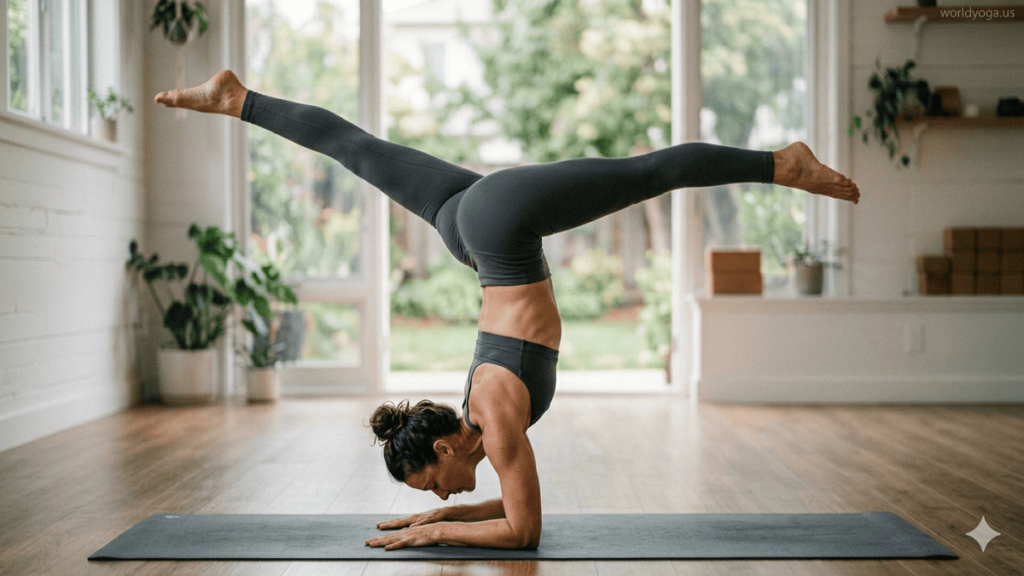
What is the proper alignment in this pose?
1. Head and Neck Alignment (Foundation Safety Zone)
- Neck remains neutral and passive
- No weight should collapse into the cervical spine
- Head lightly touches the floor (or forearms support most load in forearm variation)
- Gaze is steady or neutral, not straining
Key idea: the neck is a guide, not a load-bearing structure.
2. Shoulder Alignment (Primary Load System)
- Shoulders are firmly elevated away from the ears
- Scapulae stay stable and slightly protracted (supported by serratus anterior)
- Weight is evenly distributed through both shoulders and forearms/hands
- No sinking into one side despite leg asymmetry
If shoulders collapse, the entire structure becomes unsafe.
3. Spinal Alignment (The “Staff Line”)
The spine must remain:
- Fully elongated and vertical
- Thoracic spine lifted and lengthened (not rounded or overarched)
- Lumbar spine neutral (no compression or excessive arching)
- Hips stacked directly over shoulders
Imagine a straight vertical axis from base → spine → lifted leg.
4. Hip Alignment (Control Center)
- Hips remain square and level
- No rotation toward the lifted leg
- Pelvis stays stacked over the shoulder line
- Core actively prevents shifting or tilting
Hip stability determines whether the pose stays balanced or collapses.
5. Extended Leg Alignment
The lifted leg should be:
- Fully extended at the knee (no bend)
- Aligned vertically with the spine when viewed from front and side
- Engaged through quadriceps and hip flexors
- Either pointed or flexed foot depending on training style (but consistent)
The leg acts as an extension of the spinal line, not an independent limb.
6. Supporting Leg Alignment
The non-lifting leg (depending on variation stage):
- Remains controlled and close to midline
- Avoids swinging or drifting
- Stays engaged through core and hip flexors
- Supports balance without creating imbalance torque
7. Core Alignment (Stabilizing Engine)
- Deep abdominal engagement (transverse abdominis active)
- Rib cage stays “knit” toward pelvis
- No flaring of ribs during leg lift
- Prevents lumbar overextension during asymmetry
Core is what keeps the “staff” rigid.
8. Overall Alignment Summary
A correctly aligned One-Legged Inverted Staff Pose should feel like:
- A vertical stacked column
- Stable shoulders carrying the load
- A neutral, elongated spine
- Hips perfectly centered
- One-Legged Inverted Staff Pose extending upward like a continuation of the spine
9. Key Alignment Checkpoints
- Neck relaxed, no pressure
- Shoulders elevated and stable
- Spine straight and elongated
- Hips square and stacked
- One-Legged Inverted Staff Pose vertical and controlled
- Core fully engaged
10. Reference Sources
- Yoga Journal – Headstand alignment principles: https://www.yogajournal.com/poses/headstand/
- Yoga International – Inversion safety and structure: https://yogainternational.com/article/view/headstand-alignment
- ACE Fitness – Core stability fundamentals: https://www.acefitness.org/
- Physiopedia – Shoulder girdle mechanics: https://www.physio-pedia.com/Shoulder_Girdle
#One-Legged Inverted Staff Pose in Ahemadabad
Which muscles are engaged during the pose?
1. Shoulder Girdle (Primary Load-Bearing System)
These muscles carry most of the body weight and prevent collapse into the neck:
- Deltoids (anterior and medial fibers) → stabilize shoulder joints in inversion
- Trapezius (upper and middle fibers) → elevate and stabilize scapulae
- Serratus anterior → anchors scapulae against rib cage, critical for safe headstand mechanics
- Rhomboids → assist in scapular positioning and control
These muscles work isometrically to maintain a strong, lifted shoulder structure.
2. Core Musculature (Central Stability System)
The core is the “anti-collapse engine” of the pose:
- Transverse abdominis → deep stabilizer, maintains spinal integrity
- Rectus abdominis → supports vertical compression and prevents overextension
- Internal and external obliques → control asymmetry from one-leg extension
- Pelvic floor muscles → contribute to intra-abdominal pressure and stability
The core keeps the spine rigid like a “vertical staff.”
3. Spinal Stabilizers (Postural Control)
These muscles maintain the elongated vertical line:
- Erector spinae → supports upright spinal extension
- Multifidus → fine-tunes spinal alignment and balance adjustments
- Deep paraspinal muscles → maintain segmental stability
They prevent collapse or excessive arching under inverted load.
4. Arm and Forearm Muscles (Base Support System)
Even in headstand variations, the arms are highly active:
- Triceps brachii → supports elbow extension under load
- Forearm flexors and extensors → stabilize pressure through hands/forearms
- Biceps brachii (secondary stabilizer) → assists joint control
- Wrist stabilizers → maintain grounding and balance adjustments
These muscles act like structural pillars supporting the inversion base.
5. Hip and Lower Body Muscles
These control leg positioning and pelvic alignment:
Extended Leg (Raised Side)
- Quadriceps → keep knee fully extended
- Hip flexors (iliopsoas) → assist upward leg lift and control
- Gluteus medius/minimus → stabilize pelvis and prevent rotation
Supporting Leg (Lower Side)
- Hip flexors → maintain control and alignment
- Adductors → keep leg centered in midline
- Hamstrings (light engagement) → assist control and stabilization
6. Neck Muscles (Stabilizing, Not Load-Bearing)
- Deep cervical flexors → maintain neck neutrality
- Suboccipital muscles → fine postural control
- Minimal activation overall if alignment is correct
The neck should NOT be a primary load-bearing structure.
7. Integrated Muscle Function Summary
This pose creates a coordinated system:
- Shoulders = structural support
- Core = stability and compression control
- Spine = vertical alignment system
- Arms = load distribution base
- Hips/legs = asymmetry control system
8. Key Training Insight
The One-Legged Inverted Staff Pose is dominated by isometric endurance rather than dynamic movement. The body is essentially maintaining a rigid inverted structure while managing asymmetry from the extended leg.
9. References
- Yoga Journal – Headstand mechanics: https://www.yogajournal.com/poses/headstand/
- ACE Fitness – Core stability principles: https://www.acefitness.org/
- Physiopedia – Shoulder girdle anatomy: https://www.physio-pedia.com/Shoulder_Girdle
- Cleveland Clinic – Neck and spine safety: https://my.clevelandclinic.org/health/articles/neck-pain
#One-Legged Inverted Staff Pose in Hyderabad
What preparatory poses are recommended?
1. Shoulder Strength & Stability Foundations
Dolphin Pose (Ardha Pincha Mayurasana)
- Builds shoulder endurance under forearm load
- Strengthens serratus anterior and trapezius
- Teaches scapular elevation (critical for neck safety in inversions)
Key cue: “Push the floor away to lift shoulders.”
Forearm Plank
- Develops static shoulder and core endurance
- Reinforces straight-line body alignment
- Trains isometric stability under load
Essential for learning inversion-like pressure without full upside-down position.
2. Core Compression & Inversion Control
Hollow Body Hold
- Strengthens transverse abdominis and deep core system
- Trains rib-to-pelvis connection (prevents back collapse in inversion)
- Builds compression strength needed to lift legs upward
Boat Pose (Navasana)
- Improves hip flexor and abdominal coordination
- Enhances balance in bent-knee and straight-leg control
- Builds endurance for leg extension stability
3. Inversion Preparation (Core Skill Development)
Wall-Supported Headstand
- Introduces vertical stacking safely
- Reduces fear response in inversion
- Allows focus on shoulder and core alignment
Start with bent knees before progressing to leg extension.
Forearm Headstand Holds (Assisted or Wall)
- Builds endurance in cervical-safe inversion alignment
- Teaches weight distribution through shoulders, not neck
- Improves calm breathing under pressure
4. Spinal Alignment & Extension Preparation
Sphinx Pose
- Gently activates thoracic spine extension
- Builds awareness of upper-back mobility
- Prevents lumbar overuse in backbend phases
Cobra Pose (Bhujangasana)
- Strengthens spinal extensors
- Improves controlled chest opening
- Develops safe backbend mechanics
Focus is on thoracic lift, not deep lumbar arch.
5. Leg Control & Unilateral Strength Training
Leg Raises (Supine or Hanging Variations)
- Builds hip flexor strength for controlled leg extension
- Improves core-to-leg connection
Single-Leg Balance Drills (Standing)
- Develops pelvic stability and asymmetry control
- Prepares body for one-leg inversion coordination
6. Integrated Progression Sequence
A safe training pathway before attempting the full pose:
- Dolphin Pose (shoulder foundation)
- Forearm Plank (core + shoulder endurance)
- Hollow Body Hold (compression strength)
- Wall Headstand (bent-knee control)
- Forearm Headstand holds
- Sphinx / Cobra (spinal extension prep)
- Controlled leg raise drills
- Assisted One-Legged Inverted Staff Pose
7. Key Training Principles
- Build shoulder strength before inversion depth
- Build core compression before leg extension
- Build spinal awareness before backbend integration
- Add asymmetry only after stable symmetry control
8. Safety Note
Avoid progression if:
- Neck pressure occurs in headstand drills
- Shoulders collapse inward under load
- Lower back takes over spinal extension
- Balance cannot be maintained in wall-supported inversion
9. References
- Yoga Journal – Headstand preparation: https://www.yogajournal.com/poses/headstand/
- Yoga International – Inversion safety and alignment: https://yogainternational.com/article/view/headstand-alignment
- ACE Fitness – Core stability training principles: https://www.acefitness.org/
- Physiopedia – Shoulder mechanics: https://www.physio-pedia.com/Shoulder_Girdle
#One-Legged Inverted Staff Pose in Delhi
What are the benefits and precautions of this pose?
1. Benefits
A. Shoulder Strength and Stability
- Builds strong isometric endurance in the deltoids, trapezius, and serratus anterior
- Improves scapular control under full-body load
- Enhances shoulder resilience for other inversions and arm balances
This makes it highly effective for developing long-term upper-body stability.
B. Core Compression Strength
- Strengthens deep core muscles such as the transverse abdominis and obliques
- Improves ability to control body position while inverted
- Enhances “compression strength,” which is essential for advanced movement skills
The core acts like a stabilizing belt holding the inverted structure together.
C. Spinal Alignment and Postural Awareness
- Encourages a long, neutral spinal line under load
- Improves awareness of alignment in inverted positions
- Trains control of thoracic extension without collapsing into the lower back
Helps reduce poor posture habits in upright movement.
D. Hip Control and Leg Coordination
- Develops hip flexor strength and hamstring control
- Improves unilateral coordination between both sides of the body
- Enhances balance during asymmetrical movements
E. Neuromuscular Coordination and Focus
- Increases proprioception (body awareness upside down)
- Improves concentration and breath control under load
- Builds calmness and stability in challenging positions
2. Precautions
A. Cervical Spine Stress (High Risk Area)
- Excess weight on the head can compress the neck
- Misalignment increases risk of cervical strain or injury
- Fatigue can cause loss of shoulder engagement, One-Legged Inverted Staff Pose, increasing neck load
The neck must remain passive; shoulders must carry the load.
B. Shoulder Overload or Collapse
- Weak scapular control can cause shoulder sinking
- Asymmetry from leg extension may increase uneven stress
- Fatigue can lead to joint instability
Always maintain strong shoulder elevation.
C. Lower Back Compression (Backbend Risk)
- Over-arching can shift pressure into the lumbar spine
- Lack of core engagement may cause spinal collapse
- Misguided leg lift may disrupt spinal neutrality
Extension should come from control, not force.
D. Balance Instability
- One-leg extension shifts the center of gravity
- Beginners may experience wobbling or tipping
- Sudden movement increases fall risk
E. Inversion-Related Effects
- Increased blood pressure in head and eyes
- Dizziness or disorientation in longer holds
- Not suitable for uncontrolled hypertension or glaucoma
3. Who Should Avoid or Modify
This pose should be avoided or heavily modified if there is:
- Neck or cervical spine injury history
- Shoulder instability or rotator cuff issues
- Uncontrolled blood pressure conditions
- Lack of stable headstand or forearm stand foundation
4. Safety Principles for Practice
- Build strong shoulder stability before full inversion work
- Keep core engaged before and during leg extension
- Start with wall support for balance control
- Move slowly—no momentum or swinging
- Exit gradually and avoid sudden drops
5. Summary
The One-Legged Inverted Staff Pose is best understood as:
- A strength-building inversion (shoulders + core)
- A coordination drill (asymmetry control)
- A postural alignment exercise (spinal control under load)
When practiced correctly, One-Legged Inverted Staff Pose, it enhances full-body control and stability. When misaligned, it can place significant stress on the neck, shoulders, and lower back.
6. References
- Yoga Journal – Headstand fundamentals: https://www.yogajournal.com/poses/headstand/
- ACE Fitness – Core stability principles: https://www.acefitness.org/
- Cleveland Clinic – Neck and spine safety: https://my.clevelandclinic.org/health/articles/neck-pain
- Physiopedia – Shoulder girdle mechanics: https://www.physio-pedia.com/Shoulder_Girdle
#One-Legged Inverted Staff Pose in Banglore
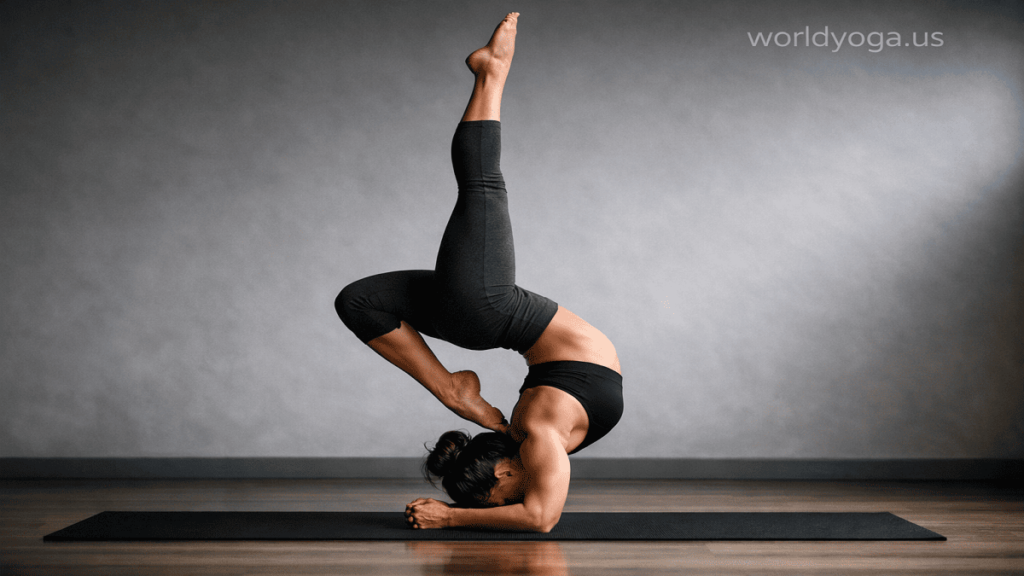
Case Study of One-Legged Inverted Staff Pose
1. Background
This case study examines the execution and adaptation of the One-Legged Inverted Staff Pose, an advanced inversion derived from forearm or headstand foundations. The subject is an experienced movement practitioner with intermediate inversion proficiency, One-Legged Inverted Staff Pose, capable of holding a stable headstand for 60–90 seconds and maintaining controlled forearm balance under wall support.
The objective was to explore unilateral leg extension in a fully stacked inverted posture while maintaining spinal neutrality and shoulder stability.
2. Objective of Practice
The training goals were:
- Develop shoulder endurance under asymmetrical load
- Improve core compression strength and pelvic control
- Enhance spinal alignment awareness under inversion
- Test neuromuscular coordination during unilateral leg extension
- Maintain safe cervical loading (no direct neck compression)
3. Methodology
A. Preparation Phase
The session began with targeted activation drills:
- Dolphin Pose (shoulder loading adaptation)
- Forearm plank (core + scapular stability)
- Hollow body hold (compression strength training)
- Sphinx pose (thoracic mobility activation)
These established baseline stability in the shoulder-core system.
B. Entry Phase
- Practitioner entered a wall-supported forearm headstand
- Elbows maintained shoulder-width alignment
- Shoulders actively elevated to prevent neck loading
- Both legs initially held in a controlled stacked inversion position
- Core engagement was prioritized before any leg movement
C. Execution Phase
- One leg was slowly extended upward into full vertical alignment
- The second leg remained controlled (initially bent for stability, later partially extended in advanced attempts)
- Spine remained elongated with minimal lumbar involvement
- Hips were carefully stabilized to avoid rotation or tilt
- Breath was maintained steady and controlled throughout
D. Exit Phase
- Extended leg was gradually returned to neutral alignment
- Both legs were re-stacked in symmetrical inversion
- Controlled descent into child’s pose for spinal decompression
4. Observations
Positive Adaptations
- Significant improvement in shoulder isometric endurance
- Increased awareness of core engagement during asymmetrical load
- Improved ability to maintain pelvic stability under inversion
- Enhanced proprioception in inverted spatial orientation
Technical Challenges
- Minor pelvic rotation during early unilateral leg extension attempts
- Increased shoulder fatigue on stabilization side
- Tendency toward lumbar overextension when core engagement reduced
- Balance instability during slow transitions between leg positions
5. Biomechanical Analysis
Key Load Distribution:
- Shoulders (primary load-bearing system): 70–85%
- Core (stabilization system): 10–20%
- Lower body (control system): variable depending on leg extension phase
- Cervical spine: minimal load when correctly executed
Key Findings:
- Shoulder elevation is the most critical factor for cervical safety
- Core compression determines spinal integrity under asymmetry
- Hip control directly influences balance stability
6. Risk Analysis
Identified Risks:
- Cervical compression if shoulder engagement drops
- Lumbar strain due to compensatory backbend
- Shoulder overload from asymmetrical load shift
- Loss of balance during unilateral extension phase
Severity Classification:
- High risk: neck collapse, shoulder failure
- Medium risk: pelvic rotation, lumbar compensation
- Low risk: minor wobbling during transition
7. Key Insights
- Core engagement must precede leg movement, not follow it
- Shoulder elevation is the primary safety mechanism in inversion
- Unilateral leg extension significantly increases pelvic instability risk
- Wall support reduces risk but does not eliminate alignment demands
- Controlled breathing improves balance consistency under load
8. Conclusion
The One-Legged Inverted Staff Pose is not a flexibility-driven movement but a high-level neuromuscular control exercise. It integrates shoulder stability, core compression, One-Legged Inverted Staff Pose and spinal alignment under asymmetric inverted load.
When performed correctly, One-Legged Inverted Staff Pose, it enhances strength, coordination, and body awareness. However, One-Legged Inverted Staff Pose, it requires strict progression control due to the high demand placed on the cervical-shoulder system.
9. References
- Yoga Journal – Headstand alignment principles: https://www.yogajournal.com/poses/headstand/
- ACE Fitness – Core stability training: https://www.acefitness.org/
- Physiopedia – Shoulder girdle biomechanics: https://www.physio-pedia.com/Shoulder_Girdle
- Cleveland Clinic – Cervical spine safety: https://my.clevelandclinic.org/health/articles/neck-pain
#One-Legged Inverted Staff Pose in Kolkata
White Paper of One-Legged Inverted Staff Pose
1. Executive Summary
The One-Legged Inverted Staff Pose is an advanced inversion-based movement pattern that integrates vertical spinal stacking, unilateral lower-limb extension, and high-demand shoulder stabilization under gravitational load. It is primarily used in advanced yoga, gymnastics conditioning, One-Legged Inverted Staff Pose and movement science training systems to develop core compression strength, scapulothoracic stability, and neuromuscular control in inverted asymmetry.
This paper outlines the biomechanical structure, One-Legged Inverted Staff Pose physiological demands, safety considerations, and applied training relevance of the posture.
2. Introduction
The pose evolves from a standard headstand or forearm balance into a unilateral extension model, where One-Legged Inverted Staff Pose remains extended vertically while the rest of the body maintains a rigid inverted “staff-like” alignment. Unlike symmetrical inversions, this variation introduces controlled instability, requiring enhanced coordination across the shoulder, core, and pelvic systems.
3. Biomechanical Framework
3.1 Load Distribution
The load in this posture is distributed as follows:
- Shoulder girdle: ~70–85% load-bearing responsibility
- Core musculature: ~10–20% stabilization and compression control
- Lower limbs: variable load based on extension phase
- Cervical spine: ideally minimal load (non-compressive role)
The system depends on force transfer from cervical region → scapulae → forearms/hands → ground.
3.2 Structural Alignment Model
The pose is governed by a “vertical staff principle”:
- Head/neck: neutral, non-weight bearing
- Shoulders: elevated and stabilized (scapular protraction + upward support)
- Spine: elongated in neutral vertical alignment
- Pelvis: stacked directly over shoulder line
- Extended leg: vertically aligned continuation of spinal axis
3.3 Unilateral Extension Mechanics
The raised leg introduces:
- Increased torque around the pelvis
- Higher demand on core anti-rotation control
- Greater reliance on hip flexor and gluteal stabilization
This creates a controlled asymmetry requiring continuous micro-adjustment.
4. Physiological Demand Profile
Primary Muscle Systems:
- Shoulder complex: deltoids, trapezius, serratus anterior
- Core system: transverse abdominis, rectus abdominis, obliques
- Spinal stabilizers: erector spinae, multifidus
- Hip flexors: iliopsoas (primary for leg extension)
- Lower limb stabilizers: quadriceps, hamstrings (supporting control leg)
- Forearm musculature: wrist flexors/extensors for base stability
Adaptation Effects:
- Increased isometric shoulder endurance
- Improved core compression strength
- Enhanced inversion proprioception
- Improved pelvic control under asymmetrical load
5. Risk Assessment
5.1 Primary Risk Domains
- Cervical compression due to shoulder collapse
- Lumbar overextension due to poor core control
- Shoulder overload from asymmetrical load distribution
- Balance failure during unilateral extension
5.2 Risk Severity
- High: Neck compression, shoulder joint instability
- Medium: Pelvic rotation, lumbar strain
- Low: Minor balance instability during learning phase
6. Safety and Control Principles
To ensure safe execution, the following principles are required:
- Maintain constant scapular elevation (no shoulder sinking)
- Ensure core engagement precedes leg movement
- Avoid momentum-based transitions
- Keep pelvis square and stable during extension
- Progress through wall-assisted inversion stages before free balance
7. Training and Progression Model
Recommended progression hierarchy:
- Dolphin Pose (shoulder conditioning base)
- Forearm Plank (core + scapular integration)
- Hollow Body Hold (compression strength)
- Wall-supported Headstand (symmetrical control)
- Static Forearm Headstand holds
- Controlled leg extension drills
- Assisted One-Legged Inverted Staff Pose
- Free balance variation (advanced stage only)
8. Applied Use Cases
This pose is primarily applied in:
- Advanced yoga teacher training (inversion refinement)
- Gymnastics and acrobatic conditioning
- Circus and hand-balancing preparation systems
- Movement education and proprioceptive training frameworks
- Athletic performance systems requiring inversion control
9. Key Performance Indicators (KPIs)
- Duration of stable hold under asymmetry
- Shoulder elevation consistency under load
- Core compression maintenance during leg extension
- Pelvic stability (no rotation deviation)
- Smoothness of entry and exit transitions
10. Conclusion
The One-Legged Inverted Staff Pose is a high-complexity neuromuscular stability model, not a flexibility-based posture. It integrates shoulder strength, core compression, One-Legged Inverted Staff Pose and spinal alignment under inverted asymmetry, One-Legged Inverted Staff Pose, making it a valuable but advanced training tool in movement science and performance conditioning systems.
Its safe application depends on structured progression, load awareness, and strict adherence to alignment principles.
11. References
- Yoga Journal – Headstand fundamentals: https://www.yogajournal.com/poses/headstand/
- ACE Fitness – Core stability principles: https://www.acefitness.org/
- Physiopedia – Shoulder girdle mechanics: https://www.physio-pedia.com/Shoulder_Girdle
- Cleveland Clinic – Cervical spine safety: https://my.clevelandclinic.org/health/articles/neck-pain
#One-Legged Inverted Staff Pose in Pune
Industry Application of One-Legged Inverted Staff Pose
1. Overview
The One-Legged Inverted Staff Pose is an advanced inversion and control-based movement pattern used across multiple performance and movement disciplines. It combines vertical spinal alignment, unilateral leg extension, shoulder-loaded stability, One-Legged Inverted Staff Pose and core compression under inverted conditions. While not a mainstream fitness exercise, its underlying principles are widely applied in elite training systems that prioritize balance, neuromuscular control, and load management under gravity.
2. Yoga and Movement Education Industry
In advanced yoga systems and teacher training programs, this pose is used as a refinement and mastery progression tool.
Applications:
- Advanced inversion training (beyond basic headstand stability)
- Teaching spinal alignment under asymmetrical load
- Developing shoulder safety awareness in inverted positions
- Enhancing cueing for controlled leg extension in inversions
Industry value:
It helps instructors understand how to safely progress students from symmetrical inversions to unilateral control patterns.
3. Gymnastics and Acrobatics Training
In gymnastics conditioning, this movement is used to build:
- Shoulder endurance in inverted static holds
- Core compression strength for aerial control
- Pelvic stability under asymmetrical load
- Fine motor adjustments during balance shifts
Practical use:
- Pre-handstand and press-handstand conditioning
- Floor routine strength development
- Control training for uneven weight distribution during transitions
It serves as a bridge between basic headstands and advanced hand balancing.
4. Dance and Contemporary Performance Arts
In dance and physical theatre, the pose contributes to:
- Inversion-based choreography development
- Controlled transitions between floor and inverted positions
- Expressive body lines using unilateral extension aesthetics
- Strengthening of spatial awareness in non-upright positions
Artistic value:
The one-legged extension adds visual dynamics while maintaining structural control, making it useful in contemporary movement vocabulary.
5. Circus Arts and Hand Balancing Systems
In circus and acrobatic disciplines, this pose supports:
- Progression toward one-arm handstand training concepts (indirectly)
- Shoulder conditioning under asymmetrical load
- Core control for aerial transitions
- Inversion endurance for performance routines
It is often used as a preparatory conditioning drill, not a performance skill itself.
6. Athletic Performance and Strength Conditioning
In sports performance environments, the underlying mechanics are used for:
- Core anti-rotation training
- Shoulder stability under vertical load
- Neuromuscular control in unstable positions
- Balance training for combat sports and gymnastics-based athletes
Relevant sports:
- Gymnastics
- Diving
- Martial arts (grappling control awareness)
- Aerial sports and parkour
7. Physiotherapy-Informed Movement Systems
In controlled rehabilitation-inspired movement training (non-clinical use), adapted versions may support:
- Scapular stability re-education
- Core engagement training under safe inversion simulation
- Postural awareness improvement
It is used only in high-level functional movement education, not as a direct treatment tool.
8. Risk-Informed Industry Classification
Across all industries, this pose is classified as:
- Advanced-level inversion skill
- High neuromuscular coordination demand
- Moderate-to-high cervical and shoulder load risk if misapplied
Therefore, it is:
- Taught only after foundational inversion mastery
- Practiced in supervised environments
- Integrated into structured progression systems
9. Transferable Training Outcomes
Across disciplines, this pose develops:
- Shoulder girdle endurance under load
- Core compression strength
- Pelvic stability in asymmetry
- Inversion proprioception (body awareness upside down)
- Controlled spinal alignment discipline
- Balance adaptation under gravitational inversion
10. Conclusion
The One-Legged Inverted Staff Pose functions as a cross-disciplinary conditioning framework rather than a standalone exercise. Its primary value lies in developing controlled asymmetry in inverted environments, making it relevant to yoga, gymnastics, dance, circus arts, and athletic performance systems.
When properly scaled, it enhances strength, coordination, and movement intelligence. When misused, it significantly increases risk to the neck, shoulders, and lower back.
11. References
- Yoga Journal – Headstand alignment principles: https://www.yogajournal.com/poses/headstand/
- ACE Fitness – Core stability training: https://www.acefitness.org/
- NASM – Movement system development: https://www.nasm.org/
- Physiopedia – Shoulder girdle mechanics: https://www.physio-pedia.com/Shoulder_Girdle
- Cleveland Clinic – Cervical spine safety: https://my.clevelandclinic.org/health/articles/neck-pain
#One-Legged Inverted Staff Pose in Mumbai
Ask FAQs
What is the One-Legged Inverted Staff Pose?
It is an advanced inversion where the body is held in a vertically aligned headstand or forearm balance while one leg is extended upward and the rest of the body remains stable in a straight “staff-like” line. It combines shoulder stability, core compression, and controlled asymmetry.
Is this pose suitable for beginners?
No. This pose is considered advanced and should only be attempted after mastering stable headstand or forearm headstand holds. Beginners should first develop shoulder strength, core control, and inversion balance through preparatory poses like dolphin pose and wall-supported headstands.
What are the main benefits of this pose?
The pose builds strong shoulder endurance, improves core compression strength, enhances spinal alignment awareness, and develops balance and coordination under asymmetrical inverted load. It also improves body awareness and control in complex movement positions.
What are the most important safety precautions?
Key precautions include avoiding pressure on the neck, keeping the shoulders strongly engaged to prevent collapse, maintaining core activation to protect the lower back, and progressing slowly into the pose using wall support if needed. Sudden movements or loss of control should be avoided.
Which muscles are primarily used in this pose?
The main muscles include the shoulders (deltoids, trapezius, serratus anterior), core muscles (abdominals and obliques), spinal stabilizers (erector spinae), and hip flexors for leg extension control. The forearms and wrists also play a key role in supporting balance and stability.
Table of Contents
Disclaimer:
This content is for educational purposes only and is not a substitute for professional instruction. The One-Legged Inverted Staff Pose is an advanced inversion that carries risk of injury if performed incorrectly. Practice only under qualified supervision, and avoid if you have neck, shoulder, spine, or cardiovascular conditions.