
Janu Garudasana
Janu Garudasana is an advanced hybrid yoga variation that combines elements of knee-based positioning (Janu = knee) with Garudasana (Eagle Pose) cross-body mechanics. It integrates lower-body stability with upper-body diagonal wrapping patterns, creating a posture that challenges balance, joint mobility, and neuromuscular coordination simultaneously.
In this variation, the practitioner typically adopts a grounded stance—often kneeling or semi-kneeling—while the arms or upper limbs engage in the Garuda-style wrap, where one limb crosses over the other and wraps tightly to create controlled compression and engagement. The lower body emphasizes knee stability, hip alignment, and pelvic control, while the upper body focuses on shoulder rotation, scapular control, and cross-lateral activation.
The primary objective of Janu Garudasana is to develop integrated body awareness through opposing directional forces: grounding through the knees and hips while simultaneously engaging rotational and compressive tension through the upper body. This creates a strong neuromuscular demand across the core, spine, shoulders, and hips.
This posture is often used in advanced yoga sequencing and functional mobility training to improve:
- Shoulder stability and rotational mobility
- Hip and knee alignment awareness
- Core anti-rotation strength
- Cross-body coordination and proprioception
- Postural control under tension
Due to its complexity, Janu Garudasana is not typically recommended for beginners. It requires foundational strength in basic kneeling postures, shoulder mobility work, and familiarity with Eagle Pose mechanics. When practiced correctly, it enhances full-body integration, controlled flexibility, and stability under asymmetrical loading conditions.
#Janu Garudasana in India
How is Janu Garudasana performed correctly?
1. Starting position (foundation setup)
Begin in a stable kneeling or half-kneeling stance:
- Knees are grounded with even pressure on both sides
- Hips are aligned and not tilted to one side
- Spine is tall and neutral, not rounded or overextended
- Core is lightly engaged to support upright posture
- Shoulders are relaxed but active
The foundation must feel stable before adding any cross-body engagement.
2. Lower body alignment (Janu base)
Depending on variation level:
- Kneeling version: both knees stay grounded, hip-width or slightly narrower
- Half-kneeling version: one knee grounded, the other foot placed forward for support
- Pelvis remains level, avoiding rotation or collapse
- Weight is evenly distributed to prevent joint strain
The lower body acts as the anchoring system of the posture.
3. Upper body positioning (Garuda arms)
Introduce the Eagle-style arm wrap:
- One arm crosses over the other at the elbow
- Forearms rotate so palms or backs of hands align or press together
- Elbows lift slightly away from the chest to prevent compression
- Shoulders stay down and away from the ears
- If hands do not connect, a strap can be used
The key is controlled compression, not forcing flexibility.
4. Spinal alignment
- Spine remains long and vertical throughout
- No excessive rounding or twisting to “force” the bind
- Chest stays gently open, not collapsed inward
- Neck remains aligned with the spine, gaze forward or slightly down
The spine acts as the central stabilizing axis between lower and upper body tension.
5. Core engagement and breath control
- Abdominals engage lightly to resist rotation
- Obliques stabilize against the cross-body pull
- Breathing remains slow, deep, and uninterrupted
- Ribcage does not flare or collapse under tension
6. Key alignment checkpoints
A correctly performed Janu Garudasana shows:
- Stable knees with no joint strain
- Even pelvic alignment without tilt
- Balanced shoulder position without shrugging
- Controlled arm wrap without pain or pinching
- Smooth, steady breathing pattern
7. Common mistakes
- Collapsing the chest forward during arm wrap
- Twisting the spine instead of isolating shoulder movement
- Uneven weight on knees or hips
- Forcing hand connection despite limited shoulder mobility
- Holding breath under tension
8. Safety considerations
- Avoid forcing deep shoulder compression
- Use props if arm binding is not accessible
- Modify knee position if there is discomfort
- Stop if sharp pain occurs in shoulders, knees, or hips
- Progress gradually rather than pushing depth
9. External references
- https://www.yogajournal.com/poses/eagle-pose/
- https://www.verywellfit.com/eagle-pose-garudasana-3567079
- https://www.yogajournal.com/poses/knee-based-yoga-variations/
#Janu Garudasana in Maharashtra
What is the proper alignment in this pose?
1. Head, Neck, and Spine Alignment
The spine should remain the central stabilizing axis:
- The spine is long, vertical, and neutral from pelvis to crown
- Neck continues the spinal line without forward jutting or tilting
- Thoracic spine stays open (not rounded or excessively arched)
- No twisting of the spine to “help” the arm bind
The body should feel like a straight column resisting diagonal pull, not a curved shape.
2. Shoulder and Arm Alignment (Garuda Structure)
Upper body alignment focuses on controlled cross-body positioning:
- One arm crosses over the other at the elbows
- Forearms wrap without collapsing the chest inward
- Elbows remain slightly lifted away from the ribcage
- Shoulders stay down and externally stabilized, not shrugged
- Scapulae remain active and supported, not pinned forward
The arms create tension across the upper back without compressing the chest.
3. Pelvis and Hip Alignment
The lower body provides grounding stability:
- Pelvis remains level and neutral, not tilted or rotated
- Weight is evenly distributed across both knees (or grounded knee in half-kneeling version)
- Hips stay square to the front
- No collapsing into one hip or shifting sideways
This ensures the lower body acts as a stable base for upper-body complexity.
4. Knee and Leg Alignment
- Knees are grounded evenly and aligned under hips
- No inward collapse or excessive external flare
- In half-kneeling versions, front knee tracks over ankle
- Joint pressure is distributed evenly, not concentrated on one side
5. Core Engagement
Core stability is essential to prevent rotational collapse:
- Abdominals gently engage to stabilize the spine
- Obliques resist the twisting force created by Garuda arms
- Ribcage remains contained (no flaring or compression)
Alignment Stability=Spinal Neutrality+Pelvic Leveling+Shoulder Symmetry−Rotational Collapse\text{Alignment Stability} = \text{Spinal Neutrality} + \text{Pelvic Leveling} + \text{Shoulder Symmetry} – \text{Rotational Collapse}Alignment Stability=Spinal Neutrality+Pelvic Leveling+Shoulder Symmetry−Rotational Collapse
6. Breathing and Internal Alignment
- Breath is smooth and uninterrupted
- No breath holding under arm tension
- Ribcage expands evenly without distortion
- Internal pressure remains balanced through the core
7. Key Alignment Indicators
A correctly aligned posture will show:
- Upright spine with no visible collapse
- Even knee and hip grounding
- Controlled arm wrap without chest compression
- Balanced shoulder positioning
- Calm and steady breathing
8. Common Misalignment Patterns
- Leaning forward to force arm binding
- Twisting spine instead of isolating shoulders
- Uneven pelvic drop or hip rotation
- Collapsing chest inward under arm wrap
- Shrugged shoulders under tension
Summary
Proper alignment in Janu Garudasana is achieved when the lower body remains stable and level, Janu Garudasana, the spine stays neutral and upright, and the upper body applies controlled cross-body tension without compressing or twisting the structure.
#Janu Garudasana in Delhi
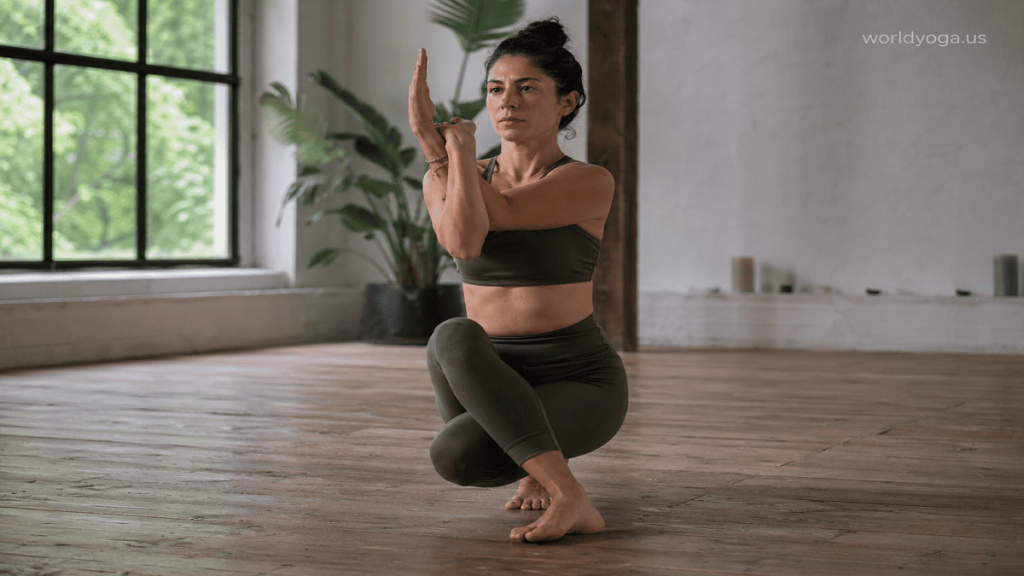
Which muscles are engaged during the posture?
1. Shoulder and Upper Back Muscles
These are heavily engaged due to the Garuda arm structure:
- Deltoids (anterior, medial, posterior): stabilize shoulder positioning during arm crossing
- Rotator cuff muscles (supraspinatus, infraspinatus, teres minor, subscapularis): maintain shoulder joint integrity under rotational tension
- Trapezius (upper, middle, lower fibers): control scapular elevation and retraction
- Rhomboids: support scapular stability and posture control
- Serratus anterior: maintains scapular alignment against the ribcage
- Latissimus dorsi: assists in shoulder extension and controlled binding
These muscles work together to manage the diagonal tension created by the arm wrap.
2. Chest and Arm Muscles
- Pectoralis major and minor: stretched under arm crossing and controlled compression
- Biceps brachii: assist in arm flexion and stabilization during wrap
- Triceps brachii: support elbow positioning in extended holds
- Forearm flexors and extensors: maintain grip and tension control if arms are bound or held
The chest is primarily lengthened while the arms remain actively engaged.
3. Core Musculature (Stabilization System)
The core prevents twisting collapse from the Garuda pattern:
- Rectus abdominis: supports upright posture
- Transverse abdominis: provides deep internal stabilization
- Internal and external obliques: resist rotational forces
- Erector spinae: maintains spinal extension and posture integrity
Core Demand=Anti-Rotation Control+Postural Stability+Breath Regulation Under Tension\text{Core Demand} = \text{Anti-Rotation Control} + \text{Postural Stability} + \text{Breath Regulation Under Tension}Core Demand=Anti-Rotation Control+Postural Stability+Breath Regulation Under Tension
4. Hip and Lower Body Muscles
In the kneeling foundation:
- Gluteus maximus: stabilizes pelvis and supports hip extension
- Gluteus medius/minimus: maintain lateral hip stability
- Hip flexors (iliopsoas group): support upright kneeling posture
- Adductors: stabilize inner thigh and knee positioning
- Quadriceps: maintain knee extension and grounding control
- Hamstrings: assist in pelvic stabilization
The lower body acts as the anchoring system for upper-body complexity.
5. Deep Stabilizers
- Pelvic floor muscles: contribute to internal core pressure regulation
- Multifidus muscles: stabilize individual spinal segments
- Deep cervical flexors: maintain head alignment over spine
6. Integrated Muscle Function Pattern
This posture is characterized by:
- Isometric contraction (stability holding) in core and hips
- Eccentric stretching in shoulders and chest
- Co-contraction across opposing muscle groups
- Diagonal muscle chain activation (Garuda cross-pattern)
7. Summary
Janu Garudasana engages the body as a fully integrated system, with primary emphasis on:
- Shoulder stabilizers and rotator cuff control
- Core anti-rotation muscles
- Hip stabilizers and adductors
- Scapular and spinal support structures
It is essentially a full-body coordination posture disguised as a mobility sequence, requiring both flexibility and stability simultaneously.
#Janu Garudasana in Ahemadabad
What preparatory poses are recommended?
1. Shoulder Mobility Preparations
These poses prepare the upper body for Garuda-style cross-body wrapping:
- Garudasana Arms (Eagle Arms): builds controlled shoulder internal rotation and scapular awareness
- Gomukhasana Arms (Cow Face Arms): develops deep shoulder external rotation and binding ability
- Thread the Needle Pose (Parsva Balasana): opens posterior shoulders and upper back
- Extended Puppy Pose (Uttana Shishosana): lengthens lats, chest, Janu Garudasana and shoulder capsule
These improve range of motion without forcing compression.
2. Hip and Knee Preparation
Since the posture uses a kneeling base, hip openness is essential:
- Bound Angle Pose (Baddha Konasana): opens inner thighs and groin
- Half Pigeon Pose (Eka Pada Rajakapotasana): increases hip external rotation
- Low Lunge (Anjaneyasana): stretches hip flexors for upright kneeling stability
- Figure-Four Stretch: supports glute and deep hip rotator flexibility
These help prevent knee strain during grounding.
3. Spinal Stability and Core Control
Core strength is required to resist twisting from Garuda mechanics:
- Cat-Cow Pose (Marjaryasana-Bitilasana): improves spinal articulation and awareness
- Boat Pose (Navasana): strengthens deep abdominal control
- Side Plank (Vasisthasana): builds anti-rotation strength
- Seated Spinal Twist (Ardha Matsyendrasana): trains controlled rotation capacity
4. Integrated Mobility Drills
These bridge upper and lower body systems:
- Eagle Arms in Seated Position with Hip Engagement: combines shoulder wrap with pelvic stability
- Kneeling Hip Mobility Flows: prepares lower body for stable grounding
- Dynamic Arm Cross Patterns in Neutral Spine Position: introduces Garuda coordination safely
5. Key Readiness Principle
Readiness=Shoulder Mobility+Hip Openness+Core Anti-Rotation Strength+Spinal Control\text{Readiness} = \text{Shoulder Mobility} + \text{Hip Openness} + \text{Core Anti-Rotation Strength} + \text{Spinal Control}Readiness=Shoulder Mobility+Hip Openness+Core Anti-Rotation Strength+Spinal Control
All four components must develop evenly to avoid compensation injuries.
6. Common Preparation Mistakes
- Forcing arm binding before shoulder mobility is ready
- Ignoring core training and relying on flexibility alone
- Skipping hip preparation and stressing knees
- Rushing into full Garuda integration without control
- Holding breath during mobility work
7. Summary
Effective preparation for Janu Garudasana requires a structured progression of shoulder opening, hip flexibility, spinal control, and core stability training. Janu Garudasana Each system must be trained individually before combining them into a single integrated movement pattern.
#Janu Garudasana in Hyderabad
What are the benefits and precautions of this pose?
Benefits
1. Shoulder Mobility and Joint Health
The Garuda arm structure promotes deep shoulder rotation and scapular control, helping to:
- Improve internal and external shoulder rotation
- Increase upper back and chest flexibility
- Reduce stiffness from sedentary posture or repetitive overhead work
2. Hip Flexibility and Lower Body Stability
The kneeling base with controlled alignment supports:
- Improved hip external rotation
- Better pelvic alignment awareness
- Increased flexibility in glutes and adductors
- Enhanced knee stability when properly aligned
3. Core Strength and Anti-Rotation Control
Because the upper body introduces diagonal tension, the core must stabilize the spine:
- Strengthens obliques and transverse abdominis
- Improves resistance to rotational forces
- Enhances spinal control under asymmetric load
Functional Benefit=Mobility (Shoulders + Hips)+Core Anti-Rotation Strength+Postural Control\text{Functional Benefit} = \text{Mobility (Shoulders + Hips)} + \text{Core Anti-Rotation Strength} + \text{Postural Control}Functional Benefit=Mobility (Shoulders + Hips)+Core Anti-Rotation Strength+Postural Control
4. Postural Awareness and Coordination
This pose improves:
- Spinal alignment awareness
- Cross-body coordination between limbs
- Proprioception (body position awareness in space)
- Breath control under tension
5. Neuromuscular Integration
The combination of lower-body grounding and upper-body crossing trains the nervous system to:
- Coordinate opposing muscle chains
- Maintain stability under multidirectional forces
- Improve movement efficiency and control
Precautions
1. Shoulder Joint Stress
- Risk of rotator cuff strain if arms are forced into binding
- Potential impingement if shoulders are rounded or collapsed forward
- Avoid pushing beyond natural range of motion
2. Knee and Hip Strain
- Knees may be stressed if hip flexibility is insufficient
- Incorrect weight distribution can strain joint ligaments
- Avoid forcing deep knee stacking
3. Spinal Compensation Risk
- Over-rotation of spine instead of isolated shoulder movement
- Forward collapse of chest under arm tension
- Loss of neutral alignment leading to discomfort
4. Breathing Restriction
- Chest compression may limit rib expansion
- Holding tension can lead to shallow breathing
- Breath should remain smooth and uninterrupted
5. Safety Guidelines
- Use straps for arm binding if needed
- Warm up shoulders and hips before practice
- Do not force depth or symmetry
- Stop immediately if sharp pain occurs in joints
Summary
Janu Garudasana offers strong benefits in shoulder mobility, hip flexibility, core stability, and neuromuscular coordination. However, it requires careful progression and strict attention to alignment to avoid strain in the shoulders, knees, Janu Garudasana and spine. The key principle is controlled engagement without forcing range of motion.
#Janu Garudasana in Pune
Case Study of Janu Garudasana
1. Subject Overview
This case study analyzes Janu Garudasana, a hybrid yoga-mobility posture combining kneeling stabilization with Garuda (Eagle-style) cross-body arm engagement. The subject is an intermediate-to-advanced practitioner with prior experience in shoulder mobility work, hip opening sequences, and basic balancing postures.
The primary objective is to evaluate how diagonal upper-body tension and grounded lower-body stability interact to produce full-body neuromuscular coordination.
2. Movement Objective
The posture is designed to:
- Develop shoulder rotational control under cross-body load
- Improve hip stability and kneeling alignment
- Enhance core anti-rotation strength
- Train coordinated upper–lower body integration under static tension
Unlike linear flexibility poses, this movement introduces multi-directional force management.
3. Biomechanical Structure
3.1 Base System (Kneeling Platform)
- Knees provide grounded stability
- Pelvis acts as central load distributor
- Spine functions as vertical stabilizing axis
3.2 Upper Body System (Garuda Layer)
- Arms cross at elbows creating compressive tension
- Shoulder joints undergo simultaneous internal and external rotation demands
- Scapulae must stabilize against inward collapse
3.3 Integrated Force Pattern
The body experiences opposing vectors:
- Lower body: stability and grounding
- Upper body: compression and rotation
Net Stability=Kneeling Base Control−Cross-Body Rotational Torque\text{Net Stability} = \text{Kneeling Base Control} – \text{Cross-Body Rotational Torque}Net Stability=Kneeling Base Control−Cross-Body Rotational Torque
4. Muscular Activation Profile
Upper Body
- Rotator cuff: stabilizes shoulder joint under torsion
- Deltoids: control arm positioning
- Trapezius and rhomboids: maintain scapular alignment
- Latissimus dorsi: assists in shoulder extension control
Core System
- Transverse abdominis: deep stabilization
- Obliques: resist rotational forces
- Rectus abdominis: supports upright posture
- Erector spinae: maintains spinal extension
Lower Body
- Gluteus maximus and medius: pelvic stabilization
- Adductors: knee alignment and inner thigh control
- Quadriceps: support kneeling posture
- Hip external rotators: maintain joint alignment
5. Observed Functional Outcomes
5.1 Mobility Adaptations
- Increased shoulder rotational capacity
- Improved hip external rotation tolerance
- Enhanced thoracic spine openness
5.2 Stability Improvements
- Stronger anti-rotation core control
- Better scapular stabilization under tension
- Improved pelvic alignment awareness
5.3 Neuromuscular Coordination
- Improved cross-limb synchronization
- Enhanced proprioceptive awareness
- Greater control under static multi-directional load
6. Risk Assessment
6.1 Joint Stress Points
- Shoulder impingement risk if binding is forced
- Knee stress if hip mobility is insufficient
- Lumbar strain if spine compensates for shoulder restriction
6.2 Movement Breakdown Patterns
- Chest collapse under arm compression
- Pelvic tilt due to uneven hip engagement
- Over-rotation of spine instead of isolated shoulder work
6.3 Respiratory Limitation
- Reduced rib expansion under arm compression
- Breath holding during intense tension phases
7. Progression Framework
Recommended developmental sequence:
- Shoulder mobility drills (Eagle Arms, Cow Face Arms)
- Hip openers (Pigeon, Bound Angle Pose)
- Kneeling stability holds (neutral spine training)
- Isolated Garuda arm work in seated position
- Integrated kneeling Cow Face base
- Full Janu Garudasana integration
8. Performance Indicators
Correct execution is identified by:
- Upright, neutral spine without collapse
- Even kneeling pressure and pelvic stability
- Controlled arm crossing without pain
- Scapular stability under tension
- Smooth, uninterrupted breathing
9. Conclusion
Janu Garudasana is a complex integration posture that trains the body to manage simultaneous mobility and stability demands. It is most effective as a neuromuscular coordination tool rather than a flexibility goal. Proper progression is essential to minimize joint stress while maximizing functional adaptation.
References
- https://www.yogajournal.com/poses/eagle-pose/
- https://www.verywellfit.com/eagle-pose-garudasana-3567079
- https://www.yogajournal.com/poses/cow-face-pose/
#Janu Garudasana in Delhi
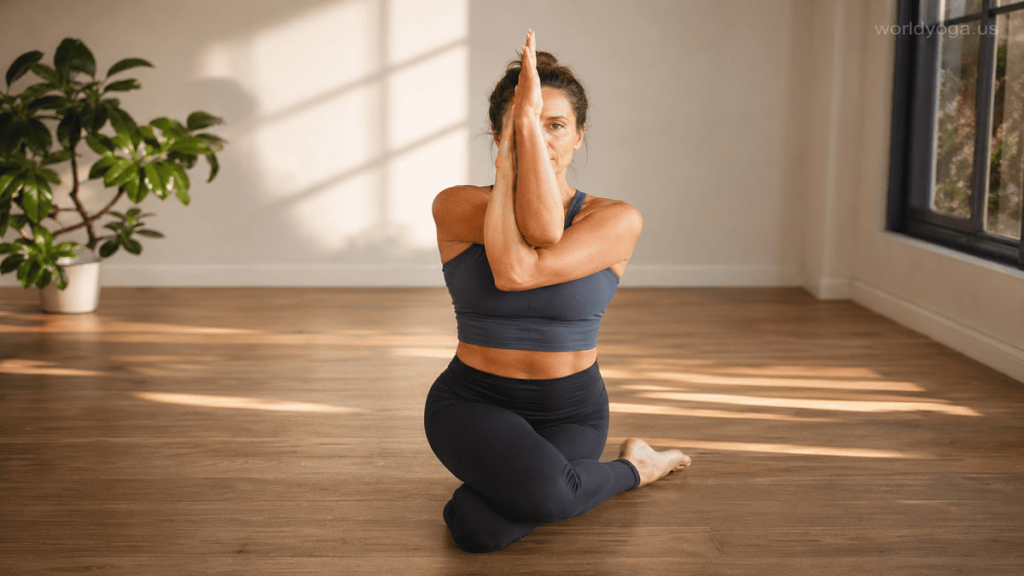
White Paper of Janu Garudasana
Abstract
This white paper examines Janu Garudasana, a hybrid yoga-mobility posture combining a kneeling base (“Janu”) with Garuda (Eagle-style) cross-body upper-limb mechanics. The pose integrates shoulder rotational control, hip stability, core anti-rotation strength, and spinal alignment under static, multi-vector loading. It is primarily used in advanced movement systems, functional mobility training, and neuromuscular coordination development.
1. Introduction
Janu Garudasana represents an integrated movement system rather than a traditional asana. It merges two biomechanical principles:
- Lower-body stabilization (kneeling base with hip alignment demands)
- Upper-body diagonal compression and rotation (Garuda patterning)
This creates a controlled environment for training the body to manage opposing forces across different anatomical chains.
2. System Architecture
The posture operates as a multi-layered structural model:
- Base layer: Kneeling foundation (ground stability)
- Pelvic system: Hip alignment and load distribution center
- Spinal axis: Neutral vertical stabilizer
- Upper limb system: Cross-body rotational tension (Garuda arms)
- Global system: Integrated neuromuscular coordination under static load
Postural Integrity=Pelvic Stability+Spinal Neutrality+Shoulder Symmetry−Rotational Compensation\text{Postural Integrity} = \text{Pelvic Stability} + \text{Spinal Neutrality} + \text{Shoulder Symmetry} – \text{Rotational Compensation}Postural Integrity=Pelvic Stability+Spinal Neutrality+Shoulder Symmetry−Rotational Compensation
3. Biomechanical Analysis
3.1 Lower Body Mechanics
- Knees provide grounded bilateral support
- Hips must remain level and externally stable
- Adductors stabilize inner thigh alignment
- Gluteal muscles control pelvic neutrality
3.2 Upper Body Mechanics
- Shoulders undergo simultaneous internal and external rotation
- Scapular control prevents collapse under compression
- Latissimus dorsi and trapezius regulate upper-back tension
3.3 Spinal Behavior
The spine functions as a load-sharing column:
- Must resist rotational torque from Garuda arms
- Maintains vertical alignment under asymmetrical tension
- Avoids compensatory flexion or extension
4. Muscular Engagement Profile
Primary muscle systems include:
- Shoulders: rotator cuff, deltoids, serratus anterior
- Upper back: trapezius, rhomboids, latissimus dorsi
- Core: transverse abdominis, obliques, rectus abdominis
- Hips: gluteus maximus/medius, adductors, deep rotators
- Stabilizers: multifidus, pelvic floor, cervical stabilizers
The dominant contraction pattern is isometric co-activation under diagonal load.
5. Functional Benefits
5.1 Mobility Development
- Enhanced shoulder rotational range
- Improved hip external rotation control
- Increased thoracic spine flexibility
5.2 Stability Enhancement
- Stronger anti-rotation core function
- Improved scapular stability under load
- Greater pelvic alignment control
5.3 Neuromuscular Integration
- Improved cross-limb coordination
- Enhanced proprioceptive accuracy
- Better movement efficiency under static tension
6. Risk Assessment
6.1 Joint Stress Factors
- Shoulder impingement from forced binding
- Knee strain due to insufficient hip mobility
- Lumbar overload from spinal compensation
6.2 Movement Breakdown Risks
- Chest collapse under arm compression
- Pelvic tilt from asymmetrical hip engagement
- Over-rotation of thoracic spine instead of isolated control
6.3 Respiratory Limitation
- Reduced rib expansion under compression
- Shallow breathing under sustained holds
7. Training and Progression Model
A structured progression is required:
- Hip openers (Bound Angle, Pigeon Pose)
- Shoulder mobility drills (Eagle Arms, Cow Face Arms)
- Kneeling stability training (neutral spine holds)
- Isolated Garuda arm integration
- Partial kneeling integration without full binding
- Full Janu Garudasana expression
8. Safety Framework
- Avoid forced range of motion in shoulders or knees
- Maintain spinal neutrality as primary constraint
- Use props (straps/blocks) when needed
- Prioritize breath continuity over depth
- Stop if joint pain occurs
9. Conclusion
Janu Garudasana functions as a high-complexity neuromuscular integration system combining mobility and stability across multiple joints. Its primary value lies in improving cross-body coordination, shoulder-hip integration, and core anti-rotation strength. It is most effective when approached through structured progression rather than direct full-expression attempts.
References
- https://www.yogajournal.com/poses/eagle-pose/
- https://www.verywellfit.com/eagle-pose-garudasana-3567079
- https://www.yogajournal.com/poses/cow-face-pose/
- https://www.ncbi.nlm.nih.gov/pmc/articles/PMC3193650/
#Janu Garudasana in Banglore
Industry Application of Janu Garudasana
1. Overview
Janu Garudasana is an advanced mobility and neuromuscular coordination pattern combining a kneeling stability base (Janu) with Garuda (Eagle-style) cross-body upper-limb mechanics. While not a mainstream standalone exercise in commercial fitness, its underlying principles—anti-rotation control, joint mobility under load, and cross-lateral coordination—are widely applied across multiple industries.
2. Sports Performance Industry
Gymnastics and Acrobatics
This movement informs training systems focused on:
- Shoulder rotational strength under compression
- Scapular control during asymmetrical loading
- Core stabilization against rotational forces
- Enhanced body awareness in inverted or bound positions
These adaptations transfer to ring work, floor sequences, and balance-based transitions.
Combat Sports and Martial Arts
In martial disciplines, similar mechanics are used for:
- Cross-body coordination in striking and grappling
- Hip stability during directional changes
- Shoulder resilience under clinch or ground positions
- Core anti-rotation strength for force absorption
The Garuda pattern is especially relevant for defensive structural control.
3. Rehabilitation and Physiotherapy Applications
In clinical and corrective exercise settings, the pose is deconstructed into components:
- Shoulder mobility drills: for rotator cuff dysfunction and postural correction
- Hip external rotation work: for joint stiffness and mobility restoration
- Kneeling stability training: for pelvic alignment and lower-limb control
- Cross-body activation patterns: for neuromuscular re-education post-injury
Rehabilitation Value=Joint Mobility Restoration+Stability Rebuilding+Neuromuscular Repatterning\text{Rehabilitation Value} = \text{Joint Mobility Restoration} + \text{Stability Rebuilding} + \text{Neuromuscular Repatterning}Rehabilitation Value=Joint Mobility Restoration+Stability Rebuilding+Neuromuscular Repatterning
4. Fitness and Functional Training Systems
Modern functional fitness systems use its principles for:
- Shoulder health maintenance in overhead athletes
- Core anti-rotation training for injury prevention
- Postural correction for sedentary populations
- Integrated mobility-stability sequencing in yoga-fusion programs
It is commonly adapted into:
- Movement therapy flows
- Corrective exercise routines
- Animal-flow inspired mobility systems
5. Performing Arts and Dance Industry
Contemporary Dance
Janu Garudasana principles support:
- Controlled upper-body shaping and expression
- Enhanced spinal awareness in grounded positions
- Cross-limb coordination for choreographic complexity
- Static holds requiring balance and muscular control
Circus and Physical Theatre
While not directly performed, it contributes to:
- Shoulder conditioning for hand-balancing skills
- Controlled compression and release techniques
- Body line precision under tension
6. Ergonomics and Workplace Health
The movement principles are applied indirectly in occupational wellness programs:
- Counteracting forward-head and rounded-shoulder posture
- Restoring shoulder rotation lost through desk work
- Improving thoracic spine mobility
- Enhancing lower-body stability in sedentary workers
These are typically simplified into micro-mobility drills rather than full pose practice.
7. Sports Science and Research Applications
Biomechanical research uses similar movement patterns to study:
- Shoulder joint behavior under rotational load
- Hip stability in closed-chain positions
- Cross-lateral motor control efficiency
- Injury risk in asymmetrical static holds
These findings inform athletic conditioning and rehabilitation protocols.
8. Industry Limitations
Despite its versatility, direct application is limited due to:
- High technical difficulty for general populations
- Risk of joint strain if improperly performed
- Need for supervised progression in clinical or athletic settings
- Preference for isolated movement drills over full integrated poses
9. Conclusion
Janu Garudasana functions primarily as a conceptual movement framework rather than a mass-market exercise. Its greatest industry value lies in its transferable principles—shoulder stability, hip mobility, and cross-body neuromuscular coordination—which are applied across sports training, rehabilitation science, performing arts, and functional fitness systems.
References
- https://www.yogajournal.com/poses/eagle-pose/
- https://www.verywellfit.com/eagle-pose-garudasana-3567079
- https://www.yogajournal.com/poses/cow-face-pose/
- https://www.ncbi.nlm.nih.gov/pmc/articles/PMC3193650/
#Janu Garudasana in Mumbai
Ask FAQs
What is Janu Garudasana?
Janu Garudasana is an advanced yoga-based movement combining a kneeling foundation (“Janu”) with Garuda (Eagle Pose) cross-body arm mechanics. It is used to develop shoulder mobility, hip stability, core control, and cross-lateral coordination in a single integrated posture.
Who can practice this pose safely?
It is best suited for intermediate to advanced practitioners who already have experience with basic hip openers, shoulder mobility work, and kneeling stability exercises. Beginners should practice preparatory poses first before attempting the full variation.
What are the main benefits of this pose?
Key benefits include improved shoulder rotation, enhanced hip flexibility, stronger core anti-rotation strength, better posture alignment, and increased neuromuscular coordination between upper and lower body.
What are the common mistakes to avoid?
Common mistakes include forcing arm binding, collapsing the chest forward, twisting the spine instead of isolating shoulder movement, uneven knee or hip alignment, and holding the breath under tension.
Are there any precautions for this pose?
Yes. Avoid forcing range of motion in the shoulders or knees, and use props if needed. People with knee, shoulder, or spine issues should modify or avoid the posture. The movement should be pain-free and controlled at all times.
Table of Contents
Disclaimer: This content is for educational purposes only and is not a substitute for professional guidance. Practice only within your comfort level, avoid forcing any movement, and discontinue if pain or discomfort occurs.