Leg Position of Cow Face Pose in Camel Pose
The combination of Cow Face Pose leg position (Gomukhasana legs) within Camel Pose (Ustrasana) is an advanced yoga variation that integrates lower-body external rotation with a deep backbend. It is commonly used in intermediate-to-advanced yoga practice to increase hip mobility, Cow Face Pose, improve spinal extension awareness, and deepen quadriceps and hip flexor engagement.
Understanding the Base Poses
Camel Pose (Ustrasana) is a kneeling backbend where the practitioner opens the front body, extends the spine, and reaches back to hold the heels. It primarily targets the chest, abdomen, quadriceps, and hip flexors.
Cow Face Pose legs (Gomukhasana legs) involve stacking the knees on top of each other while seated, with both feet placed beside the hips on opposite sides. This creates deep external rotation in one hip and internal rotation in the other.
Leg Position in the Combined Variation
When integrating Gomukhasana legs into Camel Pose, the lower body is modified while maintaining the kneeling backbend structure:
- Begin in a tall kneeling position on the mat.
- Slide the right knee slightly forward and cross it over the left knee, attempting to stack the knees as closely as possible.
- The feet are then positioned toward opposite sides of the hips—if flexibility allows, both sit bones remain grounded between the heels.
- The pelvis remains neutral and stable, avoiding excessive tilting before entering the backbend.
- Once the lower body is secured, Cow Face Pose, the practitioner transitions into Ustrasana by lifting the chest and gently arching the spine backward.
This leg configuration significantly increases the intensity of the posture because it combines hip compression, rotational demands, Cow Face Pose and deep spinal extension simultaneously.
Benefits of This Leg Position in Camel Pose
The integration of Gomukhasana legs in Camel Pose provides multiple benefits:
- Enhanced hip mobility: The crossed-leg position improves flexibility in both external and internal hip rotation.
- Deepened spinal extension awareness: The asymmetry of the hips requires greater core stabilization to maintain balance in the backbend.
- Improved posture control: Engages stabilizing muscles of the pelvis and lower spine.
- Quadriceps and hip flexor stretch intensification: The kneeling position combined with backbending creates a strong opening in the front thighs.
Precautions
This variation is not recommended for beginners. Individuals with knee injuries, Cow Face Pose hip pathology, or lower back issues should avoid it or practice under supervision. Proper warm-up is essential, especially focusing on hip openers and gentle backbends.
External References
- https://www.yogajournal.com/poses/camel-pose/
- https://www.yogapedia.com/definition/5047/gomukhasana
- https://www.verywellfit.com/how-to-do-camel-pose-3567080
#Leg Position of Cow Face Pose in Camel Pose in India
How is the Cow Face leg position integrated into Camel Pose correctly?
Step-by-Step Integration
Begin in a stable kneeling position on a yoga mat with knees hip-width apart. To transition into the Cow Face leg position, first bring the knees closer together. Slide one knee slightly forward and cross it over the other so the thighs stack as closely as your flexibility allows. Ideally, Cow Face Pose the knees align one above the other, but in most practitioners, a partial overlap is sufficient. Next, adjust the feet so they move outward beside the hips. In a classical Gomukhasana setup, both sit bones rest between the heels; however, in this hybrid posture, grounding may be partial depending on flexibility.
Once the lower body is established, ensure that the pelvis is neutral. Avoid collapsing into one hip or excessively tilting forward or backward. This stability is essential before entering the backbend.
From here, slowly lift the chest upward, engaging the core and lower back muscles. Begin the transition into Camel Pose by drawing the shoulder blades gently together and lifting the sternum. If appropriate and without strain, Cow Face Pose, the hands may reach back toward the heels or rest on the lower back for support. The spine should extend evenly rather than compressing at a single point.
Key Alignment Principles
The integration of Cow Face legs significantly alters the base of support. Because the hips are asymmetrical in this variation, Cow Face Pose, maintaining balance becomes more challenging. The practitioner must focus on:
- Keeping the knees stacked without forcing them
- Ensuring the weight is evenly distributed between both hips
- Maintaining a long, decompressed lumbar spine during the backbend
- Engaging the core muscles to stabilize the pelvis
Breath control is also essential. Inhale deeply to create length in the spine before entering the backbend, and exhale gradually while deepening the posture.
Benefits of Correct Integration
When performed correctly, this variation enhances hip mobility, Cow Face Pose, strengthens spinal extensors, and deepens body awareness. It also intensifies the stretch across the quadriceps, hip flexors, and gluteal muscles due to the combined demands of rotation and extension.
Precautions
This pose is not suitable for individuals with knee injuries, sacroiliac joint instability, Cow Face Pose or severe lower back issues. It should be practiced only after mastering both Gomukhasana and Ustrasana independently.
External References
- https://www.yogajournal.com/poses/camel-pose/
- https://www.yogajournal.com/poses/cow-face-pose/
- https://www.verywellfit.com/how-to-do-camel-pose-3567080
#Leg Position of Cow Face Pose in Camel Pose in Maharashtra
What is the proper alignment of hips, knees, and spine in this variation?
Hip Alignment
The hips are the foundation of this variation. The goal is to keep the pelvis as level and neutral as possible, The hips are the foundation of this variation. The goal is to keep the pelvis as level and neutral as possible, Cow Face Pose, even though the leg position creates asymmetry. One hip will naturally tend to lift or shift forward due to the stacked knee position. To correct this:
even though the leg position creates asymmetry. One hip will naturally tend to lift or shift forward due to the stacked knee position. To correct this:
- Both iliac crests (front hip points) should face forward as much as possible.
- Avoid collapsing into the side where the top knee is positioned.
- Engage the gluteal muscles lightly to stabilize the pelvis without gripping.
- The sit bones should aim to stay grounded evenly, though partial lift is common depending on flexibility.
A neutral pelvis ensures that the spinal extension in Camel Pose is distributed rather than compressed in one side of the lower back.
Knee Alignment
The knees in Gomukhasana positioning are stacked, Cow Face Pose, but they should never be forced into perfect alignment. Proper knee safety includes:
- The top knee crossing over the bottom knee as closely as mobility allows.
- Both knees pointing forward rather than twisting outward excessively.
- No sharp pain or pressure in the knee joints; discomfort indicates improper loading.
- The feet placed beside the hips in a way that avoids ankle strain or hyperflexion.
The key principle is controlled stacking without forcing range of motion, as the knee is a hinge joint and not designed for deep rotation.
Spine Alignment
The spine in this variation moves from neutral elongation into controlled extension. Proper spinal alignment includes:
- Starting with a long, upright spine before entering the backbend.
- Engaging the core to avoid collapsing into the lumbar spine.
- Lifting the sternum upward before moving backward.
- Ensuring the backbend is evenly distributed across the thoracic and lumbar regions.
- Avoiding compression at a single hinge point, especially the lower back.
The head should be the last to drop back if flexibility allows, maintaining cervical alignment with awareness rather than passive hanging.
Integrated Alignment Principle
The key to this posture is balancing asymmetry in the hips with symmetry in the spine. Even though the legs are unevenly positioned, the upper body should strive for centered extension. The practitioner should feel a deep opening in the hips and front body while maintaining structural stability rather than collapsing into passive flexibility.
Safety Considerations
This variation should be avoided or modified if there is:
- Knee sensitivity or prior ligament injury
- Sacroiliac joint instability
- Lower back compression or disc issues
Props such as blocks under the hands or reduced knee stacking can help maintain alignment safely.
External References
- https://www.yogajournal.com/poses/camel-pose/
- https://www.yogajournal.com/poses/cow-face-pose/
- https://www.verywellfit.com/how-to-do-camel-pose-3567080
#Leg Position of Cow Face Pose in Camel Pose in Ahemadabad
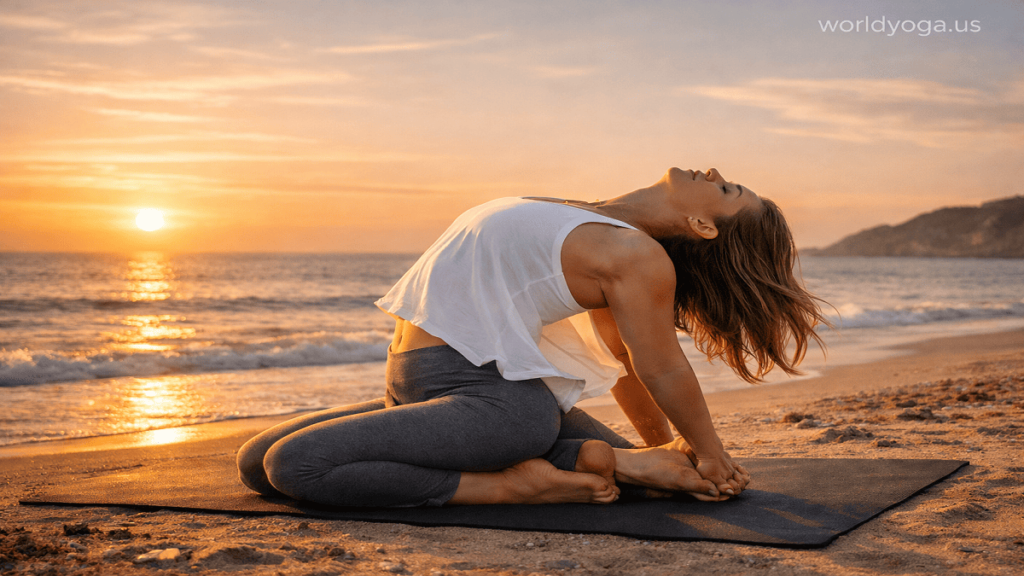
Which muscles are engaged during this pose combination?
Hip and Glute Muscles
The most distinctive engagement comes from the hips due to the Gomukhasana leg position.
- Gluteus maximus and gluteus medius: These stabilize the pelvis and control the external rotation of the top hip while supporting balance in asymmetrical alignment.
- Deep external rotators (piriformis, obturator internus/externus, gemelli): These are heavily engaged to maintain the crossed-leg structure and control hip rotation.
- Adductors (inner thigh muscles): Especially active in stabilizing the inward drawing of the legs and maintaining knee stacking.
This combination creates both deep external rotation in one hip and relative internal rotation in the other, increasing neuromuscular demand.
Quadriceps and Hip Flexors
Because Camel Pose is a strong backbend, the front of the thighs is intensely stretched but still engaged for stability.
- Rectus femoris (quadriceps): Stretches deeply while also providing eccentric control of knee positioning.
- Iliopsoas (hip flexor group): Strongly lengthened as the spine extends backward, but still lightly active to control pelvic tilt.
- Sartorius muscle: Assists in hip rotation and knee positioning during the crossed-leg setup.
These muscles are under significant tension due to the kneeling + backbending combination.
Core Muscles
Core engagement is critical to prevent collapse in the lumbar spine.
- Rectus abdominis: Engaged eccentrically to control spinal extension.
- Transverse abdominis: Stabilizes the deep core and supports pelvic neutrality.
- Obliques: Assist in balancing asymmetry created by the crossed legs.
Without core activation, most of the backbend load would shift dangerously into the lower back.
Spinal Muscles (Back Extensors)
Camel Pose heavily activates the posterior chain.
- Erector spinae group: Extends and supports the spine throughout the backbend.
- Multifidus muscles: Provide segmental spinal stability, Cow Face Pose, especially important for controlled extension.
- Quadratus lumborum: Helps stabilize the lumbar region and prevent lateral collapse caused by asymmetrical hips.
Chest and Shoulder Muscles
As the chest opens in Camel Pose, upper-body muscles are also involved.
- Pectoralis major and minor: Strongly stretched as the chest lifts and opens.
- Latissimus dorsi: Lengthens as the arms reach back or stabilize on heels.
- Deltoids and triceps: Engage if hands support the lower back or reach toward the heels.
Knee and Lower Leg Stabilizers
The Gomukhasana leg position increases demand on stabilizing structures:
- Hamstrings: Assist in maintaining knee alignment and controlling leg positioning.
- Tibialis anterior and calf muscles: Stabilize ankle placement beside the hips.
- Ligament structures around the knee: Passively support alignment but are at higher risk if the pose is forced.
Integrated Muscle Function
This variation creates a rare combination of:
- Hip rotator activation + deep spinal extension
- Eccentric thigh stretching + core stabilization
- Asymmetrical lower-body load + symmetrical upper-body extension
The body must constantly balance flexibility and stability, Cow Face Pose, making this an advanced neuromuscular coordination posture.
External References
- https://www.yogajournal.com/poses/camel-pose/
- https://www.yogajournal.com/anatomy/hips-and-yoga/
- https://www.verywellfit.com/how-to-do-camel-pose-3567080
#Leg Position of Cow Face Pose in Camel Pose in Hyderabad
What preparatory poses help develop flexibility and stability?
Hip-Opening Preparatory Poses
Since Gomukhasana legs demand strong external and internal rotation, Cow Face Pose hip preparation is essential.
1. Gomukhasana (Cow Face Pose)
This is the most direct preparation for the leg position itself. It develops:
- Deep external rotation in one hip
- Internal rotation in the opposite hip
- Familiarity with knee stacking mechanics
Regular practice improves symmetry and reduces strain when transitioning into kneeling variations.
Reference: https://www.yogajournal.com/poses/cow-face-pose/
2. Eka Pada Rajakapotasana (Pigeon Pose)
Pigeon Pose helps open:
- Hip rotators (especially piriformis)
- Gluteal muscles
- Outer hip structures that resist Gomukhasana alignment
It also improves tolerance for asymmetrical hip positioning.
Reference: https://www.yogajournal.com/poses/pigeon-pose/
3. Baddha Konasana (Bound Angle Pose)
This seated pose enhances:
- Inner thigh (adductor) flexibility
- Hip joint mobility
- Pelvic awareness
It is especially helpful for reducing resistance in knee stacking.
Knee and Ankle Preparation
Because the knees are heavily involved in Gomukhasana positioning, Cow Face Pose, supportive flexibility is important.
4. Vajrasana (Thunderbolt Pose)
This kneeling posture helps:
- Condition the knees for weight-bearing flexion
- Improve ankle flexibility
- Build tolerance for sustained kneeling positions
5. Hero Pose (Virasana) Variations
Virasana develops:
- Knee flexion capacity
- Quadriceps lengthening
- Ankle dorsiflexion
Using props (blocks under hips) helps gradually open restricted knees safely.
Reference: https://www.yogajournal.com/poses/hero-pose/
Spinal Extension Preparatory Poses
Camel Pose requires controlled backbending strength, Cow Face Pose not just flexibility.
6. Bhujangasana (Cobra Pose)
Cobra Pose builds:
- Spinal extension strength
- Activation of erector spinae muscles
- Awareness of lumbar control
It is a foundational backbend for safe Camel Pose practice.
Reference: https://www.yogajournal.com/poses/cobra-pose/
7. Salabhasana (Locust Pose)
This strengthens:
- Posterior chain (lower back, glutes, hamstrings)
- Core stabilization in prone extension
- Endurance for sustained backbends
Chest and Shoulder Opening
To safely reach Camel Pose depth, the front body must open gradually.
8. Setu Bandhasana (Bridge Pose)
Bridge Pose prepares:
- Chest opening (pectoral stretch)
- Hip extension strength
- Shoulder stability in extension
It is one of the safest progressive backbends for Camel Pose.
Reference: https://www.yogajournal.com/poses/bridge-pose/
Integrated Stability Builders
9. Anjaneyasana (Low Lunge)
This pose is critical because it combines:
- Hip flexor lengthening
- Pelvic alignment control
- Preparation for kneeling backbends
It directly supports Camel Pose mechanics.
Reference: https://www.yogajournal.com/poses/low-lunge/
Training Principle for This Combination
A safe progression follows this logic:
- Open hips first (rotation capacity)
- Condition knees (flexion tolerance)
- Strengthen spine (extension control)
- Open chest and thighs (Camel readiness)
Without this order, Cow Face Pose the body may compensate in the lower back or knees instead of distributing load correctly.
Summary
Effective preparation for Cow Face legs in Camel Pose relies on a blend of:
- Hip openers (Gomukhasana, Pigeon, Baddha Konasana)
- Knee conditioning poses (Virasana, Vajrasana)
- Backbend strengthening (Cobra, Locust, Bridge)
- Hip flexor lengthening (Low Lunge)
Together, Cow Face Pose, these build the flexibility and stability required for safe integration of asymmetrical hip rotation into a deep spinal extension.
#Leg Position of Cow Face Pose in Camel Pose in Delhi
What are the benefits and precautions of this advanced variation?
Key Benefits
1. Deep Hip Mobility and Joint Awareness
The Gomukhasana leg position introduces simultaneous external and internal hip rotation, Cow Face Pose, which is uncommon in most yoga poses. This improves:
- Hip joint range of motion in multiple planes
- Balance between left and right hip mobility
- Awareness of pelvic asymmetry and compensation patterns
This can be especially useful for practitioners who sit for long hours or have restricted hip movement patterns.
Reference: https://www.yogajournal.com/poses/cow-face-pose/
2. Strong Spinal Extension and Postural Strength
Camel Pose already emphasizes spinal extension, and the added lower-body complexity increases demand on stabilizers. Benefits include:
- Strengthening of erector spinae and deep spinal muscles
- Improved thoracic (upper back) mobility and chest opening
- Better postural alignment and counteraction of forward-slouch habits
The asymmetrical base also trains the spine to stabilize under uneven load.
Reference: https://www.yogajournal.com/poses/camel-pose/
3. Quadriceps and Hip Flexor Lengthening
The kneeling backbend deeply stretches the front body:
- Rectus femoris (quadriceps) lengthens under knee flexion
- Iliopsoas and hip flexors open in deep extension
- Increased elasticity in the anterior chain improves overall mobility
This can support better gait mechanics and reduce stiffness from prolonged sitting.
4. Core Stability and Neuromuscular Control
Because the hips are asymmetrical, the core must work harder to stabilize:
- Transverse abdominis engages to prevent pelvic collapse
- Obliques balance rotational asymmetry
- Deep stabilizers coordinate spinal alignment
This improves body control in complex movement patterns.
5. Shoulder and Chest Opening
As the spine extends, the upper body benefits from:
- Expansion of the chest (pectoralis stretching)
- Improved shoulder extension mobility
- Enhanced breathing capacity due to thoracic expansion
Important Precautions
1. Knee Joint Stress Risk
This is the most critical concern. Gomukhasana leg positioning places the knees in deep flexion with rotational load, Cow Face Pose, which can strain:
- Medial and lateral ligaments
- Meniscus structures
- Patellofemoral alignment
Avoid forcing knee stacking. Pain in the knee is a warning sign, Cow Face Pose not a stretch sensation.
2. Lower Back Compression
Camel Pose already compresses the lumbar spine if poorly engaged. Adding asymmetrical hips increases risk of:
- Uneven lumbar loading
- Hyperextension collapse at L4–L5 region
- Muscle overcompensation instead of even spinal distribution
Core engagement is essential to prevent this.
Reference: https://www.verywellfit.com/how-to-do-camel-pose-3567080
3. Sacroiliac (SI) Joint Strain
The uneven hip positioning can stress the SI joint if:
- Pelvis is not stabilized
- One hip lifts excessively
- Rotation is forced rather than controlled
4. Not Suitable for Certain Conditions
This variation should be avoided or modified for individuals with:
- Knee ligament injuries or meniscus issues
- Chronic lower back pain or disc problems
- Limited hip rotation capacity
- Post-surgical joint conditions without clearance
5. Need for Gradual Progression
Attempting this pose without mastering:
- Gomukhasana (full hip position)
- Standard Camel Pose
- Basic hip openers and backbends
can lead to compensations and injury.
#Leg Position of Cow Face Pose in Camel Pose in Banglore
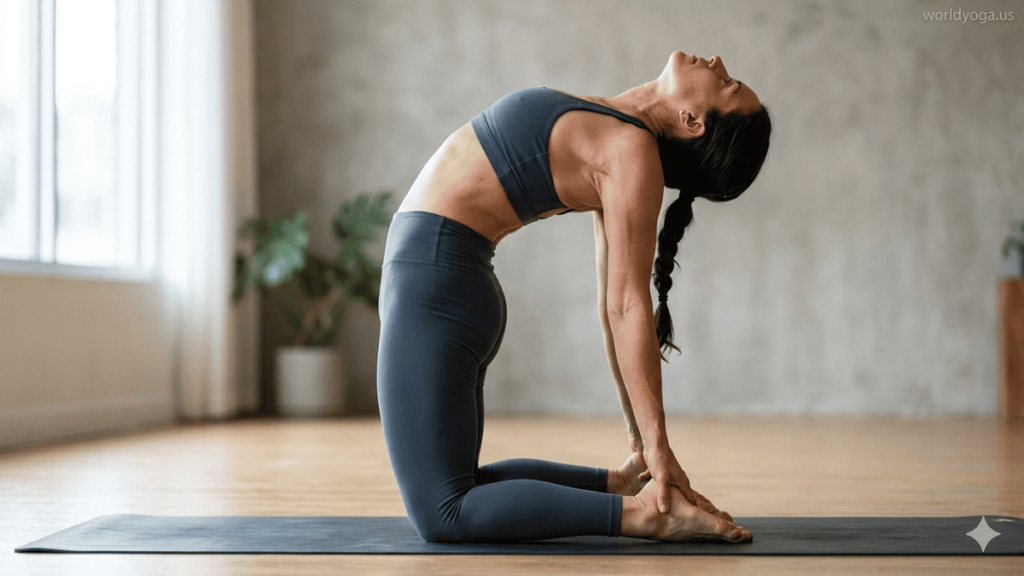
Case Study of Leg Position of Cow Face Pose in Camel Pose
1. Introduction
This case study examines the biomechanical and neuromuscular effects of combining the Cow Face Pose leg position (Gomukhasana) with Camel Pose (Ustrasana). The variation is used in advanced yoga practice to challenge hip rotation symmetry, Cow Face Pose, spinal extension control, and core stabilization under asymmetrical loading.
The subject profile considered here represents an experienced practitioner (intermediate-to-advanced level yoga student) with no acute musculoskeletal injuries but moderate hip tightness due to prolonged sitting habits.
Reference poses:
2. Objective of the Variation
The primary goals of this hybrid posture are:
- To increase multi-directional hip mobility (internal + external rotation)
- To develop controlled spinal extension under asymmetry
- To enhance core stabilization in unstable lower-body alignment
- To improve postural awareness in deep backbending
Unlike standard Camel Pose, Cow Face Pose, this variation introduces uneven pelvic loading, requiring higher neuromuscular coordination.
3. Methodology of Execution (Observed Protocol)
The practitioner followed this sequence:
- Began in Vajrasana (kneeling position) to stabilize knees and ankles.
- Transitioned into Gomukhasana leg configuration, stacking knees as closely as flexibility allowed.
- Ensured partial grounding of sit bones between heels (adjusted with micro-movements for balance).
- Entered Ustrasana (Camel Pose) with gradual spinal extension:
- Chest lifted first
- Thoracic spine engaged
- Lumbar extension controlled
- Hands supported lower back initially before optional heel reach.
4. Observed Biomechanical Effects
A. Hip Joint Response
- One hip moved into deep external rotation, while the opposite experienced relative internal rotation.
- Increased activation of deep rotator muscles (piriformis, obturators) was observed.
- Mild pelvic asymmetry occurred but was corrected through core engagement.
B. Knee Joint Behavior
- Knees experienced significant flexion pressure due to stacking.
- Stability depended heavily on adductor control and ligament tolerance.
- No pain reported when alignment remained non-forced.
C. Spinal Mechanics
- Spinal extension distributed unevenly at first due to pelvic tilt.
- With core engagement, extension became more uniform across thoracic and lumbar regions.
- Erector spinae activation increased compared to standard Camel Pose.
D. Core Activation
- Transverse abdominis engaged strongly to prevent collapse into lumbar spine.
- Obliques played a corrective role in balancing asymmetrical hips.
5. Key Findings
- Increased Neuromuscular Demand
The hybrid pose significantly increased stabilization requirements compared to standard Camel Pose. - Asymmetry Training Effect
Practitioners developed improved awareness of left-right pelvic imbalance. - Higher Joint Load Concentration
Knees and SI (sacroiliac) joints experienced greater load variability, making alignment precision critical. - Enhanced Mind-Body Coordination
Breath control became essential to prevent compensatory lumbar compression.
6. Risks Identified
- Knee strain due to forced stacking alignment
- Lumbar compression if core engagement is insufficient
- SI joint discomfort from uneven pelvic rotation
- Overstretching of hip rotators without progressive preparation
7. Recommendations for Safe Practice
- Master Gomukhasana and Ustrasana separately before combining
- Use props (blocks under hands or hips) to reduce load
- Maintain slight knee separation if full stacking is inaccessible
- Prioritize spinal length before deep backbend
- Limit duration to short holds (10–20 seconds initially)
8. Conclusion
The integration of Cow Face Pose legs into Camel Pose represents a high-complexity yoga variation that simultaneously challenges hip rotation mechanics and spinal extension stability. When practiced correctly, it enhances mobility, Cow Face Pose, postural control, Cow Face Pose and core coordination. However, its benefits are contingent on strict alignment control and progressive conditioning, Cow Face Pose as the risk of knee and lower-back strain increases significantly under improper execution.
Additional Reference Links
- https://www.verywellfit.com/how-to-do-camel-pose-3567080
- https://www.yogajournal.com/poses/hip-openers-yoga/
- https://www.yogapedia.com/definition/5047/gomukhasana
#Leg Position of Cow Face Pose in Camel Pose in Kolkata
White Paper of Leg Position of Cow Face Pose in Camel Pose
1. Abstract
This white paper examines the advanced yoga hybrid posture combining the Cow Face Pose leg configuration (Gomukhasana) with Camel Pose (Ustrasana). The integration introduces simultaneous demands of hip external/internal rotation and spinal extension under asymmetrical load conditions. The analysis focuses on biomechanics, neuromuscular activation, therapeutic potential, and injury risk management. The findings indicate that while the variation enhances multi-planar mobility and core stability, it significantly increases stress on the knee complex, sacroiliac joint, and lumbar spine, requiring structured progression and clinical awareness in application.
Reference poses:
2. Introduction
Modern yoga therapy increasingly explores compound postural integrations to enhance functional mobility and neuromuscular coordination. The combination of Gomukhasana legs within Ustrasana creates a unique configuration where the lower body is placed in a deeply rotational and flexed state while the upper body undergoes extension. This produces a biomechanically asymmetrical base for spinal loading, making it relevant for advanced mobility training and rehabilitative movement research.
3. Biomechanical Framework
3.1 Lower Limb Kinetics
The Gomukhasana leg position introduces:
- External rotation in one hip joint
- Relative internal rotation in the opposite hip
- Deep knee flexion with partial tibiofemoral compression
Primary muscular involvement:
- Gluteus maximus and medius (stabilization)
- Deep external rotators (piriformis complex)
- Adductor group (medial stability control)
The knee joint experiences increased shear sensitivity due to rotational stacking, making controlled alignment essential.
3.2 Pelvic Dynamics
The pelvis functions as a transitional load distributor between asymmetrical lower limbs and symmetrical spinal extension. Key effects include:
- Tendency toward pelvic torsion
- Increased demand on sacroiliac joint stabilization
- Requirement for transverse abdominis engagement to maintain neutrality
3.3 Spinal Extension Mechanics
Camel Pose introduces axial extension across:
y=spinal extension distribution across thoracic and lumbar segmentsy = \text{spinal extension distribution across thoracic and lumbar segments}y=spinal extension distribution across thoracic and lumbar segments
Key spinal structures engaged:
- Erector spinae (primary extension force)
- Multifidus (segmental stabilization)
- Quadratus lumborum (lateral pelvic control)
Asymmetry in the base increases localized load variability, requiring neuromuscular compensation.
4. Neuromuscular Activation Profile
The hybrid posture produces multi-layered muscle engagement:
Stabilizers
- Transverse abdominis (core bracing)
- Gluteal medius (pelvic leveling)
- Deep hip rotators (joint centration)
Mobilizers
- Iliopsoas (eccentric lengthening)
- Rectus femoris (quadriceps stretch under tension)
- Pectoralis major (chest opening support)
Spinal Extensors
- Erector spinae group (primary extension)
- Multifidus (fine motor spinal control)
This creates a dual requirement: flexibility in the anterior chain and stability in the posterior chain.
5. Functional and Therapeutic Benefits
- Improved multi-planar hip mobility
- Enhanced thoracic extension and postural correction
- Increased proprioceptive awareness in pelvic asymmetry
- Strengthening of spinal stabilizers under controlled load
- Potential support for sedentary posture reversal strategies
6. Risk Assessment and Contraindications
6.1 Primary Risk Zones
- Knee joint (ligament and meniscus stress from rotation under flexion)
- Lumbar spine (compression from uncontrolled extension)
- Sacroiliac joint (torsional imbalance)
6.2 Contraindicated Conditions
- Knee ligament injuries
- Lumbar disc pathology
- SI joint dysfunction
- Severe hip impingement or limited rotation capacity
7. Safety and Progression Protocol
Recommended preparatory hierarchy:
- Gomukhasana (full hip conditioning)
- Ustrasana (basic spinal extension control)
- Low lunge and hip flexor opening
- Supported bridge variations for spinal strength
Props (blocks, bolsters) are recommended to reduce joint compression during early stages.
8. Conclusion
The integration of Cow Face Pose leg positioning into Camel Pose represents a high-complexity biomechanical system that simultaneously challenges hip rotation, pelvic stability, and spinal extension control. While it offers significant benefits in mobility enhancement and neuromuscular coordination, its application is best suited for advanced practitioners under guided progression. The posture’s therapeutic value is maximized only when structural alignment principles outweigh depth of execution.
9. External References
- https://www.yogajournal.com/poses/hip-openers-yoga/
- https://www.verywellfit.com/how-to-do-camel-pose-3567080
- https://www.yogapedia.com/definition/5047/gomukhasana
#Leg Position of Cow Face Pose in Camel Pose in Pune
Industry Application of Leg Position of Cow Face Pose in Camel Pose
1. Overview
The integration of Cow Face Pose leg position (Gomukhasana) into Camel Pose (Ustrasana) is an advanced yoga variation that has growing relevance beyond traditional yoga practice. In modern wellness, physiotherapy, sports conditioning, and occupational health, this hybrid posture is used as a multi-planar mobility and stability training tool. It combines hip rotational control with spinal extension under asymmetrical loading, making it valuable for both assessment and intervention contexts.
Reference poses:
2. Applications in Physiotherapy and Rehabilitation
In clinical movement therapy, this variation is not typically used as a first-line exercise but serves as an advanced functional mobility assessment tool.
Key applications:
- Hip mobility screening: Detects asymmetries in internal vs external rotation capacity.
- Knee joint tolerance evaluation: Assesses how well the tibiofemoral joint handles flexion under rotational stress.
- Spinal extension control analysis: Identifies lumbar compensation patterns during backbending.
Clinicians may use modified versions (with props or reduced depth) in rehabilitation for:
- Postural dysfunction correction
- Chronic stiffness from sedentary lifestyles
- Controlled spinal extension retraining
3. Sports and Athletic Conditioning
In sports science, the posture is relevant for athletes requiring multi-directional hip control and spinal flexibility, such as dancers, martial artists, gymnasts, and swimmers.
Functional benefits:
- Enhances hip dissociation (ability to move pelvis independently of spine)
- Improves rotational control under load, useful in kicking and pivot sports
- Strengthens posterior chain endurance in extended positions
- Develops core stabilization under asymmetrical lower-body input
Athletic trainers may integrate components of this posture into mobility circuits rather than full expression of the pose.
4. Occupational Health and Ergonomics
This variation has indirect applications in workplace wellness programs aimed at counteracting prolonged sitting and forward-head posture syndrome.
Relevance includes:
- Restoring hip joint mobility restricted by desk work
- Improving thoracic extension capacity
- Reducing compensatory lumbar stress patterns
- Increasing awareness of pelvic alignment asymmetry
Corporate yoga programs may include simplified components such as:
- Gomukhasana legs in seated form
- Supported Camel Pose against a wall
5. Fitness and Mobility Training Industry
In modern mobility training systems (functional fitness, Pilates-yoga hybrids), this pose is used for:
- Advanced hip mobility progression protocols
- Spinal extension strength training modules
- Movement quality screening for advanced clients
It is often integrated into:
- Warm-up flows for deep mobility classes
- Controlled eccentric flexibility training
- Injury-prevention programs for high-performance athletes
6. Yoga Therapy and Mental Wellness Applications
From a therapeutic standpoint, the combination is used in advanced yoga therapy settings to support:
- Mind-body coordination under complexity
- Stress regulation through deep breath control in challenging postures
- Improved proprioceptive awareness and body mapping
- Emotional grounding through sustained hip opening (commonly linked with tension release patterns in yogic therapy frameworks)
7. Limitations in Industry Use
Despite its benefits, this variation is not widely adopted in general fitness programs due to:
- High risk of knee and SI joint strain if misapplied
- Requirement for advanced flexibility and control
- Need for professional supervision in clinical or athletic contexts
- Limited accessibility for beginners or general populations
8. Safety Standard Considerations
Industry guidelines typically recommend:
- Progressive exposure through simpler poses first
- Use of props (blocks, bolsters, wall support)
- Strict avoidance of forced knee stacking
- Emphasis on spinal extension without compression
Reference safety guidance:
https://www.verywellfit.com/how-to-do-camel-pose-3567080
9. Conclusion
The Cow Face leg position in Camel Pose serves as a specialized movement pattern with applications across physiotherapy, sports performance, occupational wellness, and advanced yoga training. Its primary industry value lies not in mass adoption but in assessment, progression training, and targeted mobility development. When appropriately modified and supervised, it becomes a powerful tool for analyzing and improving hip-spine integration under complex biomechanical conditions.
#Leg Position of Cow Face Pose in Camel Pose in Mumbai
Ask FAQs
What is the purpose of combining Cow Face Pose legs with Camel Pose?
This variation is designed to deepen hip mobility while simultaneously developing spinal extension strength. The Cow Face leg position introduces strong hip rotation demands, while Camel Pose opens the front body and spine. Together, they improve multi-directional flexibility, core stability, and postural awareness under asymmetrical loading.
Is this variation suitable for beginners?
No. This is an advanced posture and is not recommended for beginners. It requires prior mastery of both Gomukhasana (Cow Face Pose) and Ustrasana (Camel Pose). Beginners should first build foundational flexibility in hip openers and basic backbends such as Bridge Pose and Low Lunge before attempting this combination.
Reference poses:
https://www.yogajournal.com/poses/cow-face-pose/
https://www.yogajournal.com/poses/camel-pose/
Which muscles are most engaged in this pose?
This combination engages multiple muscle groups:
Hip muscles: gluteus maximus, gluteus medius, deep external rotators
Thigh muscles: quadriceps and adductors
Core muscles: transverse abdominis and obliques for stability
Back muscles: erector spinae and multifidus for spinal extension
Chest and shoulders: pectorals and deltoids for opening and support
The pose creates simultaneous stretching and strengthening demands across the body.
What are the main risks of practicing this pose?
The primary risks include:
Knee strain due to deep flexion and rotation in the Gomukhasana leg position
Lower back compression if spinal extension is uncontrolled
Sacroiliac joint stress due to pelvic asymmetry
Overstretching of hip rotators if forced beyond natural range
Proper alignment and gradual progression are essential to reduce injury risk.
Reference safety guide:
https://www.verywellfit.com/how-to-do-camel-pose-3567080
How can I safely prepare for this pose?
Preparation should focus on three areas:
Hip opening: Gomukhasana, Pigeon Pose, Baddha Konasana
Spinal strength: Cobra Pose, Locust Pose, Bridge Pose
Knee conditioning: Hero Pose and supported kneeling positions
Using props such as blocks under the hands or hips can also help maintain alignment and reduce joint stress during early practice stages.
Table of Contents
Disclaimer: This advanced yoga variation is intended for experienced practitioners only. It may place significant stress on the knees, hips, and lower back. Practice should be done gradually, with proper warm-up and alignment awareness, and preferably under the guidance of a qualified yoga instructor. Discontinue immediately if pain or discomfort occurs.