Wild Thing Pose
Wild Thing Pose, known in Sanskrit as Camatkarasana, is a dynamic backbend in modern yoga that combines strength, flexibility, and openness. The name translates roughly to “the ecstatic unfolding of the enraptured heart,” reflecting its expressive, expansive nature. It is commonly practiced in Vinyasa and Power Yoga sequences as a transitional or peak posture that opens the chest and shoulders while strengthening the upper body.
Technique and Alignment
Wild Thing typically begins from Downward-Facing Dog (Adho Mukha Svanasana). From there, the practitioner shifts weight into one hand and outer edge of the same-side foot while lifting the opposite leg and arching the spine. The lifted arm reaches overhead, creating a deep backbend supported by one arm and one foot.
Key alignment points include:
- Strong engagement of the supporting shoulder to avoid collapse
- Active lifting through the chest rather than compressing the lower back
- Stable grounding of the supporting foot for balance
- Controlled extension of the lifted leg to maintain equilibrium
Because it is a one-arm support pose, wrist and shoulder stability are critical. Proper warm-up is essential, especially for the spine, shoulders, and hip flexors.
Benefits
Wild Thing Pose provides multiple physical and energetic benefits:
- Spinal Mobility – Enhances extension and flexibility in the thoracic and lumbar spine.
- Shoulder Strength – Builds endurance in stabilizing muscles of the shoulder girdle.
- Chest and Hip Opening – Stretches the hip flexors, intercostal muscles, and chest.
- Balance and Coordination – Develops proprioception due to asymmetrical weight distribution.
- Energy Expansion – Often associated with emotional release and improved breathing capacity.
Precautions
This pose is not recommended for individuals with:
- Shoulder injuries or instability
- Severe lower back conditions such as herniated discs
- High blood pressure or vertigo (without supervision)
Beginners should approach with caution and consider preparatory poses like Side Plank (Vasisthasana) or Bridge Pose (Setu Bandhasana).
Modifications
- Keep the bottom knee bent for additional stability.
- Place the lifted foot lightly on the ground instead of extending fully.
- Use a wall for support when learning balance.
Further Learning
For deeper understanding and guided practice, you can refer to:
- https://www.yogajournal.com/poses/wild-thing/
- https://www.yogapedia.com/definition/6217/wild-thing-pose
- https://www.verywellfit.com/wild-thing-pose-camatkarasana-3567192
Conclusion
Wild Thing Pose is both physically demanding and expressive, combining strength with openness. When practiced correctly, it enhances spinal flexibility, shoulder resilience, and overall body awareness, making it a valuable addition to intermediate and advanced yoga practice.
#Wild Thing Pose in India
How is Wild Thing Pose performed correctly?
1. Starting Position
Begin in Downward-Facing Dog (Adho Mukha Svanasana). Ensure your hands are firmly grounded, fingers spread wide, and your spine is elongated. Your feet should be hip-width apart, with heels reaching toward the floor as much as flexibility allows. This foundational alignment sets stability for the transition.
2. Shifting Weight and Preparing the Base
From Downward Dog, shift your weight into your right hand and right foot. Engage your core muscles to maintain control and prevent collapsing into the shoulder. The right shoulder should remain strong and stable, avoiding sinking toward the ear.
Slowly roll onto the outer edge of your right foot. This external rotation is essential for creating the base of the pose. At this stage, your left foot begins to lift off the ground.
3. Opening the Body
As the left leg lifts, bend the knee and allow the hip to open naturally. Simultaneously, begin to arch your spine into a gentle backbend. The left arm reaches overhead in a sweeping arc, extending toward the front of the room or slightly behind your head depending on flexibility and balance.
The chest should open upward rather than collapsing backward. Think of lifting through the sternum instead of compressing the lower back.
4. Alignment and Engagement
Key alignment points include:
- Supporting shoulder remains stable and engaged, not collapsed
- Core muscles remain active to protect the lower back
- Bottom foot is firmly grounded on its outer edge
- Hips lift upward rather than dropping toward the floor
- Neck remains relaxed, with gaze directed comfortably upward or forward
Breathing should be steady and deep, supporting both stability and openness.
5. Exiting the Pose
To safely exit, slowly bring the lifted arm and leg back down. Return the lifted foot to the floor first, followed by the hand, moving back into Downward-Facing Dog. Rest briefly before repeating on the opposite side.
6. Common Mistakes to Avoid
- Collapsing into the supporting shoulder
- Overarching the lower back instead of lifting through the chest
- Losing balance due to insufficient core engagement
- Forcing the pose without proper shoulder preparation
7. Helpful Preparations
Practicing Side Plank (Vasisthasana), Bridge Pose (Setu Bandhasana), and gentle backbends can prepare the body for Wild Thing.
Further Reading
- https://www.yogajournal.com/poses/wild-thing/
- https://www.verywellfit.com/wild-thing-pose-camatkarasana-3567192
- https://www.yogapedia.com/definition/6217/wild-thing-pose
Conclusion
Correct execution of Wild Thing Pose depends on controlled weight distribution, strong shoulder engagement, and mindful spinal extension. When practiced with precision and awareness, it enhances flexibility, builds upper-body strength, and promotes a deep sense of openness and balance.
#Wild Thing Pose in Maharashtra
What is the proper alignment in this backbend transition?
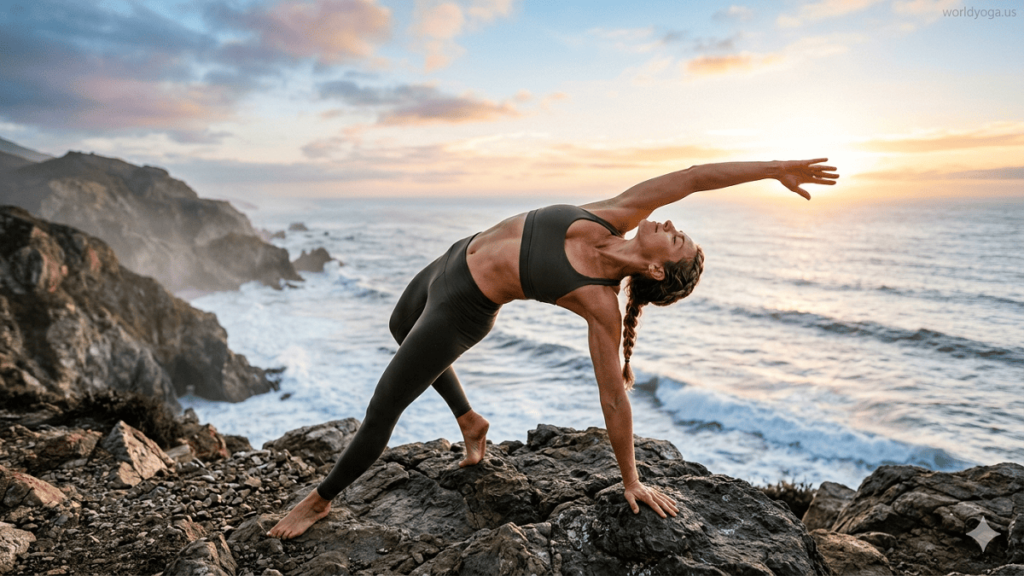
The alignment in Wild Thing Pose is critical because it is a transitional backbend that places asymmetrical load on the shoulders, spine, and supporting wrist. Correct alignment ensures stability, protects the lower back and shoulder joint, and allows the chest-opening benefits of the pose to be safely expressed.
1. Foundation: Hands, Feet, and Base Stability
The transition begins from Downward-Facing Dog, where proper foundation sets the tone for the entire pose. The supporting hand must be placed directly under the shoulder, with fingers spread wide to distribute weight evenly across the palm. The wrist should remain neutral, avoiding excessive inward collapse.
The supporting foot rotates onto its outer edge, which is essential for stabilizing the lateral chain of the body. This external rotation of the foot aligns the ankle, knee, and hip, reducing strain on the joint structures.
2. Shoulder and Upper Body Alignment
The most critical alignment principle is in the supporting shoulder. It must remain:
- Strongly engaged (not collapsed)
- Protracted slightly to stabilize the scapula
- Actively pushing the floor away
This prevents compression of the shoulder joint and reduces injury risk.
The chest should rotate open toward the ceiling as the body transitions into the backbend. However, this opening should originate from thoracic extension (upper spine), not from collapsing into the lumbar spine.
3. Spinal Alignment: Controlled Extension
The spine should form a uniform, evenly distributed arc, not a sharp bend in the lower back. Proper alignment involves:
- Lengthening through the entire spine before deepening the backbend
- Engaging abdominal muscles to support lumbar stability
- Lifting through the sternum rather than “dropping” backward
The goal is expansion, not compression.
4. Hip and Leg Positioning
The lifted leg bends at the knee, allowing the hip to open naturally. However, the hips should not twist excessively or collapse downward. Instead, they should:
- Lift diagonally upward
- Remain relatively squared to avoid spinal torque
The supporting hip remains active and elevated, preventing sinking into the shoulder.
5. Arm Extension and Neck Position
The free arm extends in a long arc overhead, creating a continuous line of energy from grounded hand to fingertips. The neck should remain relaxed, avoiding unnecessary strain. The gaze can be directed upward or forward depending on comfort and balance.
6. Breath and Integration
Breathing should remain smooth and expansive. Inhale to lengthen the spine, and exhale to deepen the opening without forcing range of motion.
Key Alignment Summary
- Strong, stable supporting shoulder
- Weight evenly distributed through grounded hand and foot
- Chest lifted through thoracic spine, not lumbar compression
- Hips elevated and controlled
- Core engaged for spinal protection
Further Reading
- https://www.yogajournal.com/poses/wild-thing/
- https://www.verywellfit.com/wild-thing-pose-camatkarasana-3567192
- https://www.yogapedia.com/definition/6217/wild-thing-pose
Conclusion
Proper alignment in Wild Thing Pose is centered on shoulder stability, spinal lengthening, and controlled hip opening. When these elements are coordinated correctly, the pose becomes a safe and effective backbend that enhances mobility, strength, and body awareness rather than stressing vulnerable joints.
#Wild Thing Pose in Banglore
Which muscles are engaged during the pose?
1. Upper Body and Shoulder Complex
The most heavily engaged region in this pose is the shoulder girdle, especially in the supporting arm.
- Deltoids (especially anterior and lateral fibers): Stabilize and support body weight through the grounded arm while controlling shoulder positioning.
- Rotator cuff muscles (supraspinatus, infraspinatus, teres minor, subscapularis): Provide joint stability and prevent shoulder collapse.
- Serratus anterior: Actively protracts the scapula, helping maintain shoulder integrity and preventing sinking into the joint.
- Trapezius (middle and lower fibers): Assists in scapular stabilization and upward rotation.
These muscles work together to maintain a safe load-bearing position on one arm.
2. Core Musculature
The core plays a critical role in preventing excessive spinal compression and maintaining balance during the transition.
- Rectus abdominis: Provides anterior spinal support and prevents over-arching in the lumbar region.
- Obliques (internal and external): Control rotational stability, especially as the body opens sideways into the backbend.
- Transverse abdominis: Acts as a deep stabilizer, maintaining intra-abdominal pressure and spinal control.
Without core engagement, the lower back would be vulnerable to overextension.
3. Spinal and Back Muscles
Wild Thing involves active spinal extension, requiring engagement of key posterior chain muscles.
- Erector spinae: Extends and supports the spine during the backbend.
- Multifidus: Provides segmental spinal stability, especially important in controlling the lumbar region.
- Latissimus dorsi: Assists in shoulder stability and contributes to the arching motion of the torso.
These muscles ensure that the backbend is distributed evenly rather than collapsing into a single spinal segment.
4. Hip and Lower Body Muscles
The lifted leg and supporting leg both contribute significantly to stability.
- Gluteus maximus: Engaged to support hip extension and maintain lift in the pelvis.
- Gluteus medius: Stabilizes the pelvis, preventing it from dropping or rotating excessively.
- Hip flexors (iliopsoas group) on the lifted side: Actively lengthen and open as the leg extends.
- Quadriceps (supporting leg): Maintain stability and grounding through the standing foot.
- Hamstrings (supporting leg): Assist in balance and control.
5. Wrist and Forearm Muscles
Because the pose is partially weight-bearing on the hands:
- Forearm flexors and extensors: Stabilize the wrist joint and distribute pressure across the palm.
- Intrinsic hand muscles: Help maintain grip and balance through finger spread and pressure control.
Functional Summary
Wild Thing Pose is a coordinated integration of:
- Shoulder stabilization under load
- Core control for spinal protection
- Posterior chain activation for extension
- Hip engagement for balance and openness
Further Reading
- https://www.yogajournal.com/poses/wild-thing/
- https://www.verywellfit.com/wild-thing-pose-camatkarasana-3567192
- https://www.yogapedia.com/definition/6217/wild-thing-pose
#Wild Thing Pose in Kolkata
What preparatory poses are recommended?
1. Downward-Facing Dog (Adho Mukha Svanasana)
This is the foundational pose for entering Wild Thing. It helps establish:
- Shoulder engagement and stability
- Length through the spine
- Awareness of weight distribution through the hands
Practicing Downward Dog regularly builds the baseline strength needed for safe one-arm transitions.
More information: https://www.yogajournal.com/poses/downward-facing-dog-pose/
2. Side Plank (Vasisthasana)
Side Plank is one of the most important preparatory poses because Wild Thing is essentially a backbending variation of a one-arm side balance.
Benefits include:
- Strengthening the supporting wrist, shoulder, and arm
- Activating the obliques for lateral stability
- Training balance under asymmetrical load
A strong Side Plank directly translates to safer execution of Wild Thing.
More information: https://www.yogajournal.com/poses/side-plank-pose/
3. Upward Plank (Purvottanasana)
This pose prepares the body for the chest-opening aspect of Wild Thing.
It helps to:
- Open the shoulders and chest
- Strengthen the posterior chain (back body)
- Build wrist and arm endurance in extension
It is particularly useful for counteracting forward shoulder collapse.
More information: https://www.yogajournal.com/poses/upward-plank-pose/
4. Bridge Pose (Setu Bandhasana)
Bridge Pose introduces controlled spinal extension without excessive load on the wrists.
It supports:
- Glute and hamstring activation
- Safe lumbar extension
- Gentle chest and hip opening
This makes it ideal for beginners developing backbend awareness.
More information: https://www.yogajournal.com/poses/bridge-pose/
5. Wheel Pose (Urdhva Dhanurasana) – Optional Advanced Prep
For practitioners with sufficient mobility, Wheel Pose builds deeper strength and flexibility.
It develops:
- Full spinal extension capacity
- Strong shoulder flexion and stability
- Integrated whole-body backbend control
More information: https://www.yogajournal.com/poses/wheel-pose/
6. Low Lunge (Anjaneyasana)
Low Lunge prepares the hip flexors and improves pelvic mobility.
It helps:
- Lengthen iliopsoas and quadriceps
- Reduce restriction in backbends
- Improve pelvic alignment during transitions
More information: https://www.yogajournal.com/poses/low-lunge/
Summary
Effective preparation for Wild Thing Pose focuses on four key areas:
- Shoulder stability (Side Plank, Downward Dog)
- Spinal extension (Bridge, Wheel Pose)
- Chest opening (Upward Plank)
- Hip flexibility (Low Lunge)
Conclusion
A structured warm-up sequence ensures that Wild Thing Pose is performed with control rather than strain. Strength-building poses like Side Plank combined with gentle backbends like Bridge Pose create the necessary balance of stability and flexibility for a safe transition into this expressive backbend.
#Wild Thing Pose in Ahemadabad
What are the benefits and precautions of Wild Thing Pose?
Benefits of Wild Thing Pose
1. Improves Spinal Flexibility and Mobility
Wild Thing encourages controlled extension of the thoracic and lumbar spine. This helps counteract stiffness caused by prolonged sitting and forward-flexed postures. When practiced correctly, it promotes balanced spinal mobility rather than isolated lower-back compression.
Reference: https://www.yogajournal.com/poses/wild-thing/
2. Strengthens Shoulders, Arms, and Upper Back
The pose is a strong upper-body stabilizer. The supporting arm engages:
- Rotator cuff muscles for joint stability
- Deltoids and triceps for load-bearing strength
- Serratus anterior for scapular control
This improves functional shoulder endurance and resilience in weight-bearing movements.
3. Opens Chest and Hip Flexors
Wild Thing creates a deep expansion across the front body:
- Chest (pectoralis muscles) opens for improved breathing capacity
- Hip flexors (iliopsoas) are lengthened
- Intercostal muscles expand, enhancing rib mobility
This contributes to better posture and respiratory efficiency.
4. Enhances Balance and Coordination
Because the pose is asymmetrical and requires control during a transition, it improves:
- Proprioception (body awareness in space)
- Core coordination
- Dynamic balance under load
5. Boosts Energy and Emotional Release
Backbends are often associated with energizing effects. Wild Thing can create a sense of openness and emotional release due to chest expansion and nervous system activation.
Reference: https://www.verywellfit.com/wild-thing-pose-camatkarasana-3567192
Precautions for Wild Thing Pose
1. Shoulder or Wrist Injuries
Avoid or modify the pose if there are:
- Rotator cuff injuries
- Wrist instability or carpal tunnel syndrome
The pose places significant load on one arm, which may worsen existing conditions.
2. Lower Back Sensitivity
Excessive lumbar compression is a common risk. Individuals with:
- Herniated discs
- Chronic lower back pain
should practice with caution or avoid deep backbending.
3. High Blood Pressure or Vertigo
Deep backbends and inverted chest opening may increase dizziness or discomfort. Medical supervision is advised in such cases.
4. Lack of Core Engagement
Without proper abdominal support, the lower spine can overextend. Core activation is essential to distribute the backbend safely.
5. Overstretching and Loss of Control
Forcing the lifted leg or collapsing into the shoulder reduces stability and increases injury risk. The pose should be entered gradually with controlled movement.
Summary
Wild Thing Pose offers a powerful combination of spinal mobility, upper-body strength, and energetic openness. However, it demands careful attention to shoulder stability, core engagement, and spinal alignment. When practiced with control and appropriate preparation, it is both safe and highly beneficial; when rushed or misaligned, it can place unnecessary strain on vulnerable joints and the lower back.
#Wild Thing Pose in Hyderabad
Case Study of Wild Thing Pose
1. Subject Profile
The practitioner is an intermediate yoga student with approximately 18 months of consistent Vinyasa practice. Baseline characteristics included:
- Moderate shoulder strength but limited stability in unilateral load-bearing poses
- Tight hip flexors due to prolonged sitting
- Adequate spinal mobility but tendency toward lumbar compression in backbends
- Limited experience with advanced arm balances or transitions
Primary goal: Improve backbend depth, shoulder control, and fluidity in transitions.
2. Intervention and Training Protocol
Wild Thing Pose was introduced gradually as part of a structured sequence including preparatory poses and progressive loading.
Phase 1: Foundational Strength (Weeks 1–2)
Focus:
- Side Plank (Vasisthasana)
- Downward-Facing Dog (Adho Mukha Svanasana)
- Bridge Pose (Setu Bandhasana)
Objective: Develop shoulder stability and core engagement.
Phase 2: Mobility and Controlled Extension (Weeks 3–5)
Focus:
- Low Lunge (Anjaneyasana)
- Upward Plank (Purvottanasana)
- Supported Bridge variations
Objective: Increase hip flexor length and spinal extension awareness without compression.
Phase 3: Introduction to Wild Thing (Weeks 6–8)
Focus:
- Assisted Wild Thing using a wall or block
- Partial transitions from Side Plank
- Full pose with controlled exit to Downward Dog
Objective: Develop coordination, balance, and safe spinal arching.
Reference: https://www.yogajournal.com/poses/wild-thing/
3. Observations and Outcomes
Positive Outcomes
- Improved Shoulder Stability: Notable increase in serratus anterior and rotator cuff engagement, reducing collapse during weight shifts.
- Enhanced Spinal Awareness: Practitioner began distributing backbend evenly across thoracic spine instead of overloading lumbar region.
- Better Hip Mobility: Increased ease in hip opening during lifted-leg extension.
- Improved Confidence in Transitions: Reduced hesitation during movement from Downward Dog to side-supported backbend.
Challenges Identified
- Initial tendency to “drop” into the lower back rather than lift through the chest
- Wrist discomfort during early attempts due to insufficient load conditioning
- Balance instability when lifting the top leg too quickly
- Breath holding during transitions, reducing control and fluidity
4. Adjustments and Corrections
To address these issues, the following modifications were applied:
- Emphasis on core activation before transition
- Slower entry with micro-pauses in Side Plank
- Use of bent supporting knee for stability during early practice
- Cueing to “lift chest forward before arching back”
- Introduction of breath-coordination drills (inhale to open, exhale to stabilize)
Reference: https://www.verywellfit.com/wild-thing-pose-camatkarasana-3567192
5. Final Outcome
By week 8, the practitioner demonstrated:
- Stable shoulder alignment under unilateral load
- Controlled spinal extension without lumbar compression
- Smooth entry and exit transitions
- Increased proprioception and confidence in backbending sequences
Wild Thing Pose evolved from a challenging transitional posture into a controlled, expressive movement integrated into Vinyasa flow practice.
6. Conclusion
This case study demonstrates that Wild Thing Pose requires progressive conditioning rather than immediate execution. Success depends on building foundational strength (especially shoulders and core), developing hip and spinal mobility, and refining movement control. When properly sequenced, it serves as an effective integration pose that enhances strength, flexibility, and dynamic balance in intermediate yoga practitioners.
#Wild Thing Pose in Pune
White Paper of Wild Thing Pose
1. Executive Summary
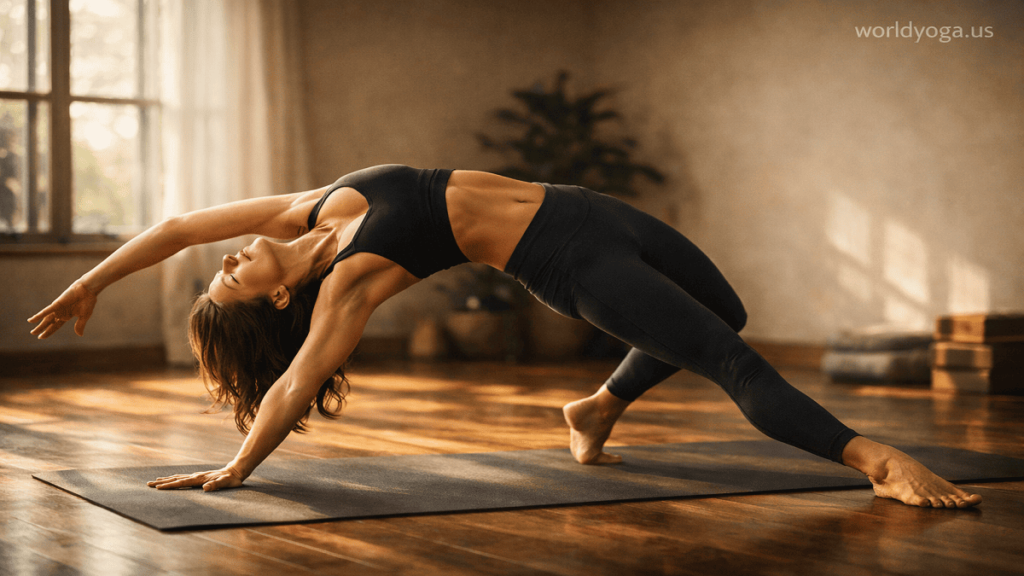
Wild Thing Pose (Sanskrit: Camatkarasana) is a dynamic, asymmetrical backbend commonly practiced in contemporary Vinyasa and Power Yoga systems. It integrates unilateral weight-bearing through the upper extremity with spinal extension and hip opening. This white paper analyzes its biomechanics, physiological effects, safety considerations, and role in modern yoga sequencing. It also outlines evidence-based recommendations for safe implementation in practice settings.
2. Introduction
Wild Thing Pose evolved from modern interpretations of traditional yoga asana practice, rather than being a classical posture found in ancient texts. It is typically introduced after foundational strength and mobility development, often as a transitional movement between Downward-Facing Dog and backbending sequences.
The pose combines:
- Shoulder-loaded stabilization
- Thoracic and lumbar extension
- Hip flexor opening
- Rotational balance demands
Reference: https://www.yogajournal.com/poses/wild-thing/
3. Biomechanical Analysis
Wild Thing is a closed kinetic chain, unilateral support posture. Key biomechanical components include:
3.1 Upper Limb Load Distribution
The supporting arm bears partial body weight while in a combination of:
- Shoulder flexion and external rotation
- Scapular stabilization via serratus anterior engagement
- Wrist extension under load
This requires coordinated rotator cuff activation to prevent glenohumeral joint collapse.
3.2 Spinal Mechanics
The spine moves into controlled extension with emphasis on:
- Thoracic extension (primary driver of safe backbend)
- Lumbar extension (secondary, requires control to prevent compression)
- Segmental stabilization via multifidus and erector spinae
3.3 Pelvic and Lower Limb Dynamics
- Supporting hip remains elevated to prevent pelvic drop
- Lifted leg contributes to counterbalance and hip opening
- Gluteal activation stabilizes pelvic orientation
4. Physiological Benefits
Wild Thing Pose provides multi-system benefits:
4.1 Musculoskeletal Benefits
- Strengthens shoulders, arms, and upper back
- Improves spinal mobility and extension capacity
- Enhances hip flexor flexibility
4.2 Respiratory and Circulatory Effects
Chest expansion increases rib mobility, potentially improving:
- Breathing capacity
- Thoracic circulation efficiency
4.3 Neuromuscular Coordination
- Enhances proprioception through asymmetrical load
- Develops dynamic balance and core integration
Reference: https://www.verywellfit.com/wild-thing-pose-camatkarasana-3567192
5. Risk Profile and Contraindications
5.1 Primary Risks
- Shoulder joint instability under unilateral load
- Lumbar spine overextension due to poor core engagement
- Wrist strain from weight-bearing extension
5.2 Contraindications
- Rotator cuff injuries or shoulder impingement
- Severe lower back disorders (e.g., herniated discs)
- Uncontrolled hypertension or vertigo
6. Implementation Guidelines
6.1 Prerequisite Competencies
- Side Plank (Vasisthasana) stability
- Downward-Facing Dog endurance
- Basic backbend familiarity (Bridge Pose recommended)
6.2 Progression Strategy
- Assisted variations (wall or block support)
- Partial range transitions
- Full expression with controlled exit pathways
6.3 Alignment Priorities
- Scapular stability over passive shoulder hanging
- Thoracic-driven extension instead of lumbar compression
- Core engagement prior to transition
7. Discussion
Wild Thing Pose represents a modern synthesis of strength training and mobility work within yoga practice. It serves as both a transitional and expressive posture that challenges neuromuscular coordination. However, its benefits are highly dependent on proper sequencing and biomechanical awareness.
It is best understood not as an isolated pose, but as a movement pattern requiring preparatory conditioning and mindful progression.
8. Conclusion
Wild Thing Pose is a high-value functional yoga posture that enhances upper-body strength, spinal mobility, and movement coordination. When appropriately sequenced and biomechanically aligned, it contributes meaningfully to modern yoga practice. However, it requires careful attention to shoulder integrity, spinal control, and progressive loading principles to ensure safety and effectiveness.
References
- https://www.yogajournal.com/poses/wild-thing/
- https://www.verywellfit.com/wild-thing-pose-camatkarasana-3567192
- https://www.yogapedia.com/definition/6217/wild-thing-pose
#Wild Thing Pose in Delhi
Industry Application of Wild Thing Pose
1. Fitness and Strength & Conditioning Industry
In modern fitness programming, Wild Thing is used as a functional mobility-strength hybrid exercise. Trainers integrate it into Vinyasa-style conditioning flows and athletic warm-ups.
Applications:
- Shoulder stability training under dynamic load
- Thoracic mobility development for overhead athletes
- Core integration drills combining rotation and extension
It is particularly relevant for sports requiring rotational power and shoulder endurance (e.g., tennis, swimming, climbing). The pose enhances neuromuscular coordination in asymmetrical movement patterns.
Reference: https://www.yogajournal.com/poses/wild-thing/
2. Physiotherapy and Rehabilitation Contexts
In rehabilitative movement therapy, modified versions of Wild Thing are used under supervision to restore controlled mobility.
Clinical Applications:
- Gradual reintroduction of weight-bearing through the shoulder complex
- Postural correction for rounded shoulders and thoracic stiffness
- Controlled spinal extension training for non-acute back conditions
Therapists typically use supported variations (wall-assisted or reduced range) to ensure joint safety and progressive load adaptation. However, it is contraindicated in acute injury phases.
Reference: https://www.verywellfit.com/wild-thing-pose-camatkarasana-3567192
3. Sports Performance Training
Athletes incorporate Wild Thing into mobility and prehabilitation routines due to its multi-joint engagement.
Key Benefits in Sports:
- Improves shoulder resilience in overhead sports
- Enhances lateral chain strength (obliques and serratus anterior)
- Develops dynamic balance and proprioceptive control
It is especially useful in preventing overuse injuries in athletes who rely heavily on repetitive shoulder motion.
4. Corporate Wellness and Stress Management
In workplace wellness programs, Wild Thing is adapted as part of short movement breaks or yoga-based stress relief sessions.
Applications:
- Counteracts prolonged sitting posture (kyphotic spine correction)
- Expands chest to improve breathing efficiency
- Provides a brief neuro-energetic reset through backbending exposure
Its expressive nature is also associated with psychological benefits such as reduced tension and increased alertness.
5. Dance, Movement Arts, and Somatic Practices
In contemporary dance and somatic movement disciplines, Wild Thing is used as a movement transition pattern rather than a static pose.
Applications:
- Improvisational movement training
- Floor-to-standing transition control
- Expansion of expressive spinal articulation
It supports fluidity, spatial awareness, and creative movement expression.
6. Fitness Technology and Virtual Training Platforms
With the rise of digital fitness platforms, Wild Thing is included in:
- Online yoga classes
- Mobility training apps
- AI-driven posture correction systems
It is often used as a marker pose to assess shoulder mobility and balance control in remote coaching environments.
7. Limitations in Industry Use
Despite its versatility, Wild Thing Pose has constraints:
- Requires prior movement literacy (not suitable for absolute beginners in high-load form)
- Risk of shoulder overload without proper progression
- Needs modification in clinical or injury-sensitive populations
8. Conclusion
Wild Thing Pose functions as a cross-disciplinary movement pattern with applications in fitness training, rehabilitation, sports performance, and wellness programming. Its value lies in its integration of strength, mobility, and balance rather than static flexibility alone. When appropriately scaled and supervised, it serves as an effective tool for improving functional movement capacity across multiple professional domains.
External References
- https://www.yogajournal.com/poses/wild-thing/
- https://www.verywellfit.com/wild-thing-pose-camatkarasana-3567192
- https://www.yogapedia.com/definition/6217/wild-thing-pose
#Wild Thing Pose in Mumbai
Ask FAQs
What is Wild Thing Pose and what movement pattern does it involve?
Wild Thing Pose (Camatkarasana) is a dynamic yoga backbend that transitions from Downward-Facing Dog into a one-arm-supported spinal extension with an open chest and lifted leg. It combines elements of a side plank, backbend, and hip opener. The movement pattern involves shifting weight onto one hand and foot, rotating the chest upward, and extending the opposite arm and leg to create an expansive arch through the body. It is considered an advanced transitional pose in modern Vinyasa yoga rather than a traditional static asana.
Reference: https://www.yogajournal.com/poses/wild-thing/
Which muscles are primarily activated during Wild Thing Pose?
Wild Thing engages multiple muscle groups simultaneously. The supporting arm activates the deltoids, rotator cuff muscles, and serratus anterior to stabilize the shoulder. The core muscles—especially the obliques and transverse abdominis—maintain balance and protect the lower back from overextension. The spinal extensors (erector spinae and multifidus) support the backbend, while the glutes and hip flexors control pelvic alignment and leg extension. Forearm and wrist muscles also work isometrically to stabilize weight distribution.
Reference: https://www.verywellfit.com/wild-thing-pose-camatkarasana-3567192
What are the main benefits of practicing Wild Thing Pose?
Wild Thing Pose improves spinal flexibility, especially in thoracic extension, and enhances shoulder strength and stability through unilateral load-bearing. It opens the chest, improving breathing capacity and posture. The pose also stretches the hip flexors and strengthens the posterior chain, including the glutes and back muscles. Additionally, it develops balance, coordination, and proprioception due to its asymmetrical structure. Many practitioners also report increased energy and mental openness after practicing backbends like this.
What are the key alignment principles in Wild Thing Pose?
Proper alignment focuses on controlled shoulder stability, even spinal extension, and safe weight distribution. The supporting shoulder must remain active and not collapse inward. The chest should lift through the upper spine rather than forcing compression into the lower back. The supporting foot stays grounded on its outer edge for stability, while the hips remain elevated and controlled rather than dropping. The lifted arm should extend freely without collapsing the neck or straining the shoulder joint.
Who should avoid or modify Wild Thing Pose?
Individuals with shoulder injuries, wrist issues, or lower back conditions such as herniated discs should avoid or modify this pose. It may also be unsuitable for those with uncontrolled hypertension, vertigo, or limited spinal mobility. Beginners should use preparatory poses or supported variations, such as wall-assisted Wild Thing or Side Plank modifications, to reduce load and improve stability. Proper warm-up and progressive training are essential to reduce injury risk and ensure safe practice.
Table of Contents
Disclaimer:
Wild Thing Pose (Camatkarasana) should be practiced with proper guidance and awareness of individual physical limitations. It involves spinal extension and shoulder weight-bearing, which may not be suitable for everyone. Individuals with injuries, medical conditions, or limited mobility should consult a qualified yoga instructor or healthcare professional before attempting this pose.