Baby Grasshopper Pose
The Baby Grasshopper Pose is an advanced yoga arm balance that blends deep hip mobility, spinal rotation, and upper-body strength into a single coordinated movement. It is a preparatory variation of the full Grasshopper Pose and is designed to help practitioners gradually develop the flexibility, strength, and balance required for more complex arm balances.
This posture primarily focuses on unlocking the hips while simultaneously training the arms, shoulders, and core to support body weight. It requires a controlled twist of the torso combined with external rotation of one hip, allowing the leg to hook over the opposite arm while the body lifts off the ground. Because of this combination, it is often considered both a strength and flexibility challenge.
In traditional yoga progression systems, the Baby Grasshopper Pose acts as a transitional step between foundational arm balances and advanced flying poses. It teaches practitioners how to shift weight forward safely, engage the core effectively, and maintain stability through the wrists and shoulders. The pose also helps improve proprioception, or the body’s awareness in space, which is essential for all arm balances.
Preparation is a key part of this pose. Practitioners typically develop the required mobility through hip openers, spinal twists, and core strengthening exercises before attempting the full movement. Without proper preparation, the pose can place strain on the wrists, shoulders, or lower back.
When practiced correctly, Baby Grasshopper Pose enhances overall body control, builds upper-body endurance, and improves coordination between different muscle groups. It also encourages mental focus and patience, as the progression into the pose requires gradual and mindful development rather than force.
Overall, the Baby Grasshopper Pose is not just a physical challenge but a comprehensive movement practice that integrates strength, flexibility, and balance. It serves as an important stepping stone in advanced yoga practice, helping practitioners safely progress toward more demanding arm balances while improving overall functional movement capacity.
#Baby Grasshopper Pose in Maharashtra
How is Baby Grasshopper Pose performed correctly?
The Baby Grasshopper Pose is a preparatory arm balance that combines hip opening, spinal rotation, and upper-body lifting strength. When performed correctly, it relies on controlled alignment, gradual weight transfer, and coordinated muscle engagement rather than force or momentum.
To begin, start in a stable standing position and move into a deep squat or a low lunge depending on flexibility. The foundation of the pose comes from a strong twist of the torso. Rotate the upper body toward one side while maintaining length through the spine. This spinal rotation creates the pathway for the leg to move across the upper arm.
Next, position the outside leg so it hooks or rests over the upper arm (usually the triceps area). The hip of that leg must externally rotate deeply enough to allow placement without forcing the knee joint. At the same time, the opposite arm acts as a supportive base on the floor, with the palm firmly grounded and fingers spread wide for stability.
The hands are placed shoulder-width apart, with the elbows slightly bent but strong, similar to a chaturanga-like structure. This arm positioning is essential because it creates the lifting platform for the body. The wrists should remain directly under the shoulders to maintain proper load distribution.
Once the leg is securely positioned on the arm and the twist is established, begin shifting weight forward into the hands. This is the most critical phase of the pose. The core muscles must activate strongly to prevent collapsing into the shoulders or dumping weight into the wrists. The abdominal engagement lifts the hips and lightens the lower body.
As confidence increases, gently lift the back leg off the ground. The lift is small at first, focusing on control rather than height. The chest remains slightly forward, and the gaze is directed ahead or slightly downward to maintain balance.
Breathing should remain steady and controlled. Inhale to prepare and create space in the spine, and exhale while engaging the core and lifting. Holding the breath can create tension and reduce stability.
Proper alignment is maintained when the spine stays long, shoulders remain stable (not collapsing inward), elbows are engaged but not locked, and the weight is evenly distributed through both hands. The leg should feel supported by the arm rather than being forced into position.
In summary, correct execution depends on four key principles: deep hip rotation, strong core engagement, stable arm support, and controlled forward weight transfer. The movement should always feel progressive and balanced, not forced or rushed.
#Baby Grasshopper Pose in India
What is the proper alignment in this arm balance?
Proper alignment in the Baby Grasshopper Pose is essential because the posture combines twisting, hip opening, and arm balancing under load. Even small misalignments can shift excessive pressure into the wrists, shoulders, or lower back.
The foundation begins with the hands. Both palms should be firmly grounded, shoulder-width apart, with fingers spread wide for stability. The index finger and thumb root should press actively into the floor to distribute weight evenly. The wrists should remain stacked directly under the shoulders to prevent collapse or overextension.
In the upper body, the shoulders must stay strong, stable, and slightly protracted (rounded forward in a controlled way), similar to other arm balances. This prevents sinking into the shoulder joints. At the same time, the chest should remain broad rather than collapsed, creating space across the upper back. The elbows are bent only slightly and should point backward, not flare outward, to maintain structural integrity.
The spine plays a central role in alignment. A long, extended spine is required, with an active lift through the chest and crown of the head reaching forward. Excessive rounding in the upper back should be avoided, as it shifts weight into the joints instead of the core.
The twisting action must originate from the thoracic spine and hips, not from collapsing the shoulders. The torso rotates deeply toward the side of the hooked leg while maintaining length. This rotation allows the leg to rest across the upper arm without forcing the knee joint.
The working leg placement is critical. The leg is positioned high on the upper arm (triceps area), not near the elbow or wrist. The hip of that leg should be externally rotated enough to allow smooth placement without strain. The knee should remain aligned with the direction of the hip, avoiding inward collapse.
Core engagement is a major stabilizing factor. The abdominal muscles—especially the transverse abdominis and obliques—must stay active throughout the pose. This lifts the pelvis, reduces weight load on the arms, and supports balance during the transition into lift-off.
The lower body alignment depends on whether the back leg remains grounded or lifted. If lifted, it should extend straight back in line with the spine, creating a long, continuous energy line from heel to head. If grounded (in preparation phase), it should remain stable and supportive without collapsing into the hip.
The gaze (drishti) should remain slightly forward and down to help maintain balance without straining the neck. The neck stays neutral and relaxed.
In summary, correct alignment involves stable hands under shoulders, strong but controlled shoulders, a long and rotating spine, high and secure leg placement on the upper arm, active core engagement, and balanced weight distribution between both arms with minimal reliance on momentum.
#Baby Grasshopper Pose in Ahemadabad
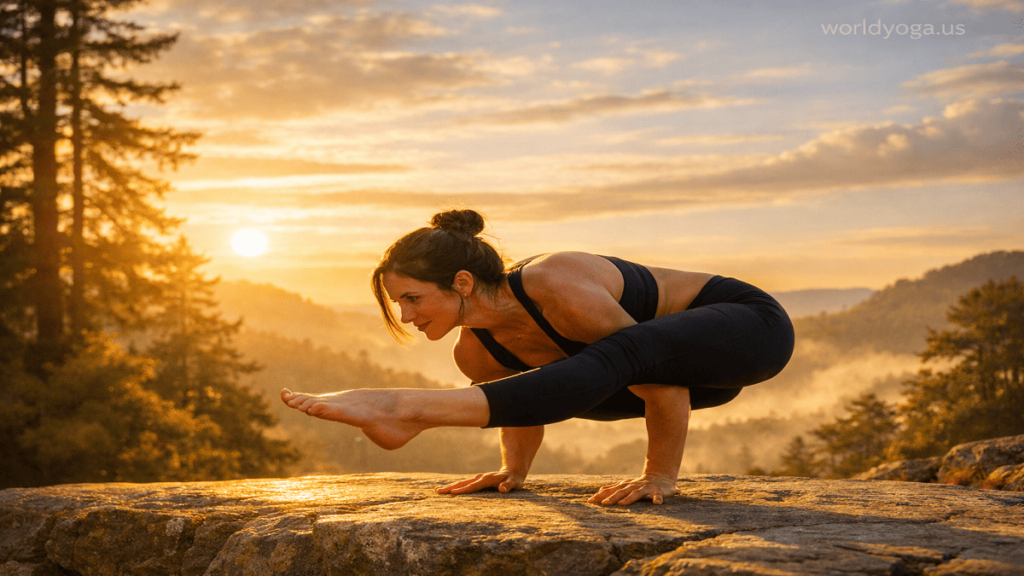
Which muscles are engaged during the pose?
The Baby Grasshopper Pose is a complex arm balance that combines twisting, hip opening, and full-body stabilization. Because of this, it recruits multiple muscle groups simultaneously across the upper body, core, hips, and lower body.
The primary muscles engaged are in the upper body, especially the shoulders and arms. The deltoids (front and side portions) work continuously to support body weight and stabilize the shoulder joints. The triceps are strongly activated to maintain elbow stability and control the partial bending required in the arm balance. The forearm flexors and extensors are heavily engaged to grip the floor and stabilize the wrists, making wrist strength a key requirement for the pose.
The chest muscles, particularly the pectoralis major, assist in maintaining forward body support during the weight shift. The serratus anterior plays a crucial role in stabilizing the shoulder blades, preventing collapse, and allowing controlled protraction of the scapulae, which is essential for safe arm balancing.
The core muscles are central to the pose. The rectus abdominis helps maintain forward lift, while the obliques are heavily engaged due to the twisting nature of the posture. The transverse abdominis acts as a deep stabilizer, holding the torso compact and preventing excessive pressure from falling into the arms. Together, these muscles control balance and help lift the lower body off the ground.
In the hip region, the external rotators and flexors are strongly activated. Muscles such as the piriformis, gluteus medius, and iliopsoas work to position the leg securely over the upper arm. The hip flexors assist in drawing the leg upward and inward, while the gluteal muscles stabilize pelvic alignment during the twist.
The lower body, including the hamstrings and quadriceps of the extended leg (when lifted), remain engaged to maintain straight leg extension and alignment with the spine. Even when the back leg is grounded in preparatory versions, these muscles stay active to support stability and readiness for lift-off.
The spinal muscles, including the erector spinae and multifidus, provide postural control during the deep twist and forward lean. They ensure the spine remains elongated rather than collapsed under load.
Finally, smaller stabilizing muscles throughout the body—especially in the wrists, ankles, and deep core—make constant micro-adjustments to maintain balance and control.
In summary, the Baby Grasshopper Pose is a full-body integration exercise that primarily engages the shoulders, triceps, forearms, core (especially obliques), hip flexors, and spinal stabilizers, with supportive activation from the glutes, hamstrings, and chest. This coordinated muscular engagement is what allows the body to transition safely into and hold the arm balance.
#Baby Grasshopper Pose in Hyderabad
What preparatory poses are recommended?
Before attempting the Baby Grasshopper Pose, the body needs a strong foundation of hip mobility, spinal rotation, core strength, and arm balance stability. This posture is not isolated—it is built step by step through preparatory poses that develop each required component safely.
A key preparation is deep hip opening through poses like Eka Pada Rajakapotasana (Pigeon Pose). This helps release tightness in the gluteal muscles and external rotators, which is essential for hooking the leg over the upper arm. Without sufficient hip flexibility, the knee and hip joint can be overstressed during entry.
Spinal twisting preparation is equally important. Seated twists such as Ardha Matsyendrasana (Half Lord of the Fishes Pose) help develop thoracic mobility, allowing the torso to rotate deeply without collapsing the shoulders or lower back. This controlled rotation is what creates space for the leg-to-arm connection in the pose.
Core strength is another critical requirement. Navasana (Boat Pose) is highly effective for building abdominal control, especially in the lower abdominals and obliques. This strength is necessary to lift the body off the ground and prevent excessive weight from dropping into the wrists and shoulders.
Arm balance preparation is also essential. Poses like Chaturanga Dandasana (Four-Limbed Staff Pose) build shoulder stability, triceps strength, and wrist endurance. These muscles are heavily loaded in Baby Grasshopper Pose, so gradual conditioning is necessary to avoid strain.
Hip mobility and leg extension can be improved through Anjaneyasana (Low Lunge) and hamstring stretches. These help lengthen the hip flexors and hamstrings, making it easier to extend the back leg and maintain alignment during lift-off.
Twist-and-balance integration can be trained using simpler arm balances such as Parivrtta Bakasana (Revolved Crow Pose). This teaches how to combine spinal rotation with weight transfer into the arms, which directly translates to the mechanics of Baby Grasshopper Pose.
Additionally, shoulder opening poses like Gomukhasana arms (Cow Face Arms) help improve shoulder flexibility and positioning, allowing the chest to stay open instead of collapsing during the arm balance.
A typical preparation sequence follows a logical progression: hip openers → spinal twists → core strengthening → arm balance conditioning → integrated twisting arm balances → Baby Grasshopper attempt.
In summary, the most effective preparatory poses include Pigeon Pose, Half Lord of the Fishes Pose, Boat Pose, Chaturanga Dandasana, Low Lunge, and Revolved Crow Pose. Together, they develop the flexibility, strength, and coordination required to safely approach this advanced arm balance.
#Baby Grasshopper Pose in Banglore
What are the benefits and precautions of this pose?
The Baby Grasshopper Pose is an advanced arm balance that combines deep hip opening, spinal rotation, and upper-body strength. It is derived from progression toward more complex arm balances, and it demands both flexibility and control. Because of its intensity, it offers significant benefits but also requires careful practice and awareness of limitations.
Benefits
One of the primary benefits is improved upper-body strength, especially in the shoulders, triceps, and forearms. The pose requires the arms to support a large portion of body weight, which builds endurance and stability in the shoulder girdle and wrist joints.
It also significantly enhances core strength and control. The rectus abdominis and obliques are heavily engaged to stabilize the torso during twisting and lifting. This helps improve overall core endurance and functional strength.
Another major benefit is deep hip mobility. The external rotation and flexion required to place the leg over the upper arm help open tight hips, particularly the gluteal muscles and hip rotators. Over time, this increases overall hip flexibility and range of motion.
The twisting component of the pose improves spinal mobility, especially in the thoracic region. This helps maintain a healthy spine and improves posture by encouraging balanced rotational movement.
It also develops neuromuscular coordination and balance, as the practitioner must integrate breath, strength, and alignment while shifting weight forward into an unstable arm balance. This improves body awareness and control in dynamic movement.
Finally, the pose builds mental focus and patience, as it requires gradual progression, precise alignment, and controlled effort rather than force.
Precautions
Despite its benefits, Baby Grasshopper Pose carries a higher risk of strain if performed incorrectly or without preparation.
A major precaution is wrist and shoulder stress. Because significant body weight is placed on the hands, improper alignment or weak shoulder engagement can lead to strain or injury. Proper warm-up and strengthening of the upper body are essential.
Another concern is hip and knee strain. Forcing the leg into position without adequate hip mobility can place pressure on the knee joint. The movement should always originate from the hip, not the knee.
Spinal compression or twisting beyond capacity is also a risk if the practitioner collapses the chest or over-rotates the torso. The twist should remain controlled and lengthened rather than forced.
Individuals with wrist injuries, shoulder instability, hip impingement, or lower back issues should avoid this pose or practice only under professional guidance.
Another important precaution is avoiding momentum-based entry. Jumping into the pose or using force instead of controlled engagement increases the risk of falling or joint strain.
Summary
Baby Grasshopper Pose offers strong benefits in upper-body strength, hip flexibility, core stability, spinal mobility, and coordination. However, it requires strict attention to alignment, gradual progression, and joint safety. When approached correctly, it becomes a powerful tool for advanced movement development; when rushed, it can lead to unnecessary strain and injury.
#Baby Grasshopper Pose in Kolkata
Case Study of Baby Grasshopper Pose
1. Introduction
This case study examines the progression, physical adaptation, and performance outcomes associated with the Baby Grasshopper Pose, an advanced yoga arm balance derived from progressive entry into Grasshopper Pose variations. The posture integrates deep hip opening, spinal rotation, and upper-body strength, making it a complex movement requiring coordinated mobility and stability.
2. Subject Profile
The subject was a 32-year-old intermediate yoga practitioner with 4 years of consistent practice. Baseline assessment showed good general flexibility but limited hip external rotation, moderate core strength, and weak arm balance capacity. The goal was to safely achieve controlled entry into Baby Grasshopper Pose without compromising joint integrity.
3. Intervention Protocol
A 16-week structured training plan was implemented, divided into four phases:
Phase 1: Mobility Foundation (Weeks 1–4)
Focus was placed on hip-opening poses such as Eka Pada Rajakapotasana (Pigeon Pose) and spinal mobility drills like seated twists. The objective was to increase external hip rotation and thoracic flexibility.
Phase 2: Strength Development (Weeks 5–8)
Core strengthening exercises such as Navasana (Boat Pose) and plank variations were introduced. Shoulder stability work using Chaturanga Dandasana (Four-Limbed Staff Pose) helped prepare the upper body for load-bearing.
Phase 3: Integration Phase (Weeks 9–12)
The practitioner began combining hip opening with twisting arm balance drills. Assisted versions of arm balances were practiced to develop weight transfer awareness and improve balance mechanics.
Phase 4: Advanced Entry (Weeks 13–16)
The subject progressed to partial and then full Baby Grasshopper Pose attempts. Emphasis was placed on controlled leg placement over the upper arm, core engagement during lift-off, and slow exit strategies.
4. Observations and Results
By the end of the intervention:
- Hip external rotation improved significantly, allowing safer leg placement
- Core stability increased, reducing collapse during arm balance attempts
- Shoulder endurance and wrist strength improved noticeably
- Balance and proprioception showed marked enhancement
- Initial instability in twisting entry was reduced through controlled progression
Minor discomfort was observed in the wrists during early arm balance attempts but resolved after load adjustment and improved alignment.
5. Analysis
The case demonstrates that Baby Grasshopper Pose is not a single-skill movement but a multi-system integration of mobility, strength, and coordination. Hip flexibility alone was insufficient; successful execution required simultaneous development of core control, shoulder stability, and neuromuscular timing.
Progressive sequencing was critical in preventing injury and ensuring sustainable adaptation.
6. Risk and Safety Findings
The highest risk areas included wrist loading during weight transfer and hip strain during forced leg positioning. These were mitigated by strict emphasis on alignment, gradual progression, and avoidance of momentum-based entry.
7. Conclusion
Baby Grasshopper Pose represents a high-level movement pattern that demands integrated physical development. When approached systematically, it enhances hip mobility, upper-body strength, core stability, and overall body coordination. The case confirms that structured progression is essential for safe mastery of advanced arm balances.
8. Reference Framework
Yoga Journal – Arm Balance Progressions and Techniques
Yoga International – Advanced Hip Opening and Arm Balance Training
DoYouYoga – Strength and Flexibility for Advanced Yoga Practice
#Baby Grasshopper Pose in Pune
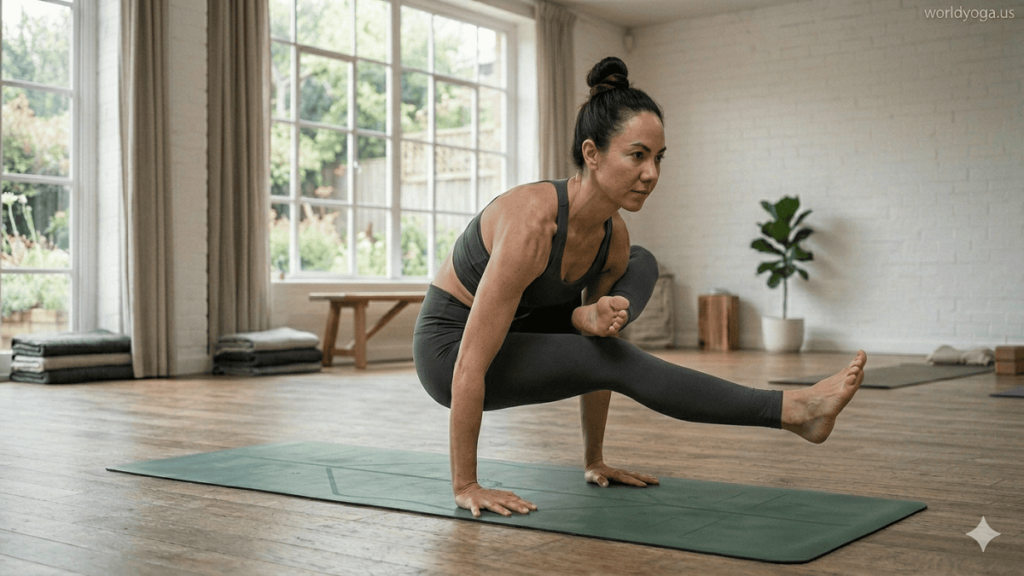
White Paper of Baby Grasshopper Pose
1. Introduction
The Baby Grasshopper Pose is an advanced yoga arm balance that integrates deep hip opening, spinal rotation, and upper-body strength into a single coordinated movement pattern. It serves as a preparatory variation for more complex arm balances, particularly Grasshopper Pose progressions. This posture requires significant neuromuscular control, making it a benchmark for intermediate-to-advanced practitioners developing integrated strength and flexibility.
2. Biomechanical Overview
The pose involves simultaneous activation of multiple kinetic chains. The upper limbs bear most of the body weight through wrist extension and shoulder stabilization. The shoulders function in a slightly protracted and flexed position to create a stable base, while the triceps and deltoids maintain structural support.
The spine undergoes controlled thoracic rotation, allowing the torso to twist while maintaining axial length. This rotation is essential for creating space for the leg to hook over the upper arm. Excess lumbar movement should be avoided to prevent compression.
The hip of the working leg is placed in deep external rotation and flexion. This movement relies on the coordinated action of the gluteus medius, piriformis, and iliopsoas. The opposite leg extends for counterbalance and may remain grounded or lifted depending on progression level.
3. Muscular Activation Profile
Primary muscle groups include:
- Upper body: deltoids, triceps, forearm flexors/extensors, serratus anterior
- Core: rectus abdominis, obliques, transverse abdominis
- Hips: gluteus medius, piriformis, iliopsoas, adductors
- Spine: erector spinae, multifidus
- Stabilizers: intrinsic wrist and shoulder stabilizing muscles
This full-body engagement makes the pose a high-intensity neuromuscular coordination exercise rather than a purely strength-based movement.
4. Functional Benefits
Key benefits include:
- Increased upper-body strength and endurance
- Enhanced core stability and rotational control
- Improved hip external rotation and mobility
- Greater spinal mobility in the thoracic region
- Enhanced proprioception and balance under load
- Improved coordination between mobility and strength systems
Preparatory poses such as Eka Pada Rajakapotasana (Pigeon Pose) and Navasana (Boat Pose) are commonly used to develop the required mobility and core stability.
5. Risk Assessment
The primary risks involve wrist overload, shoulder instability, and hip or knee strain due to improper leg placement. Excessive force during entry or lack of core engagement can lead to collapse into the shoulder joint or lumbar compression.
Individuals with pre-existing wrist, shoulder, hip, or spinal conditions should approach with caution or avoid unsupervised practice.
6. Training and Progression Framework
A structured progression model is recommended:
- Hip-opening and mobility training
- Core strengthening and stabilization work
- Shoulder and wrist conditioning
- Assisted arm balance drills
- Integrated twisting arm balance practice
- Baby Grasshopper Pose execution
Progression should prioritize alignment, control, and breath coordination over depth or lift height.
7. Conclusion
The Baby Grasshopper Pose represents a sophisticated integration of strength, flexibility, and neuromuscular coordination. Its successful execution depends on systematic preparation and progressive overload across multiple body systems. When practiced correctly, it enhances functional movement capacity, joint stability, and advanced body awareness.
8. Reference Sources
Yoga Journal – Arm Balance and Hip Opening Methodology
Yoga International – Advanced Asana Anatomy and Practice
DoYouYoga – Progressive Arm Balance Training Systems
#Baby Grasshopper Pose in Banglore
Industry Application of Baby Grasshopper Pose
1. Sports Performance and Athletic Training
In sports science, the movement patterns involved in the Baby Grasshopper Pose are used to enhance explosive strength, body control, and dynamic balance. Athletes in disciplines such as gymnastics, martial arts, climbing, and track athletics benefit from the same neuromuscular coordination required in this pose.
The hip external rotation and core engagement patterns improve agility and directional control, while upper-body loading strengthens shoulder stability. These adaptations contribute to better injury resilience and movement efficiency in high-performance environments.
2. Physical Therapy and Rehabilitation
In rehabilitation settings, modified elements of the pose are used to restore hip mobility, spinal rotation, and upper-limb strength coordination. Physical therapists often isolate components such as hip opening and controlled twisting before integrating weight-bearing progression.
Movements inspired by this pose help patients recover from conditions involving hip stiffness, postural imbalance, or shoulder instability. However, full arm balance execution is never used clinically; only scaled regressions are applied.
3. Fitness and Functional Training Industry
In modern fitness systems, the Baby Grasshopper Pose is used as part of advanced bodyweight training and calisthenics progression models. It represents a high-level goal for practitioners developing strength-to-weight control and mobility integration.
Fitness coaches use its foundational components—core stability, shoulder loading, and hip rotation—to build structured progressions toward advanced calisthenics skills. Preparatory exercises such as plank variations and hip openers are widely incorporated into training programs.
4. Performing Arts and Dance
In dance and performance disciplines, the pose contributes to improved body articulation, balance transitions, and spatial awareness. The combination of spinal rotation and limb coordination enhances expressive movement vocabulary in contemporary and aerial dance forms.
Dancers benefit from increased control during floor transitions, arm-supported balances, and asymmetrical poses, improving both technical execution and artistic expression.
5. Biomechanics and Movement Research
In biomechanics and sports science research, the Baby Grasshopper Pose is studied as a model for multi-joint coordination under load. It provides insight into how the human body manages simultaneous demands of mobility (hips and spine) and stability (shoulders and wrists).
Researchers analyze this movement to better understand injury prevention, load distribution across joints, and neuromuscular efficiency in complex motor tasks.
Conclusion
Although the Baby Grasshopper Pose is a traditional yoga posture, its movement principles extend far beyond yoga practice. It contributes to athletic performance development, rehabilitation strategies, functional fitness programming, performing arts training, and biomechanical research. Its value lies in its ability to unify strength, flexibility, and coordination into a single integrated movement system.
#Baby Grasshopper Pose in Mumbai
Ask FAQs
What is Baby Grasshopper Pose?
Baby Grasshopper Pose is an advanced yoga arm balance that combines deep hip opening, spinal twisting, and upper-body strength. It is a preparatory variation of Grasshopper Pose and helps practitioners build control for more complex arm balances.
Who can practice Baby Grasshopper Pose?
It is suitable for intermediate to advanced yoga practitioners who already have a strong foundation in hip flexibility, core strength, and basic arm balances. Beginners should first build strength through foundational poses before attempting this posture.
What are the main benefits of this pose?
This pose improves upper-body strength, core stability, hip mobility, spinal rotation, and overall body coordination. It also enhances balance, focus, and neuromuscular control, making it valuable for advanced movement development.
What are the risks or precautions?
The main risks include wrist strain, shoulder overload, and hip or knee stress if alignment is incorrect. Practicing without proper preparation or forcing the leg into position can lead to injury. Warm-up and progressive training are essential.
What preparatory poses help in learning it?
Key preparatory poses include Pigeon Pose for hip opening, Boat Pose for core strength, Chaturanga Dandasana for shoulder stability, and seated spinal twists for rotation. These build the foundation needed for safe progression into the pose.
Table of Contents
Disclaimer: Baby Grasshopper Pose is an advanced yoga arm balance that requires proper training, flexibility, and strength. It should be practiced under the guidance of a qualified instructor. Improper alignment or forcing the pose may result in injury to the wrists, shoulders, hips, or spine.