Squat: Heels Down-Arms Below Head
Squat: Heels Down–Arms Below Head is a deep functional yoga and mobility-based squat variation that focuses on full-foot grounding, hip flexibility, spinal stability, and overhead arm positioning. It is often used in mobility training, yoga conditioning, and functional movement systems to improve lower-body strength, ankle flexibility, and postural control.
Unlike traditional gym squats, this variation emphasizes mobility, alignment, and balance rather than load or resistance.
Technique and Execution
1. Starting position
Stand with feet slightly wider than hip-width apart. Turn the toes slightly outward if needed for comfort. Keep the spine tall and shoulders relaxed.
2. Lower into a deep squat
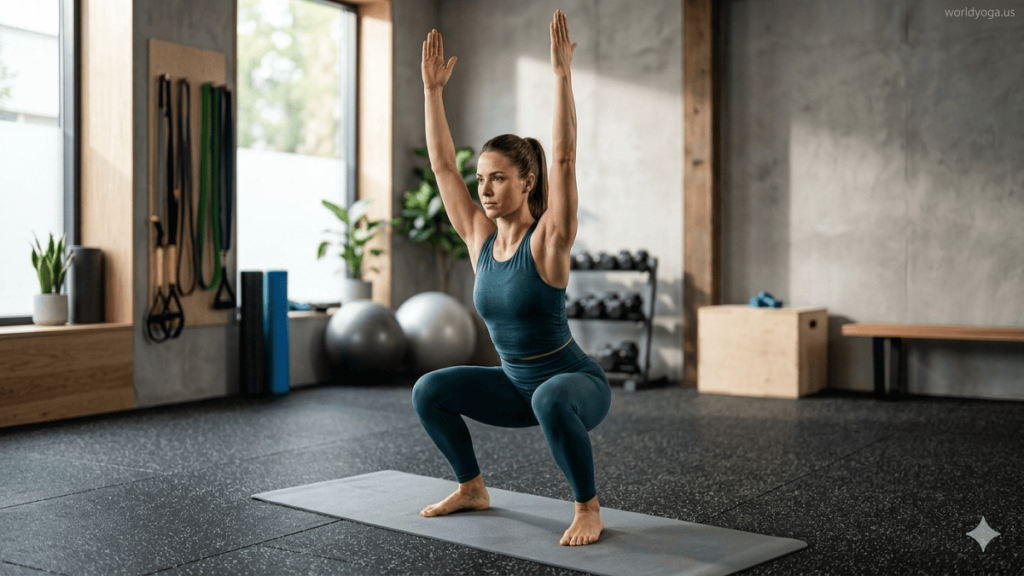
Slowly bend the knees and lower the hips toward the floor while keeping the heels grounded. The goal is to maintain full-foot contact without lifting the heels.
This requires adequate ankle dorsiflexion and hip mobility. If needed, a small adjustment in stance width can help maintain balance.
3. Heel-down alignment
Ensure:
- Heels remain firmly on the ground
- Weight is evenly distributed across both feet
- Knees track in line with toes (not collapsing inward)
This is a key stability marker in the pose.
4. Arm positioning (below head variation)
Once stable in the squat:
- Extend both arms upward
- Keep arms slightly forward or directly above the head
- Maintain relaxed shoulders (avoid shrugging)
- Keep elbows soft, not locked
This overhead reach challenges balance and improves thoracic spine mobility.
5. Spine and core control
- Maintain a neutral or slightly elongated spine
- Avoid excessive rounding of the lower back
- Engage the core gently for stability
- Keep chest open and lifted
Muscles engaged
This movement activates multiple muscle groups:
- Quadriceps (primary support in squat position)
- Gluteus maximus (hip stability and control)
- Hamstrings (eccentric stabilization)
- Calves and ankle stabilizers (heel grounding)
- Core muscles (transverse abdominis, obliques)
- Shoulder stabilizers (deltoids, trapezius during arm lift)
Benefits
1. Improves ankle mobility and balance
Maintaining heels down in a deep squat enhances ankle dorsiflexion and foot stability.
2. Strengthens lower body
Builds functional strength in quads, glutes, and hamstrings.
3. Enhances spinal and shoulder mobility
The overhead arm position improves thoracic extension and shoulder flexibility.
4. Supports posture and core control
Encourages upright alignment and core engagement under load.
5. Functional movement training
Improves everyday movement patterns such as sitting, lifting, and bending.
Precautions
- Avoid if you have knee pain or instability
- Use support under heels if ankle mobility is limited
- Do not force full depth if the spine rounds excessively
- Keep weight balanced to prevent backward tipping
- Avoid locking the knees or overextending shoulders
Related preparation poses
Helpful preparatory movements include:
- Malasana for hip opening and squat conditioning
- Downward-Facing Dog for hamstring and calf flexibility
#Squat: Heels Down-Arms Below Head in Maharashtra
How is Squat with heels down and arms below head performed correctly?
The Squat: Heels Down–Arms Below Head is a deep mobility and functional strength posture that requires coordinated control of the ankles, knees, hips, spine, and shoulders. Correct execution depends on maintaining full-foot grounding while keeping the spine stable and the arms actively supported overhead.
This variation is closely related in movement pattern to Malasana, but adds an upper-body overhead extension that increases balance and spinal engagement demands.
1. Starting stance
Begin by standing upright:
- Feet slightly wider than hip-width
- Toes turned slightly outward (as comfort allows)
- Weight evenly distributed across both feet
- Spine tall, chest open, shoulders relaxed
Avoid locking the knees or leaning forward before starting the squat.
2. Controlled descent into squat
Slowly bend the knees and lower the hips toward the ground:
- Keep the heels fully grounded at all times
- Allow hips to move downward and slightly backward
- Track knees in line with toes (avoid inward collapse)
- Maintain steady, controlled movement without dropping quickly
The goal is a stable deep squat rather than a forced depth.
3. Heel-down alignment (critical element)
Proper heel contact is essential:
- Heels stay firmly pressed into the ground
- Feet remain stable without rocking forward
- If heels lift, reduce depth or widen stance slightly
This ensures proper ankle engagement and reduces knee strain.
4. Spine and torso position
Once in the squat:
- Keep the spine elongated, not rounded
- Chest remains open and lifted
- Core engages gently for stability
- Avoid collapsing the lower back inward
Think of stacking the torso over the pelvis rather than folding forward.
5. Arm positioning (below head extension)
Raise the arms once stable in the squat:
- Extend both arms upward above or slightly in front of the head
- Keep shoulders relaxed (no shrugging toward ears)
- Elbows soft, not locked
- Palms can face each other or forward depending on comfort
This overhead reach adds balance challenge and upper spine activation.
6. Breathing and control
Breath is key for stability:
- Inhale to lengthen the spine
- Exhale while settling deeper into the squat
- Maintain slow, steady nasal breathing
- Avoid breath holding during balance effort
7. Key alignment checkpoints
Correct posture includes:
- Heels grounded
- Knees aligned with toes
- Spine neutral and elongated
- Core gently engaged
- Arms active but relaxed overhead
- Weight evenly distributed
Common mistakes to avoid
- Heels lifting off the ground
- Knees collapsing inward
- Rounding the lower back
- Overarching the spine to compensate
- Tension in shoulders or neck
- Holding breath during effort
Modifications for safety
- Place a folded mat under heels if ankle mobility is limited
- Reduce squat depth if spine rounds
- Widen stance for better balance
- Keep arms slightly forward instead of fully overhead if needed
Related preparatory movement
Practicing Downward-Facing Dog helps improve calf flexibility, ankle mobility, and hamstring length, making the squat easier to perform with proper heel grounding.
Summary
Correct execution of the Squat: Heels Down–Arms Below Head requires stable heel contact, aligned knees, an elongated spine, and controlled overhead arm extension. The posture should feel grounded, balanced, and steady—not forced or strained.
#Squat: Heels Down-Arms Below Head in Delhi
What is the proper alignment in this deep squat variation?
Proper alignment in the Squat: Heels Down–Arms Below Head focuses on maintaining a stable base through the feet, controlled knee tracking, a neutral spine, and an active but relaxed overhead reach. The posture combines deep lower-body mobility with upper-body extension, so alignment must be precise to avoid strain and maintain balance.
This squat pattern shares foundational mechanics with Malasana, but adds an overhead arm position that increases demand on spinal and shoulder stability.
1. Feet and base of support
The foundation begins with the feet:
- Feet placed slightly wider than hip-width
- Toes turned slightly outward (natural angle, not forced)
- Full contact with the ground: heel, outer edge, and ball of foot
- Weight evenly distributed across both feet
The heels must remain grounded throughout the posture. If heels lift, it indicates limited ankle mobility or excessive depth.
2. Ankle alignment
- Ankles remain neutral without collapsing inward or outward
- Shin bones tilt slightly forward as hips lower
- No rolling of the feet or instability in the arches
Strong ankle stability is essential for maintaining balance in the deep squat.
3. Knee alignment
- Knees track in the same direction as toes
- Avoid inward collapse (valgus position)
- Avoid pushing knees excessively outward
- Knees should remain soft, not locked
Proper knee tracking ensures safe load distribution through the joints.
4. Hip and pelvis alignment
- Hips lower straight down and slightly back
- Pelvis remains neutral (not excessively tucked or arched)
- Equal engagement of both hip joints
- No shifting of weight to one side
The hips act as the central stabilizer of the squat.
5. Spinal alignment
- Spine remains long and upright
- Natural curves of the spine are preserved
- No rounding in the lower back
- Chest stays open and lifted
The torso should feel stacked over the pelvis rather than collapsing forward.
6. Shoulder and arm alignment
With arms extended above or slightly in front of the head:
- Shoulders stay relaxed (not shrugged)
- Arms are active but not rigid
- Elbows remain soft, not locked
- Rib cage does not flare excessively
The overhead position should feel stable, not strained.
7. Head and neck alignment
- Head remains in line with the spine
- Chin neutral (not tilted up or dropped)
- Gaze forward or slightly downward
- Neck stays relaxed and elongated
8. Core and breath integration
- Core muscles lightly engaged for stability
- Pelvic floor subtly active for grounding
- Breath remains smooth and uninterrupted
- No breath holding during balance effort
Common alignment errors
- Heels lifting off the ground
- Knees collapsing inward
- Rounding the lower back
- Overarching ribs to compensate for arm lift
- Shoulder tension or neck stiffness
- Uneven weight distribution
Key takeaway
Proper alignment in this deep squat variation is defined by grounded heels, aligned knees, a neutral elongated spine, stable hips, and relaxed overhead arm extension. When these elements are balanced, the posture becomes stable, functional, and safe for mobility and strength development.
#Squat: Heels Down-Arms Below Head in Ahemadabad
Which muscles are engaged during the posture?
The Squat: Heels Down–Arms Below Head is a full-body, functional mobility posture that combines deep lower-body loading with upper-body stabilization. Because it involves both a deep squat and an overhead arm position, it recruits multiple muscle groups simultaneously, especially those responsible for stability, balance, and controlled mobility.
This movement shares foundational lower-body mechanics with Malasana, but adds increased demand on the core and shoulder stabilizers due to the arm elevation.
1. Lower body muscles (primary load-bearing group)
Quadriceps (front thigh)
- Control knee flexion during descent
- Maintain stability in deep squat position
- Provide strength for controlled ascent
Gluteus maximus and medius
- Support hip flexion and extension control
- Stabilize pelvis in deep squat
- Prevent hip collapse or shifting
Hamstrings
- Assist in hip stability
- Control lowering phase (eccentric activation)
- Balance knee and hip alignment
Calves (gastrocnemius and soleus)
- Maintain heel grounding
- Stabilize ankle in deep dorsiflexion
- Support balance in squat position
Hip adductors
- Stabilize inner thighs
- Help maintain knee alignment
- Assist pelvic control in deep squat
2. Core muscles (central stabilizers)
Transverse abdominis
- Provides deep abdominal stability
- Supports neutral spine under load
- Prevents excessive lumbar collapse
Rectus abdominis
- Assists in trunk stabilization
- Helps maintain upright torso position
Obliques
- Control rotational balance
- Assist in maintaining symmetry between sides
Erector spinae (lower back muscles)
- Maintain spinal extension
- Prevent rounding under squat depth
- Support upright posture against gravity
3. Hip stabilizers (control and balance)
- Deep hip rotators stabilize femur alignment
- Gluteus medius prevents knee valgus (inward collapse)
- Iliopsoas assists in controlled hip positioning
These muscles ensure safe joint alignment during deep flexion.
4. Shoulder and upper back muscles (arm extension phase)
Deltoids (especially anterior fibers)
- Support overhead arm lift
- Maintain arm elevation against gravity
Trapezius (upper and lower fibers)
- Stabilize scapulae
- Prevent shoulder collapse or shrugging
Serratus anterior
- Maintains scapular upward rotation
- Supports overhead arm positioning
Rhomboids
- Help stabilize shoulder blades
- Maintain postural control in upper back
5. Neck and postural stabilizers
- Deep cervical flexors maintain neutral head alignment
- Sternocleidomastoid assists in fine head positioning
- Suboccipital muscles stabilize head over spine
6. Nature of muscular engagement
The posture involves a combination of:
- Isometric contraction (holding squat position)
- Eccentric control (lowering into squat)
- Stabilization under load (overhead arm position)
This makes it a functional full-body stability exercise rather than a pure strength movement.
7. Related mobility context
Practicing Downward-Facing Dog helps improve ankle, calf, and hamstring flexibility, which reduces compensatory strain during deep squat positioning.
Summary
The Squat: Heels Down–Arms Below Head engages a coordinated system of lower-body strength muscles, deep core stabilizers, hip control muscles, and upper-body postural stabilizers. Its effectiveness comes from integrating strength, mobility, and balance into a single controlled movement pattern.
#Squat: Heels Down-Arms Below Head in Hyderabad
What preparatory exercises are recommended?
The Squat: Heels Down–Arms Below Head requires ankle mobility, hip flexibility, knee stability, core control, and shoulder endurance. Preparatory exercises focus on improving these movement qualities so the deep squat can be performed safely with grounded heels and stable overhead arm positioning.
This squat pattern shares foundational movement mechanics with Malasana, so most preparatory work revolves around opening the hips and improving lower-limb mobility.
1. Ankle mobility drills (for heel grounding)
Why it’s important
Limited ankle dorsiflexion is one of the main reasons heels lift in deep squats.
Recommended exercise
- Knee-to-wall ankle mobilization
- Controlled forward knee tracking over toes
- Slow repetitions with heel staying grounded
Effect
Improves tibia movement over the foot, making deep squat positioning more stable.
2. Downward-Facing Dog (calf and hamstring lengthening)
Downward-Facing Dog is a key preparatory posture.
Benefits
- Stretches calves and Achilles tendon
- Lengthens hamstrings
- Improves posterior chain flexibility
- Reduces strain during deep squat descent
Relevance
Flexible calves and hamstrings are essential for maintaining heels-down alignment.
3. Deep squat holds (assisted progression)
How it helps
Practicing supported squats builds comfort in the end range of motion.
Method
- Hold a squat with support (wall or pole)
- Keep heels grounded
- Maintain upright chest
- Start with short durations (20–60 seconds)
Benefit
Trains balance, endurance, and joint adaptation.
4. Hip opening sequence (mobility foundation)
Key exercises
- Lunging hip flexor stretches
- Low lunge variations
- Gentle lateral hip movements
Effect
- Reduces hip stiffness
- Improves squat depth control
- Prevents pelvic tilt compensation
5. Butterfly Pose (inner thigh release)
Butterfly Pose supports groin and hip flexibility.
Benefits
- Opens inner thighs (adductors)
- Improves hip external rotation
- Reduces resistance in deep squat position
Relevance
Helps maintain knee alignment during descent.
6. Core activation drills (postural stability)
Exercises
- Dead bug variations
- Gentle plank holds
- Supine pelvic tilts
Effect
- Improves trunk stability
- Prevents spinal rounding in squat
- Supports overhead arm control
7. Shoulder mobility preparation (for arm extension)
Exercises
- Arm circles
- Wall slides
- Overhead reach drills
Benefit
- Improves scapular mobility
- Reduces shoulder tension in overhead position
- Supports stable arm alignment
Suggested preparation flow
- Ankle mobility drills
- Downward-Facing Dog
- Butterfly Pose
- Hip opening lunges
- Core activation drills
- Assisted deep squat holds
- Shoulder mobility work
Key takeaway
Effective preparation for this squat variation focuses on ankle flexibility, hip openness, core stability, and shoulder mobility. When these systems are properly trained, the squat becomes more stable, safer, and easier to hold with grounded heels and controlled overhead arm positioning.
#Squat: Heels Down-Arms Below Head in Pune
What are the benefits and precautions of this squat variation?
The Squat: Heels Down–Arms Below Head is a functional mobility posture that combines deep lower-body flexion with overhead arm extension. It develops strength, balance, and joint mobility simultaneously, making it useful in yoga conditioning, functional fitness, and movement training systems.
Because it places the body in a deep loaded position, correct technique is essential to gain benefits safely.
Benefits of the posture
1. Improves ankle mobility and stability
Keeping the heels grounded in a deep squat requires strong ankle dorsiflexion. Regular practice improves ankle flexibility, joint control, and balance in weight-bearing positions.
This is especially useful for individuals with stiffness from prolonged sitting.
2. Strengthens lower body muscles
The posture engages multiple major muscle groups:
- Quadriceps for knee control
- Gluteus maximus for hip stability
- Hamstrings for controlled lowering
- Calves for ankle support
This builds functional strength useful for daily movements like sitting, lifting, and bending.
3. Enhances hip flexibility and mobility
Deep squat positioning increases hip joint range of motion and improves external rotation control. This helps reduce stiffness in the hips and lower back.
It also supports healthier movement patterns in walking and squatting.
4. Develops core stability and posture control
The upright spine combined with squat depth requires continuous core engagement.
- Transverse abdominis stabilizes the trunk
- Obliques maintain balance
- Erector spinae supports spinal extension
This improves postural endurance and spinal control.
5. Improves shoulder mobility and upper body coordination
The overhead arm position activates shoulder stabilizers and improves thoracic spine mobility.
It supports:
- Better overhead reach
- Improved scapular control
- Reduced upper-back stiffness
6. Enhances functional movement patterns
The posture replicates natural human movement patterns such as squatting, lifting, and reaching. This improves coordination between lower and upper body systems.
Precautions and safety considerations
1. Knee stress or instability
Deep squatting can stress the knees if alignment is poor.
- Avoid knees collapsing inward
- Do not force depth if pain is present
- Keep knees aligned with toes
2. Limited ankle mobility
If ankles are tight, heels may lift, increasing strain on knees and lower back.
- Use heel support if needed
- Reduce squat depth
- Gradually build flexibility
3. Lower back strain
Rounding or over-arching the spine can cause discomfort.
- Maintain a neutral spine
- Engage core gently
- Avoid collapsing forward
4. Shoulder or neck tension
Overhead arm positioning may cause strain if mobility is limited.
- Avoid shrugging shoulders
- Keep arms slightly forward if needed
- Do not lock elbows
5. Balance risk
Deep squat positions can reduce stability.
- Practice near a wall if needed
- Move slowly into and out of the pose
- Avoid sudden shifts in weight
Related preparation support
Practicing Downward-Facing Dog helps improve calf, hamstring, and ankle flexibility, making it easier to maintain heel contact and stable squat depth.
Key takeaway
The Squat: Heels Down–Arms Below Head offers strong benefits for lower-body strength, ankle mobility, hip flexibility, core stability, and shoulder coordination. However, it requires careful attention to joint alignment, controlled depth, and proper mobility preparation to avoid strain and ensure safe practice.
#Squat: Heels Down-Arms Below Head in Kolkata
Case Study of Squat: Heels Down-Arms Below Head
1. Background
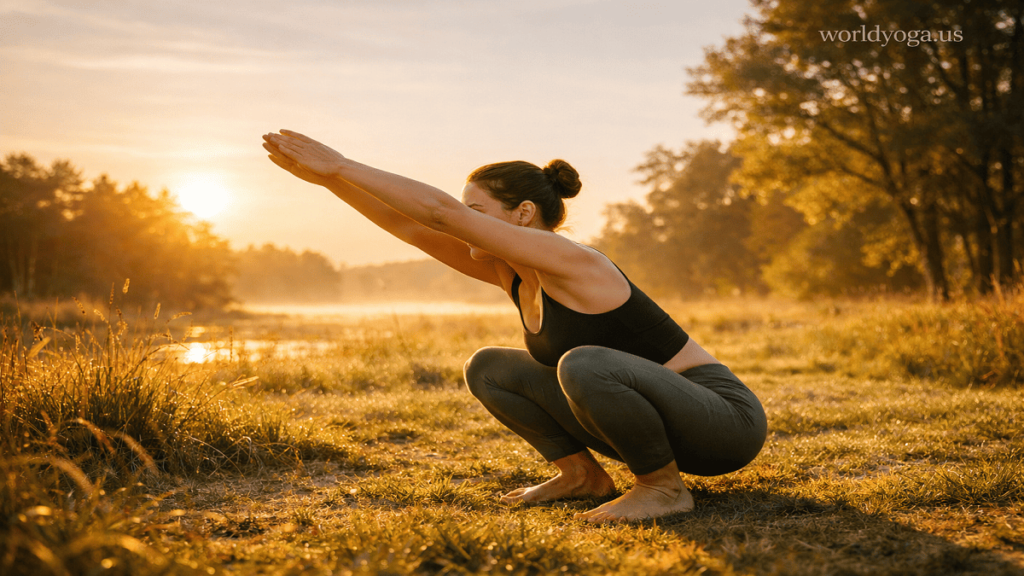
This case study examines the application of Squat: Heels Down–Arms Below Head as a functional mobility and corrective movement exercise used in a structured training program. The posture combines deep lower-body flexion with overhead arm extension, making it useful for improving ankle mobility, hip flexibility, spinal control, and overall movement coordination.
The intervention was designed for individuals with sedentary lifestyles experiencing reduced lower-limb mobility, poor squat mechanics, and postural stiffness.
The movement shares foundational mechanics with Malasana, but adds an upper-body overhead component that increases stability demands.
2. Participant profile
The participant was a 32-year-old office worker reporting:
- Difficulty performing deep squats with heels grounded
- Tight calves and hamstrings
- Mild lower back stiffness after long sitting hours
- Reduced shoulder mobility during overhead reach
No acute injuries were present, but functional movement limitations were observed.
3. Intervention protocol
The program lasted 5 weeks, with 4 sessions per week (25–35 minutes each). Each session included:
Preparatory phase:
- Downward-Facing Dog for posterior chain flexibility
- Hip opening lunges for mobility
- Bodyweight squat practice with support
Main intervention:
- Squat: Heels Down–Arms Below Head
- Progression from supported to unsupported holds
- Hold duration increased from 20 seconds to 2 minutes
- Focus on heel grounding, spinal alignment, and overhead control
4. Observations and progression
Week 1–2
- Heels frequently lifted during squat descent
- Limited ankle dorsiflexion noted
- Shoulder tension during overhead arm position
- Early improvement in body awareness
Week 3–4
- Improved heel contact and squat depth
- Reduced knee instability
- Better coordination between breathing and movement
- Increased shoulder comfort in overhead position
Week 5
- Stable deep squat maintained with heels grounded
- Improved spinal alignment and core control
- Noticeable increase in lower-body endurance
- Smoother transition into squat and return to standing
5. Outcomes
At the end of the intervention, the following improvements were observed:
- Enhanced ankle mobility and heel-grounded squat ability
- Improved hip flexibility and depth control
- Better core stability and upright posture under load
- Reduced lower back stiffness during daily activities
- Increased overhead shoulder mobility and control
- Improved functional movement confidence
No adverse effects were reported when proper progression and alignment were maintained.
6. Discussion
The case demonstrates that Squat: Heels Down–Arms Below Head functions effectively as a functional movement re-education exercise rather than a strength-only drill. Improvements were primarily driven by neuromuscular adaptation, mobility gains, and improved coordination between lower and upper body systems.
Progressive loading and preparatory mobility work (especially Downward-Facing Dog and assisted squats) were critical in preventing strain and ensuring safe adaptation.
The study also highlights the importance of ankle mobility as a limiting factor in deep squat performance.
7. Limitations
- Small sample size
- Self-reported mobility improvements
- No biomechanical measurement tools used
- Results dependent on consistency of practice
8. Conclusion
Squat: Heels Down–Arms Below Head is an effective functional mobility posture for improving lower-body flexibility, postural stability, and full-body coordination when integrated into a structured progression plan. Its benefits are maximized when combined with preparatory mobility drills and gradual load adaptation.
Further controlled studies are recommended to quantify its long-term effects on joint mobility, posture, and functional strength.
References
- Yoga Journal – Movement and Mobility Resources
- International Association of Yoga Therapists
- Yoga Alliance Educational Standards
- National Center for Complementary and Integrative Health
#Squat: Heels Down-Arms Below Head in Banglore
White Paper of Squat: Heels Down-Arms Below Head
Abstract
The Squat: Heels Down–Arms Below Head is a functional mobility and stability posture that integrates deep lower-body flexion with controlled overhead arm extension. It is widely used in yoga conditioning, corrective exercise, and movement re-education systems to improve ankle mobility, hip flexibility, spinal alignment, and neuromuscular coordination. This white paper analyzes its biomechanical structure, muscle activation patterns, physiological effects, applications in training and rehabilitation contexts, and associated safety considerations.
1. Introduction
Modern sedentary behavior has led to widespread limitations in ankle dorsiflexion, hip mobility, and squat mechanics. The Squat: Heels Down–Arms Below Head addresses these dysfunctions by combining full-foot grounding with upright spinal control and overhead reach integration.
It shares foundational movement mechanics with Malasana, but introduces additional upper-body loading through arm elevation, increasing postural and stability demands.
2. Biomechanical framework
Key structural components:
- Deep knee and hip flexion under bodyweight load
- Full plantar foot contact (heel, midfoot, forefoot)
- Neutral to elongated spinal alignment
- Overhead shoulder flexion with scapular stability
Movement objectives:
- Improve closed-chain lower limb mobility
- Enhance ankle dorsiflexion range
- Develop upright trunk control under load
- Integrate upper and lower body coordination
3. Musculoskeletal activation profile
Lower body
- Quadriceps: eccentric and isometric control in squat depth
- Gluteus maximus: hip stabilization and extension support
- Hamstrings: posterior chain control and balance
- Calves (gastrocnemius/soleus): ankle stability and heel grounding
- Hip adductors: knee alignment and pelvic stabilization
Core system
- Transverse abdominis: deep trunk stabilization
- Obliques: rotational and lateral balance control
- Erector spinae: spinal extension maintenance
Upper body
- Deltoids: overhead arm support
- Trapezius (upper/lower): scapular positioning
- Serratus anterior: upward scapular rotation control
- Rhomboids: postural stabilization
4. Physiological and functional effects
4.1 Mobility enhancement
Improves ankle dorsiflexion, hip joint range of motion, and thoracic spine extension.
4.2 Neuromuscular coordination
Enhances integrated control between lower limb stability and upper limb reach mechanics.
4.3 Postural adaptation
Encourages upright spinal alignment and reduces compensatory lumbar flexion patterns.
4.4 Functional movement transfer
Improves real-world movement efficiency in squatting, lifting, and reaching tasks.
5. Applications in industry
5.1 Yoga and movement therapy
Used in corrective sequencing to retrain squat mechanics and postural alignment.
5.2 Fitness and strength conditioning
Serves as a low-load mobility-strength hybrid for functional training programs.
5.3 Rehabilitation and corrective exercise
Applied in early-stage movement restoration for ankle, hip, and core dysfunction.
5.4 Workplace wellness
Used in short movement breaks to counteract prolonged sitting effects.
Organizations such as International Association of Yoga Therapists recognize similar posture-based interventions in therapeutic yoga frameworks.
6. Contraindications and precautions
High-risk considerations:
- Knee instability or acute joint injury
- Severe ankle dorsiflexion restriction
- Lumbar disc pathology or acute lower back pain
- Shoulder impingement or limited overhead mobility
Common risks:
- Heel lift causing forward imbalance
- Lumbar rounding under deep squat load
- Shoulder elevation and neck tension
- Loss of balance in deep flexion
Safety guidelines:
- Use support (wall or prop) if needed
- Reduce squat depth for beginners
- Prioritize heel grounding over depth
- Maintain controlled breathing throughout
7. Implementation protocol
A structured training sequence typically includes:
- Ankle mobility drills
- Posterior chain stretching (e.g., Downward-Facing Dog)
- Assisted deep squat holds
- Progressive full squat practice
- Integration of overhead arm extension
- Controlled hold and breath training
8. Discussion
The posture functions primarily as a functional movement integration tool, combining mobility, stability, and neuromuscular control. Its effectiveness depends on gradual progression and preparatory mobility work rather than static endurance alone.
9. Conclusion
The Squat: Heels Down–Arms Below Head is a highly effective functional movement posture for improving lower-body mobility, core stability, spinal alignment, and upper-limb coordination. When applied correctly, it serves as a bridge between mobility training, corrective exercise, and yoga-based movement systems.
Further research is needed to quantify its long-term effects on joint health, postural correction, and functional performance outcomes.
References
- Yoga Journal – Movement and Mobility Research
- International Association of Yoga Therapists
- Yoga Alliance Standards
- National Center for Complementary and Integrative Health
#Squat: Heels Down-Arms Below Head in Mumbai
Industry Application of Squat: Heels Down-Arms Below Head
The Squat: Heels Down–Arms Below Head is a functional mobility and stability exercise used across multiple industries that focus on movement efficiency, injury prevention, rehabilitation, and performance training. Its value lies in combining deep lower-body flexion, full-foot grounding, core engagement, and overhead shoulder integration in a single controlled pattern.
This movement shares foundational mechanics with Malasana, while adding an overhead reach component that increases demand on balance, spinal alignment, and shoulder stability.
1. Fitness and strength conditioning industry
In fitness programming, this squat variation is used as a mobility-strength hybrid exercise.
Key applications:
- Functional lower-body strength development
- Ankle and hip mobility training
- Bodyweight conditioning circuits
- Balance and coordination drills
It is especially useful in beginner-to-intermediate programs where joint control and movement quality are prioritized over external loading.
2. Yoga and movement therapy industry
Within yoga and therapeutic movement systems, the posture is used to improve:
- Deep squat accessibility
- Pelvic alignment awareness
- Spinal extension control
- Breath-movement coordination
Organizations such as International Association of Yoga Therapists recognize similar functional postures in therapeutic sequencing for musculoskeletal and postural correction.
It is often integrated into restorative or alignment-based yoga classes.
3. Physiotherapy and rehabilitation sector
In rehabilitation environments, this squat variation is applied for movement re-education and joint restoration.
Clinical applications:
- Postural correction for sedentary individuals
- Gradual return to squatting mechanics after inactivity
- Ankle dorsiflexion rehabilitation
- Hip mobility restoration
- Core stability retraining
It is typically introduced in a progressive, assisted format to ensure safety and control.
4. Workplace wellness and corporate health
In corporate wellness programs, the posture is used to counteract effects of prolonged sitting.
Benefits in workplace settings:
- Reduces lower back stiffness from desk work
- Improves circulation and mobility during breaks
- Enhances posture awareness
- Supports stress reduction through movement and breath
Short guided movement breaks often include this squat as part of active recovery sessions.
5. Sports performance and athletic training
Athletic programs use this squat variation for:
- Dynamic mobility enhancement
- Warm-up activation routines
- Injury prevention (especially knees and ankles)
- Functional movement pattern training
- Core and balance integration
It improves transferability to sports requiring squatting, jumping, or directional changes.
6. Education and movement training industry
In yoga teacher training and movement education systems, this posture is used to teach:
- Squat mechanics and alignment principles
- Heel grounding and ankle mobility concepts
- Integration of upper and lower body movement
- Breath coordination in loaded positions
It is often included in foundational anatomy and functional movement modules.
7. Key implementation considerations
Across industries, correct application depends on:
- Maintaining heel contact and knee alignment
- Gradual progression of squat depth
- Controlled overhead arm positioning
- Integration of preparatory mobility work (e.g., hip and ankle opening)
- Emphasis on quality of movement over intensity
Conclusion
The Squat: Heels Down–Arms Below Head is widely applied across fitness, rehabilitation, yoga therapy, workplace wellness, sports performance, and education sectors. Its versatility comes from its ability to simultaneously train mobility, stability, and coordination in a single functional movement pattern.
#Squat: Heels Down-Arms Below Head in India
Ask FAQs
What is the main purpose of this squat variation?
The primary purpose of the Squat: Heels Down–Arms Below Head is to improve functional mobility, lower-body strength, and full-body coordination. It trains ankle flexibility, hip range of motion, core stability, and shoulder control in a single integrated movement pattern.
Is it necessary to keep the heels on the ground?
Yes, keeping the heels grounded is a key alignment requirement. It ensures proper weight distribution, protects the knees, and improves ankle dorsiflexion. If heels lift, the stance should be adjusted or depth reduced until mobility improves.
What muscles are most active during this exercise?
The main muscles include the quadriceps, gluteus maximus, hamstrings, calves, and hip adductors in the lower body. The core muscles (transverse abdominis and obliques) stabilize the torso, while the shoulders, trapezius, and serratus anterior support the overhead arm position.
Can beginners safely practice this squat?
Yes, beginners can practice it safely if they start with modifications. Using a wider stance, reducing squat depth, or supporting the heels with a small elevation can help. It is important to progress gradually and avoid forcing full depth or overhead reach.
What are the common mistakes to avoid?
Common mistakes include lifting the heels, allowing knees to collapse inward, rounding the lower back, over-arching the spine, and tensing the shoulders during arm extension. Maintaining controlled breathing and proper alignment is essential for safety and effectiveness.
Table of Contents
Disclaimer: The Squat: Heels Down–Arms Below Head is a functional mobility exercise intended for general fitness, movement training, and wellness practice. It is not a substitute for medical evaluation, diagnosis, or treatment. Individuals with knee, ankle, hip, shoulder, or lower back conditions should consult a qualified healthcare professional before attempting this exercise.