Arms Spread Out Garland Pose
The “Arms Spread Out Garland Pose” is best understood as a variation of Garland Pose (Malasana), a deep yogic squat commonly practiced in Hatha and Vinyasa yoga. In this variation, the practitioner not only settles into a squat but also extends the arms outward, which enhances balance engagement, chest opening, and spinal alignment. This posture is often used in mobility training, hip-opening sequences, and grounding practices.
In its traditional form, Malasana involves squatting with feet slightly wider than hip-width apart, toes turned slightly outward, and palms joined at the chest. The extended arm variation modifies this by spreading the arms either parallel to the ground or slightly angled outward, increasing activation in the shoulders and upper back while encouraging postural awareness.
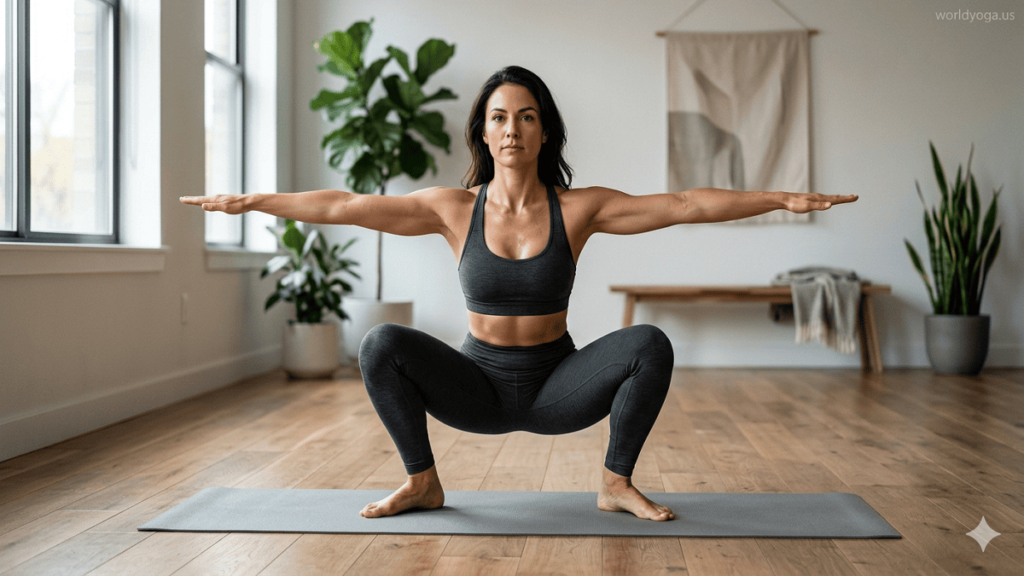
To enter the pose, begin standing with feet wider than shoulder-width. Slowly bend the knees and lower the hips toward the ground, keeping the heels grounded if possible. If heel contact is difficult, a folded mat or support can be used. Once in the squat, engage the core and lengthen the spine. Extend the arms outward at shoulder height, palms facing forward or downward. This extension helps counterbalance the lower-body depth of the squat and improves proprioception.
The pose strongly targets the hips, groin, ankles, and lower back. It also strengthens stabilizing muscles in the legs and core. The arm extension activates the deltoids, trapezius, and upper back muscles, making it a full-body engagement posture. Practicing controlled breathing is essential; slow inhalations help elongate the spine, while exhalations deepen the squat safely.
According to yoga tradition, Malasana is considered a grounding posture that supports digestion and pelvic mobility. It is also often recommended for improving ankle flexibility and relieving tension from prolonged sitting. However, individuals with knee injuries, hip impingement, or lower back conditions should approach the pose cautiously or use props for support.
From a modern anatomical perspective, the extended arm variation enhances scapular stability and improves coordination between upper and lower body chains. It is often included in functional movement training due to its ability to mimic natural human squatting mechanics.
For further understanding of the foundational pose, you may refer to detailed breakdowns such as Yoga Journal – Garland Pose Guide and anatomical references like Malasana Overview.
Overall, Arms Spread Out Garland Pose is a hybrid mobility and stability posture that combines deep lower-body engagement with upper-body activation, making it valuable for both yoga practitioners and general fitness routines focused on flexibility, posture, and functional strength.
#Arms Spread Out Garland Pose in India
How is Arms Spread Out Garland Pose performed correctly?
Arms Spread Out Garland Pose is a dynamic variation of Garland Pose (Malasana) that combines deep squatting with active upper-body engagement. Correct execution depends on alignment, controlled descent, balanced weight distribution, and coordinated breathing.
To begin, stand with your feet slightly wider than hip-width apart. The toes should point outward at an angle that feels natural for your hips, typically between 20–45 degrees. Avoid forcing excessive turnout, as this can strain the knees. Slowly bend the knees and lower the hips toward the floor into a deep squat. The goal is to bring the pelvis close to the ground while maintaining stability and control.
If the heels lift off the floor, place a folded yoga mat, wedge, or block beneath them for support. Keep the spine long rather than collapsing forward. The chest should remain open, and the torso should not round excessively.
Once you are stable in the squat, bring your arms into position. Extend them outward at shoulder height, either parallel to the ground or slightly angled downward depending on shoulder mobility. The palms may face forward or down. The key is to actively reach through the fingertips while keeping the shoulders relaxed away from the ears. This creates a balance between expansion and grounding.
Engage the core muscles gently to stabilize the lower back. The knees should track in the same direction as the toes to maintain joint safety. Weight should be evenly distributed across both feet, avoiding collapse into the inner arches.
Breathing plays an essential role. Inhale deeply to lengthen the spine and expand the chest. Exhale slowly as you deepen into the squat or maintain the position. The breath should remain steady and unforced throughout.
Common mistakes include rounding the lower back, letting the knees collapse inward, or overextending the arms with tension in the shoulders. Another frequent error is dropping the chest too far forward, which reduces spinal integrity and balance. The pose should feel stable, not strained.
Modifications are important for beginners or individuals with limited hip mobility. Sitting on a block under the hips can reduce intensity, while holding a wall or chair for balance can help maintain stability. Over time, flexibility in the hips, ankles, and lower back will improve with consistent practice.
From an anatomical perspective, this pose strengthens the quadriceps, glutes, calves, and core while opening the hips and groin. The arm extension activates the deltoids, upper back, and postural stabilizers, making it a full-body functional movement.
For additional guidance on proper alignment and traditional Garlands Pose foundations, you may refer to trusted yoga resources such as Yoga Journal – Garland Pose (Malasana) Guide and anatomical explanations at Malasana Reference Overview.
When performed correctly, Arms Spread Out Garland Pose enhances mobility, posture, balance, and body awareness through a combination of deep lower-body engagement and active upper-body extension.
#Arms Spread Out Garland Pose in Maharashtra
What is the proper alignment in this variation of Malasana?
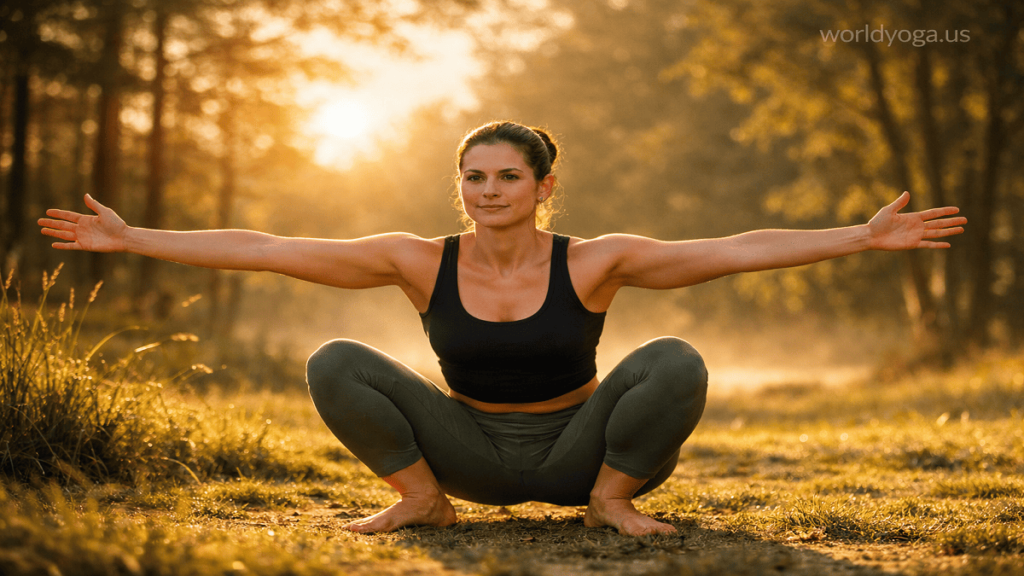
Proper alignment in the Arms Spread Out variation of Garland Pose (Malasana) focuses on maintaining joint safety, spinal neutrality, and balanced muscular engagement between the lower and upper body. Because this variation adds arm extension to a deep squat, alignment becomes even more important to prevent strain in the knees, lower back, and shoulders.
Start with the feet placed slightly wider than hip-width. The toes should turn outward just enough to match the natural external rotation of the hips. Over-rotation of the feet is a common misalignment that can stress the knees. As you lower into the squat, the knees should track directly in line with the toes. This alignment protects the knee joint and ensures proper load distribution through the legs.
The pelvis should lower toward the ground while the spine remains long and neutral. Avoid rounding the lower back or excessively tucking the pelvis under. Instead, aim for a gentle lift through the chest and crown of the head. The torso should feel supported by the core muscles, not collapsed onto the thighs.
Heels ideally stay grounded. If this is not possible due to limited ankle mobility, placing a folded mat or small wedge under the heels helps maintain stability without compromising alignment. Weight should be evenly distributed across the entire foot—heel, big toe mound, and little toe mound—avoiding collapse into the inner arches.
In the upper body, the arms are extended outward at shoulder height or slightly below. The shoulders should remain relaxed and drawn away from the ears. A key alignment cue is to keep the shoulder blades gently engaged but not squeezed together. The arms should feel active but not tense, creating a balanced extension through the fingertips.
The neck remains neutral, with the gaze forward or slightly downward depending on comfort. Avoid excessive lifting or dropping of the head, which can disrupt spinal alignment.
Breath also supports alignment: inhalation lengthens the spine and lifts the chest, while exhalation helps deepen the squat without collapsing structure. Stability should always take priority over depth.
From an anatomical perspective, correct alignment ensures proper engagement of the quadriceps, glutes, adductors, and core while reducing stress on the knees and lower back. The arm extension activates the deltoids, upper back, and postural stabilizers, promoting integrated full-body control.
For foundational reference on the base posture, you can review detailed breakdowns of Malasana at Yoga Journal – Garland Pose Alignment Guide and anatomical context at Malasana Overview.
In summary, proper alignment in this variation depends on stable knees, grounded feet, a lengthened spine, relaxed shoulders, and controlled arm extension working together to create a balanced and sustainable squat position.
#Arms Spread Out Garland Pose in Ahemadabad
Which muscles are engaged during the pose?
Arms Spread Out Garland Pose, a variation of Malasana (Garland Pose), is a compound movement that engages multiple muscle groups across the lower body, core, and upper body. Because it combines a deep squat with active arm extension, it functions as a full-body isometric and mobility posture rather than an isolated stretch.
Lower body muscles
The primary load of the pose is carried by the lower body. The quadriceps are heavily engaged to control knee flexion and maintain stability in the deep squat. The gluteus maximus and gluteus medius support hip flexion and external rotation while stabilizing the pelvis. The hamstrings assist in controlling descent and maintaining balance in the squat position.
The adductor muscle group (inner thighs) plays a significant role in stabilizing the legs and preventing the knees from collapsing inward. This is especially important in deep squatting positions like Malasana, where hip mobility is tested.
The calves (gastrocnemius and soleus) are also engaged isometrically, particularly if the heels remain grounded. If ankle flexibility is limited, these muscles may work more intensely to maintain balance.
Core and spinal stabilizers
The rectus abdominis, transverse abdominis, and obliques are activated to stabilize the torso and prevent rounding of the lower back. These muscles help maintain an upright spine in a deep squat position.
The erector spinae along the back of the spine work to keep the torso elongated and prevent collapse forward. Together, these core and spinal muscles ensure postural integrity throughout the pose.
Upper body muscles (arm extension variation)
The addition of arms spread outward increases upper-body engagement. The deltoids (shoulders) are actively engaged to hold the arms at shoulder height. The trapezius and rhomboids stabilize the shoulder blades, ensuring controlled scapular positioning without excessive tension.
The serratus anterior supports shoulder stability and helps maintain proper arm extension. The forearm muscles are lightly engaged depending on whether the palms are open or flexed.
Functional integration
This pose creates a strong kinetic chain between the lower and upper body. The hips and legs provide a stable base, while the core connects and transfers force upward to the arms. This integrated engagement improves coordination, balance, and functional strength.
From a biomechanical perspective, Malasana variations are widely used in mobility training because they improve hip external rotation, ankle dorsiflexion, and pelvic stability while simultaneously strengthening stabilizing muscle groups.
For anatomical reference on the base posture and its muscular involvement, you can refer to Yoga Journal – Garland Pose (Malasana) Guide and structural breakdowns at Malasana Overview.
Overall, this variation engages a coordinated system of lower-body strength muscles, core stabilizers, and upper-body postural muscles, making it both a strengthening and mobility-focused posture.
#Arms Spread Out Garland Pose in Hyderabad
What preparatory poses are recommended?
Arms Spread Out Garland Pose (a dynamic variation of Malasana) requires a combination of hip mobility, ankle flexibility, core stability, and shoulder opening. Because it involves a deep squat with added upper-body engagement, preparatory poses should gradually prepare the joints and muscles for both depth and stability.
Hip-opening preparatory poses
Since Malasana is primarily a deep hip-opening posture, it is essential to prepare the hip flexors, adductors, and external rotators.
- Bound Angle Pose (Baddha Konasana) helps open the inner thighs and groin, making it easier to lower into a squat.
- Butterfly Stretch gently increases adductor flexibility and reduces tension in the inner thighs.
- Low Lunge (Anjaneyasana) prepares hip flexors and improves pelvic mobility, which supports a more upright spine in the squat.
These poses improve hip external rotation, which is critical for maintaining knee alignment in Malasana.
Ankle mobility preparatory poses
Limited ankle dorsiflexion is one of the most common barriers to a stable squat.
- Heel Raises and Drops (standing calf mobilization) improve ankle range and calf flexibility.
- Downward-Facing Dog (Adho Mukha Svanasana) gently stretches the calves and Achilles tendon.
- Garland Pose with support (Malasana using a block or heels elevated) gradually builds tolerance for deeper squat positioning.
Improving ankle mobility ensures the heels can stay grounded or supported without strain.
Core and spinal preparation
A stable squat requires strong core engagement to prevent rounding of the spine.
- Cat-Cow Pose (Marjaryasana–Bitilasana) improves spinal flexibility and awareness.
- Plank Pose (Phalakasana) strengthens the core stabilizers that support upright posture in the squat.
- Seated Forward Fold (Paschimottanasana) encourages controlled spinal lengthening and hamstring flexibility.
These poses help maintain a neutral spine under load.
Shoulder and upper-body preparation
Because this variation includes arm extension, shoulder readiness is important.
- Eagle Arms (Garudasana arms) improves scapular mobility and upper back engagement.
- Thread the Needle Pose opens the posterior shoulder chain.
- Shoulder Circles and Arm Swings increase circulation and mobility in the deltoids and trapezius.
These ensure the arms can extend outward without tension or compression in the shoulders.
Integrated preparation
Before attempting the full pose, practicing a supported squat or holding Malasana with hands at the chest is often recommended. This allows the body to adjust to depth before adding arm extension.
For reference on the foundational posture and alignment principles, you may review Yoga Journal – Garland Pose Preparation Guide and anatomical background at Malasana Overview.
#Arms Spread Out Garland Pose in Delhi
What are the benefits and precautions of this pose?
Arms Spread Out Garland Pose is a functional variation of Malasana (Garland Pose) that combines a deep squat with active arm extension. Because it engages both the lower and upper body simultaneously, it offers a wide range of physical benefits but also requires careful attention to joint safety and mobility limits.
Benefits
1. Improved hip and lower-body mobility
This pose deeply opens the hips by stretching the adductors, glutes, and hip flexors. Regular practice can improve external hip rotation and overall squat depth, which is useful for daily movements like sitting and lifting.
2. Strengthening of legs and core
The deep squat position activates the quadriceps, hamstrings, and gluteal muscles, building lower-body endurance. At the same time, the core muscles (abdominals and lower back stabilizers) work continuously to maintain balance and spinal alignment, improving functional core strength.
3. Enhanced ankle flexibility and stability
Holding a deep squat encourages ankle dorsiflexion and strengthens stabilizing muscles in the feet and calves. This can improve balance and reduce stiffness from prolonged sitting.
4. Upper-body activation and posture improvement
The arm extension engages the deltoids, trapezius, and upper back muscles, helping improve shoulder stability and posture. It also encourages scapular awareness, which is beneficial for desk-related postural issues.
5. Digestive and grounding effects
Traditionally, Malasana is considered a grounding posture that may support digestion by gently compressing the abdominal region. It also promotes relaxation and body awareness through controlled breathing.
Precautions
1. Knee sensitivity or injury
People with knee pain, meniscus issues, or ligament injuries should avoid deep squatting or use support under the hips. Misalignment (knees collapsing inward) can increase joint stress.
2. Ankle and heel limitations
Limited ankle flexibility may cause the heels to lift excessively, leading to instability. Using a folded mat or heel support is recommended to maintain safe alignment.
3. Lower back strain
Rounding the lower back while in a deep squat can strain the lumbar spine. Maintaining a neutral spine and engaging the core is essential to prevent injury.
4. Hip impingement or tightness
Individuals with hip impingement or severe tightness in the groin should avoid forcing depth. The pose should be gradual, not forced.
5. Shoulder tension
Overextending or locking the arms can create strain in the shoulders and neck. The arms should remain active but relaxed, without shrugging.
Safe practice guidelines
Beginners should start with supported Malasana using blocks or wall assistance before adding arm extension. Movement should be slow and controlled, with steady breathing to maintain stability.
For foundational alignment and safe execution principles, refer to Yoga Journal – Garland Pose Guide and anatomical reference at Malasana Overview.
In summary, this pose improves lower-body mobility, core strength, and posture while promoting grounding and balance, but it must be practiced with attention to joint alignment and individual flexibility limits to avoid strain or injury.
#Arms Spread Out Garland Pose in Pune
Case Study of Arms Spread Out Garland Pose
Background
This case study examines the application of Arms Spread Out Garland Pose, a variation of Malasana (Garland Pose), in a structured mobility and functional movement program. The subject is a 34-year-old office worker with complaints of hip stiffness, reduced squat depth, and postural fatigue due to prolonged sitting (8–10 hours daily). The goal was to improve lower-body mobility, core stability, and postural control over an 8-week intervention.
Initial Assessment
At baseline, the subject demonstrated:
- Limited ankle dorsiflexion, causing heel lift during squats
- Tight hip adductors and restricted external rotation
- Weak core engagement during functional movements
- Rounded upper back posture during sitting and squatting attempts
Deep squat capacity was limited, with discomfort reported in the lower back and knees when attempting Malasana.
Intervention Protocol
The program introduced progressive preparation followed by structured practice of the Arms Spread Out Garland Pose:
- Weeks 1–2: Mobility Foundation
- Assisted squats using a wall
- Bound Angle Pose (Baddha Konasana) for hip opening
- Calf stretches and ankle mobilization drills
- Weeks 3–5: Supported Malasana Practice
- Squatting with yoga block support under hips
- Hands placed at chest for stability
- Focus on neutral spine alignment and breath control
- Weeks 6–8: Full Variation Introduction
- Transition to Arms Spread Out Garland Pose
- Arms extended at shoulder height for scapular activation
- Emphasis on even weight distribution and knee tracking
Reference alignment principles were based on standard Malasana biomechanics Yoga Journal – Garland Pose Guide and anatomical squat function analysis Malasana Overview.
Observations and Outcomes
By week 8, significant improvements were recorded:
- Hip mobility increased, allowing deeper squat depth without pain
- Ankle flexibility improved, reducing heel lift by approximately 60%
- Core stability strengthened, with improved ability to maintain upright posture
- Upper back posture improved, especially during seated work hours
- The subject reported reduced stiffness and improved movement confidence in daily activities such as lifting and bending
The arm extension variation played a key role in enhancing scapular stability and postural awareness, making the movement more functional and integrated compared to traditional squats.
Discussion
The case demonstrates that Arms Spread Out Garland Pose is not only a flexibility exercise but also a multi-joint functional movement that integrates lower-body mobility with upper-body stability. The progression strategy—starting from supported squats to full variation—was essential in preventing strain and ensuring neuromuscular adaptation.
Conclusion
Arms Spread Out Garland Pose, when introduced progressively and with proper alignment, can effectively improve hip mobility, ankle flexibility, core strength, and postural control. It is particularly beneficial for individuals with sedentary lifestyles, provided that preparatory work and modifications are respected.
#Arms Spread Out Garland Pose in Kolkata
White Paper of Arms Spread Out Garland Pose
1. Executive Summary
Arms Spread Out Garland Pose is a functional variation of Malasana (Garland Pose) used in yoga, mobility training, and corrective movement systems. It combines a deep squat with simultaneous upper-limb extension, creating a multi-joint, full-body engagement pattern. This white paper outlines its biomechanics, physiological effects, applications, and safety considerations, with emphasis on mobility development, postural control, and functional strength enhancement.
2. Background and Context
Malasana is a traditional deep squat posture widely used in yoga for hip opening and grounding. The extended arm variation increases neuromuscular demand by integrating upper-body stabilization with lower-body mobility. According to standard yoga anatomy references, Malasana primarily targets hip flexion and external rotation while promoting spinal lengthening Yoga Journal – Garland Pose Guide. Anatomically, it reflects natural human squatting mechanics essential for functional movement patterns Malasana Overview.
3. Biomechanical Analysis
This variation involves simultaneous engagement across multiple kinetic chains:
- Lower body: The quadriceps control knee flexion under load, while the gluteus maximus and medius stabilize hip positioning. The adductors regulate inward knee collapse and maintain pelvic alignment.
- Core system: The rectus abdominis, transverse abdominis, and spinal erectors maintain trunk stability and prevent lumbar flexion under compression.
- Upper body: The deltoids maintain arm elevation, while the trapezius and rhomboids stabilize scapular positioning during outward arm extension.
The pose functions as a closed-chain isometric hold with integrated upper-lower kinetic connectivity.
4. Physiological and Functional Benefits
The posture provides multi-dimensional adaptations:
- Mobility enhancement: Improves hip external rotation, ankle dorsiflexion, and thoracic extension.
- Strength development: Builds isometric endurance in quadriceps, glutes, and core stabilizers.
- Postural correction: Strengthens scapular stabilizers, reducing rounded shoulder posture.
- Neuromuscular integration: Enhances coordination between upper and lower body movement systems.
- Functional carryover: Supports daily activities such as squatting, lifting, and bending.
5. Applications
Arms Spread Out Garland Pose is applied in:
- Yoga sequencing for hip-opening flows
- Functional movement training programs
- Rehabilitation and corrective exercise protocols
- Athletic mobility conditioning
It is particularly valuable in populations with sedentary lifestyles due to its ability to counteract prolonged sitting-related stiffness.
6. Risk Factors and Contraindications
Despite its benefits, the posture requires careful implementation:
- Knee pathology: Deep flexion may aggravate meniscal or ligament injuries
- Ankle limitations: Restricted dorsiflexion may compromise stability
- Lumbar strain risk: Loss of spinal neutrality increases compressive forces
- Hip impingement: Forced depth may cause joint discomfort
- Shoulder strain: Improper arm extension may overload deltoids and neck muscles
Use of props such as blocks or heel support is recommended for modified practice.
7. Methodological Considerations
Optimal execution depends on progressive training:
- Mobility preparation (hips, ankles, shoulders)
- Supported squat adaptation
- Gradual introduction of arm extension
- Full isometric hold with breath control integration
8. Conclusion
Arms Spread Out Garland Pose represents an advanced functional variation of Malasana that integrates mobility, strength, and postural control in a single movement system. When appropriately scaled and aligned, it serves as an effective tool for improving lower-body flexibility, upper-body stability, and overall movement efficiency.
#Arms Spread Out Garland Pose in Banglore
Industry Application of Arms Spread Out Garland Pose
Arms Spread Out Garland Pose, a dynamic variation of Malasana (Garland Pose), is increasingly applied beyond traditional yoga practice in several professional sectors focused on movement efficiency, injury prevention, and human performance optimization. Its value lies in combining deep lower-body mobility with upper-body postural activation, making it a multi-system functional movement.
1. Fitness and Functional Training Industry
In strength and conditioning programs, this pose is used as a mobility-strength hybrid drill. Trainers incorporate it into warm-ups and corrective routines to improve squat mechanics and hip function.
- Enhances deep squat patterning for athletes
- Improves ankle dorsiflexion and hip external rotation
- Builds isometric endurance in quads, glutes, and core
- Used in functional training systems such as mobility circuits and movement prep sequences
Fitness professionals value it because it reinforces natural human squatting mechanics described in foundational Malasana biomechanics Yoga Journal – Garland Pose Guide.
2. Physiotherapy and Rehabilitation
In rehabilitation settings, modified versions of the pose are used for non-invasive mobility restoration.
- Helps patients recover hip and ankle range of motion
- Supports postural retraining in sedentary individuals
- Assists in knee stability re-education when performed with support
- Used cautiously in early-stage lower-limb rehabilitation programs
Clinicians often begin with supported squats before progressing to full arm extension to ensure joint safety.
3. Sports Performance and Athletics
Athletes use this variation as part of movement preparation and injury prevention systems.
- Improves explosive movement foundations (jumping, sprinting, lifting)
- Enhances hip stability for directional changes in sports
- Strengthens scapular control for overhead athletes
- Supports mobility requirements in sports like wrestling, martial arts, and football
Its integrated nature makes it useful for developing coordinated kinetic chain control rather than isolated muscle strength.
4. Corporate Wellness and Occupational Health
In workplace wellness programs, the pose is applied to counteract prolonged sitting syndrome.
- Reduces hip stiffness from sedentary desk work
- Improves postural awareness and spinal alignment
- Supports stress reduction through breath-linked movement
- Can be performed in short mobility breaks without equipment
This aligns with ergonomic health strategies that address musculoskeletal strain from modern office environments.
5. Yoga and Mind-Body Industry
Within yoga systems, the pose is used in advanced sequencing and mobility flows.
- Prepares practitioners for deeper hip-opening asanas
- Integrates upper-lower body coordination in vinyasa transitions
- Enhances grounding and body awareness in meditative movement
The foundational principles remain consistent with traditional Malasana alignment practices Malasana Overview.
Conclusion
Arms Spread Out Garland Pose has cross-industry relevance due to its combination of mobility training, strength activation, and postural correction. It is widely used in fitness, rehabilitation, sports performance, corporate wellness, and yoga systems. Its adaptability—from supported therapeutic versions to advanced athletic applications—makes it a versatile movement tool for improving functional human biomechanics across populations.
#Arms Spread Out Garland Pose in Mumbai
Ask FAQs
What is Arms Spread Out Garland Pose?
Arms Spread Out Garland Pose is a variation of Malasana (Garland Pose) where the practitioner performs a deep squat while extending the arms outward at shoulder level. It combines lower-body mobility work with upper-body activation, making it a full-body functional posture used in yoga and mobility training.
Who can practice this pose?
It is suitable for individuals with basic to moderate mobility in the hips, knees, and ankles. Beginners can practice it using support such as a yoga block under the hips or heels. However, individuals with knee injuries, hip impingement, or severe ankle limitations should modify or avoid deep squatting positions.
What are the main benefits of this pose?
The pose improves hip flexibility, strengthens the quadriceps, glutes, and core, and enhances ankle mobility. The arm extension also activates the shoulders and upper back, improving posture and scapular stability. It supports functional movement patterns like squatting, bending, and lifting.
What are common mistakes to avoid?
Common mistakes include letting the knees collapse inward, rounding the lower back, lifting the heels excessively without support, and over-tensing the shoulders during arm extension. These errors can reduce effectiveness and increase strain on the joints. Proper alignment and controlled breathing are essential.
How should beginners modify the pose?
Beginners can use a yoga block or cushion under the hips to reduce squat depth. Keeping hands at the chest instead of extending the arms can help maintain balance initially. Gradually, as hip and ankle flexibility improves, arm extension and deeper squatting can be introduced.
Table of Contents
Disclaimer: This information is for general educational and informational purposes only and is not a substitute for professional medical advice, diagnosis, or treatment. Practice yoga poses like Arms Spread Out Garland Pose only within your comfort and mobility limits. Consult a qualified healthcare professional or certified yoga instructor before beginning any new exercise program, especially if you have existing injuries or medical conditions.