
Eka Pada Baddha Malasana
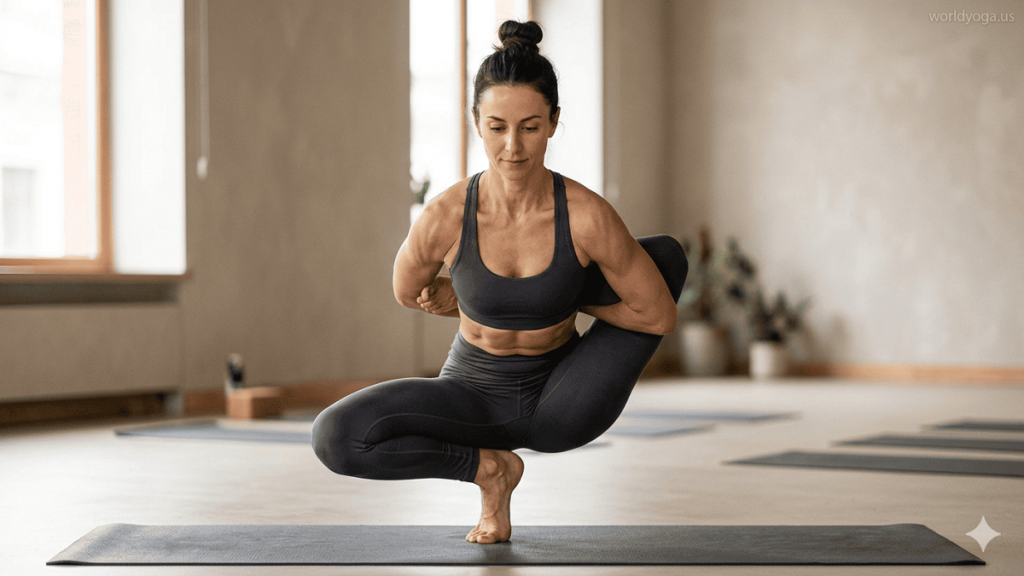
Eka Pada Baddha Malasana is a deep hip-opening yoga posture that blends grounding, balance, and flexibility into a single integrated movement. Derived from the traditional Malasana (Garland Pose), this variation introduces a bind and a one-legged extension, making it significantly more advanced. It is commonly practiced in Hatha and Vinyasa yoga traditions as part of hip mobility sequences and preparatory work for deeper forward bends and meditation postures.
In Sanskrit, “Eka Pada” means one leg, “Baddha” means bound, and “Malasana” refers to a garland or squatting posture. The pose requires a combination of strength, openness in the hips, and stability in the ankles and spine. It is typically entered from a deep squat, with one leg folded into Malasana while the other leg is extended and bound behind the back with the arms.
One of the key benefits of Eka Pada Baddha Malasana is the intense opening it creates in the hips and groin. This makes it especially valuable for individuals who spend long hours sitting, as it helps release tension in the hip flexors and lower back. It also improves mobility in the ankles and strengthens the muscles of the feet and legs due to the deep squatting position.
From an energetic perspective, this posture is believed to activate the Muladhara (root chakra), promoting a sense of grounding, stability, and emotional release. The bind adds an element of introspection, encouraging practitioners to cultivate focus and patience while maintaining balance.
However, this pose should be approached with caution. It requires a pre-existing level of hip flexibility and knee sensitivity awareness. Beginners are advised to first master Malasana and hip-opening preparatory poses such as Pigeon Pose or Bound Angle Pose before attempting this variation.
Alignment is critical in Eka Pada Baddha Malasana. The spine should remain elongated rather than rounded, the chest open, and the shoulders relaxed even while holding the bind. Breath control plays an essential role, helping the practitioner ease deeper into the posture without forcing the stretch.
Regular practice of this pose can enhance functional mobility, improve posture, and support deeper meditative seated positions.
For further reading on Malasana and hip-opening practices, you can explore:
- Yoga Journal – Yoga Poses Directory
- Yoga Basics – Squatting Pose (Malasana) Guide
- Ekhart Yoga – Hip Opening Sequences
#Eka Pada Baddha Malasana in India
How is Eka Pada Baddha Malasana performed correctly?
Eka Pada Baddha Malasana (One-Legged Bound Garland Pose) is an advanced variation of Malasana that requires controlled mobility, stability, and mindful alignment. Performing it correctly is essential to avoid strain in the knees, hips, and lower back while maximizing its benefits for flexibility and balance.
The practice begins in a deep squat position (Malasana). Stand with feet slightly wider than hip-width apart and gradually lower your hips toward the ground. Keep your heels grounded as much as possible; if they lift, a folded blanket or yoga block under the heels can provide support. The toes naturally turn slightly outward, and the knees track in the same direction as the toes to protect joint alignment.
Once stable in Malasana, shift your weight slightly onto one leg. Let’s assume the right leg remains grounded. The right thigh should stay engaged to support balance. The spine should be elongated, not rounded, and the chest gently lifted.
Next, transition into the bind. Slowly extend the opposite leg (left leg) backward, bending the knee so the foot moves toward the upper back. Reach one arm under the same-side leg (right arm under right thigh if following alignment cues depending on tradition), and the other arm reaches over the shoulder to clasp the lifted foot. This creates the “bound” position that defines the posture.
Once the bind is secured, gently lift the chest and lengthen the spine. Avoid collapsing forward or forcing the leg higher than comfortable range. The focus should remain on stability in the standing leg and openness in the hips rather than depth of the bind.
Breathing plays a crucial role. Slow, steady breaths help maintain balance and prevent unnecessary muscular tension. Hold the posture for a few seconds initially, gradually increasing duration with practice.
To release, carefully let go of the bind, return the lifted foot to the ground, and come back into a neutral Malasana before switching sides.
Common mistakes include rounding the spine, forcing the bind, or allowing the standing knee to collapse inward. These misalignments can lead to strain and reduce the effectiveness of the posture. Beginners should prioritize supported Malasana and hip-opening poses before attempting this variation.
Preparatory poses such as Malasana (Garland Pose), Baddha Konasana (Bound Angle Pose), and Eka Pada Rajakapotasana (Pigeon Pose) are highly recommended to build the required flexibility.
For additional guidance on alignment and safety, you may refer to:
- https://www.yogajournal.com/poses/
- https://www.yogabasics.com/asana/malasana/
- https://www.ekhartyoga.com/articles/practice/hip-openers
#Eka Pada Baddha Malasana in Maharashtra

What is the proper alignment in this one-legged bound squat?
Proper alignment in Eka Pada Baddha Malasana is essential because the posture combines deep hip flexion, spinal lengthening, and a binding action that challenges balance. When aligned correctly, the pose enhances hip mobility and stability without placing unnecessary stress on the knees or lower back.
The foundation begins in a stable squat similar to Malasana (Garland Pose). Feet are placed slightly wider than hip-width, with toes turned out just enough to allow the knees to track comfortably in the same direction. The weight should be evenly distributed across both feet, especially the heels. If the heels lift, using support such as a folded blanket can help maintain structural integrity without compromising alignment.
The spine is the central focus of alignment. Even in a deep squat, the back should remain long and neutral rather than rounded. The tailbone gently points downward while the crown of the head lifts upward, creating axial extension. The chest remains open, and the shoulders are relaxed away from the ears. This prevents compression in the lower back and encourages balanced engagement of the core muscles.
When transitioning into the one-legged bind, the standing leg becomes the anchor. The knee of the grounded leg must stay aligned with the second and third toes to prevent inward collapse. The thigh remains engaged to stabilize the pelvis. The pelvis itself should stay as level as possible, avoiding excessive tilting or rotation as the lifted leg moves into position.
The lifted leg is bent and drawn upward behind the body, but it should never be forced. The foot is guided toward the upper back only within a pain-free range. The bind is achieved by gently reaching one arm under the thigh or side body and the other over the shoulder, clasping the foot. The bind should feel supportive, not restrictive.
Breath plays a key role in maintaining alignment. Inhalation helps lengthen the spine, while exhalation supports deepening the squat and stabilizing the bind. The torso should remain lifted rather than collapsing forward, which is a common misalignment.
A helpful preparatory posture is Baddha Konasana (Bound Angle Pose), which develops external hip rotation and pelvic awareness. Similarly, Eka Pada Rajakapotasana (Pigeon Pose) prepares the hips for asymmetrical extension and rotation required in this pose.
Key alignment checkpoints include:
- Even weight distribution in the grounded foot
- Knee tracking aligned with toes
- Neutral, elongated spine
- Stable pelvis without excessive tilt
- Controlled, non-forced bind
For further technical alignment guidance, refer to:
- https://www.yogajournal.com/poses/
- https://www.yogabasics.com/asana/malasana/
- https://www.ekhartyoga.com/articles/practice/hip-openers
#Eka Pada Baddha Malasana in Ahemadabad
Which muscles are engaged during the pose?
Eka Pada Baddha Malasana (One-Legged Bound Garland Pose) is a compound yoga posture that activates multiple muscle groups simultaneously due to its deep squat base, asymmetrical leg position, and binding action. It blends strength, mobility, and stability work across the lower body, core, and upper back.
The most dominant engagement occurs in the lower body, particularly the hips and legs. In the grounded leg, the quadriceps work isometrically to support the deep squat position. The gluteus maximus and gluteus medius help stabilize the pelvis and control external rotation of the hip. The adductors (inner thigh muscles) are strongly engaged to maintain balance and prevent the knees from collapsing inward. The calves, especially the soleus muscle, assist in maintaining ankle stability in the deep squat.
The lifted leg introduces a different pattern of activation. The hip flexors, including the iliopsoas, assist in drawing the leg upward and backward into the bound position. The hamstrings and gluteal muscles of the lifted leg are stretched while also engaging eccentrically to control the movement. This creates both strength and flexibility demands at the same time.
At the hip joint level, this posture significantly activates the deep stabilizers such as the piriformis and other external rotators, which are essential for maintaining control in asymmetrical positions. This is one reason the pose is often included in advanced hip-opening sequences.
The core musculature plays a central stabilizing role. The rectus abdominis, transverse abdominis, and obliques engage continuously to support spinal alignment and prevent collapse in the torso. Because the body is in a low squat with a forward lean tendency, the core must work actively to keep the spine elongated and stable.
In the upper body, the muscles involved in the bind are equally important. The latissimus dorsi and trapezius assist in shoulder positioning, while the deltoids and rotator cuff muscles control the reaching and gripping action of the arms. The forearm flexors engage during the foot hold, contributing to grip strength and stability in the bind.
The spinal erectors along the back help maintain an upright posture, preventing excessive rounding. Meanwhile, smaller stabilizing muscles along the spine work continuously to maintain balance.
A foundational preparation for this engagement pattern is Malasana (Garland Pose), which builds baseline activation in the lower body and ankles. Another useful preparatory posture is Eka Pada Rajakapotasana (Pigeon Pose), which helps condition the hip rotators and gluteal muscles for asymmetrical stretching and control.
For deeper anatomical reference and movement breakdowns, you may explore:
- https://www.yogajournal.com/poses/
- https://www.yogabasics.com/asana/malasana/
- https://www.ekhartyoga.com/articles/anatomy-of-yoga
#Eka Pada Baddha Malasana in Hyderabad
What preparatory poses are recommended?
Eka Pada Baddha Malasana is an advanced combination of deep squatting, hip opening, and binding. Because it demands mobility in the hips, stability in the ankles and knees, and control through the spine and shoulders, proper preparation is essential. A structured warm-up sequence helps reduce strain and improves accessibility to the posture over time.
The foundation begins with general hip and ankle preparation. A key starting point is Malasana (Garland Pose). This posture conditions the ankles, knees, and hips for deep flexion while teaching balance in a low squat. Practicing Malasana regularly helps develop comfort in the grounded position required for the one-legged variation.
To open the hips more specifically, Baddha Konasana (Bound Angle Pose) is highly effective. This seated posture targets the inner thighs and groin, improving external hip rotation. It also encourages pelvic awareness, which is important for maintaining stability when transitioning into asymmetrical shapes.
Another essential preparatory pose is Eka Pada Rajakapotasana (Pigeon Pose). This posture deeply stretches the hip flexors, glutes, and piriformis, which are heavily involved in the bound leg position of Eka Pada Baddha Malasana. It also helps release tension in the lower back, making it easier to maintain an upright spine during the squat.
For improving balance and leg strength, standing hip openers such as Warrior II and Extended Side Angle Pose are useful additions. These help strengthen the quadriceps, adductors, and core muscles, which are essential for stability in the grounded leg.
Ankle mobility drills, such as heel lifts in a squat or supported toe stretches, can also be beneficial. Since deep squatting requires sufficient ankle dorsiflexion, improving this range reduces strain on the knees and improves grounding in the pose.
Core activation exercises, including plank variations, are often overlooked but important. A strong core helps maintain spinal alignment and prevents collapsing forward when entering the bind.
Shoulder preparation is also relevant due to the binding action. Simple shoulder openers such as cow-face arms or thread-the-needle variations can improve flexibility in the deltoids and rotator cuff muscles, making the bind more accessible.
For reference and deeper study of hip-opening sequences and anatomy-based preparation, you may explore:
- https://www.yogajournal.com/poses/
- https://www.yogabasics.com/asana/malasana/
- https://www.ekhartyoga.com/articles/practice/hip-openers
#Eka Pada Baddha Malasana in Delhi
What are the benefits and precautions of Eka Pada Baddha Malasana?
Eka Pada Baddha Malasana (One-Legged Bound Garland Pose) is an advanced yoga posture that combines a deep squat with a hip-opening bind. Because it challenges multiple joints and muscle groups at once, it offers significant physical and energetic benefits—but it also requires careful attention to safety and alignment.
Benefits of Eka Pada Baddha Malasana
One of the primary benefits of this posture is deep hip opening and mobility improvement. The asymmetrical positioning of the legs targets the hip flexors, glutes, and adductors, helping release chronic tightness caused by prolonged sitting or sedentary lifestyles. Over time, this can improve overall range of motion in the hips and pelvis.
The posture also enhances lower-body strength and stability. The grounded leg works intensely through the quadriceps, calves, and intrinsic foot muscles to maintain balance in a deep squat. This builds functional strength that supports everyday movements like walking, lifting, and bending.
A key structural benefit is improved spinal awareness and posture control. Because the torso must remain lifted while the hips are deeply flexed, the core and spinal stabilizers are continuously engaged. This encourages better postural alignment and body awareness.
Energetically, the pose is associated with grounding and emotional release. It stimulates the lower energy centers of the body, particularly the root region, which is linked with stability and grounding in yogic philosophy.
Practicing foundational postures such as Malasana (Garland Pose) helps develop the base strength and mobility required for this variation. Similarly, Eka Pada Rajakapotasana (Pigeon Pose) supports deep hip flexibility and prepares the body for the asymmetrical stretch pattern.
Precautions and Contraindications
Despite its benefits, Eka Pada Baddha Malasana is not suitable for everyone without preparation.
A major concern is knee strain. Because the posture involves deep flexion and rotation, individuals with knee injuries, meniscus issues, or ligament instability should avoid forcing the squat or the bind.
Hip impingement or tightness can also limit safe depth in the posture. Forcing the leg into the bind may lead to discomfort or injury in the hip joint. The movement should always remain within a pain-free range.
The lower back is another sensitive area. Rounding the spine excessively while trying to achieve the bind can place stress on the lumbar region. Maintaining an elongated spine is essential to prevent compression.
Individuals with ankle limitations may find it difficult to maintain a grounded heel position in the squat. Using props or modifying the depth of the squat is recommended in such cases.
Pregnant practitioners or those with balance issues should avoid deep squat bindings unless under professional guidance.
Safe Practice Guidelines
- Warm up thoroughly with hip-opening and squat-preparation poses
- Avoid forcing the bind or depth of squat
- Keep the spine long and chest open
- Use props (blocks or blankets) for support if needed
- Progress gradually rather than attempting full expression immediately
For additional anatomical and safety guidance, you may refer to:
- https://www.yogajournal.com/poses/
- https://www.yogabasics.com/asana/malasana/
- https://www.ekhartyoga.com/articles/practice/hip-openers
#Eka Pada Baddha Malasana in Banglore
Case Study of Eka Pada Baddha Malasana
This case study explores the practical application of Eka Pada Baddha Malasana (One-Legged Bound Garland Pose) within a structured yoga therapy setting, focusing on its impact on hip mobility, functional movement, and postural awareness. The subject was a 34-year-old office professional with a sedentary lifestyle, reporting chronic tightness in the hips, occasional lower back discomfort, and reduced mobility in deep squatting movements.
Initial Assessment
At baseline, the subject demonstrated limited hip external rotation, restricted ankle dorsiflexion, and difficulty maintaining balance in a deep squat. Attempts at Malasana (Garland Pose) resulted in heel lift and early fatigue in the quadriceps. The subject also showed stiffness in the hip flexors, particularly on the dominant sitting side, which affected pelvic alignment.
Intervention Strategy
A progressive preparatory sequence was introduced over six weeks. The program emphasized foundational mobility before introducing the full pose. Key preparatory postures included Baddha Konasana (Bound Angle Pose) for improving external hip rotation and groin flexibility, and Eka Pada Rajakapotasana (Pigeon Pose) to target unilateral hip release and gluteal soft tissue lengthening.
Strength-building elements were incorporated through supported squats and core stabilization drills. Shoulder mobility work was also added to prepare for the binding component of the posture.
Progression to Eka Pada Baddha Malasana
By week four, the subject was able to maintain a stable Malasana with improved heel grounding and reduced spinal rounding. At week six, partial expression of Eka Pada Baddha Malasana was introduced. The focus was not on achieving the full bind but on maintaining spinal elongation, pelvic neutrality, and controlled hip extension of the lifted leg.
Initially, the bind was achieved only on one side due to asymmetrical hip flexibility. The subject reported greater restriction on the right hip, which aligned with habitual sitting posture patterns.
Outcomes
After eight weeks, measurable improvements were observed:
- Increased depth and stability in squat position
- Improved hip external rotation and reduced stiffness
- Enhanced core engagement and postural control
- Reduced lower back discomfort during daily activities
- Greater body awareness during asymmetrical movement patterns
The subject also reported improved ease in functional tasks such as bending, lifting, and prolonged sitting.
Discussion
This case highlights that Eka Pada Baddha Malasana is not merely a flexibility posture but a functional mobility and stability tool. Its effectiveness depends heavily on preparatory work and gradual progression rather than immediate attainment of the full expression.
The integration of preparatory poses such as Malasana and Pigeon Pose played a critical role in safely unlocking the required range of motion. Without this foundation, the risk of strain in the knees, hips, and lower back would have been significantly higher.
Reference Resources
- https://www.yogajournal.com/poses/
- https://www.yogabasics.com/asana/malasana/
- https://www.ekhartyoga.com/articles/anatomy-of-yoga
#Eka Pada Baddha Malasana in Pune
White Paper of Eka Pada Baddha Malasana
Abstract
Eka Pada Baddha Malasana is an advanced yoga posture combining deep squatting, unilateral hip opening, spinal stabilization, and upper-body binding. This white paper examines its biomechanical demands, physiological effects, therapeutic relevance, and safety considerations. The posture is increasingly referenced in modern yoga therapy and movement science for its role in improving hip mobility, functional strength, and postural integration.
1. Introduction
Eka Pada Baddha Malasana is a progression of the foundational squat posture Malasana (Garland Pose), integrated with a unilateral leg bind. It requires simultaneous control of mobility (hips, ankles, shoulders) and stability (core, knees, spine). The pose is typically practiced in advanced Hatha and Vinyasa systems as part of hip-opening sequences and neuromuscular coordination training.
Its complexity makes it both a mobility drill and a neuromotor challenge, involving multiple joint systems under load.
2. Biomechanical Overview
The posture consists of three primary biomechanical components:
2.1 Deep Squat Base
The base is established in Malasana (Garland Pose), requiring:
- Knee flexion under load
- Ankle dorsiflexion stability
- Hip external rotation and abduction
Primary muscle engagement includes quadriceps, gluteus maximus, adductors, and calf stabilizers.
2.2 Unilateral Hip Extension and Bind
The lifted leg transitions into hip flexion with external rotation, demanding:
- Iliopsoas engagement for lift
- Gluteal and piriformis lengthening
- Controlled eccentric hamstring activity
2.3 Upper Body Binding Mechanics
Shoulder flexion and internal rotation are required to secure the foot, involving latissimus dorsi, deltoids, trapezius, and forearm flexors.
3. Physiological and Functional Benefits
3.1 Hip Mobility Enhancement
The pose significantly improves range of motion in hip external rotation and flexion patterns. This is particularly beneficial for individuals with sedentary movement patterns.
3.2 Neuromuscular Coordination
As a unilateral balance posture, it enhances proprioception, joint stability, and cross-body coordination.
3.3 Postural Integration
The requirement of spinal elongation under load strengthens deep core stabilizers, including the transverse abdominis and multifidus muscles.
3.4 Functional Movement Transfer
Improvements translate into daily activities such as squatting, lifting, and directional movement control.
Supporting preparatory posture Eka Pada Rajakapotasana (Pigeon Pose) enhances hip flexibility and prepares asymmetrical movement patterns required for this pose.
4. Therapeutic Applications
Eka Pada Baddha Malasana is used in yoga therapy contexts for:
- Addressing hip stiffness from prolonged sitting
- Improving pelvic mobility dysfunction
- Supporting lower back decompression strategies (indirectly via hip release)
- Enhancing functional squat mechanics in rehabilitation settings
It is not a standalone treatment but part of a progressive mobility framework.
5. Risks and Contraindications
Due to its intensity, several risks must be considered:
- Knee stress: Excessive flexion or inward collapse may aggravate ligament strain
- Hip impingement: Forced depth can compress femoroacetabular structures
- Lumbar rounding: Loss of spinal alignment may increase disc pressure
- Shoulder strain: Improper binding may stress rotator cuff structures
Individuals with prior knee, hip, or spinal injuries should approach with caution or avoid full expression.
6. Methodological Recommendations
A structured progression is recommended:
- Foundational squat training (Malasana variations)
- Hip opening (Pigeon Pose, Bound Angle Pose)
- Core stabilization drills
- Assisted binding practice
- Gradual integration into full posture
Consistency and gradual overload are essential principles.
7. Conclusion
Eka Pada Baddha Malasana represents a high-complexity movement integrating flexibility, strength, and neuromuscular control. When introduced progressively, it serves as a valuable tool for improving hip function, movement efficiency, and postural awareness. However, its effectiveness is strongly dependent on preparatory conditioning and biomechanical discipline.
References
- https://www.yogajournal.com/poses/
- https://www.yogabasics.com/asana/malasana/
- https://www.ekhartyoga.com/articles/anatomy-of-yoga
- https://www.ncbi.nlm.nih.gov/ (general movement science and rehabilitation literature)
#Eka Pada Baddha Malasana in Kolkata
Industry Application of Eka Pada Baddha Malasana
Eka Pada Baddha Malasana (One-Legged Bound Garland Pose) is increasingly being integrated beyond traditional yoga practice into multiple modern industries, particularly those focused on health, movement science, fitness, rehabilitation, and workplace wellness. Its value lies in its combined demands of hip mobility, balance, spinal control, and neuromuscular coordination, making it relevant as both a diagnostic movement screen and a corrective exercise tool.
1. Fitness and Functional Training Industry
In the fitness sector, Eka Pada Baddha Malasana is used as an advanced mobility and stability drill. Trainers incorporate it into functional training programs to improve:
- Deep squat mechanics
- Hip mobility and symmetry
- Single-leg stability and coordination
It is often included in corrective warm-ups before strength training sessions, especially for athletes performing squats, deadlifts, and Olympic lifts. The posture helps identify movement asymmetries between left and right hips, making it useful for program customization.
Foundational movements such as Malasana (Garland Pose) are often used as regression tools before progressing to the full one-legged variation.
2. Physical Therapy and Rehabilitation
In physiotherapy and rehabilitation settings, the pose is not typically used in its full expression initially, but its components are highly valuable. Therapists use progressive elements of the posture to:
- Restore hip external rotation
- Improve ankle dorsiflexion
- Rebuild functional squat capacity after injury
It is especially relevant in lower-limb rehabilitation protocols following knee stabilization or hip mobility restrictions.
Supporting postures such as Eka Pada Rajakapotasana (Pigeon Pose) are frequently used to release tight hip structures before introducing weight-bearing asymmetrical patterns.
3. Corporate Wellness Programs
In workplace wellness initiatives, simplified versions of this posture are adapted for employees with sedentary desk jobs. The focus is on:
- Counteracting prolonged sitting
- Improving pelvic mobility
- Reducing lower back stiffness
While the full posture is not typically practiced in office settings, its preparatory movements are included in guided mobility breaks and yoga-based ergonomics programs.
4. Sports Performance and Athletic Conditioning
Athletic performance coaches use Eka Pada Baddha Malasana as part of mobility screening and prehabilitation. It is particularly useful in sports requiring:
- Multi-directional agility
- Explosive lower-body strength
- Rotational control (e.g., football, martial arts, tennis)
The pose highlights limitations in hip rotation and core stability, which are critical factors in injury prevention and performance efficiency.
5. Mind-Body and Wellness Industry
In yoga studios and holistic wellness environments, the posture is used for:
- Deep nervous system grounding
- Emotional release through hip-opening work
- Advanced flexibility progression programs
It is often positioned as a peak posture in hip-opening sequences and integrated into mindfulness-based movement classes.
6. Biomechanics and Movement Science Applications
Researchers and movement specialists analyze the posture for:
- Joint load distribution in deep squatting
- Asymmetrical movement control
- Proprioceptive demand under complex positioning
It serves as a practical model for studying how the body manages multi-joint stability under dynamic constraint.
Conclusion
Eka Pada Baddha Malasana has evolved from a traditional yoga posture into a multifunctional tool across fitness, rehabilitation, corporate wellness, and sports science industries. Its value lies not only in flexibility development but also in its ability to reveal movement limitations and enhance functional human biomechanics when applied systematically.
Reference Links
- https://www.yogajournal.com/poses/
- https://www.yogabasics.com/asana/malasana/
- https://www.ekhartyoga.com/articles/anatomy-of-yoga
- https://www.ncbi.nlm.nih.gov/ (movement science and rehabilitation research database)
#Eka Pada Baddha Malasana in Mumbai
Ask FAQs
What is Eka Pada Baddha Malasana?
Eka Pada Baddha Malasana, or One-Legged Bound Garland Pose, is an advanced yoga posture that combines a deep squat with a one-legged bind. It is a variation of Malasana (Garland Pose), where one leg remains grounded in a squat while the other is lifted and bound behind the back, requiring hip flexibility, balance, and core strength.
What are the main benefits of practicing this pose?
This posture primarily improves hip mobility, lower-body strength, and balance. It helps release tightness in the hips and groin, strengthens the quadriceps and core muscles, and enhances spinal awareness. Over time, it can also improve functional movement patterns such as squatting and bending.
Who should avoid Eka Pada Baddha Malasana?
Individuals with knee injuries, hip impingement, or lower back issues should avoid or modify this pose. It is also not recommended for beginners without prior preparation in hip-opening and squatting postures. Pregnant practitioners or those with balance difficulties should practice only under professional supervision.
What are the best preparatory poses before attempting it?
Effective preparatory poses include Eka Pada Rajakapotasana (Pigeon Pose) for deep hip release and Baddha Konasana (Bound Angle Pose) for improving groin flexibility. These help open the hips and prepare the body for asymmetrical binding and deep squatting.
How long should one hold this pose safely?
Beginners should start with 5–10 seconds per side, focusing on alignment and stability rather than depth. With consistent practice, the duration can gradually increase to 20–30 seconds. The pose should never be held through pain; breath control and comfort are more important than duration.
Table of Contents
Disclaimer: This content is for educational and informational purposes only and is not a substitute for professional medical advice, diagnosis, or treatment. Always consult a qualified healthcare provider or certified yoga instructor before attempting advanced yoga practices, especially if you have any existing injuries or health conditions.