Lion Pose Dedicated to an Avatar of Lord Vishnu in Garland Pose
Lion Pose, or Simhasana, when integrated into a Garland Pose base (Malasana), becomes a powerful hybrid yoga expression that combines deep grounding with expressive facial and breath activation. In this devotional variation, the posture is symbolically dedicated to an avatar of Lord Vishnu, reflecting themes of protection, strength, and controlled intensity within yogic practice.
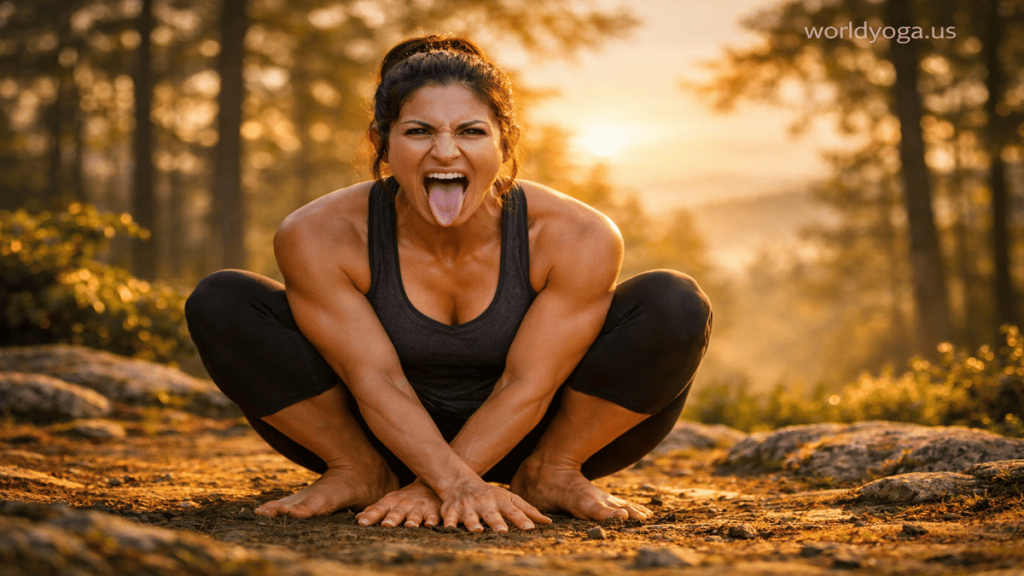
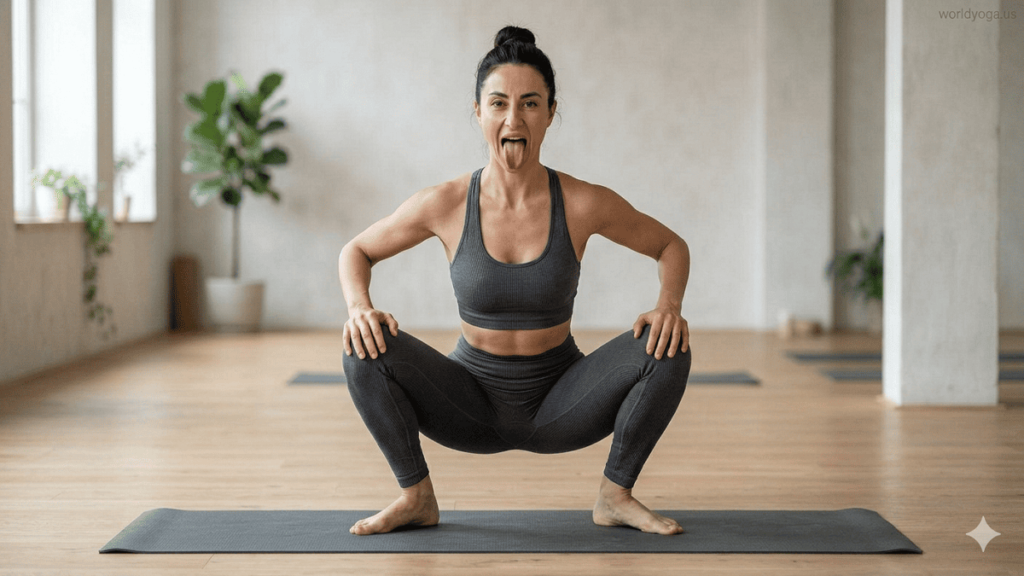
In its structural foundation, the lower body remains in Malasana (Garland Pose). The practitioner begins in a deep squat with feet slightly wider than hip-width apart, toes turned outward, and heels grounded or supported if needed. The hips drop low while the spine stays elongated, maintaining balance and stability through the legs and core. This grounded position activates the quadriceps, glutes, adductors, and calves while also opening the hips and ankles.
From this stable base, the upper-body expression transitions into Simhasana (Lion Pose). The practitioner places hands on the knees or thighs, spreads the fingers wide, and opens the chest. On an exhalation, the mouth opens wide, the tongue extends outward, and the gaze lifts toward the brow or slightly upward. A controlled “roar-like” exhalation is performed through the mouth, releasing tension from the jaw, throat, and face. This expressive component symbolizes courage, emotional release, and energetic activation.
The integration of Malasana and Simhasana creates a unique mind-body dynamic: the lower body remains calm, grounded, and stable, while the upper body expresses intensity and release. This contrast enhances neuromuscular awareness and encourages emotional catharsis through breath and facial engagement.
When performed with devotional focus, the posture is sometimes associated with symbolic reverence toward an avatar of Lord Vishnu, representing preservation, balance, and protective energy within yogic philosophy. This adds a meditative and spiritual dimension to the physical practice.
Key Benefits
- Jaw and facial tension release: The wide mouth opening relaxes facial muscles and reduces stress accumulation
- Throat and respiratory activation: Strong exhalation improves breath awareness and vocal release
- Hip mobility and grounding: The Malasana base improves lower-body flexibility and stability
- Emotional release: The expressive “lion breath” helps reduce mental and emotional tension
- Postural awareness: Encourages upright spinal alignment even in a deep squat
Precautions
- Avoid forcing the squat if knees or ankles are sensitive
- Do not strain the neck during upward gaze or tongue extension
- Individuals with jaw, throat, or cervical issues should modify the expression
- Maintain breath control; avoid excessive force in exhalation
Preparatory Practice
A strong foundation in Malasana (Garland Pose) is essential before adding the lion expression. Gentle hip openers and breath-awareness exercises are also recommended to ensure comfort and stability.
Reference Resources
- https://www.yogajournal.com/poses/
- https://www.yogabasics.com/asana/malasana/
- https://www.ekhartyoga.com/articles/practice/breathwork-pranayama
Summary
Lion Pose in Garland Pose is a powerful combination of grounding and expression. It unites physical stability with emotional release, making it a valuable practice for improving hip flexibility, respiratory awareness, and stress relief while adding a symbolic devotional layer to traditional yoga practice.
#Lion Pose Dedicated to an Avatar of Lord Vishnu in Garland Pose in India
How is Lion Pose in Garland Pose performed correctly?
Lion Pose in Garland Pose is a hybrid practice that combines the deep squat foundation of Malasana with the expressive breath and facial release of Simhasana (Lion Pose). Correct execution depends on stable lower-body alignment, an upright spine, and controlled breath-driven expression rather than force.
1. Enter the Malasana Base
Begin in Malasana (Garland Pose).
- Stand with feet slightly wider than hip-width
- Turn toes slightly outward
- Slowly lower into a deep squat
- Keep heels grounded; use a block or folded blanket if needed
- Allow knees to open naturally in line with toes
Key alignment cues:
- Spine stays long and lifted
- Chest remains open, not collapsed
- Weight is evenly distributed through both feet
- Hips sink down without forcing depth
This creates a stable foundation for the upper-body expression.
2. Establish Upright Spinal Position
Once settled in the squat:
- Engage the core lightly to support the lower back
- Lengthen through the crown of the head
- Relax the shoulders away from the ears
- Keep the jaw soft before transitioning into the expression
The spine should remain neutral even in deep flexion.
3. Transition into Lion Pose Expression
This is the Simhasana (Lion Pose) component:
- Place hands on knees or thighs
- Spread fingers wide for grounding support
- Inhale deeply through the nose
- Open the mouth wide on exhalation
- Extend the tongue downward and outward
- Optionally lift the gaze slightly toward the brow or ceiling
- Exhale strongly with a controlled “ha” sound through the mouth
This expression is traditionally associated with Simhasana and helps release tension in the face, throat, and chest.
4. Maintain Lower-Body Stability During Expression
While performing the lion breath:
- Keep the squat steady and balanced
- Avoid shifting weight forward onto the toes
- Ensure knees remain aligned with toes
- Maintain engagement in thighs and core
- Do not let the spine collapse during exhalation
The lower body should remain calm and grounded while the upper body expresses intensity.
5. Breathing Pattern
- Inhale: Calm, nasal breath to prepare
- Exhale: Strong, audible mouth exhalation with tongue extension
- Repeat 3–6 rounds depending on comfort
Breath should be controlled, not forced or strained.
6. Release from the Pose
- Close the mouth and relax the face
- Bring the tongue back in
- Place hands on thighs for support
- Slowly straighten the legs to exit the squat
Move gradually to avoid strain on knees or ankles.
7. Common Mistakes to Avoid
- Collapsing the chest forward in the squat
- Losing balance onto the toes
- Forcing the tongue or jaw aggressively
- Holding breath during the expression
- Rushing transitions in and out of the pose
Summary
Correct performance of Lion Pose in Garland Pose requires a stable Malasana foundation combined with controlled facial expression and breath release. The key is maintaining grounded lower-body alignment while allowing the upper body and breath to express intensity safely and consciously.
#Lion Pose Dedicated to an Avatar of Lord Vishnu in Garland Pose in Maharashtra
What is the proper alignment in this variation of Malasana?
Proper alignment in Lion Pose performed within Malasana focuses on maintaining a strong, stable squat foundation while allowing expressive upper-body release through breath and facial activation. The key principle is grounded stability in the lower body with controlled expansion in the upper body and face.
1. Lower Body Alignment (Malasana Base)
The foundation comes from Malasana (Garland Pose), which must remain stable throughout the expression.
Key alignment points:
- Feet placed slightly wider than hip-width
- Toes turned slightly outward (natural angle, not forced)
- Knees track in line with toes (avoid inward collapse)
- Heels grounded or supported with a prop if needed
- Hips sink evenly between the heels
The pelvis should remain balanced, not tilted excessively forward or backward. Weight should be evenly distributed through both feet.
2. Spinal Alignment
Even in a deep squat, the spine must remain long and neutral:
- Crown of the head lifts upward
- Tailbone drops downward without over-tucking
- Chest remains open and lifted
- Shoulders stay relaxed and away from ears
- Core engages gently to stabilize the torso
Avoid rounding the lower back or collapsing the chest forward, especially during the lion exhalation.
3. Upper Body Alignment (Lion Expression / Simhasana)
The upper-body expression is based on Simhasana (Lion Pose):
- Hands rest firmly on thighs or knees
- Fingers spread wide for grounding support
- Elbows slightly bent and active, not locked
- On exhale, mouth opens wide without jaw tension
- Tongue extends forward and downward in a relaxed manner
- Gaze may lift slightly, but neck stays long and not compressed
The facial expression should be active but not strained.
4. Integrated Full-Body Alignment
When combined, the posture should reflect:
- Stable, grounded lower body (Malasana base)
- Upright and elongated spine
- Relaxed but open shoulders
- Controlled, expressive facial release on exhale
- Even balance between both feet without shifting forward
The contrast between stillness (lower body) and expression (upper body) is intentional and should remain controlled.
5. Common Alignment Errors
- Collapsing the spine during exhalation
- Lifting heels without support, causing instability
- Leaning forward excessively during lion breath
- Tension in jaw, neck, or shoulders
- Losing squat alignment while focusing on facial expression
6. Summary
Proper alignment in Lion Pose within Malasana requires a stable squat foundation, neutral spinal positioning, and controlled expressive release through the face and breath. The lower body should remain grounded and steady, while the upper body and facial muscles perform a safe, intentional release without disrupting structural alignment.
#Lion Pose Dedicated to an Avatar of Lord Vishnu in Garland Pose in Ahemadabad
Which muscles are engaged during the pose?
Lion Pose performed within Malasana creates a unique combination of deep lower-body loading with expressive upper-body and facial activation. The posture simultaneously engages stabilizing muscles (for the squat) and releasing muscles (for the lion expression), making it a full-body neuromuscular exercise.
1. Lower Body Muscles (Malasana Base)
The foundational squat comes from Malasana (Garland Pose), which primarily activates the lower body in an isometric hold.
Key muscles engaged:
- Quadriceps: Maintain knee flexion and support the deep squat
- Gluteus maximus: Stabilizes hip position and controls descent
- Adductor group (inner thighs): Helps control knee alignment and external rotation
- Hamstrings: Assist in hip stability and balance control
- Calves (gastrocnemius and soleus): Support ankle stability and grounding
- Intrinsic foot muscles: Maintain balance and arch support
These muscles work together to maintain a stable, grounded squat position.
2. Hip and Pelvic Stabilizers
- Piriformis and deep external rotators: Control hip opening in the squat
- Iliopsoas (stabilizing role): Supports pelvic positioning
- Tensor fasciae latae (TFL): Assists lateral hip stability
These muscles ensure the pelvis remains balanced and prevents collapsing inward or excessive tilting.
3. Core Musculature
The core plays a major stabilizing role:
- Transverse abdominis: Maintains deep core stability and spinal support
- Rectus abdominis: Controls trunk positioning in the squat
- Obliques: Assist in balance adjustments and postural control
- Erector spinae: Maintain spinal extension and upright posture
The core ensures that the expressive upper-body movement does not destabilize the base.
4. Upper Body Muscles (Lion Pose / Simhasana Expression)
The upper-body action is derived from the expressive mechanics of Simhasana (Lion Pose), focusing on breath-driven release.
Key muscles involved:
- Masseter and facial muscles: Relax and release tension in jaw and face
- Tongue muscles (extrinsic and intrinsic): Control tongue extension during exhale
- Suprahyoid and infrahyoid muscles: Support throat and laryngeal movement
- Diaphragm: Drives strong exhalation and breath release
- Intercostals: Assist in forceful exhalation through the mouth
This creates a controlled “release mechanism” through breath and facial expression.
5. Neck and Shoulder Muscles
- Trapezius (upper and mid fibers): Stabilize shoulder positioning
- Sternocleidomastoid: Supports head positioning during expression
- Scalene muscles: Assist in controlled neck stability
These muscles help maintain an upright posture while allowing facial expansion.
6. Integrated Muscle Function
Lion Pose in Malasana is a dual-action posture:
- Lower body = stability and endurance
- Core = structural control
- Upper body and face = expressive release and breath activation
This combination trains the body to maintain physical stability while allowing emotional and respiratory release.
7. Summary
The pose engages a wide muscular network:
- Strong activation in quadriceps, glutes, adductors, and calves for the squat
- Deep core engagement for spinal stability
- Facial, respiratory, and neck muscles for expressive lion breath release
Together, these systems create a balanced interaction of grounding strength and upper-body release, making the posture both physically and neurologically integrative.
#Lion Pose Dedicated to an Avatar of Lord Vishnu in Garland Pose in Hyderabad
What preparatory poses are recommended?
Lion Pose in Malasana combines a deep squat with expressive breath work, so preparation should focus on three key areas: hip mobility, ankle flexibility, and breath/facial release awareness. A gradual progression helps ensure stability in the lower body while allowing safe upper-body expression.
1. Foundational Squat Preparation
The most important base posture is Malasana (Garland Pose). This prepares the ankles, knees, and hips for sustained flexion.
Benefits of this preparation:
- Improves ankle dorsiflexion for grounded heels
- Builds endurance in quadriceps and glutes
- Opens hips in external rotation
- Trains balance in a low center of gravity
Begin with supported versions (heels elevated or sitting on a block) if full depth is not accessible.
2. Hip Opening Preparations
Hip mobility is essential for comfortable squatting and pelvic stability.
A key preparatory posture is Eka Pada Rajakapotasana (Pigeon Pose). This helps release tension in:
- Gluteal muscles
- Hip flexors
- Piriformis and deep external rotators
Other helpful movements include:
- Low lunges (Anjaneyasana variations)
- Butterfly pose (Bound Angle Pose)
- Dynamic squat pulses
These improve range of motion needed for deep squat positioning.
3. Ankle and Knee Mobility Work
Because Malasana requires strong ankle flexion:
- Heel raises in squat position
- Wall-supported ankle stretches
- Gentle calf stretching sequences
These reduce strain on knees and improve grounding ability.
4. Core Activation Exercises
A stable core prevents collapse during the squat and supports breath control:
- Plank variations
- Dead bug exercises
- Slow controlled squats
Core engagement ensures the spine remains stable during lion breath exhalation.
5. Breath and Facial Preparation
Since the lion expression involves strong exhalation, preparatory breathing is important:
- Deep diaphragmatic breathing
- Slow nasal inhalation and mouth exhalation practice
- Jaw relaxation exercises
- Gentle tongue relaxation drills
These help prepare the facial and throat muscles for controlled release.
6. Neck and Shoulder Preparation
Although the upper body is less load-bearing, tension release is important:
- Neck rolls and gentle stretches
- Shoulder circles
- Cow-face arms (Gomukhasana arms)
- Thread-the-needle pose
These help reduce stiffness in the upper back and jaw region.
7. Summary
Effective preparation for Lion Pose in Malasana includes:
- Squat conditioning through Malasana
- Hip opening via Pigeon Pose and lunges
- Ankle mobility work for grounding stability
- Core strengthening for spinal control
- Breath and facial relaxation training for expressive release
When these preparatory elements are practiced consistently, the pose becomes safer, more stable, and significantly more effective in releasing both physical and facial tension.
#Lion Pose Dedicated to an Avatar of Lord Vishnu in Garland Pose in Pune
What are the benefits and precautions of this pose?
Lion Pose performed within Malasana combines a deep squat with an expressive breath and facial release. This creates a unique blend of grounding, mobility, and emotional release. While highly beneficial for body awareness and tension relief, it also requires careful attention to joint safety and breath control.
Benefits of the Pose
1. Deep Lower-Body Strength and Mobility
The squat base from Malasana (Garland Pose) strengthens the lower body by engaging the quadriceps, glutes, adductors, and calves. It also improves ankle flexibility and hip external rotation, supporting better functional movement such as squatting and bending.
2. Hip and Pelvic Release
The deep squat position helps open the hips and release tension in the groin and inner thighs. Over time, this can improve pelvic mobility and reduce stiffness caused by prolonged sitting.
3. Facial, Jaw, and Throat Relaxation
The lion expression involves wide mouth opening and tongue extension, which helps release tension in the jaw, face, and throat muscles. This can be especially beneficial for individuals who hold stress in the facial region.
4. Breath and Emotional Release
The strong exhalation pattern stimulates the diaphragm and encourages controlled breath release. This may help reduce mental stress and promote emotional release through structured breathing.
5. Improved Postural Awareness
Maintaining an upright spine in a deep squat improves core engagement and spinal awareness, helping develop better posture control in daily life.
Precautions and Contraindications
1. Knee Sensitivity
Deep squatting places significant pressure on the knees. Individuals with knee injuries, arthritis, or ligament instability should avoid deep depth or use support under the hips.
2. Ankle Limitations
Limited ankle dorsiflexion may cause discomfort or loss of balance. Using a heel lift or prop is recommended for safety.
3. Jaw and Neck Strain
Excessive force during tongue extension or facial expression may strain the jaw or neck. The expression should be active but not forced.
4. Lower Back Strain
Rounding the spine during the squat can increase lumbar pressure. Maintaining a long, neutral spine is essential.
5. Breathing Overexertion
The lion breath should be controlled. Overly forceful exhalation may cause dizziness or throat strain.
Safe Practice Guidelines
- Warm up hips, ankles, and shoulders before practice
- Use props for support if squat depth is limited
- Keep facial expression controlled, not strained
- Maintain steady breathing between repetitions
- Avoid pain in knees, hips, or jaw at all times
Summary
Lion Pose in Malasana offers a powerful combination of physical grounding and expressive release. It strengthens the lower body, improves hip mobility, and supports emotional and respiratory release. However, its benefits are best achieved when practiced with proper alignment, controlled breath, and respect for joint limitations.
#Lion Pose Dedicated to an Avatar of Lord Vishnu in Garland Pose in Banglore
Case Study of Lion Pose Dedicated to an Avatar of Lord Vishnu in Garland Pose
1. Overview
This case study examines the practical application of Lion Pose (Simhasana) performed within Garland Pose (Malasana), with a devotional focus dedicated to an avatar of Lord Vishnu. The practice integrates deep squatting mechanics, breath-driven facial expression, and symbolic grounding. It is analyzed within a holistic yoga therapy context to assess its effects on physical mobility, respiratory control, and emotional regulation.
2. Subject Profile and Initial Assessment
The subject is a 35-year-old individual with moderate physical activity levels and a history of:
- Chronic jaw and facial tension due to stress
- Mild hip tightness from prolonged sitting
- Occasional lower-back stiffness
- Limited breath awareness under stress conditions
At baseline, the subject demonstrated restricted squat depth and difficulty maintaining relaxed facial musculature during breath work.
The foundational squat capacity was assessed using Malasana (Garland Pose), where mild heel lift and forward trunk inclination were observed.
3. Intervention Protocol
A 5-week progressive training protocol was implemented with three phases:
Phase 1: Structural Conditioning
Focus on hip opening, ankle mobility, and squat endurance. Supported Malasana variations were introduced to build stability and comfort in the lower body.
Phase 2: Breath and Facial Awareness Training
Controlled diaphragmatic breathing and gentle facial release exercises were added. The subject practiced slow nasal inhalation followed by relaxed mouth exhalation to prepare for Lion Pose expression.
Phase 3: Integrated Simhasana–Malasana Practice
The full integration of Lion Pose within Malasana was introduced. The subject performed deep squat positioning followed by controlled lion breath exhalation (mouth open, tongue extended, audible release), maintaining spinal stability throughout.
4. Observations and Progress
By week 3:
- Improved squat stability with reduced heel lift
- Increased hip openness and reduced groin tension
- Better awareness of breath rhythm during exertion
By week 5:
- Noticeable reduction in jaw and facial muscle tension
- Improved ability to maintain upright spine in deep squat
- Enhanced breath control during expressive exhalation
- Increased comfort with emotional release through breath work
The subject reported a subjective feeling of “lightness” and reduced stress after practice sessions.
5. Therapeutic Outcomes
Physical Benefits:
- Improved hip mobility and lower-body endurance
- Enhanced ankle stability and squat depth control
- Reduced facial and jaw tension
Respiratory Benefits:
- Increased diaphragmatic engagement
- Improved exhalation strength and control
- Greater breath-body coordination
Emotional and Psychological Benefits:
- Reduced perceived stress levels
- Enhanced emotional release through structured breath work
- Improved body awareness during tension states
6. Discussion
The integration of Lion Pose within Malasana demonstrates a unique synergy between structural grounding and expressive release. The lower body provides stability while the upper body and breath facilitate controlled emotional discharge.
The devotional framing toward an avatar of Lord Vishnu added a reflective and meditative layer, supporting focus and consistency in practice. This symbolic element appeared to enhance the subject’s engagement and mindfulness during sessions.
7. Limitations
- Deep squatting may not be accessible to all individuals without modification
- Breath intensity must be carefully regulated to avoid dizziness
- Emotional release responses may vary among individuals
- Requires progressive training to avoid joint strain
8. Conclusion
Lion Pose in Garland Pose, when practiced with structured progression and mindful awareness, serves as an effective integrated movement for improving hip mobility, breath control, and facial tension release. The addition of devotional focus may enhance psychological engagement and consistency, supporting a deeper mind-body connection.
9. References
- https://www.yogajournal.com/poses/
- https://www.yogabasics.com/asana/malasana/
- https://www.ekhartyoga.com/articles/practice/breathwork-pranayama
- https://www.ncbi.nlm.nih.gov/ (breath regulation and stress response research)
#Lion Pose Dedicated to an Avatar of Lord Vishnu in Garland Pose in Kolkata
White Paper of Lion Pose Dedicated to an Avatar of Lord Vishnu in Garland Pose
1. Abstract
Lion Pose performed within Garland Pose is an integrated yogic practice combining deep squatting biomechanics with expressive breath and facial release. When framed within a devotional context dedicated to an avatar of Lord Vishnu, the practice incorporates physical alignment, respiratory regulation, and symbolic focus. This white paper analyzes its biomechanical structure, physiological effects, therapeutic applications, and safety considerations within modern yoga therapy and movement science frameworks.
2. Introduction
This hybrid posture merges two foundational systems:
- Malasana (Garland Pose) for grounding and lower-body stability
- Simhasana (Lion Pose) for breath-driven facial and throat release
The lower-body structure originates from Malasana (Garland Pose), while the expressive upper-body and breath mechanism is derived from Simhasana principles. The devotional framing toward an avatar of Lord Vishnu adds a meditative focus, emphasizing preservation, balance, and controlled energy release.
3. Biomechanical Analysis
3.1 Lower-Body Mechanics (Malasana Base)
The squat position involves:
- Deep knee flexion under controlled load
- Hip external rotation and abduction
- Ankle dorsiflexion stability
Primary muscle activation:
- Quadriceps (isometric support)
- Gluteus maximus (hip stabilization)
- Adductors (pelvic control)
- Calves and intrinsic foot muscles (grounding and balance)
3.2 Core Stabilization System
- Transverse abdominis maintains spinal integrity
- Obliques assist balance adjustments
- Erector spinae support upright posture
The core acts as a stabilizing bridge between lower-body grounding and upper-body expression.
3.3 Upper-Body and Facial Mechanics (Simhasana Expression)
- Jaw opening activates masseter relaxation patterns
- Tongue extension engages suprahyoid and infrahyoid muscles
- Diaphragm drives forceful exhalation
- Intercostals assist controlled breath release
- Facial muscles release tension through exaggerated expression
4. Physiological Effects
4.1 Musculoskeletal Benefits
- Increased hip mobility and squat endurance
- Improved ankle stability and lower-limb coordination
- Release of jaw, neck, and upper-back tension
4.2 Respiratory Regulation
The lion breath enhances:
- Diaphragmatic activation
- Exhalation strength and control
- Breath–movement synchronization
4.3 Neuromuscular Coordination
The posture trains simultaneous:
- Stability (lower body)
- Mobility (upper body)
- Expression (facial and breath systems)
5. Therapeutic Applications
This integrated posture is applied in:
- Stress and tension release protocols
- Jaw and facial muscle relaxation therapy
- Hip mobility restoration programs
- Breath regulation and pranayama-based interventions
Its squat foundation is often reinforced through preparatory work in Malasana (Garland Pose) before introducing expressive breath patterns.
6. Risks and Contraindications
- Knee stress: Deep flexion may aggravate joint conditions
- Hip restrictions: Limited mobility may cause impingement
- Jaw strain: Excessive facial expression may overactivate temporomandibular joint
- Neck tension: Improper gaze or strain during exhalation
- Breath overexertion: Forceful exhalation may cause dizziness
7. Methodological Progression
A structured approach is recommended:
- Squat conditioning (Malasana variations)
- Hip and ankle mobility development
- Breath awareness training (controlled exhalation)
- Facial relaxation and jaw release exercises
- Integrated Simhasana–Malasana practice
8. Discussion
This posture demonstrates a rare integration of structural stability and expressive release. The lower body remains grounded and passive in strength, while the upper body and breath engage in active release. The devotional framing toward an avatar of Lord Vishnu introduces a cognitive anchor that may enhance focus, consistency, and meditative engagement.
9. Conclusion
Lion Pose in Garland Pose represents a multidimensional yoga practice combining biomechanics, respiratory science, and symbolic focus. When practiced progressively, it enhances hip mobility, breath control, and neuromuscular coordination while supporting stress release and postural awareness.
10. References
- https://www.yogajournal.com/poses/
- https://www.yogabasics.com/asana/malasana/
- https://www.ekhartyoga.com/articles/practice/breathwork-pranayama
- https://www.ncbi.nlm.nih.gov/ (respiratory physiology and stress response studies)
#Lion Pose Dedicated to an Avatar of Lord Vishnu in Garland Pose in Delhi
Industry Application of Lion Pose Dedicated to an Avatar of Lord Vishnu in Garland Pose
Lion Pose performed within Garland Pose combines deep squatting mechanics with expressive breath and facial release. In modern practice, this hybrid movement is not limited to traditional yoga settings; it has practical applications across fitness, rehabilitation, corporate wellness, sports conditioning, and mind–body therapy industries. Its value lies in simultaneously training mobility, stability, respiratory control, and stress regulation.
1. Fitness and Functional Training Industry
In fitness environments, this posture is used as a mobility-strength integration drill. Trainers use it to improve:
- Deep squat mechanics
- Hip mobility and ankle stability
- Core endurance in low positions
- Breath control under physical load
The squat foundation from Malasana (Garland Pose) is often included in warm-ups or corrective training before progressing to expressive variations. It helps identify movement restrictions in the hips and lower back while improving functional range of motion.
2. Physical Therapy and Rehabilitation
In rehabilitation settings, the posture is adapted in a controlled and modified form. It is useful for:
- Restoring hip and pelvic mobility
- Improving ankle dorsiflexion
- Reducing jaw and facial tension through breath work
- Re-educating squat patterns after inactivity or injury
The lion breath component supports neuromuscular relaxation and controlled exhalation training, often used in stress-related tension rehabilitation protocols.
3. Corporate Wellness Programs
In workplace wellness initiatives, simplified versions of this practice are used to counteract sedentary work habits. It is applied for:
- Reducing stiffness from prolonged sitting
- Improving spinal awareness and posture
- Releasing jaw and neck tension from screen usage
- Enhancing short-duration stress relief exercises
Short guided breathing breaks inspired by this posture are increasingly integrated into corporate mindfulness programs.
4. Sports Performance and Athletic Conditioning
In sports science, this posture is used as a functional movement and breath-control screening tool. It supports athletes in:
- Developing squat endurance and stability
- Improving hip rotational capacity
- Enhancing breath control under exertion
- Reducing tension in jaw and upper body during performance
It is particularly relevant in sports requiring agility, explosive movement, and breath regulation such as martial arts, football, and track athletics.
5. Mind–Body Wellness and Yoga Industry
Within yoga studios and wellness centers, this posture is used in:
- Stress release and emotional regulation classes
- Hip-opening and grounding sequences
- Breathwork (pranayama) integrated sessions
- Meditative movement practices
The expressive lion breath adds a psychosomatic release element, making it valuable in mental wellness-focused programs.
6. Movement Science and Biomechanics Research
In academic and applied movement research, the posture is analyzed for:
- Load distribution in deep squats
- Coordination between respiratory and musculoskeletal systems
- Neuromuscular response to combined stability–expression tasks
- Proprioceptive control under low-position load
It serves as a model for studying how the body integrates grounding postures with active breath-driven release mechanisms.
Conclusion
Lion Pose in Garland Pose has evolved into a multidisciplinary tool with applications far beyond traditional yoga. It is now utilized in fitness training, rehabilitation, corporate wellness, sports conditioning, and movement science. Its strength lies in combining physical grounding with expressive breath release, making it a valuable integrated practice for both physical performance and stress regulation systems.
#Lion Pose Dedicated to an Avatar of Lord Vishnu in Garland Pose in Mumbai
Ask FAQs
What is Lion Pose in Garland Pose?
Lion Pose in Garland Pose is a combined yoga variation where a deep squat (Malasana) is paired with the expressive Lion Pose (Simhasana) breath. It involves grounding the lower body while releasing tension through a wide mouth exhalation and tongue extension.
What are the main benefits of this pose?
This posture improves hip flexibility, strengthens the lower body, and enhances ankle mobility. It also helps release jaw, face, and throat tension, improves breath control, and supports emotional stress relief through controlled exhalation.
Is this pose suitable for beginners?
Yes, but with modifications. Beginners should first practice Malasana (Garland Pose) to build squat stability before adding the lion breath expression. Support under the heels or hips may be needed for comfort and safety.
What are the common mistakes to avoid?
Common mistakes include collapsing the spine, lifting the heels without support, forcing the jaw or tongue during expression, and holding the breath. These errors can reduce benefits and increase strain on the knees or neck.
Who should avoid this pose?
People with knee injuries, severe hip limitations, jaw disorders, or neck issues should avoid or modify this pose. It should also be practiced cautiously by individuals with balance difficulties or respiratory conditions sensitive to forceful exhalation.
Table of Contents
Disclaimer: This content is for educational and informational purposes only and is not a substitute for professional medical advice. Practice yoga under the guidance of a qualified instructor, especially for advanced or combined postures, and consult a healthcare professional if you have any existing injuries, medical conditions, or concerns.