Urdhva Mukha Paschimottanasana
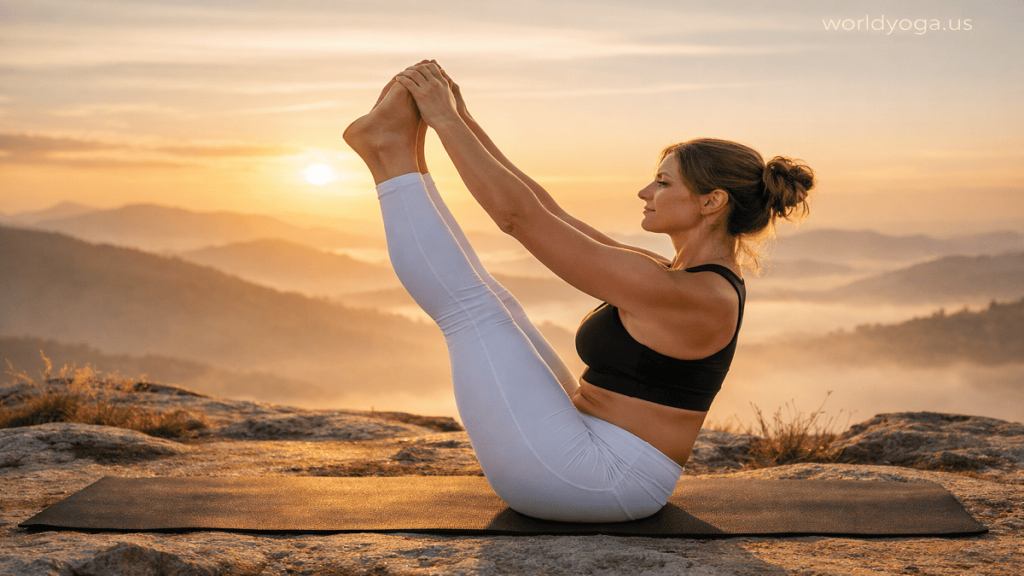
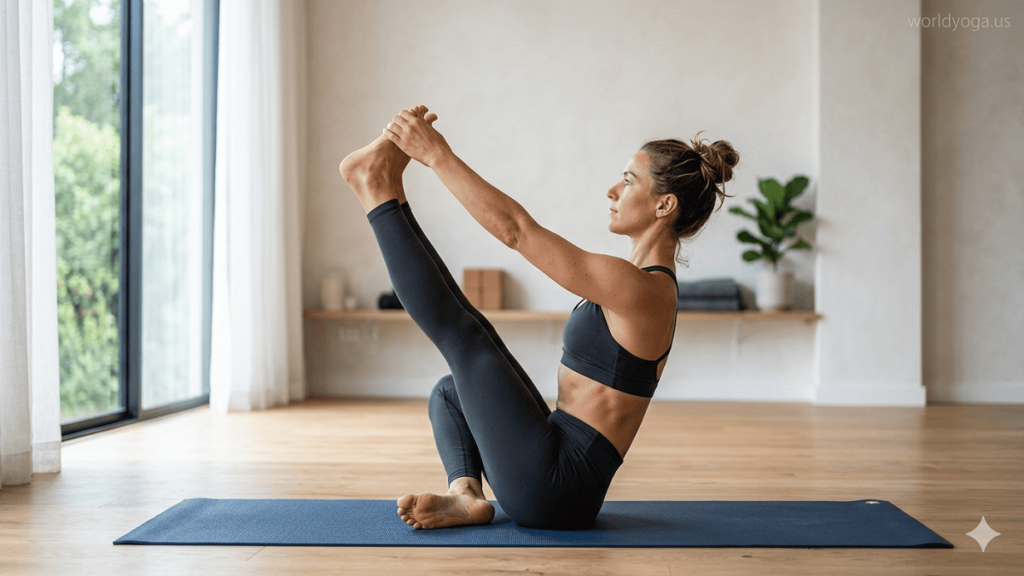
Urdhva Mukha Paschimottanasana is an advanced yoga posture and a dynamic variation of Paschimottanasana (Seated Forward Bend). The name translates to “Upward-Facing Intense West Stretch,” where Paschima refers to the back of the body. In this variation, the practitioner lifts the entire body and legs upward while maintaining a strong grip on the feet, creating a powerful combination of spinal lengthening, core engagement, and hamstring flexibility.
This posture is commonly practiced in advanced Hatha and Ashtanga yoga sequences. It demands a high level of strength in the abdominal muscles, flexibility in the hamstrings, and stability in the spine. Unlike the traditional forward fold where the torso moves toward the legs, this variation requires controlled lifting, making it significantly more challenging.
Key Benefits
Urdhva Mukha Paschimottanasana offers several physical and mental benefits. It strengthens the core muscles deeply, including the rectus abdominis and transverse abdominis, as they must stabilize the body while both legs and torso are elevated. It also improves hamstring flexibility through sustained, controlled extension.
The posture enhances spinal awareness and postural strength by requiring the back muscles to maintain length under load. Additionally, it supports improved balance, coordination, and concentration due to the intensity of the lift and breath control required.
Alignment and Technique
Proper alignment is essential for safe execution. The spine should remain elongated without rounding excessively. The shoulders must stay relaxed while the chest remains open. The legs should be extended and lifted evenly, and the grip on the feet should be firm but not forceful.
Breathing plays a crucial role—inhale to lengthen the spine and prepare, and exhale to stabilize the lift. The movement should be slow and controlled, avoiding jerky or forceful lifting.
Preparatory Poses
Before attempting this posture, practitioners should build strength and flexibility through:
- Navasana (Boat Pose) for core strength
- Paschimottanasana for hamstring flexibility
- Supta Padangusthasana for controlled leg extension
- Dandasana for spinal alignment awareness
Precautions
This posture is not recommended for beginners or individuals with lower back injuries, hamstring strains, or spinal issues. Overstretching or collapsing the spine can lead to discomfort or injury. Using a strap or practicing under supervision is advised for safe progression.
Learn More
Urdhva Mukha Paschimottanasana is a powerful test of strength, flexibility, and control, making it an important advanced posture for developing full-body integration and deep core awareness.
#Urdhva Mukha Paschimottanasana in India
How is Urdhva Mukha Paschimottanasana performed correctly?
Urdhva Mukha Paschimottanasana (Upward-Facing Intense West Stretch) is an advanced yoga posture that requires a precise combination of spinal extension, core strength, and hamstring flexibility. Correct execution is less about lifting high and more about maintaining alignment, control, and breath coordination throughout the movement.
Step-by-Step Execution
Begin in Dandasana (Staff Pose) with both legs extended straight forward. Sit tall on the sitting bones, ensuring the spine is fully elongated and the shoulders are relaxed. The chest should remain open, and the pelvis should be neutral.
Next, inhale deeply and lengthen the spine upward. This initial spinal extension is critical as it creates space between the vertebrae and prepares the body for the lift. Avoid rounding the back at this stage.
On an exhale, gently hinge from the hips while maintaining spinal length. Reach forward and grasp the feet or big toes using the index and middle fingers. If flexibility is limited, use a yoga strap around the feet to maintain proper alignment.
Once the grip is secure, inhale again to re-extend the spine. This helps prevent collapsing into the lower back during the lift phase.
As you exhale, engage the core muscles strongly and begin lifting both legs and the torso upward simultaneously. The movement should be slow, controlled, and coordinated, not forceful. The goal is to maintain length in the spine while the entire body lifts as one unit.
Alignment Focus
- Spine remains long and not rounded
- Chest stays open and lifted
- Legs extend evenly without bending the knees excessively
- Shoulders remain relaxed, not hunched
- Core stays fully engaged throughout
Breathing Pattern
Breath control is essential:
- Inhale: lengthen the spine and prepare
- Exhale: engage core and initiate lift
- Maintain steady, controlled breathing while holding
Avoid breath-holding, as it increases tension and reduces stability.
Common Mistakes to Avoid
- Rounding the lower back during the lift
- Using momentum instead of core strength
- Over-gripping the feet and creating shoulder tension
- Lifting legs without spinal control
- Collapsing the chest inward
Safe Exit
To release, slowly lower the legs and torso back to the mat with control. Return to Dandasana and relax the breath before transitioning into a counterpose such as a forward fold or relaxation posture.
Modifications
Beginners can:
- Use a strap around the feet
- Lift one leg at a time
- Keep knees slightly bent until flexibility improves
Learn More
When performed correctly, Urdhva Mukha Paschimottanasana builds exceptional core strength, improves hamstring flexibility, and enhances full-body coordination through controlled, mindful movement.
#Urdhva Mukha Paschimottanasana in Maharashtra
What is the proper alignment in this seated forward fold variation?
Proper alignment in Urdhva Mukha Paschimottanasana (Upward-Facing Intense West Stretch) is essential because this posture combines deep hamstring extension with simultaneous core engagement and spinal control. Unlike a traditional forward fold, this variation requires maintaining spinal length while lifting the body, making alignment the key factor for both safety and effectiveness.
Spinal Alignment
The spine should remain long, extended, and neutral throughout the pose. The most common mistake is rounding the lower back while lifting the legs. Instead, the lift should originate from the core while the spine stays elongated upward and forward. Think of creating space between each vertebra rather than collapsing into the lumbar region.
Pelvis Position
The pelvis should remain balanced on the sitting bones with a slight natural forward tilt if needed. Excessive posterior tilt (tucking under) will round the spine, while excessive anterior tilt can strain the lower back. A neutral, stable pelvic position supports safe spinal extension.
Leg Alignment
Both legs should stay fully engaged and evenly extended. The knees should remain straight but not locked. The inner and outer thighs should activate equally to prevent rotation or imbalance. Uneven leg activation often leads to strain in the hips or hamstrings.
Shoulder and Chest Alignment
The shoulders should stay relaxed, down, and away from the ears. The chest should remain open and lifted rather than collapsing inward. Over-gripping the feet can cause shoulder tension, so the arms should assist the lift without dominating it.
Core Engagement
The abdominal muscles (especially transverse abdominis and rectus abdominis) must remain active throughout the pose. The core is responsible for stabilizing the spine and assisting in the controlled lift. Without proper engagement, the lower back takes excessive load.
Neck and Head Position
The neck should stay neutral and aligned with the spine. The gaze may be forward or slightly upward, but there should be no compression or excessive extension in the cervical region. The head follows the natural line of the spine.
Breathing Alignment Support
Breath plays a structural role in alignment:
- Inhale: lengthen spine and create space
- Exhale: engage core and stabilize lift
Steady breathing prevents collapse and supports structural integrity.
Key Alignment Summary
- Spine long and not rounded
- Chest open and lifted
- Pelvis neutral on sitting bones
- Legs evenly extended and active
- Core fully engaged
- Shoulders relaxed, not hunched
- Neck neutral and aligned
Final Insight
In Urdhva Mukha Paschimottanasana, alignment is more important than height or depth. A controlled, lengthened spine supported by strong core engagement ensures safety and maximizes the benefits of flexibility, strength, and balance development.
#Urdhva Mukha Paschimottanasana in Ahemadabad
Which muscles are engaged during the pose?
Urdhva Mukha Paschimottanasana (Upward-Facing Intense West Stretch) is a demanding full-body yoga posture that requires simultaneous engagement of multiple muscle groups for lifting, stabilization, and controlled flexibility. It blends strength and stretch, making it both a core-intensive and posterior-chain lengthening pose.
Primary Muscles Engaged
1. Core Muscles
The core is the main driver of this posture:
- Rectus abdominis: Controls forward lift and spinal flexion control
- Transverse abdominis: Provides deep spinal stabilization
- Obliques: Assist in balance and prevent lateral collapse
These muscles work together to lift the body and maintain spinal integrity.
2. Hip Flexors
Strong activation is required to elevate the legs:
- Iliopsoas: Primary hip flexor responsible for lifting the legs
- Rectus femoris: Assists in hip flexion and knee extension control
These muscles are heavily engaged throughout the lift phase.
3. Hamstrings (Stretch Phase)
The hamstrings are deeply stretched while maintaining control:
- Biceps femoris
- Semitendinosus
- Semimembranosus
They lengthen under tension, improving flexibility over time.
Secondary Muscles Engaged
4. Spinal Stabilizers
- Erector spinae: Maintains spinal extension and posture
- Multifidus: Supports fine spinal alignment control
These muscles prevent collapse during the lift.
5. Shoulder and Upper Back Muscles
- Latissimus dorsi: Assists in arm stability during grip
- Trapezius and rhomboids: Support chest lift and shoulder positioning
- Forearm flexors: Maintain grip on feet or toes
6. Pelvic and Lower Body Stabilizers
- Gluteus maximus: Assists in pelvic control
- Gluteus medius/minimus: Maintain hip stability and symmetry
7. Neck and Postural Muscles
- Cervical stabilizers: Keep the neck aligned with the spine without strain
Functional Muscle Integration
This posture creates a coordinated chain of activation:
- Core generates lift
- Hip flexors elevate legs
- Spinal muscles stabilize posture
- Hamstrings resist and lengthen
- Shoulders maintain upper-body control
Final Insight
Urdhva Mukha Paschimottanasana is a high-level integration pose that trains both strength and flexibility simultaneously. It builds core endurance, improves posterior chain mobility, and enhances neuromuscular coordination, making it a valuable posture for advanced yoga and functional movement training.
#Urdhva Mukha Paschimottanasana in Hyderabad
What preparatory poses are recommended before practicing it?
Urdhva Mukha Paschimottanasana is an advanced seated forward fold variation that demands a strong combination of core strength, hamstring flexibility, hip control, and spinal stability. Proper preparatory poses are essential to ensure safe execution and to gradually build the required mobility and strength.
1. Core Strength Preparatory Poses
A strong core is the foundation of this posture, as it drives the lift and stabilizes the spine.
- Navasana (Boat Pose): Builds deep abdominal strength and endurance
- Ardha Navasana (Half Boat Pose): Targets lower abdominal activation and spinal control
These poses train the body to resist collapse during leg lift and forward extension.
2. Hamstring Flexibility Preparations
Flexible hamstrings are necessary to maintain leg extension without rounding the spine.
- Paschimottanasana (Seated Forward Bend): Lengthens the entire posterior chain
- Supta Padangusthasana (Reclining Big Toe Pose): Improves controlled hamstring flexibility
- Utthita Hasta Padangusthasana (Standing Big Toe Hold): Develops dynamic flexibility and balance
These help reduce strain during deep forward extension.
3. Hip Flexor Activation and Control
Strong hip flexors assist in lifting the legs efficiently.
- Low Lunge (Anjaneyasana): Opens hip flexors and improves pelvic mobility
- Leg Raises (supine variations): Strengthens iliopsoas for controlled lifting power
4. Spinal Awareness and Alignment Training
Maintaining a long spine is critical in this pose.
- Dandasana (Staff Pose): Establishes foundational seated alignment
- Bridge Pose (Setu Bandhasana): Strengthens spinal extensors and improves postural endurance
These poses help prevent spinal collapse during the lift.
5. Coordination and Balance Preparation
Since the posture involves simultaneous lifting and holding, coordination training is important.
- Tolasana (Scale Pose): Builds arm-core coordination and lifting control
- Supported core lifts with props: Helps develop safe neuromuscular coordination
6. Breath Control Preparation
Controlled breathing enhances stability and reduces tension:
- Diaphragmatic breathing for core activation
- Slow inhale–exhale coordination to improve control under effort
Final Insight
Preparing for Urdhva Mukha Paschimottanasana is about developing a balance of core strength, hamstring flexibility, hip stability, and spinal awareness. When these foundational elements are trained progressively, the posture becomes significantly safer, more controlled, and more accessible at advanced levels.
#Urdhva Mukha Paschimottanasana in Delhi
What are the benefits and precautions of this posture?
Urdhva Mukha Paschimottanasana (Upward-Facing Intense West Stretch) is an advanced yoga posture that combines deep hamstring stretching with intense core activation and spinal control. Because it requires lifting both legs and maintaining spinal integrity simultaneously, it delivers powerful physical benefits but also demands careful attention to safety and alignment.
Key Benefits of Urdhva Mukha Paschimottanasana
1. Strengthens the Core Musculature
This posture intensely activates the abdominal muscles, especially the rectus abdominis and transverse abdominis. The sustained lift improves core endurance, stability, and control.
2. Improves Hamstring Flexibility
The pose provides a deep, controlled stretch to the hamstrings, helping increase flexibility in the posterior chain. This can improve posture, walking efficiency, and overall mobility.
3. Enhances Spinal Strength and Awareness
Maintaining an elongated spine under load strengthens spinal stabilizers like the erector spinae. This improves posture and reduces slouching tendencies.
4. Builds Hip Flexor Strength
The iliopsoas and related hip flexor muscles engage strongly to lift the legs, improving functional strength and movement control.
5. Improves Balance and Coordination
Holding the body in an elevated position develops neuromuscular coordination and enhances body awareness and balance control.
6. Supports Breath Control and Focus
The intensity of the posture encourages slow, controlled breathing, which improves concentration and mental discipline.
Precautions for Urdhva Mukha Paschimottanasana
1. Avoid if You Have Lower Back Issues
Individuals with lumbar disc problems or chronic lower back pain should avoid this posture, as incorrect alignment can increase spinal pressure.
2. Do Not Force Hamstring Flexibility
Overstretching tight hamstrings can cause strain and may lead to rounding of the spine, increasing injury risk.
3. Maintain Core Engagement at All Times
Without proper abdominal activation, the lower back may take excessive load, leading to discomfort or strain.
4. Avoid Shoulder and Neck Tension
Over-gripping the feet or tensing the upper body can cause unnecessary stress in the shoulders and cervical spine.
5. Use Modifications When Necessary
Beginners should use:
- Yoga straps around the feet
- One-leg variations
- Partial lifts instead of full elevation
6. Practice Under Supervision if Advanced
Due to its intensity, guidance from a qualified yoga instructor is recommended for safe progression.
Final Insight
Urdhva Mukha Paschimottanasana is a powerful posture that builds strength, flexibility, and control simultaneously. However, its benefits are only fully realized when practiced with proper alignment, gradual progression, and mindful awareness of physical limitations.
References
#Urdhva Mukha Paschimottanasana in Banglore
Case Study of Urdhva Mukha Paschimottanasana
Introduction
Urdhva Mukha Paschimottanasana (Upward-Facing Intense West Stretch) is an advanced yoga posture that integrates deep hamstring flexibility, core strength, spinal control, and hip flexor engagement. This case study examines a structured training approach applied to an intermediate yoga practitioner over a 10-week period, focusing on physical adaptation, performance changes, and movement efficiency improvements.
Participant Profile
A 32-year-old yoga practitioner with 3 years of consistent practice participated in the study. The individual had moderate hamstring tightness, limited core endurance, and difficulty maintaining spinal alignment during advanced seated forward fold variations.
Primary goals included:
- Improving hamstring flexibility
- Increasing core strength and stability
- Enhancing spinal control under load
- Developing controlled full-body coordination
Training Methodology
The training program was conducted five days per week and included progressive layering of strength, flexibility, and control:
Foundational Preparation
- Dandasana for spinal alignment awareness
- Paschimottanasana for posterior chain flexibility
- Navasana for core strengthening
Progressive Strength Integration
- Ardha Navasana for lower abdominal activation
- Supta Padangusthasana for hamstring control
- Controlled leg lift drills with breath synchronization
Full Pose Development
- Assisted Urdhva Mukha Paschimottanasana using strap support
- Gradual reduction of external support over time
- Focus on spinal length before lift initiation
Observations and Progress
Week 1–3
- Difficulty maintaining spinal extension during lift
- Hamstring tightness restricted full leg elevation
- Core fatigue occurred quickly during holds
Week 4–7
- Improved ability to maintain upright spinal alignment
- Increased hamstring flexibility with reduced strain
- Longer hold duration with better breath control
Week 8–10
- Achieved controlled full lift for 4–7 breaths
- Significant improvement in core endurance
- Better coordination between breath, lift, and stabilization
Key Outcomes
Physical Improvements
- Enhanced hamstring flexibility and tolerance
- Stronger abdominal and hip flexor engagement
- Improved spinal alignment under dynamic load
Functional Benefits
- Better posture during seated daily activities
- Increased control in other forward fold and balance poses
- Improved movement coordination and body awareness
Mental and Neuromuscular Benefits
- Improved focus during sustained effort
- Better breath regulation under physical stress
- Increased confidence in advanced yoga transitions
Challenges Identified
- Initial difficulty maintaining spinal length under load
- Core fatigue leading to early collapse in posture
- Hamstring tightness limiting full extension
These were addressed through gradual progression, strap assistance, and reduced hold durations.
Conclusion
The case study demonstrates that Urdhva Mukha Paschimottanasana can significantly improve core strength, flexibility, and spinal control when practiced progressively. Success in this posture depends more on controlled alignment and structured progression than on raw flexibility alone.
#Urdhva Mukha Paschimottanasana in Pune
White Paper of Urdhva Mukha Paschimottanasana
Abstract
Urdhva Mukha Paschimottanasana is an advanced seated yoga posture that combines spinal extension, hamstring flexibility, hip flexor activation, and core stabilization under dynamic load. This white paper analyzes its biomechanics, muscular engagement, physiological benefits, contraindications, progression methodology, and applications in modern movement science and performance training systems.
1. Introduction
Urdhva Mukha Paschimottanasana (Upward-Facing Intense West Stretch) is a variation of Paschimottanasana where the practitioner lifts both legs and torso simultaneously while maintaining a controlled grip on the feet. It is widely used in advanced Hatha and Ashtanga yoga systems as a benchmark posture for integrated strength and flexibility.
The pose is characterized by simultaneous posterior chain engagement and anterior core activation, making it a complex neuromuscular coordination task.
2. Biomechanical Analysis
The posture involves three primary mechanical demands:
- Spinal elongation under load
- Bilateral hip flexion with controlled elevation
- Isometric core stabilization during lift phase
The pelvis must remain balanced on the ischial tuberosities while preventing posterior collapse. The spine functions as a dynamic stabilizer rather than a passive structure.
3. Muscular Engagement
Primary Muscles
- Rectus abdominis (trunk flexion control)
- Transverse abdominis (deep stabilization)
- Iliopsoas (primary hip flexor)
- Rectus femoris (knee extension + hip flexion synergy)
Stabilizing Muscles
- Erector spinae (spinal support)
- Obliques (lateral stabilization)
- Deep pelvic stabilizers
Lengthened Muscles
- Hamstrings (biceps femoris, semitendinosus, semimembranosus)
- Gastrocnemius–soleus complex
- Posterior fascial chain structures
4. Physiological Benefits
4.1 Core Strength Development
The posture builds high-level isometric endurance in abdominal musculature.
4.2 Posterior Chain Flexibility
Sustained hamstring elongation improves mobility and functional movement efficiency.
4.3 Spinal Stability Enhancement
Improves neuromuscular control of the vertebral column under load.
4.4 Hip Flexor Strength
Enhances functional lifting capacity and pelvic control.
4.5 Neuromuscular Coordination
Improves synchronization between breath, balance, and bilateral limb movement.
5. Risk Profile and Contraindications
Potential Risks
- Lumbar spinal strain due to loss of core control
- Hamstring overstretching injuries
- Hip flexor fatigue and imbalance
- Cervical tension from compensatory posture
Contraindications
- Acute lower back disorders
- Severe hamstring injuries
- Post-operative spinal conditions
- Advanced disc pathologies
6. Progressive Training Framework
Recommended progression model:
- Dandasana (postural baseline)
- Navasana (core endurance training)
- Paschimottanasana (hamstring flexibility development)
- Supta Padangusthasana (controlled stretching mechanics)
- Ardha Navasana (lower abdominal activation)
- Assisted Urdhva Mukha Paschimottanasana (strap-supported)
- Full expression of posture
7. Applications in Modern Systems
Fitness Training
Used in functional core conditioning and mobility-based programming.
Sports Performance
Enhances posterior chain flexibility and trunk stability under dynamic load.
Rehabilitation (Modified Use)
Applied in controlled environments for postural correction and mobility restoration.
Movement Science
Serves as a model for studying integrated kinetic chain control and isometric stability.
8. Conclusion
Urdhva Mukha Paschimottanasana is a high-complexity yoga posture that integrates strength, flexibility, and neuromuscular control. Its effectiveness lies in spinal stability under simultaneous lower-limb load and core engagement. With progressive training, it enhances functional mobility, postural integrity, and full-body coordination.
References
- Yoga Journal Pose Library
- Yoga International Practice Resources
- American Council on Exercise
- National Academy of Sports Medicine
#Urdhva Mukha Paschimottanasana in Kolkata
Industry Application of Urdhva Mukha Paschimottanasana
Introduction
Urdhva Mukha Paschimottanasana (Upward-Facing Intense West Stretch) is an advanced yoga posture that combines spinal extension, core stabilization, hamstring flexibility, and hip flexor activation under dynamic load. While traditionally rooted in yoga systems such as Ashtanga and Hatha yoga, the posture and its training principles have strong applications across modern industries focused on movement efficiency, injury prevention, rehabilitation, and performance optimization.
1. Fitness Industry Application
In the fitness industry, this posture is used as a functional core and mobility training model. Trainers often incorporate its components into advanced bodyweight conditioning programs.
Key Uses:
- Core endurance training under load
- Hamstring flexibility development
- Controlled spinal mobility exercises
- Integration into yoga-fusion and functional fitness circuits
It is especially useful for clients with sedentary lifestyles needing improved posture and posterior chain activation.
2. Sports Performance Training
Athletes benefit significantly from the biomechanics of this posture due to its emphasis on core control and posterior chain flexibility.
Performance Benefits:
- Improved hamstring length for sprinting and agility
- Enhanced core stability for force transfer
- Better neuromuscular coordination
- Reduced injury risk in dynamic sports movements
It is often adapted into warm-up and recovery protocols for dancers, gymnasts, runners, and martial artists.
3. Rehabilitation and Physical Therapy
In clinical environments, modified versions of the posture are used for controlled mobility restoration and postural correction.
Therapeutic Applications:
- Hamstring tightness reduction
- Spinal mobility improvement
- Core reactivation after injury
- Controlled range-of-motion training
Physical therapists typically use strap-assisted or partial-range variations to ensure safety and gradual progression.
4. Corporate Wellness Programs
With increasing sedentary work environments, corporate wellness programs integrate yoga-based mobility training inspired by this posture.
Workplace Benefits:
- Reduced lower back stiffness
- Improved seated posture
- Enhanced focus and energy levels
- Stress reduction through breath control
Short, modified versions are often included in desk-break stretching routines.
5. Wellness and Mind–Body Industry
Wellness studios, retreats, and holistic training centers use this posture as part of advanced mobility and awareness programs.
Focus Areas:
- Breath-controlled movement training
- Mind-body coordination
- Deep flexibility conditioning
- Postural awareness development
It supports both physical and mental performance enhancement.
6. Safety and Implementation Considerations
Due to its advanced nature, safe application across industries requires structured progression:
- Use of modifications (straps, bent-knee variations)
- Progressive core strengthening before full expression
- Supervised instruction in rehabilitation or athletic settings
- Emphasis on alignment over depth
Conclusion
Urdhva Mukha Paschimottanasana has evolved from a traditional yoga posture into a valuable functional movement model across fitness, sports performance, rehabilitation, corporate wellness, and holistic health industries. Its integration supports core strength, flexibility, posture correction, and neuromuscular coordination when adapted appropriately for each professional context.
References
- Yoga Journal Pose Library
- American Council on Exercise
- National Academy of Sports Medicine
- Yoga International Resources
#Urdhva Mukha Paschimottanasana in Mumbai
Ask FAQs
What is Urdhva Mukha Paschimottanasana?
Urdhva Mukha Paschimottanasana is an advanced yoga posture where both legs and the torso are lifted while holding the feet, combining deep hamstring stretching with strong core engagement and spinal control.
Who should practice this pose?
This posture is suitable for intermediate to advanced practitioners who already have good hamstring flexibility and strong core stability. Beginners should first build strength through preparatory poses like Navasana and Paschimottanasana.
What are the main benefits of this posture?
It strengthens the core muscles, improves hamstring flexibility, enhances spinal stability, builds hip flexor strength, and improves overall balance and body coordination.
What are common mistakes in this pose?
Common mistakes include rounding the lower back, using momentum instead of core strength, over-tensing the shoulders, and lifting the legs without maintaining spinal alignment.
Are there any precautions to consider?
Yes. People with lower back injuries, hamstring strains, or spinal issues should avoid or modify this posture. Using props like a yoga strap and practicing under expert guidance is recommended for safety.
Table of Contents
Disclaimer:
This content is for educational and informational purposes only and is not intended as medical advice. Practice advanced yoga postures only under the guidance of a qualified instructor. Individuals with injuries, medical conditions, or physical limitations should consult a healthcare professional before attempting this pose.