Boat Pose: One Foot to Knee
The “One Foot to Knee” variation of Boat Pose (Paripurna Navasana) is a controlled asymmetrical progression that builds on the foundational Boat Pose by introducing unilateral leg positioning. Instead of placing the foot toward the hip socket, one foot is guided to rest lightly against the opposite knee or inner knee line, creating a more accessible but still challenging balance variation.
1. How the Pose is Performed
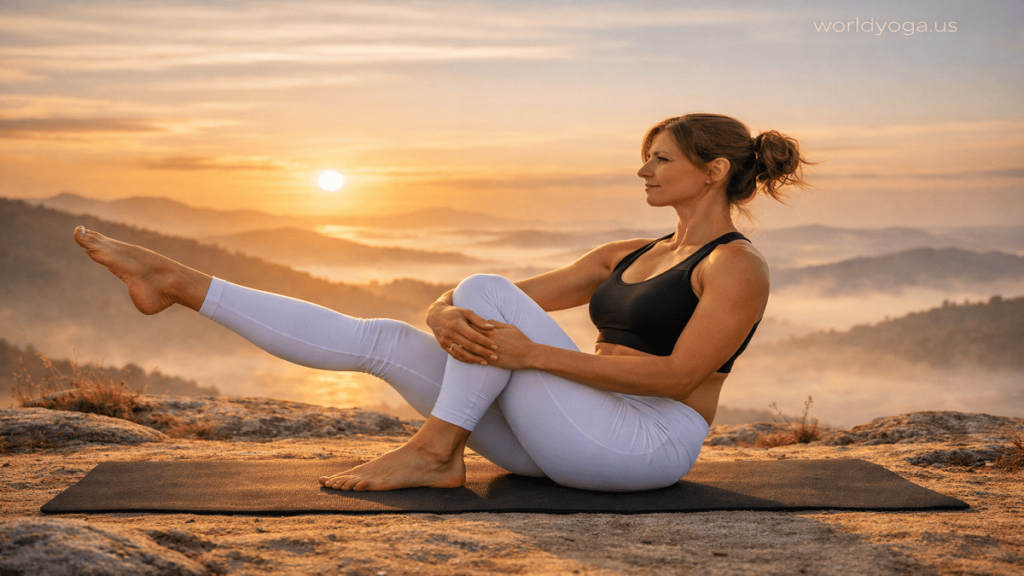
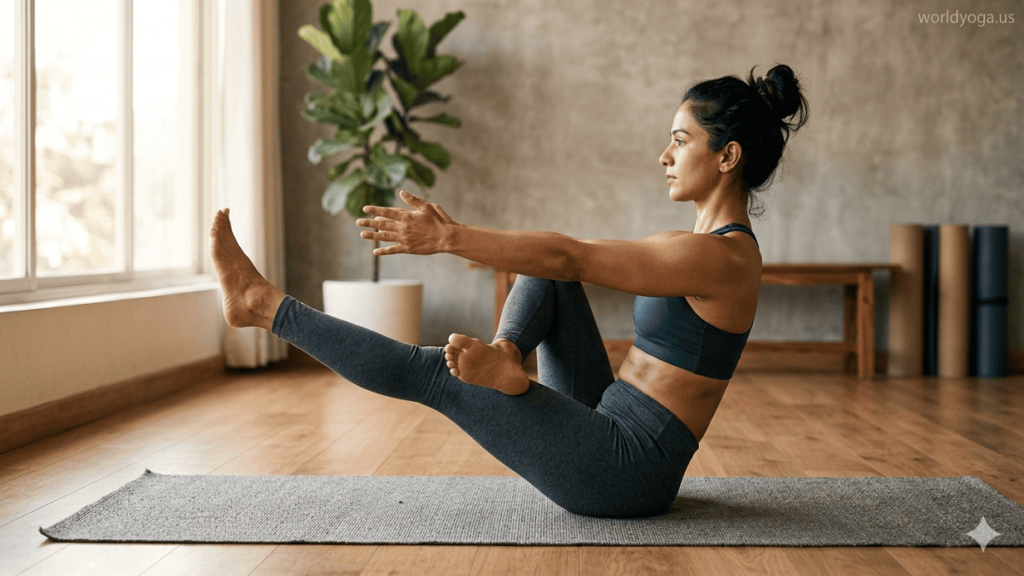
Begin in standard Boat Pose by balancing on the sit bones with the spine elongated and core engaged. One knee is bent and the foot is gently placed near or against the opposite knee while the other leg remains extended and active. The movement must originate from the hip joint, One Foot to Knee not the knee, to avoid strain.
2. Primary Benefits
This variation improves core endurance, pelvic stability, and unilateral control. It reduces intensity compared to deeper hip-socket placement while still challenging the obliques and transverse abdominis to resist rotation and maintain balance.
3. Muscle Engagement
Key muscles activated include the rectus abdominis, transverse abdominis, obliques, iliopsoas, and gluteal stabilizers. The extended leg engages the quadriceps, One Foot to Knee while the bent leg works in controlled flexion to maintain alignment without collapsing inward.
4. Alignment Focus
Proper alignment requires a neutral pelvis, lifted chest, and elongated spine. The bent knee should remain stable without twisting, One Foot to Knee and the foot should rest lightly near the knee rather than pressing forcefully. Shoulders stay relaxed while the gaze remains forward for balance.
5. Common Mistakes
Frequent errors include rounding the lower back, collapsing the chest, over-rotating the bent leg, One Foot to Knee or forcing the foot into the knee joint. These mistakes can reduce core activation and increase strain on the hips or lumbar spine.
6. Preparatory and Progression Use
This variation is often used as a bridge between basic Boat Pose and more advanced asymmetrical forms like hip-socket placement. It is suitable for practitioners developing core strength, improving hip control, or recovering from instability in the pelvis or lower back.
Reference Links
- https://www.yogajournal.com/poses/full-boat-pose/
- https://www.verywellfit.com/boat-pose-paripurna-navasana-3567068
#Boat Pose: One Foot to Knee in India
How is Boat Pose with one foot to knee performed correctly?
Performing Boat Pose with the “one foot to knee” variation (Paripurna Navasana progression) requires controlled core engagement, hip stability, and careful attention to spinal alignment. This version is slightly more accessible than deeper asymmetrical variations, but correct technique is still essential to avoid strain.
Begin seated on the floor with knees bent and feet flat. Sit tall on your sit bones and lengthen your spine upward. Engage your abdominal muscles first, One Foot to Knee as this creates the foundation for lifting the legs without collapsing the lower back.
Slowly lean back while keeping the chest open and the spine long, then lift both feet off the ground to enter a basic Boat Pose position. At this stage, your shins may remain parallel to the floor or you may extend your legs if you have sufficient core strength. The key is to maintain stability before introducing asymmetry.
To move into the “one foot to knee” variation, bend one knee and gently guide the foot toward the opposite knee. The foot should rest lightly near or against the knee area, One Foot to Knee not press into it. The movement should originate from the hip joint rather than twisting or pulling from the knee itself. The opposite leg remains extended and active, with toes pointing forward and the quadriceps engaged.
Throughout the pose, spinal alignment is critical. The spine should remain long rather than rounded, and the chest should stay lifted. Avoid collapsing into the lower back, as this is a common compensation when the core is not fully engaged. The pelvis should stay as stable as possible, One Foot to Knee resisting any side-to-side tilting.
The shoulders should remain relaxed and away from the ears, while the arms extend forward for balance or rest alongside the legs depending on strength level. The gaze should remain steady and forward, One Foot to Knee which helps maintain equilibrium and prevents unnecessary neck tension.
Breathing should be smooth and controlled. Inhale to lengthen the spine and exhale to deepen core engagement. Avoid holding the breath, One Foot to Knee as this reduces stability and increases muscular tension.
Common mistakes include collapsing the chest, rounding the lower back, forcing the foot onto the knee joint, or allowing the pelvis to rotate. These errors reduce effectiveness and may increase strain on the hips or lumbar spine.
For beginners, modifications such as keeping both knees bent or lightly supporting the thighs with the hands can help build strength. This variation is often used as a preparatory step before progressing to more advanced asymmetrical forms of Boat Pose.
For reference on foundational alignment and progression, you can explore Yoga Journal’s guide: https://www.yogajournal.com/poses/full-boat-pose/ and Verywell Fit’s breakdown: https://www.verywellfit.com/boat-pose-paripurna-navasana-3567068.
#Boat Pose: One Foot to Knee in Maharashtra
What is the proper alignment in this asymmetrical Navasana variation?
Proper alignment in the “one foot to knee” asymmetrical variation of Boat Pose (Paripurna Navasana) is centered on maintaining a stable pelvis, a long spine, and balanced core engagement while one leg moves into a bent, cross-body position.
Start with the foundation: sit firmly on the sit bones with both hip points facing forward. The pelvis should remain neutral—not tucked under and not excessively tilted forward. This neutral base is what allows the spine to lift without compression in the lower back.
The spine must stay elongated throughout the pose. The chest should remain open, and the ribcage gently contained rather than flaring outward. A common mistake is collapsing into the lumbar spine when the legs become asymmetrical; instead, the abdominal muscles should actively support the torso to maintain lift.
In the lower body, one leg remains extended and active. The quadriceps should be engaged, and the toes either point forward or slightly upward to maintain muscular activation. The opposite leg bends at the hip, and the foot is placed lightly near or against the opposite knee. Importantly, this movement should come from the hip joint, not by twisting or pulling the knee inward. The knee itself should remain free of pressure and not act as a point of force.
Pelvic stability is the most critical alignment principle in this variation. Because the legs are asymmetrical, there is a natural tendency for the pelvis to rotate or drop toward the bent-leg side. Both hip bones should stay level and oriented forward. The obliques play a major role here, preventing rotation and keeping the torso centered.
The shoulders should stay relaxed and aligned over the hips as much as possible. Avoid hunching or elevating the shoulders toward the ears. The arms may extend forward parallel to the floor, acting as a counterbalance, but they should not create tension in the neck or upper back.
The neck remains neutral, with the gaze directed forward at a steady point. This helps maintain equilibrium and prevents unnecessary strain in the cervical spine.
Breathing should remain steady and controlled. Inhale to lengthen the spine, and exhale to reinforce abdominal engagement without gripping or bracing excessively. Breath stability directly supports postural stability in this variation.
Common alignment errors include rounding the lower back, collapsing the chest, over-rotating the bent knee inward, or allowing the pelvis to tilt unevenly. These mistakes reduce core efficiency and may increase stress on the hips or lumbar spine.
#Boat Pose: One Foot to Knee in Ahemadabad
Which muscles are engaged during the pose?
During the “one foot to knee” asymmetrical variation of Boat Pose (Paripurna Navasana), the body works as a coordinated stability system where the core, hips, and spine must counteract uneven loading created by the asymmetrical leg position.
The primary muscle group engaged is the abdominal core. The rectus abdominis is responsible for maintaining trunk flexion and keeping the torso lifted, while the transverse abdominis provides deep internal stabilization of the spine and pelvis. The obliques—both internal and external—are especially active because they resist rotational forces created by the bent-leg position and help keep the pelvis facing forward.
The hip flexors are also heavily involved. The iliopsoas complex (iliacus and psoas major) stabilizes the lifted position of both legs. In the extended leg, the hip flexors work isometrically to maintain elevation, while in the bent leg, they control the movement as the foot is guided toward the opposite knee without collapsing or twisting.
The quadriceps of the extended leg are strongly engaged to maintain knee extension and prevent the leg from dropping. At the same time, the hamstrings of the bent leg remain in a lengthened but controlled state, allowing safe hip flexion without putting stress on the knee joint.
The gluteal muscles, particularly the gluteus medius and gluteus minimus, play a key stabilizing role. These muscles help maintain pelvic alignment and prevent the hips from tilting or rotating. The deep external rotators of the hip also assist in controlling the position of the bent leg and maintaining joint integrity.
Spinal stabilizers such as the erector spinae and multifidus muscles work continuously to keep the spine elongated and prevent excessive rounding. These muscles ensure that the posture remains lifted rather than collapsing into the lower back under load.
The upper body is also lightly engaged. The deltoids and trapezius muscles help stabilize the shoulders when the arms are extended forward, while the latissimus dorsi contributes to maintaining overall upper-body structure. Forearm and hand muscles may engage isometrically if the arms are used for balance support.
Because the pose involves asymmetry, smaller stabilizing muscles throughout the body are highly active. These include deep pelvic floor muscles, intercostals between the ribs, and stabilizers around the ankles and hips that continuously adjust to maintain equilibrium.
Compared to a standard Boat Pose, this variation increases unilateral demand, meaning each side of the body must independently stabilize against shifting forces rather than relying on symmetrical support. This significantly enhances neuromuscular coordination and anti-rotation strength.
#Boat Pose: One Foot to Knee in Hyderabad
What preparatory poses are recommended before practicing it?
Before attempting the “one foot to knee” asymmetrical variation of Boat Pose (Paripurna Navasana), it is important to build a foundation of core strength, hip mobility, and spinal control. Because this variation introduces uneven loading, preparatory poses should progressively train stability rather than flexibility alone.
A primary preparatory posture is the standard Boat Pose itself. Practicing basic Navasana with bent knees helps develop core endurance and teaches balance on the sit bones without collapsing the spine. Once this becomes steady, holding the pose with extended legs further strengthens abdominal control and hip flexor endurance.
Plank Pose is another essential preparation. It builds full-body core stability, especially in the transverse abdominis, obliques, shoulders, and spinal stabilizers. Since Boat Pose requires maintaining a lifted torso without external support, plank strength directly supports safe progression.
Low Boat Pose (Ardha Navasana) is also highly effective. In this variation, the body is closer to the mat, increasing abdominal demand and teaching control in a more challenging lever position. This helps build endurance in the deep core muscles needed for asymmetrical balance.
Hip mobility poses such as Bound Angle Pose (Baddha Konasana) and reclining hip openers are useful for preparing the hip joint for controlled knee movement toward the opposite side. These poses reduce tension in the inner thighs and groin, allowing smoother and safer leg placement.
Low Lunge (Anjaneyasana) is another key preparatory pose because it targets the iliopsoas and other hip flexors. Strong yet flexible hip flexors are essential for lifting and holding the legs in Boat Pose variations without strain on the lower back.
Seated forward fold variations also help by increasing hamstring flexibility and improving pelvic awareness. This reduces compensatory rounding in the lower spine when lifting the legs.
In addition, supine core activation drills such as bent-knee leg lifts or dead bug variations help train pelvic stability while the limbs move independently. This directly translates to controlling asymmetrical positioning in Boat Pose.
Finally, gentle spinal mobility work like Cat-Cow helps prepare the vertebral column for controlled flexion and extension under load. It improves awareness of neutral spine positioning, which is essential for safe practice.
A proper progression should always begin with mastering standard Boat Pose before introducing asymmetrical variations. This ensures that core strength, hip control, and balance are sufficient to handle uneven loading safely.
#Boat Pose: One Foot to Knee in Delhi
What are the benefits and precautions of this Boat Pose variation?
Benefits of the Variation
One of the main benefits is improved core stability. The asymmetrical leg position forces the abdominal muscles—especially the transverse abdominis and obliques—to work harder to prevent rotation and maintain a steady torso. This builds stronger anti-rotation control compared to standard symmetrical holds.
It also enhances hip control and coordination. By guiding one foot toward the opposite knee, the hip flexors and stabilizing muscles must coordinate movement precisely, improving awareness of how the hip joint functions in isolation from the knee.
Another benefit is improved unilateral strength. Each side of the body must stabilize independently, which helps address muscular imbalances between the left and right sides. This is especially useful for functional movement patterns in walking, running, and athletic performance.
The posture also supports spinal endurance. The erector spinae and deep stabilizing muscles of the spine remain engaged to maintain an elongated posture under load, helping improve postural strength over time.
Additionally, this variation improves balance and neuromuscular coordination. Because the body is working against uneven weight distribution, the nervous system is trained to make constant micro-adjustments, enhancing overall stability and control.
Precautions and Safety Guidelines
Despite its benefits, this variation places stress on the lower back, hips, and knees if performed incorrectly. One of the most important precautions is avoiding spinal rounding. Excessive flexion in the lumbar spine can lead to discomfort or strain, especially when core engagement is insufficient.
Another key precaution is knee protection. The foot should never be forced into the knee joint. The movement must originate from the hip, and the knee should remain free of pressure or twisting. Misalignment here can create unnecessary strain on ligaments.
Individuals with lower back injuries, disc issues, or sacroiliac joint instability should approach this variation cautiously or avoid it until core strength improves. Similarly, those with hip impingement or tight hip flexors should modify the pose to reduce joint compression.
Breathing control is also essential. Holding the breath increases internal tension and reduces stability, making the pose harder to maintain safely. Steady, controlled breathing helps support core engagement and balance.
Shoulder and neck tension should be avoided as well. Lifting the chest excessively or gripping the upper body can disrupt alignment and shift stress away from the core.
Finally, progression should be gradual. Practitioners should first master standard Boat Pose before introducing asymmetrical variations. Building a strong foundation reduces the risk of compensation patterns and improves long-term stability.
Summary
This variation of Boat Pose offers strong benefits in core strength, hip coordination, and unilateral stability, but it must be practiced with proper alignment, controlled movement, and appropriate progression to ensure safety and effectiveness.
#Boat Pose: One Foot to Knee in Pune
Case Study of Boat Pose: One Foot to Knee
Overview
The “one foot to knee” variation of Boat Pose (Paripurna Navasana) was introduced into a structured movement training program to assess its effectiveness in improving core stability, pelvic control, and unilateral coordination in an intermediate-level practitioner. This case study focuses on adaptation, progression, and functional outcomes over a six-week training period.
Subject Profile
The subject was a 29-year-old recreational fitness practitioner with moderate core strength but noticeable asymmetry in hip stability during unilateral exercises such as lunges and single-leg balances. The subject could hold standard Boat Pose for approximately 25–30 seconds but exhibited early fatigue and mild lumbar rounding beyond this duration.
Intervention Strategy
The intervention followed a progressive sequence designed to reduce risk and improve neuromuscular control:
- Basic Boat Pose with bent knees to establish core engagement
- Extended-leg Boat Pose to build endurance
- Controlled unilateral leg lift (no cross placement)
- Introduction of “one foot to knee” variation
Supporting exercises included Plank Pose, low Boat variations, and supine core activation drills to reinforce pelvic stability and anti-rotation strength.
Execution Phase
During the introduction of the asymmetrical variation, the practitioner maintained a lifted spine and neutral pelvis while bending one knee and placing the foot lightly near the opposite knee. Initial observations showed a tendency for pelvic rotation toward the bent-leg side and slight chest collapse during fatigue.
Corrective cues focused on:
- Keeping hip points level
- Engaging obliques for anti-rotation control
- Maintaining sternum lift without rib flare
Over time, the practitioner demonstrated improved control in stabilizing the pelvis and reducing rotational drift.
Observed Outcomes
After six weeks of consistent practice (3 sessions per week), the following improvements were recorded:
- Core endurance increased from ~30 seconds to ~55 seconds in asymmetrical hold
- Significant reduction in lumbar rounding during fatigue phases
- Improved left-right balance in single-leg stability exercises
- Enhanced control during transitional movements such as step-ups and lunges
Subjective feedback also indicated improved awareness of pelvic positioning and reduced lower-back discomfort during daily sitting.
Key Findings
The case highlights that introducing asymmetry into core training increases neuromuscular demand significantly more than symmetrical holds. The “one foot to knee” variation effectively bridges the gap between foundational core strength and advanced unilateral stability.
Key adaptations observed included:
- Improved oblique activation for anti-rotation control
- Better hip joint awareness and movement precision
- Increased spinal endurance under uneven load conditions
However, early-stage compensations (lumbar rounding and pelvic tilt) emphasize the importance of gradual progression and strong foundational training.
Conclusion
The “one foot to knee” variation of Boat Pose proved to be an effective intermediate progression for enhancing core stability, hip coordination, and functional balance. When introduced systematically alongside foundational exercises like Plank Pose, it supports measurable improvements in movement quality and postural control.
Reference Links
- https://www.yogajournal.com/poses/full-boat-pose/
- https://www.verywellfit.com/boat-pose-paripurna-navasana-3567068
#Boat Pose: One Foot to Knee in Banglore
White Paper of Boat Pose: One Foot to Knee
Abstract
The “One Foot to Knee” variation of Boat Pose (Paripurna Navasana) is an intermediate asymmetrical core stability posture derived from traditional yoga biomechanics. This paper evaluates its structural mechanics, neuromuscular activation patterns, progression methodology, and applied use in fitness, rehabilitation, and performance training systems. The variation introduces unilateral loading while maintaining a reduced range of hip rotation demand compared to deeper asymmetrical variations.
1. Introduction
Paripurna Navasana is widely used for developing core strength, spinal endurance, and balance. The “one foot to knee” modification introduces controlled asymmetry by bending one leg and placing the foot near or against the opposite knee. This adjustment reduces lever intensity while increasing anti-rotation demands on the trunk, making it a transitional progression between beginner and advanced core stabilization training.
2. Biomechanical Analysis
The posture shifts the body into a partially asymmetric load distribution. The center of mass moves laterally toward the bent-leg side, requiring compensatory stabilization.
Key biomechanical characteristics include:
- Increased anti-rotation demand on obliques
- Moderate unilateral hip flexor activation
- Enhanced pelvic stabilization requirements
- Controlled lumbar isometric engagement
Unlike deeper variations, knee flexion reduces torque on the hip joint, making this version more accessible while still challenging core control systems.
3. Muscle Activation Profile
Primary muscles engaged:
- Rectus abdominis: trunk flexion maintenance
- Transverse abdominis: deep spinal stabilization
- Internal and external obliques: rotational resistance control
- Iliopsoas group: hip flexion stabilization
- Erector spinae: spinal alignment support
Secondary stabilizers:
- Gluteus medius and minimus (pelvic control)
- Quadriceps (extended leg stabilization)
- Deep spinal stabilizers (multifidus)
4. Functional Applications
This variation is applied in multiple domains:
Fitness and Strength Training:
Used as a regression-to-progression bridge for core stability development and anti-rotation conditioning.
Rehabilitation:
Introduced in controlled environments for restoring pelvic stability and core control post-lumbar or hip dysfunction.
Sports Performance:
Supports unilateral strength development required for running, directional change, and single-leg loading sports.
Movement Therapy:
Used to retrain motor control patterns and correct asymmetries in trunk-pelvic coordination.
5. Progression Framework
Recommended progression model:
- Basic Boat Pose with bent knees
- Full symmetrical Boat Pose
- Extended-leg stability holds
- One-leg lift (no cross placement)
- One foot to knee variation
- Advanced asymmetrical hip-socket variations
Supporting exercises include Plank Pose and low Boat variations for foundational core endurance.
6. Safety Considerations
Key risks include lumbar flexion overload, pelvic rotation, and knee strain if improper foot placement is forced.
Contraindications:
- Acute lower back injury
- Hip impingement or instability
- Severe core deconditioning
Proper execution requires neutral pelvis alignment, spinal elongation, and hip-driven movement rather than knee torque.
7. Conclusion
The “One Foot to Knee” variation of Boat Pose serves as an effective transitional core stability tool. It bridges basic bilateral training and advanced unilateral control by introducing moderate asymmetry with reduced joint stress. When integrated into structured progression models, it improves anti-rotation strength, pelvic control, and functional movement efficiency.
References
- Yoga Journal – Boat Pose Guide: https://www.yogajournal.com/poses/full-boat-pose/
- Verywell Fit – Navasana Technique Overview: https://www.verywellfit.com/boat-pose-paripurna-navasana-3567068
#Boat Pose: One Foot to Knee in Kolkata
Industry Application of Boat Pose: One Foot to Knee
The “One Foot to Knee” variation of Boat Pose (Paripurna Navasana) has practical value across multiple industries due to its balance of accessibility and functional challenge. It bridges foundational core training with unilateral stability work, making it useful in fitness, rehabilitation, sports science, and wellness technology.
1. Fitness and Strength Training Industry
In fitness programming, this variation is used as a mid-level core stability exercise. Trainers include it in functional circuits to improve anti-rotation strength and controlled hip engagement without requiring equipment.
It is commonly applied to:
- Core conditioning programs
- Posture correction routines
- Stability-focused training blocks
Because it is less intense than deeper asymmetrical versions, it is also used as a regression tool for clients transitioning from basic core work to advanced stability training.
2. Sports Performance and Athletic Conditioning
Athletic trainers use this variation to develop unilateral control and improve movement efficiency in sports requiring single-leg dominance, such as running, football, tennis, and martial arts.
Key performance applications include:
- Improving pelvic stability during sprinting mechanics
- Enhancing core control during directional changes
- Reducing injury risk from rotational imbalance
It helps athletes train anti-rotation strength, which is critical for resisting external forces during competition.
3. Physical Therapy and Rehabilitation
In rehabilitation environments, this variation is often introduced in early-to-mid recovery phases for core and hip dysfunction.
Therapists use it to:
- Rebuild deep core activation safely
- Restore pelvic alignment control
- Reintroduce coordinated limb movement patterns
Because the knee is flexed rather than deeply rotated, this version reduces stress on the hip joint compared to more advanced asymmetrical poses.
4. Yoga Therapy and Corrective Movement Systems
In yoga therapy, this variation is used to correct asymmetries in pelvic control and trunk stability. It is often included in therapeutic sequencing for individuals recovering from sedentary posture-related issues.
Benefits in this context include:
- Improved awareness of pelvic positioning
- Reduced compensatory lumbar movement
- Enhanced breath-linked stability control
It serves as a stepping stone toward more complex variations of Boat Pose.
5. Corporate Wellness and Digital Fitness Platforms
Corporate wellness programs incorporate simplified core stability exercises like this variation to counteract prolonged sitting and postural fatigue.
Digital fitness platforms and yoga apps use it for:
- Short guided core activation sessions
- Desk-break mobility routines
- Beginner-friendly stability training modules
It is especially useful in virtual training environments where scalability and safety are priorities.
6. Key Industry Value
Across industries, this variation is valued for its:
- Low equipment requirement
- Scalable difficulty level
- Strong functional carryover to real-world movement
- Reduced injury risk compared to advanced asymmetrical holds
It effectively balances accessibility and training intensity, making it suitable for large-scale implementation in diverse populations.
Conclusion
The “One Foot to Knee” variation of Boat Pose is a versatile tool across fitness, rehabilitation, and performance industries. Its controlled asymmetry allows practitioners to develop core stability, hip control, and neuromuscular coordination in a safe and progressive manner.
References
- https://www.yogajournal.com/poses/full-boat-pose/
- https://www.verywellfit.com/boat-pose-paripurna-navasana-3567068
#Boat Pose: One Foot to Knee in Mumbai
Ask FAQs
What is the “One Foot to Knee” variation of Boat Pose?
It is an intermediate variation of Boat Pose (Paripurna Navasana) where one knee is bent and the foot is placed lightly near or against the opposite knee while maintaining a lifted core balance position.
Is this variation suitable for beginners?
Not usually. Beginners should first build stability in basic Boat Pose and bent-knee versions before attempting this asymmetrical variation to avoid strain on the lower back and hips.
What are the main benefits of this variation?
It improves core strength, especially anti-rotation control, enhances hip stability, and builds better balance and coordination between the left and right sides of the body.
What are the most common mistakes?
Common mistakes include rounding the lower back, collapsing the chest, forcing the foot into the knee joint, or allowing the pelvis to rotate instead of staying level and stable.
Are there any safety precautions?
Yes. Avoid this variation if you have lower back injuries, hip impingement, or sacroiliac joint issues. Always maintain controlled breathing and ensure movement originates from the hip, not the knee, to prevent joint strain.
Table of Contents
Disclaimer: This content is for educational purposes only and is not a substitute for professional medical advice. Practice variations of Boat Pose only under proper guidance, especially if you have existing injuries, pain, or medical conditions.