Boat Pose: Scissor Legs
Boat Pose Scissor Legs is a dynamic variation of Navasana that combines static core stabilization with alternating leg movement. In this variation, the practitioner maintains the foundational Boat Pose position while moving the legs in a scissor-like motion, creating increased demand on abdominal endurance, hip flexor control, and neuromuscular coordination.
Unlike traditional Navasana, where both legs remain still, the scissor-leg variation introduces continuous movement and asymmetrical loading. This makes the posture more challenging because the core must stabilize the spine and pelvis while the legs alternate positions. The movement pattern increases activation of the obliques and deep stabilizing muscles, particularly during transitions between leg positions.
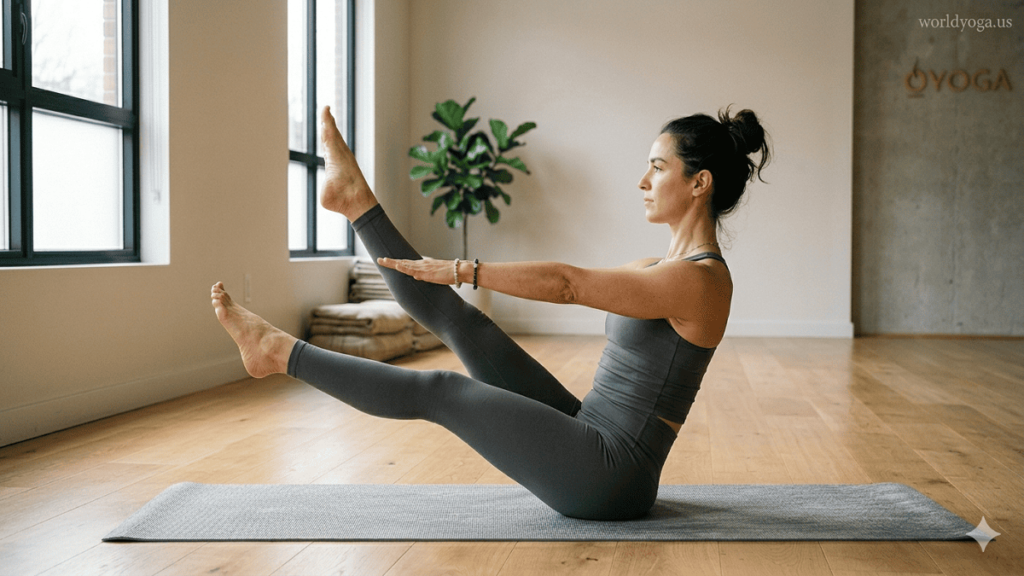
The pose typically begins from a balanced seated position with the torso leaning slightly backward and the spine elongated. Both legs are lifted off the floor while the chest remains open and the abdominal wall engaged. From this position, the practitioner alternates one leg upward while lowering the other in a controlled scissor motion. The movement should remain smooth and deliberate rather than fast or momentum-driven.
From a biomechanical perspective, Boat Pose: Scissor Legs functions as both a core endurance drill and a coordination exercise. The rectus abdominis works isometrically to maintain trunk position, while the obliques and transverse abdominis resist pelvic rotation caused by the alternating legs. The hip flexors and quadriceps remain continuously active to sustain leg elevation and movement control.
This variation is commonly used in:
- Advanced yoga sequencing
- Functional core training programs
- Pilates-inspired conditioning sessions
- Athletic stability and endurance training
The dynamic nature of the posture also challenges breath regulation. Practitioners must maintain steady breathing despite increased muscular demand, improving coordination between the diaphragm and deep core stabilizers.
Boat Pose: Scissor Legs is particularly valuable for developing:
- Core endurance
- Pelvic stability under movement
- Lower abdominal activation
- Coordination and balance
- Functional anti-rotation strength
However, because of the repetitive leg movement and increased load on the lumbar region, proper alignment is essential. Rounding the lower back or relying excessively on hip flexors can create unnecessary strain.
#Boat Pose: Scissor Legs in India
How is Boat Pose with scissor legs performed correctly?
Boat Pose Scissor Legs is performed by combining the foundational stability of Navasana with controlled alternating leg movements. The objective is to maintain spinal alignment and core engagement while the legs move in a steady scissor-like pattern without using momentum.
Step 1: Establish the Base Position
Begin seated on a yoga mat with the knees bent and feet flat on the floor. Sit tall on the sit bones and lengthen the spine upward. Engage the abdominal muscles gently before leaning the torso slightly backward.
Lift both feet off the floor and balance in a stable Boat Pose position. The chest should remain lifted and open while the spine stays long rather than rounded.
Step 2: Activate the Core
Before moving the legs, establish strong core engagement. Draw the navel inward slightly while maintaining steady breathing. The goal is to stabilize the pelvis and lumbar spine so the leg movement does not create collapse or twisting.
The shoulders should stay relaxed and away from the ears.
Step 3: Extend the Legs
Straighten both legs to a comfortable height while keeping them active. The quadriceps engage to support the knees, and the toes point upward or remain neutrally flexed.
If straight legs compromise spinal alignment, keep a slight bend in the knees.
Step 4: Begin the Scissor Motion
Slowly lower one leg while simultaneously lifting the opposite leg slightly higher, creating a scissor-like movement. Then switch positions in a controlled manner.
The movement should be:
- Slow and deliberate
- Evenly controlled on both sides
- Driven by core stability rather than momentum
The pelvis should remain steady without rocking side to side.
Step 5: Maintain Proper Alignment
Throughout the movement:
- Keep the spine elongated
- Maintain an open chest
- Avoid collapsing into the lower back
- Keep the core continuously engaged
- Prevent excessive neck or shoulder tension
The torso should remain relatively still while the legs move independently.
Step 6: Coordinate the Breath
Use smooth nasal breathing throughout the exercise. A common method is:
- Inhale during one scissor phase
- Exhale during the switch
Steady breathing helps maintain intra-abdominal pressure and improves stability.
Common Mistakes to Avoid
Rounding the Lower Back
This usually indicates weak core engagement or legs lowered too far.
Using Momentum
Fast kicking motions reduce abdominal activation and compromise control.
Overusing Hip Flexors
The movement should originate from core stabilization, not only from the front of the hips.
Tension in the Neck and Shoulders
Shoulders should stay relaxed while the chest remains lifted.
Lowering Legs Too Far
Only move within a range where spinal alignment can be maintained.
Recommended Progression
Before practicing this variation, practitioners should be comfortable holding:
- Navasana
- Supported boat variations
- Static leg extension holds
- Plank-based core stabilization exercises
Conclusion
Boat Pose with scissor legs is performed correctly when the torso remains stable, the spine stays long, and the legs move in a controlled alternating pattern without disrupting pelvic alignment. By combining dynamic movement with static core stabilization, Boat Pose Scissor Legs becomes an effective exercise for improving abdominal endurance, coordination, and functional balance control.
#Boat Pose: Scissor Legs in Maharashtra
What is the proper alignment in this dynamic Navasana variation?
Spine Alignment: Long and Stable
The spine should remain elongated throughout the movement. The torso leans slightly backward, but the chest stays lifted and open instead of collapsing into a rounded shape. A neutral-to-lightly posterior pelvic tilt is ideal to support the lumbar spine without excessive flattening.
The lower back should not sink or compress as the legs move. If the spine rounds, the legs are likely too low or the core is insufficiently engaged.
Pelvic Position: Level and Controlled
The pelvis serves as the stability center of the pose. During the scissor movement, the hips should remain level without rocking side to side. The abdominal wall and obliques work continuously to resist rotational forces created by alternating leg motion.
Both sit bones should initially feel balanced before lift-off, and the pelvis should remain controlled as the legs alternate.
Core Engagement: Continuous and Dynamic
The abdominal muscles should remain active at all times, not only during the leg switch. The transverse abdominis stabilizes the lumbar region while the obliques prevent twisting. The rectus abdominis maintains trunk position against gravity.
The engagement should feel steady and integrated rather than rigid or forceful.
Leg Positioning: Active and Symmetrical
Both legs should remain active throughout the movement:
- Knees stay straight or softly bent with control
- Quadriceps remain engaged
- Toes point upward or remain neutrally flexed
- Movement range stays controlled and symmetrical
The scissor motion should be smooth and even rather than fast or jerky.
Chest and Shoulder Alignment
The chest remains open with the sternum gently lifted. The shoulders should stay relaxed and drawn away from the ears. Excessive tension in the neck or upper trapezius usually indicates poor core stabilization.
The arms may extend forward parallel to the floor or lightly support the body depending on the practitioner’s level.
Breath Coordination
Breathing should remain steady and uninterrupted. Smooth nasal breathing helps maintain intra-abdominal pressure and improves stability. Breath holding often causes unnecessary muscular tension and reduces movement efficiency.
Common Alignment Errors
Lumbar Rounding
Occurs when the legs lower too far or the core disengages.
Pelvic Rocking
Usually caused by weak oblique activation or uncontrolled leg switching.
Neck Tension
Results from lifting the shoulders or straining the head forward.
Momentum-Based Movement
Fast scissor kicks reduce muscular control and compromise alignment.
Collapsed Chest
This shifts load into the lower back and weakens balance stability.
Summary
Correct alignment in Boat Pose Scissor Legs depends on maintaining:
- A long neutral spine
- Stable and level pelvis
- Continuous core activation
- Controlled leg movement
- Relaxed shoulders and steady breath
When these elements work together, the posture becomes an effective dynamic core-conditioning exercise that develops balance, endurance, and anti-rotation control while protecting the spine from unnecessary strain.
#Boat Pose: Scissor Legs in Ahemadabad

Which muscles are engaged during the pose?
Deep Core Stabilizers
Transverse Abdominis
The transverse abdominis is one of the most important muscles activated during the pose. It functions like an internal support belt, stabilizing the lumbar spine and maintaining intra-abdominal pressure as the legs move.
Multifidus
These deep spinal stabilizers support vertebral alignment and prevent excessive movement in the lumbar region during the scissor action.
Pelvic Floor Muscles
The pelvic floor works with the diaphragm and deep abdominals to create internal support and improve balance control.
Superficial Abdominal Muscles
Rectus Abdominis
The rectus abdominis maintains the lifted trunk position and prevents the torso from collapsing backward. In this variation, it works isometrically while the legs move dynamically.
Internal and External Obliques
The obliques are heavily activated because the alternating leg motion creates rotational forces. These muscles resist twisting and keep the pelvis and ribcage aligned.
This anti-rotation function is one of the primary reasons the scissor-leg variation is more demanding than static Navasana.
Hip Flexors and Leg Muscles
Iliopsoas
The iliopsoas lifts and controls the legs during the scissor movement. It plays a major role in maintaining leg elevation.
Rectus Femoris
Part of the quadriceps group, this muscle assists hip flexion and knee extension during the alternating leg motion.
Quadriceps
The quadriceps keep the knees extended and stabilize the legs throughout the movement.
Adductors
The inner thigh muscles help maintain leg alignment and movement control during the crossing motion.
Spinal and Postural Muscles
Erector Spinae
These muscles support spinal length and posture. They help prevent excessive rounding while the torso remains in a semi-reclined position.
Deep Cervical Stabilizers
The neck muscles work lightly to maintain head alignment without excessive forward tension.
Shoulder and Upper Body Stabilizers
If the arms extend forward, the:
- Deltoids
- Trapezius stabilizers
- Serratus anterior
assist in maintaining upper-body positioning and postural balance.
Respiratory Integration
Diaphragm
The diaphragm coordinates with the deep core muscles to regulate breathing and maintain stability. Proper breath control improves muscular efficiency and reduces compensatory tension.
Functional Muscle Coordination
The pose is especially effective because it trains:
- Anti-rotation control
- Dynamic core endurance
- Pelvic stabilization under movement
- Coordination between upper and lower body systems
Rather than isolating one muscle group, the exercise develops integrated movement stability.
Summary
Boat Pose Scissor Legs activates:
- Transverse abdominis
- Rectus abdominis
- Internal and external obliques
- Iliopsoas and hip flexors
- Quadriceps and adductors
- Multifidus and erector spinae
- Shoulder stabilizers and diaphragm
Together, these muscles create a dynamic stabilization system that supports controlled movement, balance, endurance, and spinal protection throughout the posture.
#Boat Pose: Scissor Legs in Hyderabad
What preparatory poses help build strength and stability for this variation?
Preparing for Boat Pose Scissor Legs requires more than basic abdominal strength. Because this variation combines static balance with dynamic leg movement, practitioners need stability in the spine, endurance in the core, and controlled hip flexor activation before attempting the scissor action safely.
The most effective preparation comes from gradually progressing through foundational poses that develop trunk stability, anti-rotation control, and movement coordination.
1. Navasana (Boat Pose)
Standard Navasana is the primary foundation for this variation. It teaches:
- Core engagement
- Spinal alignment awareness
- Balance control on the sit bones
- Hip flexor endurance
Practitioners should be able to hold Boat Pose comfortably with steady breathing before introducing leg movement.
2. Ardha Navasana (Half Boat Pose)
Ardha Navasana strengthens the lower abdominal region and improves anti-extension control. Since scissor-leg movements tend to pull the lumbar spine into collapse, this pose helps develop the deep core stability needed to maintain alignment.
It also improves endurance in the transverse abdominis and obliques.
3. Plank Pose
Plank Pose develops integrated full-body core strength. It teaches the body to resist spinal collapse while maintaining neutral alignment under load.
This is especially important because Boat Pose Scissor Legs requires the torso to remain stable while the legs move independently.
Benefits include:
- Deep core activation
- Shoulder stability
- Pelvic control
- Anti-extension strength
4. Side Plank Variations
Side plank training develops oblique strength and anti-rotation control. Since the scissor-leg motion creates rotational instability, side plank helps the body resist twisting and maintain level hips during movement.
This preparation is critical for maintaining symmetrical alignment.
5. Seated Leg Lift Drills
Controlled seated leg lifts improve:
- Hip flexor endurance
- Quadriceps activation
- Neuromuscular coordination
Practicing alternating leg lifts while seated helps simulate the mechanics of the scissor movement without full balance demand.
6. Low Boat Hover Holds
Low Boat variations strengthen the lower abdominal wall and improve control of leg positioning close to the floor. This is valuable because the scissor variation often challenges practitioners when the legs descend too low.
These holds train:
- Lower abdominal endurance
- Lumbar stabilization
- Controlled breathing under load
7. Cat-Cow Mobility Practice
Cat-Cow (Marjaryasana-Bitilasana) improves awareness of spinal positioning and pelvic movement. Understanding neutral spine alignment helps prevent excessive rounding during dynamic Navasana work.
8. Supine Scissor Leg Exercises
Performing scissor-leg movements while lying on the back introduces the movement pattern with reduced balance demand. This allows practitioners to:
- Develop coordination
- Strengthen lower abdominals
- Practice controlled leg switching
before adding the seated balance component.
Progression Strategy
A recommended preparation sequence:
- Navasana
- Ardha Navasana
- Plank Pose
- Side plank variations
- Seated leg lifts
- Supine scissor drills
- Boat Pose Scissor Legs
Conclusion
The safest and most effective preparation for Boat Pose Scissor Legs involves building layered stability through foundational core poses, anti-rotation exercises, and controlled leg movement drills. When practitioners first develop endurance in Navasana and related stabilization exercises, they are better equipped to perform this dynamic variation with proper alignment, balance, and spinal control.
#Boat Pose: Scissor Legs in Delhi
What are the benefits and precautions of practicing this pose?
Boat Pose Scissor Legs is a dynamic progression of Navasana that combines static balance with alternating leg movement. This variation increases the demand on the abdominal muscles, hip flexors, and spinal stabilizers while also improving coordination and endurance. Although highly effective for core conditioning, it requires proper alignment and controlled execution to avoid unnecessary strain.
Benefits of Boat Pose Scissor Legs
1. Strengthens the Entire Core System
This posture activates both deep and superficial abdominal muscles, including the transverse abdominis, rectus abdominis, and obliques. The alternating leg motion creates instability, forcing the core to stabilize continuously throughout the exercise.
2. Improves Anti-Rotation Stability
Because the legs move asymmetrically, the obliques and pelvic stabilizers must resist twisting forces. This improves anti-rotation strength, which is important for posture, athletic movement, and spinal protection.
3. Enhances Hip Flexor Endurance
The iliopsoas and quadriceps remain active to support and alternate the legs. Over time, this improves hip flexor endurance and lower-body control.
4. Develops Coordination and Balance
The scissor motion trains neuromuscular coordination between the upper and lower body. Practitioners learn to stabilize the torso while the legs move independently, improving overall movement efficiency.
5. Builds Functional Core Endurance
Unlike short-duration abdominal exercises, this variation develops sustained muscular endurance. This can support better posture and reduce fatigue during daily movement and athletic activity.
6. Encourages Breath-Control Under Load
Maintaining smooth breathing during the movement improves diaphragm-core coordination and helps practitioners stay stable under physical effort.
Precautions and Safety Considerations
1. Avoid Lower Back Compression
One of the most common risks is collapsing into the lumbar spine. If the core is not sufficiently engaged, the lower back may round or compress excessively.
To reduce strain:
- Keep the chest lifted
- Maintain a long spine
- Do not lower the legs beyond controllable range
2. Do Not Use Momentum
Fast kicking motions reduce muscular control and shift stress into the hip flexors and lower back. The movement should remain slow and deliberate.
3. Watch for Hip Flexor Dominance
Overusing the hip flexors instead of engaging the abdominal wall can create tightness in the front of the hips and reduce core effectiveness.
4. Maintain Neck and Shoulder Relaxation
Tension in the shoulders or neck usually indicates compensation. The shoulders should remain relaxed and away from the ears throughout the exercise.
5. Practice Within Strength Capacity
If the practitioner cannot maintain alignment, it is safer to:
- Bend the knees slightly
- Reduce movement range
- Return to static Navasana training
6. Contraindications
This variation should be avoided or modified in cases of:
- Acute lower back pain
- Herniated discs
- Hip flexor injuries
- Recent abdominal surgery
- Pregnancy without professional guidance
Conclusion
Boat Pose Scissor Legs is an effective dynamic core-conditioning posture that improves abdominal endurance, anti-rotation strength, balance, and movement coordination. When practiced with proper alignment, controlled breathing, and progressive preparation from foundational Navasana work, it becomes a valuable tool for developing functional stability and spinal control. However, careful attention to technique is essential to avoid lower back strain and muscular compensation.
#Boat Pose: Scissor Legs in Pune
Case Study of Boat Pose: Scissor Legs
1. Background and Objective
This case study evaluates the use of Boat Pose Scissor Legs as a dynamic core-conditioning method within an intermediate yoga and functional fitness program. The study focused on improving abdominal endurance, anti-rotation stability, and pelvic control in practitioners who had already established competency in Navasana.
The primary objective was to determine whether integrating controlled scissor-leg movement into static Boat Pose training could improve dynamic trunk stability without increasing lumbar discomfort.
2. Participant Profile
The program involved intermediate-level practitioners aged 24–40 with:
- Prior experience in foundational yoga postures
- No acute spinal injuries
- Moderate baseline core endurance
- Difficulty maintaining pelvic stability during dynamic movement exercises
Participants trained three times weekly over a six-week period.
3. Training Methodology
The progression model was divided into three phases:
Phase 1: Foundational Stabilization (Weeks 1–2)
Participants practiced:
- Static Navasana holds
- Ardha Navasana
- Plank and side plank stabilization drills
The emphasis was on maintaining spinal neutrality and breath control.
Phase 2: Controlled Dynamic Integration (Weeks 3–4)
Scissor-leg movement was introduced gradually:
- Alternating leg switches at slow tempo
- Limited range of motion to preserve lumbar alignment
- 10–15 second movement intervals with rest periods
Focus remained on minimizing pelvic rocking and preventing momentum-driven movement.
Phase 3: Endurance and Coordination Development (Weeks 5–6)
Participants increased:
- Hold duration
- Movement consistency
- Breath synchronization during leg transitions
More advanced practitioners reduced arm support to increase stabilization demand.
4. Observed Outcomes
By the end of the program, participants demonstrated measurable improvements in:
Core Endurance
Longer duration holds without lumbar collapse or fatigue-related compensation.
Anti-Rotation Stability
Reduced side-to-side pelvic movement during alternating leg patterns.
Neuromuscular Coordination
Improved ability to maintain stable trunk positioning while moving the lower limbs independently.
Breath Regulation
More consistent diaphragmatic breathing during dynamic movement.
Postural Awareness
Better recognition of spinal alignment and pelvic positioning during seated balance exercises.
5. Challenges Identified
Common challenges included:
- Hip flexor overactivation during faster movements
- Lower back rounding when legs descended too low
- Shoulder tension from over-bracing
- Breath holding during fatigue phases
Regression strategies included bending the knees, shortening movement range, and returning temporarily to static Boat Pose work.
6. Analysis
The study demonstrated that Boat Pose Scissor Legs effectively bridges static and dynamic core training. The movement increased demand on the obliques and deep stabilizers more than static Navasana alone, while also enhancing movement coordination.
The dynamic asymmetry forced practitioners to stabilize against rotational forces, creating functional trunk endurance beneficial for yoga transitions, athletic performance, and movement efficiency.
These observations align with principles described in resources such as Yoga Journal Core Stability Training and Verywell Fit Functional Core Training.
7. Conclusion
This case study indicates that Boat Pose Scissor Legs is an effective dynamic progression for improving core endurance, anti-rotation control, and movement coordination. When introduced after foundational mastery of Navasana, it provides a safe and structured method for developing functional trunk stability and controlled lower-body movement under asymmetrical load.
#Boat Pose: Scissor Legs in Kolkata
White Paper of Boat Pose: Scissor Legs
1. Executive Summary
Boat Pose Scissor Legs is a dynamic progression of Navasana that integrates alternating lower-limb movement into a seated core balance framework. The posture combines isometric trunk stabilization with repetitive asymmetrical leg motion, creating a high-demand neuromuscular conditioning environment.
This white paper examines the pose from biomechanical, functional, and movement-training perspectives, highlighting its role in core endurance development, anti-rotation stability, and coordinated movement conditioning.
2. Functional Classification
Boat Pose Scissor Legs falls within three primary training categories:
- Dynamic core stabilization
- Anti-rotation endurance conditioning
- Neuromuscular coordination training
Unlike static Navasana, this variation introduces repetitive limb motion while requiring continuous trunk control.
3. Biomechanical Analysis
The posture places the body in a semi-reclined seated balance position while the legs alternate in opposing vertical motion. This creates:
- Continuous instability through the pelvis
- Rotational force generation requiring oblique stabilization
- Sustained lumbar anti-collapse demand
- Dynamic hip flexion under static trunk load
The torso remains relatively fixed while the lower limbs move independently, requiring integrated stabilization across the abdominal wall and spinal support systems.
4. Muscular Activation Systems
Primary Core Stabilizers
- Transverse abdominis
- Rectus abdominis
- Internal and external obliques
- Multifidus
Lower Body Activation
- Iliopsoas
- Rectus femoris
- Quadriceps
- Adductors
Postural and Support Muscles
- Erector spinae
- Deep cervical stabilizers
- Shoulder stabilizers (if arms are extended)
The scissor motion increases oblique recruitment significantly compared to static Navasana.
5. Functional Applications
This variation is widely applicable in:
Yoga Conditioning Programs
Used as an advanced progression to improve endurance and dynamic trunk control.
Functional Fitness Training
Integrated into bodyweight conditioning systems for anti-rotation and core endurance development.
Athletic Performance Programs
Supports movement efficiency in sports requiring rapid directional changes and trunk stabilization.
Pilates and Movement Therapy
Used in modified form to improve coordination and controlled pelvic movement.
6. Performance Objectives
Key training outcomes include:
- Improved dynamic core endurance
- Enhanced anti-rotation control
- Increased pelvic stabilization capacity
- Better coordination between upper and lower body systems
- Improved breathing control during movement under load
7. Progression Framework
Recommended progression pathway:
- Static Navasana
- Ardha Navasana
- Seated single-leg extension drills
- Supine scissor-leg movements
- Controlled Boat Pose Scissor Legs integration
- Reduced support and extended endurance intervals
This staged progression reduces compensatory movement patterns and supports safe adaptation.
8. Risk Assessment and Contraindications
Primary Risks
- Lumbar flexion collapse due to insufficient core engagement
- Hip flexor dominance
- Excessive momentum-driven movement
- Neck and shoulder tension from postural compensation
Contraindications
- Acute lower back injuries
- Herniated disc conditions
- Severe hip flexor strain
- Post-surgical abdominal recovery phases
Movement quality should take priority over movement speed or duration.
9. Comparative Analysis
Compared to static Boat Pose, the scissor-leg variation introduces:
- Higher rotational instability
- Greater neuromuscular coordination demand
- Increased endurance requirement
- More complex breath-movement synchronization
Despite increased complexity, the movement remains low-impact and equipment-free.
10. Conclusion
Boat Pose Scissor Legs represents an advanced dynamic core-conditioning model that combines balance, anti-rotation stability, and coordinated lower-limb movement within a seated yoga framework. When introduced progressively after foundational mastery of Navasana, it becomes an effective tool for improving functional trunk stability, endurance, and neuromuscular control across yoga, fitness, and athletic conditioning environments.
#Boat Pose: Scissor Legs in Banglore
Industry Application of Boat Pose: Scissor Legs
Introduction
Boat Pose Scissor Legs is a dynamic progression of Navasana that integrates controlled alternating leg movement with static core stabilization. Because it develops anti-rotation strength, balance, coordination, and muscular endurance simultaneously, the pose has practical applications across multiple industries including fitness, yoga education, sports performance, rehabilitation, and workplace wellness.
1. Fitness and Functional Training Industry
In the fitness sector, Boat Pose Scissor Legs is used as a dynamic bodyweight core-conditioning exercise. Trainers integrate it into:
- Functional fitness circuits
- HIIT core sessions
- Pilates-inspired programs
- Mobility and stability training systems
The posture is especially valued because it develops:
- Core endurance
- Lower abdominal activation
- Pelvic stability under movement
- Coordination without external equipment
Its dynamic nature also increases cardiovascular demand slightly compared to static Boat Pose variations.
2. Yoga Industry and Teacher Training
Within yoga systems, the posture is commonly used in:
- Advanced Vinyasa sequencing
- Core-focused yoga classes
- Progressive Navasana training
- Teacher education programs
Yoga instructors use it to teach:
- Dynamic core control
- Breath synchronization with movement
- Anti-rotation stability awareness
- Smooth transition mechanics between seated balances
It is often introduced after foundational mastery of Navasana and Ardha Navasana.
3. Sports Performance and Athletic Conditioning
Athletic conditioning programs use Boat Pose Scissor Legs to improve:
- Midline stabilization during movement
- Rotational control for sports performance
- Hip-core coordination
- Endurance under asymmetrical load
The exercise is particularly relevant in:
- Martial arts
- Football
- Running
- Gymnastics
- Climbing
- Dance conditioning
Because athletes frequently generate force while resisting rotation, this variation provides functional transfer into dynamic sport movement patterns.
4. Rehabilitation and Corrective Exercise
In controlled rehabilitation environments, modified versions are used to:
- Retrain deep abdominal activation
- Improve pelvic movement awareness
- Develop safe dynamic stabilization
- Transition patients from static to movement-based core training
The movement is generally introduced only during later rehabilitation phases once foundational spinal stability has been restored.
5. Pilates and Movement Therapy Systems
Pilates instructors and movement specialists use similar scissor-based seated core drills to:
- Improve lower abdominal endurance
- Enhance movement precision
- Build coordinated breathing patterns
- Strengthen lumbo-pelvic control
The yoga variation integrates these principles within a seated balance framework.
6. Corporate Wellness and Ergonomic Programs
Simplified versions of the posture are occasionally adapted into workplace wellness initiatives to address:
- Sedentary posture weakness
- Reduced core endurance from prolonged sitting
- Early-stage spinal support conditioning
Short-duration dynamic seated core exercises inspired by this movement help improve postural awareness and trunk activation.
7. Digital Fitness and Online Training Platforms
Online fitness platforms and virtual yoga programs frequently include Boat Pose Scissor Legs because:
- It requires no equipment
- It fits small training spaces
- It is visually engaging for guided classes
- It scales across multiple difficulty levels
Its dynamic motion also makes it highly effective for video-based instructional formats.
Conclusion
Boat Pose Scissor Legs has evolved into a versatile movement tool used across yoga, fitness, rehabilitation, athletic conditioning, and digital wellness industries. By combining static trunk stabilization with controlled dynamic leg movement, it delivers integrated core training that improves endurance, balance, anti-rotation strength, and neuromuscular coordination. When progressed properly from foundational Navasana training, it serves as an effective low-impact conditioning method for both performance enhancement and movement education.
#Boat Pose: Scissor Legs in Mumbai
Ask FAQs
What is Boat Pose Scissor Legs?
Boat Pose Scissor Legs is a dynamic variation of Navasana where the legs alternate in a scissor-like motion while the torso remains balanced and stable.
Is Boat Pose Scissor Legs suitable for beginners?
This variation is generally recommended for intermediate practitioners because it requires strong core stability and balance control. Beginners should first develop stability in basic Boat Pose before attempting dynamic leg movements.
Which muscles are mainly targeted in this pose?
The pose primarily engages the abdominal muscles, obliques, hip flexors, quadriceps, and spinal stabilizers. It also improves anti-rotation control and pelvic stability.
What are the most common mistakes during the pose?
Common mistakes include rounding the lower back, using momentum instead of control, lowering the legs too far, and creating tension in the neck or shoulders.
How long should Boat Pose Scissor Legs be practiced?
Beginners may start with 10–15 seconds of controlled movement, gradually increasing duration as strength and endurance improve while maintaining proper alignment and steady breathing.
Table of Contents
Disclaimer:
The information provided about Boat Pose Scissor Legs is for educational purposes only and should not replace professional medical or fitness advice. Practice under the guidance of a qualified yoga instructor, especially if you have existing injuries, spinal conditions, or health concerns. Stop immediately if pain or discomfort occurs during practice.