Parivritta Ardha Vayu Muktyasana
Parivritta Ardha Vayu Muktyasana is a supine twisting variation of the traditional wind-relieving posture, designed to gently combine abdominal compression with spinal rotation. It is commonly used in yoga therapy sequences to support digestion, spinal mobility, Parivritta Ardha Vayu Muktyasana and relaxation through controlled movement and breath awareness.
Pawanmuktasana serves as the foundational base for this variation, where the practitioner introduces a gentle twist while maintaining the core principles of supine alignment and mindful breathing.
Meaning of the Name
- Parivritta: Revolved or twisted
- Ardha: Half
- Vayu: Air or wind
- Muktyasana: Wind-releasing posture
The name reflects its dual action of releasing trapped gas and gently rotating the spine.
How It is Performed (Basic Outline)
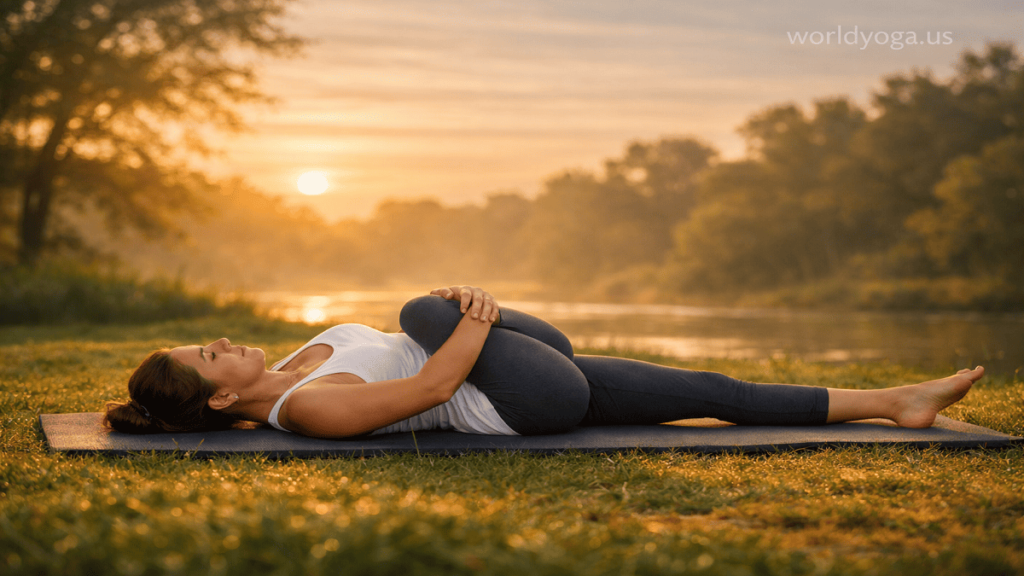
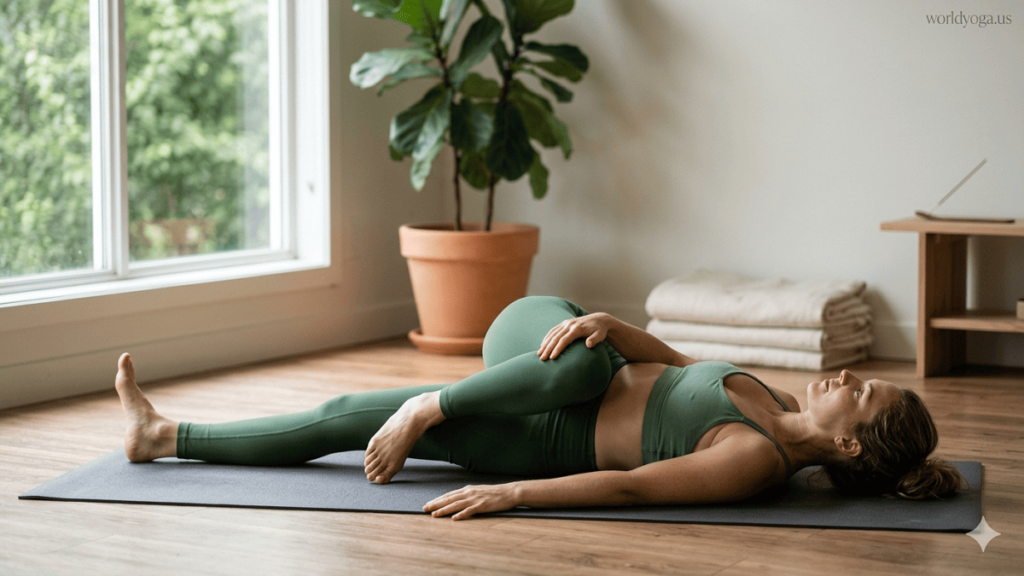
- Lie on your back in a supine position.
- Bring one knee toward the chest.
- Gently guide the bent knee across the body toward the opposite side.
- Allow the spine to rotate naturally while keeping shoulders grounded.
- Extend the opposite arm sideways for balance.
- Hold with steady breathing, then return and switch sides.
Key Benefits
1. Improves Digestion
The combination of abdominal compression and spinal twist helps stimulate digestive organs and may assist in relieving bloating and gas.
2. Enhances Spinal Mobility
The gentle rotation improves flexibility in the thoracic and lumbar spine without excessive strain.
3. Supports Lower Back Relief
Controlled twisting helps release tension in the lower back muscles and surrounding connective tissues.
4. Promotes Relaxation
The supine position encourages nervous system relaxation and supports stress reduction through breath awareness.
5. Improves Body Awareness
The pose strengthens coordination between breath, movement, and alignment, enhancing overall somatic awareness.
Precautions
- Avoid in cases of severe spinal injuries or acute disc issues
- Do not force the twist beyond comfortable range
- Avoid during recovery from abdominal surgery
- Pregnant individuals should practice only under expert supervision
- Keep movements slow and controlled to avoid strain
Conclusion
Parivritta Ardha Vayu Muktyasana is a gentle yet effective rotational variation of the wind-relieving family of postures. It integrates abdominal compression with spinal twisting, Parivritta Ardha Vayu Muktyasana making it beneficial for digestive support, mobility improvement, Parivritta Ardha Vayu Muktyasana and relaxation when practiced with proper alignment and awareness.
#Parivritta Ardha Vayu Muktyasana in India
How is Parivritta Ardha Vayu Muktyasana performed correctly?
Parivritta Ardha Vayu Muktyasana is a gentle supine twisting variation of the wind-relieving family of yoga postures. Correct execution requires controlled movement, spinal stability, and coordinated breathing to ensure safe spinal rotation and effective abdominal engagement.
Pawanmuktasana serves as the foundational structure for this variation, with an added spinal twist that must be performed gradually and with alignment awareness.
Step-by-Step Correct Method
1. Starting Position
Lie flat on your back on a yoga mat in a relaxed supine position.
Keep both legs extended and arms resting alongside the body with palms facing down or up for comfort.
Allow the spine to settle into a neutral position.
2. Bend One Knee
Slowly bend your right knee toward the chest while exhaling.
Interlock your fingers around the shin or just below the knee.
Keep the opposite leg straight and fully relaxed on the floor.
3. Initiate the Twist
Gently guide the bent knee across the body toward the left side.
Allow the pelvis to rotate slightly while keeping the movement controlled.
Do not force the knee to touch the ground.
4. Upper Body Alignment
Keep both shoulders grounded as much as possible.
Extend the right arm out to the side at shoulder level for balance.
Turn the head gently in the opposite direction of the bent knee if comfortable.
5. Spinal Position
The spine should rotate smoothly without sudden jerks.
Maintain length through the spine rather than collapsing into the twist.
Avoid lifting the opposite shoulder off the mat excessively.
6. Breathing Pattern
Inhale to prepare and create space in the spine.
Exhale slowly while deepening the twist within a comfortable range.
Maintain steady, natural breathing throughout the hold.
7. Holding the Pose
Hold the position for 15–30 seconds or 5–8 relaxed breaths.
Focus on softening the abdomen and releasing tension in the back muscles.
8. Returning and Switching Sides
Inhale gently to bring the knee back to center.
Extend the leg and rest briefly before repeating on the opposite side.
Key Alignment Points
- Shoulders should remain as grounded as possible
- The twist should originate from the spine, not force
- Opposite leg remains straight and relaxed
- Movement should be slow and controlled
- Breath must remain smooth and uninterrupted
Common Mistakes to Avoid
- Forcing the knee to the floor
- Lifting both shoulders off the mat
- Holding the breath during the twist
- Rushing the movement or using momentum
- Over-rotating the spine beyond comfort
Conclusion
Correct practice of Parivritta Ardha Vayu Muktyasana depends on gradual spinal rotation, stable shoulder grounding, and mindful breathing. When performed with proper alignment and without force, it provides gentle spinal mobility, abdominal stimulation, and deep relaxation benefits while maintaining safety for beginners and therapeutic practitioners.
#Parivritta Ardha Vayu Muktyasana in Maharashtra
What is the proper alignment in this twisted half wind-relieving pose?
The Twisted Half Wind-Relieving Pose is a supine spinal rotation combined with single-leg hip flexion. Proper alignment is essential to ensure that the twist remains gentle, controlled, and beneficial for the spine, abdomen, and hips without creating strain in the lower back or shoulders.
Pawanmuktasana provides the base alignment framework, while the twisting variation introduces controlled spinal rotation that must be distributed evenly through the spine.
Key Alignment Principles
1. Neutral Supine Base Position
Before initiating the twist, the body should be correctly grounded:
- Spine lies evenly on the mat in a neutral position
- Pelvis is stable and not tilted
- Both shoulders rest symmetrically on the ground
- Neck remains long and relaxed
This foundation ensures safe spinal rotation.
2. Controlled Hip Flexion (Bent Leg)
The working leg maintains precise alignment:
- Knee is drawn toward the chest without force
- Hip flexion remains controlled and stable
- Thigh stays close to the abdomen before initiating the twist
This prevents unnecessary strain on the hip joint.
3. Spinal Rotation Alignment
The twist should follow the natural curve of the spine:
- Rotation begins from the lower spine and progresses upward
- Spine remains elongated rather than compressed
- Movement is smooth, not segmented or forced
The twist should feel distributed, not localized in the lower back.
4. Shoulder and Upper Body Position
Proper shoulder alignment is critical for safety:
- Opposite shoulder remains grounded on the mat
- Arms extend naturally for balance and support
- Chest remains open without collapsing inward
Excess lifting of the shoulder indicates over-rotation.
5. Pelvic Stability and Control
The pelvis should rotate gently but remain stable:
- Slight pelvic rotation is natural and acceptable
- Avoid abrupt lifting or tilting of the hips
- Maintain balance between both sides of the pelvis
This ensures the twist is spinal rather than purely hip-driven.
6. Head and Neck Alignment
Neck positioning supports spinal integrity:
- Head may gently turn opposite to the bent knee
- Neck remains relaxed without tension
- No strain should be felt in the cervical spine
Alignment should remain comfortable at all times.
7. Extended Leg Position
The non-working leg provides grounding:
- Remains fully extended and relaxed on the mat
- Thigh and calf stay soft without muscular engagement
- Foot remains neutral, not forced into flexion or extension
This stabilizes the entire posture.
8. Breath Integration with Alignment
Breath supports safe rotation:
- Inhale creates length in the spine
- Exhale allows gradual deepening of the twist
- No breath retention during the hold phase
Summary of Correct Alignment
Proper alignment in the Twisted Half Wind-Relieving Pose involves:
- A stable neutral supine base
- One hip in controlled flexion
- Gentle spinal rotation without force
- Grounded shoulders and elongated spine
- Relaxed neck, arms, and extended leg
- Smooth, continuous breathing throughout
Conclusion
The effectiveness of this twisting variation depends on maintaining spinal length, shoulder grounding, and controlled hip flexion. When alignment is correct, the pose delivers safe spinal mobility, abdominal stimulation, and relaxation without compromising joint integrity or structural balance.
#Parivritta Ardha Vayu Muktyasana in Ahemadabad
Which muscles are engaged during the posture?
The Twisted Half Wind-Relieving Pose (Parivritta Ardha Vayu Muktyasana) is a gentle supine spinal rotation combined with single-leg hip flexion. Although it appears simple, it involves a coordinated interaction of core stabilizers, hip flexors, spinal rotators, and postural muscles working in a controlled and balanced manner.
Pawanmuktasana forms the foundational movement pattern, while the added twist increases activation of the deep spinal and abdominal muscle groups.
Primary Muscles Engaged
1. Deep Core Muscles
These muscles stabilize the spine and control abdominal compression:
- Transverse abdominis: Provides deep core stability and supports spinal alignment
- Rectus abdominis: Assists in hip flexion and abdominal compression
- Internal and external obliques: Actively engaged to facilitate spinal rotation
These muscles work together to control both movement and stability during the twist.
2. Hip Flexor Group
The bent-leg position activates hip flexion muscles:
- Iliopsoas (psoas major and iliacus): Primary driver of knee-to-chest movement
- Rectus femoris: Assists in hip flexion and stabilizes thigh position
- Sartorius: Supports controlled hip movement and alignment
These muscles are engaged in a gentle, non-straining manner.
Secondary Muscles Involved
3. Spinal Rotators and Stabilizers
These muscles manage the twisting motion of the spine:
- Multifidus: Provides segmental spinal stability during rotation
- Rotatores: Assist in fine control of vertebral movement
- Erector spinae (lower portion): Maintains spinal extension and alignment
These muscles ensure that the twist remains controlled and safe.
4. Gluteal Muscles
The gluteal region plays a stabilizing role:
- Gluteus medius and minimus: Help stabilize the pelvis and prevent excessive rotation
- Gluteus maximus: Remains lightly engaged to support pelvic alignment
5. Muscles of the Extended Leg
The straight leg remains passive but contributes to stability:
- Hamstrings: Maintain relaxation while supporting leg extension
- Quadriceps: Lightly engaged to keep the knee extended and stable
- Calf muscles: Remain relaxed but assist in overall limb alignment
Muscles Passively Stretched
Certain muscles experience gentle elongation during the posture:
- Lower back muscles (lumbar region): Experience decompression through rotation
- Hip flexors of the extended leg: Maintain length in a passive stretch
- Gluteal muscles of the bent side: Receive mild rotational stretch
Respiratory and Supporting Muscles
Breath coordination enhances muscular efficiency:
- Diaphragm: Actively engaged during deep, controlled breathing
- Intercostals: Assist in rib cage expansion during inhalation
Breathing helps regulate tension in the core and supports smoother spinal rotation.
Summary
The Twisted Half Wind-Relieving Pose engages a coordinated system of core stabilizers, hip flexors, and spinal rotators while keeping overall muscular effort minimal. The obliques and transverse abdominis play a key role in controlling the twist, while the hip flexors manage leg positioning and the spinal stabilizers ensure safe alignment.
#Parivritta Ardha Vayu Muktyasana in Hyderabad
What preparatory poses are recommended before practicing it?
The Twisted Half Wind-Relieving Pose (Parivritta Ardha Vayu Muktyasana) involves a combination of supine hip flexion and spinal rotation. Proper preparation is important to ensure spinal safety, improve mobility, and reduce strain on the hips, lower back, and abdominal region.
Pawanmuktasana serves as the foundational posture, and a few preparatory movements help the body adapt to both the knee-to-chest action and gentle twisting motion.
1. Supine Joint Mobilization (Pawanmuktasana Series – Part 1)
This is one of the most effective warm-ups for this posture.
- Ankle rotations and flexion-extension
- Knee bends and extensions in supine position
- Gentle hip circles while lying down
- Alternating knee-to-chest movements
These movements prepare the hip joints and reduce stiffness in the lower body.
2. Supine Knee-to-Chest Pose (Single and Double)
A direct preparation for the main movement pattern.
- Brings awareness to hip flexion
- Gently compresses the abdomen
- Helps the body adapt to knee-to-chest positioning
- Improves control of lumbar relaxation
This is the closest foundational movement to the final pose.
3. Supine Spinal Twists (Gentle Variation)
Before introducing the full posture, basic twisting is helpful.
- Lying spinal rotations with both knees bent
- Controlled side-to-side movement
- Shoulder grounding awareness
- Slow, breath-led motion
This prepares the spine for safe rotational movement.
4. Cat-Cow Pose (Spinal Mobilization)
A simple dynamic sequence that activates spinal flexibility.
- Improves mobility of the entire vertebral column
- Engages core muscles gently
- Enhances coordination between breath and movement
- Reduces stiffness in the lumbar and thoracic spine
5. Bridge Pose (Setu Bandhasana – Gentle Activation)
A light strengthening posture that supports stability.
- Activates glutes and lower back muscles
- Opens hip flexors
- Improves pelvic control and alignment awareness
This helps stabilize the body during twisting.
6. Supine Pelvic Tilts
A subtle but highly effective preparatory exercise.
- Strengthens deep core stabilizers
- Improves control of pelvic positioning
- Reduces lower back rigidity
- Enhances awareness of spinal neutrality
7. Relaxation in Supine Position (Constructive Rest)
A short relaxation phase before practice.
- Reduces muscular guarding in the back and hips
- Calms the nervous system
- Prepares breath awareness for movement
Summary
Before practicing the Twisted Half Wind-Relieving Pose, it is beneficial to prepare the body with joint mobility work, gentle spinal twists, and supine hip flexion exercises. Movements such as knee-to-chest variations, pelvic tilts, and Cat-Cow create a safe and stable foundation for deeper spinal rotation.
#Parivritta Ardha Vayu Muktyasana in Delhi
What are the benefits and precautions of this supine twist variation?
The Twisted Half Wind-Relieving Pose (Parivritta Ardha Vayu Muktyasana) is a gentle supine yoga variation that combines abdominal compression with spinal rotation. It is widely used in yoga therapy and beginner-level mobility practices due to its low impact and functional benefits for digestion, spine health, and relaxation.
Pawanmuktasana serves as the base posture, with an added twist that enhances spinal mobility and internal organ stimulation.
Benefits of the Twisted Half Wind-Relieving Pose
1. Supports Digestive Function
The combination of knee-to-chest compression and spinal rotation gently stimulates the abdominal organs.
- Encourages movement in the intestines
- May help relieve gas and bloating
- Supports overall digestive efficiency
2. Improves Spinal Mobility
The twisting motion enhances flexibility along the spine.
- Increases rotational mobility of the thoracic spine
- Promotes healthy spinal articulation
- Reduces stiffness caused by prolonged sitting
3. Relieves Lower Back Tension
The supine position allows controlled decompression of the lumbar region.
- Releases tightness in lower back muscles
- Encourages relaxation of deep spinal tissues
- Supports recovery from postural fatigue
4. Enhances Core Stability and Awareness
The posture gently engages deep abdominal muscles.
- Activates obliques for controlled rotation
- Strengthens awareness of pelvic alignment
- Improves coordination between breath and movement
5. Promotes Relaxation and Stress Reduction
The supine and rhythmic nature of the pose calms the nervous system.
- Supports parasympathetic activation
- Reduces mental and physical tension
- Encourages deeper, slower breathing patterns
Precautions for the Twisted Half Wind-Relieving Pose
1. Avoid Over-Twisting the Spine
- Do not force the knee to the floor
- Maintain a comfortable range of motion
- Stop if sharp pain is felt in the back
2. Spinal or Disc Conditions
- Avoid or modify in cases of severe disc herniation or acute spinal injury
- Seek guidance from a qualified yoga therapist or healthcare provider
3. Post-Abdominal Surgery
- Avoid abdominal compression if recently operated
- Allow sufficient healing time before practice
4. Knee Sensitivity
- Do not force the knee into deep flexion
- Use support if there is discomfort in the joint
5. Pregnancy Considerations
- Generally not recommended due to abdominal compression and twisting
- Practice only under professional supervision if advised
6. Breath and Movement Safety
- Do not hold the breath during the twist
- Avoid rapid or jerky movements
- Maintain slow, controlled transitions
Conclusion
The Twisted Half Wind-Relieving Pose offers a balanced combination of digestive stimulation, spinal mobility, and relaxation benefits. However, its effectiveness and safety depend on controlled movement, proper alignment, and respect for individual physical limitations.
#Parivritta Ardha Vayu Muktyasana in Pune
Case Study of Parivritta Ardha Vayu Muktyasana
This case study explores the practical application of the Twisted Half Wind-Relieving Pose in a structured yoga therapy setting, focusing on its effects on digestion, spinal mobility, and stress-related musculoskeletal tension.
Pawanmuktasana was used as the foundational posture, with the twisting variation introduced to enhance spinal rotation and abdominal organ stimulation.
1. Background of the Case
A small group of adult participants (ages 28–50) with sedentary work routines were included in a four-week guided yoga intervention. Common concerns reported at baseline included:
- Frequent bloating and irregular digestion
- Lower back stiffness from prolonged sitting
- Reduced spinal flexibility
- Mild stress and fatigue
- Limited daily physical movement
The Twisted Half Wind-Relieving Pose was included as part of a daily 12–15 minute supine mobility and relaxation sequence.
2. Intervention Protocol
Participants practiced the following routine:
- Twisted Half Wind-Relieving Pose (3–4 rounds per side)
- Basic supine knee-to-chest preparation
- Gentle spinal awareness breathing
- Short relaxation in supine position after practice
Key emphasis was placed on:
- Slow, controlled movement
- Breath synchronization
- Avoidance of forceful twisting
- Proper shoulder grounding
3. Observations and Outcomes
3.1 Digestive Improvements
By the second and third weeks, participants reported noticeable changes:
- Reduced abdominal bloating
- Improved sense of digestive lightness
- More regular bowel comfort in some individuals
The combination of compression and rotation appeared to support functional digestive ease.
3.2 Reduction in Lower Back Stiffness
Participants with desk-based jobs showed gradual improvement in spinal comfort:
- Decreased morning stiffness
- Improved ease in bending and sitting posture
- Reduced muscular tightness in lumbar region
The supine twist helped decompress the lower back without strain.
3.3 Increased Spinal Mobility
Participants demonstrated better range of motion in gentle trunk rotation:
- Improved comfort during seated twisting movements
- Enhanced awareness of spinal alignment
- Smoother movement coordination
3.4 Stress and Relaxation Response
A consistent calming effect was reported:
- Reduced perceived stress levels after sessions
- Improved sleep quality in some participants
- Enhanced relaxation through controlled breathing
4. Challenges Observed
- Initial difficulty in keeping shoulders grounded during the twist
- Over-rotation in a few participants due to lack of awareness
- Mild knee discomfort in individuals with pre-existing joint sensitivity
- Need for repeated verbal cues for breath coordination
These challenges were resolved through alignment correction and reduced range of motion.
5. Key Learnings
- Gentle progression is essential for safe spinal twisting
- Breath awareness significantly improves relaxation outcomes
- Supine positioning reduces risk and increases accessibility
- Consistency is more effective than intensity in therapeutic results
- Individual limitations must be respected to avoid strain
6. Conclusion
The case study indicates that Parivritta Ardha Vayu Muktyasana can be an effective addition to therapeutic yoga programs targeting digestive discomfort, spinal stiffness, and stress-related symptoms. Its supine nature makes it accessible, while its combined actions of hip flexion and spinal rotation provide functional benefits when practiced with correct alignment and mindful breathing.
#Parivritta Ardha Vayu Muktyasana in Banglore
White Paper of Parivritta Ardha Vayu Muktyasana
Abstract
This white paper presents an analytical overview of Parivritta Ardha Vayu Muktyasana, a supine yoga-based spinal rotation combined with unilateral hip flexion. The posture is evaluated in terms of biomechanics, physiological impact, therapeutic applications, and safety considerations within yoga therapy and preventive wellness frameworks.
Pawanmuktasana forms the foundational structure of this variation, with an added rotational component that enhances spinal mobility and abdominal organ engagement.
1. Introduction
Parivritta Ardha Vayu Muktyasana is a modified supine posture derived from the wind-relieving series of yoga practices. It integrates two primary movement patterns: knee-to-chest hip flexion and controlled spinal rotation. The posture is commonly applied in therapeutic yoga due to its low mechanical load and high functional utility.
Its relevance lies in its ability to simultaneously address digestive function, spinal mobility, and neuromuscular relaxation in a single, accessible movement pattern.
2. Objectives of the Posture
The primary objectives include:
- Enhancing spinal rotational mobility
- Supporting digestive system stimulation
- Reducing lower back muscular tension
- Improving hip joint flexibility
- Promoting parasympathetic nervous system activation
- Encouraging breath-body coordination
3. Biomechanical Analysis
3.1 Joint Involvement
- Hip joint: Unilateral flexion in the bent leg
- Spine: Controlled axial rotation across vertebral segments
- Shoulder girdle: Stabilization against floor contact
- Pelvis: Mild rotational movement with controlled grounding
3.2 Movement Characteristics
- Low-load, gravity-assisted motion
- Alternating stability (grounded side) and mobility (rotating side)
- Emphasis on controlled range rather than depth
4. Muscular Engagement
Primary Muscles
- Obliques: Responsible for spinal rotation control
- Transverse abdominis: Deep core stabilization
- Rectus abdominis: Assists in hip flexion and abdominal compression
- Iliopsoas: Primary hip flexor in the bent leg
Secondary Muscles
- Multifidus and rotatores (spinal stabilizers)
- Erector spinae (postural support)
- Gluteus medius (pelvic stabilization)
Passive Structures
- Hamstrings of extended leg (relaxed lengthening)
- Lumbar fascia (decompression effect)
5. Physiological Effects
5.1 Digestive System
- Gentle abdominal compression may stimulate peristalsis
- Encourages gas release and reduces bloating
- Supports visceral mobility through rotational influence
5.2 Musculoskeletal System
- Improves thoracic and lumbar rotation
- Reduces stiffness from prolonged sitting
- Enhances hip-spine coordination
5.3 Nervous System
- Promotes parasympathetic activation
- Reduces sympathetic overactivity linked to stress
- Encourages relaxation through supine positioning and breath control
6. Therapeutic Applications
The posture is applied in multiple wellness domains:
- Yoga therapy for digestive discomfort
- Rehabilitation support for sedentary lifestyle conditions
- Stress reduction and relaxation programs
- Gentle spinal mobility training
- Beginner-level yoga instruction systems
7. Contraindications and Safety Considerations
Contraindications
- Severe lumbar disc pathology or acute spinal injury
- Recent abdominal surgery
- Acute knee joint inflammation or instability
- Pregnancy (due to twisting and abdominal compression)
Safety Guidelines
- Avoid forcing the knee toward the floor
- Maintain grounded shoulders during rotation
- Use a limited range of motion in early practice
- Synchronize movement with slow breathing
- Avoid jerky or ballistic transitions
8. Methodological Considerations
Effective practice delivery requires:
- Emphasis on gradual progression rather than depth
- Integration of breath awareness with movement
- Consistent bilateral practice for symmetry
- Use of supine relaxation phases between repetitions
- Adaptation for individual mobility limitations
9. Discussion
Parivritta Ardha Vayu Muktyasana demonstrates strong utility as a low-risk, high-accessibility therapeutic posture. Its effectiveness is derived from the integration of two biomechanical actions—hip flexion and spinal rotation—performed in a gravity-supported environment.
#Parivritta Ardha Vayu Muktyasana in Kolkata
Industry Application of Parivritta Ardha Vayu Muktyasana
Parivritta Ardha Vayu Muktyasana (Twisted Half Wind-Relieving Pose) is increasingly utilized across multiple wellness, healthcare, and fitness industries due to its low-impact nature and functional benefits for digestion, spinal mobility, and stress regulation.
Pawanmuktasana serves as the foundational structure, while the added twist enhances its applicability in therapeutic and preventive health systems.
1. Healthcare and Yoga Therapy Sector
In integrative healthcare and yoga therapy settings, the posture is applied as a supportive intervention for functional conditions.
Applications:
- Digestive discomfort management (bloating, sluggish digestion)
- Mild lower back pain support protocols
- Stress-related somatic symptom relief
- Post-illness recovery programs
Industry Role:
It is commonly included in supervised therapeutic sequences due to its gentle spinal rotation and minimal load on joints.
2. Physiotherapy and Rehabilitation Industry
The posture is used as an adjunct movement in rehabilitation programs focused on restoring mobility and reducing stiffness.
Applications:
- Early-stage spinal mobility restoration
- Lumbar flexibility training support
- Postural correction for sedentary individuals
- Gradual return-to-movement protocols
Functional Value:
It provides controlled spinal rotation without weight-bearing stress, making it suitable for progressive rehabilitation stages.
3. Corporate Wellness Programs
Organizations incorporate short yoga modules to address workplace-related physical strain and stress.
Applications:
- Relief from desk-related lower back stiffness
- Midday stress reduction practices
- Digestive discomfort from irregular eating habits
- Short guided relaxation sessions
Business Impact:
- Improved employee comfort and productivity
- Reduced musculoskeletal complaints
- Low-cost, scalable wellness solution
4. Fitness and Yoga Studios
Yoga studios integrate this posture into beginner, restorative, and mobility-focused classes.
Applications:
- Beginner-level supine yoga sequences
- Restorative yoga classes
- Post-workout recovery routines
- Spinal mobility enhancement sessions
Training Role:
It acts as a foundational twist preparation posture before progressing to more advanced spinal rotations.
5. Senior and Geriatric Wellness Programs
Due to its gentle supine nature, it is widely used in senior wellness contexts.
Applications:
- Joint mobility maintenance programs
- Gentle spinal rotation exercises
- Digestive support routines
- Relaxation and sleep improvement practices
Value:
It offers safe mobility training with minimal risk of strain, supporting aging populations.
6. Mental Health and Stress Management Industry
Mind-body wellness programs integrate this posture for its calming and regulatory effects.
Applications:
- Anxiety and stress reduction sessions
- Breath-awareness training modules
- Guided relaxation therapy
- Pre-meditation preparation practices
Mechanism:
Supine positioning combined with slow twisting supports parasympathetic nervous system activation.
7. Digital Health and Wellness Platforms
The posture is widely used in online fitness and wellness applications.
Applications:
- Guided beginner yoga programs
- Digestive health-focused routines
- Sleep improvement sequences
- Short “office break” mobility sessions
Advantage:
Its simplicity makes it easy to demonstrate and follow in digital formats without requiring advanced supervision.
8. Education and Professional Training Institutions
Yoga education programs include this posture in foundational anatomy and therapy modules.
Applications:
- Yoga teacher training curricula
- Therapeutic yoga certification programs
- Anatomy and biomechanics education
- Movement therapy workshops
Conclusion
Parivritta Ardha Vayu Muktyasana demonstrates strong cross-industry applicability due to its therapeutic versatility, accessibility, and low-risk profile. Its integration across healthcare, rehabilitation, corporate wellness, fitness, and digital health platforms reflects a growing demand for simple, evidence-informed movement practices.
#Parivritta Ardha Vayu Muktyasana in Mumbai
Ask FAQs
What is Parivritta Ardha Vayu Muktyasana?
It is a supine yoga posture that combines a single knee-to-chest position with a gentle spinal twist. The movement is designed to support digestion, improve spinal flexibility, and relieve lower back tension through controlled rotation.
Who can practice this pose safely?
This pose is generally suitable for beginners and individuals with mild stiffness or sedentary lifestyle-related discomfort. However, people with severe spinal issues, recent abdominal surgery, or acute knee injuries should avoid or modify the posture under professional guidance.
What are the main benefits of this posture?
Key benefits include improved digestion, reduced bloating, enhanced spinal mobility, relief from lower back stiffness, and better relaxation through gentle nervous system activation.
How long should the pose be held?
The pose is typically held for 15–30 seconds on each side or 5–8 slow breaths. Beginners should focus on comfort and proper alignment rather than duration or depth of the twist.
Can this pose help with back pain?
Yes, in mild cases of muscular stiffness or postural back discomfort, it may help relieve tension by gently decompressing and rotating the spine. However, it should not be used as a treatment for serious spinal conditions without medical advice.
Table of Contents
Disclaimer: This content is for educational and informational purposes only and does not constitute medical advice. Practice yoga poses only within your comfort level, and consult a qualified healthcare professional before starting if you have any medical conditions, injuries, or concerns.