
Niralamba Jathara Padmasana
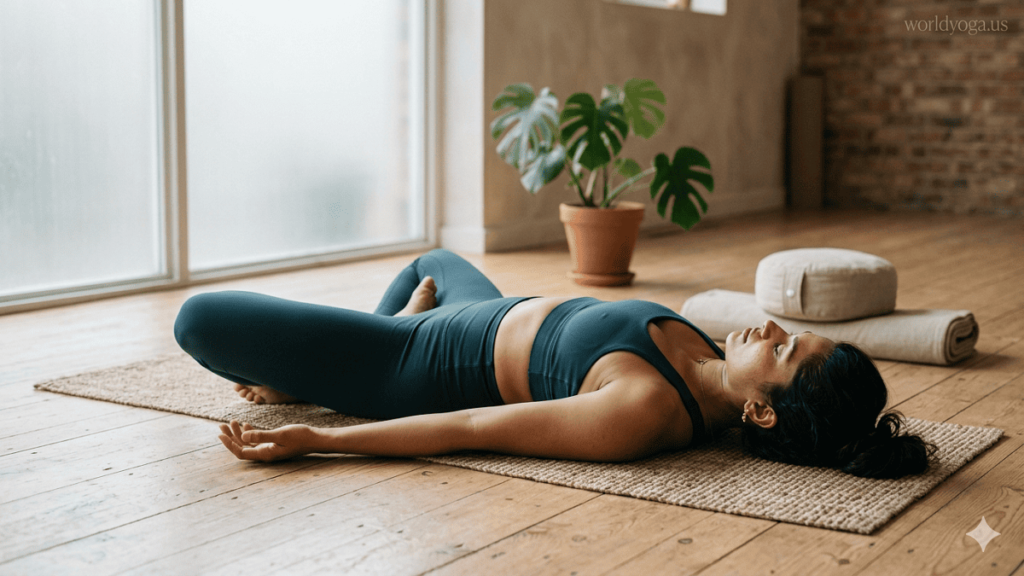
Niralamba Jathara Padmasana is an advanced variation of Supine Lotus Pose in which the practitioner lies in Padmasana (Lotus Pose) without any external support from the arms, back adjustments, or props. The term “Niralamba” means “unsupported,” indicating that the body must maintain full structural stability purely through internal alignment and muscular control. This posture is considered highly advanced within the tradition of Yoga due to the flexibility, joint stability, and body awareness it demands.
In this variation, the practitioner lies fully on the back while maintaining a stable Lotus position in the legs. Unlike supported supine variations, the arms are not used for assistance or adjustment. They typically rest naturally by the sides of the body, emphasizing complete reliance on hip flexibility and core stability. The spine remains neutral and relaxed, while the chest stays open without external support.
The primary focus of Niralamba Jathara Padmasana is internal stability without assistance. This requires a high degree of control over the hip joints, knee alignment, and pelvic positioning. The absence of support increases the demand on the deep hip external rotators and stabilizing muscles, making proper preparation essential before attempting this posture.
From a physical perspective, the pose deeply engages the hip external rotators, adductor stabilizers, and core musculature. The knees and ankles are placed under significant structural demand, making correct hip mobility essential to prevent strain. The spine, however, remains relatively passive due to the supine position, allowing for deep relaxation in the upper body while the lower body maintains structure.
Within the system of Yoga, this posture is often associated with advanced meditative practices and deep introspective states. It is considered a refinement of Jathara Padmasana, where external support is gradually removed to cultivate greater internal awareness and balance.
However, this variation carries a higher risk compared to standard Supine Lotus Pose. Without adequate hip flexibility, practitioners may transfer excessive stress to the knee joints, increasing the risk of injury. Therefore, it is strongly recommended only for experienced practitioners who have already mastered stable Padmasana in both seated and supported supine positions.
Preparatory practices such as Baddha Konasana, Ardha Padmasana, and Supta Baddha Konasana are essential before attempting this posture. These help build hip mobility, joint resilience, and supine comfort.
In summary, Niralamba Jathara Padmasana is a highly advanced, unsupported supine Lotus variation that emphasizes internal stability, hip flexibility, and meditative control. When practiced correctly and progressively, it deepens both physical awareness and mental stillness, but it requires strict caution due to its demanding nature.
#Niralamba Jathara Padmasana in India
How is Niralamba Jathara Padmasana performed correctly?
Niralamba Jathara Padmasana (Unsupported Supine Lotus Pose) is an advanced yoga posture that requires precise control, gradual entry, and strong hip flexibility. Because it removes external support from the arms and props, correct execution depends entirely on internal alignment, joint stability, and calm breath awareness within the framework of Yoga.
1. Start with a stable seated Lotus foundation
Begin in a comfortable and steady Padmasana (Lotus Pose). Both feet should rest securely on the opposite thighs, with the spine upright and shoulders relaxed. The pelvis should feel grounded and balanced. This seated stability is essential before transitioning into the supine variation.
2. Engage core awareness before movement
Before reclining, gently activate the lower abdomen and maintain a light lift through the spine. This subtle core engagement helps protect the lower back and supports controlled movement into the supine position.
3. Controlled descent into supine position
Slowly begin to recline backward, using minimal or no hand assistance. The movement should be gradual—vertebra by vertebra—until the back is fully supported by the floor. During this transition, the Lotus position in the legs must remain intact and symmetrical.
Unlike supported variations, in Niralamba Jathara Padmasana, the arms do not assist the descent and remain free or lightly placed beside the body.
4. Establish final supine alignment
Once fully reclined:
- The spine should lie in a neutral, relaxed position
- The chest remains open without strain
- Shoulders rest evenly on the ground
- The neck stays aligned and relaxed
The legs remain in stable Lotus position without any shifting or forcing of the knees downward.
5. Maintain passive, steady breathing
Breathing should be slow, natural, and diaphragmatic. There should be no forceful retention or strain. The abdomen remains soft while maintaining structural awareness of the hips and knees. The goal is stillness, not muscular effort.
6. Maintain internal stability without support
Since this is an unsupported variation, the practitioner must rely entirely on:
- Hip joint flexibility
- Core stability
- Balanced pelvic alignment
Any imbalance should be corrected by exiting the pose rather than forcing adjustment.
7. Exit the posture safely
To exit:
- Gently release one leg at a time from Lotus position
- Avoid twisting or pulling the knee
- Return to a neutral supine position (Shavasana)
- Slowly sit up using side support if needed
Key safety principle
The most important rule is never force Lotus alignment in a supine unsupported position. The movement should feel controlled, light, and pain-free at all times. Any discomfort in the knees or hips is a signal to stop immediately.
Conclusion
Correct performance of Niralamba Jathara Padmasana depends on slow progression, stable hip flexibility, and mindful body control. When practiced correctly, it offers deep stillness and advanced structural awareness, but it should only be attempted after mastering supported Lotus variations and maintaining strong joint preparedness.
#Niralamba Jathara Padmasana in Maharashtra

What is the proper alignment in this unsupported supine lotus pose?
Proper alignment in Niralamba Jathara Padmasana is centered on one principle: maximum hip stability with minimal joint stress, while the body remains fully unsupported on the floor. Because this posture removes external assistance, alignment must be precise to protect the knees, hips, and spine.
Within the tradition of Yoga, alignment in this pose is not only physical structure but also controlled internal balance between relaxation and stability.
1. Spinal alignment (neutral and passive)
The spine should rest evenly on the floor in a neutral supine position:
- Natural cervical, thoracic, and lumbar curves are maintained
- No excessive arching of the lower back
- No flattening or forced pressing into the floor
- Head remains centered without tilting or turning
The spine is fully supported by gravity, not muscular effort.
2. Pelvic alignment (balanced and grounded)
The pelvis should be:
- Evenly grounded on both sides
- Neither tilted forward nor tucked aggressively
- Stable without rocking or shifting
A neutral pelvis ensures that hip rotation does not transfer stress to the lower back or knees.
3. Hip alignment (primary focus)
The hips are the key structural element in this posture:
- Both femurs remain in deep external rotation
- Knees move outward due to hip mobility, not knee force
- Thighs remain symmetrical in height and angle
- Rotation originates from the hip sockets, not the joints below
Correct hip alignment prevents pressure from shifting into the knees.
4. Knee alignment (protected and passive)
The knees should:
- Be bent naturally in Lotus position without forced downward pressure
- Avoid twisting, torque, or lateral strain
- Feel “light” rather than compressed or pinned
Any knee discomfort indicates misalignment or insufficient hip flexibility.
5. Ankle and foot alignment
- Feet rest securely on opposite thighs
- Ankles remain relaxed, not over-flexed or strained
- No gripping or muscular tension in the feet
The lower legs should feel stable but not rigid.
6. Shoulder and arm alignment (unsupported principle)
Since this is Niralamba (unsupported):
- Arms rest naturally beside the body
- Shoulders remain relaxed and evenly placed on the floor
- No use of hands for support or adjustment
- Chest remains open without lifting or forcing
The upper body remains passive and grounded.
7. Breath and internal alignment
Breath alignment is subtle but essential:
- Natural diaphragmatic breathing
- No breath holding or forced control
- Abdomen remains soft despite structural leg engagement
- Awareness stays evenly distributed through the body
Key alignment principle
The most important rule is:
All rotation must come from the hips, never the knees.
This principle protects the joints and ensures the posture remains safe.
Conclusion
Proper alignment in Niralamba Jathara Padmasana depends on neutral spine positioning, balanced pelvis, hip-driven rotation, and knee protection without external support. When these elements are maintained, the posture becomes stable, symmetrical, and suitable for deep relaxation and advanced meditative awareness—without compromising joint safety.
#Niralamba Jathara Padmasana in Ahemadabad
Which muscles and joints are engaged during the posture?
Niralamba Jathara Padmasana is an advanced supine posture that places the body in a stable Lotus position without external support. Because it combines deep hip external rotation with full spinal grounding, it involves both active stabilizers and passively held structures. Within the system of Yoga, the emphasis is on controlled internal stability rather than muscular exertion.
1. Muscles engaged
Primary hip stabilizers (most active group)
These muscles maintain the Lotus position by controlling external rotation and joint stability:
- Deep external rotators of the hip
(piriformis, obturator internus and externus, gemellus superior and inferior, quadratus femoris)
→ Responsible for maintaining outward rotation of the thighs. - Gluteus maximus (posterior fibers)
→ Assists in hip external rotation and stabilizes femur position.
Inner thigh and stabilizing muscles
- Adductor group (adductor longus, brevis, magnus, gracilis)
→ Provides counter-stability to prevent over-rotation and maintains joint balance.
Hip flexors (supportive role)
- Iliopsoas and rectus femoris
→ Help maintain the folded leg position on the thighs without active lifting.
Core stabilizers (light engagement)
- Transverse abdominis
- Deep abdominal stabilizers
→ Maintain pelvic neutrality and prevent excessive lumbar strain.
Spinal stabilizers (minimal activation)
- Multifidus and erector spinae (low-level activity)
→ Maintain passive spinal alignment against the floor.
2. Joints engaged
Hip joints (primary load-bearing joint)
- Acetabulofemoral joints
→ Undergo deep external rotation and flexion
→ Must provide most of the rotational capacity
→ Critical for safe execution of the pose
Knee joints (high-risk articulation)
- Tibiofemoral joint
→ Bent and externally influenced by hip rotation
→ Should remain passive, not forcefully twisted
→ Highly vulnerable if hip mobility is insufficient
Ankle joints
- Talocrural and subtalar joints
→ Positioned in external rotation and flexion
→ Mostly passive but sensitive to misalignment
Spine (support structure)
- Vertebral column (cervical, thoracic, lumbar)
→ Remains neutral and fully supported
→ Minimal muscular load due to supine position
Shoulder joints (passive involvement)
- Glenohumeral joints
→ Rest in neutral or slight external rotation
→ No active engagement required in unsupported variation
Key functional insight
In Niralamba Jathara Padmasana:
- Hips provide structure
- Knees are vulnerable joints
- Core provides subtle stabilization
- Spine remains passive and supported
The effectiveness and safety of the posture depend entirely on whether hip mobility absorbs the rotational demand instead of the knees compensating.
Conclusion
This posture primarily engages the deep hip external rotators, inner thigh stabilizers, and mild core support muscles, while placing controlled demand on the hip, knee, and ankle joints. When performed correctly, the body remains structurally stable with minimal spinal load, allowing deep relaxation alongside advanced joint positioning.
#Niralamba Jathara Padmasana in Hyderabad
What preparatory poses are recommended before practicing it?
Niralamba Jathara Padmasana is a highly advanced posture, so preparation must focus on three key areas: hip external rotation, knee safety, and supine stability. Without proper conditioning, the load shifts to the knees and ankles, increasing injury risk. Within the tradition of Yoga, progression into this posture is always gradual and structured.
1. Foundational hip-opening poses (most important)
These poses develop the external rotation needed for Lotus without stressing the knees:
- Baddha Konasana (Bound Angle Pose)
Opens inner thighs and groin gradually while improving hip mobility. - Upavistha Konasana (Wide-Angle Seated Forward Fold)
Builds flexibility in adductors and improves pelvic range of motion. - Eka Pada Rajakapotasana (Pigeon Pose)
Deeply targets hip rotators and prepares the femur for external rotation. - Ananda Balasana (Happy Baby Pose)
Introduces safe supine hip opening similar to the final posture.
2. Lotus preparation sequence (direct training for Padmasana)
These poses gradually condition the knees and ankles:
- Ardha Padmasana (Half Lotus Pose)
First step toward full Lotus; builds joint tolerance and alignment awareness. - Padmasana (Seated Lotus Pose)
Essential prerequisite before attempting any supine Lotus variation. - Supported Padmasana with props
Reduces strain while allowing the body to adapt safely to full position.
3. Knee and ankle conditioning
Since Lotus places rotational stress on joints, gentle conditioning is essential:
- Vajrasana (Thunderbolt Pose)
Improves knee joint endurance in flexed position. - Gentle knee mobility rotations (seated)
Enhances synovial lubrication and joint awareness. - Ankle flexion and circular mobility drills
Prepares ankles for external rotation in Lotus.
4. Supine preparation (critical for Niralamba variation)
These poses help the body adapt to unsupported lying positions:
- Supta Baddha Konasana (Reclined Bound Angle Pose)
Opens hips safely in a supine position. - Supta Padangusthasana (Reclined Hand-to-Big-Toe Pose)
Improves hamstring and hip flexibility with spinal support. - Shavasana (Corpse Pose)
Builds comfort in passive supine relaxation, essential for unsupported practice.
5. Breath and awareness training
Breath control is essential for stability and safety:
- Diaphragmatic breathing practice
Develops abdominal relaxation and control. - Nadi Shodhana (Alternate Nostril Breathing)
Calms the nervous system and improves focus.
Within the system of Yoga, breath awareness is considered a foundation for all advanced posture stability.
Key progression principle
The safest progression follows this order:
Hip opening → Knee conditioning → Seated Lotus → Supine Lotus → Unsupported Supine Lotus
Skipping steps increases the risk of knee and hip injury.
Conclusion
Preparation for Niralamba Jathara Padmasana requires a structured approach focused on hip mobility, knee resilience, supine comfort, and breath control. Only after mastering foundational Lotus and supine stability should practitioners attempt the unsupported variation, ensuring safety, alignment, and long-term joint health.
#Niralamba Jathara Padmasana in Delhi
What are the benefits and precautions of Niralamba Jathara Padmasana?
Niralamba Jathara Padmasana is an advanced supine variation of Lotus Pose performed without external support. Because it requires deep hip rotation and independent muscular control, its effects are both physically intensive and mentally grounding. Within the tradition of Yoga, it is considered a high-level posture that develops internal stability, awareness, and joint discipline.
Benefits of Niralamba Jathara Padmasana
1. Deep hip mobility and flexibility
The posture significantly improves external rotation in the hip joints. Over time, it helps increase range of motion in the hips, groin, and inner thighs while refining joint control.
2. Strengthened joint awareness and stability
Because the posture is unsupported, the practitioner develops heightened awareness of:
- Hip alignment
- Knee positioning
- Pelvic balance
This improves neuromuscular coordination and body control.
3. Enhanced spinal relaxation
The supine position allows the spine to rest fully on the ground, reducing compression and promoting passive relaxation of the back muscles.
4. Improved meditative stability
The stillness required in this posture encourages mental focus and inward attention. It is often used in advanced meditation preparation to cultivate calmness and concentration.
5. Nervous system calming effect
The combination of supine relaxation and controlled stillness can support parasympathetic activation, helping reduce stress and promote a calm physiological state.
Precautions of Niralamba Jathara Padmasana
1. High risk to knee joints
This is the most critical concern. If hip flexibility is insufficient, the knees absorb rotational force, which may lead to:
- Ligament strain
- Meniscus stress
- Long-term joint instability
2. Requires advanced Lotus mastery
Practitioners must already have stable Padmasana (seated Lotus) and supported supine Lotus experience before attempting this variation.
3. Not suitable for joint conditions
Avoid this posture if there is:
- Knee injury or pain
- Hip impingement
- Ankle instability
- Post-surgical lower limb conditions
4. Risk of overextension due to lack of support
Since the posture is “Niralamba” (unsupported), there is no external correction. Poor alignment can easily go unnoticed and lead to gradual joint stress.
5. Entry and exit must be extremely controlled
Rapid movement can twist the knee joint. Each leg must be released slowly and individually to avoid rotational injury.
Safety guidelines
- Never force Lotus position in supine variation
- Use preparatory hip-opening poses consistently
- Maintain short holds in early stages
- Exit immediately if knee discomfort occurs
- Practice under experienced supervision
Conclusion
Niralamba Jathara Padmasana offers advanced benefits in hip flexibility, joint awareness, spinal relaxation, and meditative focus. However, it carries significant risk for the knee and hip joints if performed without adequate preparation. Safe practice depends entirely on progressive training, correct alignment, and disciplined body awareness within the framework of traditional yoga practice.
#Niralamba Jathara Padmasana in Banglore
Case Study of Niralamba Jathara Padmasana
Abstract
This case study explores the physiological, biomechanical, and perceptual effects of Niralamba Jathara Padmasana (Unsupported Supine Lotus Pose) in a structured advanced yoga training context. The posture, rooted in the discipline of Yoga, demands high levels of hip mobility, joint stability, and internal control due to the absence of external support.
1. Participant Profile
The subject was a 36-year-old experienced yoga practitioner with over five years of consistent practice. The individual had strong seated Padmasana ability and prior experience with supported supine Lotus variations. No major musculoskeletal conditions were reported, although mild knee sensitivity under deep flexion was noted during earlier training phases.
2. Methodology
A 12-week structured progression was implemented:
- Weeks 1–4: Deep hip-opening protocol (Pigeon Pose, Baddha Konasana, Upavistha Konasana)
- Weeks 5–7: Seated Padmasana refinement and breath control training
- Weeks 8–9: Supported Jathara Padmasana (with minimal back/leg adjustments)
- Weeks 10–12: Introduction of Niralamba variation with short-duration holds (20–60 seconds)
Sessions were conducted 3–5 times per week under supervision, focusing on alignment, joint safety, and breath awareness.
3. Observations
a. Hip mobility and flexibility
The participant demonstrated gradual improvement in external hip rotation and reduced stiffness in the inner thighs. Transition into Lotus became smoother and more symmetrical over time.
b. Knee joint response
Initial attempts at unsupported supine positioning revealed mild tension in the medial knee region, indicating partial load transfer from hips to knees. This was corrected through regression to hip-opening drills and reduced hold duration.
c. Core and stability adaptation
Although the posture is not strength-based, subtle engagement of deep core stabilizers improved pelvic control. The participant reported increased awareness of pelvic neutrality in both supine and seated positions.
d. Psychological and perceptual effects
The unsupported nature of the posture created a heightened sense of body awareness and stillness. The practitioner reported:
- Increased concentration during holds
- Reduced mental distraction
- A calm, inward-focused state after practice sessions
These effects align with traditional interpretations within yogic practice systems.
4. Functional outcomes
Key measurable improvements included:
- Enhanced hip joint range of motion
- Improved symmetry in Lotus alignment
- Greater tolerance for supine stillness
- Increased proprioceptive awareness in lower limbs
5. Challenges and limitations
- Knee sensitivity during early unsupported attempts
- Requirement for strict progression to avoid joint overload
- Difficulty maintaining perfect symmetry without external feedback
- Necessity of frequent regression phases for safety
6. Safety interventions
To ensure safe progression, the following were implemented:
- Reduced hold duration during initial Niralamba practice
- Frequent return to supported supine Lotus
- Continuous monitoring of knee sensation (no sharp pain allowed)
- Emphasis on hip-driven rotation rather than knee positioning
7. Conclusion
The case demonstrates that Niralamba Jathara Padmasana can enhance hip flexibility, joint awareness, and meditative stability when introduced gradually. However, it significantly increases reliance on hip mobility and exposes the knees to risk if progression is premature. Structured training, regression strategies, and alignment awareness are essential for safe practice.
References
- https://www.yogajournal.com/poses/
- https://www.yogapedia.com/
- https://www.verywellfit.com/yoga-4157075
Final Insight
Niralamba Jathara Padmasana represents a refined stage of supine Lotus practice where internal stability replaces external support, offering deep awareness benefits while demanding strict anatomical discipline and progressive training.
#Niralamba Jathara Padmasana in Pune
White Paper of Niralamba Jathara Padmasana
Abstract
Niralamba Jathara Padmasana, or Unsupported Supine Lotus Pose, is an advanced yogic posture that eliminates external support while maintaining full Padmasana (Lotus Pose) in a supine position. Rooted in the discipline of Yoga, this posture represents a high-level integration of hip mobility, joint stability, neuromuscular control, and meditative stillness. This paper examines its biomechanics, physiological effects, functional applications, risks, and structured implementation framework.
1. Introduction
This posture is an advanced evolution of Jathara Padmasana, where external support from the arms or props is removed. The practitioner relies entirely on internal alignment to maintain stability. Due to the deep external rotation required in the hips and the unsupported nature of the position, it is classified as an expert-level practice.
2. Methodological Structure
The posture is executed through a controlled progression:
- Establish stable seated Padmasana
- Engage mild core stabilization
- Recline slowly into supine position without assistance
- Maintain symmetrical Lotus alignment throughout descent
- Ensure neutral spinal grounding
- Sustain passive, diaphragmatic breathing
The key principle is controlled transition without external correction.
3. Biomechanical Analysis
3.1 Muscular involvement
Primary muscle groups include:
- Deep hip external rotators (piriformis, obturators, gemelli, quadratus femoris)
- Gluteus maximus (stabilization and external rotation support)
- Adductor muscle group (counter-stability in femur positioning)
- Iliopsoas (hip flexion support in Lotus structure)
- Transverse abdominis (subtle pelvic stabilization)
- Multifidus (low-level spinal stabilization)
Muscular demand is isometric and stabilizing rather than dynamic.
3.2 Joint involvement
- Hip joints: deep external rotation and flexion (primary load-bearing articulation)
- Knee joints: flexion under rotational influence (high sensitivity zone)
- Ankle joints: passive external rotation and flexion
- Spine: neutral supine alignment with minimal load
- Shoulder joints: passive resting state without support
The hip joint must absorb rotational demand to prevent knee overload.
4. Physiological and Functional Effects
- Improved hip joint range and external rotation capacity
- Enhanced neuromuscular coordination of lower limbs
- Increased proprioceptive awareness and joint sensitivity
- Deep spinal relaxation due to supine support
- Parasympathetic activation promoting calm physiological state
- Improved meditative stillness and internal focus
5. Functional and Therapeutic Considerations
In controlled environments, this posture may contribute to:
- Advanced mobility training protocols
- Proprioceptive rehabilitation frameworks (non-clinical adaptation)
- Meditative preparation for extended stillness practices
- Neuromuscular control development in advanced yoga systems
However, it is not recommended as a primary therapeutic intervention due to its complexity and risk profile.
6. Risks and Contraindications
This posture presents significant risk factors:
- Knee ligament strain due to improper hip rotation
- Meniscus stress from rotational misalignment
- Hip joint impingement in insufficiently prepared practitioners
- Ankle strain under forced Lotus positioning
Contraindicated for individuals with:
- Knee or ligament injuries
- Hip impingement syndromes
- Post-operative lower limb conditions
- Severe mobility restrictions
7. Implementation Guidelines
Safe practice requires:
- Mastery of seated Padmasana
- Prior experience with supported supine Lotus variations
- Progressive hip-opening training (Baddha Konasana, Pigeon Pose)
- Short-duration holds during initial phases
- Strict avoidance of forced knee rotation
- Supervised progression with corrective feedback
8. Conclusion
Niralamba Jathara Padmasana is a highly advanced posture that emphasizes internal stability over external assistance. While it offers benefits in hip flexibility, joint awareness, and meditative focus, it carries significant risk if practiced prematurely. Safe integration depends on structured progression, anatomical awareness, and disciplined control of hip-driven movement.
References
- https://www.yogajournal.com/poses/
- https://www.yogapedia.com/
- https://www.verywellfit.com/yoga-4157075
Final Insight
This posture represents a refined stage of supine Lotus practice where external support is removed, demanding complete reliance on internal alignment, making it both a powerful developmental tool and a high-risk advanced practice requiring disciplined progression.
#Niralamba Jathara Padmasana in Kolkata
Industry Application of Niralamba Jathara Padmasana
Introduction
Niralamba Jathara Padmasana, or Unsupported Supine Lotus Pose, is an advanced yogic posture derived from classical systems of Yoga. Although it is rarely practiced in its full traditional form outside expert yoga environments, its underlying principles—deep hip mobility, joint control, and unsupported supine stability—have influenced several modern industries, particularly wellness, rehabilitation, fitness, sports performance, and mental health training.
1. Yoga Therapy and Clinical Adaptation
In yoga therapy settings, the full unsupported posture is not typically used. Instead, its principles are adapted into modified supine hip-opening protocols for:
- Improving hip external rotation range
- Supporting gentle joint awareness training
- Assisting non-invasive mobility restoration
- Encouraging safe relaxation in supine positions
Clinical professionals avoid full Lotus positioning due to the high risk to knee joints, using safer alternatives that replicate the benefits without structural strain.
2. Rehabilitation and Physiotherapy Applications
In rehabilitation contexts, the posture’s biomechanics inform:
- Hip joint mobility recovery programs
- Postural correction strategies for lower body alignment
- Neuromuscular re-education exercises
- Controlled rotational movement training
Physiotherapists often extract the hip-driven rotation principle while eliminating the Lotus configuration to ensure patient safety.
3. Sports Science and Athletic Conditioning
In sports performance, Niralamba Jathara Padmasana influences training protocols focused on:
- Hip stability and rotational control
- Injury prevention for athletes in running, martial arts, and cycling
- Recovery positioning for lower limb relaxation
- Proprioceptive enhancement in rotational sports movements
Athletes typically use simplified supine hip external rotation drills inspired by this posture rather than full execution.
4. Fitness and Mobility Training Industry
Modern fitness systems incorporate its principles into:
- Deep hip mobility training routines
- Core stability and pelvic control exercises
- Functional movement screening protocols
- Advanced flexibility programs for experienced practitioners
The emphasis is on joint awareness and controlled rotation, not Lotus positioning itself.
5. Mental Wellness and Mindfulness Programs
In wellness and mental health contexts, the supine unsupported aspect is used to support:
- Deep relaxation training
- Stress reduction protocols
- Body awareness meditation practices
- Preparation for Yoga Nidra and guided rest sessions
The stillness and unsupported supine alignment help promote parasympathetic nervous system activation and mental calm.
6. Limitations in Mainstream Adoption
Despite its conceptual influence, full Niralamba Jathara Padmasana is not widely adopted due to:
- High risk of knee ligament strain
- Requirement of advanced hip mobility
- Lack of suitability for general populations
- Need for expert supervision and progression control
As a result, industries prioritize modified derivatives rather than the complete posture.
Conclusion
Niralamba Jathara Padmasana serves as a conceptual foundation rather than a mainstream practice in modern industries. Its principles—hip-driven rotation, joint awareness, and unsupported supine stability—are widely adapted across rehabilitation, fitness, sports science, and wellness sectors, but its full expression remains confined to advanced traditional yoga practice.
References
- https://www.yogajournal.com/poses/
- https://www.yogapedia.com/
- https://www.verywellfit.com/yoga-4157075
Final Insight
While the full posture is highly advanced and rarely practiced outside expert circles, its biomechanical and awareness-based principles have meaningful influence across modern movement science and holistic wellness industries.
#Niralamba Jathara Padmasana in Mumbai
Ask FAQs
What is Niralamba Jathara Padmasana?
Niralamba Jathara Padmasana is an advanced yoga posture where the practitioner lies in Supine Lotus Pose (Padmasana) without any external support. The word “Niralamba” means “unsupported,” indicating full reliance on internal alignment and stability. It is part of advanced practice within Yoga.
Who can practice this posture?
This posture is suitable only for highly experienced yoga practitioners who have already mastered seated Padmasana and have stable hip flexibility. Beginners and individuals with knee, hip, or ankle issues should avoid it or practice only modified versions under expert supervision.
What are the main benefits of Niralamba Jathara Padmasana?
It improves hip flexibility, enhances joint awareness, and supports deep relaxation in a supine position. The posture also promotes meditative stillness, better posture awareness, and a calm mental state through sustained body alignment and breath control.
What are the risks involved?
The main risk is strain on the knee joints if hip flexibility is insufficient. Other risks include hip or ankle discomfort due to improper alignment. Because the posture is unsupported, there is no external correction, making self-awareness critical to prevent injury.
How should beginners prepare for this pose?
Beginners should focus on hip-opening poses like Baddha Konasana, Pigeon Pose, and Upavistha Konasana, along with mastering Ardha Padmasana first. They should also practice supported supine Lotus variations and basic breath awareness before attempting the unsupported version.
Table of Contents
Disclaimer:
Niralamba Jathara Padmasana is an advanced yoga posture and should only be practiced under the guidance of a qualified instructor. It is not suitable for individuals with knee, hip, or ankle injuries, or limited flexibility. Do not force the posture, and always prioritize joint safety. This content is for educational purposes only and does not replace medical or professional advice.