
Jathara Padmasana
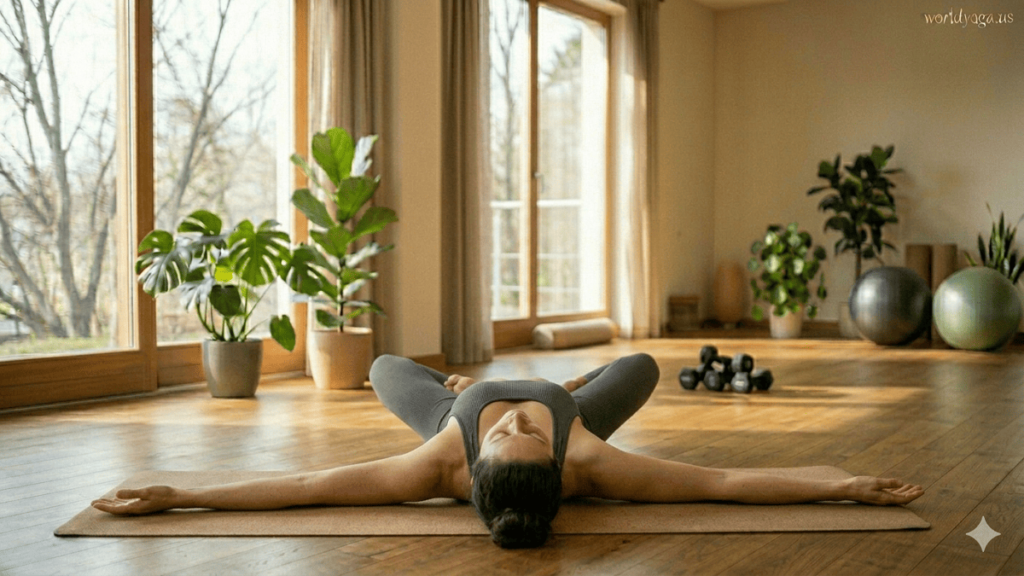
Jathara Padmasana, commonly known as Supine Lotus Pose, is an advanced yoga posture in which the practitioner lies on the back (supine position) while maintaining the legs in Lotus Pose (Padmasana). The term comes from Sanskrit, where “Jathara” refers to the abdomen or stomach, and “Padmasana” refers to the Lotus Pose. This posture is considered highly advanced due to the flexibility and joint stability required in the hips, knees, and ankles.
In this position, the practitioner carefully transitions from a seated Lotus Pose into a controlled reclined position while keeping the spine aligned on the floor. The arms are usually placed alongside the body or used for support depending on flexibility and experience level. The chest remains open, and the breath is kept slow and steady to maintain relaxation and stability in the posture.
Within the system of Yoga, Jathara Padmasana is often associated with deep relaxation, hip opening, and meditative awareness. It is believed to enhance flexibility in the hip joints while encouraging a state of inner calm and introspection. The posture also helps in gently stretching the abdominal region, improving awareness of breath flow and core relaxation.
From a physical perspective, this pose deeply engages and stretches the hip flexors, groin muscles, and lower back. It also promotes improved circulation in the pelvic region. Because the body is fully supported by the ground, it can encourage passive opening without active muscular strain, making it useful for advanced restorative practices when performed correctly.
However, Jathara Padmasana is not suitable for beginners. It requires mastery of both Padmasana and strong hip-knee flexibility. Practicing it without adequate preparation can place stress on the knee joints and ankle ligaments. Individuals with knee injuries, hip limitations, or joint instability should avoid this posture or practice only under expert supervision.
The posture is often used in advanced meditation sequences or as a transition into deep relaxation states such as Yoga Nidra. It is also occasionally incorporated into traditional pranayama practices to support stillness and breath awareness.
For safe progression, preparatory poses such as Baddha Konasana, Ardha Padmasana, and gentle hip-opening sequences are recommended before attempting Jathara Padmasana.
In summary, Jathara Padmasana is a profound restorative and meditative posture that combines the structural challenge of Lotus Pose with the calming effects of a supine position. When practiced with caution and proper preparation, it can significantly enhance flexibility, body awareness, and meditative depth.
#Jathara Padmasana in India
How is Jathara Padmasana performed correctly?
Jathara Padmasana (Supine Lotus Pose) is an advanced posture that requires careful preparation, precise alignment, and controlled movement to ensure safety for the knees and hips. It combines the structural demands of Padmasana with the support of a reclined position, so correct execution is essential to avoid joint strain.
To begin, the practitioner should first establish a stable Padmasana in a seated position. Both feet are placed securely on the opposite thighs with the soles facing upward. The spine should be erect, shoulders relaxed, and breath steady. This seated base is important because any instability in Lotus will carry into the supine transition.
Once seated comfortably, the practitioner engages the core lightly and places the hands beside the hips for support. The movement into the supine position must be slow and controlled. The upper body is gently lowered backward, vertebra by vertebra, until the back is fully supported by the floor. Throughout this transition, the Lotus position in the legs must remain intact without forcing the knees downward or allowing the feet to slip.
When the back reaches the ground, the spine should lie in a neutral alignment with the natural curves preserved. The chest remains open, and the shoulders relax away from the ears. The arms can rest alongside the body with palms facing upward or downward, depending on comfort and stability.
Breathing should be slow, deep, and natural. There should be no strain or breath retention in this posture. The abdomen remains relaxed, allowing the diaphragm to move freely. Within the system of Yoga, this controlled stillness is considered essential for developing meditative awareness and internal relaxation.
The legs in Lotus should feel stable but not forced. The knees must remain supported by the floor or gently cushioned if needed. If there is any sharp sensation in the knees or ankles, the posture should be released immediately, as this indicates improper alignment or insufficient flexibility.
To exit the pose safely, the practitioner should first release the Lotus position carefully. One leg is gently unlocked at a time to avoid twisting the knee joint. After both legs are released, the body can return to a seated position or rest in Shavasana for recovery.
Proper performance of Jathara Padmasana depends heavily on preparation. Hip-opening exercises such as Baddha Konasana and Ardha Padmasana, along with gentle seated forward bends, help prepare the body. Without this foundation, the risk of strain increases significantly.
This posture should ideally be practiced on an empty stomach and under the supervision of an experienced instructor, especially for beginners transitioning into Lotus-based poses.
When performed correctly, Jathara Padmasana offers deep relaxation, enhanced hip flexibility, and a calm meditative state, making it a valuable advanced posture in traditional yoga practice.
#Jathara Padmasana in Maharashtra
What is the proper alignment in this supine lotus variation?
Proper alignment in Jathara Padmasana (Supine Lotus Pose) is essential because the posture places the hips and knees in a deeply externally rotated position while the body is fully supported on the back. Even small misalignments can place unnecessary stress on the knee joints, so attention to structure and symmetry is critical.
The foundation begins with the spine in a neutral supine position. Once the practitioner lowers into the pose from seated Padmasana, the entire back should rest evenly on the floor or mat. The natural curves of the cervical, thoracic, and lumbar spine are preserved without flattening or over-arching. The head remains centered, not tilted to either side, with the neck relaxed and long.
The pelvis should remain neutral and grounded, without tilting forward or rolling backward excessively. Both sides of the pelvis should feel evenly supported by the floor. This balance helps distribute the weight of the torso evenly and prevents strain in the lower back.
The most critical alignment element is the Lotus position of the legs (Padmasana). Each foot rests securely on the opposite thigh, with the soles facing upward. The knees should ideally be lowered toward the floor in a passive way, but never forced down. The hips—not the knees—should provide the primary external rotation. If the knees are higher, it indicates limited hip mobility, and the pose should not be forced deeper.
The knees must remain symmetrical and relaxed, avoiding twisting or lateral pressure. Any sensation of pinching or sharp discomfort in the knees is a sign of misalignment. In correct alignment, the sensation should be felt in the hips and outer thighs, not the joints.
The feet should remain stable on the thighs, not sliding or pressing excessively into the knee joint. Ankles should be relaxed, avoiding tension in the toes or arches.
The chest remains open and broad, with the shoulders gently rolled back and down. Arms rest alongside the body with palms facing upward or downward depending on comfort. The elbows should be soft, not locked or overly extended.
Breath alignment is also important. Within the practice of Yoga, breathing in supine Lotus should be smooth, diaphragmatic, and unrestricted. The abdomen should remain soft, allowing natural expansion and release without effort.
Finally, overall symmetry and ease define correct alignment. The body should feel evenly distributed, grounded, and stable, with no strain in the knees, hips, or lower back. The posture should feel passive rather than forced, even though it is structurally demanding.
Correct alignment in Jathara Padmasana is less about depth and more about safe hip rotation, spinal neutrality, and joint protection. When these elements are maintained, the pose becomes a stable platform for relaxation, breath awareness, and advanced meditative practice.
#Jathara Padmasana in Ahemadabad

Which muscles and joints are engaged during the posture?
In Jathara Padmasana (Supine Lotus Pose), both the muscular system and key joints of the lower body are placed into a deep, externally rotated configuration while the upper body remains in a relaxed supine alignment. Understanding what is engaged—and what should remain passive—is essential for safe and effective practice.
Muscles engaged
The primary muscular engagement occurs in the hip and thigh region, although most of the activation is isometric rather than dynamic.
- Deep hip external rotators: including the piriformis, obturator internus and externus, gemellus superior and inferior, and quadratus femoris. These muscles are responsible for maintaining the external rotation required for Lotus position.
- Adductor muscles (inner thigh group): the adductor longus, brevis, magnus, gracilis, and pectineus help stabilize the femur in the hip socket. While not actively contracting strongly, they provide balanced support.
- Hip flexors: such as the iliopsoas and rectus femoris, assist in maintaining the folded leg position on the thighs.
- Core stabilizers: including the transverse abdominis and deeper abdominal stabilizing muscles, remain lightly engaged to maintain pelvic neutrality in the supine position.
- Spinal stabilizers: the multifidus and surrounding paraspinal muscles support a neutral, relaxed spinal alignment against the floor.
Importantly, the abdominal muscles are not actively braced, as the posture is primarily restorative rather than strength-based.
Joints involved
Jathara Padmasana places significant demand on multiple joints, especially in the lower body:
- Hip joints (acetabulofemoral joints): These are the most deeply engaged joints. They undergo strong external rotation and flexion. Proper hip mobility is essential to reduce strain on other joints.
- Knee joints (tibiofemoral joints): The knees are in a flexed and externally rotated position, but they should not be twisted. The knees are vulnerable in this pose if the hips lack sufficient flexibility.
- Ankle joints (talocrural and subtalar joints): The ankles are also externally rotated and flexed as the feet rest on the opposite thighs.
- Spine (vertebral column): The spine remains in a neutral supine position with minimal joint loading, allowing passive relaxation.
- Shoulder joints: These remain relatively passive, typically in slight external rotation with arms resting alongside the body.
Functional perspective within Yoga
Within the framework of Yoga, this posture is considered a deep hip-opening and meditative alignment pose. The emphasis is not on muscular exertion but on controlled joint positioning and relaxed stability. The engagement is largely isometric and supportive, rather than active contraction.
Key safety insight
Although many muscles are involved in stabilizing the posture, the hips must bear the primary load of external rotation. If this mobility is insufficient, the stress shifts to the knees and ankles, increasing injury risk. Therefore, correct muscular distribution is more important than achieving a visually perfect Lotus position.
In summary, Jathara Padmasana primarily engages the deep hip rotators and stabilizing muscle groups while placing controlled stress on the hip, knee, and ankle joints. When performed correctly, it encourages passive opening rather than forceful stretching, supporting both structural alignment and meditative ease.
#Jathara Padmasana in Hyderabad
What preparatory poses are recommended before practicing it?
Preparing for Jathara Padmasana (Supine Lotus Pose) is essential because the posture demands deep external hip rotation, stable knee alignment, and controlled joint flexibility. Without proper preparation, the load can shift from the hips to the knees and ankles, increasing the risk of strain. A structured progression focusing on hip opening, knee conditioning, and seated Lotus preparation is strongly recommended.
1. Hip-opening preparatory poses
The foundation of safe practice lies in improving external rotation at the hip joints.
- Baddha Konasana (Bound Angle Pose): Helps open the inner thighs and groin while gently improving hip external rotation.
- Upavistha Konasana (Wide-Angle Seated Forward Bend): Encourages gradual lengthening of the inner legs and improves pelvic mobility.
- Eka Pada Rajakapotasana (Pigeon Pose): Deeply targets hip flexors and external rotators, essential for Lotus readiness.
- Ananda Balasana (Happy Baby Pose): Safely introduces hip external rotation in a supine position similar to Jathara Padmasana.
2. Lotus preparation postures
These poses directly prepare the body for Padmasana positioning.
- Ardha Padmasana (Half Lotus Pose): Builds tolerance in the knees and ankles while gradually conditioning hip rotation.
- Sukhasana (Easy Pose) with hip elevation: Improves seated comfort and spinal alignment before full Lotus.
- Supported Padmasana (using props): Allows gradual adaptation to full Lotus without excessive joint stress.
3. Knee and ankle conditioning
Since Lotus places the knees in a vulnerable position, gentle strengthening and mobility work are important.
- Vajrasana (Thunderbolt Pose): Strengthens knee joint tolerance in a controlled flexed position.
- Gentle knee rotations in seated posture: Improves synovial fluid circulation and joint awareness.
- Ankle mobility drills (flexion and rotation): Help reduce stiffness before entering Lotus-based poses.
4. Supine and relaxation-based preparation
These help transition awareness toward the final supine position of Jathara Padmasana.
- Supta Baddha Konasana (Reclined Bound Angle Pose): Introduces passive hip opening in a supine position.
- Supta Padangusthasana (Reclined Hand-to-Big-Toe Pose): Improves hamstring and hip flexibility with spinal support.
- Shavasana (Corpse Pose): Trains the body to relax fully in a supine position, essential for safe execution.
5. Breathing and awareness practices
Within the tradition of Yoga, breath control is considered essential before attempting advanced poses.
- Diaphragmatic breathing: Builds awareness of abdominal relaxation.
- Nadi Shodhana (Alternate Nostril Breathing): Calms the nervous system and prepares for stillness.
Key progression principle
The most important rule is progressive hip opening without knee strain. If any preparatory pose causes sharp knee discomfort, it indicates that Lotus-based poses are not yet appropriate.
Conclusion
Jathara Padmasana requires a layered preparation strategy involving hip mobility, knee conditioning, supine awareness, and breath control. When these preparatory elements are practiced consistently, the body develops the structural freedom and stability needed to safely enter the posture and experience its restorative and meditative benefits.
#Jathara Padmasana in Delhi
What are the benefits and precautions of Jathara Padmasana?
Jathara Padmasana, or Supine Lotus Pose, is an advanced posture in which the body lies on the back while maintaining Padmasana (Lotus Pose). Because it combines deep hip external rotation with full-body relaxation, it offers both restorative and meditative benefits, but it also carries significant joint-related risks if practiced incorrectly.
Benefits of Jathara Padmasana
1. Deep hip opening and flexibility
This posture provides sustained external rotation of the hip joints, helping improve flexibility in the hip rotators, inner thighs, and gluteal region. Over time, it can increase overall hip mobility when practiced safely and progressively.
2. Enhanced spinal relaxation
Since the body is fully supported on the floor, the spine experiences minimal load. This allows the paraspinal muscles to relax deeply, promoting decompression and a sense of physical ease in the back region.
3. Improved posture awareness
Regular practice increases awareness of pelvic alignment and hip symmetry. This awareness often carries over into seated and standing postures, improving overall postural control.
4. Calming effect on the nervous system
The supine position combined with stillness encourages parasympathetic activation, supporting relaxation and mental calm. Within the discipline of Yoga, such postures are often used to prepare the mind for meditation and deep rest states.
5. Support for meditative practices
The stability of the lower body and the comfort of lying down make it easier for some practitioners to enter meditative awareness or guided relaxation practices like Yoga Nidra.
Precautions of Jathara Padmasana
1. High stress on knee joints
The biggest risk lies in the knees. If hip flexibility is insufficient, the knees may compensate, leading to strain or injury. Any sharp pain in the knee is a warning sign to exit the posture immediately.
2. Requires advanced hip mobility
Practitioners without established Lotus Pose ability should avoid this posture. Forcing the legs into Padmasana can cause damage to ligaments rather than stretching muscles.
3. Not suitable for joint injuries
Individuals with knee injuries, meniscus issues, hip impingement, or ankle instability should avoid this pose entirely or practice only modified versions under supervision.
4. Risk of overextension
Long holds without proper conditioning can lead to overstretching of ligaments in the knees and ankles. Unlike muscles, ligaments do not recover easily from overstress.
5. Need for controlled entry and exit
Entering or exiting the pose too quickly can twist the knee joint. Each leg must be released carefully to avoid rotational stress.
Safety guidelines
- Practice only after mastering Ardha Padmasana and seated Padmasana
- Use props under the knees if needed for support
- Avoid forcing any depth in the Lotus position
- Keep breath natural and relaxed throughout the posture
- Exit immediately if discomfort appears in joints
Conclusion
Jathara Padmasana offers significant benefits in hip flexibility, spinal relaxation, and meditative preparation when practiced correctly. However, it is a high-risk posture for the knee joints if performed without adequate preparation. A gradual, mindful approach rooted in proper hip mobility and awareness is essential to safely experience its benefits.
#Jathara Padmasana in Pune
Case Study of Jathara Padmasana
Abstract
This case study examines the effects of Jathara Padmasana (Supine Lotus Pose) on flexibility, joint mobility, relaxation response, and meditative stability in a structured yoga practice setting. The posture, rooted in the tradition of Yoga, was observed as part of a progressive training program focusing on hip mobility and supine restorative postures.
1. Participant Profile
The subject was a 34-year-old intermediate yoga practitioner with approximately two years of consistent practice. The individual had moderate hip flexibility but limited experience with full Lotus Pose. There was no history of major musculoskeletal injury, although mild tightness in the hips and inner thighs was reported.
2. Methodology
The study followed a 10-week structured progression:
- Weeks 1–3: Hip-opening foundation (Baddha Konasana, Pigeon Pose, Upavistha Konasana)
- Weeks 4–6: Introduction to Ardha Padmasana and supported seated Lotus
- Weeks 7–8: Transition training into controlled supine positioning without full Lotus hold
- Weeks 9–10: Introduction of full Jathara Padmasana under supervision, with short holds (30–90 seconds)
Sessions were conducted 3–4 times per week with emphasis on alignment, breath awareness, and joint safety.
3. Observations
a. Physical response
After consistent practice, the participant demonstrated:
- Increased hip external rotation range
- Improved ability to maintain seated Padmasana without discomfort
- Reduced stiffness in inner thigh and groin regions
- Better pelvic stability in supine and seated positions
b. Joint sensitivity
Early attempts revealed mild discomfort in the knees when hip engagement was insufficient. After corrective hip-focused training, knee strain reduced significantly, highlighting the importance of proper load distribution.
c. Nervous system response
The supine and static nature of the posture promoted a noticeable relaxation response. The participant reported reduced physical tension and a calmer physiological state after practice sessions.
4. Functional outcomes
Within the structured program, Jathara Padmasana contributed to:
- Enhanced hip joint mobility and flexibility
- Improved awareness of lower body alignment
- Greater ease in transitioning into meditative states
- Increased tolerance for stillness in supine positions
These outcomes align with traditional yogic principles emphasizing stability, stillness, and internal awareness within advanced postures.
5. Challenges and limitations
- Initial knee strain risk due to limited hip flexibility
- Requirement for slow progression to avoid joint stress
- Difficulty maintaining symmetrical alignment in early stages
- Necessity of supervision to prevent over-rotation of the knees
6. Safety interventions
To reduce risk, the following measures were implemented:
- Use of knee supports during early supine Lotus attempts
- Gradual increase in hold duration
- Strict avoidance of forcing Lotus position
- Continuous monitoring of knee and hip sensations
7. Conclusion
The case study indicates that Jathara Padmasana, when introduced progressively, can significantly improve hip flexibility, joint awareness, and relaxation response. However, it is highly dependent on preparatory work and proper alignment. Without adequate hip conditioning, the posture may place undue stress on the knees, making structured progression essential.
References
- https://www.yogajournal.com/poses/
- https://www.yogapedia.com/
- https://www.verywellfit.com/yoga-4157075
#Jathara Padmasana in Banglore
White Paper of Jathara Padmasana
Abstract
Jathara Padmasana, commonly referred to as Supine Lotus Pose, is an advanced yogic posture in which the practitioner lies in a supine position while maintaining Padmasana (Lotus Pose). Rooted in the discipline of Yoga, this posture combines deep hip external rotation with full spinal support. This white paper examines its biomechanical structure, physiological effects, therapeutic potential, risks, and implementation guidelines within modern yoga practice systems.
1. Introduction
Jathara Padmasana is traditionally used in advanced meditative and restorative sequences. Unlike seated Lotus, the supine variation reduces axial spinal load while increasing demand on hip and knee joint flexibility. It is considered a high-level posture due to the anatomical requirements of sustained external rotation in the lower limbs.
2. Methodological Structure
The posture is executed through a controlled sequence:
- Establish stable Padmasana in seated position
- Engage core lightly for stability
- Gradually recline into supine position
- Maintain symmetrical Lotus alignment in legs
- Ensure neutral spinal contact with the floor
- Sustain passive breathing and relaxation
This structure emphasizes controlled descent and joint preservation rather than muscular exertion.
3. Biomechanical Analysis
3.1 Muscular involvement
Primary muscle groups include:
- Deep hip external rotators (piriformis, obturators, gemelli, quadratus femoris)
- Hip flexors (iliopsoas, rectus femoris)
- Adductor group for stabilization
- Spinal stabilizers (multifidus, erector spinae)
Muscular activity is largely isometric and supportive rather than dynamic.
3.2 Joint involvement
- Hip joints: deep external rotation and flexion
- Knee joints: flexion under rotational load (high sensitivity zone)
- Ankle joints: passive external rotation
- Spine: neutral supine alignment
The hip joints must bear the primary rotational demand to prevent knee strain.
4. Physiological and Functional Effects
- Improved hip joint mobility and range of motion
- Enhanced pelvic stability and alignment awareness
- Reduction in spinal compression due to supine support
- Activation of parasympathetic nervous system response
- Support for meditative stillness and relaxation states
Within yogic tradition, this posture is associated with deep inward awareness and preparatory states for meditation.
5. Therapeutic Considerations
In controlled settings, Jathara Padmasana may support:
- Gentle hip mobility training
- Relaxation therapy protocols
- Body awareness and proprioception development
- Preparatory stages for advanced seated meditation postures
However, it is not classified as a primary therapeutic intervention due to its advanced nature.
6. Risks and Contraindications
This posture carries significant risk factors:
- Knee ligament strain due to improper hip mobility
- Hip joint compression in underprepared practitioners
- Ankle stress in forced Lotus positioning
- Contraindicated for individuals with:
- Knee injuries or meniscus damage
- Hip impingement or limited external rotation
- Post-surgical lower limb conditions
Improper execution may result in long-term joint instability.
7. Implementation Guidelines
Safe integration requires:
- Progressive preparation through hip-opening postures
- Mastery of Ardha Padmasana before full Lotus attempts
- Use of props for knee support during early stages
- Controlled entry and exit to avoid rotational stress
- Practice on soft, stable surfaces
- Supervision by experienced yoga instructors
8. Conclusion
Jathara Padmasana is a highly specialized yoga posture that integrates deep hip flexibility with supine relaxation mechanics. While it offers benefits in mobility, alignment awareness, and meditative preparation, its application is limited by significant anatomical demands. Safe practice depends on progressive conditioning, joint awareness, and adherence to structured alignment principles.
References
- https://www.yogajournal.com/poses/
- https://www.yogapedia.com/
- https://www.verywellfit.com/yoga-4157075
#Jathara Padmasana in Kolkata
Industry Application of Jathara Padmasana
Introduction
Jathara Padmasana, or Supine Lotus Pose, is an advanced posture within the discipline of Yoga that combines deep hip external rotation with a fully supported supine position. While traditionally used for meditation and restorative practice, its underlying principles of joint mobility, neuromuscular control, and relaxation response have led to increasing interest across multiple modern industries, particularly wellness, rehabilitation, fitness, and mental health applications.
1. Yoga Therapy and Rehabilitation Industry
In yoga therapy settings, Jathara Padmasana is primarily used in modified forms, not full expression, due to its advanced nature. Therapists apply its principles for:
- Gentle hip mobility training in early-stage rehabilitation
- Improving proprioception in the pelvic and lower limb region
- Supporting controlled relaxation in supine therapeutic sequences
- Assisting recovery from sedentary lifestyle stiffness (with caution)
However, full Lotus positioning is avoided in clinical populations due to knee joint vulnerability.
2. Mental Health and Stress Management Programs
In mindfulness-based wellness programs, the supine aspect of the posture is used to promote deep relaxation and parasympathetic activation. Adapted versions support:
- Stress reduction protocols
- Guided relaxation and body-scan practices
- Preparation for Yoga Nidra sessions
- Emotional grounding through stillness and breath awareness
The posture’s stable supine alignment helps reduce sensory overload and supports calm physiological states.
3. Fitness and Mobility Training Industry
Within modern fitness systems, Jathara Padmasana influences mobility training programs focused on:
- Hip external rotation development
- Joint control and range-of-motion improvement
- Functional movement screening for lower body asymmetries
- Injury-prevention strategies for athletes requiring hip stability
While the full posture is rarely used, its biomechanical principles inform corrective exercise routines.
4. Sports Performance and Athletic Recovery
Sports science applications focus on the recovery and mobility aspects of the posture:
- Passive hip opening for athletes with tight hip flexors
- Post-training recovery positioning for lower body relaxation
- Improved neuromuscular awareness in rotational movements
- Support for injury-prevention programs in running, martial arts, and cycling
Coaches often use modified supine hip-opening positions inspired by Jathara Padmasana rather than the full Lotus form.
5. Wellness and Spa Industry
In spa and holistic wellness environments, the posture’s principles are incorporated into:
- Deep relaxation therapy sessions
- Assisted stretching routines
- Restorative yoga-inspired treatments
- Breath-led relaxation experiences
The emphasis here is not on flexibility achievement but on calming the nervous system and reducing physical tension.
6. Limitations in Industry Adoption
Despite its benefits, full Jathara Padmasana has limited mainstream adoption due to:
- High risk of knee joint strain
- Requirement of advanced hip mobility
- Need for trained supervision
- Unsuitability for general population use
As a result, industries typically adopt modified or partial versions rather than the complete posture.
Conclusion
Jathara Padmasana serves as a conceptual and functional reference across multiple industries rather than a universally practiced technique. Its influence is strongest in areas focusing on hip mobility, relaxation response, and mindful body awareness. While the full posture remains advanced and specialized, its principles contribute significantly to modern rehabilitation, wellness, and performance-based movement systems.
References
- https://www.yogajournal.com/poses/
- https://www.yogapedia.com/
- https://www.verywellfit.com/yoga-4157075
#Jathara Padmasana in Mumbai
Ask FAQs
What is Jathara Padmasana?
Jathara Padmasana, also known as Supine Lotus Pose, is an advanced yoga posture where the practitioner lies on the back while maintaining the Lotus Pose (Padmasana). It combines deep hip external rotation with full spinal support and is part of advanced practice in Yoga.
Who can practice Jathara Padmasana?
This posture is suitable only for advanced practitioners who have already mastered Padmasana comfortably in a seated position. It requires strong hip flexibility and knee stability. Beginners and individuals with joint issues should avoid it or practice only modified versions under expert supervision.
What are the main benefits of Jathara Padmasana?
The posture helps improve hip flexibility, enhances posture awareness, and supports deep relaxation due to its supine position. It can also promote a calm mental state, reduce physical tension, and prepare the body for meditation or restorative yoga practices.
What are the risks of practicing this pose?
The primary risk is strain on the knee joints if hip flexibility is insufficient. It can also cause discomfort in the ankles or hips if forced. Improper entry or exit may lead to joint injury, making careful progression and guidance essential.
How should beginners prepare for this posture?
Beginners should focus on hip-opening poses like Baddha Konasana, Pigeon Pose, and Ardha Padmasana before attempting full Lotus. Strengthening knee awareness, improving hip mobility, and practicing supine relaxation poses such as Supta Baddha Konasana are also important preparatory steps.
Table of Contents
Disclaimer:
Jathara Padmasana (Supine Lotus Pose) is an advanced yoga posture that should be practiced only under the guidance of a qualified instructor. It is not suitable for individuals with knee, hip, or ankle injuries, or those with limited flexibility. Avoid forcing the position and always prioritize joint safety. The information provided is for educational purposes only and does not replace medical or professional advice.