Downward Dog: Forearms and Head on the Floor
Downward Dog with Forearms and Head on the Floor is a modified variation of the traditional Adho Mukha Svanasana that emphasizes support, stability, and deeper upper-body engagement. In this version, the practitioner lowers the forearms to the ground while allowing the head to gently approach or rest on the floor, creating a more grounded and restorative interpretation of the classic inverted “V” shape.
This variation is commonly used to reduce pressure on the wrists while still maintaining the core benefits of Downward Dog, such as spinal elongation, hamstring stretching, and shoulder opening. By shifting the support base from the palms to the forearms, the posture encourages greater activation of the shoulder girdle and upper back muscles, helping to build strength and stability in a safer, more controlled manner.
It is particularly beneficial for beginners, individuals with wrist discomfort, or practitioners recovering from strain, as it provides a stable foundation while still allowing the body to experience inversion-based alignment. At the same time, the gentle placement of the head toward the floor introduces a calming, grounding effect that supports breath awareness and nervous system regulation.
This pose is widely incorporated in yoga therapy, mobility training, and restorative yoga sequences due to its adaptability and reduced joint load. It also serves as a transitional posture for building toward more advanced arm balances and forearm-based inversions.
Overall, Downward Dog with Forearms and Head on the Floor offers a balanced combination of strength, flexibility, and relaxation, making it an accessible yet highly effective variation within modern yoga practice.
#Downward Dog: Forearms and Head on the Floor in India
How is Downward Dog with forearms and head on the floor performed correctly?
Downward Dog with forearms and head on the floor is a supported variation of Adho Mukha Svanasana that requires careful attention to alignment, weight distribution, and spinal length. The goal is to maintain the inverted “V” shape while shifting support from the hands to the forearms, reducing wrist strain and increasing upper-body engagement.
To begin, the practitioner starts in a tabletop position on hands and knees. The elbows are then lowered to the floor one at a time, placing the forearms parallel to each other. The elbows should be positioned directly under the shoulders to create a strong and stable base. The forearms press evenly into the mat, with palms either flat or gently cupped depending on comfort and flexibility.
Next, the toes are tucked under, and the hips are slowly lifted upward and backward. As the pelvis rises, the spine should lengthen rather than collapse. The practitioner actively presses the forearms into the ground while drawing the shoulders away from the ears. This engagement helps prevent sinking into the shoulder joints and supports a stable upper back structure.
The legs extend gradually, with heels reaching toward the floor without forcing contact. The knees can remain slightly bent if hamstrings are tight, as the priority is spinal elongation rather than straight legs. The feet are hip-width apart, and weight is distributed evenly between both sides of the body.
The head is gently lowered toward the floor, but it should remain relaxed rather than bearing weight. In many cases, the forehead lightly touches or hovers just above the mat. The neck stays neutral, with no compression or tension. The gaze is naturally directed toward the space between the forearms or toward the feet.
Proper alignment requires continuous engagement of the core muscles to stabilize the pelvis and prevent excessive arching in the lower back. The shoulders remain active, pushing away from the floor to maintain space in the upper body. The chest moves slightly toward the thighs while maintaining a long spine.
Breath control plays an important role in maintaining the posture. Slow, steady breathing helps deepen the stretch in the hamstrings and shoulders while keeping the nervous system relaxed. The pose should feel stable and supported, not forced or strained.
Common mistakes include collapsing into the shoulders, placing too much weight on the head, or allowing the elbows to flare outward. These errors can reduce stability and increase joint stress. Instead, the emphasis should always remain on forearm grounding, spinal length, and controlled hip elevation.
According to established yoga references such as Yoga Journal Downward Dog Guide and Verywell Fit Yoga Alignment Tips, proper execution depends on balanced weight distribution and active shoulder engagement rather than passive hanging in the joints.
In summary, correct performance of this variation involves stable forearm placement, lifted hips, engaged core, relaxed neck, and lengthened spine, creating a grounded yet effective full-body stretch.
#Downward Dog: Forearms and Head on the Floor in Maharashtra
What is the proper alignment in this forearm variation of Adho Mukha Svanasana?
The forearm variation of Adho Mukha Svanasana requires a precise alignment system that balances shoulder stability, spinal length, and even weight distribution through the forearms and lower body. Unlike the traditional version on the hands, this variation shifts the base of support to the forearms, making shoulder positioning and core engagement even more important.
The foundation begins with the forearms placed firmly on the mat, parallel to each other, shoulder-width apart. The elbows should be positioned directly beneath the shoulders, not drifting forward or backward. This vertical stacking is essential for joint safety and structural support. The forearms press evenly into the floor, creating a stable base that prevents collapse into the shoulders.
From this foundation, the shoulders must actively lift away from the floor. The scapulae (shoulder blades) gently draw outward and upward, preventing sinking between the shoulders. At the same time, the upper back remains broad and engaged, avoiding rounding or compression. This engagement ensures that the shoulder joints remain stable under load.
The spine is the central axis of alignment. It should remain long and extended from the pelvis to the crown of the head. The movement originates from lifting the hips upward and backward, creating space in the torso. The lower back should not collapse or overly arch; instead, it maintains a neutral, lengthened curve supported by core engagement.
The pelvis plays a key role in alignment. It should be tilted slightly forward while lifting upward, allowing the sit bones to reach toward the ceiling. This helps lengthen the hamstrings and maintain balance between the front and back of the body. The legs extend actively, with knees either straight or slightly bent depending on flexibility. Heels move toward the floor but do not need to force contact.
The head and neck remain relaxed and neutral. The head may gently lower toward the floor, but no weight should be placed on it. The neck should feel long, with the gaze naturally directed toward the space between the forearms or the feet.
Weight distribution is another critical element. Pressure should be evenly shared between both forearms and both feet. There should be no excessive loading on the shoulders, elbows, or head. If imbalance is felt, it usually indicates misalignment in the elbows or hips.
Engagement of the core muscles, including the transverse abdominis and obliques, is essential for maintaining stability. Without core support, the pelvis may drop or rotate, disrupting the alignment of the entire posture.
According to established yoga anatomy references such as Yoga Journal Downward Dog Alignment and Verywell Fit Forearm Yoga Guide, correct alignment depends on stacked joints, active shoulders, and a continuously lengthened spine.
In summary, proper alignment in this forearm variation requires elbows under shoulders, active shoulder lift, a long neutral spine, engaged core, lifted hips, and relaxed neck positioning, ensuring both stability and effective full-body stretching.
#Downward Dog: Forearms and Head on the Floor in Ahemadabad
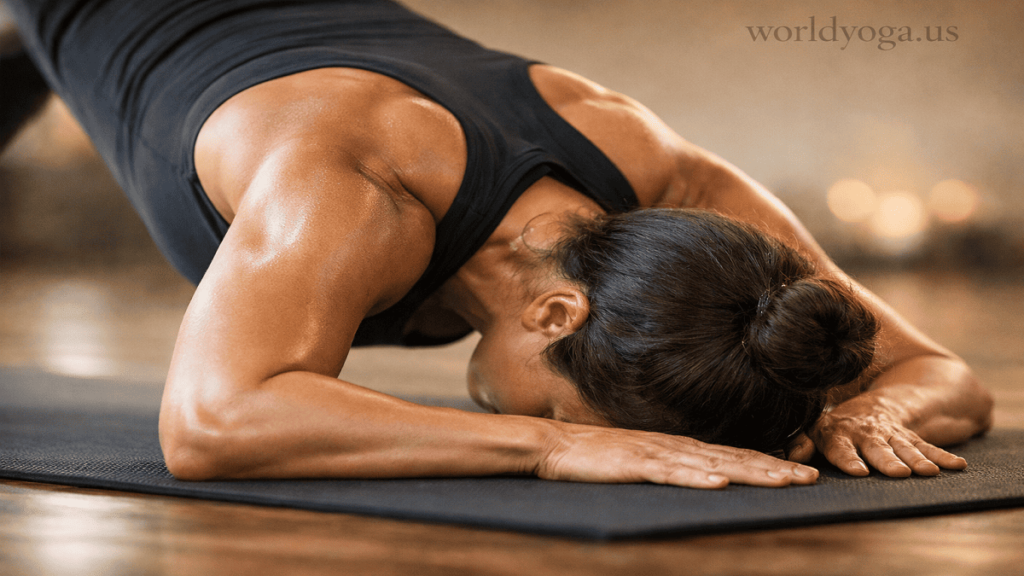
Which muscles are engaged during this posture?
The forearm variation of Downward Dog is a full-body posture that engages multiple muscle groups simultaneously to support stability, alignment, and controlled stretching. Because the base of support shifts from the hands to the forearms, the shoulders and upper back play a more active stabilizing role, while the posterior chain experiences a deep lengthening effect.
Upper Body Muscles
The shoulders are highly engaged, especially the deltoids and rotator cuff muscles. These muscles work continuously to stabilize the shoulder joint and prevent collapsing into the forearms. The serratus anterior is also strongly activated to maintain scapular stability and keep the shoulder blades lifted away from the spine.
In the upper back, the trapezius (particularly the lower and middle fibers) and rhomboids help maintain posture by controlling scapular positioning. The triceps assist in supporting forearm pressure and maintaining elbow stability, even though the arms are not fully extended.
Core Muscles
The core plays a central stabilizing role. The transverse abdominis engages deeply to support the spine and prevent sagging in the lower back. The obliques assist in maintaining balance and preventing unwanted rotation of the pelvis. The rectus abdominis contributes to overall trunk control, ensuring the torso remains long and stable rather than collapsing.
The spinal extensors (erector spinae) also remain active, working isometrically to maintain spinal length and alignment throughout the posture.
Lower Body Muscles
The hamstrings are significantly stretched while also engaging lightly to control leg extension and support hip positioning. The gluteus maximus assists in lifting and stabilizing the pelvis, while the gluteus medius helps maintain even hip alignment and prevents lateral collapse.
The quadriceps engage to stabilize the knees and support controlled extension of the legs. The calves (gastrocnemius and soleus) are also stretched as the heels move toward the floor, contributing to lower-leg flexibility.
Shoulder Girdle and Stabilizers
A key feature of this variation is increased engagement of the shoulder stabilizers. The serratus anterior and lower trapezius work together to maintain upward rotation and elevation control of the scapulae. This prevents shoulder compression and supports safe weight-bearing through the forearms.
Neck and Upper Spine Muscles
The neck muscles remain relaxed but supported. The deep cervical flexors help maintain a neutral neck position, especially when the head is lowered toward the floor. This prevents strain and ensures the cervical spine remains elongated.
Summary
Forearm Downward Dog engages a coordinated chain of muscles across the entire body. The upper body stabilizers (shoulders and upper back) work actively, the core maintains structural integrity, and the lower body muscles provide both stretch and controlled engagement. This balanced activation makes the posture effective for building strength, improving flexibility, and enhancing postural awareness.
#Downward Dog: Forearms and Head on the Floor in Hyderabad
What preparatory poses are recommended before practicing it?
Forearm Downward Dog requires a combination of shoulder stability, hamstring flexibility, core control, and spinal awareness. Preparing the body with targeted poses helps reduce strain on the shoulders and ensures safe alignment when weight is transferred to the forearms.
1. Dolphin Pose (Ardha Pincha Mayurasana)
Dolphin Pose is the most direct preparation for Forearm Downward Dog because it uses the same forearm base and inverted “V” structure. It builds shoulder endurance, strengthens the serratus anterior, and teaches proper scapular engagement. Practicing this pose helps the body adapt to weight-bearing through the forearms while maintaining a lifted shoulder position.
2. Downward Facing Dog (Adho Mukha Svanasana)
The traditional version of Downward Dog prepares the posterior chain by stretching the hamstrings, calves, and lower back. It also helps establish the fundamental alignment of lifting the hips up and back, which directly translates into the forearm variation. Practicing this pose first builds familiarity with the inverted shape before reducing wrist support.
3. Plank Pose (Phalakasana)
Plank Pose strengthens the core, shoulders, and arms, all of which are essential for stability in Forearm Downward Dog. A strong core prevents sagging in the lower back and helps maintain a long spine during inversion. It also builds endurance in the shoulder stabilizers needed for safe forearm loading.
4. Puppy Pose (Uttana Shishosana)
Puppy Pose is excellent for opening the chest, shoulders, and upper back. It gently prepares the spine for extension and shoulder flexion without full weight-bearing stress. This pose helps improve shoulder mobility, making it easier to maintain proper alignment in the forearm variation.
5. Low Lunge (Anjaneyasana)
Low Lunge targets the hip flexors, particularly the iliopsoas, which are often tight due to prolonged sitting. Releasing this area allows better pelvic tilt and improves the ability to lift the hips in Forearm Downward Dog without compressing the lower back.
6. Thread the Needle Pose (Parsva Balasana variation)
This pose helps release tension in the upper back and rear shoulders. It improves rotational mobility and reduces stiffness in the scapular region, which is important for maintaining stable shoulder positioning on the forearms.
Summary
A well-rounded preparation sequence includes Dolphin Pose for direct adaptation, Downward Dog for posterior chain flexibility, Plank Pose for core strength, Puppy Pose for shoulder opening, and Low Lunge for hip mobility. Together, these poses build the strength, flexibility, and joint awareness needed for safe practice of Forearm Downward Dog.
For reference, see Yoga Journal Dolphin Pose Guide and Verywell Fit Shoulder Opening Yoga Poses.
#Downward Dog: Forearms and Head on the Floor in Pune
What are the benefits and precautions of this supported Downward Dog variation?
Forearm Downward Dog is a supported inversion that modifies the traditional Adho Mukha Svanasana by shifting weight from the hands to the forearms and reducing wrist load. This adjustment changes the biomechanics of the posture while still preserving many of its full-body benefits. It is widely used in yoga therapy, mobility training, and rehabilitation-focused practices.
Benefits
1. Reduced Wrist Strain
One of the most significant benefits is the elimination of pressure on the wrists. By grounding the forearms instead of the palms, this variation becomes accessible for individuals with wrist sensitivity, carpal discomfort, or repetitive strain concerns, while still allowing them to practice an inverted posture safely.
2. Improved Shoulder Strength and Stability
This posture requires active engagement of the shoulder stabilizers, including the serratus anterior, rotator cuff, and trapezius muscles. Over time, this builds shoulder endurance and improves joint stability, which is beneficial for both daily movement and more advanced yoga poses.
3. Enhanced Spinal Decompression
Like traditional Downward Dog, this variation lengthens the spine and creates space between vertebrae. The inverted “V” shape helps reduce compressive forces on the lower back, promoting spinal decompression and improved postural alignment.
4. Increased Hamstring and Calf Flexibility
The extended leg position stretches the hamstrings and calves more deeply. This can improve lower-body flexibility, support better walking and running mechanics, and reduce tightness caused by prolonged sitting.
5. Core Activation and Postural Awareness
Maintaining stability in this pose requires consistent core engagement. The abdominal muscles work to support the pelvis and prevent collapse in the lower back, improving overall body awareness and control.
Precautions
1. Shoulder Overload Risk
Because more weight is placed on the forearms and shoulders, improper alignment can lead to shoulder strain. Collapsing into the shoulder joints or failing to actively lift the scapulae may cause discomfort or injury over time.
2. Neck Compression
If the head is placed too heavily on the floor or the neck is not kept neutral, there can be unnecessary cervical pressure. The head should remain relaxed without bearing weight.
3. Lower Back Strain
Individuals with tight hamstrings or weak core muscles may experience lower back rounding or compression. This can be avoided by bending the knees slightly and maintaining spinal length rather than forcing straight legs.
4. Elbow Misalignment
Elbows that drift outward or forward can destabilize the posture and increase joint stress. Proper alignment requires elbows stacked under the shoulders and forearms kept parallel.
5. Inversion Sensitivity
Since this is a mild inversion, individuals with uncontrolled blood pressure issues, vertigo, or certain cardiovascular conditions should practice cautiously or seek professional guidance before attempting.
Summary
Forearm Downward Dog offers a safer, wrist-friendly alternative to traditional Downward Dog while enhancing shoulder strength, spinal length, hamstring flexibility, and core stability. However, its effectiveness depends on correct alignment, especially in the shoulders, elbows, and spine. When practiced mindfully, it serves as both a therapeutic and strengthening posture.
#Downward Dog: Forearms and Head on the Floor in Delhi
Case Study of Downward Dog: Forearms and Head on the Floor
1. Introduction
The forearm-supported variation of Downward Dog with the head gently approaching or resting near the floor is a modified inversion used in yoga therapy and mobility training. It reduces wrist loading while increasing shoulder stabilization demands and promoting spinal elongation. This case study examines its biomechanical effects, adaptation process, and functional outcomes in a structured practice setting.
2. Subject Profile
The subject is a 35-year-old office professional with a sedentary lifestyle and mild wrist discomfort due to prolonged computer use. The individual reports tight hamstrings, occasional upper back stiffness, and reduced shoulder endurance. No acute injuries are present, but postural fatigue and forward-shoulder rounding are observed.
3. Methodology
The subject practiced the forearm Downward Dog variation over a 6-week period, 4 times per week. Each session included:
- Shoulder warm-up (Puppy Pose, Thread the Needle)
- Core activation drills (Plank variations)
- Entry into Dolphin Pose before progressing into full forearm Downward Dog
- Hold duration: 20–60 seconds per repetition, 3–5 rounds per session
Progress was assessed based on shoulder stability, spinal alignment, hamstring flexibility, and comfort in forearm support.
4. Biomechanical Observations
During initial sessions, the subject exhibited shoulder collapse and uneven weight distribution across the forearms. The scapulae tended to retract excessively, indicating weak serratus anterior engagement. The head frequently bore partial weight, suggesting insufficient upper-body control.
By week 3, improved activation of the shoulder stabilizers was observed. The serratus anterior and rotator cuff muscles began maintaining scapular elevation, reducing compression in the shoulder joints. The spine showed improved elongation, and hamstring tightness gradually decreased.
By week 6, the subject demonstrated stable forearm grounding, with even weight distribution and minimal cervical involvement. The hips lifted more effectively, and the posture became more structurally balanced.
5. Outcomes
Key improvements included:
- Reduced wrist discomfort due to elimination of palm loading
- Increased shoulder endurance and stability
- Improved hamstring flexibility and posterior chain mobility
- Better postural awareness in seated and standing positions
- Enhanced core engagement and spinal control
Subjectively, the posture transitioned from effortful to more controlled and sustainable over time.
6. Challenges and Adjustments
Initial challenges included:
- Shoulder fatigue due to weak stabilizers
- Neck discomfort from improper head placement
- Difficulty maintaining straight legs without lumbar rounding
Adjustments implemented:
- Use of bent knees to reduce hamstring strain
- Emphasis on forearm pressing rather than passive support
- Removal of head pressure to maintain cervical neutrality
- Increased preparatory work with Dolphin Pose
7. Discussion
This case highlights that the forearm Downward Dog variation is primarily a shoulder stability and core control exercise rather than a flexibility-only posture. The head should remain passive, and alignment must originate from the shoulders and hips rather than the neck or lower back.
The progression demonstrates that neuromuscular adaptation—especially in the serratus anterior and deep core muscles—is the key determinant of success in this posture.
8. Conclusion
The forearm-supported Downward Dog with head near the floor is an effective modification for improving shoulder strength, spinal alignment, and posterior chain flexibility while reducing wrist stress. When introduced progressively, it offers a safe and scalable approach to inversion-based yoga practice.
#Downward Dog: Forearms and Head on the Floor in Banglore
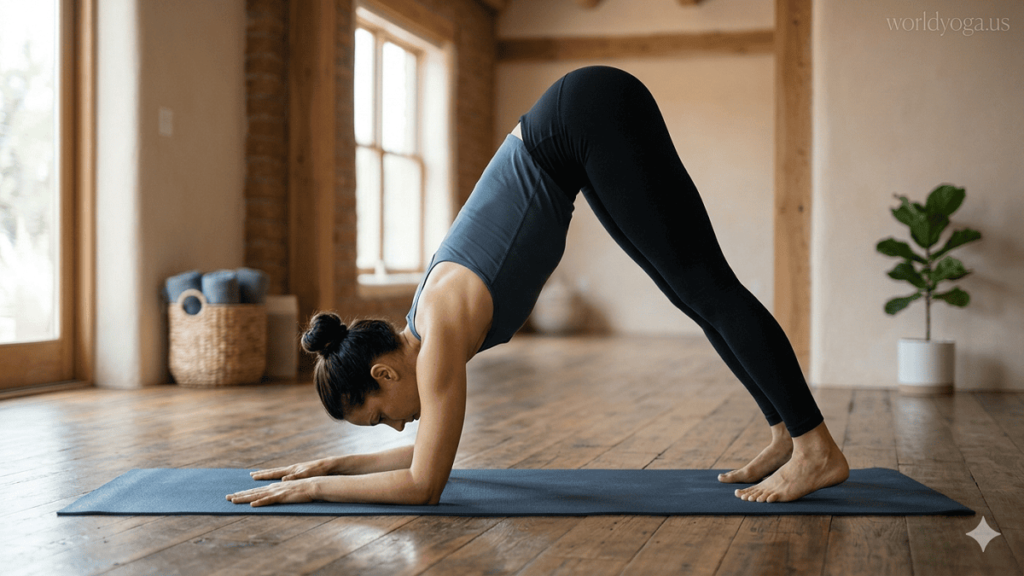
White Paper of Downward Dog: Forearms and Head on the Floor
1. Executive Summary
The forearm-supported variation of Downward Dog with the head gently approaching or resting near the floor is a modified inversion used in yoga therapy, rehabilitation, and functional mobility training. This posture redistributes load from the wrists to the forearms, increases demand on shoulder stabilizers, and promotes spinal elongation and posterior chain flexibility. This white paper outlines its biomechanical structure, muscular engagement, clinical applications, safety considerations, and implementation guidelines for safe and effective practice.
2. Background and Functional Context
Traditional Adho Mukha Svanasana is widely used to develop full-body integration, combining upper-body strength with lower-body flexibility. However, wrist sensitivity, repetitive strain injuries, and limited wrist extension capacity can restrict accessibility. The forearm variation offers a scalable alternative that maintains core benefits while reducing distal joint stress. It is frequently integrated into yoga therapy, sports mobility programs, and corrective exercise protocols.
3. Biomechanical Framework
This posture operates as a closed-chain kinetic structure where force is transferred through the forearms rather than the palms. The elbows are positioned directly under the shoulders, creating vertical load stacking for joint stability. The shoulder girdle becomes the primary load-bearing region, requiring active scapular elevation and stabilization.
The spine functions as a lengthened tension bridge between pelvis and shoulder girdle. The pelvis is elevated and slightly anteriorly tilted to support hamstring lengthening while maintaining lumbar neutrality. The head remains passive, typically hovering or lightly contacting the floor without bearing weight.
4. Muscular Activation Profile
Primary muscle groups include:
- Shoulder stabilizers: Serratus anterior, rotator cuff, lower trapezius
- Upper back muscles: Rhomboids and middle trapezius for scapular control
- Core musculature: Transverse abdominis, obliques, rectus abdominis for spinal stability
- Posterior chain: Hamstrings and gluteus maximus for hip elevation and leg extension control
- Lower leg muscles: Gastrocnemius and soleus under eccentric stretch
- Neck stabilizers: Deep cervical flexors maintaining neutral cervical alignment
This coordinated activation ensures structural integrity across multiple kinetic chains.
5. Joint Mechanics
- Shoulder joint: Primary load-bearing articulation requiring dynamic stabilization
- Elbow joint: Fixed flexion support under vertical alignment
- Spine: Maintains axial elongation under decompressive load
- Hip joint: Executes controlled flexion with posterior chain engagement
- Knee joint: Passive hinge stability under hamstring tension
- Cervical spine: Neutral or passive positioning without compression
Proper joint stacking is essential to prevent compensatory strain, particularly in the shoulders and cervical region.
6. Clinical and Functional Applications
This variation is widely applied in:
- Yoga therapy for wrist-sensitive practitioners
- Physiotherapy adjunct programs for shoulder stabilization
- Athletic conditioning for posterior chain flexibility
- Postural correction programs for sedentary populations
- Breath-based nervous system regulation practices
Authoritative references such as Yoga Journal Dolphin Pose Guide and Verywell Fit Forearm Downward Dog Analysis support its role in improving shoulder endurance and spinal alignment.
7. Risk Factors and Safety Considerations
Key risks include:
- Shoulder overload due to improper scapular engagement
- Cervical strain if the head bears unintended weight
- Lumbar compression from weak core activation
- Elbow instability from misalignment
- Hamstring overstretching in tight posterior chain individuals
Mitigation strategies include progressive loading, bent-knee modifications, and emphasis on forearm pressing rather than passive sinking.
8. Implementation Guidelines
- Begin with Dolphin Pose for foundational adaptation
- Progress gradually into full forearm Downward Dog
- Maintain elbows directly under shoulders
- Keep head passive and non-weight-bearing
- Use bent knees if spinal alignment is compromised
- Emphasize scapular lift and core activation throughout
9. Conclusion
Forearm Downward Dog with head near the floor is a clinically relevant modification that preserves the structural and therapeutic benefits of traditional Downward Dog while reducing wrist load. Its effectiveness depends on precise shoulder mechanics, spinal elongation, and progressive adaptation. When implemented correctly, it serves as a scalable tool for rehabilitation, mobility development, and integrated movement training.
#Downward Dog: Forearms and Head on the Floor in Kolkata
Industry Application of Downward Dog: Forearms and Head on the Floor
1. Overview
The forearm-supported variation of Downward Dog with the head gently resting or hovering near the floor is increasingly used across yoga therapy, physiotherapy, sports conditioning, occupational health, and corrective exercise industries. Its value lies in its ability to reduce wrist loading while maintaining a strong focus on shoulder stability, spinal elongation, and posterior chain flexibility. This makes it a versatile tool for both rehabilitation and performance enhancement contexts.
2. Application in Physiotherapy and Rehabilitation
In physiotherapy settings, this variation is commonly used as a wrist-friendly inversion alternative for patients with carpal tunnel syndrome, repetitive strain injuries, or wrist post-surgical limitations. By shifting weight from the hands to the forearms, it allows controlled loading of the shoulder girdle without aggravating distal joint structures.
Clinicians often use it to:
- Rebuild shoulder stability post-injury
- Improve scapular control and serratus anterior activation
- Gradually reintroduce weight-bearing upper-body movement
- Support spinal decompression in patients with postural pain
It is frequently integrated into graded mobility protocols where load tolerance is progressively increased.
3. Application in Sports Performance and Athletic Training
In athletic conditioning, the posture is used to develop shoulder endurance, core stability, and posterior chain flexibility. It is especially relevant for sports requiring overhead strength, sprint mechanics, and dynamic trunk control.
Key benefits for athletes include:
- Enhanced scapular stability for throwing and overhead actions
- Improved hamstring flexibility for stride efficiency
- Core activation for injury prevention and force transfer
- Shoulder resilience under bodyweight load
Sports such as football, martial arts, gymnastics, and track athletics often incorporate this variation into warm-up or recovery sessions.
4. Application in Fitness and Functional Training
In gym-based and functional fitness environments, this posture is used as a corrective movement drill. Trainers include it in mobility circuits to counteract the effects of prolonged sitting and upper-body compression from weight training.
It is commonly applied to:
- Improve overhead pressing mechanics
- Correct rounded shoulder posture
- Enhance hamstring and calf flexibility
- Build foundational shoulder stability before advanced calisthenics
Because it removes wrist strain, it is particularly useful for clients transitioning from sedentary lifestyles to structured training programs.
5. Application in Occupational Health and Corporate Wellness
In corporate wellness and ergonomics-focused programs, this variation is used as a micro-intervention to reduce musculoskeletal fatigue caused by long hours of desk work.
It helps employees:
- Relieve upper back and shoulder stiffness
- Improve posture awareness
- Reduce cumulative wrist stress from typing
- Restore spinal length after prolonged sitting
Its accessibility makes it suitable for guided workplace movement breaks and wellness workshops.
6. Application in Yoga Therapy and Mind-Body Practices
In yoga therapy, this posture is used as a supportive inversion for nervous system regulation and gentle full-body engagement. The forearm base provides grounding stability, while the head’s passive position encourages relaxation and breath awareness.
Therapeutic applications include:
- Stress reduction and calming the autonomic nervous system
- Gentle inversion for energy regulation
- Shoulder rehabilitation within mindful movement frameworks
- Progressive preparation for advanced inversions
7. Risk Management Across Industries
Across all applications, safety considerations remain consistent:
- Avoid collapsing into shoulders or neck
- Maintain elbows stacked under shoulders
- Keep head passive without weight-bearing pressure
- Modify with bent knees for hamstring or lumbar protection
- Progress gradually in load and duration
8. Conclusion
Forearm Downward Dog with head near the floor is a highly adaptable movement pattern with strong relevance across rehabilitation, sports performance, fitness training, occupational health, and yoga therapy. Its ability to reduce wrist strain while maintaining full-body engagement makes it a valuable interdisciplinary tool for improving mobility, posture, and musculoskeletal resilience.
#Downward Dog: Forearms and Head on the Floor in Mumbai
Ask FAQs
What is the main difference between this variation and traditional Downward Dog?
The main difference is that the forearm variation shifts body weight from the hands to the forearms. This reduces wrist pressure and increases demand on shoulder stabilizers, while still maintaining spinal length, hamstring stretching, and full-body engagement.
Is it safe to place the head on the floor during this pose?
The head should remain passive and should not bear weight. It may lightly touch or hover near the floor depending on flexibility, but the primary support must come from the forearms and shoulders to avoid neck strain.
Who should practice this variation?
This pose is suitable for beginners, individuals with wrist discomfort, and practitioners looking to build shoulder strength and stability. It is also used in yoga therapy and mobility training. However, people with severe shoulder injuries or uncontrolled blood pressure conditions should consult a professional before practicing.
What are the most common mistakes in this pose?
Common mistakes include collapsing into the shoulders, placing too much pressure on the head, allowing elbows to drift out of alignment, and rounding the lower back. These errors usually result from weak core engagement or improper shoulder activation.
What are the key benefits of practicing this variation regularly?
Regular practice improves shoulder strength and stability, enhances hamstring and calf flexibility, supports spinal decompression, reduces wrist strain compared to traditional Downward Dog, and builds overall postural awareness and core control.
Table of Contents
Disclaimer: This content is for educational and informational purposes only and is not a substitute for professional medical, physiotherapy, or certified yoga instruction. Practice mindfully and avoid any posture that causes pain or discomfort. Consult a qualified healthcare professional before starting any new exercise routine, especially if you have existing injuries or health conditions.