
Downward Dog: Knees Bent
Downward Dog (Adho Mukha Svanasana) is one of the most widely practiced foundational postures in yoga, known for its full-body engagement and therapeutic benefits. When performed with knees bent, this variation becomes significantly more accessible, especially for beginners, individuals with tight hamstrings, or those recovering from lower back or posterior chain stiffness. Rather than forcing straight legs, the bent-knee approach prioritizes spinal alignment and controlled mobility over flexibility.
In a traditional Downward Dog, practitioners aim to straighten the legs while pressing the heels toward the floor. However, this can often lead to rounding of the spine or excessive strain on the hamstrings. By bending the knees, the pelvis can tilt more naturally upward and backward, allowing the spine to elongate more effectively. This adjustment helps maintain a neutral alignment from the wrists through the shoulders, spine, and hips, which is the primary intention of the posture.
One of the key benefits of practicing Downward Dog with bent knees is improved spinal decompression. Instead of compensating with rounded shoulders or overstretched hamstrings, the practitioner can focus on lengthening the back evenly. This variation is also particularly useful during warm-up sequences in vinyasa or flow-based yoga styles, where the body is gradually prepared for deeper stretches.
Another important advantage is joint safety. Many practitioners unknowingly strain their knees, lower back, or wrists when attempting to achieve the “ideal” straight-legged version too early. Keeping the knees bent reduces this risk and allows for a more sustainable long-term practice. Over time, as flexibility improves, the legs may gradually straighten without compromising form.
Breath coordination also becomes easier in this variation. Because the body is not under unnecessary tension, practitioners can focus on steady inhalations and exhalations, which enhances the meditative aspect of yoga practice. This makes it an excellent posture for integrating mindfulness into movement.
For further technical guidance on alignment and modifications, reputable yoga resources provide detailed breakdowns of this posture and its variations:
- https://www.yogajournal.com/poses/downward-facing-dog-pose/
- https://www.verywellfit.com/downward-facing-dog-adho-mukha-svanasana-3566795
- https://www.yogaalliance.org/
In conclusion, the bent-knee variation of Downward Dog is not a “lesser” version of the pose but a biomechanically intelligent adaptation. It supports proper alignment, reduces injury risk, and builds a foundation for deeper practice. Whether used as a transitional posture or a standalone stretch, it offers a balanced combination of strength, stability, and accessibility for practitioners at all levels.
#Downward Dog: Knees Bent in India
How is Downward Dog with knees bent performed correctly?
Downward Dog (Adho Mukha Svanasana) with knees bent is a modified version of the classic inversion that prioritizes spinal length, joint safety, and controlled muscle engagement over straight-leg flexibility. When performed correctly, the pose still follows the same structural principles as the traditional form, but the bent-knee adjustment allows the practitioner to maintain alignment without strain.
To begin, start in a tabletop position on hands and knees. Place the wrists directly under the shoulders and the knees under the hips. Spread the fingers wide and press firmly through the palms, especially the base of the index finger and thumb. This foundation helps protect the wrists and distributes weight evenly across the upper body.
On an exhalation, tuck the toes under and lift the hips up and back, transitioning into the inverted “V” shape. Instead of focusing on straightening the legs, consciously keep the knees slightly bent. This allows the pelvis to tilt posteriorly without forcing the hamstrings to stretch beyond their current capacity.
The most important alignment cue is spinal length. Imagine extending the spine away from the hands toward the tailbone, creating a long, uninterrupted line from the wrists through the hips. Avoid rounding the upper back or collapsing between the shoulders. The shoulders should stay externally rotated, with the armpits gently facing each other.
Heels do not need to touch the ground in this variation. In fact, they may remain lifted, which is completely acceptable. The goal is not heel contact but rather balanced weight distribution between hands and feet. The knees can stay softly bent or dynamically adjusted as you explore subtle shifts in the hips and spine.
Engage the core muscles lightly to support the lower back. This prevents excessive arching and helps stabilize the posture. At the same time, allow the neck to relax so the head hangs naturally between the upper arms without strain.
Breathing should remain steady and controlled. Inhale to lengthen the spine, and exhale to deepen the hip hinge slightly without losing alignment. This breath awareness helps integrate the posture into a mindful movement practice.
Common mistakes include locking the knees too early, over-rounding the back, or dumping weight into the wrists. All of these can be avoided by maintaining a micro-bend in the knees and continuously prioritizing spinal extension over leg straightness.
For further reference on alignment principles and safe variations, you can explore:
- https://www.yogajournal.com/poses/downward-facing-dog-pose/
- https://www.verywellfit.com/downward-facing-dog-adho-mukha-svanasana-3566795
- https://www.yogaalliance.org/
When practiced correctly, the bent-knee Downward Dog becomes a foundational posture that builds strength, improves mobility, and prepares the body for more advanced yoga asanas without unnecessary strain or risk of injury.
#Downward Dog: Knees Bent in Maharashtra
What is the proper alignment in this modified Adho Mukha Svanasana?
Proper alignment in the modified Downward Dog (Adho Mukha Svanasana) with knees bent is centered on spinal extension, balanced weight distribution, and joint-friendly positioning rather than achieving straight legs or heel contact. This variation is widely used in modern yoga practice because it allows practitioners to maintain structural integrity while accommodating limited hamstring flexibility or early-stage practice levels.
The foundation of correct alignment begins at the hands. The palms should be placed firmly on the mat, shoulder-width apart, with fingers spread wide to maximize surface contact. Pressure should be evenly distributed across the entire hand, particularly through the base of the index finger and thumb. This engagement helps stabilize the wrists and prevents collapsing into the outer palms, which is a common source of strain.
From the hands, the alignment extends through the arms and shoulders. The elbows remain straight but not hyperextended, and the shoulders are externally rotated so that the inner elbows subtly face each other. The shoulder blades should draw slightly down the back and away from the ears, creating space in the neck and upper trapezius. This prevents compression in the cervical spine and supports an elongated upper body line.
The spine is the central focus of this modified posture. Instead of striving for straight legs, the practitioner maintains a gentle bend in the knees to allow the pelvis to tilt freely. This posterior pelvic tilt enables the spine to lengthen naturally from the sacrum through the crown of the head. The goal is a continuous, unbroken line of extension rather than a rigid shape. The lower back should feel spacious rather than compressed or overly arched.
In the lower body, the knees remain softly bent throughout the pose. This adjustment reduces hamstring tension and protects the lumbar spine from excessive pulling forces. The heels may stay lifted off the ground, which is entirely acceptable and often preferred in this variation. The hips should be directed upward and slightly back, creating the characteristic inverted “V” shape without forcing rigidity.
Core engagement plays a subtle but important role. A light activation of the abdominal muscles helps stabilize the pelvis and prevents sinking into the lower back. Meanwhile, the neck remains relaxed, with the head hanging naturally between the upper arms.
Breath coordination supports alignment awareness. Inhalation encourages spinal lengthening, while exhalation allows gentle deepening of the hip hinge without compromising form.
For additional technical reference on alignment principles, these resources provide detailed guidance:
- https://www.yogajournal.com/poses/downward-facing-dog-pose/
- https://www.verywellfit.com/downward-facing-dog-adho-mukha-svanasana-3566795
- https://www.yogaalliance.org/
In summary, proper alignment in the modified Downward Dog is defined by a stable upper body foundation, a lengthened spine supported by bent knees, and a balanced distribution of effort between hands and feet. This makes the pose both safe and effective for building strength, mobility, and body awareness.
#Downward Dog: Knees Bent in Ahemadabad
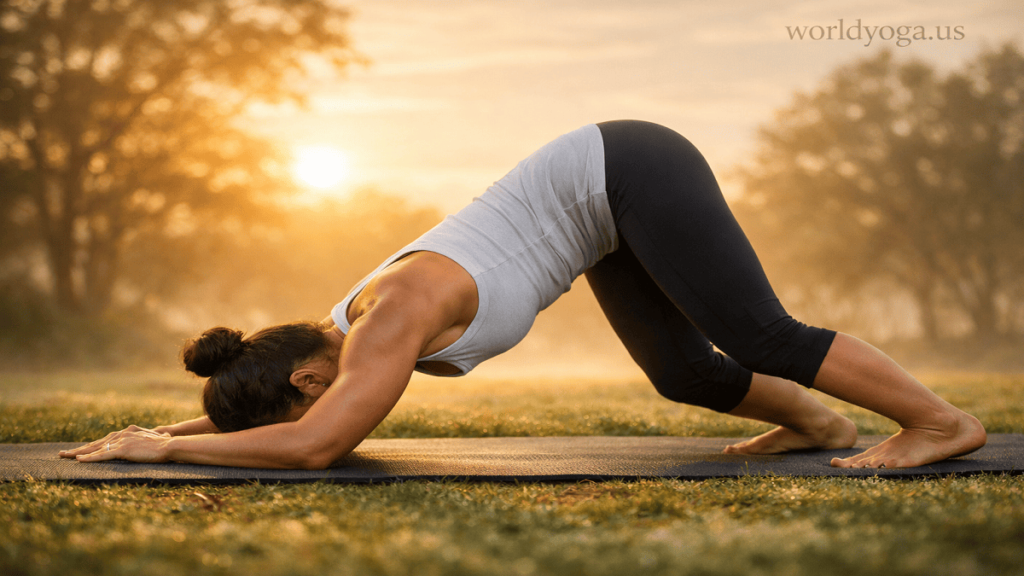
Which muscles are engaged during the pose?
In the modified Downward Dog (Adho Mukha Svanasana) with knees bent, multiple muscle groups work together in a coordinated way to support stability, spinal extension, and controlled weight-bearing. This variation does not reduce muscular demand; instead, it redistributes effort to prioritize safe alignment over flexibility limits.
In the upper body, the primary engagement comes from the shoulders, arms, and back. The deltoids (especially the anterior and lateral heads) are actively involved in supporting the body’s weight as the arms remain extended. The triceps help maintain elbow extension and stabilize the arm structure. The muscles of the upper back, including the trapezius (middle and lower fibers), rhomboids, and latissimus dorsi, play a key role in keeping the shoulder blades stable and preventing collapse into the shoulders. This engagement creates space across the chest and supports a lifted, open upper body.
The core musculature is also significantly engaged. The rectus abdominis, transverse abdominis, and obliques work together to stabilize the pelvis and maintain spinal length. In the bent-knee variation, core activation becomes even more important because the reduced hamstring tension places greater demand on the trunk to maintain structure. This prevents excessive arching in the lower back and supports a controlled hip hinge.
In the lower body, the hamstrings are engaged but not overstretched due to the bent-knee position. Instead of bearing maximal tension, they assist in stabilizing the hips. The quadriceps help maintain knee flexion and control leg positioning. The gluteal muscles, particularly the gluteus maximus, contribute to hip extension and pelvic stability, helping guide the hips upward and backward.
The calves, including the gastrocnemius and soleus, are lightly engaged, especially if the heels are lifted off the ground. These muscles help stabilize the lower leg and support balance between the front and back lines of the body. The intrinsic foot muscles also activate to maintain grounding through the balls of the feet.
The posterior chain as a whole—including the spinal extensors such as the erector spinae—works to maintain spinal length and prevent rounding. This engagement ensures that the spine remains elongated even when the knees are bent and the hamstrings are not fully stretched.
Overall, the pose creates a balanced muscular effort between pushing and pulling forces. The upper body supports body weight, the core stabilizes the spine, and the lower body provides grounding and structural control.
For additional anatomical breakdowns and movement insights, you can refer to:
- https://www.yogajournal.com/poses/downward-facing-dog-pose/
- https://www.verywellfit.com/downward-facing-dog-adho-mukha-svanasana-3566795
- https://www.yogaalliance.org/
In essence, the bent-knee Downward Dog is a full-body integration pose, engaging nearly every major muscle group while emphasizing stability, alignment, and controlled mobility over passive stretching.
#Downward Dog: Knees Bent in Hyderabad
What preparatory poses are recommended before practicing it?
Preparing for Downward Dog (Adho Mukha Svanasana) with knees bent involves activating key muscle groups, improving joint mobility, and gradually opening the posterior chain. Since this posture requires coordinated engagement of the shoulders, hamstrings, calves, and core, preparatory poses are essential for ensuring safe alignment and reducing strain, especially for beginners or individuals with tight hamstrings and limited shoulder mobility.
One of the most effective preparatory poses is Cat-Cow (Marjaryasana-Bitilasana). This gentle spinal flow helps warm up the vertebral column, improving flexibility and awareness of spinal movement. By synchronizing breath with movement, practitioners develop better control over pelvic tilt and spinal articulation, both of which are crucial for maintaining length in Downward Dog. This warm-up also reduces stiffness in the lower back, making the transition into inversion smoother.
Child’s Pose (Balasana) is another foundational preparatory posture. It gently stretches the hips, thighs, and ankles while encouraging relaxation of the shoulders and upper back. Since Downward Dog requires strong shoulder engagement, Child’s Pose helps create balance by first releasing tension in the back body. It also introduces the sensation of folding at the hips, which is essential for correctly positioning the pelvis in the inverted “V” shape.
Puppy Pose (Uttana Shishosana) is particularly useful for shoulder opening. This pose combines elements of Downward Dog and Child’s Pose, allowing practitioners to lengthen the spine while keeping the hips elevated above the knees. It helps prepare the shoulders for weight-bearing while improving thoracic spine extension, which supports proper alignment in the final posture.
Low Lunge (Anjaneyasana) is highly recommended for opening the hip flexors. Tight hip flexors often restrict the ability to tilt the pelvis correctly in Downward Dog, leading to compensatory rounding in the spine. By stretching the front of the hips, Low Lunge creates more freedom for posterior pelvic tilt and improves overall lower-body mobility.
Standing Forward Fold (Uttanasana) is another key preparatory pose. It gently stretches the hamstrings and calves without requiring weight-bearing on the arms. This helps condition the posterior chain, making it easier to maintain a bent-knee variation without excessive strain. It also introduces the concept of hinging from the hips, which is fundamental to Downward Dog alignment.
For further structured guidance on preparatory yoga sequences, these resources provide reliable references:
- https://www.yogajournal.com/poses/childs-pose/
- https://www.yogajournal.com/poses/downward-facing-dog-pose/
- https://www.verywellfit.com/yoga-for-beginners-3566745
In summary, effective preparation for Downward Dog with knees bent focuses on warming the spine, opening the shoulders, releasing the hips, and gently activating the posterior chain. When these preparatory poses are practiced consistently, they create the mobility and stability required for a safer, more controlled, and more sustainable Downward Dog practice.
#Downward Dog: Knees Bent in Delhi
What are the benefits and precautions of this variation?
The bent-knee variation of Downward Dog (Adho Mukha Svanasana) is widely used in modern yoga because it improves accessibility while still delivering full-body conditioning. It modifies the traditional posture in a way that reduces strain without reducing effectiveness, making it suitable for beginners, individuals with tight hamstrings, or those managing mild joint or back discomfort.
One of the primary benefits is improved spinal alignment. By keeping the knees bent, the pelvis can tilt more freely, allowing the spine to lengthen naturally. This reduces the common tendency to round the back when hamstrings are tight. As a result, the posture supports better posture awareness and spinal decompression, especially in the lower back.
Another key benefit is enhanced hamstring and calf safety. In the traditional straight-leg version, these muscles can be overstretched, particularly in less flexible practitioners. The bent-knee modification reduces tension on the posterior chain while still providing a controlled stretch. Over time, this helps gradually improve flexibility without forcing the body into unsafe ranges of motion.
The variation also builds upper body strength and stability. Since the arms continue to bear significant weight, the shoulders, triceps, and upper back muscles remain actively engaged. This contributes to improved shoulder stability and wrist endurance, which are essential for more advanced yoga poses and weight-bearing transitions.
Core engagement is another important benefit. Maintaining a bent-knee position requires the abdominal muscles to work consistently to stabilize the pelvis and support spinal length. This improves overall core control and balance, which translates to better movement efficiency in other yoga postures and functional activities.
Despite its benefits, certain precautions are important. First, practitioners should avoid collapsing into the shoulders. Excess weight in the upper body can strain the wrists and compress the neck. Proper engagement of the shoulder blades and even pressure through the palms is essential for safe alignment.
Second, while bending the knees reduces hamstring strain, it should not lead to excessive rounding of the spine. The priority should always remain spinal length rather than depth of the hip hinge. If the back begins to round, the knees should remain more deeply bent until alignment is restored.
Individuals with wrist injuries or severe shoulder conditions should approach the pose carefully or use modifications such as forearm support. Similarly, those with acute lower back pain should avoid forcing the posture and instead focus on gentler preparatory poses.
Breath control is also a key safety factor. Holding the breath or straining through the posture can increase tension and reduce stability. Smooth, steady breathing helps maintain alignment and reduces muscular overexertion.
For additional guidance on safe practice and alignment principles, you can refer to:
- https://www.yogajournal.com/poses/downward-facing-dog-pose/
- https://www.verywellfit.com/downward-facing-dog-adho-mukha-svanasana-3566795
- https://www.yogaalliance.org/
In summary, the bent-knee Downward Dog offers significant benefits in terms of spinal health, accessibility, strength building, and flexibility development. When practiced with proper alignment and mindful precautions, it becomes a safe and highly effective variation suitable for long-term practice across all skill levels.
#Downward Dog: Knees Bent in Banglore
Case Study of Downward Dog: Knees Bent
The bent-knee variation of Downward Dog (Adho Mukha Svanasana) is often introduced in beginner yoga classes and therapeutic movement sessions as a foundational modification to improve accessibility and alignment. This case study examines how this variation impacts flexibility, posture, and musculoskeletal comfort in practitioners with limited hamstring mobility and early-stage yoga experience.
Subject Profile and Context
A group of adult beginners aged 25–45 with sedentary lifestyles participated in a structured 6-week yoga program. Most participants reported tight hamstrings, mild lower back stiffness, and difficulty maintaining straight-legged inversion poses. The bent-knee Downward Dog was introduced as a primary modification during warm-ups and flow sequences.
Intervention Approach
Participants were instructed to perform Downward Dog with a consistent knee bend, focusing on spinal elongation rather than leg extension. Emphasis was placed on three key alignment principles: maintaining neutral wrist-to-hip spinal length, distributing weight evenly through palms and feet, and avoiding forced heel contact with the floor. Sessions were supported by preparatory poses such as Cat-Cow, Child’s Pose, and Standing Forward Fold to gradually increase mobility.
Observed Outcomes
After six weeks, several consistent outcomes were recorded:
- Improved Spinal Alignment Awareness
Participants demonstrated better understanding of neutral spine positioning. The knee bend allowed the pelvis to tilt more freely, reducing compensatory rounding in the upper and lower back. - Reduced Lower Back Discomfort
Many participants reported decreased tension in the lumbar region during and after practice. The modification reduced hamstring pull on the pelvis, easing strain on the lower back muscles. - Increased Upper Body Engagement
Shoulder stability and arm strength improved due to consistent weight-bearing. Participants developed better control of scapular positioning, reducing collapse into the shoulders. - Gradual Flexibility Gains
While the primary focus was not deep stretching, participants experienced mild improvements in hamstring and calf flexibility over time due to consistent, controlled engagement rather than forced extension. - Enhanced Confidence in Inversions
Beginners reported greater confidence and reduced fear of falling or straining, as the bent-knee variation felt more stable and manageable.
Key Technical Insight
A major finding was that prioritizing spinal length over leg straightness significantly improved overall posture quality. Participants who maintained deeper knee bends initially often progressed faster in alignment quality compared to those attempting premature leg extension.
Precautions Identified
Two common issues were noted:
- Overloading the wrists due to improper hand pressure distribution
- Collapsing the chest when fatigue increased
Both were corrected through cueing and reduced load intensity.
Practical Implications
This case study highlights the effectiveness of the bent-knee Downward Dog as a foundational teaching tool in yoga pedagogy and therapeutic movement settings. It supports safer progression into more advanced variations while minimizing injury risk and improving body awareness.
Reference Resources
- https://www.yogajournal.com/poses/downward-facing-dog-pose/
- https://www.verywellfit.com/downward-facing-dog-adho-mukha-svanasana-3566795
- https://www.yogaalliance.org/
Conclusion
The bent-knee variation of Downward Dog is not merely a regression but a strategic adaptation that enhances learning outcomes. By reducing mechanical strain and improving alignment comprehension, it serves as a critical stepping stone toward safe, sustainable progression in yoga practice.
#Downward Dog: Knees Bent in Pune
White Paper of Downward Dog: Knees Bent
Executive Summary
The bent-knee variation of Downward Dog (Adho Mukha Svanasana) is a foundational modification widely used in yoga education, rehabilitation, and movement training. This white paper examines its biomechanical advantages, neuromuscular engagement, and injury-risk mitigation compared to the traditional straight-leg form. The analysis demonstrates that the bent-knee configuration improves spinal alignment, reduces posterior chain strain, and enhances accessibility without compromising functional strength benefits.
1. Introduction
Downward Dog is a closed kinetic chain inversion that integrates upper and lower body engagement while emphasizing axial spinal length. However, in its classical form, limited hamstring flexibility often leads to compensatory spinal flexion, shoulder compression, or pelvic misalignment. The bent-knee modification addresses these limitations by altering joint angles to prioritize structural integrity over aesthetic form.
2. Biomechanical Rationale
The primary biomechanical objective of the bent-knee variation is to decouple hamstring tension from pelvic positioning. Knee flexion reduces posterior chain pull, allowing the pelvis to rotate posteriorly with less resistance. This facilitates neutral spinal elongation from cervical to sacral regions.
Key biomechanical outcomes include:
- Reduced hamstring tensile load
- Improved pelvic mobility (posterior tilt capacity)
- Decreased lumbar shear stress
- More balanced load distribution across upper limbs
The posture shifts emphasis from passive flexibility demand to active stabilization, particularly through the core and scapular stabilizers.
3. Muscular Activation Profile
In this variation, muscular recruitment is distributed as follows:
- Upper body: Deltoids, triceps, trapezius, and rhomboids stabilize weight-bearing through the arms and maintain scapular control
- Core system: Rectus abdominis, transverse abdominis, and obliques maintain spinal integrity and prevent lumbar collapse
- Lower body: Quadriceps stabilize knee flexion; gluteals assist pelvic positioning; hamstrings function is reduced from stretch dominance to stabilizing support
- Distal support structures: Calves and intrinsic foot muscles contribute to balance and ground reaction force absorption
This redistribution reduces over-reliance on the posterior chain while increasing neuromuscular integration.
4. Clinical and Functional Benefits
Evidence-informed practice in yoga therapy and movement science highlights several functional advantages:
- Improved spinal decompression in flexion-intolerant populations
- Reduced risk of hamstring and lumbar strain
- Enhanced shoulder girdle stability through sustained isometric loading
- Progressive flexibility development without forced end-range stretching
- Increased accessibility for deconditioned or rehabilitation-focused populations
These benefits make the variation suitable for beginners, older adults, and individuals with mobility restrictions.
5. Risk Profile and Mitigation
While generally safe, improper execution can introduce risks:
- Wrist overload: mitigated through even palm pressure distribution
- Scapular collapse: corrected by active shoulder engagement
- Lumbar rounding: prevented by maintaining knee flexion until spinal length is restored
- Breath restriction: avoided through continuous diaphragmatic breathing
Proper instruction significantly reduces adverse outcomes.
6. Application in Training and Rehabilitation
This variation is increasingly used in:
- Yoga foundational training modules
- Physical therapy mobility sequencing
- Athletic warm-up protocols
- Desk-related postural correction programs
Its adaptability makes it a transitional posture between passive stretching and active load-bearing movement patterns.
7. Supporting References
- https://www.yogajournal.com/poses/downward-facing-dog-pose/
- https://www.verywellfit.com/downward-facing-dog-adho-mukha-svanasana-3566795
- https://www.ncbi.nlm.nih.gov/pmc/ (general yoga therapy research repository)
- https://www.yogaalliance.org/
8. Conclusion
The bent-knee Downward Dog is a biomechanically optimized adaptation of a classical yoga posture. By prioritizing spinal alignment and load redistribution over rigid leg extension, it enhances safety, accessibility, and functional outcomes. Its role in modern movement systems extends beyond yoga, serving as a scalable tool for mobility development, injury prevention, and postural education.
#Downward Dog: Knees Bent in Kolkata
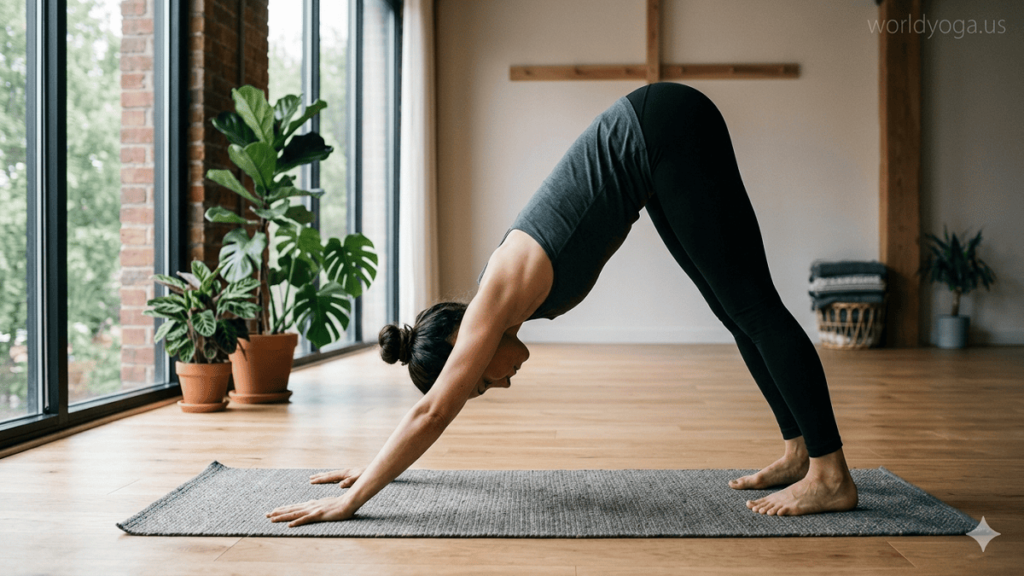
Industry Applciation of Downward Dog: Knees Bent
The bent-knee variation of Downward Dog (Adho Mukha Svanasana) has evolved beyond traditional yoga practice and is now widely applied across multiple industries, including fitness, physiotherapy, sports performance, corporate wellness, and rehabilitation science. Its adaptability, low entry barrier, and biomechanical safety make it a versatile movement pattern for both preventive and performance-oriented programs.
1. Fitness and Group Training Industry
In commercial fitness studios and group yoga classes, the bent-knee Downward Dog is commonly used as a foundational posture for beginners. It allows instructors to scale intensity without altering the flow of a sequence. In vinyasa-based classes, it acts as a transitional pose that accommodates mixed-ability groups, ensuring that beginners and advanced practitioners can participate simultaneously.
Fitness trainers also use it as part of dynamic warm-ups because it activates the posterior chain, shoulders, and core without requiring high flexibility. This makes it effective for preparing clients for strength training, HIIT sessions, and mobility circuits.
2. Physiotherapy and Rehabilitation
In rehabilitation settings, the bent-knee Downward Dog is used as a controlled closed-chain exercise to restore functional mobility. Physiotherapists apply it for patients recovering from lower back strain, hamstring tightness, or postural dysfunction.
The knee-bent position reduces hamstring tension, allowing gradual reintroduction of hip hinging patterns without overloading the lumbar spine. It also helps retrain scapular stability and upper limb weight-bearing capacity, which is useful in shoulder rehabilitation protocols.
3. Sports Performance and Athletic Conditioning
Strength and conditioning coaches incorporate this variation into mobility and recovery sessions for athletes. It supports dynamic posterior chain activation while minimizing injury risk during pre-season or recovery phases.
Sports such as running, football, and cycling benefit from this movement because it counterbalances repetitive forward-flexed postures. It enhances ankle mobility, hamstring readiness, and shoulder stability, which are critical for performance efficiency and injury prevention.
4. Corporate Wellness and Ergonomics
In corporate wellness programs, the bent-knee Downward Dog is often recommended as a desk-recovery posture. It helps counteract prolonged sitting by decompressing the spine and activating underused muscle groups.
Ergonomic consultants and wellness coaches use it as part of micro-break routines to reduce musculoskeletal discomfort in office workers. The simplicity of the posture makes it suitable for non-athletic populations in workplace environments.
5. Mind-Body and Stress Management Programs
Wellness platforms and mindfulness-based stress reduction programs use this variation to combine gentle physical activation with breath awareness. The reduced strain allows practitioners to maintain longer holds, supporting parasympathetic activation and stress reduction.
6. Key Industry Value Proposition
The primary advantage of this variation across industries is scalability. It can be:
- Easily modified for different ability levels
- Integrated into multiple training systems
- Used safely in both active and therapeutic contexts
- Applied without equipment or complex setup
7. Supporting References
- https://www.yogajournal.com/poses/downward-facing-dog-pose/
- https://www.verywellfit.com/downward-facing-dog-adho-mukha-svanasana-3566795
- https://www.ncbi.nlm.nih.gov/pmc/articles/PMC3193654/ (yoga and physical therapy research overview)
- https://www.yogaalliance.org/
Conclusion
The bent-knee Downward Dog is no longer limited to yoga practice; it functions as a cross-disciplinary movement tool. Its integration into fitness, rehabilitation, sports science, and workplace wellness highlights its value as a safe, adaptable, and functionally relevant exercise for modern movement ecosystems.
#Downward Dog: Knees Bent in Mumbai
Ask FAQs
Why should I bend my knees in Downward Dog?
Bending the knees in Downward Dog (Adho Mukha Svanasana) reduces tension in the hamstrings and lower back. It allows the pelvis to tilt more freely, helping the spine lengthen properly instead of rounding. This makes the posture safer and more accessible, especially for beginners or people with tight posterior muscles.
Does bending the knees reduce the benefits of the pose?
No, the benefits remain largely the same. Even with bent knees, the pose still strengthens the shoulders, arms, and core while improving spinal alignment. In fact, the modification often improves benefits for beginners because it encourages correct form rather than forcing flexibility.
How long should I hold Downward Dog with bent knees?
Most practitioners hold the pose for 20–60 seconds, depending on comfort and fitness level. In dynamic yoga flows, it may be held for just a few breaths, while in restorative or beginner sessions, longer holds are common. The key is maintaining steady breathing and proper alignment throughout.
Can beginners safely practice this variation daily?
Yes, beginners can safely practice the bent-knee Downward Dog daily if done with proper alignment. It is often recommended as a foundational posture to build strength and mobility. However, it should be balanced with rest days or gentle stretching if any discomfort in wrists, shoulders, or lower back occurs.
What is the most common mistake to avoid?
The most common mistake is focusing on straightening the legs instead of maintaining spinal length. This often causes rounding in the back or collapsing into the shoulders. In the bent-knee variation, the priority should always be a long, neutral spine with even weight distribution through the hands and feet.
Table of Contents
Disclaimer: This content is for general educational and informational purposes only and is not a substitute for professional medical advice, diagnosis, or treatment. Always consult a qualified healthcare provider or certified yoga instructor before starting or modifying any exercise practice, especially if you have existing injuries, medical conditions, or concerns.