
Mermaid Pose
Mermaid Pose is an advanced yoga posture derived from Eka Pada Rajakapotasana (One-Legged King Pigeon Pose). It is known for its deep hip opening, backbending action, and shoulder flexibility demands. In modern yoga practice, Mermaid Pose is often used as a progression step toward the full King Pigeon Pose, helping practitioners build the strength, flexibility, and balance required for deeper backbends.
How to Perform Mermaid Pose
The pose begins in a pigeon position. One leg is bent in front with the shin angled across the mat, while the opposite leg extends straight back with the top of the foot grounded. The hips should remain as square as possible toward the front of the mat.
From this foundation, the back knee is bent, and the foot is drawn toward the body. The practitioner then reaches one arm overhead to catch the back foot, gradually bringing it closer toward the head or elbow crease. The chest lifts upward into a controlled backbend while maintaining stability through the hips.
Both hands eventually may bind the back foot, creating the “mermaid” variation. The spine lengthens while the chest opens, and the gaze is lifted slightly upward without compressing the neck.
Key Alignment Principles
Proper alignment in Mermaid Pose begins with stable hips. One of the most important goals is to keep the front hip from collapsing outward. Engaging the core helps maintain balance and protects the lower back.
The spine should move into extension gradually, avoiding sudden compression in the lumbar region. The shoulders must remain open, and the chest should lead the movement rather than forcing the backbend from the lower spine.
The neck should stay long and relaxed. Overarching or compressing the cervical spine should be avoided, as this can reduce stability and increase strain.
Benefits of Mermaid Pose
Mermaid Pose offers multiple physical and energetic benefits. It deeply stretches the hip flexors, quadriceps, and gluteal muscles, improving overall hip mobility. The backbend component opens the chest and shoulders, supporting better posture and respiratory capacity.
Regular practice may help reduce stiffness in the lower back and improve spinal flexibility. It also enhances balance, focus, and body awareness due to its demanding nature.
On an energetic level, it is believed in yogic tradition to stimulate the heart chakra, promoting emotional openness and release of stored tension.
Precautions
Mermaid Pose is not recommended for beginners without proper preparation. Individuals with knee injuries, hip issues, or lower back problems should approach this posture cautiously or avoid it altogether.
Warm-up poses such as Pigeon Pose, Low Lunge, and gentle backbends are essential before attempting Mermaid Pose. The pose should never be forced, especially when binding the back foot.
Conclusion
Mermaid Pose is a powerful intermediate-to-advanced yoga posture that combines deep hip opening with controlled spinal extension. When practiced with proper alignment and preparation, it can significantly improve flexibility, posture, and body awareness. However, it requires patience, consistency, and respect for physical limits to avoid injury and achieve its full benefits.
References
- https://www.yogajournal.com/poses/eka-pada-rajakapotasana/
- https://www.verywellfit.com/pigeon-pose-eka-pada-rajakapotasana-3567083
- https://www.ncbi.nlm.nih.gov/pmc/articles/PMC3193654/
#Mermaid Pose in India
How is Mermaid Pose performed correctly in yoga practice?
Mermaid Pose is an advanced variation of Eka Pada Rajakapotasana (One-Legged King Pigeon Pose) that combines deep hip opening with a controlled backbend and shoulder bind. Correct execution requires careful progression, strong foundational alignment, and respect for the body’s limits. It is not a pose that should be rushed, as improper technique can strain the knees, hips, and lower back.
Step 1: Entering Pigeon Pose Foundation
The practice begins in a stable Pigeon Pose. From a tabletop position, bring one knee forward toward the wrist while extending the opposite leg straight back. The front shin should be angled comfortably across the mat, not forced parallel to the front edge.
The hips should remain as square as possible to the front of the mat. This alignment is essential to prevent uneven stress on the sacroiliac joint and lower spine. The back leg remains active, with the thigh extended and the top of the foot resting on the mat.
Step 2: Establishing Upright Alignment
Once stable in pigeon, the torso is lifted upright. The spine should be elongated, and the chest gently opens. The shoulders remain relaxed and away from the ears.
At this stage, breathing becomes slow and steady. This upright position prepares the body for deeper extension and ensures that flexibility is not forced prematurely.
Step 3: Preparing the Back Leg Bend
The back knee is then bent, and the foot is slowly drawn toward the body. This is where hip flexibility is tested, so movement must remain gradual. If the foot cannot be reached comfortably, a strap may be used as support.
The key is to avoid collapsing the lower back. The movement should originate from the hip joint, not the spine.
Step 4: Creating the Bind (Mermaid Variation)
From the upright position, one arm reaches overhead and bends backward to catch the back foot. The other arm may also reach back to assist in the bind or stabilize on the floor initially.
Once the foot is secured, the chest lifts upward into a gentle backbend. The spine extends evenly, and the shoulders open without excessive compression in the lumbar region.
The gaze remains soft and slightly upward, keeping the neck long rather than compressed.
Step 5: Final Alignment and Hold
In the full Mermaid Pose, the chest is open, hips remain grounded and squared, and the back foot is held with one or both hands. The pose should feel expansive in the chest and hips, not painful or forced.
Breathing remains steady. Holding time should be short initially, gradually increasing as flexibility improves.
Key Alignment Principles
Proper Mermaid Pose alignment focuses on three main areas:
- Hips: Must remain as square as possible to avoid strain
- Spine: Should lengthen before deepening into backbend
- Shoulders: Must stay open without collapsing forward
The pose should never rely on forceful pulling of the foot or excessive lumbar compression.
Common Mistakes to Avoid
Many practitioners make the mistake of forcing the back foot too quickly, collapsing into the lower back, or allowing the front hip to lift. These errors reduce stability and increase injury risk.
Another common issue is holding tension in the neck and shoulders. The upper body should remain relaxed even in the deepest variation.
Conclusion
Mermaid Pose is performed correctly when it is built gradually from a stable pigeon foundation, with careful attention to hip alignment, spinal extension, and shoulder openness. It is a posture that prioritizes control over depth, and consistency over intensity. When practiced mindfully, it enhances flexibility, posture, and overall body awareness while minimizing risk of strain.
References
- https://www.yogajournal.com/poses/eka-pada-rajakapotasana/
- https://www.verywellfit.com/pigeon-pose-eka-pada-rajakapotasana-3567083
- https://www.ncbi.nlm.nih.gov/pmc/articles/PMC3193654/
#Mermaid Pose in Maharashtra
What is the proper alignment in Mermaid Pose?
Mermaid Pose is an advanced yoga posture that requires precise alignment to ensure safety and effectiveness. Since it combines deep hip opening, spinal extension, and a shoulder bind, proper alignment is essential to prevent strain in the knees, hips, lower back, and shoulders. The goal is not maximum depth, but controlled openness with structural stability.
Hip Alignment
The foundation of Mermaid Pose begins with the hips. The front leg is placed in a pigeon position with the shin angled comfortably across the mat. A key alignment principle is keeping the hips as square as possible toward the front of the mat. This prevents uneven pressure on the sacroiliac joint and supports balanced spinal positioning.
The back leg extends straight behind with the thigh rotated downward and the top of the foot resting on the mat. The hip of the back leg should not collapse outward or rotate excessively.
Spinal Alignment
The spine should first be lengthened before any backbend is introduced. This axial extension creates space between the vertebrae and reduces compression during deeper movement.
Once the base is stable, the chest lifts upward in a controlled extension. The backbend should be distributed evenly along the thoracic spine rather than concentrated in the lower back. Overarching the lumbar region is a common misalignment that can lead to discomfort or injury.
Shoulder and Arm Alignment
Mermaid Pose includes a binding action, making shoulder alignment critical. One arm reaches overhead and bends backward to hold the back foot, while the other arm may assist or stabilize.
The shoulders should remain open and drawn back without collapsing forward. The chest leads the movement, not the arms pulling the foot. Elbows should avoid excessive flaring or compression, and the bind should feel supportive rather than forced.
Neck and Head Position
The neck should remain long, relaxed, and aligned with the spine. The head may gently tilt upward, but there should be no compression in the cervical region. Straining the neck backward is a common alignment error that reduces stability and increases tension.
Core and Lower Body Engagement
The core muscles play a stabilizing role in Mermaid Pose. Gentle engagement of the abdominal muscles helps protect the lower back and maintain balance.
The front thigh remains grounded, and the back leg stays active to support pelvic stability. The weight should be evenly distributed through the hips rather than collapsing to one side.
Key Alignment Principles
Proper Mermaid Pose alignment can be summarized through three essential principles:
- Square the hips: Maintain even pelvic orientation
- Lengthen before bending: Create spinal space before deep extension
- Bind without force: Use control, not pulling, to reach the back foot
Common Misalignment Issues
Frequent mistakes include allowing the front hip to lift, over-compressing the lower back, or forcing the foot into the bind before adequate flexibility is developed. Another issue is collapsing the shoulders forward, which reduces chest opening and destabilizes the pose.
Conclusion
Proper alignment in Mermaid Pose is defined by stable hips, an elongated spine, and an open yet controlled shoulder bind. The posture should feel expansive rather than compressed, with movement guided by awareness rather than force. When alignment principles are followed, Mermaid Pose becomes a powerful tool for improving hip flexibility, spinal mobility, and overall body balance.
References
- https://www.yogajournal.com/poses/eka-pada-rajakapotasana/
- https://www.verywellfit.com/pigeon-pose-eka-pada-rajakapotasana-3567083
- https://www.ncbi.nlm.nih.gov/pmc/articles/PMC3193654/
#Mermaid Pose in Ahemadabad
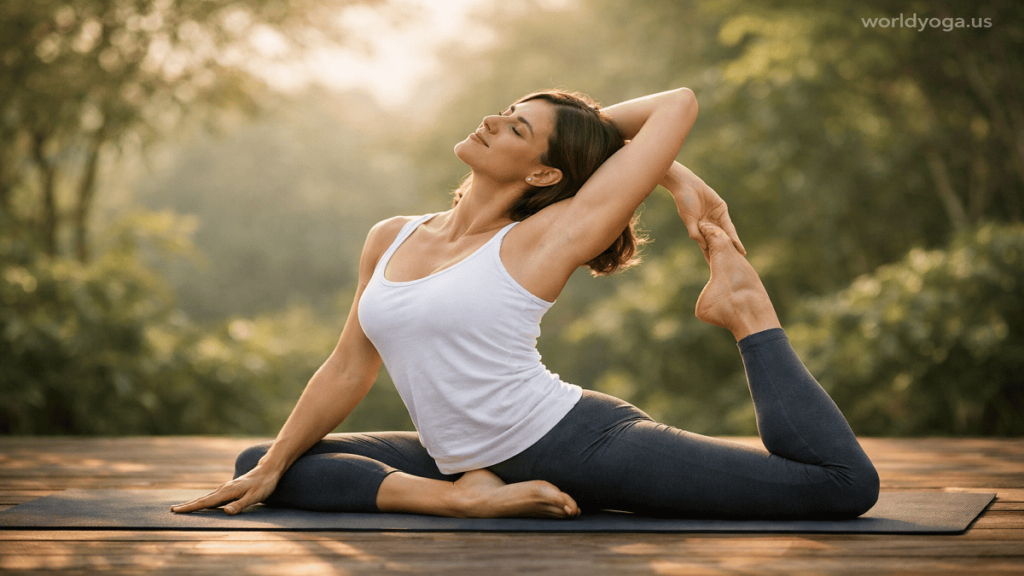
Which muscles and joints are engaged during this backbend variation?
Mermaid Pose, a deep variation of Eka Pada Rajakapotasana (One-Legged King Pigeon Pose), combines intense hip opening with spinal extension and a shoulder bind. Because it integrates multiple movement patterns, it engages a wide network of muscles and joints across the lower body, spine, and upper limbs. Understanding this anatomy helps practitioners perform the pose safely and with better control.
Hip and Lower Body Muscles
The most significant engagement occurs in the hips and front thigh of the folded leg. The hip flexors, especially the iliopsoas, are deeply stretched as the pelvis opens into extension. The gluteus maximus and gluteus medius help stabilize the pelvis and control external rotation of the hip joint.
The front leg also engages the adductors to maintain stability and alignment, while the back leg stretches the quadriceps (rectus femoris) and hip flexors as it extends behind the body. These muscles work together to create the deep hip-opening effect that defines the pose.
Spinal and Back Muscles
The backbend component primarily engages the erector spinae group, including the spinalis, longissimus, and iliocostalis muscles, which support spinal extension. The multifidus muscles play a key role in segmental stability of the vertebrae.
The latissimus dorsi and trapezius (middle and lower fibers) assist in chest opening and shoulder positioning. During controlled extension, the thoracic spine (mid-back region) experiences the greatest mobility, while the lumbar spine requires stability to prevent over-compression.
Shoulder and Arm Muscles
The binding action in Mermaid Pose heavily involves the shoulder complex. The deltoids, particularly the anterior and posterior fibers, assist in arm elevation and extension. The rotator cuff muscles (supraspinatus, infraspinatus, teres minor, and subscapularis) stabilize the shoulder joint during the bind.
The biceps and triceps contribute to arm positioning and control, while the pectoralis major and minor stretch as the chest opens. These muscles work in coordination to allow safe shoulder extension without impingement.
Core Muscles
The core plays a stabilizing role throughout the pose. The rectus abdominis and obliques engage lightly to protect the lower back and maintain balance. Deep stabilizers such as the transverse abdominis help support spinal alignment and prevent excessive lumbar compression.
Joints Involved
Mermaid Pose involves multiple major joints working in coordinated movement:
- Hip joint (acetabulofemoral joint): Deep flexion, extension, and external rotation in the front leg
- Knee joint: Flexion in the front leg and controlled extension in the back leg
- Sacroiliac joint: Stabilization under pelvic rotation stress
- Spinal joints (cervical, thoracic, lumbar): Controlled extension and mobility, especially in the thoracic region
- Shoulder joint (glenohumeral joint): Extension, flexion, and external rotation during the bind
- Elbow joint: Flexion during foot grip in the bind
Functional Interaction of Muscles and Joints
The effectiveness of Mermaid Pose comes from the coordinated interaction between hip mobility and spinal extension. As the hips open, the spine is able to extend more freely, while the shoulder bind enhances chest expansion. However, imbalance in any one region—such as tight hip flexors or restricted shoulders—can shift stress to the lower back.
Conclusion
Mermaid Pose engages a complex network of muscles and joints, including the hip flexors, glutes, spinal extensors, shoulder stabilizers, and core muscles. Key joints involved include the hips, spine, knees, and shoulders. Proper coordination of these systems allows for a safe, controlled backbend that enhances flexibility while maintaining structural integrity.
References
- https://www.yogajournal.com/anatomy/hip-openers/
- https://www.verywellfit.com/pigeon-pose-eka-pada-rajakapotasana-3567083
- https://www.ncbi.nlm.nih.gov/pmc/articles/PMC3193654/
#Mermaid Pose in Hyderabad
What preparatory poses are recommended before attempting Mermaid Pose?
Mermaid Pose (a deep variation of Eka Pada Rajakapotasana) is an advanced backbend that requires significant hip flexibility, spinal mobility, and shoulder opening. Attempting it without proper preparation can place unnecessary stress on the knees, hips, and lower back. A structured warm-up sequence helps gradually open the body and build the stability required for safe execution.
1. Pigeon Pose (Eka Pada Rajakapotasana – Basic)
Pigeon Pose is the most essential preparatory posture for Mermaid Pose. It directly targets the hip joint by stretching the glutes, piriformis, and deep external rotators.
This pose helps condition the front leg position used in Mermaid Pose while gradually improving hip external rotation. Practicing both upright and forward-fold variations builds the foundation for deeper backbending later.
2. Low Lunge (Anjaneyasana)
Low Lunge is highly effective for opening the hip flexors, particularly the iliopsoas and rectus femoris. These muscles are heavily engaged in Mermaid Pose and must be sufficiently lengthened to allow safe pelvic alignment.
By lifting the chest and gently sinking the hips forward, this pose also prepares the spine for controlled extension.
3. King Arthur Pose (Supported Quad Stretch)
Often used in yoga therapy, King Arthur Pose deeply stretches the quadriceps and hip flexors of the back leg. Since the back leg in Mermaid Pose is extended and then bent toward the body, quad flexibility is essential.
This posture reduces resistance in the knee and hip connection, making the transition into the bind smoother and safer.
4. Camel Pose (Ustrasana – Gentle Variation)
Camel Pose introduces controlled spinal extension and chest opening. It prepares the thoracic spine and shoulders for the backbend component of Mermaid Pose.
A gentle variation is recommended initially to avoid compressing the lumbar spine. This helps practitioners learn to distribute the backbend evenly through the spine rather than overloading the lower back.
5. Cobra Pose (Bhujangasana)
Cobra Pose strengthens the spinal extensors and improves thoracic mobility. It is a safer introductory backbend that conditions the muscles needed for deeper extension in Mermaid Pose.
This pose also helps activate the chest opening required for maintaining lift during the final bind.
6. Gomukhasana Arms (Cow Face Arms Variation)
The shoulder bind in Mermaid Pose requires significant flexibility in the shoulders and chest. Gomukhasana arms help open the deltoids, triceps, and chest muscles while improving internal and external rotation of the shoulder joint.
This prepares the upper body for safely reaching the back foot without strain.
7. Supported Bridge Pose (Setu Bandhasana)
Bridge Pose activates the glutes, strengthens the back muscles, and gently opens the chest. It also introduces safe spinal extension without excessive pressure on the lower back.
Supported variations using a block help beginners experience backbending in a controlled and stable way.
Conclusion
Effective preparation for Mermaid Pose requires a combination of hip openers, quadriceps stretches, shoulder mobility work, and gentle backbends. Poses such as Pigeon Pose, Low Lunge, Camel Pose, Cobra Pose, Gomukhasana Arms, and Bridge Pose collectively build the flexibility and stability needed for safe practice.
When performed consistently, these preparatory poses reduce injury risk, improve alignment awareness, and make the transition into Mermaid Pose smoother and more controlled.
References
- https://www.yogajournal.com/poses/eka-pada-rajakapotasana/
- https://www.verywellfit.com/pigeon-pose-eka-pada-rajakapotasana-3567083
- https://www.yogajournal.com/poses/camel-pose/
- https://www.ncbi.nlm.nih.gov/pmc/articles/PMC3193654/
#Mermaid Pose in Delhi
What are the benefits and precautions of practicing Mermaid Pose?
Mermaid Pose, a deep variation of Eka Pada Rajakapotasana (One-Legged King Pigeon Pose), is an advanced yoga posture that combines intense hip opening with a controlled backbend and shoulder bind. While it offers significant physical and energetic benefits, it also requires careful preparation and awareness due to its demanding nature on the joints and spine.
Benefits of Mermaid Pose
1. Deep Hip Flexibility and Mobility
One of the primary benefits of Mermaid Pose is improved flexibility in the hips. It deeply stretches the hip flexors, gluteal muscles, and deep external rotators, helping reduce stiffness caused by prolonged sitting or sedentary lifestyles. Over time, this can improve overall hip mobility and ease in daily movements.
2. Improved Spinal Extension and Posture
The backbend component of Mermaid Pose enhances spinal flexibility, particularly in the thoracic region. It strengthens the erector spinae muscles and encourages a more upright posture. Regular practice may help counteract forward-rounded shoulders and slouched posture.
3. Shoulder and Chest Opening
The binding action in Mermaid Pose opens the chest and shoulders by stretching the pectoralis muscles, deltoids, and rotator cuff group. This can improve shoulder range of motion and support better breathing capacity through expanded chest space.
4. Enhanced Body Awareness and Balance
Because Mermaid Pose requires coordination between hips, spine, and shoulders, it significantly improves proprioception and body awareness. Maintaining stability in this pose helps develop focus, balance, and controlled movement.
5. Emotional Release and Stress Relief
Deep hip openers are often associated in yoga therapy with emotional release. Mermaid Pose may help reduce stored tension in the hips and lower back, contributing to a sense of emotional relaxation and mental clarity.
Precautions for Mermaid Pose
1. Avoid in Knee or Hip Injuries
Mermaid Pose places strong pressure on the front knee and hip joint. Individuals with knee injuries, meniscus issues, or hip impingement should avoid or modify this posture.
2. Risk of Lower Back Compression
Improper alignment can lead to excessive compression in the lumbar spine. Practitioners should avoid forcing the backbend and ensure the movement is distributed through the thoracic spine rather than the lower back.
3. Shoulder Strain from Binding
The shoulder bind requires significant flexibility. Forcing the bind can strain the rotator cuff and shoulder joint, leading to injury. Using a strap or modified variation is recommended for beginners.
4. Not Suitable Without Warm-Up
Mermaid Pose should never be practiced without proper preparation. Cold muscles increase the risk of strain. Warm-up poses such as Pigeon Pose, Low Lunge, and gentle backbends are essential.
5. Avoid During Acute Pain or Pregnancy (Advanced Backbends)
Individuals experiencing acute back pain, sciatica flare-ups, or other spinal conditions should avoid this pose. It is also generally not recommended during pregnancy due to the deep backbend component.
Safe Practice Guidelines
- Move gradually into deeper variations without forcing flexibility
- Keep hips squared to protect the sacroiliac joint
- Engage the core to support the lower back
- Maintain steady, controlled breathing throughout the pose
- Use props such as straps or blocks if needed
Conclusion
Mermaid Pose offers powerful benefits for hip flexibility, spinal mobility, posture improvement, and shoulder opening. However, due to its advanced nature, it must be practiced with caution, proper preparation, and awareness of individual physical limitations. When performed correctly, it becomes a highly effective posture for developing strength, flexibility, and body control.
References
- https://www.yogajournal.com/poses/eka-pada-rajakapotasana/
- https://www.verywellfit.com/pigeon-pose-eka-pada-rajakapotasana-3567083
- https://www.health.harvard.edu/pain/relieving-neck-pain-with-exercise
- https://www.ncbi.nlm.nih.gov/pmc/articles/PMC3193654/
#Mermaid Pose in Banglore
Case Study of Mermaid Pose
Mermaid Pose, an advanced variation of Eka Pada Rajakapotasana (One-Legged King Pigeon Pose), is widely used in modern yoga practice to develop deep hip flexibility, spinal extension, and shoulder mobility. This case study presents a structured observation of its application within a guided yoga therapy setting, focusing on functional outcomes, adaptation strategies, and safety considerations.
Background of the Case
A 29-year-old recreational yoga practitioner reported stiffness in the hips, limited shoulder mobility, and mild lower back discomfort after prolonged desk work. The individual had intermediate yoga experience but had never practiced deep backbends or bind-based postures such as Mermaid Pose.
The primary goals of intervention were:
- Improve hip flexibility
- Increase thoracic spine mobility
- Enhance shoulder range of motion
- Reduce postural stiffness from sedentary lifestyle
A progressive yoga therapy plan was designed over an 8-week period, gradually introducing Mermaid Pose through preparatory postures.
Intervention Approach
The training protocol included three phases:
Phase 1: Foundational Mobility (Weeks 1–3)
Focus was placed on preparing the body using:
- Pigeon Pose (static and forward fold variations)
- Low Lunge (hip flexor opening)
- Cobra Pose (gentle spinal extension)
- Gomukhasana Arms (shoulder opening)
These poses improved baseline flexibility and reduced initial stiffness in the hips and shoulders.
Phase 2: Controlled Backbend Preparation (Weeks 4–6)
Intermediate backbends and strengthening were introduced:
- Camel Pose (modified variation)
- Bridge Pose (supported and active)
- Extended Pigeon with upright chest lift
At this stage, core engagement and spinal awareness became key focus areas to avoid lumbar strain.
Phase 3: Introduction to Mermaid Pose (Weeks 7–8)
The practitioner was guided into a modified Mermaid Pose using a strap initially to reach the back foot. Emphasis was placed on:
- Keeping hips squared
- Lengthening spine before binding
- Avoiding forced shoulder extension
- Maintaining steady breath control
Gradually, the strap was reduced as flexibility improved.
Observations and Outcomes
By the end of the 8-week program, the practitioner showed measurable improvements:
- Increased hip external rotation and comfort in pigeon-based positions
- Improved thoracic spine extension and posture alignment
- Enhanced shoulder mobility, particularly in overhead and backward reach
- Reduced lower back stiffness during prolonged sitting
- Ability to hold a modified Mermaid Pose for 20–30 seconds without strain
Subjectively, the participant reported improved body awareness and reduced muscular tension, especially in the hips and lower back.
Key Insights from the Case
- Progressive preparation is essential: Direct entry into Mermaid Pose without preparatory work increases injury risk.
- Hip flexibility is the limiting factor: Most restriction originated in hip external rotation, not the spine.
- Shoulder bind requires gradual adaptation: Use of props like straps significantly improved safety and accessibility.
- Core engagement protects the lumbar spine: Stability in the abdomen prevented over-compression during backbending.
Precautions Observed
No adverse effects were reported, but strict precautions were maintained:
- No forcing into the bind position
- Immediate regression if knee or hip discomfort occurred
- Avoidance of deep backbend intensity in early stages
- Continuous monitoring of spinal alignment
Conclusion
This case study demonstrates that Mermaid Pose can be safely introduced through a structured, progressive yoga therapy approach. When properly prepared, it enhances hip flexibility, spinal mobility, and shoulder openness while improving overall postural health. However, its effectiveness depends heavily on gradual progression, alignment awareness, and respect for individual anatomical limits.
References
- https://www.yogajournal.com/poses/eka-pada-rajakapotasana/
- https://www.verywellfit.com/pigeon-pose-eka-pada-rajakapotasana-3567083
- https://www.ncbi.nlm.nih.gov/pmc/articles/PMC3193654/
#Mermaid Pose in Pune
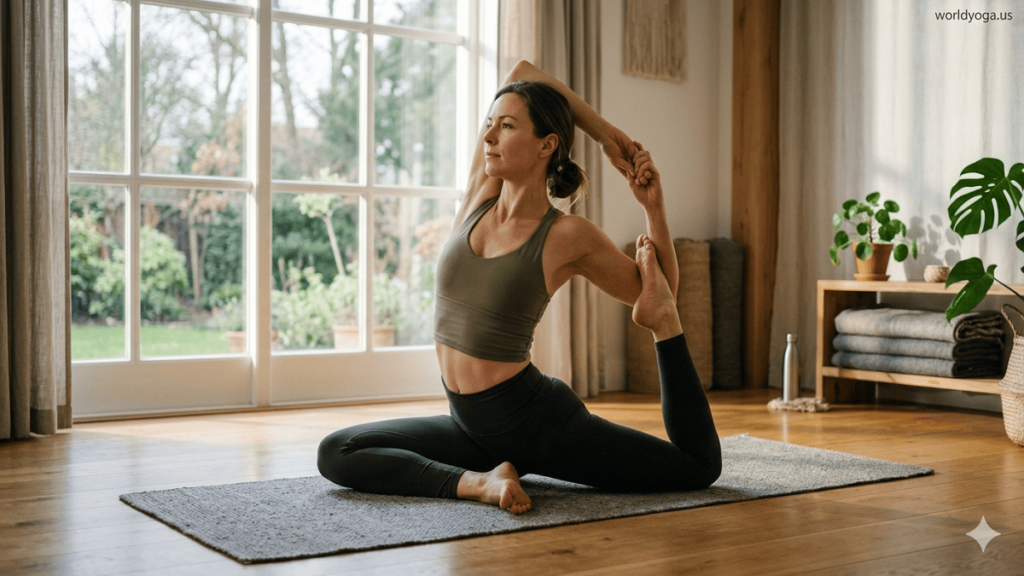
White Paper of Mermaid Pose
Abstract
Mermaid Pose, an advanced variation of Eka Pada Rajakapotasana (One-Legged King Pigeon Pose), is a deep hip-opening and spinal extension posture widely used in modern yoga practice and yoga therapy. It integrates hip flexibility, thoracic spine mobility, and shoulder binding mechanics into a single complex movement pattern. Although not described in classical yogic texts as a distinct posture, it has gained significance in contemporary yoga systems due to its functional application in mobility training, postural correction, and integrative physical conditioning. This white paper examines its anatomical basis, biomechanical demands, therapeutic relevance, application methods, and safety considerations.
1. Introduction
Modern lifestyles characterized by prolonged sitting, reduced physical activity, and postural imbalances have increased the prevalence of hip stiffness, spinal rigidity, and shoulder tightness. Mermaid Pose is frequently introduced in advanced yoga frameworks as a progressive posture to address these limitations. It combines elements of hip external rotation, spinal extension, and shoulder flexion/extension, making it a comprehensive mobility posture.
2. Structural and Biomechanical Framework
Mermaid Pose involves coordinated engagement of multiple anatomical systems:
- Hip joint (acetabulofemoral joint): Deep flexion, external rotation, and extension in asymmetrical positioning
- Spine (cervical, thoracic, lumbar): Controlled extension with emphasis on thoracic mobility
- Shoulder joint (glenohumeral joint): Extension and external rotation during bind
- Knee joint: Flexion under load in front leg position
- Sacroiliac joint: Stabilization under rotational pelvic stress
Primary muscular involvement includes the iliopsoas, gluteals, piriformis, erector spinae, latissimus dorsi, deltoids, and rotator cuff group.
3. Methodological Approach to Practice
Mermaid Pose is typically introduced through a progressive methodology:
- Hip opening foundation (Pigeon Pose variations)
- Quadriceps and hip flexor release (Low Lunge, King Arthur Pose)
- Thoracic extension preparation (Cobra Pose, Bridge Pose)
- Shoulder mobility training (Gomukhasana arms)
- Gradual transition into bind-based Mermaid variation
The final posture requires gradual binding of the back foot while maintaining spinal elongation and hip alignment.
4. Therapeutic Applications
Mermaid Pose is applied in several modern wellness and therapeutic contexts:
- Correction of sedentary posture patterns
- Improvement of hip and pelvic mobility
- Enhancement of thoracic spine extension
- Shoulder flexibility and range of motion training
- Stress-related muscular tension reduction
In yoga therapy, it is often used as part of structured backbend progressions and mobility rehabilitation programs.
5. Benefits Profile
When practiced correctly, Mermaid Pose contributes to:
- Increased hip flexibility and joint lubrication
- Improved spinal extension and posture correction
- Enhanced shoulder range of motion
- Greater neuromuscular coordination and balance
- Improved body awareness and breath control integration
6. Risks and Limitations
Despite its benefits, Mermaid Pose carries notable risks if improperly executed:
- Knee stress due to deep flexion in pigeon alignment
- Lumbar compression from excessive backbending
- Shoulder strain during forced binding
- Sacroiliac joint discomfort from improper hip alignment
It is not recommended for individuals with acute knee injuries, hip impingement, or severe spinal disorders without professional supervision.
7. Safety and Implementation Guidelines
Safe practice requires adherence to key principles:
- Progressive preparation before attempting full pose
- Maintenance of squared hips and elongated spine
- Use of props such as straps for modified binding
- Avoidance of forceful movement or depth chasing
- Integration of breath awareness and core engagement
8. Conclusion
Mermaid Pose represents a complex integrative yoga posture that combines flexibility, strength, and alignment awareness. While it is not a traditional classical asana, its structured application in modern yoga therapy provides significant benefits for mobility enhancement and postural correction. Its effectiveness depends on progressive training, anatomical awareness, and disciplined practice methodology.
References
- https://www.yogajournal.com/poses/eka-pada-rajakapotasana/
- https://www.verywellfit.com/pigeon-pose-eka-pada-rajakapotasana-3567083
- https://www.ncbi.nlm.nih.gov/pmc/articles/PMC3193654/
#Mermaid Pose in Kolkata
Industry Application of Mermaid Pose
Mermaid Pose, a deep hip-opening and backbending variation of Eka Pada Rajakapotasana (One-Legged King Pigeon Pose), has expanded beyond traditional yoga practice into multiple modern industries. While it remains an advanced posture in yoga systems, its biomechanical benefits—such as improving hip mobility, spinal extension, and shoulder flexibility—make it relevant in occupational health, fitness training, rehabilitation, and wellness design.
1. Corporate Wellness and IT Industry
One of the most significant applications of Mermaid Pose is in corporate wellness programs, particularly in IT and desk-based professions. Employees who spend long hours seated often experience hip tightness, forward head posture, and lower back stiffness.
In structured wellness sessions, simplified versions of Mermaid Pose are introduced to:
- Improve hip mobility after prolonged sitting
- Reduce lumbar and cervical strain
- Enhance posture awareness during work hours
Due to its intensity, full Mermaid Pose is rarely used; instead, modified pigeon and supported backbends are integrated into workplace yoga breaks.
2. Physiotherapy and Rehabilitation Centers
In physiotherapy environments, Mermaid Pose is used in a progressive mobility framework for patients recovering from non-acute musculoskeletal stiffness. It is not a standalone treatment but part of a guided rehabilitation protocol.
Applications include:
- Hip mobility restoration programs
- Shoulder range-of-motion improvement
- Postural correction therapy for sedentary injuries
Therapists often use props such as straps and blocks to safely simulate the movement pattern without forcing full expression of the pose.
3. Yoga Therapy and Clinical Wellness
In yoga therapy settings, Mermaid Pose is incorporated into advanced spinal and hip opening modules. It is used for clients who have already developed foundational strength and flexibility.
Key applications include:
- Structured backbend progression training
- Emotional release-focused hip opening sequences
- Breath-linked mobility and nervous system regulation practices
It is often combined with preparatory poses like Pigeon Pose, Low Lunge, and Bridge Pose for safe progression.
4. Fitness and Mobility Training Industry
In modern fitness studios and mobility programs, Mermaid Pose is used as a flexibility benchmark movement. Trainers incorporate its components into dynamic stretching routines and functional mobility workouts.
Applications include:
- Hip mobility enhancement for athletes
- Shoulder flexibility training for gym-goers
- Recovery routines for strength training programs
- Movement quality assessment in advanced flexibility training
However, trainers typically avoid full binding in beginner populations.
5. Sports Training and Athletic Recovery
Athletes in disciplines requiring high flexibility—such as gymnastics, dance, swimming, and martial arts—use Mermaid Pose variations as part of recovery and mobility maintenance.
Benefits include:
- Improved hip range for explosive movements
- Reduced muscle tightness after training
- Enhanced spinal mobility and posture control
- Injury prevention through controlled flexibility training
It is particularly useful in off-season conditioning programs.
6. Digital Wellness and App-Based Platforms
With the rise of remote work and digital health tools, Mermaid Pose variations are integrated into guided mobility apps and online yoga platforms. These systems offer:
- Short guided hip-opening sessions
- Modified Mermaid Pose tutorials using props
- AI-driven posture correction routines
- Screen-time break reminders
These adaptations make the pose accessible in a simplified, user-friendly format.
7. Limitations in Industrial Use
Despite its versatility, Mermaid Pose has limitations in industry applications:
- Not suitable for mass untrained populations in full form
- Requires progression to avoid knee and lower back strain
- Needs supervision in therapeutic contexts
- Must be modified for workplace safety standards
Conclusion
Mermaid Pose has evolved into a multifunctional movement pattern used across wellness, healthcare, fitness, and digital health industries. While the full posture remains advanced, its components are widely adapted for mobility improvement, postural correction, and rehabilitation. Its industrial value lies in scalability through modified versions rather than full expression of the pose.
References
- https://www.yogajournal.com/poses/eka-pada-rajakapotasana/
- https://www.verywellfit.com/pigeon-pose-eka-pada-rajakapotasana-3567083
- https://www.ncbi.nlm.nih.gov/pmc/articles/PMC3193654/
#Mermaid Pose in Mumbai
Ask FAQs
What is Mermaid Pose in yoga?
Mermaid Pose is an advanced variation of Eka Pada Rajakapotasana (One-Legged King Pigeon Pose) that combines deep hip opening, spinal extension, and a shoulder bind. It is commonly practiced in modern yoga for improving flexibility, posture, and mobility.
Is Mermaid Pose suitable for beginners?
No, Mermaid Pose is not recommended for beginners. It requires a strong foundation in hip openers, backbends, and shoulder flexibility. Beginners should first master poses like Pigeon Pose, Low Lunge, and Bridge Pose before attempting it.
What are the main benefits of Mermaid Pose?
Mermaid Pose helps improve hip flexibility, spinal mobility, and shoulder opening. It can also enhance posture, increase body awareness, and reduce stiffness caused by prolonged sitting or sedentary habits.
What precautions should be taken while practicing Mermaid Pose?
Practitioners should avoid forcing the bind or deep backbend. It is important to keep the hips aligned, engage the core, and move gradually. People with knee injuries, hip impingement, or lower back issues should avoid this pose or practice under supervision.
How can I safely progress toward Mermaid Pose?
Safe progression includes consistent practice of preparatory poses such as Pigeon Pose, Camel Pose, Cobra Pose, and Gomukhasana arms. Using props like straps and practicing under the guidance of a qualified yoga instructor is highly recommended.
Table of Contents
Disclaimer
The information provided about Mermaid Pose is for educational and informational purposes only and is not a substitute for professional medical advice, diagnosis, or treatment. This advanced yoga posture should be practiced with proper guidance, especially by individuals with knee, hip, shoulder, or spinal conditions. Always consult a qualified healthcare professional or certified yoga instructor before attempting new or advanced yoga practices.