Lunge: Back Knee on the Floor Under the Hip Socket-Backbend
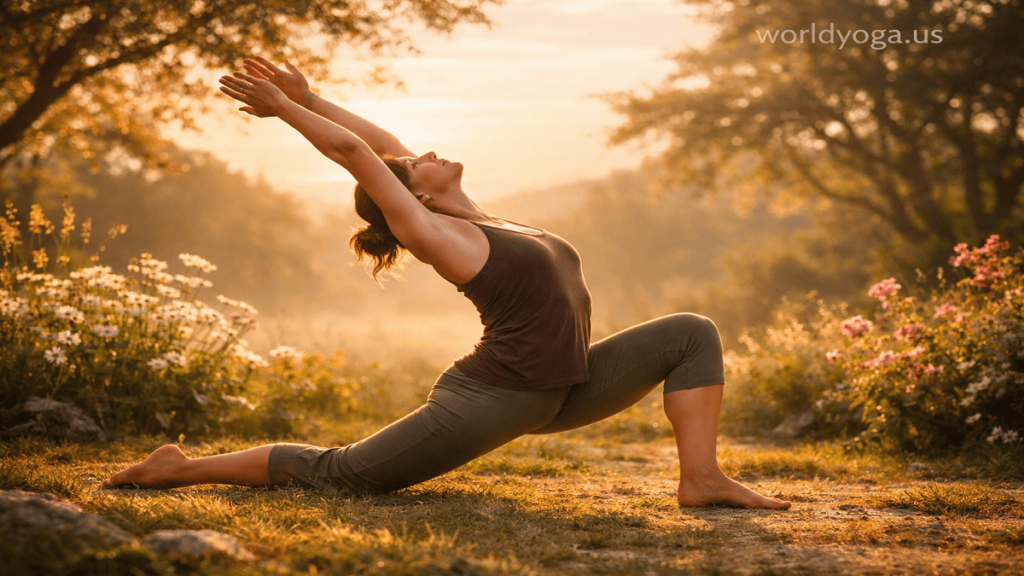
The “Lunge: Back Knee on the Floor Under the Hip Socket with Backbend” is a foundational yoga alignment variation of the low lunge that emphasizes structural precision, hip opening, and spinal extension. In traditional yoga practice, this position closely relates to Anjaneyasana (Low Lunge Yoga Pose), often used to stretch the hip flexors while building stability in the lower body.
In this variation, the back knee is placed directly under the hip socket rather than extending far behind the body. This alignment is significant because it creates a stacked joint relationship—hip over knee—allowing the practitioner to maintain balance and reduce unnecessary strain on the lumbar spine or front knee. The front leg remains bent at approximately a right angle, ensuring stability and engagement of the quadriceps and glute muscles.
Once the lower body is stabilized, the upper body transitions into a controlled backbend. The chest lifts upward and forward, and the sternum gently opens toward the ceiling. This backbend is not about compressing the lower back but about creating length through the front body, especially the hip flexors, abdomen, and chest. The action encourages thoracic extension rather than lumbar overextension, making it safer and more effective for long-term spinal health.
This posture is widely used in yoga sequences to counteract prolonged sitting and forward-leaning postures. It helps release tight hip flexors such as the iliopsoas, which often become shortened due to sedentary lifestyles. When practiced correctly, it also improves posture, enhances breathing capacity, and increases awareness of pelvic alignment.
Common mistakes include letting the front knee collapse inward, over-arching the lower back, or allowing the back hip to drift behind the knee, which reduces stability. To refine the pose, practitioners are encouraged to engage the core lightly, press the front foot firmly into the ground, and visualize lifting the rib cage away from the pelvis before deepening the backbend.
Modifications can make this posture more accessible. Placing a folded blanket under the back knee reduces pressure, while keeping the hands on the front thigh instead of lifting the arms can help beginners maintain balance. For deeper intensity, practitioners may lift the arms overhead or add a gentle neck extension, always ensuring the movement originates from the upper spine.
Regular practice of this alignment-focused lunge supports both mobility and strength, making it valuable for yoga practitioners of all levels. It is commonly integrated into vinyasa flows and mobility routines for athletes and office workers alike.
For further reference on alignment principles and hip-opening sequences, you may explore:
Yoga Journal Pose Library
Verywell Fit Yoga Guides
#Lunge: Back Knee on the Floor Under the Hip Socket-Backbend in India
How is Lunge with back knee under the hip socket and backbend performed correctly?
The “Lunge with back knee under the hip socket and backbend” is a precise alignment-based variation of a low lunge that combines lower-body stability with controlled spinal extension. It is closely associated with Anjaneyasana (Low Lunge Yoga Pose) and is commonly used in yoga mobility sequences to open the hips while improving posture and balance.
To perform this variation correctly, begin in a kneeling position on a yoga mat. Step one foot forward into a lunge so that the front knee is stacked approximately over the ankle. The key adjustment in this variation is the position of the back knee: instead of placing it far behind the hips, bring it directly under the hip socket. This creates a vertical alignment between the hip and knee, which stabilizes the pelvis and reduces strain on the lower back.
Once the base is set, ensure the pelvis is neutral. Avoid tilting the hips excessively forward or backward. Engage the core lightly to support the spine. The front foot should be firmly grounded, with weight distributed evenly through the heel and the ball of the foot.
From this stable foundation, begin the upper-body movement into a backbend. Lift the chest upward rather than collapsing into the lower back. The movement should originate from the thoracic spine (mid and upper back), not the lumbar region. Imagine lengthening through the crown of the head while simultaneously lifting the sternum toward the ceiling. This creates space across the front body, particularly the hip flexors and abdominal region.
If appropriate, the arms can be raised overhead with palms facing each other or slightly apart. The shoulders should stay relaxed, avoiding tension near the neck. The gaze can be neutral or gently lifted, depending on comfort and neck mobility.
Breathing plays an important role in maintaining control. Inhale deeply to expand the chest and support the lift into the backbend. Exhale slowly to maintain stability and prevent over-arching. The breath should feel smooth and steady throughout the posture.
Common errors include letting the back hip drift behind the knee, collapsing into the lower back, or losing engagement in the front leg. To correct these, focus on stacking joints (hip over knee), activating the abdominal muscles, and lifting through the sternum instead of pushing the pelvis forward.
For beginners, placing a folded blanket under the back knee can reduce pressure and improve comfort. Advanced practitioners may deepen the stretch by slightly increasing thoracic extension while maintaining pelvic stability.
This posture improves hip flexibility, strengthens lower-body stability, and supports better spinal alignment. It is often included in yoga flows designed for posture correction, athletic recovery, and functional mobility training.
For additional alignment guidance and safe progression techniques, you can refer to:
Yoga Journal – Lunge Pose Guide
Verywell Fit – Low Lunge Instructions
#Lunge: Back Knee on the Floor Under the Hip Socket-Backbend in Maharashtra
What is the proper alignment in this supported backbending lunge variation?
The supported backbending lunge variation—often practiced as a structured form of Anjaneyasana (Low Lunge Yoga Pose)—focuses on precise joint stacking, pelvic stability, and controlled spinal extension. Proper alignment is essential because the pose combines a deep hip flexor stretch with a mild backbend, and incorrect positioning can easily shift pressure into the lower back or knees.
The foundation begins with the lower body. The front foot is placed flat on the mat, with the front knee aligned directly over the ankle. This alignment prevents excessive forward stress on the knee joint. The back knee is placed directly under the hip socket, not behind it. This “stacked” position creates a vertical line from hip to knee, improving stability and allowing the pelvis to stay balanced rather than tilted.
The pelvis is the central focus of alignment. It should remain in a neutral position, meaning neither excessively tucked (posterior tilt) nor overly arched forward (anterior tilt). A neutral pelvis ensures that the stretch is distributed through the hip flexors rather than concentrated in the lumbar spine. Gentle engagement of the lower abdominal muscles supports this neutrality.
Once the base is stable, attention shifts to the spine and upper body. The backbend is introduced by lifting through the sternum rather than pushing the pelvis forward. The goal is to create length along the front body—particularly the iliopsoas, rectus abdominis, and chest muscles—while maintaining control in the lower back. The extension should originate from the thoracic spine (mid-back), not the lumbar region.
The shoulders remain relaxed and drawn slightly down away from the ears. If the arms are lifted overhead, they should extend in line with the ears without forcing shoulder compression. The neck remains long, with the gaze either forward or gently upward, depending on comfort and cervical spine mobility.
Weight distribution is another important alignment factor. The front foot should carry most of the load evenly between the heel and forefoot, while the back knee lightly supports balance without excessive pressure. The core remains gently active to stabilize the torso and prevent collapsing into the hips or lower back.
Breath coordination supports alignment integrity. Inhaling encourages lengthening through the spine and chest, while exhaling helps maintain stability in the pelvis and abdomen. This rhythm prevents overextension and keeps the posture controlled.
Common alignment errors include letting the back knee drift behind the hip, collapsing into the lumbar spine, or flaring the ribs forward. Correcting these involves re-stacking the joints, engaging the core, and focusing on upward chest lift rather than backward bending.
When performed correctly, this supported backbending lunge improves hip mobility, strengthens postural awareness, and enhances spinal extension in a safe and structured way. For deeper reference on alignment principles, you may explore:
Yoga Journal – Pose Alignment Guides
Verywell Fit – Yoga Form Instructions
#Lunge: Back Knee on the Floor Under the Hip Socket-Backbend in Ahemadabad
Which muscles are engaged during the posture?
The supported backbending lunge variation, commonly based on Anjaneyasana (Low Lunge Yoga Pose), is a compound posture that simultaneously stretches the front body while engaging key stabilizing muscle groups in the lower body, core, and upper back. Because it combines a lunge with spinal extension, it creates a balanced interaction between mobility and strength.
In the lower body, the primary muscles engaged are the quadriceps of the front leg, especially the rectus femoris, which helps stabilize the knee and maintain the lunge position. The gluteus maximus and gluteus medius are also active, supporting pelvic alignment and controlling hip stability. On the back leg, the hip flexors—particularly the iliopsoas—are deeply stretched while still requiring light engagement to stabilize the hip in the stacked knee position. The hamstrings of the front leg may also assist in stabilizing the stance.
The core plays a central role in this posture. The rectus abdominis, transverse abdominis, and obliques engage isometrically to support a neutral pelvis and prevent excessive lumbar compression during the backbend. This core activation ensures that the extension comes from controlled spinal lengthening rather than collapsing into the lower back.
In the spinal and upper body region, the erector spinae muscles along the back are engaged to support the controlled arching of the spine. However, this engagement is balanced rather than forceful, as the goal is extension through length rather than compression. The thoracic extensors are particularly active in lifting the chest upward.
The shoulders and upper back also contribute significantly. The trapezius (especially the lower and middle fibers) and the rhomboids work to stabilize the shoulder blades and maintain an open chest position. If the arms are raised overhead, the deltoids become engaged, particularly the anterior and medial heads, while the rotator cuff muscles stabilize the shoulder joint.
In the neck, the deep cervical flexors help maintain alignment when the gaze is forward, while the posterior neck muscles may engage lightly if the head is lifted into extension. This engagement should remain subtle to avoid strain.
Stabilizing muscles in the feet and ankles are also active. The tibialis anterior and calf muscles help maintain balance and grounding through the front foot, ensuring steady weight distribution throughout the pose.
Overall, this posture creates a coordinated full-body engagement pattern: the lower body provides stability, the core maintains structural integrity, and the upper body opens into extension. At the same time, the hip flexors and chest are stretched, making it both a strengthening and flexibility-building position.
For further anatomical breakdowns of yoga postures, you may refer to:
Yoga Journal Anatomy Guides
Verywell Fit – Yoga Muscle Engagement
#Lunge: Back Knee on the Floor Under the Hip Socket-Backbend in Hyderabad
What preparatory poses are recommended before practicing it?
Preparing for the supported backbending lunge variation based on Anjaneyasana (Low Lunge Yoga Pose) requires a structured warm-up that targets hip mobility, spinal flexibility, and core activation. Because this posture combines a deep hip flexor stretch with spinal extension, preparatory poses should progressively open the front body while building stability in the lower body and trunk.
A strong starting point is gentle spinal articulation through poses such as Cat-Cow. This movement helps awaken the entire spine, improving awareness of flexion and extension patterns. It also prepares the thoracic region for controlled backbending, which is essential for preventing overuse of the lumbar spine later in the practice. Slow, synchronized breathing during this warm-up enhances neuromuscular control and prepares the nervous system for deeper stretches.
Next, low-intensity backbends like Cobra Pose or Sphinx Pose are highly effective. These poses gently activate the erector spinae and open the chest without placing excessive load on the lower back. They also introduce safe spinal extension mechanics, encouraging the practitioner to lift through the sternum rather than compressing the lumbar region. This principle becomes essential in the final lunge variation.
Hip-opening poses are equally important. Poses such as Low Lunge with a neutral spine and gentle forward shifting help prepare the iliopsoas and quadriceps for lengthening. Holding a basic lunge with the back knee grounded allows gradual adaptation to the alignment required in the final posture. This stage should emphasize stability over depth, ensuring the pelvis remains neutral and the front knee stays aligned over the ankle.
Warrior I is another highly recommended preparatory posture. It builds strength in the front leg while stretching the hip flexors of the back leg in a more upright position. This creates a bridge between strength and flexibility, helping the practitioner maintain balance when transitioning into a deeper backbend. It also reinforces proper pelvic alignment under load.
In addition, supported chest-opening poses such as Bridge Pose can be beneficial. This posture activates the glutes, opens the anterior chain, and strengthens spinal extensors in a controlled manner. It helps the practitioner understand how to distribute extension evenly across the spine instead of concentrating it in one area.
Finally, gentle core activation exercises such as Plank Pose prepare the abdominal muscles for stabilizing the pelvis during the backbend. A strong core is essential to prevent excessive lumbar compression and maintain control throughout the movement.
When combined, these preparatory poses create a progressive pathway: spinal awareness, gentle extension, hip opening, and core stability. This sequence ensures that the body is not only flexible enough to enter the supported backbending lunge but also strong and stable enough to hold it safely.
For further reading on foundational yoga preparation and sequencing principles, you can refer to:
Yoga Journal – Yoga Sequencing Basics
Verywell Fit – Yoga Warm-Up Guide
#Lunge: Back Knee on the Floor Under the Hip Socket-Backbend in Delhi
What are the benefits and precautions of this backbending lunge variation?
The supported backbending lunge variation, based on Anjaneyasana (Low Lunge Yoga Pose), combines a hip-opening lunge with a controlled spinal extension. When practiced with correct alignment, it offers significant mobility, strength, and postural benefits, but it also requires mindful execution due to the load placed on the hips, knees, and lumbar spine.
One of the primary benefits is improved hip flexor flexibility. Because the back leg is positioned in a grounded, stacked alignment, the iliopsoas and rectus femoris are gently lengthened over time. This is especially beneficial for individuals who spend long hours sitting, as it helps counteract adaptive shortening in the front of the hip. Increased hip mobility also supports more efficient walking, running, and squatting mechanics.
Another key benefit is enhanced spinal extension and posture awareness. The controlled backbend encourages thoracic spine mobility while strengthening the muscles that support upright posture, including the erector spinae and upper back stabilizers. Over time, this can help reduce the tendency toward rounded shoulders and forward head posture, which are common in sedentary lifestyles.
The posture also improves lower-body strength and stability. The front leg works isometrically to maintain the lunge position, engaging the quadriceps and gluteal muscles. This builds endurance in the supporting musculature while reinforcing knee stability when properly aligned over the ankle. The core muscles are also actively engaged to stabilize the pelvis, improving overall trunk control.
In addition, the chest-opening aspect of the backbend supports better breathing capacity. By expanding the rib cage and encouraging thoracic extension, the posture helps create more space for diaphragmatic breathing, which may improve respiratory efficiency and relaxation.
Despite these benefits, there are important precautions to consider. Individuals with lower back issues should be particularly cautious, as excessive lumbar compression during the backbend can aggravate discomfort. The extension should always originate from the upper and mid-back rather than the lower spine.
Knee sensitivity is another consideration. Improper alignment—such as allowing the front knee to collapse inward or placing too much pressure on the back knee—can lead to joint strain. Using padding under the back knee and ensuring proper stacking of the hip over the knee helps reduce this risk.
Those with hip or sacroiliac joint instability should approach the pose gradually. Deep hip extension combined with backbending can sometimes create excessive tension in these areas if not properly controlled.
Neck strain is also a potential issue if the head is dropped too far back during the extension. Keeping the neck neutral or only gently extended helps maintain cervical safety.
Pregnant practitioners or individuals with uncontrolled high blood pressure should consult a qualified instructor or healthcare professional before attempting deep backbending variations.
Overall, when performed with correct alignment and progressive preparation, this posture is highly beneficial for mobility, strength, and postural health. However, it requires careful attention to spinal mechanics and joint positioning to ensure a safe and sustainable practice.
For additional safety and anatomy-based guidance, you may refer to:
Yoga Journal – Safe Backbends Guide
Verywell Fit – Yoga Safety Tips
#Lunge: Back Knee on the Floor Under the Hip Socket-Backbend in Banglore
Case Study of Lunge: Back Knee on the Floor Under the Hip Socket-Backbend
1. Background and Objective
This case study examines a structured yoga intervention using a supported backbending lunge variation where the back knee is aligned directly under the hip socket. The goal was to evaluate improvements in hip mobility, spinal extension control, and postural alignment in individuals with sedentary lifestyles and mild anterior pelvic tilt patterns.
The pose integrates two key components: a vertically stacked low lunge base and a controlled thoracic-dominant backbend. This combination is commonly used in functional yoga therapy and mobility training.
2. Participant Profile
A group of adult participants (ages 25–45) with predominantly desk-based occupations were selected. Common baseline issues included:
- Tight hip flexors (iliopsoas and rectus femoris)
- Reduced thoracic spine mobility
- Weak core stabilization
- Mild lower back discomfort during prolonged standing
Participants had no acute musculoskeletal injuries and were cleared for low-to-moderate intensity movement practice.
3. Intervention Protocol
The practice was introduced over a 4-week period, 4 sessions per week. Each session included:
- Breathing preparation (diaphragmatic breathing)
- Gentle spinal warm-up (cat-cow movements)
- Low lunge hold with stacked alignment
- Gradual progression into backbend with chest lift
- Short holds (15–30 seconds) repeated 3–5 times per side
Emphasis was placed on:
- Back knee positioned under hip socket for pelvic stacking
- Neutral pelvis before initiating extension
- Thoracic spine-led backbending rather than lumbar compression
4. Observations and Outcomes
Improved Hip Flexor Length
Participants showed noticeable reduction in anterior hip tightness. The stacked alignment allowed controlled stretching of the iliopsoas without excessive lumbar strain.
Enhanced Postural Awareness
By isolating thoracic extension, participants developed improved awareness of upright posture. Reduced forward shoulder rounding was observed during standing assessments.
Increased Core Engagement
The requirement to stabilize the pelvis during backbending led to improved activation of deep core muscles, particularly the transverse abdominis.
Reduced Lower Back Discomfort
When alignment principles were followed, participants reported decreased discomfort in the lumbar region compared to traditional deep lunges.
5. Challenges and Common Errors
- Overarching from the lumbar spine instead of the thoracic spine
- Allowing the back knee to drift behind the hip socket
- Collapsing into the front hip instead of maintaining lift
- Holding breath during deeper backbend phases
These errors often reduced the therapeutic benefit and increased strain risk.
6. Clinical and Functional Interpretation
This variation proved effective as a corrective movement for individuals with hip tightness and postural imbalance. The stacked knee-to-hip alignment reduced compensatory stress patterns, making it suitable for rehabilitation-informed yoga sequencing and mobility conditioning programs.
However, the pose requires progressive preparation and supervision in early stages to ensure correct spinal mechanics.
7. Conclusion
The supported backbending lunge is a highly effective posture for improving hip flexibility, spinal control, and postural stability when performed with precise alignment. Its therapeutic value lies in its ability to isolate hip extension while promoting safe thoracic backbending mechanics.
For additional anatomy and sequencing context, refer to:
Yoga Journal – Anatomy of Yoga Practice
Verywell Fit – Yoga Alignment and Safety
#Lunge: Back Knee on the Floor Under the Hip Socket-Backbend in Pune
White Paper of Lunge: Back Knee on the Floor Under the Hip Socket-Backbend
1. Abstract
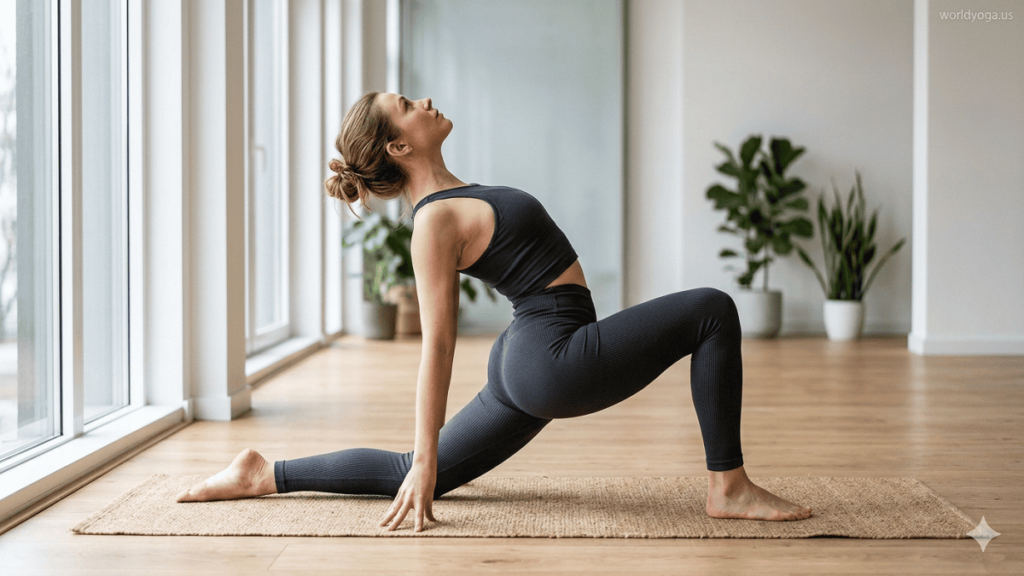
This white paper examines a supported backbending lunge variation characterized by a vertically stacked rear-leg alignment (back knee under hip socket) combined with controlled spinal extension. The objective is to evaluate its biomechanical efficiency, neuromuscular demands, therapeutic applications, and safety considerations within movement training and yoga-based mobility systems. The analysis suggests that this variation offers a stable framework for hip flexor lengthening and thoracic extension when executed with correct alignment principles.
2. Introduction
Low lunge-based postures are widely used in yoga and functional mobility training to address hip tightness, postural dysfunction, and spinal stiffness. The specific modification of aligning the back knee under the hip socket introduces a vertical load-bearing structure that enhances pelvic stability and reduces compensatory lumbar stress during backbending.
This variation is particularly relevant for populations with sedentary movement patterns and anterior chain tightness.
3. Biomechanical Framework
3.1 Lower Body Alignment
The stacked knee-to-hip configuration creates a near-vertical force line through the femur and tibia. This alignment reduces shear stress at the knee joint and improves proprioceptive stability in the hip complex.
Primary muscular involvement includes:
- Quadriceps (front leg stabilisation)
- Gluteus maximus and medius (pelvic control)
- Iliopsoas (eccentric lengthening in rear leg)
3.2 Pelvic Mechanics
Neutral pelvic positioning is essential. The posture requires balanced anterior chain lengthening without anterior pelvic tilt dominance. This allows hip flexor release without transferring load into lumbar compression zones.
3.3 Spinal Extension Pattern
The backbend is ideally distributed through the thoracic spine rather than the lumbar region. This reduces compressive load on vertebral joints while encouraging extension mobility in the mid-back.
4. Neuromuscular Engagement
The posture creates a multi-system activation pattern:
- Core stabilizers (transverse abdominis, obliques) maintain pelvic neutrality
- Spinal extensors regulate controlled extension
- Shoulder girdle stabilizers (rhomboids, trapezius) support chest opening
- Lower limb musculature maintains isometric endurance in the lunge base
This coordinated engagement enhances functional strength and postural integration.
5. Functional and Therapeutic Applications
This variation is applicable in:
- Postural correction programs for kyphotic tendencies
- Hip mobility interventions for sedentary populations
- Athletic recovery routines for running and cycling athletes
- Preparatory sequencing for deeper backbending progressions
The pose functions as a bridge between static stretching and dynamic spinal control training.
6. Risk Profile and Contraindications
While generally safe when properly aligned, risks include:
- Lumbar hyperextension due to poor thoracic engagement
- Anterior knee strain from misalignment
- Hip impingement in individuals with limited extension capacity
- Cervical compression if head position is uncontrolled
Contraindications may include acute lumbar disorders, uncontrolled hypertension, and severe sacroiliac instability.
7. Discussion
The key differentiator of this variation is its structural stacking principle. By aligning the back knee under the hip socket, practitioners achieve a mechanically efficient base that reduces instability and allows safer exploration of spinal extension. This makes the posture particularly valuable in rehabilitative movement design and mobility-focused yoga systems.
8. Conclusion
The supported backbending lunge represents a biomechanically intelligent variation of traditional low lunge practice. When executed with correct alignment and progressive conditioning, it enhances hip flexibility, thoracic mobility, and core stability while minimizing unnecessary lumbar strain. Its structured nature makes it suitable for both therapeutic and performance-oriented movement frameworks.
References and Further Reading
Yoga Journal – Anatomy and Alignment Resources
Verywell Fit – Yoga Safety and Technique Guides
#Lunge: Back Knee on the Floor Under the Hip Socket-Backbend in Kolkata
Industry Application of Lunge: Back Knee on the Floor Under the Hip Socket-Backbend
The supported backbending lunge variation, characterized by a stacked back knee under the hip socket combined with controlled spinal extension, has expanded beyond traditional yoga practice into multiple modern industries. Its biomechanical structure—combining hip flexor lengthening, pelvic stabilization, and thoracic extension—makes it a versatile tool for movement training, rehabilitation, sports performance, and workplace wellness systems.
1. Physiotherapy and Rehabilitation
In clinical physiotherapy settings, this posture is applied as a controlled mobility drill for patients with hip flexor tightness, postural imbalances, and mild lumbar stiffness. The stacked alignment reduces shear forces on the knee and lumbar spine, making it suitable for progressive rehabilitation programs.
Therapists use this variation to:
- Restore hip extension after prolonged immobilization
- Improve pelvic control in anterior tilt dysfunction
- Re-educate spinal extension patterns without lumbar overloading
It is often integrated into corrective exercise protocols for individuals recovering from sedentary-related musculoskeletal issues.
2. Sports Performance and Athletic Training
In sports science and conditioning programs, the posture is used to enhance anterior chain flexibility and posterior chain activation balance. Athletes in running, cycling, football, and martial arts benefit from improved hip extension and stride efficiency.
Key performance applications include:
- Increasing stride length and running economy
- Reducing hip flexor tightness from repetitive motion sports
- Improving core stability during unilateral lower-body loading
Strength and conditioning coaches often include it in dynamic mobility circuits and cooldown protocols.
3. Yoga Therapy and Movement Education
Within yoga therapy systems, this variation is used as a foundational progression toward deeper backbends. Its structured alignment teaches safe spinal extension mechanics, emphasizing thoracic mobility over lumbar compression.
It is commonly used for:
- Postural re-education programs
- Breath expansion training through chest opening
- Progressive sequencing into advanced backbends
4. Corporate Wellness and Ergonomic Programs
In workplace wellness initiatives, especially for desk-based employees, this posture is introduced as a corrective movement for prolonged sitting effects. It directly addresses hip shortening and thoracic stiffness caused by sedentary work environments.
Applications include:
- Micro-break mobility routines
- Postural correction workshops
- Stress reduction through breath-led chest opening
Ergonomic trainers often pair it with seated posture education to reduce long-term musculoskeletal risk.
5. Fitness and Functional Training Industry
In fitness studios and functional movement systems, the posture is integrated into mobility flows and corrective warm-ups. Trainers use it to improve joint range of motion before strength training sessions, particularly squats, deadlifts, and overhead presses.
Benefits include:
- Improved hip hinge mechanics
- Better overhead shoulder positioning through chest opening
- Enhanced core control during compound lifts
6. Dance, Performing Arts, and Movement Training
In dance and performance disciplines, the posture supports flexibility, extension control, and expressive spinal movement. It is used to develop controlled backbending capacity without compromising stability.
Applications include:
- Pre-performance mobility conditioning
- Injury prevention for extreme range movements
- Enhancing spinal articulation for choreography
Conclusion
The supported backbending lunge variation functions as a multidisciplinary movement tool bridging rehabilitation, athletic performance, fitness training, and workplace health. Its structured alignment principle—stacking the back knee under the hip socket—makes it adaptable across industries that require safe hip opening and controlled spinal extension.
References
Yoga Journal – Yoga Anatomy and Practice Insights
Verywell Fit – Mobility and Yoga Applications
#Lunge: Back Knee on the Floor Under the Hip Socket-Backbend in Mumbai
Ask FAQs
What is the purpose of keeping the back knee under the hip socket in this lunge variation?
Keeping the back knee directly under the hip socket creates a stacked joint alignment that improves stability and reduces strain on the lower back and knee. This positioning allows the pelvis to remain neutral, making it easier to isolate hip flexor stretching while maintaining safe spinal mechanics during the backbend.
Is this lunge suitable for beginners?
Yes, but it should be introduced gradually. Beginners can practice the base lunge position first without a deep backbend. Using a cushion under the back knee and keeping hands on the front thigh can help maintain balance and reduce strain while building foundational strength and flexibility.
What are the main benefits of this posture?
The posture improves hip flexor flexibility, enhances spinal mobility, and strengthens core stability. It also supports better posture by opening the chest and encouraging thoracic extension. Over time, it can reduce stiffness caused by prolonged sitting and improve overall movement efficiency.
What are common mistakes to avoid?
Common mistakes include allowing the back knee to drift behind the hip, collapsing into the lower back during the backbend, and letting the front knee move inward. Another frequent error is forcing the neck into deep extension instead of keeping the spine long and controlled.
Who should avoid or modify this posture?
Individuals with lower back injuries, severe hip limitations, or knee pain should modify or avoid this posture. Pregnant practitioners and those with uncontrolled hypertension should also consult a qualified professional before practicing deep backbending variations. Modifications like reducing the depth of the lunge or avoiding the backbend are recommended.
Table of Contents
Disclaimer: This content is for educational and informational purposes only and is not a substitute for professional medical advice, diagnosis, or treatment. Practice the described movement variations only under proper guidance if you are a beginner or have any existing injuries, especially related to the spine, hips, or knees. Always consult a qualified healthcare provider or certified yoga professional before starting any new exercise routine.