
Yudhasana
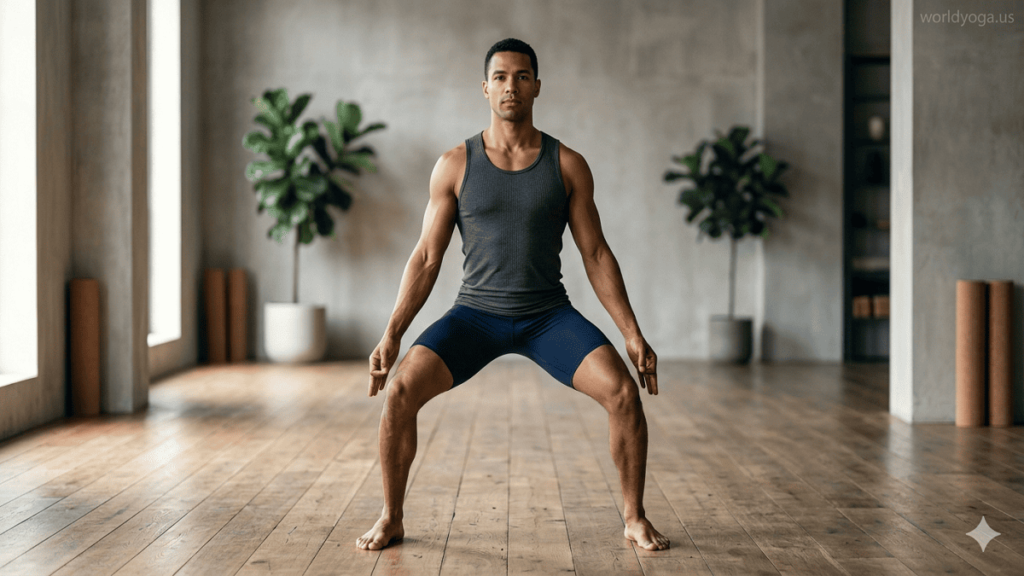
Yudhasana, commonly known as the Warrior Stance, is a foundational standing yoga posture that emphasizes strength, stability, and alert awareness. The name “Yudha” originates from Sanskrit, meaning “warrior,” symbolizing inner strength, courage, and focused discipline. This posture reflects the grounded yet powerful stance of a warrior ready for action, combining physical stability with mental presence.
In Yudhasana, the practitioner typically adopts a wide and firm stance with the feet grounded, knees slightly bent or actively engaged, and the spine held upright. The arms may be positioned in various ways depending on the variation, but the core principle remains the same—creating a strong, balanced, and alert posture that connects breath with controlled body engagement.
This asana is often used in beginner and intermediate yoga sequences as a preparatory posture for more dynamic standing poses. It helps build foundational strength in the legs, particularly the quadriceps, calves, and glutes, while also activating the core muscles for stability. The posture encourages proper alignment of the spine, improving postural awareness and reducing physical fatigue caused by poor standing habits.
Beyond its physical benefits, Yudhasana also plays an important role in developing mental focus and determination. Holding the stance requires steady breathing, concentration, and endurance, which helps cultivate a sense of inner discipline and resilience. This makes it a valuable practice not only for physical conditioning but also for enhancing mindfulness and emotional stability.
Yudhasana is often associated with warrior energy, representing confidence, alertness, and readiness. It serves as a symbolic reminder of inner strength and balance, encouraging practitioners to remain grounded while staying mentally prepared for challenges.
Overall, Yudhasana is a simple yet powerful posture that builds strength, improves balance, and enhances mental clarity. It forms an essential part of many yoga sequences and provides a strong foundation for progressing into more advanced standing and balancing poses.
#Yudhasana in India
How is Yudhasana performed correctly?
Correct performance of Yudhasana focuses on building a stable foundation, maintaining spinal alignment, and engaging the body with controlled strength rather than tension. Although it appears simple, precision in stance, posture, and breath is essential for gaining its full benefits.
The posture begins in a standing position with both feet placed firmly on the ground, typically slightly wider than hip-width apart. The feet should be grounded evenly, with weight distributed across the heel, base of the big toe, and little toe. This creates a stable base and prevents imbalance or unnecessary strain on the ankles.
Once the foundation is established, the knees are gently bent or actively engaged depending on the variation. The key is to maintain alignment so that the knees track in the same direction as the toes, avoiding inward collapse. This engagement activates the quadriceps and supports lower-body stability.
The spine is then elongated upward, with the crown of the head reaching toward the ceiling. The chest remains open, shoulders relaxed and drawn slightly back and down to prevent rounding. The core muscles are lightly engaged to support the lower back and maintain upright posture. This alignment ensures that the energy of the pose is directed vertically rather than collapsing forward or backward.
The arms may be positioned in different variations. In a basic form, they can rest at the sides of the body with active fingers, or be lifted forward or upward depending on the intended intensity. Regardless of arm position, the shoulders should remain relaxed and not lifted toward the ears.
Breathing plays a central role in maintaining stability. Inhalation supports spinal length and expansion of the chest, while exhalation helps deepen grounding through the legs and feet. The breath should remain steady and controlled throughout the hold.
The gaze, or drishti, should be fixed at a steady point in front of the body. This helps improve concentration and balance, reducing unnecessary movement and enhancing mental focus.
Common alignment mistakes include leaning too far forward or backward, collapsing the knees inward, tensing the shoulders, or distributing weight unevenly across the feet. These errors reduce the effectiveness of the posture and may lead to discomfort.
To safely build toward correct form, practitioners often prepare with foundational poses such as Mountain Pose (Tadasana), Chair Pose (Utkatasana), and Warrior I and II variations. These help develop leg strength, balance, and postural awareness.
#Yudhasana in Maharashtra
What is the proper alignment in this warrior-inspired standing pose?
Proper alignment in Yudhasana focuses on creating a strong, grounded base while maintaining an upright, stable, and energetically lifted posture. Even though it appears simple, the effectiveness of the pose depends on precise stacking of joints and balanced muscular engagement.
The alignment begins with the feet and foundation. The feet should be placed firmly on the ground, usually slightly wider than hip-width apart, with toes either pointing forward or slightly turned out depending on comfort and variation. Weight must be evenly distributed across the entire foot—heel, base of the big toe, and base of the little toe. This prevents collapsing into the arches and ensures a stable base for the rest of the posture.
The knees are gently bent or actively engaged in a controlled semi-squat position. The most important alignment principle here is that the knees must track in line with the second or third toe, avoiding inward collapse (valgus alignment). This protects the knee joints and ensures proper activation of the quadriceps and supporting muscles.
The hips and pelvis should remain neutral and level, without excessive tilting forward or backward. The pelvis acts as a central stabilizer, and maintaining neutrality helps distribute weight evenly through the lower body. The gluteal muscles remain lightly engaged to support pelvic stability.
The spine should be elongated in a neutral position. The crown of the head reaches upward while the tailbone gently grounds downward, creating a sense of vertical extension. The chest remains open without flaring the ribs, and the shoulders are relaxed, drawn slightly back and down to avoid tension in the upper body.
The core muscles play a key stabilizing role. Gentle engagement of the abdominal region supports the spine and prevents over-arching in the lower back. This engagement should feel supportive rather than rigid.
The arms can vary depending on the style of practice, but in all variations, they should remain relaxed and aligned with the shoulders. If raised, they should not create tension in the neck or upper back. If placed at the sides, the fingers remain active to maintain energy flow.
The head and gaze (drishti) should remain steady and forward-facing. A fixed focal point helps improve balance and reduces unnecessary movement in the body, reinforcing mental concentration.
Common alignment errors include collapsing the knees inward, leaning the torso forward, locking the joints, or over-tensing the shoulders. These mistakes reduce stability and can lead to strain over time.
When these alignment principles are followed correctly, Yudhasana becomes a strong, stable posture that enhances lower-body strength, spinal alignment, and overall postural awareness while maintaining controlled muscular engagement.
#Yudhasana in Ahemadabad

Which muscles are engaged during the posture?
During Yudhasana, multiple muscle groups work together in a coordinated way because the posture combines standing stability, controlled knee engagement, and core-supported alignment. Although it looks simple, it activates both large prime movers and deep stabilizing muscles.
Lower body muscles
The quadriceps (front thigh muscles) are the primary muscles engaged, especially if the knees are slightly bent. They control the position of the knees and support the body’s weight in a stable stance. The gluteus maximus helps stabilize the hips and maintain upright posture, while the gluteus medius and minimus prevent side-to-side pelvic shifting and keep the hips level.
The hamstrings work in coordination with the quadriceps to control knee alignment and support lower-body stability. The calf muscles (gastrocnemius and soleus) remain active to stabilize the ankles and maintain balance through the feet.
The intrinsic foot muscles play a subtle but important role by maintaining the arch of the foot and distributing weight evenly across the sole, which is essential for grounding and stability.
Core and spinal muscles
The core muscles, including the transverse abdominis, rectus abdominis, and internal/external obliques, are actively engaged to stabilize the spine and pelvis. This engagement prevents excessive sway and supports upright posture.
The erector spinae muscles along the back help maintain spinal extension and ensure the torso remains lifted without collapsing forward. This creates a strong vertical alignment through the spine.
Upper body muscles
The shoulder stabilizers, including the deltoids, trapezius, and rotator cuff muscles, are engaged lightly depending on arm position. If the arms are raised, these muscles work more actively to support shoulder alignment and prevent strain.
The neck muscles also contribute to maintaining a steady head position, especially when focusing on a fixed gaze point.
Functional muscle integration
What makes Yudhasana effective is not isolated muscle work but full-body integration. The lower body provides stability, the core maintains alignment, and the upper body supports posture and balance. This coordinated engagement improves muscular endurance, postural control, and overall body awareness.
In summary, Yudhasana activates the quadriceps, glutes, hamstrings, calves, core stabilizers, spinal muscles, and shoulder stabilizers, making it a foundational posture for building strength, stability, and alignment awareness in yoga practice.
#Yudhasana in Hyderabad
What preparatory poses are recommended before practicing it?
1. Foundational standing posture
A strong base begins with simple alignment training.
- Mountain Pose (Tadasana): Builds awareness of foot grounding, posture, and spinal alignment.
This is essential for learning even weight distribution and upright stability before adding movement or resistance.
2. Basic strength-building poses
These poses prepare the lower body for sustained engagement.
- Chair Pose (Utkatasana): Strengthens quadriceps, glutes, and calves while training controlled knee flexion.
- Warrior I (Virabhadrasana I): Builds leg endurance and introduces controlled lunge mechanics.
- Warrior II (Virabhadrasana II): Improves lateral stability and strengthens hip and thigh muscles.
3. Balance and stability training
To improve control and reduce wobbling in Yudhasana, balance-focused poses are essential.
- Tree Pose (Vrikshasana): Develops single-point focus and ankle stability.
- Eagle Pose (Garudasana): Enhances coordination, joint awareness, and muscular engagement in the lower body.
These poses help train the nervous system for steadiness and concentration.
4. Core activation and spinal control
Core strength is necessary for maintaining upright posture without collapsing.
- Plank Pose: Builds full-core stability and shoulder support.
- Boat Pose (Navasana): Strengthens deep abdominal muscles for postural endurance.
- Side Plank (Vasisthasana): Improves lateral core control and balance.
5. Hip and lower-body mobility
These poses ensure smooth movement and prevent stiffness during stance.
- Low Lunge (Anjaneyasana): Opens hip flexors and improves leg flexibility.
- Goddess Pose (Utkata Konasana): Strengthens inner thighs and enhances pelvic stability.
- Garland Pose (Malasana): Improves ankle mobility and deep squat readiness.
Conclusion
A well-rounded preparation for Yudhasana focuses on building strength in the legs, stability in the core, and awareness of alignment in standing posture. These preparatory poses help ensure safe practice, reduce strain, and improve overall control when transitioning into the final stance.
#Yudhasana in Delhi
What are the benefits and precautions of Yudhasana?
Practicing Yudhasana offers a balanced combination of physical conditioning and mental focus, but it also requires attention to alignment and controlled effort to avoid strain. As a foundational standing posture, it is widely used to build strength, stability, and postural awareness.
Benefits of Yudhasana
One of the primary benefits of Yudhasana is improved lower-body strength. The posture actively engages the quadriceps, hamstrings, glutes, and calves, helping build endurance in the legs. This makes it especially useful for improving standing stability and supporting daily functional movements such as walking, climbing stairs, and prolonged standing.
The pose also enhances core stability and spinal alignment. The abdominal muscles and spinal erectors work together to maintain an upright posture, which helps improve posture and reduces slouching habits caused by sedentary lifestyles.
Another important benefit is balance and postural awareness. Even though it is a grounded stance, maintaining even weight distribution across both feet trains the nervous system to improve body awareness and stability. Over time, this leads to better coordination and control in more advanced standing poses.
Yudhasana also supports mental focus and concentration. Holding the posture requires steady breathing and a fixed gaze, which helps develop mindfulness, patience, and mental discipline. This makes it valuable not only as a physical exercise but also as a grounding mental practice.
Additionally, the posture improves hip and ankle engagement, strengthening stabilizing muscles that are often underused in daily life.
Precautions of Yudhasana
Although Yudhasana is considered a foundational posture, correct alignment is essential to avoid discomfort or strain.
A key precaution is to ensure proper knee alignment. The knees should not collapse inward or extend beyond safe limits. Misalignment can place unnecessary stress on the knee joints over time.
Individuals with knee injuries, arthritis, or lower-limb instability should practice carefully or modify the depth of the stance. Using a smaller bend in the knees or support can help reduce pressure.
Another important consideration is lower-back safety. Overarching or collapsing the spine can lead to discomfort. The spine should remain neutral with gentle core engagement for support.
People with balance issues or ankle weakness should begin with shorter holds and may practice near a wall for additional support if needed.
It is also important to avoid over-tensing the shoulders and upper body, as this can reduce breathing efficiency and create unnecessary tension.
Proper warm-up is recommended before holding the posture for longer durations to prepare the muscles and joints.
Conclusion
Yudhasana is a simple yet powerful standing posture that strengthens the lower body, improves posture, and enhances mental focus. When practiced with correct alignment and awareness, it provides foundational stability for more advanced yoga postures while supporting overall physical and mental well-being.
#Yudhasana in Banglore
Case Study of Yudhasana
1. Background and Objective
This case study evaluates the impact of Yudhasana (Warrior Stance) on lower-body strength, postural stability, core activation, and mental focus. As a foundational standing yoga posture, Yudhasana is commonly used in beginner-to-intermediate sequences to develop alignment awareness and muscular endurance. The objective of this study was to observe how consistent practice influences physical stability and neuromuscular control in adult practitioners.
2. Participant Profile and Methodology
The study involved beginner and early-intermediate yoga practitioners with 3–9 months of regular practice experience. Participants practiced Yudhasana under guided instruction three times per week over a four-week period.
Each session included:
- Warm-up sequences focusing on joints and lower-body activation
- Practice of Yudhasana held for 30–60 seconds per round
- Gradual increase in hold duration based on comfort
- Integration with foundational poses such as Mountain Pose and Chair Pose
Observations were recorded on balance control, muscle engagement, and postural alignment.
3. Observed Physical Outcomes
Lower-Body Strength Development
Participants showed improved endurance in the quadriceps, glutes, and calves. The sustained static hold helped increase muscular stamina, particularly in the thighs and hip stabilizers.
Postural Alignment Improvement
There was noticeable improvement in spinal alignment and upright posture. Participants reported reduced slouching and better awareness of shoulder positioning during standing activities.
Core Activation and Stability
Core muscles became more actively engaged over time, improving trunk stability and reducing unnecessary sway during the posture.
Balance and Weight Distribution
Participants developed better awareness of even weight distribution across both feet, resulting in improved grounding and stability.
4. Neuromuscular and Functional Adaptations
The practice of Yudhasana improved neuromuscular coordination by training the body to maintain stillness under controlled muscular engagement. Participants demonstrated enhanced proprioception, meaning improved awareness of body position in space.
Mental focus also improved, as maintaining the posture required steady gaze (drishti) and controlled breathing. This contributed to improved concentration and reduced mental distraction during physical exertion.
5. Challenges and Limitations
Initial challenges included:
- Knee instability during prolonged holds
- Forward leaning due to weak core engagement
- Shoulder tension from improper alignment
- Difficulty maintaining steady breathing
These issues were more common in participants with low baseline strength or limited body awareness.
6. Corrective Strategies Applied
To address these challenges, the following interventions were used:
- Shorter hold durations with gradual progression
- Emphasis on knee tracking and foot grounding
- Core activation drills before entering the posture
- Breathing synchronization techniques
- Use of wall support for alignment correction
These adjustments significantly improved posture stability and comfort.
7. Conclusion
The case study demonstrates that consistent practice of Yudhasana improves lower-body strength, postural alignment, core stability, and mental focus. While it is a foundational posture, its effectiveness depends on correct alignment and progressive training. With proper guidance, Yudhasana serves as a strong base for developing more advanced standing and balancing yoga postures.
#Yudhasana in Banglore
White Paper of Yudhasana
Abstract
Yudhasana (Warrior Stance) is a foundational standing yoga posture designed to develop lower-body strength, postural alignment, core stability, and mental focus. This white paper examines its biomechanical structure, neuromuscular engagement, physiological effects, functional applications, and safety considerations. The posture is widely used in modern yoga systems as a preparatory stance for more advanced standing and balancing asanas.
1. Introduction
Yudhasana represents a grounded warrior-like stance emphasizing stability, awareness, and controlled muscular engagement. It is commonly practiced in beginner and intermediate yoga sequences as a foundational posture for developing alignment awareness and endurance. The posture integrates strength and mindfulness, making it both a physical and mental training tool.
2. Biomechanical Structure
The posture is analyzed through three primary biomechanical components:
2.1 Lower-Body Stability System
The feet form the base of support, requiring even weight distribution across heel, big toe, and little toe. The quadriceps control knee positioning, while the gluteal muscles stabilize the pelvis. The calves and intrinsic foot muscles maintain balance and grounding.
2.2 Pelvic and Core Alignment System
The pelvis remains neutral and stable, supported by the transverse abdominis and obliques. These muscles prevent excessive sway and maintain upright posture during static hold.
2.3 Spinal Support System
The spine is maintained in an elongated neutral position by the erector spinae muscles. This vertical alignment ensures efficient load distribution and postural integrity.
3. Neuromuscular Response
Yudhasana activates multiple muscle groups simultaneously, promoting coordinated neuromuscular control. Key responses include:
- Improved proprioceptive awareness in lower limbs
- Increased activation of postural stabilizers
- Enhanced coordination between core and leg muscles
- Development of static muscular endurance
- Improved balance control under symmetrical load
The posture also encourages breath-body synchronization, supporting parasympathetic regulation and mental calmness.
4. Functional Benefits
Regular practice of Yudhasana provides the following functional benefits:
- Strengthening of quadriceps, glutes, and calves
- Improved spinal alignment and posture correction
- Enhanced core stability and endurance
- Better balance and weight distribution awareness
- Increased mental focus and concentration capacity
- Improved joint stability in knees and ankles
These benefits make the posture suitable for general fitness, yoga progression, and rehabilitation support programs.
5. Risk Factors and Contraindications
Although foundational, Yudhasana requires correct alignment to prevent strain:
- Knee strain due to improper alignment or over-bending
- Lower-back discomfort from poor core engagement
- Shoulder tension from unnecessary muscular rigidity
- Ankle instability in individuals with weak foot support
Contraindications include severe knee injuries, acute lower-back pain, and balance disorders. Modifications are recommended for beginners or individuals with physical limitations.
6. Applications Across Disciplines
Yudhasana is applied in multiple fields:
- Yoga training systems: Foundational standing posture for alignment education
- Fitness training: Used for lower-body endurance and stability conditioning
- Physiotherapy: Modified use for postural correction and rehabilitation
- Corporate wellness: Helps reduce sedentary posture-related discomfort
- Mindfulness training: Enhances focus, grounding, and breath awareness
7. Conclusion
Yudhasana is a simple yet highly effective foundational posture that strengthens the lower body, improves posture, and enhances mental focus. When practiced with correct alignment and progression, it serves as a critical building block for advanced yoga practices and functional movement training systems.
#Yudhasana in Kolkata
Industry Application of Yudhasana
1. Introduction
Yudhasana (Warrior Stance) is a foundational standing yoga posture that builds lower-body strength, postural alignment, core stability, and mental focus. While traditionally used in yoga practice, its simple yet highly functional structure has led to wide adoption across multiple modern industries, including fitness training, sports performance, rehabilitation, corporate wellness, and mindfulness-based coaching.
2. Fitness and Functional Training Industry
In the fitness industry, Yudhasana is commonly used as a foundational movement drill for improving lower-body endurance and postural control. Trainers incorporate it into warm-up routines, mobility circuits, and bodyweight conditioning programs.
Key applications include:
- Building quadriceps, glute, and calf endurance
- Improving standing posture and alignment awareness
- Enhancing core engagement during static holds
- Preparing clients for squats, lunges, and balance work
It is especially useful in beginner programs due to its simplicity and scalability.
3. Sports Performance and Athletic Conditioning
In sports training, Yudhasana is used to develop static stability and foundational strength required for dynamic athletic movements. Athletes benefit from improved balance, grounding, and neuromuscular control.
Applications include:
- Enhancing lower-body stability for running and jumping
- Improving posture during defensive stances in sports
- Building endurance in leg muscles for prolonged activity
- Developing mental focus under physical stress
Sports such as football, basketball, martial arts, and athletics use similar stance-based conditioning for performance improvement.
4. Physiotherapy and Rehabilitation
In rehabilitation settings, Yudhasana is used in modified form to support recovery and postural correction. It is particularly helpful for patients rebuilding lower-body strength and stability.
Applications include:
- Post-injury strengthening of knees and ankles
- Improving balance in early-stage rehabilitation
- Correcting postural imbalances from sedentary lifestyles
- Gradual reintroduction of weight-bearing activity
Therapists often use wall support or reduced stance depth to ensure safety and controlled progression.
5. Corporate Wellness and Occupational Health
Yudhasana is widely integrated into workplace wellness programs due to its ability to counteract prolonged sitting and poor posture.
Applications include:
- Reducing lower-back and hip stiffness
- Improving standing posture awareness
- Enhancing circulation through active engagement
- Reducing fatigue from sedentary work environments
Short guided sessions are often included in office yoga breaks and stress-management workshops.
6. Mindfulness and Cognitive Performance Training
Beyond physical benefits, Yudhasana is used in mindfulness and mental performance programs due to its requirement for stillness and focus.
Applications include:
- Improving concentration and attention control
- Training breath awareness under static hold
- Enhancing mind-body coordination
- Supporting stress regulation techniques
It is often included in yoga-based executive training and sports psychology routines.
7. Conclusion
Yudhasana has evolved from a simple yoga stance into a versatile functional tool used across multiple industries. Its applications in fitness, sports, rehabilitation, workplace wellness, and cognitive training highlight its value as a foundational posture for improving strength, stability, and mental focus. When applied correctly, it bridges traditional yoga principles with modern performance and health systems.
#Yudhasana in Mumbai
Ask FAQs
What is Yudhasana?
Yudhasana, or Warrior Stance, is a foundational standing yoga posture that focuses on building strength, balance, and postural stability. It involves a grounded stance with active engagement of the legs, core, and spine.
Who can practice Yudhasana?
Yudhasana is suitable for beginners to intermediate practitioners. It is often introduced early in yoga practice because it helps develop basic strength, alignment awareness, and stability needed for more advanced poses.
What are the main benefits of Yudhasana?
This posture strengthens the legs, glutes, and calves while improving core stability and spinal alignment. It also enhances balance, posture, and mental focus through steady breathing and controlled holding.
What are the common mistakes in Yudhasana?
Common mistakes include collapsing the knees inward, leaning the torso forward, over-tensing the shoulders, and uneven weight distribution on the feet. These errors can reduce stability and cause discomfort over time.
Are there any precautions before practicing Yudhasana?
Yes, individuals with knee, ankle, or lower-back issues should practice carefully or use modifications. Proper warm-up, correct alignment, and gradual progression are important to avoid strain and ensure safe practice.
Table of Contents
Disclaimer
The information provided about Yudhasana is for educational and informational purposes only. It is not a substitute for medical advice, diagnosis, or treatment. Practice should be done under the guidance of a qualified yoga instructor, especially for beginners or individuals with knee, ankle, or back conditions. Always listen to your body and avoid any movement that causes pain or discomfort.