Parivritta Anjaneyasana
Parivritta Anjaneyasana, commonly known as Revolved Low Lunge, is a dynamic yoga posture that combines a stable lunge foundation with deep spinal rotation. The Sanskrit name is derived from “Parivritta” meaning revolved, “Anjaneya” referring to the deity Hanuman (symbolizing devotion and strength), and “Asana” meaning posture. This pose is widely practiced in modern yoga sequences for its ability to integrate lower-body stability with upper-body mobility.
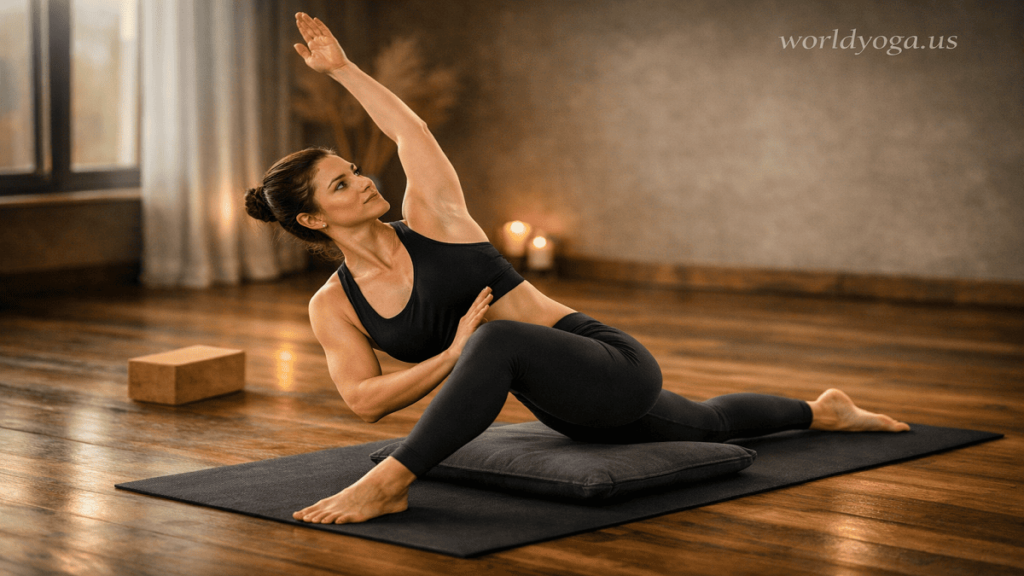
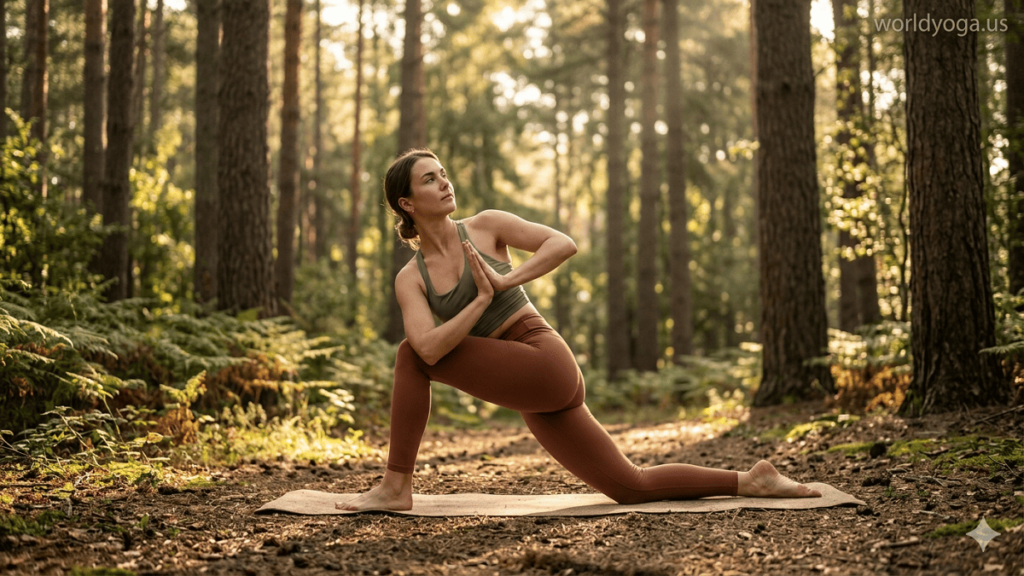
In this posture, the practitioner begins in a low lunge position with one foot forward and the back knee grounded. The torso is then rotated toward the front leg, often with a prayer twist or an extended arm variation, creating a strong rotational stretch through the spine, chest, and shoulders while maintaining a stable lower-body base.
Parivritta Anjaneyasana is particularly valued for improving thoracic spine mobility, strengthening the core muscles, and enhancing balance and coordination. It also deeply engages the hip flexors of the back leg while stretching the glutes and hamstrings of the front leg, making it a highly effective full-body integration pose.
Beyond physical benefits, this posture is often associated with increased body awareness and mental focus due to the demand for stability and controlled rotation. It encourages practitioners to maintain steady breath while coordinating movement between the upper and lower body.
Because of its combination of stability and twist, Parivritta Anjaneyasana is commonly used in yoga flows as a preparatory pose for deeper spinal twists and standing balance postures. When practiced correctly with proper alignment, it becomes a powerful tool for building functional strength, improving posture, and increasing overall mobility.
#Parivritta Anjaneyasana in India
How is Parivritta Anjaneyasana performed correctly?
Parivritta Anjaneyasana (Revolved Low Lunge) is performed by combining a stable lunge base with controlled spinal rotation. Proper alignment is essential to ensure the twist comes from the thoracic spine while the hips remain steady and protected.
Step 1: Enter a stable low lunge
Begin in a low lunge position. Step your right foot forward between your hands, aligning the front knee directly over the ankle. Lower the back knee gently onto the mat and place the top of the foot flat for support. Ensure the pelvis is square and facing forward.
Step 2: Establish a strong foundation
Engage your core lightly to stabilize the lower back. Keep both hips level and avoid letting one side drop. The spine should be long, with the chest lifted before initiating the twist. This foundation is critical for safe rotation.
Step 3: Initiate the twist
Bring your hands to prayer position at the center of the chest. On an inhale, lengthen through the crown of the head. On the exhale, begin rotating your torso toward the front leg. The twist should originate from the mid and upper back, not the lower spine.
Step 4: Deepen the posture (optional variation)
For a deeper expression, extend the opposite arm upward toward the ceiling while keeping the lower hand at the heart or reaching down for balance. Stack the shoulders vertically and allow the gaze to follow the lifted hand if the neck remains comfortable.
Step 5: Maintain alignment and breath
Keep the front knee tracking over the ankle and prevent it from collapsing inward. The back leg remains active and stable, even though the knee is on the floor. Maintain steady breathing to support controlled rotation and avoid strain.
Key alignment principles
The pelvis should remain as stable as possible throughout the twist. Avoid rotating from the lower back; instead, focus on thoracic spine mobility. The chest should stay open, and the shoulders should remain relaxed away from the ears.
Common mistakes to avoid
Avoid forcing the twist beyond your natural range of motion. Do not allow the front knee to drift inward or overextend past the ankle. Collapsing into the lower back or rounding the spine reduces effectiveness and increases risk of strain.
Conclusion
When performed correctly, Parivritta Anjaneyasana builds core strength, improves spinal mobility, and enhances balance. Precision in alignment and mindful breathing are essential to safely experience its full benefits.
#Parivritta Anjaneyasana in Maharashtra
What is the proper alignment in this revolved crescent lunge?
Proper alignment in Parivritta Anjaneyasana focuses on building a stable lower-body foundation while allowing controlled spinal rotation through the upper back. The goal is to keep the hips steady and square while the torso rotates independently.
Lower body alignment (foundation)
Start in a low lunge with the front foot placed firmly on the mat. The front knee should be directly stacked over the ankle, forming a stable 90-degree angle. The weight is distributed evenly across the front foot—avoid collapsing into the inner arch or shifting too far forward.
The back knee rests gently on the floor, positioned slightly behind the hip for stability. The top of the back foot is grounded to support balance. The pelvis should remain level and facing forward, resisting the natural tendency to open or twist with the upper body.
Pelvis and hip alignment
The pelvis is the most important stabilizing element in this posture. Both hip points should remain squared toward the front of the mat. Even as the torso rotates, the hips should not follow the twist. This separation between stable hips and rotating spine is what creates safe spinal mobility.
Engage the lower abdomen lightly to prevent excessive arching in the lower back. This helps maintain pelvic neutrality and protects the lumbar spine during rotation.
Spinal alignment
Before twisting, lengthen the spine upward through the crown of the head. The spine should feel elongated rather than compressed. The twist should originate from the thoracic spine (mid-back), not the lumbar region.
As you rotate, the chest turns toward the front leg while maintaining vertical length. The shoulders should stack as much as possible in the full expression, without forcing the rotation.
Upper body and arm alignment
Hands may stay in prayer position at the chest or one arm may extend upward. In both variations, the shoulders should remain relaxed and away from the ears. The chest stays open, avoiding collapse or rounding.
The gaze can follow the top hand in advanced variations, but only if the neck remains comfortable and aligned with the spine.
Key alignment principles
- Front knee aligned over ankle
- Back knee grounded and stable
- Hips square and facing forward
- Twist initiated from thoracic spine
- Spine long before and during rotation
- Core gently engaged for lumbar protection
Common alignment errors
Avoid letting the front knee drift inward or collapse. Do not allow the pelvis to rotate with the torso, as this reduces spinal isolation. Twisting from the lower back instead of the upper spine can lead to discomfort or strain.
Conclusion
Correct alignment in Parivritta Anjaneyasana ensures that mobility is focused in the thoracic spine while stability is maintained in the hips and knees. This balance between movement and control is what makes the posture both safe and effective.
#Parivritta Anjaneyasana in Ahemadabad
Which muscles are engaged during the twist in the posture?
During the twisting phase of Parivritta Anjaneyasana (Revolved Low Lunge), the body engages a coordinated network of core stabilizers, spinal rotators, and lower-body support muscles to create controlled rotation while maintaining a stable lunge base.
Core and deep abdominal muscles
The primary drivers of the twist are the internal and external obliques, which control rotational movement of the torso. These muscles work in opposition—one side contracts while the other lengthens—to produce and regulate spinal rotation.
The transverse abdominis plays a stabilizing role by tightening around the midsection like a natural corset. It helps protect the lumbar spine by preventing excessive movement and maintaining intra-abdominal pressure during the twist.
Spinal muscles
The multifidus and other deep stabilizers along the spine are highly active, especially in the thoracic region. These muscles guide segmental rotation and help maintain spinal integrity throughout the movement.
The erector spinae assist in keeping the spine elongated and upright, preventing collapse or rounding as the torso rotates.
Hip and pelvic stabilizers
While the upper body twists, the lower body remains relatively stable. The gluteus medius and gluteus maximus of the front leg help stabilize the pelvis and prevent it from rotating along with the torso. This separation between stable hips and rotating spine is essential for safe alignment.
The hip flexors of the back leg (iliopsoas and rectus femoris) remain in a lengthened state, providing passive stretch while still contributing to balance and control.
Shoulder and upper back muscles
In arm-extended variations, the deltoids and rotator cuff muscles stabilize the lifted arm. The serratus anterior and trapezius assist in maintaining proper scapular positioning, preventing shoulder collapse during rotation.
The latissimus dorsi also contributes to upper-body control, especially when the arm is extended overhead.
Functional role of muscle engagement
The twist in this posture is not driven by a single muscle but by an integrated chain of stabilizers and rotators. The core initiates and controls rotation, the spine guides the movement, and the hips anchor the base. This coordination allows safe spinal mobility while maintaining balance and alignment.
Summary
During the twist in Parivritta Anjaneyasana, the obliques, transverse abdominis, spinal stabilizers, glutes, and shoulder support muscles all work together to create controlled rotation. This integrated activation improves core strength, spinal mobility, and functional movement control.
#Parivritta Anjaneyasana in Hyderabad
What preparatory poses are recommended before practicing it?
Before practicing Parivritta Anjaneyasana (Revolved Low Lunge), it is important to prepare the hips, spine, and shoulders so the body can safely handle both deep lunging and spinal rotation. Proper preparation reduces strain on the knees and lower back while improving the quality of the twist.
Hip-opening preparatory poses
A key foundation is a basic low lunge hold. This helps open the hip flexors of the back leg and builds stability in the front thigh. It also trains the body to stay grounded in a split-leg position, which is essential for revolved variations.
Anjaneyasana is one of the most important preparatory poses. It gently stretches the iliopsoas and quadriceps while encouraging upright spinal alignment. Practicing this pose with arms lifted also begins to open the chest, which is useful for maintaining length during the twist.
Spinal mobility preparation
To prepare for safe rotation, gentle twisting poses are highly effective. Simple seated spinal twists or supine twists help activate the obliques and train the thoracic spine to rotate without overloading the lower back.
Adho Mukha Svanasana is also valuable for preparing the spine and shoulders. It lengthens the hamstrings, calves, and back body while introducing controlled weight-bearing through the upper limbs.
Hip and groin openness
Tight inner thighs can restrict lunge depth and pelvic stability.
Baddha Konasana helps open the adductors and groin region, making it easier to maintain a square pelvis in the lunge position.
Core activation preparation
Core engagement is essential for controlling the twist. Gentle plank holds or knee-to-chest movements help activate the transverse abdominis and obliques, which stabilize the spine during rotation.
Shoulder and chest preparation
Since the posture often includes arm variations, shoulder mobility work is useful. Simple arm circles, thread-the-needle stretches, or gentle chest openers prepare the deltoids, rotator cuff, and upper back muscles for safe alignment.
Integrated preparation flow
A well-rounded warm-up typically follows this order:
- Joint mobility and breath awareness
- Hip-opening lunges and low lunge holds
- Hamstring and spine lengthening (Downward-Facing Dog)
- Gentle twists for spinal rotation
- Core activation and shoulder preparation
Conclusion
Proper preparation for Parivritta Anjaneyasana ensures that the hips remain stable, the spine rotates safely from the thoracic region, and the shoulders stay open and supported. This structured warm-up significantly improves safety, alignment, and effectiveness in the final posture.
#Parivritta Anjaneyasana in Delhi
What are the benefits and precautions of Parivritta Anjaneyasana?
Parivritta Anjaneyasana (Revolved Low Lunge) is a powerful combination of hip opening and spinal rotation. It delivers strong functional benefits, but it also requires careful alignment because it involves load on the knees, hips, and spine simultaneously.
Key Benefits
1. Improves spinal mobility
The twisting action primarily targets the thoracic spine, helping improve rotational capacity. This supports better posture, reduces mid-back stiffness, and enhances movement efficiency in daily activities like turning, reaching, and lifting.
2. Strengthens the core
The obliques and transverse abdominis are heavily engaged to control rotation. This builds functional core strength, improving stability and reducing strain on the lower back during movement.
3. Opens the hips and hip flexors
The back leg remains in a deep hip flexor stretch, targeting muscles like the iliopsoas and rectus femoris. This helps reduce tightness caused by prolonged sitting and improves lower-body mobility.
4. Enhances balance and coordination
Because the body must stabilize the lower half while rotating the upper half, the pose improves neuromuscular coordination and full-body control.
5. Improves posture and body awareness
Regular practice encourages spinal alignment awareness and balanced muscular engagement, which supports healthier posture over time.
Precautions
1. Knee protection is essential
The front knee must stay aligned directly over the ankle. Allowing it to collapse inward or extend too far forward can create joint stress.
2. Avoid twisting from the lower back
Rotation should come from the thoracic spine, not the lumbar spine. Excess lumbar twisting can lead to discomfort or injury, especially in individuals with lower back issues.
3. Maintain pelvic stability
The hips should remain square and facing forward. Letting the pelvis rotate reduces effectiveness and increases strain on the spine and hips.
4. Be cautious with neck positioning
In advanced variations where the gaze follows the top hand, avoid over-rotating the neck. Keep it comfortable and aligned with the spine.
5. Modify if needed
People with knee injuries, hip impingement, or spinal conditions should reduce depth, use props under the back knee, or avoid deep twisting altogether.
Conclusion
When practiced with correct alignment and mindful progression, Parivritta Anjaneyasana is an effective posture for building core strength, improving spinal mobility, and enhancing hip flexibility. However, its benefits are best achieved only when joint alignment and controlled movement principles are respected.
#Parivritta Anjaneyasana in Pune
Case Study of Parivritta Anjaneyasana
1. Introduction
Parivritta Anjaneyasana is a combined mobility and stability posture used in yoga therapy and functional movement training. It integrates a low lunge base with thoracic spinal rotation, making it a valuable tool for improving hip flexibility, core strength, and spinal mobility in sedentary populations.
This case study explores its effects in a structured 6-week mobility intervention program focused on individuals experiencing reduced spinal rotation and hip stiffness due to prolonged sitting.
2. Participant Profile and Objectives
The participant group consisted of adults aged 25–45 with desk-based occupations reporting:
- Restricted thoracic rotation
- Tight hip flexors
- Mild lower back stiffness
- Reduced postural awareness
The primary objectives were to:
- Improve spinal mobility
- Increase hip flexor flexibility
- Enhance core stability
- Reduce discomfort from prolonged sitting
3. Methodology
The intervention was conducted over 6 weeks with 3 guided sessions per week. Each session followed a structured sequence:
- Joint warm-up and breath awareness (5–7 minutes)
- Hip-opening foundation using Anjaneyasana (Low Lunge)
- Spinal preparation using gentle twists and Downward-Facing Dog
- Introduction of supported Parivritta Anjaneyasana
- Progression to deeper twists with arm extension
- Cool-down using restorative supine stretches
Emphasis was placed on maintaining a square pelvis and initiating rotation from the thoracic spine.
4. Observations and Progression
Week 1–2:
Participants initially struggled with pelvic stability during twisting. Mild compensatory movement in the lower back was observed. However, hip flexor stretching improved noticeably.
Week 3–4:
Improved control in spinal rotation was observed. Most participants could maintain a stable pelvis while twisting. Core engagement increased significantly, reducing lower back strain.
Week 5–6:
Participants demonstrated:
- Increased thoracic rotation range
- Improved hip flexor flexibility
- Better balance and coordination
- Reduced stiffness after prolonged sitting
- Enhanced postural awareness
5. Key Findings
- Thoracic isolation is critical for safe and effective twisting
- Hip stability directly influences spinal rotation quality
- Core engagement reduces lumbar compensation
- Supported variations improve accessibility and safety
- Gradual progression prevents strain and improves adherence
6. Precautions Identified
- Over-rotation caused discomfort in participants with weak core control
- Knee instability occurred when alignment was not monitored
- Lumbar compensation increased risk of strain in early stages
- Lack of warm-up reduced effectiveness of the twist
Use of props and reduced depth significantly improved safety outcomes.
7. Conclusion
The case study demonstrates that Parivritta Anjaneyasana is an effective multi-dimensional movement for improving hip mobility, spinal rotation, and core stability. When introduced progressively with proper alignment cues, it provides measurable improvements in functional movement and postural control, particularly in individuals with sedentary lifestyles.
#Parivritta Anjaneyasana in Banglore
White Paper of Parivritta Anjaneyasana
Abstract
Parivritta Anjaneyasana is a multi-planar yoga posture combining a low lunge foundation with thoracic spinal rotation. It is widely used in yoga therapy, mobility training, and functional conditioning due to its ability to simultaneously enhance hip flexibility, core stability, and spinal mobility. This white paper analyzes its biomechanics, muscular engagement, applications, risks, and evidence-informed utility in movement-based disciplines.
1. Introduction
Revolved Low Lunge is a transitional posture frequently used in dynamic yoga sequences. It integrates lower-body stability with upper-body rotation, making it valuable for improving functional movement patterns. It is particularly relevant for individuals with sedentary lifestyles, where hip tightness and reduced spinal mobility are common.
2. Biomechanical Overview
The posture consists of three primary structural components:
- Lower body base:
Front hip flexion with knee flexion over ankle; back knee grounded in extension with hip flexor stretch. - Pelvic stability system:
Pelvis remains square and forward-facing, resisting rotational drift. - Spinal rotation system:
Thoracic spine rotates independently while lumbar spine remains relatively stable.
This separation of movement between pelvis and spine is critical for safe execution and functional mobility development.
3. Muscular Engagement
Key muscle groups involved include:
- Core stabilizers: transverse abdominis, internal/external obliques
- Spinal muscles: multifidus, erector spinae
- Hip flexors (back leg): iliopsoas, rectus femoris (lengthening phase)
- Gluteal stabilizers (front leg): gluteus medius, gluteus maximus
- Quadriceps: front leg stabilization
- Shoulder stabilizers (arm variations): deltoids, serratus anterior, rotator cuff
This coordinated activation supports both mobility and postural control.
4. Functional Applications
4.1 Mobility Enhancement
Improves thoracic rotation, hip flexor length, and pelvic control.
4.2 Postural Correction
Reduces stiffness patterns associated with prolonged sitting and anterior pelvic tilt.
4.3 Athletic Conditioning
Enhances rotational power, balance, and core control in dynamic sports movements.
4.4 Rehabilitation Contexts
Used in controlled environments to restore hip–spine coordination and improve movement symmetry.
5. Methodology of Practice
A progressive framework is recommended:
- Low lunge foundation
- Supported twist (hands at heart center)
- Arm extension variation for deeper rotation
- Breath-coordinated holds
- Gradual increase in duration and depth
Alignment priority: pelvis stability and thoracic-driven rotation.
6. Risk Assessment and Precautions
- Lumbar strain from improper twisting mechanics
- Knee stress if alignment is compromised
- Hip impingement in forced depth positions
- Shoulder strain in aggressive arm extension
- Loss of pelvic stability reducing spinal safety
Modifications include props under the back knee, reduced rotation range, and guided progression.
7. Evidence-Informed Perspective
While direct clinical trials specific to this posture are limited, related research in lunge-based biomechanics and spinal rotation training supports its effectiveness in improving functional mobility, postural alignment, and core stability in sedentary populations.
8. Conclusion
Parivritta Anjaneyasana is a biomechanically integrated posture that effectively combines hip opening, spinal rotation, and core activation. Its structured application in yoga therapy, fitness training, and rehabilitation contexts makes it a valuable tool for improving functional movement capacity when practiced with proper alignment and progressive loading.
#Parivritta Anjaneyasana in Kolkata
Industry Application of Parivritta Anjaneyasana
Parivritta Anjaneyasana is a multi-planar movement pattern that integrates lower-body stability with thoracic spinal rotation. Because of this combination, it is widely adopted across multiple industries including fitness, physiotherapy, sports performance, corporate wellness, and yoga education.
1. Fitness and Strength Training Industry
In fitness settings, Revolved Low Lunge is commonly used in warm-ups, mobility flows, and corrective exercise programs. Trainers incorporate it to prepare the body for compound movements such as squats, deadlifts, and overhead presses.
The posture improves hip flexor length, spinal rotation, and core activation, making it especially useful for enhancing movement efficiency. It is also used in dynamic flexibility training to improve range of motion in both the hips and thoracic spine.
2. Physiotherapy and Rehabilitation
In rehabilitation environments, Parivritta Anjaneyasana is applied as a controlled mobility exercise for restoring hip–spine coordination.
Physiotherapists use it to address:
- Reduced thoracic rotation
- Hip flexor tightness
- Postural imbalances from prolonged sitting
The posture is often introduced in supported forms to ensure pelvic stability and reduce strain on the lumbar spine and knees.
3. Sports Performance and Athletic Conditioning
Athletes benefit from this movement due to its strong emphasis on rotational mobility and lower-body stability. It is frequently used in sports such as:
- Running
- Football
- Tennis
- Martial arts
Strength and conditioning coaches use it to improve rotational power, stride mechanics, balance, and core control. It is also included in pre-activation warm-ups and recovery routines to reduce stiffness and improve movement readiness.
4. Corporate Wellness Programs
In corporate wellness environments, this posture is used to counteract the effects of prolonged sitting. It helps release tight hip flexors, improve spinal mobility, and reduce upper-back stiffness.
Short guided mobility breaks featuring Revolved Low Lunge improve posture awareness, reduce musculoskeletal discomfort, and enhance energy levels during work hours.
5. Yoga Education and Teacher Training
In yoga teacher training programs, Parivritta Anjaneyasana is a key teaching posture for understanding alignment, sequencing, and safe twisting mechanics.
Trainees learn:
- How to stabilize the pelvis during rotation
- How to isolate thoracic spine movement
- How to modify for different body types
It is also used as a preparatory posture for deeper twists and advanced standing balance sequences.
6. Conclusion
Parivritta Anjaneyasana has strong cross-industry relevance due to its combination of stability and mobility. Its adaptability makes it valuable in fitness training, rehabilitation, athletic conditioning, workplace wellness, and yoga education. When applied with correct alignment and progressive loading, it serves as an effective tool for improving functional movement, posture, and overall mobility.
#Parivritta Anjaneyasana in Mumbai
Ask FAQs
What is Parivritta Anjaneyasana?
Parivritta Anjaneyasana is a yoga posture that combines a low lunge with a spinal twist. It helps improve hip flexibility, core strength, and thoracic spine mobility while promoting balance and stability.
What are the main benefits of this pose?
This posture improves spinal rotation, strengthens the core, stretches the hip flexors, and enhances overall posture. It also helps reduce stiffness caused by prolonged sitting and supports better functional movement.
Which muscles are engaged in this pose?
Key muscles include the obliques, transverse abdominis, erector spinae, glutes, quadriceps, and hip flexors. Shoulder stabilizers are also engaged when the arms are extended in the twisting variation.
What are common mistakes to avoid?
Common mistakes include twisting from the lower back instead of the upper spine, letting the front knee collapse inward, and allowing the hips to rotate with the torso. Poor alignment can reduce benefits and increase injury risk.
Who should modify or avoid this pose?
People with knee injuries, hip impingement, or lower back issues should modify the posture. Using props under the back knee, reducing twist depth, or avoiding the full arm extension is recommended for safety.
Table of Contents
Disclaimer: The information provided about Parivritta Anjaneyasana is for educational and general fitness purposes only and is not a substitute for professional medical advice. Individuals with injuries, medical conditions, or physical limitations should consult a qualified healthcare provider or certified yoga instructor before attempting this posture.