
Lunge: Back Knee on the Floor-Twists and Side Bends
The lunge position with the back knee on the floor is a foundational yoga and mobility posture used to build stability, flexibility, and controlled movement in the lower body and spine. It is often practiced as a preparatory or transitional shape that supports deeper asanas, including hip openers, backbends, and spinal twists.
In this variation, the front leg is placed in a forward lunge with the knee aligned over the ankle, while the back knee rests gently on the ground for support. This grounded setup reduces strain on the legs and allows the practitioner to focus on alignment, breath, and upper-body mobility.
Twists and side bends introduced from this position add a dynamic spinal element to the pose. In a gentle twist, the torso rotates over the front leg, enhancing spinal mobility and engaging the obliques. This movement improves thoracic flexibility and supports healthy rotation patterns in daily activities such as walking, lifting, and reaching.
Side bends, on the other hand, involve lifting one arm overhead and leaning laterally, creating an opening along the side body. This variation stretches the intercostal muscles between the ribs, improves rib cage mobility, and supports deeper breathing capacity. It also enhances balance and coordination by challenging core stability while the lower body remains grounded.
Together, these movements transform a simple supported lunge into a multi-dimensional mobility exercise. The combination of grounded stability and upper-body articulation makes it particularly useful in yoga therapy, athletic warm-ups, and functional movement training.
This posture is also highly accessible, making it suitable for beginners while still offering depth for advanced practitioners through longer holds and deeper ranges of motion. When performed with mindful breathing and proper alignment, it helps release tension in the hips, spine, and shoulders while improving overall movement efficiency and body awareness.
#Lunge: Back Knee on the Floor-Twists and Side Bends in Ahemadabad
How is Lunge with back knee on the floor incorporating twists and side bends performed correctly?
The Lunge with Back Knee on the Floor incorporating twists and side bends is a controlled mobility sequence that combines lower-body stability with spinal rotation and lateral flexion. It is commonly used in yoga and functional training to improve hip flexibility, core strength, and thoracic mobility when performed with correct alignment.
Step-by-step execution
Begin in a low lunge position. Step your right foot forward between your hands, ensuring the front knee is aligned directly over the ankle. The back knee is gently lowered to the mat, with the top of the back foot resting flat for support. The pelvis should remain stable and squared forward.
Engage your core lightly to maintain balance and prevent excessive arching in the lower back. Keep the torso upright and the spine elongated before initiating any upper-body movement.
Incorporating twists
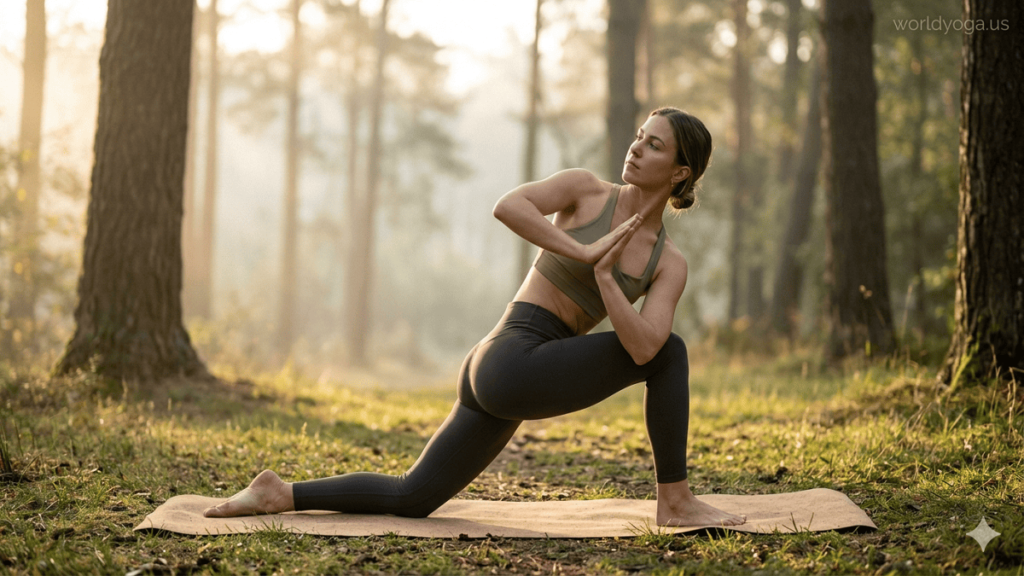
To add a twist, bring your hands to prayer position at the chest. On an inhale, lengthen the spine; on the exhale, rotate the torso toward the front leg (right side). The twist should originate from the thoracic spine, not the lower back. Keep the hips steady and facing forward while the chest opens toward the side.
For a deeper variation, extend the opposite arm upward toward the ceiling, stacking the shoulders. The gaze can follow the lifted hand if the neck is comfortable. Maintain steady breathing to support controlled rotation and avoid jerky movements.
Incorporating side bends
To perform a side bend, return to a neutral lunge position. Extend your right arm overhead and gently lean the torso toward the opposite side, creating a stretch along the side body. Keep both hips anchored and avoid collapsing into the lower back.
The movement should be long and spacious rather than compressed. The focus is on lengthening the rib cage and intercostal muscles while maintaining stability through the grounded lower body.
Key alignment principles
The front knee must stay aligned with the ankle to protect the joint. The back knee should remain cushioned and comfortable, with even weight distribution. The pelvis should stay neutral and not tilt excessively forward or sideways.
Core engagement is essential throughout both twist and side bend variations to support spinal safety. The chest should remain open, avoiding collapse into the shoulders, especially during rotation.
Common mistakes to avoid
Avoid twisting from the lower back, as this can strain the lumbar spine. Do not allow the front knee to collapse inward or extend too far beyond the toes. In side bends, avoid compressing the waist or shifting weight unevenly into the front leg.
Conclusion
When performed correctly, the lunge with back knee on the floor combined with twists and side bends becomes a highly effective mobility exercise. It improves hip stability, enhances spinal flexibility, and builds functional strength through controlled, mindful movement.
#Lunge: Back Knee on the Floor-Twists and Side Bends in India
What is the proper alignment in this multi-directional low lunge variation?
Proper alignment in a multi-directional low lunge (back knee on the floor) with twists and side bends is about maintaining a stable lower body base while allowing controlled movement through the spine and rib cage without compromising joint safety.
Start with the foundational low lunge setup. The front foot is placed forward with the knee stacked directly over the ankle. The shin should be vertical, and the weight distributed evenly across the whole front foot rather than collapsing into the toes or heel. The back knee rests on the mat, positioned slightly behind the hip, with a cushioned surface under it if needed for comfort. The top of the back foot can be flat on the floor to provide additional stability.
The pelvis is the most critical alignment element. It should remain as neutral and square as possible, facing forward toward the top of the mat. Avoid allowing the hip of the back leg to rotate outward or the front hip to drop excessively. A level pelvis creates a safe foundation for spinal movement and prevents compensatory stress in the lower back.
The spine should remain long before any twist or side bend is introduced. Think of lifting the crown of the head upward while gently drawing the navel inward to engage the core. This creates axial length, which protects the lumbar spine during rotation and lateral movement.
In the twisting variation, alignment begins from the thoracic spine. The chest rotates while the hips stay stable and forward-facing. The shoulders should stack over one another in the full expression, but without forcing the rotation. The neck follows naturally, avoiding excessive strain. The twist should feel distributed along the mid-back rather than concentrated in the lower spine.
In the side bend variation, both hips remain anchored and level. The movement originates from the ribs, not the waist or lower back. The upper arm reaches overhead in a long arc while the opposite side of the body lengthens. The torso should avoid collapsing forward or backward, maintaining a lateral plane of movement.
The front knee must always track in line with the second or third toe to prevent inward collapse. The back leg remains passive but grounded, supporting balance without excessive tension. The shoulders stay relaxed and away from the ears, especially during overhead or twisting positions.
Breath and alignment work together. Inhalation creates space and elongation, while exhalation supports gentle rotation or side lengthening without force.
Overall, correct alignment in this variation depends on three principles: a stable square pelvis, an engaged but non-rigid core, and movement isolated to the thoracic spine and rib cage rather than the lower back or joints.
#Lunge: Back Knee on the Floor-Twists and Side Bends in Hyderabad
Which muscles are engaged during the twisting and side-bending movements?
In a low lunge with the back knee on the floor, adding twists and side bends creates a coordinated demand on stabilizing muscles of the lower body and mobilizing muscles of the spine and trunk. The engagement changes depending on whether you rotate (twist) or laterally flex (side bend), but both patterns rely on a strong base from the hips and core.
During the twisting variation, the primary muscles of engagement are the core stabilizers, especially the obliques (internal and external obliques). These muscles control rotational movement of the torso and help keep the pelvis stable while the chest rotates. The transverse abdominis also plays a key role by providing deep abdominal support and maintaining spinal integrity during rotation.
The spinal muscles, particularly the multifidus and other deep stabilizers along the vertebral column, assist in controlled rotation of the thoracic spine. The erector spinae help maintain upright posture and prevent collapse during the twist.
In the lower body, the gluteus maximus and gluteus medius of the front leg work isometrically to stabilize the pelvis. The quadriceps of the front leg remain active to support the knee joint, while the hip flexors of the back leg (especially iliopsoas and rectus femoris) are gently stretched and lengthened due to the lunge position.
During the side-bending variation, the muscle emphasis shifts toward lateral chain engagement. The obliques again play a central role, but now function more in lengthening control rather than rotation. The quadratus lumborum (QL) becomes especially active, as it is the primary muscle responsible for lateral flexion of the spine and rib cage stabilization.
The intercostal muscles between the ribs are stretched and engaged, supporting rib expansion and improved breathing capacity. The latissimus dorsi on the extended side assists in controlling the overhead reach and maintaining shoulder stability.
In the lower body, the same foundational muscles remain active: quadriceps in the front leg for knee stability, gluteals for pelvic control, and hip flexors in the back leg under controlled stretch. The adductors of the front leg also contribute to stabilizing the inward-outward balance of the pelvis during side bending.
The shoulder complex becomes more engaged in both variations. The deltoids and rotator cuff muscles stabilize the arm during overhead reach in side bends, while the scapular stabilizers (trapezius and serratus anterior) help control shoulder positioning during twists and extended arm movements.
Overall, both twisting and side-bending in this low lunge variation create an integrated full-body activation pattern. The core controls spinal movement, the hips stabilize the base, and the shoulders guide upper-body expression, resulting in a balanced combination of mobility and stability.
#Lunge: Back Knee on the Floor-Twists and Side Bends in Delhi
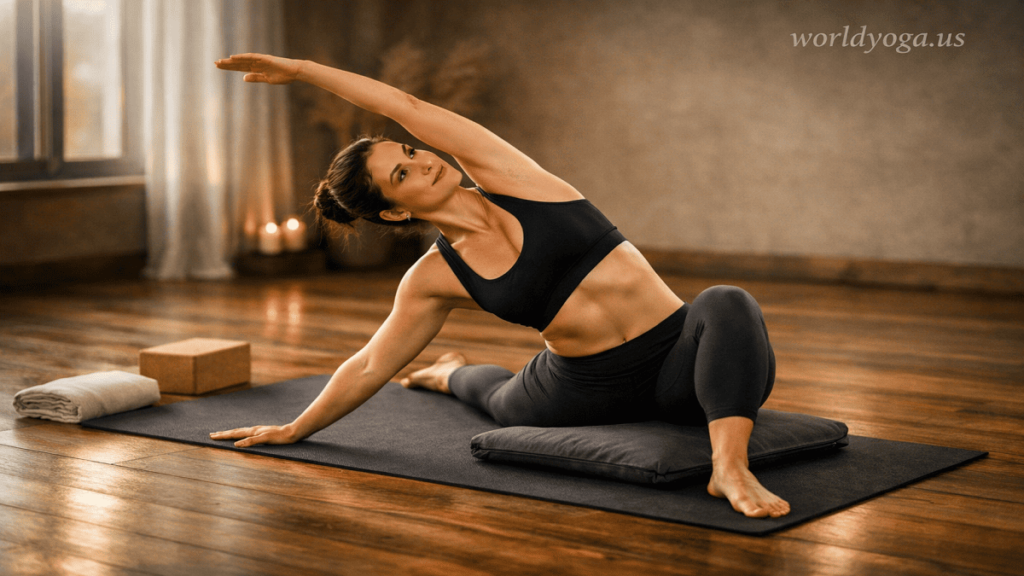
What preparatory poses are recommended before practicing it?
Before practicing a low lunge with the back knee on the floor combined with twists and side bends, it is important to prepare the hips, spine, and shoulders so the body can move safely without strain. The preparation should focus on opening the hip flexors, activating the core, and improving spinal mobility.
A foundational preparatory pose is a basic low lunge hold. This helps the body adapt to the split-leg position, especially stretching the hip flexors of the back leg while strengthening the front thigh. Keeping the back knee down and gradually sinking into the hips builds stability before adding any spinal movement.
Anjaneyasana is one of the most important preparatory postures. It directly targets the iliopsoas and quadriceps of the back leg while encouraging upright spinal alignment. Practicing this pose with arms lifted also begins to open the rib cage, which is essential for later side bending and twisting.
Adho Mukha Svanasana is another key preparation. It lengthens the hamstrings, calves, and spine while introducing gentle shoulder engagement. This helps create overall body awareness and improves the ability to transition smoothly into and out of the lunge position.
For spinal mobility, gentle twists such as seated or supine spinal twists are highly beneficial. These movements prepare the thoracic spine for rotation, ensuring that twisting in the lunge comes from the upper back rather than the lower back.
Baddha Konasana helps open the inner thighs and groin area, reducing resistance in the hips. This is especially useful for easing into deeper lunge positions without strain in the adductors.
Side-body preparation can be achieved through standing or seated side stretches, where one arm reaches overhead and the torso gently leans laterally. This begins to activate the intercostal muscles and quadratus lumborum, which are essential for controlled side bending.
Gentle core activation exercises such as plank variations or slow knee-to-chest movements help prepare the abdominal muscles for stabilizing the spine during twisting movements. Without this activation, the lower back may compensate during rotation.
A well-rounded warm-up typically combines hip opening, spinal mobility, and core engagement. When these elements are prepared properly, the transition into a multi-directional low lunge becomes smoother, safer, and more effective.
#Lunge: Back Knee on the Floor-Twists and Side Bends in Maharashtra
What are the benefits and precautions of this dynamic lunge variation?
A low lunge with the back knee on the floor combined with twists and side bends is a multi-planar mobility exercise that blends stability, flexibility, and controlled spinal movement. When practiced correctly, it offers significant functional benefits, but it also requires careful attention to alignment due to the involvement of multiple joints and movement directions.
Benefits
One of the primary benefits is improved hip flexibility. The grounded lunge position deeply stretches the hip flexors of the back leg while strengthening the front leg. Over time, this helps reduce tightness caused by prolonged sitting and improves stride efficiency in walking, running, and athletic movements.
The twisting component enhances spinal mobility, particularly in the thoracic region. This improves rotational capacity, which is essential for daily activities such as reaching, turning, and lifting. It also supports better posture by reducing stiffness in the mid-back and encouraging balanced spinal movement.
Side bending adds another layer of mobility by targeting the lateral chain of the body. It stretches the intercostal muscles, latissimus dorsi, and quadratus lumborum, improving rib cage flexibility and supporting deeper, more efficient breathing patterns. This can contribute to better oxygen intake and reduced tension in the side body.
The posture also strengthens core stability. The obliques and deep abdominal muscles must continuously engage to control rotation and prevent collapse during side bending. This builds functional core strength that supports spinal health and overall balance.
In addition, the lower body muscles—especially the quadriceps, glutes, and stabilizing muscles of the hips—are activated isometrically. This improves joint stability and coordination between the upper and lower body.
Precautions
Despite its benefits, this variation requires careful execution. One of the most important precautions is protecting the front knee. It must remain aligned with the ankle and should not collapse inward, as this can create unnecessary joint stress.
Twisting should always originate from the thoracic spine, not the lower back. Excessive lumbar rotation can lead to discomfort or strain, especially in individuals with pre-existing lower back issues. The pelvis should remain stable and facing forward throughout the movement.
In side bending, there is a risk of compressing the lower back if the movement is not controlled. The body should lengthen first before bending sideways, rather than collapsing into the waist. This helps distribute the stretch evenly along the side body.
Individuals with hip injuries, knee sensitivity, or spinal conditions should modify the depth of the lunge and avoid forcing range of motion. Using a cushion under the back knee or reducing the depth of the lunge can significantly improve safety.
Wrist discomfort may occur if the hands are used for support in deeper variations. In such cases, reducing weight on the hands or using forearm support is recommended.
Conclusion
This dynamic lunge variation is highly effective for improving hip mobility, spinal flexibility, and core strength when performed with proper alignment. However, its multi-directional nature demands mindful control, gradual progression, and respect for individual body limits to ensure safe and sustainable practice.
#Lunge: Back Knee on the Floor-Twists and Side Bends in Pune
Case Study of Lunge: Back Knee on the Floor-Twists and Side Bends
A multi-directional low lunge with the back knee on the floor combined with twisting and side-bending movements is a widely used mobility sequence in yoga therapy, functional training, and rehabilitation programs. This case study examines its application in improving spinal mobility, hip flexibility, and core stability in individuals with sedentary lifestyles.
Participant Profile and Objective
The case involved a group of adults aged 28–45 with desk-based occupations reporting common issues such as hip tightness, reduced spinal rotation, and mild lower back stiffness. The primary objective was to improve functional mobility through a structured, low-impact movement protocol that emphasized controlled range of motion.
Methodology
The intervention was implemented over a 5-week period with three supervised sessions per week. Each session followed a progressive sequence:
- Joint warm-up and breath awareness (5–8 minutes)
- Hip-opening preparation using low lunges and standing stretches
- Introduction of supported low lunge with back knee on floor
- Gradual addition of spinal rotation (twists)
- Controlled lateral flexion (side bends)
- Cool-down using supine restorative poses
Emphasis was placed on maintaining a stable pelvis while isolating movement to the thoracic spine during twists and to the lateral rib cage during side bends.
Observations
By Week 2, participants demonstrated improved tolerance in the lunge position and reduced discomfort in the hip flexors. Early adaptations showed better balance and increased awareness of knee alignment.
By Week 3–4, most participants were able to perform controlled spinal rotations without pelvic compensation. Twisting quality improved significantly, with reduced strain in the lower back and better engagement of the obliques.
Side bending capacity improved gradually, with participants reporting increased rib cage expansion and improved breathing efficiency. Many also noted reduced stiffness along the lateral torso after prolonged sitting.
By Week 5, the group demonstrated:
- Increased hip flexor flexibility
- Improved thoracic spinal rotation
- Better lateral trunk mobility
- Enhanced core stability and postural awareness
- Reduced self-reported lower back discomfort
Key Technical Insights
The case study highlighted that the effectiveness of this movement pattern depends heavily on pelvic stability. Participants who maintained a square pelvis experienced better spinal isolation and reduced lumbar strain.
It was also observed that twisting from the thoracic spine, rather than the lumbar region, significantly reduced discomfort and improved rotational control. Similarly, side bends were more effective when initiated from rib cage expansion rather than waist compression.
Use of support (such as padding under the back knee) improved consistency and reduced joint stress, especially in early stages.
Precautions Identified
Participants with pre-existing knee sensitivity required careful monitoring to avoid excessive pressure on the grounded knee. Those with lower back stiffness needed reduced range in twists to prevent over-rotation.
Rapid progression without adequate hip preparation was identified as a primary risk factor for compensation patterns in the lumbar spine.
Conclusion
The case study demonstrates that a lunge with the back knee on the floor combined with twists and side bends is an effective multi-planar mobility tool. When introduced progressively and with proper alignment cues, it significantly improves hip flexibility, spinal mobility, and core control while reducing stiffness associated with sedentary behavior.
#Lunge: Back Knee on the Floor-Twists and Side Bends in Banglore
White Paper of Lunge: Back Knee on the Floor-Twists and Side Bends
Abstract
A supported low lunge with the back knee on the floor combined with twisting and side-bending movements is a multi-planar mobility protocol widely used in yoga therapy, physiotherapy-informed movement systems, and functional fitness training. This white paper examines its biomechanical structure, neuromuscular engagement, clinical applications, safety considerations, and its role in improving hip–spine integration and functional movement capacity.
1. Introduction
The low lunge position with the back knee grounded provides a stable foundation for controlled mobility of the spine and hips. When combined with rotational (twist) and lateral flexion (side bend) patterns, the posture becomes a comprehensive movement drill targeting hip flexibility, spinal articulation, and core stability. It is frequently applied in corrective exercise programs for individuals with sedentary lifestyles and movement restrictions.
2. Biomechanical Structure
This variation involves three primary movement systems:
- Lower body base:
Front hip flexion and knee stability with ankle dorsiflexion; back hip extension with knee support on the floor. - Spinal rotation (twist):
Primarily driven by the thoracic spine, with controlled stabilization from the lumbar region. - Lateral flexion (side bend):
Controlled by the quadratus lumborum, intercostals, and oblique muscle chain.
The posture requires simultaneous stability (lower body) and mobility (upper body), making it a closed-chain kinetic exercise with multi-directional loading.
3. Muscular Engagement
Key muscle groups include:
- Hip flexors: iliopsoas, rectus femoris (back leg stretch phase)
- Quadriceps: front leg stabilization
- Gluteals: pelvic control and alignment support
- Core muscles: transverse abdominis, internal/external obliques
- Spinal stabilizers: multifidus, erector spinae
- Lateral chain muscles: quadratus lumborum, latissimus dorsi, intercostals
- Shoulder stabilizers (if arms elevated): deltoids, serratus anterior
This integrated activation supports both mobility and joint stability.
4. Functional Applications
4.1 Mobility Enhancement
Improves hip extension, thoracic rotation, and lateral trunk flexibility.
4.2 Postural Correction
Reduces stiffness patterns associated with prolonged sitting and anterior pelvic tilt.
4.3 Athletic Conditioning
Enhances rotational power, stride mechanics, and core control for sports requiring directional changes.
4.4 Rehabilitation and Movement Therapy
Used in low-load environments to restore hip–spine coordination and improve movement symmetry.
5. Methodology of Implementation
A progressive approach is recommended:
- Static supported low lunge
- Addition of thoracic rotation (twists)
- Integration of lateral flexion (side bends)
- Breath-coordinated flow sequencing
- Load reduction or prop support as needed
Emphasis is placed on pelvic stability and thoracic isolation.
6. Risk Assessment and Precautions
- Knee joint stress if alignment is compromised
- Lumbar strain from improper twisting mechanics
- Hip impingement risk in forced depth positions
- Over-compression during side bending if rib cage collapses
- Shoulder overload in extended arm variations
Modifications include knee padding, reduced range of motion, and block support.
7. Evidence-Informed Insights
While direct clinical trials on this exact sequence are limited, research in lunge-based movement therapy and spinal mobility training supports its effectiveness in improving hip range of motion, thoracic rotation, and functional movement quality in sedentary populations.
8. Conclusion
The supported low lunge with integrated twists and side bends is a highly effective multi-planar movement strategy for improving hip flexibility, spinal mobility, and core stability. Its value lies in its scalability, making it suitable for rehabilitation, fitness conditioning, and yoga-based movement systems when applied with structured progression and alignment control.
#Lunge: Back Knee on the Floor-Twists and Side Bends in Kolkata
Industry Application of Lunge: Back Knee on the Floor-Twists and Side Bends
A supported low lunge with the back knee on the floor combined with twisting and side-bending movements is a highly versatile movement pattern used across multiple industries, including fitness, physiotherapy, sports performance, corporate wellness, and yoga education. Its multi-planar nature makes it valuable for improving hip mobility, spinal rotation, lateral flexibility, and core stability in a single integrated sequence.
1. Fitness and Strength Training Industry
In the fitness industry, this movement pattern is commonly used in warm-ups, mobility flows, and corrective exercise programs. Trainers incorporate it before lower-body strength training sessions to activate the hip flexors, glutes, and core while preparing the spine for rotational load.
The twisting component enhances thoracic mobility, which supports compound lifts such as squats, deadlifts, and overhead presses by improving postural alignment. Side bends are used to increase lateral core strength and rib cage mobility, contributing to better stability during functional movements.
2. Physiotherapy and Rehabilitation
In physiotherapy settings, this lunge variation is used as a low-impact rehabilitation tool for restoring hip–spine coordination. It is particularly beneficial for individuals recovering from sedentary stiffness, mild lower back discomfort, or restricted hip mobility.
Therapists use it to retrain movement patterns by emphasizing controlled pelvic stability and isolating spinal motion to specific regions. Twists are introduced gradually to improve thoracic rotation, while side bends help restore balanced lateral flexibility.
3. Sports Performance and Athletic Conditioning
Athletes in sports such as running, football, tennis, and martial arts use this movement to enhance functional mobility. The lunge position replicates athletic stance mechanics, while twisting improves rotational power and side bending supports lateral agility.
Strength and conditioning coaches use it to improve stride efficiency, directional change capacity, and core control under dynamic conditions. It is often included in pre-competition warm-ups and recovery sessions.
4. Corporate Wellness Programs
In corporate environments, this movement is used in workplace yoga and ergonomic intervention programs. It helps counteract the effects of prolonged sitting by opening the hip flexors, mobilizing the spine, and reducing stiffness in the upper body.
Short guided sessions incorporating this lunge variation improve posture awareness, reduce musculoskeletal discomfort, and enhance energy levels during work hours.
5. Yoga Education and Teacher Training
In yoga teacher training programs, this posture is used as a foundational teaching tool for understanding multi-planar movement. Trainees learn how to safely guide students through hip opening, spinal rotation, and lateral flexion while maintaining alignment principles.
It also serves as a progression base for deeper asanas such as twists in standing lunges and advanced hip openers like pigeon variations and lizard pose progressions.
6. Conclusion
The lunge with the back knee on the floor combined with twists and side bends is a highly adaptable movement used across multiple professional domains. Its ability to integrate lower-body stability with upper-body mobility makes it a valuable tool for rehabilitation, athletic conditioning, fitness programming, and workplace wellness interventions.
#Lunge: Back Knee on the Floor-Twists and Side Bends in Mumbai
Ask FAQs
What is a lunge with back knee on the floor combined with twists and side bends?
It is a supported low lunge variation where the back knee rests on the floor while the practitioner adds spinal twists and side bends. This movement improves hip flexibility, spinal mobility, and core stability in a controlled and stable position.
What are the main benefits of this lunge variation?
This posture helps release tight hip flexors, improves thoracic spine rotation, enhances lateral flexibility of the torso, and strengthens core muscles. It is also useful for improving posture and reducing stiffness caused by long hours of sitting.
Which muscles are most engaged during this movement?
Key muscles include the hip flexors, quadriceps, glutes, and adductors in the lower body. The core muscles (especially obliques and transverse abdominis) are heavily engaged during twists, while the quadratus lumborum and intercostals are activated during side bends.
What are the common mistakes to avoid?
Common mistakes include collapsing the front knee inward, twisting from the lower back instead of the thoracic spine, and over-compressing the side body during bends. Poor pelvic alignment can also reduce effectiveness and increase strain.
Who should avoid or modify this exercise?
Individuals with knee injuries, hip impingement, or lower back issues should modify the pose. Using padding under the back knee, reducing range of motion, or avoiding deep twists and side bends is recommended for safety.
Table of Contents
Disclaimer: The information provided about the lunge with back knee on the floor, twists, and side bends is for educational and general fitness purposes only and is not a substitute for professional medical advice. Individuals with injuries, pain, or medical conditions should consult a qualified healthcare or fitness professional before attempting this movement.