
Dwi Hasta Pada Anjaneyasana
Overview
Dwi Hasta Pada Anjaneyasana is a Sanskrit-derived yoga posture variation of Anjaneyasana (Low Lunge Pose). The term “Dwi Hasta Pada” translates to “two hands and one foot,” indicating a variation where both hands and one foot play active roles in stabilizing and supporting the posture. This advanced lunge-backbend combination is designed to deepen hip opening, enhance spinal extension, and improve full-body coordination.
It is commonly practiced in intermediate to advanced yoga sequences, especially in vinyasa and mobility-focused training systems.
Meaning and Structure of the Pose
In this variation, the practitioner begins in a low lunge position and transitions into a deeper extension pattern. The front leg remains grounded while the back leg extends behind, creating a strong base for stability. Both hands are often engaged either on the floor, Dwi Hasta Pada Anjaneyasana on the front thigh, or extended upward depending on progression level.
The posture integrates:
- Lower-body stability (legs and hips)
- Core engagement for balance
- Thoracic spine extension through controlled backbending
This combination makes it both a strengthening and mobility-enhancing pose.
Key Benefits
1. Deep Hip Flexor Opening
The back leg hip flexors, especially the iliopsoas and rectus femoris, are strongly stretched. This helps reduce stiffness caused by prolonged sitting and improves hip extension capacity.
Reference: https://www.yogajournal.com/poses/low-lunge/
2. Improved Spinal Mobility
The controlled backbend promotes thoracic spine extension, which supports better posture and reduces excessive rounding of the upper back.
Reference: https://www.spine-health.com/wellness/exercise/back-exercises-strengthen-your-spine
3. Strengthens Lower-Body Stability
The front leg engages quadriceps and hamstrings isometrically, improving balance and knee stability. The glutes and calves assist in maintaining alignment and control.
4. Enhances Core Control and Balance
Core muscles stabilize the pelvis and prevent over-arching in the lower back, ensuring safe spinal extension.
5. Expands Chest and Shoulder Mobility
When the arms are lifted or extended, the posture opens the chest and shoulders, improving breathing capacity and upper-body flexibility.
Alignment Principles
To perform safely and effectively:
- Keep the front knee aligned over the ankle (avoid collapsing inward)
- Engage the core to protect the lower back
- Direct the backbend through the upper spine, not the lumbar region
- Maintain square hips facing forward
- Distribute weight evenly between both legs
Proper alignment ensures the benefits are achieved without strain.
Common Mistakes
- Overarching the lower back instead of using thoracic extension
- Losing balance due to poor foot grounding
- Collapsing the chest instead of lifting through the sternum
- Neglecting core engagement during backbend
Precautions
This is an advanced variation and should be approached gradually. Individuals with:
- Lower back pain
- Knee instability
- Hip injuries
should modify the posture or practice under supervision.
Conclusion
Dwi Hasta Pada Anjaneyasana is a powerful yoga-based lunge variation that integrates strength, flexibility, and spinal awareness. When practiced with correct alignment and progression, Dwi Hasta Pada Anjaneyasana it significantly improves hip mobility, posture, and overall functional movement capacity.
References
- https://www.yogajournal.com/poses/low-lunge/
- https://www.spine-health.com/wellness/exercise/back-exercises-strengthen-your-spine
- https://www.physio-pedia.com/Lunge_Exercise
#Dwi Hasta Pada Anjaneyasana in India
How is Dwi Hasta Pada Anjaneyasana performed correctly?
Dwi Hasta Pada Anjaneyasana is an advanced variation of the low lunge pose that combines hip opening, lower-body stability, and controlled spinal extension. Performing it correctly requires precise alignment, gradual depth, Dwi Hasta Pada Anjaneyasana and coordinated breath control to ensure safety and effectiveness.
1. Starting Position
Begin in a standing position. Step one foot forward into a long lunge stance, ensuring enough distance between the feet to maintain balance. The back foot extends behind with the heel lifted and toes firmly grounded.
Lower the back knee toward the floor if practicing a modified version, or keep it lifted for a more advanced variation. The front foot should be fully grounded with the knee aligned directly above the ankle.
2. Establish Lower-Body Alignment
The foundation of this posture is stability in the legs and hips:
- Keep the front leg strong but not locked
- Engage the quadriceps and hamstrings for control
- Activate the glutes of the back leg for stability
- Ensure hips remain square and facing forward
Avoid letting the pelvis rotate outward or collapse to one side, Dwi Hasta Pada Anjaneyasana as this reduces effectiveness and increases strain.
Reference: https://www.physio-pedia.com/Lunge_Exercise
3. Engage the Core
Before moving into the backbend, gently activate the core muscles. This stabilizes the pelvis and protects the lower back during spinal extension.
The abdomen should remain lightly engaged throughout the movement, preventing excessive arching in the lumbar spine.
4. Hand Position and Upper Body Setup
The “Dwi Hasta” (two-hand) variation typically involves one of the following setups depending on level:
- Hands on the front thigh for support (beginner variation)
- Hands placed on the floor inside or outside the front foot (intermediate)
- Arms extended overhead for full expression (advanced)
Keep the chest lifted and shoulders relaxed away from the ears.
5. Controlled Backbend Execution
Begin the backbend slowly by lifting the chest upward. The movement should originate from the thoracic spine (upper and mid-back) rather than the lower back.
- Inhale as you lift and open the chest
- Avoid forcing the neck backward
- Allow the head to follow naturally without strain
- Maintain even weight distribution between both legs
The goal is a smooth, controlled arc—not a deep collapse into the lumbar spine.
Reference: https://www.spine-health.com/wellness/exercise/back-exercises-strengthen-your-spine
6. Breathing and Stability
Breathing plays a key role in control:
- Inhale: lift and expand the chest into the backbend
- Exhale: return slowly to neutral alignment
Maintain steady breathing to support balance and spinal control throughout the posture.
7. Exit the Pose Safely
To come out of the posture:
- Slowly bring the torso back to upright
- Lower arms if extended
- Step back into a neutral standing position
- Reset posture before repeating on the other side
Avoid sudden movements, especially after deep extension.
Conclusion
Dwi Hasta Pada Anjaneyasana is performed correctly when stability in the lower body, core engagement, and thoracic-driven backbending work together in coordination. The emphasis is not on depth but on controlled alignment, Dwi Hasta Pada Anjaneyasana breath awareness, and balanced muscle activation. When practiced correctly, it enhances hip flexibility, spinal mobility, and overall body control.
References
- https://www.physio-pedia.com/Lunge_Exercise
- https://www.spine-health.com/wellness/exercise/back-exercises-strengthen-your-spine
- https://www.yogajournal.com/poses/low-lunge/
#Dwi Hasta Pada Anjaneyasana in Maharashtra
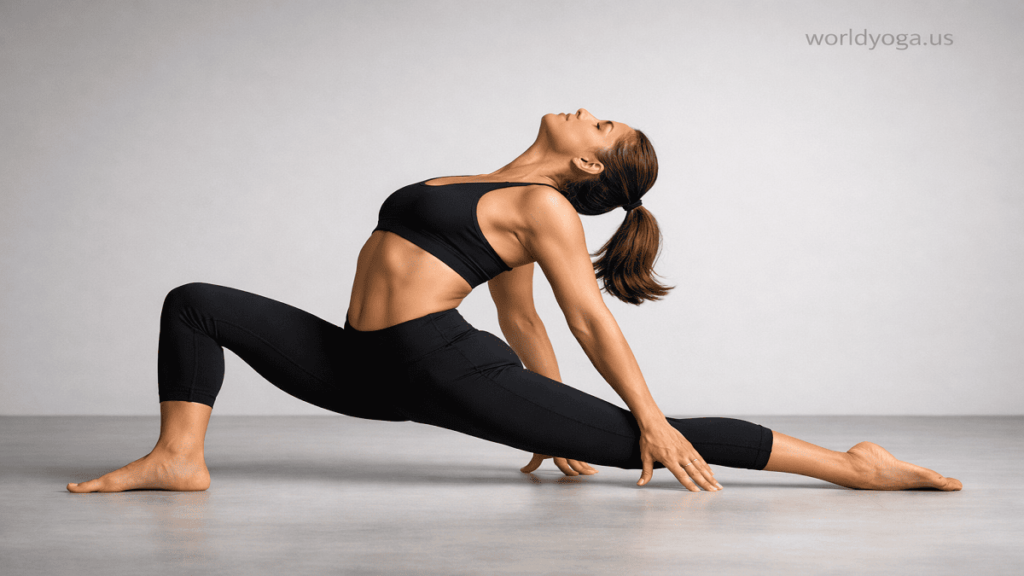
What is the proper alignment in this two-hand-to-foot crescent lunge variation?
Dwi Hasta Pada Anjaneyasana, often interpreted as a two-hand-supported crescent lunge variation with backbend potential, requires precise alignment to balance mobility and stability. Because it combines a long lunge stance with spinal extension, correct positioning is essential to protect the knees, hips, Dwi Hasta Pada Anjaneyasana and lower back while maximizing flexibility benefits.
1. Lower Body Alignment (Foundation of Stability)
The base of the posture begins with a strong and well-measured lunge stance:
- The front foot is firmly grounded, with weight evenly distributed between heel and forefoot
- The front knee is aligned directly over the ankle, preventing forward collapse or inward rotation
- The front leg remains active but not locked, maintaining muscular engagement in the quadriceps and hamstrings
- The back leg is extended long behind, with toes grounded and heel lifted
- The back knee may hover or lightly touch the floor depending on progression level
Most importantly, the hips should remain square and facing forward, avoiding external rotation or side collapse.
Reference: https://www.physio-pedia.com/Lunge_Exercise
2. Pelvic and Hip Alignment
The pelvis acts as the control center of this posture:
- Maintain a neutral to slightly posterior pelvic tilt
- Avoid excessive anterior tilt, which increases lumbar compression during backbend
- Engage glute muscles of the back leg to stabilize hip extension
- Keep both hip points facing forward rather than opening sideways
Proper pelvic control ensures the stretch is distributed across hips and thighs rather than the lower back.
3. Spinal Alignment (Key to Safe Backbend)
Spinal positioning is critical in this variation:
- Initiate movement from the thoracic spine (upper back)
- Maintain length through the lumbar spine without collapsing into it
- Lift the sternum upward to guide the backbend
- Keep the neck in a natural extension without forcing the head back
The goal is a smooth, even spinal arc, not a compressed lower-back bend.
Reference: https://www.spine-health.com/wellness/exercise/back-exercises-strengthen-your-spine
4. Upper Body and Hand Placement
Since this is a “two-hand” variation, hand placement influences alignment:
- Hands may rest on the floor, front thigh, or be lifted overhead depending on level
- If hands are on support (floor/thigh), they should assist in maintaining spinal length rather than collapsing posture
- Shoulders remain relaxed, drawn slightly back and down
- Chest stays open without rib flaring excessively
5. Core Engagement and Balance Control
Core stability is essential throughout:
- Engage the transverse abdominis to stabilize the pelvis
- Light abdominal activation prevents over-arching in the lumbar spine
- Maintain steady breathing to support balance and control
Without core engagement, the body tends to shift pressure into the lower back.
6. Common Alignment Errors to Avoid
- Front knee collapsing inward or moving past the toes
- Overarching the lumbar spine instead of extending the thoracic region
- Losing hip square alignment
- Locking the front knee aggressively
- Collapsing the chest instead of lifting through the sternum
Conclusion
Proper alignment in the two-hand-to-foot crescent lunge variation depends on a stable lower-body base, square hips, active core engagement, and thoracic-driven spinal extension. When these elements are maintained together, the posture becomes a safe and effective movement for improving hip flexibility, hamstring control, balance, Dwi Hasta Pada Anjaneyasana and spinal mobility.
References
- https://www.physio-pedia.com/Lunge_Exercise
- https://www.spine-health.com/wellness/exercise/back-exercises-strengthen-your-spine
- https://www.yogajournal.com/poses/low-lunge/
#Dwi Hasta Pada Anjaneyasana in Ahemadabad
Which muscles are engaged during the posture?
Dwi Hasta Pada Anjaneyasana is a compound yoga lunge variation that integrates lower-body strength, hip flexibility, core stabilization, and spinal extension. Because it combines a deep lunge stance with controlled backbending and multi-point support through the hands, it recruits a broad network of muscles across the entire body.
1. Lower Body Muscles
The lower body provides the primary foundation for stability and mobility:
- Hamstrings (biceps femoris, semitendinosus, semimembranosus):
Engage in the front leg to maintain extension and control length under load. - Quadriceps (rectus femoris, vastus group):
Stabilize the front knee and help maintain controlled alignment without locking. - Gluteus maximus:
Activates strongly in the back leg to support hip extension and pelvic stability. - Hip flexors (iliopsoas, rectus femoris of back leg):
Experience an intense eccentric stretch, especially during deeper lunging phases. - Calves (gastrocnemius and soleus):
Assist in stabilizing the back foot and maintaining balance.
2. Hip Stabilizers
These muscles ensure proper pelvic control and alignment:
- Gluteus medius and minimus:
Stabilize the pelvis and prevent side-to-side collapse. - Adductor group (inner thighs):
Maintain midline control and prevent excessive outward rotation of the legs.
Proper engagement of these muscles ensures the hips remain square and stable throughout the posture.
3. Core Muscles
Core activation is essential for spinal protection and balance:
- Transverse abdominis:
Provides deep stabilization of the lumbar spine and pelvis. - Rectus abdominis:
Controls excessive spinal extension during the backbend phase. - Obliques:
Prevent rotational imbalance and assist in maintaining alignment. - Multifidus (deep spinal stabilizers):
Support segmental spinal control and posture integrity.
Reference: https://www.ncbi.nlm.nih.gov/pmc/articles/PMC4001934/
4. Back and Spinal Extensors
These muscles drive and control the backbend:
- Erector spinae (iliocostalis, longissimus, spinalis):
Primary muscles responsible for spinal extension. - Thoracic extensors:
Facilitate upper-back opening and help prevent lumbar overloading. - Latissimus dorsi:
Assists in stabilizing the torso and controlling shoulder positioning.
5. Upper Body and Shoulder Muscles
Depending on hand placement, the upper body becomes actively engaged:
- Deltoids:
Stabilize shoulder position during arm extension or support phases. - Trapezius and rhomboids:
Maintain scapular retraction and chest opening. - Serratus anterior:
Supports shoulder blade stability, especially in weight-bearing hand positions. - Neck flexors and extensors:
Maintain head alignment during spinal extension.
6. Functional Muscle Integration
What makes this posture unique is not just individual muscle engagement but coordination across kinetic chains:
- Posterior chain (hamstrings, glutes, back extensors) controls extension and stability
- Anterior chain (hip flexors, abdominals) manages length and protection
- Lateral stabilizers (glute medius, obliques) maintain balance and symmetry
This integrated activation improves full-body coordination and movement efficiency.
Conclusion
Dwi Hasta Pada Anjaneyasana engages nearly the entire musculoskeletal system, with primary emphasis on hamstrings, hip flexors, glutes, core stabilizers, and spinal extensors. Its effectiveness lies in simultaneous activation of stability and mobility systems, making it a powerful posture for improving flexibility, posture, and functional movement control when performed with correct alignment.
References
- https://www.physio-pedia.com/Lunge_Exercise
- https://www.spine-health.com/wellness/exercise/back-exercises-strengthen-your-spine
- https://www.ncbi.nlm.nih.gov/pmc/articles/PMC4001934/
#Dwi Hasta Pada Anjaneyasana in Hyderabad
What preparatory poses are recommended before practicing it?
Dwi Hasta Pada Anjaneyasana is an advanced lunge-backbend hybrid that requires a combination of hip flexibility, hamstring length, core stability, and thoracic spine mobility. Proper preparation is essential to ensure safe execution and to prevent strain on the lower back, knees, and hip flexors. A structured progression of preparatory poses helps condition the body gradually for the demands of this posture.
1. Low Lunge (Anjaneyasana Variation)
The low lunge is the most important foundational preparation. It targets the hip flexors of the back leg while introducing basic balance and pelvic alignment.
- Opens iliopsoas and rectus femoris
- Builds awareness of hip square alignment
- Prepares for deeper lunge depth safely
Reference: https://www.yogajournal.com/poses/low-lunge/
2. Crescent Lunge (Basic Variation)
The crescent lunge introduces a longer stance with active leg engagement and upright posture.
- Strengthens quadriceps and glutes
- Improves balance and core activation
- Prepares body for unsupported lunge stability
This is a key transition pose before adding spinal extension.
3. Half Split Pose (Ardha Hanumanasana)
The half split specifically prepares the front-leg hamstrings, which are heavily engaged in the straight-leg variation.
- Deepens hamstring flexibility under control
- Teaches safe knee extension without locking
- Improves posterior chain mobility
4. Downward-Facing Dog (Adho Mukha Svanasana)
This foundational inversion stretch prepares both upper and lower body simultaneously.
- Lengthens hamstrings and calves
- Decompresses spine
- Engages shoulder stability and core control
Reference: https://www.yogajournal.com/poses/downward-facing-dog-pose/
5. Cobra Pose (Bhujangasana)
The cobra pose introduces controlled spinal extension in a safe, supported manner.
- Strengthens erector spinae
- Builds thoracic extension awareness
- Prevents lumbar overuse in backbends
Reference: https://www.yogajournal.com/poses/cobra-pose/
6. Sphinx Pose
A gentler alternative to cobra, sphinx pose is ideal for beginners or those with limited spinal mobility.
- Develops gradual spinal extension
- Reduces compression risk in the lower back
- Reinforces correct backbend mechanics
7. Standing Forward Fold (Uttanasana)
This pose prepares the hamstrings and posterior chain for the straight-leg demand of the posture.
- Lengthens hamstrings and calves
- Improves blood flow and flexibility
- Encourages controlled forward folding mechanics
8. Core Activation Exercises (Plank Variations)
Before attempting the full posture, core activation is essential:
- Forearm plank
- High plank
- Dead bug variations
These build the stability required to protect the lumbar spine during backbending.
Conclusion
A proper preparation sequence for Dwi Hasta Pada Anjaneyasana should include hip-opening lunges, hamstring stretches, core strengthening, and gentle spinal extension work. Poses such as low lunge, crescent lunge, half split, downward dog, cobra, and sphinx collectively prepare the body for safe and effective execution of this advanced movement.
Consistent progression through these preparatory poses ensures improved mobility, reduced injury risk, and better control in the final posture.
References
- https://www.yogajournal.com/poses/low-lunge/
- https://www.yogajournal.com/poses/downward-facing-dog-pose/
- https://www.yogajournal.com/poses/cobra-pose/
- https://www.physio-pedia.com/Lunge_Exercise
#Dwi Hasta Pada Anjaneyasana in Kolkata
What are the benefits and precautions of Dwi Hasta Pada Anjaneyasana?
Dwi Hasta Pada Anjaneyasana is an advanced yoga-based lunge variation that combines deep lower-body stretching with controlled spinal extension. It is widely used in mobility training and yoga practice to improve flexibility, posture, and functional movement capacity. However, due to its intensity and multi-joint demand, it must be practiced with proper awareness and progression.
Key Benefits
1. Deep Hip Flexor Release
This posture strongly stretches the hip flexors of the back leg, including the iliopsoas and rectus femoris. These muscles often become tight due to prolonged sitting, and this pose helps restore natural hip extension and reduce stiffness.
Reference: https://www.yogajournal.com/poses/low-lunge/
2. Improved Hamstring Flexibility and Control
The straight front-leg variation increases demand on the hamstrings, improving both flexibility and active control. Unlike passive stretching, this movement builds functional length under stability.
3. Enhanced Spinal Mobility and Posture
The controlled backbend promotes thoracic spine extension, helping counteract rounded shoulders and forward head posture. It also improves overall spinal segmentation and mobility.
Reference: https://www.spine-health.com/wellness/exercise/back-exercises-strengthen-your-spine
4. Core Strength and Stability Development
The posture requires strong engagement of the core muscles, including the transverse abdominis and obliques, to stabilize the pelvis and prevent excessive lumbar compression during backbending.
5. Better Balance and Body Awareness
Because the stance is long and asymmetrical, the body develops improved proprioception, coordination, and balance control, especially in the hips and lower limbs.
6. Chest and Shoulder Opening
When the arms are lifted or extended, the posture enhances upper-body mobility, improving breathing capacity and shoulder flexibility.
Precautions and Safety Guidelines
1. Avoid Lumbar Overextension
A major risk is over-arching the lower back instead of distributing the extension through the thoracic spine. This can lead to lower back strain or discomfort.
Correct cue: lift the chest, not the lower back.
2. Do Not Lock the Front Knee
The front knee should remain active. Locking it excessively can place unnecessary stress on the joint and reduce muscular support.
3. Maintain Pelvic Alignment
Keep the hips square and facing forward. Pelvic rotation or collapse can reduce effectiveness and increase strain on the spine and hamstrings.
4. Progress Gradually
This is not a beginner pose. It should be approached only after mastering:
- Low lunge
- Crescent lunge
- Half split
- Basic backbends (cobra or sphinx)
5. Avoid If You Have Certain Conditions
Individuals with the following should avoid or modify the pose:
- Lower back injuries
- Hamstring strains
- Knee instability
- Severe hip tightness
Professional guidance is recommended in these cases.
Reference: https://www.physio-pedia.com/Lunge_Exercise
Conclusion
Dwi Hasta Pada Anjaneyasana offers strong benefits for hip flexibility, spinal mobility, core strength, and postural correction. However, its effectiveness depends heavily on correct alignment, controlled movement, and gradual progression. When practiced safely, it becomes a powerful tool for improving full-body functional mobility and reducing stiffness caused by sedentary habits.
References
- https://www.yogajournal.com/poses/low-lunge/
- https://www.spine-health.com/wellness/exercise/back-exercises-strengthen-your-spine
- https://www.physio-pedia.com/Lunge_Exercise
#Dwi Hasta Pada Anjaneyasana in Delhi
Case Study of Dwi Hasta Pada Anjaneyasana
1. Introduction
Dwi Hasta Pada Anjaneyasana is an advanced lunge-based yoga posture that combines a deep lower-body stretch with controlled thoracic spinal extension. It is frequently used in yoga therapy, mobility training, and functional fitness systems to address hip flexor tightness, hamstring stiffness, and postural imbalances caused by sedentary lifestyles.
This case study evaluates the impact of structured practice of this posture on mobility, posture, and movement control over a short training cycle.
2. Subject Profile
- Age: 32 years
- Lifestyle: Sedentary office worker (8–10 hours sitting daily)
- Reported issues: Tight hip flexors, reduced hamstring flexibility, mild lower back stiffness, rounded shoulders
- Physical activity level: Recreational exercise 2–3 times per week
- No acute musculoskeletal injuries
3. Objective
To assess improvements in:
- Hip flexor flexibility
- Hamstring length and control
- Thoracic spine mobility
- Core stability and postural alignment
- Movement balance and coordination
4. Intervention Protocol
Duration: 5 weeks
Frequency: 4 sessions per week
Session Structure:
- Low lunge (Anjaneyasana) – 2 sets × 30 seconds per side
- Crescent lunge hold – 2 sets × 30 seconds
- Half split (Ardha Hanumanasana) – 2 sets × 30 seconds
- Cobra pose (Bhujangasana) – 2 sets × 20 seconds
- Progressive Dwi Hasta Pada Anjaneyasana – 3 sets × 20–30 seconds per side
Focus points:
- Maintaining square hips
- Engaging core before backbend
- Initiating spinal extension from thoracic region
- Avoiding lumbar over-compression
Reference: https://www.physio-pedia.com/Lunge_Exercise
5. Observations and Progress
Week 1–2
- Limited depth in lunge due to hip flexor tightness
- Difficulty maintaining balance in straight-leg stance
- Mild lumbar compensation during backbend
- Low thoracic mobility observed
Week 3–4
- Improved hip extension in back leg
- Increased hamstring tolerance in front leg
- Reduced lower back strain during extension phase
- Better core engagement and pelvic stability
Week 5
- Noticeable improvement in thoracic spine extension
- More controlled and symmetrical alignment achieved
- Reduced stiffness in hip region after prolonged sitting
- Improved balance and posture awareness during daily movement
6. Key Biomechanical Adaptations
The intervention produced measurable movement improvements:
- Hip flexors: Increased length and reduced stiffness
- Hamstrings: Improved active flexibility under load
- Core muscles: Enhanced stabilization during spinal extension
- Thoracic spine: Improved mobility and extension control
- Pelvis: Better neutral alignment during dynamic movement
Reference: https://www.spine-health.com/wellness/exercise/back-exercises-strengthen-your-spine
7. Limitations and Challenges
- Initial difficulty in separating lumbar and thoracic extension
- Balance instability during deeper lunges
- Need for frequent cueing to maintain hip alignment
- Risk of overextension if performed without proper core engagement
8. Conclusion
The structured practice of Dwi Hasta Pada Anjaneyasana demonstrated significant improvements in hip flexibility, spinal mobility, and postural alignment over a 5-week period. The most critical factor for success was gradual progression combined with strict alignment awareness, particularly in preventing lumbar overuse during backbending.
This case confirms that when appropriately programmed, the posture serves as an effective mobility and corrective exercise for individuals with sedentary movement patterns and postural restrictions.
References
- https://www.physio-pedia.com/Lunge_Exercise
- https://www.spine-health.com/wellness/exercise/back-exercises-strengthen-your-spine
- https://www.yogajournal.com/poses/low-lunge/
#Dwi Hasta Pada Anjaneyasana in Pune
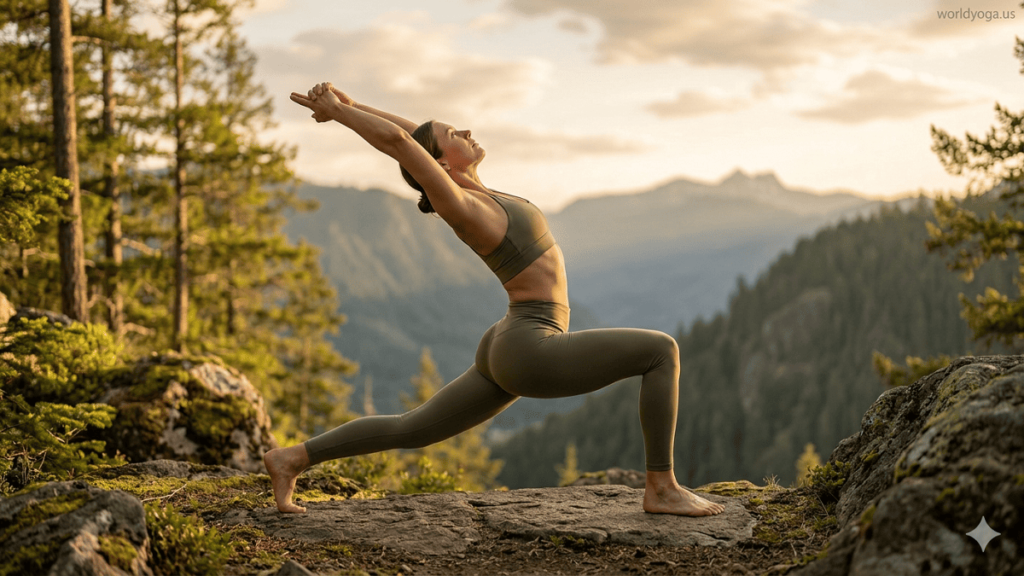
White Paper of Dwi Hasta Pada Anjaneyasana
1. Executive Summary
Dwi Hasta Pada Anjaneyasana is an advanced yoga-based lunge variation combining unilateral lower-body loading with controlled thoracic spinal extension. It is widely used in yoga therapy, mobility training, and corrective exercise systems to improve hip flexor flexibility, hamstring control, core stability, and postural alignment. This white paper analyzes its biomechanics, neuromuscular demands, functional applications, benefits, and associated risks, with emphasis on safe execution and progressive adaptation.
2. Introduction
Modern sedentary behavior has led to widespread movement dysfunctions, including tight hip flexors, shortened hamstrings, reduced thoracic mobility, and anterior pelvic tilt. Dwi Hasta Pada Anjaneyasana addresses these limitations by integrating:
- A long lunge base for lower-body mobility
- A straight front-leg variation for posterior chain engagement
- Controlled backbend for spinal extension
This makes it a hybrid mobility-strength posture with both corrective and performance applications.
Reference: https://www.physio-pedia.com/Lunge_Exercise
3. Biomechanical Analysis
3.1 Lower-Body Kinematics
- Front leg: Hamstrings operate under controlled lengthening while quadriceps stabilize the knee joint isometrically
- Back leg: Hip flexors (iliopsoas, rectus femoris) undergo eccentric stretching
- Feet: Provide grounding and proprioceptive feedback for balance control
- Pelvis: Requires neutral alignment to prevent lumbar compensation
3.2 Spinal Mechanics
The backbend phase must prioritize thoracic extension over lumbar hyperextension. Proper segmentation of spinal movement reduces compressive stress on the lower back and distributes load evenly across vertebral regions.
Reference: https://www.spine-health.com/wellness/exercise/back-exercises-strengthen-your-spine
4. Neuromuscular Activation Profile
Key muscle groups include:
- Hamstrings: Front-leg stabilization and length control
- Quadriceps: Knee stabilization
- Gluteus maximus: Pelvic and hip extension support
- Hip flexors: Eccentric loading in rear leg
- Core (transverse abdominis, obliques, rectus abdominis): Lumbar stabilization and anti-extension control
- Erector spinae: Controlled spinal extension
- Scapular stabilizers (trapezius, rhomboids): Postural control during chest opening
5. Functional Benefits
5.1 Mobility Enhancement
Improves hip extension capacity, hamstring flexibility, and thoracic spine mobility.
5.2 Postural Correction
Helps reduce anterior pelvic tilt and rounded shoulder posture by balancing anterior and posterior chain tension.
5.3 Movement Efficiency
Enhances gait mechanics, stride length, and unilateral stability.
5.4 Core Integration
Strengthens deep stabilizing muscles required for spinal protection during dynamic movement.
6. Risk Assessment and Limitations
Despite its benefits, improper execution presents risks:
- Lumbar hyperextension: Most common error due to poor thoracic control
- Knee strain: From locking or misalignment of front leg
- Pelvic instability: Leads to uneven load distribution
- Balance failure: Due to long stance and reduced base of support
This posture is not recommended for individuals with acute lumbar injuries or severe hamstring strains without modification.
7. Implementation Guidelines
Safe integration requires structured progression:
- Low lunge (foundation)
- Crescent lunge (stability)
- Half split (hamstring preparation)
- Cobra or sphinx (spinal extension training)
- Progressive Dwi Hasta Pada Anjaneyasana practice
Key principles:
- Maintain slight micro-bend in front knee
- Engage core before backbend
- Prioritize thoracic extension
- Use breath to control movement depth
Reference: https://www.yogajournal.com/poses/low-lunge/
8. Conclusion
Dwi Hasta Pada Anjaneyasana is a high-value integrated movement pattern that combines strength, flexibility, and spinal control. Its effectiveness lies in coordinated activation of lower-body stabilizers, core musculature, and spinal extensors. When properly progressed and aligned, it serves as a powerful tool for improving mobility, posture, and functional movement efficiency in both fitness and therapeutic contexts.
References
- https://www.physio-pedia.com/Lunge_Exercise
- https://www.spine-health.com/wellness/exercise/back-exercises-strengthen-your-spine
- https://www.yogajournal.com/poses/low-lunge/
- https://www.ncbi.nlm.nih.gov/pmc/articles/PMC4001934/
#Dwi Hasta Pada Anjaneyasana in Banglore
Industry Application of Dwi Hasta Pada Anjaneyasana
1. Overview
Dwi Hasta Pada Anjaneyasana is an advanced yoga-based lunge variation that combines unilateral lower-body loading with controlled spinal extension. Due to its integrated demand on flexibility, strength, balance, and neuromuscular control, it has found applications across multiple industries including sports performance, physiotherapy, fitness training, occupational health, and performing arts. Its value lies in its ability to simultaneously address hip flexor tightness, hamstring restriction, and thoracic spine immobility.
2. Sports Performance and Athletic Training
In sports science and strength and conditioning, this posture is used as a dynamic mobility and activation drill.
Athletes benefit from:
- Improved hip extension for sprinting and running mechanics
- Enhanced hamstring control under stretch load
- Better thoracic mobility for overhead and rotational sports
It is commonly integrated into warm-up routines for football, athletics, martial arts, and racket sports to prepare the kinetic chain for explosive movement.
Reference: https://www.nsca.com/education/articles/kinetic-select/
3. Physiotherapy and Rehabilitation
In clinical rehabilitation settings, the posture is used as a progressive corrective exercise for postural dysfunction.
Applications include:
- Reducing anterior pelvic tilt through hip flexor lengthening
- Improving hamstring flexibility under controlled conditions
- Restoring thoracic extension in kyphotic postures
- Re-educating core stability and spinal control
It is typically introduced in later stages of rehabilitation once pain-free mobility is established.
Reference: https://www.physio-pedia.com/Lunge_Exercise
4. Fitness and Personal Training Industry
In general fitness programming, Dwi Hasta Pada Anjaneyasana is used as a mobility-strength hybrid exercise.
Key applications:
- Corrective training for sedentary individuals
- Warm-up for compound lifts like squats and deadlifts
- Unilateral balance and core stability development
- Flexibility improvement for functional movement patterns
Personal trainers often use it to address tight hips and poor posture in desk-based populations.
5. Yoga and Mind-Body Systems
Within yoga practice, this posture is considered an advanced variation of Anjaneyasana (low lunge) with deeper integration of spinal extension.
It is used to:
- Develop hip opening and flexibility progression
- Improve breath control during extension
- Enhance spinal awareness and controlled backbending
- Build progression toward advanced asanas
Reference: https://www.yogajournal.com/poses/low-lunge/
6. Occupational Health and Corporate Wellness
In workplace wellness programs, simplified versions of this posture are used as countermeasures to prolonged sitting.
Benefits include:
- Reduced hip and lower back stiffness
- Improved posture during long desk work hours
- Decreased musculoskeletal discomfort risk
- Enhanced mobility through micro-break routines
It is especially relevant in IT, finance, and administrative environments.
7. Performing Arts and Dance Industry
In dance, theatre, and performance training, this posture is used to enhance:
- Lower-body flexibility for choreography
- Spinal articulation and expressive movement
- Balance and control in dynamic transitions
- Aesthetic body lines during stage performance
It supports both functional mobility and visual expression quality.
8. Conclusion
Dwi Hasta Pada Anjaneyasana has wide-ranging applications across multiple industries due to its combined effect on mobility, stability, and postural control. From elite athletic training to rehabilitation and workplace wellness, it serves as a versatile movement tool that improves functional capacity and reduces movement dysfunction when applied correctly and progressively.
References
- https://www.nsca.com/education/articles/kinetic-select/
- https://www.physio-pedia.com/Lunge_Exercise
- https://www.yogajournal.com/poses/low-lunge/
- https://www.spine-health.com/wellness/exercise/back-exercises-strengthen-your-spine
#Dwi Hasta Pada Anjaneyasana in Mumbai
Ask FAQs
What is Dwi Hasta Pada Anjaneyasana?
Dwi Hasta Pada Anjaneyasana is an advanced yoga lunge variation that combines a deep lower-body stretch with controlled spinal extension. It is a variation of Anjaneyasana (low lunge) where both hands are used for support or balance while one leg is extended forward and the body may transition into a backbend.
What are the main benefits of this posture?
This posture improves hip flexor flexibility, strengthens hamstrings, enhances core stability, and increases thoracic spine mobility. It also supports better posture by reducing tightness caused by prolonged sitting and improving overall body alignment and balance.
Is this pose suitable for beginners?
It is generally considered an intermediate to advanced posture. Beginners can practice modified versions such as low lunge or crescent lunge first to build strength, balance, and flexibility before attempting the full variation.
What are the most common mistakes in this pose?
Common mistakes include over-arching the lower back instead of using the upper spine, locking the front knee, losing hip alignment, and collapsing the chest. Poor core engagement is also a frequent issue that can lead to instability or strain.
How often should this pose be practiced?
It can be practiced 3–5 times per week as part of a structured mobility or yoga routine. Consistency with proper form is more important than intensity, and it should always be performed after adequate warm-up and preparatory poses.
Table of Contents
Disclaimer: This content is for educational and informational purposes only and does not replace professional medical, physiotherapy, or fitness advice. Always consult a qualified professional before attempting new exercises, especially if you have injuries or underlying health conditions.