
Half Bound Reverse Warrior Pose
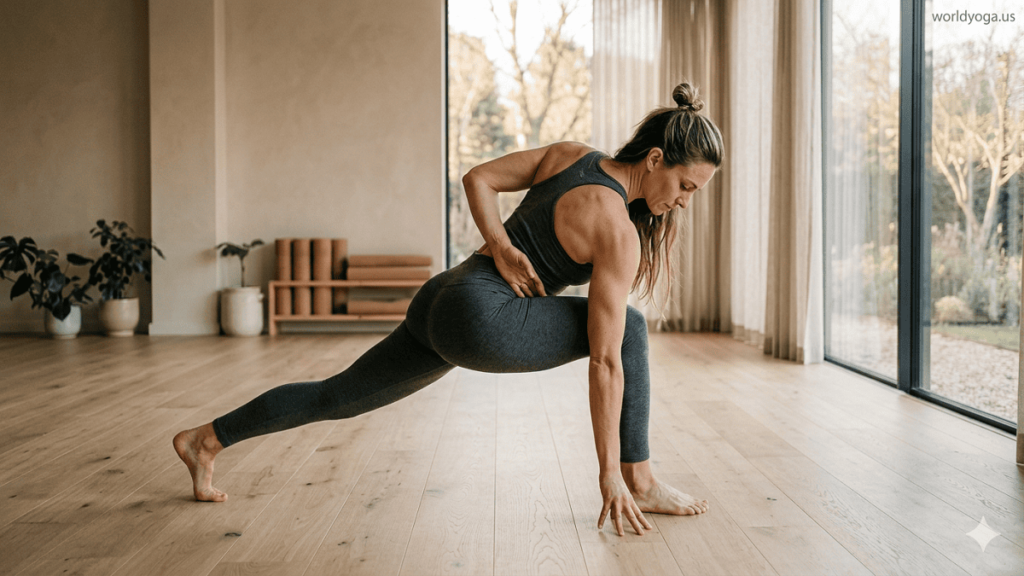
Ardha Baddha Viparita Virabhadrasana, commonly known as Half Bound Reverse Warrior Pose, is an advanced standing yoga posture that combines strength, flexibility, balance, and controlled breathing into a single dynamic movement. Rooted in traditional Warrior pose variations, this asana blends the stability of Warrior II with the expansive backbend of Reverse Warrior while adding a challenging half bind that enhances shoulder and chest mobility.
This posture is widely practiced in Vinyasa and flow-based yoga sequences because it develops both physical endurance and mental concentration. The deep lunge foundation strengthens the legs and improves lower-body stability, while the reverse extension opens the rib cage, spine, Half Bound Reverse Warrior Pose and shoulders. The half bind further intensifies the pose by encouraging greater flexibility in the upper body and improving postural awareness.
Half Bound Reverse Warrior Pose is not only a flexibility-focused posture but also a functional movement pattern that activates multiple muscle groups simultaneously. It engages the quadriceps, glutes, hamstrings, core muscles, and shoulders while promoting spinal elongation and breath expansion. As a result, the pose is often used to enhance mobility, body control, and coordination in intermediate to advanced yoga practice.
Because of its complexity, proper alignment and gradual preparation are essential. Practitioners typically build toward this pose through foundational postures such as Warrior II, Half Bound Reverse Warrior Pose Reverse Warrior, and shoulder-opening exercises. When practiced mindfully, the posture helps cultivate balance between strength and openness, making it both physically empowering and mentally grounding.
For additional guidance and alignment principles, trusted yoga resources such as Yoga Journal Pose Library and Yoga Alliance Official Site provide detailed educational support for safe yoga practice.
#Half Bound Reverse Warrior Pose in India
How is Half Bound Reverse Warrior Pose performed correctly?
Ardha Baddha Viparita Virabhadrasana is an advanced standing yoga posture that combines the stability of Warrior II with the chest-opening extension of Reverse Warrior and a controlled shoulder bind. Performing the pose correctly requires balance, flexibility, Half Bound Reverse Warrior Pose and mindful alignment to ensure both safety and effectiveness.
Begin by stepping into Warrior II Pose. Place the feet wide apart, turning the front foot forward and the back foot slightly inward. Bend the front knee until it stacks directly above the ankle while keeping the back leg straight and strong. Ground firmly through the outer edge of the back foot to stabilize the pelvis and maintain balance.
From Warrior II, transition into Reverse Warrior by inhaling and lifting the front arm upward and slightly backward. Allow the back hand to rest lightly along the back leg without placing excessive weight on it. Focus on lengthening the spine upward rather than collapsing into the lower back. The chest should remain open while the hips stay grounded and stable.
To enter the half bind, bring the lifted front arm behind the lower back and attempt to hold the opposite wrist or fingers. If the bind is not accessible, use a yoga strap to maintain proper alignment without strain. The shoulders should stay relaxed, Half Bound Reverse Warrior Pose and the chest should continue expanding rather than compressing forward.
Once in the full expression of the pose, maintain active engagement through both legs. The front knee should continue tracking in line with the toes, preventing inward collapse. Activate the core muscles to support the spine and avoid excessive lumbar compression during the backbend.
Breathing is essential throughout the posture. Inhale to create space in the chest and side body, and exhale to deepen stability and maintain control. Keep the neck neutral or gently turn the gaze upward only if it feels comfortable and does not strain the cervical spine.
Hold the posture for several steady breaths before slowly releasing the bind and returning to Warrior II. Repeat on the opposite side to maintain muscular balance and symmetrical mobility.
Preparatory poses such as Reverse Warrior, Extended Side Angle, low lunges, and shoulder-opening stretches can significantly improve readiness for this variation. Consistent practice helps develop the flexibility and strength required for safe execution.
For detailed instructional guidance and alignment support, trusted yoga resources such as Yoga Journal Pose Library and Yoga Alliance Official Site provide valuable educational information for practitioners at different levels.
#Half Bound Reverse Warrior Pose in Maharashtra

What is the proper alignment in this bound Warrior variation?
Proper alignment in Ardha Baddha Viparita Virabhadrasana is essential for maintaining stability, preventing injury, and achieving the full physical benefits of the posture. Since this advanced variation combines a deep lunge, Half Bound Reverse Warrior Pose spinal extension, and shoulder binding, alignment should focus on balanced muscular engagement rather than maximum flexibility.
The foundation of the pose begins with the feet and legs. The front foot should face forward while the back foot turns slightly inward, creating a stable Warrior II stance. The front knee must remain directly above the ankle and aligned with the toes to avoid unnecessary pressure on the knee joint. The back leg stays fully active and grounded through the outer edge of the foot, helping stabilize the hips and pelvis.
Pelvic positioning is another critical aspect of alignment. The hips remain open in a Warrior II orientation rather than forcing them completely forward. Keeping the pelvis stable prevents excessive strain on the lower back during the reverse extension. The practitioner should avoid dropping weight into the front hip, which can reduce balance and compromise structural support.
As the torso moves into the Reverse Warrior shape, the spine should lengthen upward before extending backward. Instead of collapsing into the lumbar region, focus on creating even extension throughout the entire spine. The chest should lift and broaden while the rib cage expands naturally with the breath. This spinal elongation protects the lower back and enhances mobility in the thoracic region.
The half bind requires careful shoulder alignment. The binding arm moves behind the lower back, but the shoulders should remain level and relaxed rather than pulled aggressively. The movement should originate from chest opening and shoulder mobility, Half Bound Reverse Warrior Pose not force. If flexibility is limited, using a yoga strap helps maintain proper alignment without overstretching the shoulder joint.
Core engagement is essential throughout the pose. Activating the abdominal muscles supports spinal stability and prevents over-arching in the backbend. At the same time, the legs remain strong and grounded to distribute weight evenly across the body.
The neck should stay neutral or gently extend upward only if comfortable. The gaze should not create tension in the cervical spine or disrupt overall balance.
Breath also influences alignment. Deep, controlled breathing helps maintain expansion through the chest and side body while stabilizing the posture internally.
For further alignment guidance and anatomical instruction, trusted yoga resources such as Yoga Journal Pose Library and Yoga Alliance Official Site provide detailed educational support for safe yoga practice.
When practiced with proper alignment, this bound Warrior variation becomes a powerful posture for developing strength, mobility, balance, and postural awareness simultaneously.
#Half Bound Reverse Warrior Pose in Ahemadabad
Which muscles are engaged during the posture?
Ardha Baddha Viparita Virabhadrasana is a full-body yoga posture that activates multiple muscle groups simultaneously to maintain balance, stability, flexibility, and controlled movement. Because the pose combines a deep lunge, spinal extension, and a half shoulder bind, it requires coordinated muscular engagement throughout the entire body.
The lower body is the primary source of strength and stability in this posture. The quadriceps of the front leg work intensely to support the bent knee and maintain proper alignment over the ankle. The gluteus maximus and gluteus medius stabilize the pelvis and help prevent the front knee from collapsing inward. In the back leg, the hamstrings and calf muscles remain actively engaged to keep the leg extended and grounded through the outer edge of the foot.
The hip muscles also play an important role. The hip flexors and adductors help control pelvic positioning, while the abductors contribute to lateral stability during the standing lunge position. These muscle groups work together to maintain balance and support smooth transitions into the reverse extension.
Core engagement is essential throughout the posture. The rectus abdominis, obliques, and transverse abdominis stabilize the torso and protect the spine from excessive compression during the backbend. A strong core helps distribute movement evenly through the spine rather than placing stress solely on the lower back.
In the upper body, the erector spinae muscles along the back support spinal extension and help maintain an elongated posture. The latissimus dorsi and serratus anterior assist in shoulder stabilization and upper-body control during the bind.
The shoulders and arms are also heavily involved. The deltoids help maintain arm positioning, while the rotator cuff muscles—including the infraspinatus and teres minor—stabilize the shoulder joint during the half bind. The chest muscles, particularly the pectoralis major and minor, experience both engagement and stretching as the chest opens in the posture.
The neck and upper trapezius muscles remain lightly active to stabilize the head and maintain a comfortable gaze direction. Meanwhile, the intrinsic muscles of the feet continuously engage to support balance and weight distribution.
This combination of muscular activation makes the posture highly effective for improving strength, mobility, endurance, and postural control. It also develops better body awareness by teaching coordinated engagement across multiple movement patterns.
For deeper anatomical insights and safe practice recommendations, trusted resources such as Yoga Journal Pose Library and Yoga Alliance Official Site provide detailed educational guidance on yoga anatomy and alignment.
#Half Bound Reverse Warrior Pose in Hyderabad
What preparatory poses are recommended before practicing it?
Before practicing Ardha Baddha Viparita Virabhadrasana, it is important to prepare the body with foundational yoga postures that improve leg strength, hip mobility, shoulder flexibility, spinal extension, and balance. Since this advanced posture combines a deep lunge, a reverse backbend, and a half bind, proper preparation reduces the risk of strain and improves overall alignment.
One of the most essential preparatory poses is Warrior II Pose. This posture develops lower-body stability, strengthens the quadriceps and glutes, and teaches correct knee alignment. Because Half Bound Reverse Warrior is built on the Warrior II foundation, mastering this stance is crucial before progressing further.
Reverse Warrior Pose is another key preparation posture. It introduces the spinal extension and lateral side-body stretch required in the final variation. Practicing Reverse Warrior helps students learn how to open the chest and lengthen the spine without collapsing into the lower back.
Extended Side Angle Pose is highly effective for improving hip opening and side-body flexibility. It also strengthens the legs and enhances balance while encouraging proper pelvic positioning. This posture additionally helps develop awareness of grounding through the feet, which is essential for maintaining stability in standing poses.
For shoulder mobility and the binding action, Gomukhasana arms (Cow Face Pose arms) are strongly recommended. This shoulder-opening exercise increases internal and external rotation while improving flexibility in the chest and upper back. Practicing shoulder stretches regularly makes the half bind more accessible and safer.
Low Lunge variations such as Anjaneyasana help open the hip flexors and improve pelvic mobility. Tight hip flexors can limit the depth and comfort of standing lunge-based postures, so these stretches are valuable for creating greater freedom of movement.
Core-strengthening poses such as Plank Pose and Boat Pose also provide important preparation. Strong abdominal engagement supports spinal stability and prevents excessive compression during the backbend portion of the pose.
Forward folds like Prasarita Padottanasana or Uttanasana can help lengthen the hamstrings and release tension in the posterior chain. This allows for better lower-body alignment and improved mobility in standing sequences.
In addition to physical preparation, breath awareness practices are beneficial. Controlled breathing improves balance, concentration, and stability while transitioning into complex postures.
For detailed alignment techniques and yoga preparation methods, trusted resources such as Yoga Journal Pose Library and Yoga Alliance Official Site provide reliable educational guidance for safe progression.
With consistent preparation and mindful practice, these foundational poses create the mobility, strength, and body awareness necessary to approach Half Bound Reverse Warrior Pose safely and effectively.
#Half Bound Reverse Warrior Pose in Delhi
What are the benefits and precautions of Half Bound Reverse Warrior Pose?
Ardha Baddha Viparita Virabhadrasana is an advanced standing yoga posture that combines strength, flexibility, balance, and spinal mobility into one integrated movement. Practiced correctly, it offers significant physical and mental benefits while also requiring careful attention to alignment and safety precautions.
One of the primary benefits of this posture is improved lower-body strength. The deep lunge position strongly activates the quadriceps, glutes, hamstrings, and calves, helping develop muscular endurance and stability in the legs. This engagement also improves balance and coordination, especially during dynamic yoga transitions.
The posture is also highly effective for increasing spinal mobility and chest expansion. The Reverse Warrior component creates a deep side-body stretch while encouraging thoracic extension. This can help improve posture and counteract stiffness caused by prolonged sitting or poor movement habits. The chest-opening action may also support better breathing capacity by expanding the rib cage and improving respiratory awareness.
Another major benefit is enhanced shoulder flexibility. The half bind challenges shoulder mobility and encourages opening across the chest, upper back, and rotator cuff muscles. Over time, consistent practice can improve upper-body movement patterns and postural alignment.
Core activation is another important aspect of the pose. Maintaining balance and spinal support during the backbend requires continuous engagement of the abdominal muscles, which helps strengthen the core and improve body control.
Beyond physical improvements, the pose also promotes concentration and mindfulness. Coordinating the bind, balance, and breath requires mental focus, helping practitioners cultivate greater awareness and emotional grounding during practice.
Despite these advantages, several precautions should be observed. Individuals with shoulder injuries or limited shoulder mobility should avoid forcing the bind, as excessive internal rotation may increase the risk of strain or impingement. Using a yoga strap is recommended when flexibility is limited.
People with lower back pain should practice cautiously because improper spinal extension can lead to lumbar compression. Engaging the core and lengthening the spine before deepening the backbend are essential for protecting the lower back.
Knee alignment is another critical safety factor. The front knee must stay directly above the ankle and aligned with the toes to prevent unnecessary joint stress. Collapsing inward at the knee can increase the risk of ligament strain.
Beginners and practitioners with tight hips or hamstrings should spend time preparing with foundational postures before attempting the full variation. Warm-up sequences and mobility exercises are essential for reducing injury risk.
For professional alignment guidance and safe progression techniques, trusted resources such as Yoga Journal Pose Library and Yoga Alliance Official Site offer detailed educational support.
When practiced mindfully and progressively, Half Bound Reverse Warrior Pose becomes a powerful posture for developing strength, flexibility, posture, and body awareness while promoting balanced movement throughout the body.
#Half Bound Reverse Warrior Pose in Pune
Case Study of Half Bound Reverse Warrior Pose
This case study examines the impact of incorporating Ardha Baddha Viparita Virabhadrasana into an intermediate-level yoga training program focused on improving flexibility, balance, postural control, and functional strength. The objective was to evaluate how consistent practice of this advanced standing posture influenced mobility, muscular endurance, and body awareness over a structured eight-week period.
The study involved 10 intermediate yoga practitioners between the ages of 26 and 40 who had at least one year of regular yoga experience. Initial assessments identified common movement limitations among participants, including tight hip flexors, restricted shoulder mobility, limited thoracic extension, and difficulty maintaining balance in asymmetrical standing poses.
During the first phase of the program, participants focused on foundational postures such as Warrior II, Reverse Warrior, Extended Side Angle, low lunges, and shoulder-opening exercises including Gomukhasana arms. These preparatory movements were used to build lower-body strength, increase hip flexibility, and improve shoulder mobility before introducing the complete bound variation.
By the third week, modified versions of Half Bound Reverse Warrior Pose were introduced using yoga straps to assist with the bind. Participants practiced maintaining proper alignment by stabilizing the pelvis, engaging the core, and lengthening the spine before deepening the backbend. Emphasis was placed on controlled breathing and balanced muscular engagement rather than achieving maximum flexibility.
At the end of the eight-week training period, participants demonstrated measurable improvements in several areas. Most practitioners showed increased stability in standing postures, improved shoulder range of motion, and better thoracic mobility. Many participants also reported reduced stiffness in the hips and lower back, particularly after prolonged sitting during daily activities.
Functional improvements were observed in posture and movement efficiency. The strengthening effect on the legs and core contributed to greater balance control, while the chest-opening component enhanced breathing awareness and upper-body posture. Several participants also noted improved concentration and mental focus during yoga sessions due to the coordination required in the pose.
However, the study also highlighted the importance of gradual progression and alignment awareness. Two participants experienced mild shoulder discomfort when attempting to force the bind prematurely, demonstrating that mobility limitations must be respected. Adjustments and strap-assisted variations successfully reduced strain and allowed continued participation without injury.
The findings suggest that consistent practice of Half Bound Reverse Warrior Pose can support improvements in mobility, stability, strength, and body awareness when integrated into a properly structured yoga program. The pose proved especially effective as a functional movement pattern combining flexibility and muscular control simultaneously.
For additional anatomical guidance and safe yoga sequencing recommendations, trusted resources such as Yoga Journal Pose Library and Yoga Alliance Official Site provide valuable educational information for practitioners and instructors.
#Half Bound Reverse Warrior Pose in Banglore
White Paper of Half Bound Reverse Warrior Pose
Abstract
Ardha Baddha Viparita Virabhadrasana is an advanced standing yoga posture that integrates lower-body stability, thoracic extension, shoulder mobility, and neuromuscular coordination. This white paper explores the biomechanical structure, muscular engagement, functional applications, therapeutic relevance, and safety considerations associated with the pose. As yoga increasingly intersects with modern fitness, rehabilitation, and wellness industries, this posture demonstrates significant value as a movement-based tool for improving mobility, balance, posture, and muscular control.
Introduction
Half Bound Reverse Warrior Pose is derived from the traditional Warrior sequence and combines elements of Warrior II, Reverse Warrior, and a shoulder-binding variation. The posture requires synchronized activation of the lower body, core, spine, and shoulders while maintaining controlled breathing and postural alignment. Due to its complexity, it is primarily practiced by intermediate and advanced yoga practitioners within Vinyasa and flow-based systems.
Biomechanical Analysis
The pose is built on a wide asymmetrical stance requiring strong lower-limb engagement. The front leg maintains knee flexion while the back leg stabilizes through isometric muscular activation. Proper weight distribution between both legs is essential for maintaining balance and pelvic stability.
The spine performs controlled lateral extension and mild backbending, primarily emphasizing thoracic mobility while minimizing lumbar compression. Simultaneously, the shoulder girdle undergoes internal rotation during the half bind, requiring flexibility in the chest, rotator cuff, and scapular stabilizers.
Core musculature plays a central role in maintaining spinal integrity and preventing excessive collapse into the lower back. This integrated movement pattern makes the posture biomechanically demanding yet highly effective for developing coordinated mobility and strength.
Muscular Engagement
Primary muscles engaged during the posture include:
- Quadriceps and gluteal muscles for lower-body stabilization
- Hamstrings and calves for grounding and balance
- Rectus abdominis and obliques for core support
- Erector spinae for spinal extension
- Deltoids and rotator cuff muscles for shoulder stabilization
- Latissimus dorsi and pectoral muscles for upper-body control and chest opening
The posture also activates smaller stabilizing muscles throughout the feet, hips, and shoulders to maintain balance and alignment.
Functional Applications
In modern wellness and movement practices, Half Bound Reverse Warrior Pose is widely used for improving posture, mobility, and movement efficiency. The pose supports thoracic extension, hip opening, and shoulder flexibility, making it beneficial for individuals experiencing stiffness caused by prolonged sitting or repetitive movement patterns.
The posture is also applied in functional fitness and athletic mobility programs because it develops unilateral strength, rotational control, and proprioceptive awareness.
Risks and Contraindications
Despite its benefits, the posture requires careful progression. Individuals with shoulder injuries, lower back pain, knee instability, or limited hip mobility should approach the pose cautiously. Forcing the bind or overextending the spine may increase the risk of strain or joint compression.
Using props such as yoga straps and modifying the depth of the backbend can improve accessibility and safety.
Conclusion
Ardha Baddha Viparita Virabhadrasana represents a comprehensive movement pattern that combines flexibility, balance, strength, and controlled breathing. Its applications extend beyond traditional yoga into rehabilitation, athletic training, and posture-focused wellness programs. When practiced progressively and with proper alignment, the pose provides substantial physical and functional benefits.
References
#Half Bound Reverse Warrior Pose in Kolkata
Industry Application of Half Bound Reverse Warrior Pose
Ardha Baddha Viparita Virabhadrasana has evolved from a traditional yoga posture into a valuable movement practice used across multiple industries, including fitness, rehabilitation, sports performance, wellness, and corporate health programs. Its combination of balance, strength, flexibility, and coordinated mobility makes it highly adaptable for modern movement-based applications.
Fitness and Functional Training Industry
In the fitness industry, Half Bound Reverse Warrior Pose is frequently incorporated into mobility and functional training programs. Trainers use the posture to improve lower-body strength, hip mobility, spinal flexibility, and shoulder stability. The asymmetrical stance develops unilateral leg strength, while the reverse extension enhances thoracic mobility and postural control.
Functional fitness coaches often integrate this pose into warm-up flows and recovery sessions because it activates multiple muscle groups simultaneously. It also helps clients improve balance, coordination, and movement efficiency, which are essential for athletic and everyday performance.
Yoga and Wellness Industry
Within yoga studios and wellness centers, this posture is used in intermediate and advanced Vinyasa sequences to build endurance, flexibility, and mental concentration. The pose encourages breath awareness and mindful movement, making it valuable for stress reduction and body awareness practices.
Wellness programs also utilize this posture to improve posture and mobility in individuals affected by sedentary lifestyles. Its chest-opening and spinal extension components are especially beneficial for reducing stiffness caused by prolonged desk work.
Physiotherapy and Rehabilitation Sector
Modified variations of Half Bound Reverse Warrior Pose are increasingly applied in physiotherapy and rehabilitation settings. Physical therapists may use the posture to improve thoracic extension, hip flexibility, and shoulder mobility in patients recovering from mild postural dysfunctions or movement restrictions.
Supported versions using yoga straps or wall assistance help patients safely improve joint mobility and neuromuscular coordination without excessive strain. The pose is especially useful in rehabilitation programs focused on posture correction and controlled movement retraining.
Sports Performance and Athletic Training
Athletes in sports requiring rotational power, balance, and lower-body stability can benefit from this posture. Strength and conditioning specialists use it to improve flexibility, core engagement, and unilateral strength in disciplines such as martial arts, tennis, cricket, gymnastics, and running.
The posture also supports injury prevention by increasing mobility in the hips, shoulders, and thoracic spine while reinforcing muscular stability around major joints.
Corporate Wellness Programs
Corporate wellness initiatives increasingly include yoga-based movement sessions to address workplace-related musculoskeletal issues. Simplified versions of Half Bound Reverse Warrior Pose are used to improve posture, reduce back stiffness, and increase mobility among office workers.
Its integration into workplace wellness programs can contribute to improved concentration, reduced physical fatigue, and better overall movement health for employees.
Conclusion
Across industries, Ardha Baddha Viparita Virabhadrasana is recognized as more than a traditional yoga posture. It functions as a comprehensive movement tool that supports strength, flexibility, rehabilitation, posture correction, and performance enhancement. Its adaptability and functional benefits continue to expand its role in modern health, fitness, and wellness practices.
References
#Half Bound Reverse Warrior Pose in Mumbai
Ask FAQs
What is Half Bound Reverse Warrior Pose?
Half Bound Reverse Warrior Pose is an advanced standing yoga posture that combines the foundation of Warrior II with a Reverse Warrior backbend and a half shoulder bind. It improves strength, flexibility, balance, and body awareness.
Is Half Bound Reverse Warrior Pose suitable for beginners?
This posture is generally recommended for intermediate to advanced practitioners because it requires good balance, shoulder mobility, and lower-body strength. Beginners should first practice foundational poses such as Warrior II and Reverse Warrior.
What are the main benefits of this posture?
The pose helps strengthen the legs and core, improve spinal mobility, open the chest and shoulders, and enhance balance and concentration. It also supports better posture and breathing awareness.
Can I practice this pose if I have shoulder or back pain?
Individuals with shoulder injuries, lower back pain, or knee issues should practice cautiously and seek guidance from a qualified yoga instructor or healthcare professional. Modifications and yoga straps can help reduce strain.
What preparatory poses should be practiced before attempting it?
Recommended preparatory poses include Warrior II, Reverse Warrior, Extended Side Angle Pose, low lunges, and shoulder-opening stretches such as Gomukhasana arms. These help improve flexibility, strength, and alignment for safer practice.
Table of Contents
Disclaimer: The information provided about Ardha Baddha Viparita Virabhadrasana is for educational and informational purposes only and should not replace professional medical or fitness advice. Always practice under the guidance of a qualified yoga instructor, especially when attempting advanced poses. Individuals with injuries, medical conditions, or physical limitations should consult a healthcare professional before practice.