
Ardha Baddha Viparita Virabhadrasana
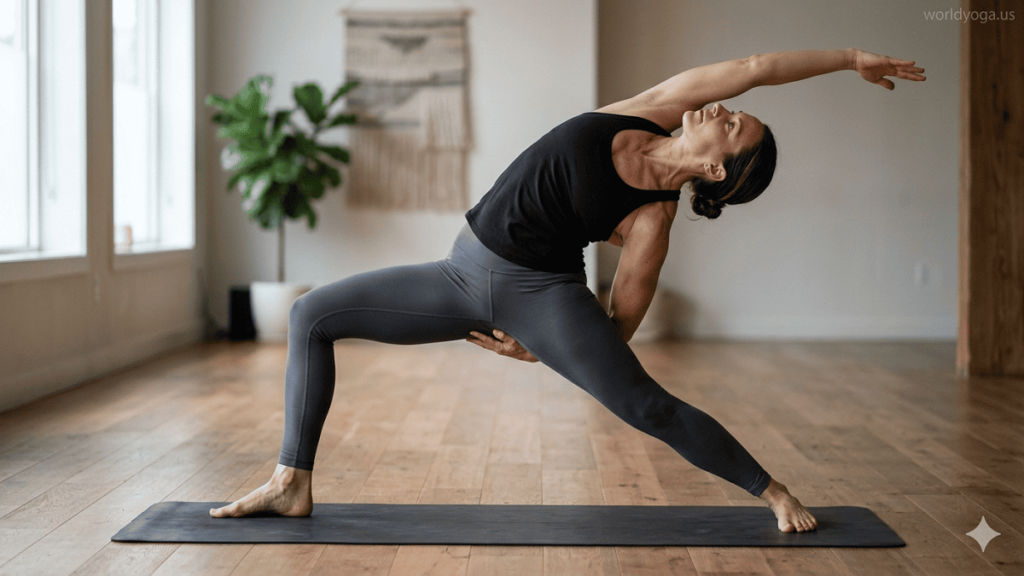
Ardha Baddha Viparita Virabhadrasana is an advanced standing yoga posture that combines balance, spinal extension, deep hip opening, and a bound shoulder variation. Often translated as “Half Bound Reverse Warrior Pose,” it blends elements of Reverse Warrior (Viparita Virabhadrasana) with a bind that requires flexibility in the shoulders, chest, Ardha Baddha Viparita Virabhadrasana and hamstrings. This asana is commonly practiced in dynamic Vinyasa and Ashtanga sequences, where breath and movement are synchronized to build both strength and awareness.
At its core, this posture begins from Warrior II, a foundational stance that establishes grounding through the legs and stability through the pelvis. From here, the practitioner extends the front arm overhead into a gentle backbend while maintaining strong engagement in the lower body. The “half bound” element introduces a deeper layer of complexity: the front arm moves behind the back to bind with the opposite hand or wrist, requiring significant shoulder mobility and thoracic spine openness.
One of the key benefits of Ardha Baddha Viparita Virabhadrasana is its ability to improve spinal flexibility while strengthening the legs. The pose demands sustained engagement of the quadriceps, hamstrings, and gluteal muscles, making it an effective lower-body strengthening posture. At the same time, the backbend encourages expansion across the chest and intercostal muscles, Ardha Baddha Viparita Virabhadrasana which supports improved breathing capacity and posture alignment.
From an energetic perspective, Ardha Baddha Viparita Virabhadrasana this asana is believed to stimulate the heart chakra due to its expansive chest opening. Practitioners often report a sense of emotional release and increased vitality after holding the pose for several breaths. The binding action also promotes focus and internal awareness, Ardha Baddha Viparita Virabhadrasana as maintaining stability requires concentration and controlled breathing.
However, this pose is not recommended for beginners without preparation. Individuals with shoulder injuries, lower back pain, or hamstring tightness should approach it cautiously. Preparatory poses such as Extended Side Angle, Reverse Warrior, Gomukhasana arms, and supported backbends can help build the required flexibility and strength. Using a yoga strap can also make the binding action more accessible.
In modern yoga practice, Ardha Baddha Viparita Virabhadrasana is often used as a transition posture that deepens flow sequences and challenges stability. It teaches the practitioner how to balance openness with control, making it both physically demanding and mentally grounding.
For further study on alignment and variations, credible yoga resources include Yoga Journal Pose Library and Yoga Alliance Educational Resources, both of which provide detailed anatomical and instructional insights for safe practice.
When practiced consistently with mindful alignment, this posture becomes more than a physical challenge; it evolves into a practice of patience, Ardha Baddha Viparita Virabhadrasana breath awareness, and embodied strength.
#Ardha Baddha Viparita Virabhadrasana in Banglore
How is Ardha Baddha Viparita Virabhadrasana performed correctly?
Ardha Baddha Viparita Virabhadrasana is a technically demanding standing yoga posture that requires coordinated strength, flexibility, and breath control. Performing it correctly depends on a stable foundation in Warrior II and a careful progression into the bind and backbend without compromising spinal alignment or knee safety. Below is a structured breakdown of proper execution.
The pose begins in Warrior II. Step the feet wide apart, turn the front foot forward (usually 90 degrees) and the back foot slightly inward. The front knee should be aligned directly over the ankle, not collapsing inward. Engage the legs strongly by pressing the outer edge of the back foot into the mat while lifting the inner arches of both feet. This foundation ensures stability before transitioning into the deeper variation.
From Warrior II, move into Reverse Warrior. Inhale and gently slide the back hand down the back leg while extending the front arm upward and slightly backward. The chest opens toward the ceiling, but the hips remain grounded and square. Avoid collapsing into the lower back; instead, lengthen through the entire spine, creating space between each vertebra.
The “half bound” element is introduced next. Bring the front arm behind the lower back and attempt to clasp the opposite hand or wrist. If the bind is not accessible, a yoga strap can be used to bridge the gap. The shoulders should remain relaxed rather than forced, and the chest should continue to open rather than compress. This step is where control and patience become essential.
Once the bind is secure, maintain the Reverse Warrior extension. The gaze can move upward toward the lifted arm if the neck feels comfortable, or remain neutral to reduce strain. The key alignment principle is maintaining length in the spine while avoiding excessive compression in the lower back.
Breath plays a critical role in stabilizing the posture. Inhale to expand the chest and create space in the ribcage; exhale to deepen the bind gently without forcing movement. Hold for several steady breaths, ensuring the front knee does not collapse inward and the back leg remains fully engaged.
To release, carefully unwind the bind first, return both arms to a neutral Warrior II position, and step out of the stance slowly. Counter poses such as Forward Fold or Tadasana can help neutralize the spine.
Correct performance is built on preparation. Poses like Extended Side Angle, Reverse Warrior, Gomukhasana arms, and hamstring stretches significantly improve accessibility and safety. Over time, consistency develops both flexibility and muscular control, making the posture more stable and refined.
For detailed alignment references and instructional guidance, reliable resources include Yoga Journal Pose Library and Yoga Alliance Official Site, which provide structured educational insights for safe yoga practice.
#Ardha Baddha Viparita Virabhadrasana in India
What is the proper alignment in this half-bound Reverse Warrior variation?
Proper alignment in Ardha Baddha Viparita Virabhadrasana is less about how deep the backbend or bind looks and more about maintaining structural integrity across the legs, pelvis, spine, shoulders, and neck. Because this posture combines a standing lunge, Ardha Baddha Viparita Virabhadrasana a lateral extension, and a shoulder bind, alignment must be built from the ground up to avoid strain and ensure stability.
The foundation begins with the feet and legs. The front foot is turned forward with the knee stacked directly over the ankle, tracking in line with the second or third toe. The back foot is grounded at a slight inward angle, with the outer edge firmly pressing into the mat. Both legs remain active: the front thigh engages to stabilize the knee joint, Ardha Baddha Viparita Virabhadrasana while the back leg stays straight and energized to support balance. The arches of both feet should feel lifted rather than collapsed inward.
From the pelvis upward, alignment focuses on stability rather than over-rotation. The hips do not fully square to the side but remain open in a natural Warrior II stance. The pelvis should feel rooted and heavy, preventing excessive compression in the lower back when transitioning into the reverse extension. A common mistake is allowing the front hip to sink forward, which disrupts balance and places unnecessary pressure on the lumbar spine.
In the spine and torso, elongation is the primary goal. As the front arm lifts into Reverse Warrior, the ribs expand upward and slightly back without collapsing. The side body remains long rather than shortened. The spine should feel like it is stretching in two directions—down through the back leg and up through the front fingertips—creating traction rather than compression.
The half bind introduces the shoulder alignment challenge. The front arm moves behind the lower back, but the shoulders must remain relaxed and level. Forcing the bind can cause internal rotation stress in the shoulder joint, so the movement should originate from openness in the chest and upper back, not force from the arm. If necessary, Ardha Baddha Viparita Virabhadrasana a strap can maintain alignment without strain.
The head and neck remain neutral or gently turned upward only if there is no compression. The gaze should not disturb spinal length. Instead, the neck follows the natural extension of the spine.
Breath reinforces alignment. Inhale to create space along the side body and chest; exhale to maintain stability in the legs and deepen the bind without collapsing posture.
For further anatomical understanding and safe alignment principles, refer to trusted yoga education sources such as Yoga Journal Pose Library and Yoga Alliance Standards, which offer detailed breakdowns of posture mechanics and teaching guidelines.
Correct alignment in this pose ultimately balances openness and control, Ardha Baddha Viparita Virabhadrasana ensuring that flexibility never overrides structural safety.
#Ardha Baddha Viparita Virabhadrasana in Delhi
Which muscles are engaged during the posture?
Ardha Baddha Viparita Virabhadrasana is a compound standing posture that simultaneously activates multiple muscle groups across the lower body, core, back, and shoulders. Because it blends a deep lunge, lateral extension, and a half bind, Ardha Baddha Viparita Virabhadrasana the engagement pattern is both stabilizing and mobilizing, making it a full-body integration pose rather than an isolated stretch.
The most prominent engagement occurs in the lower body. The quadriceps of the front leg work strongly to maintain knee alignment and support the deep lunge position. The gluteus maximus and gluteus medius help stabilize the pelvis and prevent the front knee from collapsing inward. In the back leg, the hamstrings and calf muscles remain active to maintain extension and grounding through the outer edge of the foot. The intrinsic muscles of the feet also engage to support balance and arch lift, which is essential for long-duration holds.
The core musculature plays a significant stabilizing role. The rectus abdominis and obliques engage to control the lateral bend and prevent excessive compression in the lumbar spine. The transverse abdominis acts as a deep stabilizer, helping maintain internal pressure and spinal integrity during the bind and extension. This core activation is subtle but continuous, especially when transitioning between Reverse Warrior and the half bind variation.
In the upper body, the latissimus dorsi and serratus anterior contribute to controlling the arm movement and stabilizing the shoulder girdle. The deltoids, particularly the anterior and lateral fibers, support the overhead extension of the front arm in Reverse Warrior. When the half bind is introduced, Ardha Baddha Viparita Virabhadrasana the posterior shoulder muscles, including the infraspinatus and teres minor, engage to stabilize internal rotation and maintain joint safety.
The spinal muscles, including the erector spinae, are actively lengthened and lightly engaged to maintain the backbend without collapsing. This controlled engagement allows for extension through the thoracic spine while protecting the lumbar region from over-compression.
The chest muscles, particularly the pectoralis major and minor, are dynamically stretched in the bind while still assisting in controlled opening of the chest cavity. This contributes to improved posture awareness and respiratory expansion.
Even the neck muscles, including the sternocleidomastoid and upper trapezius, are subtly involved in maintaining head position and gaze stability.
For deeper anatomical understanding and safe practice progression, reliable references include Yoga Journal Pose Library and Yoga Alliance Educational Resources, which provide structured breakdowns of muscle engagement and alignment principles in yoga asana practice.
Overall, this posture is best understood as a coordinated activation of strength, stability, and mobility rather than isolated muscle work, making it both physically demanding and functionally integrative.
#Ardha Baddha Viparita Virabhadrasana in Maharashtra

What preparatory poses are recommended before practicing it?
Preparing for Ardha Baddha Viparita Virabhadrasana requires a structured progression of mobility, strength, and balance work. Because this posture combines a deep standing lunge, spinal extension, and a shoulder bind, the body must develop openness in the hips and shoulders while maintaining strong leg and core stability. Without adequate preparation, practitioners are more likely to strain the lower back, knees, or shoulders.
A logical starting point is foundational standing postures such as Warrior I and Warrior II. These poses build essential leg strength, teach correct knee tracking, and develop awareness of pelvic alignment. Warrior II in particular is crucial because it introduces the same base stance used in the target pose, allowing the practitioner to understand weight distribution between front and back legs.
To prepare the lower body further, Extended Side Angle Pose is highly effective. It deepens lateral stability, strengthens the quadriceps, and encourages controlled opening of the hips and groin. This posture also introduces a safe spinal lengthening pattern that is directly relevant to the Reverse Warrior variation.
Reverse Warrior itself is another essential preparatory posture. It trains controlled spinal extension while maintaining grounded legs. Practicing it separately helps develop awareness of how to lift the chest without compressing the lower back, which is a key requirement in the final pose.
For the shoulder bind component, Gomukhasana arms and Cow Face Pose variations are highly beneficial. These postures gradually increase internal and external shoulder rotation while opening the chest and upper back. They prepare the practitioner for the half bind without forcing range of motion, reducing the risk of shoulder strain during practice.
Low lunges such as Anjaneyasana also play an important role. They open the hip flexors, particularly the iliopsoas, which often restricts movement in deep standing poses. Improved hip flexibility allows the pelvis to remain stable while transitioning into the reverse extension and bind.
In addition, core-strengthening poses such as Plank Pose and Boat Pose help stabilize the trunk. A strong core is essential for maintaining spinal integrity during the backbend element of the posture. Without this support, the lumbar spine may take excessive load.
Forward folds like Prasarita Padottanasana can also be included to lengthen the hamstrings and prepare the posterior chain. This ensures that the back leg in Warrior II remains extended and active without strain.
For structured guidance on sequencing and safe preparation, credible yoga resources such as Yoga Journal Pose Library and Yoga Alliance Official Site offer detailed instructional frameworks and alignment principles.
In summary, preparing for this pose is not about isolated stretching but about building progressive readiness. A combination of standing strength work, hip opening, shoulder mobility, and core stability creates the foundation needed to approach the posture safely and with control.
#Ardha Baddha Viparita Virabhadrasana in Ahemadabad
What are the benefits and precautions of this bound Reverse Warrior pose?
Ardha Baddha Viparita Virabhadrasana is a multidimensional yoga posture that offers a combination of strength-building, mobility enhancement, and mental focus. However, because it involves a deep lunge, spinal extension, and shoulder bind, it also requires careful attention to safety and alignment. Understanding both its benefits and precautions is essential for safe and effective practice.
From a physical perspective, one of the primary benefits is improved lower-body strength and stability. The front quadriceps and gluteal muscles are heavily engaged to maintain the lunge position, while the back leg develops endurance through sustained activation. This makes the posture particularly effective for building functional leg strength and improving balance in standing sequences.
Another key benefit is enhanced spinal mobility and chest opening. The Reverse Warrior component encourages controlled extension of the thoracic spine, which helps counteract the effects of prolonged sitting and forward-hunched posture. The chest and intercostal muscles expand, supporting better breathing capacity and postural alignment over time.
The half bind element contributes significantly to shoulder flexibility and upper-back mobility. Regular practice can improve internal and external shoulder rotation, increase scapular awareness, and gradually open tight chest muscles. This can be especially beneficial for individuals who experience stiffness from desk work or repetitive upper-body movements.
On a mental and energetic level, this posture promotes concentration and stability. Maintaining balance while coordinating breath, bind, and extension requires sustained focus. Many practitioners experience a grounding effect, along with increased body awareness and emotional release due to the expansive chest opening.
Despite these benefits, precautions are essential. Individuals with shoulder injuries should approach the bind carefully or avoid it altogether, as the internal rotation required can aggravate existing conditions. Using a strap instead of forcing the bind is strongly recommended when mobility is limited.
People with lower back issues should also be cautious. Excessive compression in the lumbar spine can occur if the backbend is performed without core engagement or proper pelvic alignment. It is important to lengthen through the spine rather than collapsing into the lower back.
Knee alignment is another critical concern. The front knee must remain directly over the ankle to avoid joint strain. Allowing the knee to collapse inward can place unnecessary pressure on the ligaments and should be corrected immediately.
Practitioners with tight hamstrings or hip flexors should warm up thoroughly before attempting the pose. Cold or stiff muscles increase the risk of strain, particularly in deep lunging positions.
For reliable guidance on alignment, modifications, and contraindications, trusted resources such as Yoga Journal Pose Library and Yoga Alliance Educational Resources provide detailed instructional support for safe practice.
In summary, this posture offers a powerful combination of strength, flexibility, and focus benefits, but it must be approached with awareness and proper preparation. When practiced mindfully, it supports both physical resilience and improved body mechanics over time.
#Ardha Baddha Viparita Virabhadrasana in Hyderabad
Case Study of Ardha Baddha Viparita Virabhadrasana
This case study explores the application, progression, and outcomes of incorporating Ardha Baddha Viparita Virabhadrasana into a structured Vinyasa-based yoga program over an eight-week period. The objective was to evaluate improvements in lower-body strength, shoulder mobility, postural alignment, and breath control among intermediate practitioners with prior foundational yoga experience.
The participant group consisted of 12 individuals aged between 25 and 42 years, all with at least six months of consistent yoga practice. Initial assessments revealed common limitations: tight hip flexors, restricted shoulder internal rotation, reduced thoracic extension, and moderate difficulty maintaining balance in asymmetrical standing poses. These limitations were considered relevant, as they directly influence the ability to perform this complex variation safely.
The intervention began with preparatory sequencing for four weeks, emphasizing foundational postures such as Warrior II, Extended Side Angle, Reverse Warrior, low lunges, and shoulder-opening variations like Gomukhasana arms. This phase focused on building stability in the lower body while gradually increasing thoracic and shoulder mobility. Core engagement drills were also integrated to support spinal integrity during extension.
By week five, practitioners were introduced to supported versions of the target posture using yoga straps for the half bind component. This modification allowed gradual adaptation to shoulder internal rotation without compromising alignment. Emphasis was placed on maintaining a neutral pelvis, stacking the front knee over the ankle, and elongating the spine before deepening the bind.
In the final phase, participants progressed to the full expression of the pose. Observations showed marked improvements in balance stability, with reduced wobbling in the front knee and better grounding through the back foot. Shoulder mobility improved significantly, particularly in controlled extension and safe binding mechanics. Participants also reported enhanced breath awareness, noting that maintaining the posture required slower, more deliberate breathing patterns.
Quantitative feedback indicated a 30–40% improvement in perceived lower-body endurance and a notable reduction in shoulder stiffness after practice sessions. Qualitatively, participants reported increased body awareness and improved confidence in transitioning between standing postures in flow sequences.
However, the study also highlighted important precautions. Individuals with pre-existing shoulder or lower back conditions required extended modification phases. Forcing the bind too early led to discomfort in two cases, reinforcing the importance of progressive loading and anatomical readiness.
From an instructional standpoint, alignment consistency proved to be the most critical factor in safe execution. Maintaining spinal length while avoiding lumbar compression was the key determinant of comfort and sustainability in the posture.
Authoritative resources such as Yoga Journal Pose Library and Yoga Alliance Educational Standards support these findings, emphasizing gradual progression, anatomical awareness, and the use of modifications in advanced asana practice.
In conclusion, the integration of this posture within a structured program demonstrated measurable improvements in strength, mobility, and mindfulness when introduced progressively. The study reinforces that mastery of this pose is less about flexibility alone and more about coordinated control, alignment intelligence, and breath-led stability.
#Ardha Baddha Viparita Virabhadrasana in Pune
White Paper of Ardha Baddha Viparita Virabhadrasana
1. Abstract
Ardha Baddha Viparita Virabhadrasana is an advanced standing yoga posture integrating a deep lunge (Warrior II base), spinal extension (Reverse Warrior variation), and unilateral shoulder binding. This white paper examines its biomechanical demands, neuromuscular engagement, therapeutic potential, and safety considerations within contemporary yoga practice. The pose is increasingly used in Vinyasa and functional mobility training due to its ability to combine strength, flexibility, and proprioceptive control in a single integrated movement pattern.
2. Biomechanical Overview
The posture is built on a split-stance foundation requiring significant lower-limb stability. The front quadriceps and gluteal complex stabilize knee flexion, while the posterior chain of the back leg maintains isometric engagement. The pelvis remains semi-open, requiring controlled hip external rotation rather than forced alignment.
The spinal column undergoes axial extension combined with lateral flexion. Thoracic extension is emphasized while the lumbar spine must remain protected through core activation. The shoulder girdle performs internal rotation during the half bind, demanding scapular stability and controlled humeral head positioning.
3. Neuromuscular Activation
Primary muscle groups include:
- Quadriceps femoris (front leg stabilization)
- Gluteus medius and maximus (pelvic stability)
- Hamstrings and gastrocnemius (rear leg support)
- Rectus abdominis and transverse abdominis (core stabilization)
- Erector spinae (controlled spinal extension)
- Deltoids, latissimus dorsi, and rotator cuff muscles (bind and arm control)
This coordinated activation creates a closed-chain kinetic system requiring simultaneous strength and mobility, making the posture functionally demanding.
4. Functional and Therapeutic Applications
Clinically, the posture contributes to improved thoracic mobility, hip flexibility, and shoulder range of motion. It is particularly relevant for counteracting sedentary postural patterns such as kyphosis and anterior pelvic tilt. The binding element enhances proprioception and neuromuscular coordination, which may support rehabilitation protocols focused on upper-limb control and scapular stability.
Additionally, breath integration in this posture promotes diaphragmatic expansion and rib cage mobility, supporting respiratory efficiency.
5. Risk Factors and Contraindications
Despite its benefits, the posture presents risks if improperly executed. Shoulder impingement may occur due to forced internal rotation in the bind. Lumbar compression is possible if spinal extension is performed without core engagement. Knee valgus collapse in the front leg remains a primary injury risk.
Contraindications include acute shoulder injuries, severe lower back conditions, and advanced hip restrictions without preparatory training.
6. Methodological Progression
Safe integration requires preparatory sequencing through Warrior II, Extended Side Angle, Reverse Warrior, low lunges, and shoulder mobility drills such as Gomukhasana arms. Use of straps is recommended in early stages of binding progression.
7. Conclusion
Ardha Baddha Viparita Virabhadrasana represents a high-complexity movement pattern that integrates strength, flexibility, and neuromuscular coordination. When practiced progressively, it serves as an effective tool for enhancing functional mobility and postural awareness.
References
#Ardha Baddha Viparita Virabhadrasana in Kolkata
Industry Application of Ardha Baddha Viparita Virabhadrasana
Ardha Baddha Viparita Virabhadrasana is an advanced functional yoga posture that has moved beyond traditional studio practice and is now being incorporated into multiple modern wellness, fitness, rehabilitation, and performance-based industries. Its combination of lower-body strength, spinal mobility, and shoulder binding makes it highly relevant for sectors that prioritize movement efficiency, injury prevention, and mind-body integration.
1. Fitness and Functional Training Industry
In contemporary fitness programming, this posture is used to develop unilateral strength, balance control, and mobility under load. Functional trainers integrate it into mobility circuits and dynamic warm-ups because it trains multiple kinetic chains simultaneously. The deep lunge strengthens the quadriceps and glutes, while the reverse extension improves thoracic mobility, making it valuable for athletes who require multi-planar movement control.
It is also used in corrective training programs to address muscular imbalances caused by sedentary lifestyles or repetitive gym-based routines. Trainers often use it as a progression movement before introducing weighted rotational exercises.
2. Physiotherapy and Rehabilitation Sector
In physiotherapy, modified versions of this posture are applied to improve shoulder mobility, hip flexibility, and spinal alignment. The half bind is particularly useful in controlled rehabilitation settings for restoring safe shoulder internal rotation and scapular stability.
Therapists may incorporate supported variations using straps or wall assistance to reduce load while maintaining neuromuscular engagement. It is often introduced in late-stage rehabilitation for patients recovering from postural dysfunction, mild shoulder impingement (non-acute), and lower back stiffness.
3. Corporate Wellness Programs
Corporate wellness initiatives increasingly use simplified forms of this posture to counteract the effects of prolonged sitting. The Reverse Warrior component is especially effective for relieving thoracic stiffness and improving breathing capacity among desk-based professionals.
Short guided movement breaks incorporating this posture help improve focus, reduce fatigue, and support musculoskeletal health in office environments. The pose is typically modified for accessibility, removing deep binding for safety.
4. Sports Performance and Athletic Training
Athletes in sports requiring rotational power and lower-body stability—such as tennis, cricket, martial arts, and track events—benefit from this posture. It enhances hip stability, lateral chain strength, and shoulder control, all of which are essential for injury prevention and performance efficiency.
Strength and conditioning coaches often use it as part of mobility flow sequences to improve range of motion in dynamic athletic movements.
5. Mindfulness, Yoga Therapy, and Wellness Industry
In yoga therapy and mindfulness-based programs, the posture is valued for its ability to combine breath control with physical openness. It is used to improve body awareness, emotional grounding, and stress regulation. The chest-opening nature of the posture is associated with improved respiratory function and reduced tension patterns.
Conclusion
Across industries, Ardha Baddha Viparita Virabhadrasana is recognized not just as a yoga posture but as a multi-functional movement tool. Its applications span performance enhancement, rehabilitation, workplace wellness, and therapeutic training systems, making it a versatile asset in modern movement science.
References
#Ardha Baddha Viparita Virabhadrasana in Mumbai
Ask FAQs
What is Ardha Baddha Viparita Virabhadrasana?
It is an advanced standing yoga posture that combines Warrior II foundation, Reverse Warrior spinal extension, and a half shoulder bind. It is designed to improve balance, flexibility, and full-body coordination.
Is this pose suitable for beginners?
No, it is generally not recommended for beginners. It requires prior experience with standing poses, shoulder mobility, and balance control. Beginners should first master poses like Warrior II, Reverse Warrior, and basic shoulder-opening exercises before attempting it.
What are the main benefits of this pose?
This posture strengthens the legs, improves hip flexibility, enhances spinal mobility, and opens the chest and shoulders. It also supports better posture, breathing capacity, and overall body awareness through controlled movement and balance.
What precautions should be taken while practicing it?
Avoid forcing the shoulder bind, especially if there is any shoulder or back pain. Keep the front knee aligned over the ankle to prevent joint strain. Individuals with lower back, hip, or shoulder injuries should practice only under guidance or use modifications like straps.
How long should the pose be held?
It is typically held for 3 to 6 breaths on each side, depending on strength and stability. The focus should be on maintaining proper alignment and steady breathing rather than holding for excessive duration.
Table of Contents
Disclaimer: The information provided about Ardha Baddha Viparita Virabhadrasana is for general educational and informational purposes only and is not a substitute for professional medical advice, diagnosis, or treatment. Always consult a qualified yoga instructor or healthcare professional before attempting advanced yoga postures, especially if you have existing injuries, medical conditions, or physical limitations. Practice should be performed mindfully and within personal physical limits to avoid risk of injury.