Ardha Baddha Utthita Parshva Konasana
Ardha Baddha Utthita Parshva Konasana, commonly known as Half Bound Extended Side Angle Pose, is a challenging standing yoga posture that combines elements of balance, forward folding, spinal rotation, and shoulder binding. It is a variation of Extended Side Angle Pose where one hand reaches behind the back to bind with the opposite hand or wrist while the torso folds forward over a bent front leg.
This pose requires a high level of coordination between flexibility and stability. The lower body builds a strong foundation through a deep lunge stance, while the upper body focuses on shoulder opening and controlled binding. Unlike the full Bound Side Angle Pose, Ardha Baddha Utthita Parshva Konasana the half bind variation emphasizes gradual development of shoulder mobility and balance control without fully closing the bind behind the back.
Practicing Ardha Baddha Utthita Parshva Konasana helps improve hamstring flexibility, hip opening, and spinal alignment. It also strengthens the quadriceps, Ardha Baddha Utthita Parshva Konasana core muscles, and stabilizing muscles around the ankles and knees. The binding action enhances shoulder flexibility and chest expansion, making it especially beneficial for individuals who spend long hours sitting or working at desks.
This posture also trains mental focus and body awareness, as maintaining balance in a forward-leaning position requires steady breath control and concentration. Over time, regular practice can help prepare the body for more advanced asymmetrical standing poses and deeper binding variations.
As with all intermediate to advanced yoga postures, proper alignment and gradual progression are essential. Using preparatory poses such as Extended Side Angle Pose, Warrior II, and shoulder-opening exercises can help safely build the required strength and flexibility for this asana.
#Ardha Baddha Utthita Parshva Konasana in India
How is Ardha Baddha Utthita Parshva Konasana performed correctly?
Ardha Baddha Utthita Parshva Konasana, or Half Bound Extended Side Angle Pose, is an advanced standing yoga posture that combines a deep side lunge, forward fold, spinal rotation, and a half bind. Performing it correctly requires careful attention to alignment, breath control, Ardha Baddha Utthita Parshva Konasana and gradual progression rather than forcing flexibility.
The pose typically begins in a wide stance similar to Warrior II. The front foot points forward, while the back foot is angled slightly inward for stability. The front knee bends deeply, Ardha Baddha Utthita Parshva Konasana ideally stacking directly over the ankle to protect the joint. The back leg remains straight, active, and firmly grounded, Ardha Baddha Utthita Parshva Konasana creating a strong foundation for balance and movement.
From this base, the practitioner begins to lean the torso forward over the front thigh while maintaining length in the spine. Unlike a collapsed forward fold, the back remains elongated to prevent compression in the lower back. The chest should stay open as the body moves into the side angle position.
The defining feature of this posture is the half bind. One arm reaches behind the back, typically moving from underneath, while the opposite arm may either extend forward, rest on the floor, or support the pose on a block. The practitioner attempts to connect the hands behind the back by holding a wrist or fingertips, Ardha Baddha Utthita Parshva Konasana depending on flexibility. It is important to note that the bind should never compromise spinal alignment or shoulder safety. If the bind is not accessible, Ardha Baddha Utthita Parshva Konasana a strap can be used as a modification.
Once the bind is established, the torso gently rotates and folds forward over the front leg. The gaze may be directed downward or sideways depending on balance and neck comfort. The chest remains broad rather than collapsing inward, and the shoulders should stay relaxed and away from the ears.
Breath plays a crucial role in maintaining stability. Inhalation helps lengthen the spine and create space in the torso, while exhalation supports deeper folding and controlled engagement. Holding the breath or forcing depth can lead to strain and misalignment.
Correct execution of Ardha Baddha Utthita Parshva Konasana is not about achieving a deep bind but about maintaining structural integrity while gradually increasing range of motion. The focus should remain on alignment, Ardha Baddha Utthita Parshva Konasana controlled movement, and steady breathing.
Preparatory poses such as Warrior II, Extended Side Angle Pose, and shoulder-opening stretches are highly recommended before attempting this variation. With consistent practice, the posture enhances balance, flexibility, Ardha Baddha Utthita Parshva Konasana and coordination across the entire body.
#Ardha Baddha Utthita Parshva Konasana in Maharashtra
What is the proper alignment in this half-bound Extended Side Angle Pose?
Proper alignment in Ardha Baddha Utthita Parshva Konasana is essential because the pose combines a deep lunge, forward fold, spinal rotation, and a half bind. Each component must be aligned correctly to avoid strain in the knees, Ardha Baddha Utthita Parshva Konasana hips, spine, and shoulders while maintaining stability and breath control.
Lower Body Alignment
The foundation begins with a wide stance similar to Warrior II. The front foot points straight forward, and the back foot is angled slightly inward for balance. The front knee should bend deeply and stay directly stacked over the ankle. This alignment protects the knee joint from excessive pressure and ensures even weight distribution. The back leg remains straight, active, Ardha Baddha Utthita Parshva Konasana and engaged, with the outer edge of the back foot firmly grounded. The hips should stay level rather than dropping unevenly toward the front leg.
Pelvis and Hip Position
The pelvis should remain stable and square enough to support forward folding without collapsing. A common mistake is over-rotating the hips too early, which can destabilize the base. Instead, the movement should come from controlled hip hinging combined with spinal lengthening. The inner thighs remain active to support pelvic stability.
Spinal Alignment
The spine should remain long and extended before any forward fold is introduced. The movement begins from the hip crease, not the lower back. As the torso folds forward, Ardha Baddha Utthita Parshva Konasana the spine should stay elongated rather than rounded. The chest remains open, and the thoracic spine should support gentle rotation rather than collapse. The goal is controlled extension with space between the vertebrae.
Upper Body and Binding Alignment
In the half bind, one arm reaches behind the back, usually moving from beneath the torso, while the opposite arm supports the posture either on the floor, a block, or extended forward. The hands may connect at the fingers or wrist, but the bind should never force shoulder closure. The shoulders should remain broad, with the chest gently lifted rather than compressed inward. The scapulae (shoulder blades) should move toward a natural retraction without tension.
Neck and Gaze
The neck should remain neutral and relaxed, avoiding strain. The gaze can be directed downward for stability or sideways depending on balance. The head should stay in line with the spine rather than dropping or over-rotating.
Key Alignment Principle
The most important principle in this pose is length before depth. The spine must remain elongated, the front knee stable, and the shoulders open before attempting to deepen the fold or bind. The half bind should support the posture, not compromise it.
Reference alignment guidance:
https://www.yogajournal.com/poses/extended-side-angle-pose/
https://www.yogabasics.com/asana/extended-side-angle-pose/
Summary
Correct alignment in this pose is achieved through a strong lower-body foundation, an elongated spine, controlled hip hinging, and a non-forced shoulder bind. When these elements work together, the posture becomes stable, safe, and effective for improving flexibility, strength, and balance.
#Ardha Baddha Utthita Parshva Konasana in Ahemadabad
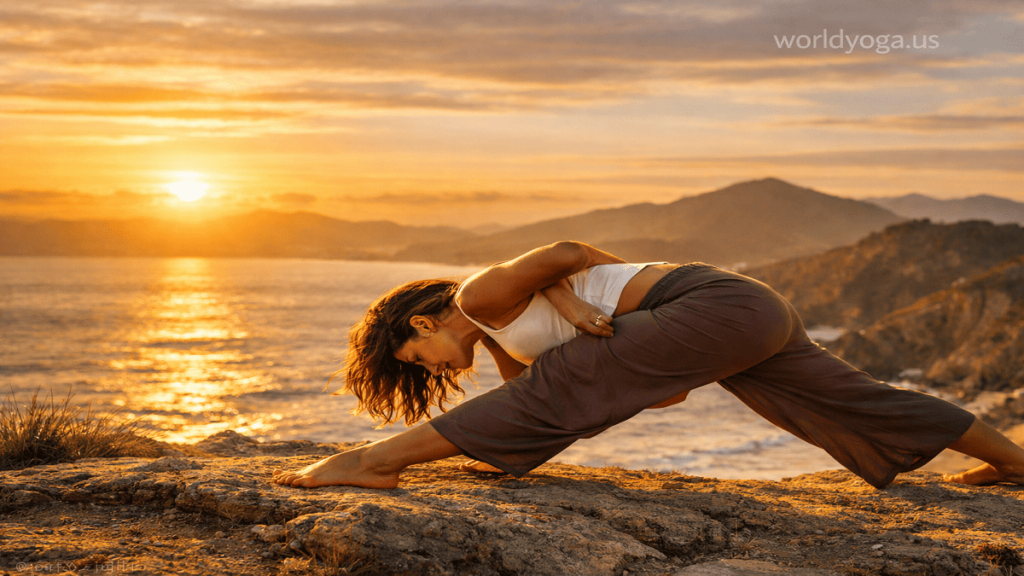
Which muscles and joints are engaged during the posture?
Ardha Baddha Utthita Parshva Konasana (Half-Bound Extended Side Angle Pose) is a complex multi-joint posture that integrates strength, flexibility, balance, and rotational control. Because it combines a deep lunge, forward fold, and half bind, it activates a wide range of muscles while placing controlled demand on several major joints.
Lower Body Muscles and Joints
The front leg quadriceps are heavily engaged to maintain the deep knee bend and stabilize the knee joint in flexion. The gluteus maximus and gluteus medius support hip stability and help control alignment of the pelvis. The hamstrings assist in maintaining control during the forward fold phase, especially in the eccentric lengthening position.
The adductor muscles (inner thighs) are actively engaged to stabilize the pelvis and prevent collapse toward the floor. The calf muscles (gastrocnemius and soleus) and smaller ankle stabilizers maintain grounding and balance through the feet.
From a joint perspective, the front knee joint is in deep flexion under load, requiring precise alignment to avoid strain. The hip joints undergo flexion, external rotation, and controlled stabilization in the front leg, while the back hip remains extended and engaged. The ankle joints play a crucial role in proprioception and balance throughout the stance.
Core and Spinal Engagement
The core musculature plays a central stabilizing role. The rectus abdominis supports forward flexion control, while the obliques assist in rotational stability during the twisting component of the posture. The transverse abdominis acts as a deep stabilizer, maintaining intra-abdominal pressure and spinal support.
The erector spinae muscles help maintain spinal extension and prevent excessive rounding during the forward fold. The multifidus muscles provide fine stabilization of individual vertebrae, especially during rotation.
The spine itself is engaged in controlled flexion (forward fold) combined with axial rotation, primarily in the thoracic region. The lumbar spine should remain relatively stable to prevent compression.
Upper Body Muscles and Joints
The binding component significantly activates the shoulders, chest, and arms. The latissimus dorsi and teres major support shoulder extension and internal rotation needed for the bind. The pectoralis major and minor are stretched as the chest opens and rotates.
The deltoids, particularly the posterior fibers, assist in shoulder positioning. The biceps and triceps contribute to arm positioning and stabilization during the bind, while the forearm flexors and extensors maintain grip when fingers or wrists are connected.
The scapular stabilizers, including the rhomboids and trapezius muscles, control shoulder blade retraction and positioning.
From a joint perspective, the shoulder joint (glenohumeral joint) undergoes extension, internal rotation, and adduction. The scapulothoracic joint is highly active in stabilizing and positioning the shoulder blades. The elbow joints may be flexed depending on the depth of the bind, while the wrist and hand joints assist in grip and connection.
Summary
Ardha Baddha Utthita Parshva Konasana is a full-body integrative posture that simultaneously engages:
- Lower body: quadriceps, glutes, hamstrings, calves, adductors
- Core: rectus abdominis, obliques, transverse abdominis
- Spine: erector spinae and deep stabilizers
- Upper body: latissimus dorsi, pectorals, deltoids, scapular stabilizers
Joint involvement includes the hips, knees, ankles, spine, shoulders, elbows, and wrists, all working together in a coordinated kinetic chain.
Reference resources:
https://www.yogajournal.com/poses/extended-side-angle-pose/
https://www.acefitness.org/resources/everyone/exercise-library/
#Ardha Baddha Utthita Parshva Konasana in Hyderabad
What preparatory poses are recommended before practicing it?
Ardha Baddha Utthita Parshva Konasana (Half-Bound Extended Side Angle Pose) is an advanced posture that requires a combination of hip flexibility, hamstring length, spinal rotation, core stability, and shoulder mobility. Proper preparatory work is essential to ensure safe alignment and to gradually build the range of motion needed for the half bind and forward fold.
1. Warrior II (Virabhadrasana II)
Warrior II is the foundational standing pose for this sequence. It develops lower-body strength, pelvic stability, and knee alignment awareness. The deep front knee bend and wide stance prepare the quadriceps and hips for the load-bearing demands of the final posture. It also introduces the correct leg positioning and grounding needed for balance.
Reference: https://www.yogajournal.com/poses/warrior-ii-pose/
2. Extended Side Angle Pose (Utthita Parsvakonasana)
This is the most direct preparatory posture. It introduces lateral flexion of the spine, hip opening, and full-body integration in a lunge position. Practicing this pose helps establish correct alignment between the chest, ribs, and pelvis while strengthening the legs under load. It is also the first step toward integrating upper-body extension with lower-body stability.
Reference: https://www.yogabasics.com/asana/extended-side-angle-pose/
3. Revolved Side Angle Pose (Parivrtta Parsvakonasana)
This variation is essential for developing spinal rotation and core control, both of which are critical for achieving the half bind safely. It strengthens the obliques and teaches controlled twisting without collapsing the spine or overloading the lower back.
Reference: https://www.yogajournal.com/poses/revolved-side-angle-pose/
4. Standing Forward Fold (Uttanasana)
Standing Forward Fold helps lengthen the hamstrings and calves, which is important for the forward-folding component of the posture. It also teaches safe hip hinging mechanics, reducing strain on the lower back during forward movement.
Reference: https://www.yogajournal.com/poses/standing-forward-bend/
5. Gomukhasana (Cow Face Pose)
Gomukhasana is one of the best preparatory poses for the binding element. It improves shoulder external rotation, chest opening, and upper-back flexibility, all of which are necessary for safely achieving the half bind.
Reference: https://www.yogajournal.com/poses/cow-face-pose/
6. Garudasana Arms (Eagle Arms Variation)
This arm position helps improve scapular mobility and shoulder blade control. It also stretches the upper trapezius and deltoids, making it easier to access the bind without straining the shoulders.
Reference: https://www.yogajournal.com/poses/eagle-pose/
7. Low Lunge (Anjaneyasana)
Low Lunge opens the hip flexors, quadriceps, and groin muscles, which are essential for stability in the deep lunge position. It also helps improve pelvic control and balance before transitioning into side angle variations.
Reference: https://www.yogajournal.com/poses/low-lunge/
Summary
Effective preparation for Ardha Baddha Utthita Parshva Konasana requires a structured progression that develops strength, mobility, and rotation simultaneously. Standing strength poses build stability, forward folds improve hamstring length, spinal twists enhance rotation, and shoulder openers prepare the body for safe binding. Practicing these poses consistently reduces injury risk and improves overall control in the final posture.
#Ardha Baddha Utthita Parshva Konasana in Delhi
What are the benefits and precautions of this bound side angle variation?
Ardha Baddha Utthita Parshva Konasana (Half-Bound Extended Side Angle Pose) is an advanced yoga posture that combines a deep lunge, spinal rotation, forward fold, and shoulder binding. It offers significant physical and neuromuscular benefits but also requires careful attention to alignment due to its complexity and load-bearing nature.
Benefits of the Pose
1. Improves Lower-Body Strength and Stability
This pose strongly engages the quadriceps, glutes, hamstrings, and calves, especially in the front leg. Holding a deep lunge under control builds endurance in the legs and improves joint stability in the knees and ankles. It also strengthens the muscles that support everyday movements like walking, climbing, and squatting.
2. Enhances Hip Flexibility and Mobility
The wide stance and deep knee bend open the hip flexors, groin, and inner thighs. Over time, this improves hip range of motion and reduces stiffness caused by prolonged sitting or sedentary habits.
Reference: https://www.yogajournal.com/poses/extended-side-angle-pose/
3. Develops Shoulder and Upper Back Mobility
The half bind action stretches the pectorals, deltoids, and latissimus dorsi while improving shoulder internal and external rotation. This can help counter rounded shoulders and upper-back tightness commonly caused by desk work.
4. Strengthens Core and Improves Spinal Control
The twisting and forward-folding elements activate the obliques, rectus abdominis, and deep stabilizing muscles of the spine. This improves core strength, spinal awareness, and postural control.
5. Improves Balance, Coordination, and Focus
Maintaining stability in a forward-leaning, asymmetrical position enhances proprioception and mental concentration. The need to coordinate breath, balance, and bind develops strong mind-body awareness.
Precautions and Contraindications
1. Knee Joint Safety
The front knee is under significant load in deep flexion. It must stay aligned directly over the ankle. Allowing the knee to collapse inward can strain ligaments and increase injury risk.
2. Shoulder and Rotator Cuff Strain
Forcing the half bind can overstretch the shoulder joint or irritate the rotator cuff. The bind should never come at the cost of chest collapse or shoulder pain. A strap or partial bind is recommended if mobility is limited.
Reference: https://www.verywellfit.com/side-angle-pose-3567040
3. Lower Back Compression Risk
Excessive rounding or twisting in the lumbar spine can cause compression and discomfort. The movement should come from the hips and thoracic spine, not the lower back.
4. Balance and Stability Concerns
The forward fold combined with a bind can challenge balance. Practicing near a wall or using a block under the supporting hand is advised for beginners.
5. Hip and Hamstring Limitations
Tight hamstrings or hip flexors may restrict proper alignment and cause compensatory movement patterns. Gradual progression is essential to avoid overstretching.
Summary
Ardha Baddha Utthita Parshva Konasana offers a powerful combination of strength building, flexibility enhancement, and postural improvement. However, due to its complexity, it must be practiced with careful attention to knee alignment, shoulder safety, and spinal integrity. When approached progressively, it becomes an effective posture for developing integrated full-body control and functional mobility.
#Ardha Baddha Utthita Parshva Konasana in Pune
Case Study of Ardha Baddha Utthita Parshva Konasana
1. Introduction
Ardha Baddha Utthita Parshva Konasana, or Half-Bound Extended Side Angle Pose, is an advanced standing yoga posture that integrates a deep lunge, forward fold, spinal rotation, and a half bind. This case study explores its practical application in a structured yoga progression, focusing on alignment development, mobility improvements, and functional outcomes in an intermediate practitioner.
2. Practitioner Profile
The subject is a 34-year-old office professional with 18 months of consistent yoga practice. The practitioner demonstrates:
- Moderate lower-body strength
- Tight hamstrings and hip flexors
- Limited shoulder internal rotation
- Mild thoracic stiffness due to prolonged sitting
The individual can comfortably perform Warrior II and Extended Side Angle Pose but struggles with maintaining a stable bind and forward fold simultaneously.
Reference: https://www.yogajournal.com/poses/extended-side-angle-pose/
3. Initial Assessment
At baseline, the practitioner exhibited:
- Difficulty maintaining knee-over-ankle alignment in deep lunge
- Inability to connect hands in half bind without collapsing the chest
- Rounded upper back during forward fold
- Loss of balance when attempting rotation and bind together
These limitations indicated insufficient integration of hip mobility, shoulder flexibility, and core stability.
4. Intervention Strategy
A structured six-week progression plan was implemented, emphasizing gradual adaptation rather than forced depth.
Phase 1: Foundational Strength and Stability
- Warrior II (Virabhadrasana II) for leg endurance
- Low Lunge (Anjaneyasana) for hip flexor release
- Standing Forward Fold (Uttanasana) for hamstring lengthening
Phase 2: Mobility and Rotation
- Extended Side Angle Pose for alignment control
- Revolved Side Angle Pose (Parivrtta Parsvakonasana) for spinal rotation
- Seated spinal twists for controlled mobility
Phase 3: Shoulder Opening and Binding Preparation
- Gomukhasana for shoulder external rotation
- Eagle Arms (Garudasana variation) for scapular mobility
- Strap-assisted binding drills in standing positions
Phase 4: Integrated Pose Practice
- Half bind in Side Angle Pose with support
- Gradual removal of props as control improved
- Focus on breath-led movement rather than depth
Reference: https://www.yogabasics.com/asana/bound-side-angle-pose/
5. Observations and Progress
After six weeks, the following improvements were recorded:
- Improved knee alignment stability during deep lunges
- Increased thoracic rotation, allowing better chest opening
- Partial bind achieved without chest collapse
- Enhanced hamstring flexibility, improving forward fold control
- Better balance and breath coordination during transition phases
The practitioner transitioned from forced movement patterns to controlled, breath-led alignment.
6. Discussion
This case highlights that Ardha Baddha Utthita Parshva Konasana is not an isolated flexibility goal but a coordinated full-body integration posture. Progress was only achieved through sequential development of strength, mobility, and neuromuscular control.
Key insight: Shoulder binding improved significantly only after thoracic rotation and hip stability were addressed, reinforcing the importance of kinetic chain sequencing.
7. Precautions Observed During Practice
- Avoided forcing the half bind during early phases
- Maintained strict knee alignment to prevent joint strain
- Used props (block and strap) to preserve spinal length
- Prioritized breath stability over depth of fold
8. Conclusion
The case study demonstrates that successful execution of Ardha Baddha Utthita Parshva Konasana depends on progressive conditioning rather than immediate flexibility. Structured preparation significantly improves safety, alignment, and performance outcomes. When practiced systematically, the posture enhances integrated strength, mobility, and body awareness across multiple joint systems.
#Ardha Baddha Utthita Parshva Konasana in Banglore
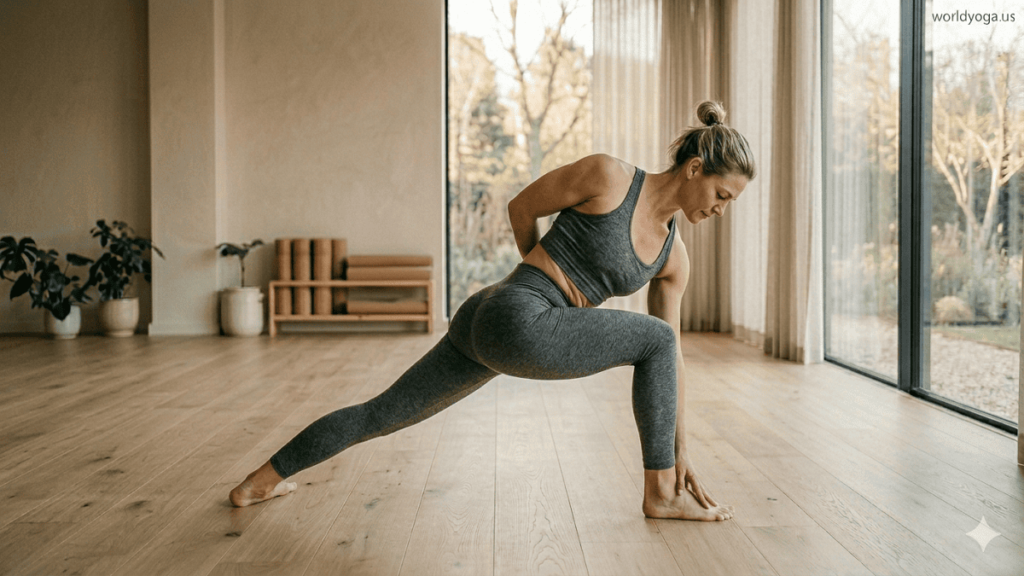
White Paper of Ardha Baddha Utthita Parshva Konasana
1. Executive Summary
Ardha Baddha Utthita Parshva Konasana (Half-Bound Extended Side Angle Pose) is an advanced multi-planar yoga posture combining lateral flexion, spinal rotation, hip flexion, and unilateral binding mechanics. This white paper outlines its biomechanical structure, physiological effects, progression methodology, and safety considerations. The pose is widely used in contemporary yoga systems as a functional movement pattern that integrates strength, flexibility, balance, and neuromuscular coordination.
2. Introduction
This posture is a variation of Extended Side Angle Pose (Utthita Parsvakonasana) with the addition of a half bind and forward fold. It requires coordinated engagement of the lower kinetic chain (legs and hips), axial skeleton (spine), and upper limb complex (shoulders and arms). Due to its complexity, it is considered an intermediate-to-advanced asana used for developing integrated body control.
Reference: https://www.yogajournal.com/poses/extended-side-angle-pose/
3. Biomechanical Analysis
3.1 Lower Body Mechanics
The posture begins in a wide stance with:
- Front hip in flexion and external rotation
- Front knee in deep flexion under load
- Back leg in extension with active muscular engagement
Primary stabilizers include the quadriceps, gluteus medius/maximus, hamstrings, and adductor group. The ankle complex provides proprioceptive feedback and stability under asymmetric load.
3.2 Spinal and Core Mechanics
The spine undergoes combined:
- Lateral flexion (frontal plane)
- Axial rotation (transverse plane)
- Controlled forward flexion (sagittal plane)
The thoracic spine is the primary driver of rotation, while the lumbar spine must remain relatively stable to avoid compression. Core musculature (obliques, transverse abdominis, rectus abdominis) provides dynamic stabilization.
3.3 Upper Body and Binding Mechanics
The half bind requires:
- Shoulder extension and internal rotation
- Scapular retraction and stabilization
- Controlled elbow flexion depending on grip
Key muscles include latissimus dorsi, pectoralis major/minor, deltoids, and rotator cuff stabilizers. The scapulothoracic joint plays a critical role in maintaining shoulder alignment during binding.
Reference: https://www.acefitness.org/resources/everyone/exercise-library/
4. Physiological Effects
4.1 Musculoskeletal Adaptation
Regular practice contributes to:
- Increased hip joint range of motion
- Improved thoracic spinal rotation
- Enhanced shoulder mobility and binding capacity
- Strength development in lower limb stabilizers
4.2 Neuromuscular Integration
The pose enhances coordination between:
- Lower-body stability systems
- Core rotational control mechanisms
- Upper-body binding pathways
This improves movement efficiency and postural control in asymmetrical loading conditions.
4.3 Functional Movement Benefits
The posture supports functional patterns such as:
- Lateral lunging
- Rotational reaching
- Cross-body coordination
- Balance under asymmetrical load
5. Methodological Progression Framework
A structured training progression is recommended:
Phase 1: Foundational Strength
- Warrior II (Virabhadrasana II)
- Low Lunge (Anjaneyasana)
Phase 2: Mobility Development
- Extended Side Angle Pose
- Standing Forward Fold (Uttanasana)
Phase 3: Rotational Control
- Revolved Side Angle Pose (Parivrtta Parsvakonasana)
- Seated spinal twists
Phase 4: Binding Integration
- Strap-assisted half bind
- Partial hand connection
- Full expression with controlled stability
Reference: https://www.yogabasics.com/asana/bound-side-angle-pose/
6. Risk Assessment and Safety Considerations
6.1 Primary Risk Factors
- Knee valgus collapse under load
- Shoulder impingement from forced internal rotation
- Lumbar spine over-rotation or compression
- Loss of balance in forward fold position
6.2 Contraindications
- Acute knee injuries or ligament instability
- Rotator cuff injuries
- Severe hip impingement
- Lumbar disc pathology without supervision
6.3 Risk Mitigation Strategies
- Use of props (blocks, straps)
- Emphasis on spinal elongation before binding
- Progressive range-of-motion training
- Knee alignment over ankle at all times
7. Discussion
Ardha Baddha Utthita Parshva Konasana is best understood as a systemic integration posture rather than a flexibility-based shape. Its effectiveness depends on the coordination of multiple joint systems and muscular chains. Proper sequencing is essential, as shoulder binding capacity is heavily influenced by thoracic mobility and hip stability.
8. Conclusion
This posture represents a high-value movement pattern for developing integrated strength, mobility, and neuromuscular control. When practiced with structured progression and biomechanical awareness, it enhances full-body coordination and functional movement efficiency. However, due to its complexity, it requires careful attention to alignment, controlled progression, and individualized adaptation.
#Ardha Baddha Utthita Parshva Konasana in Kolkata
Industry Application of Ardha Baddha Utthita Parshva Konasana
1. Introduction
Ardha Baddha Utthita Parshva Konasana (Half-Bound Extended Side Angle Pose) is an advanced multi-planar yoga posture that integrates lower-body strength, spinal rotation, hip mobility, and upper-body binding mechanics. While traditionally rooted in yoga practice, its structured movement pattern has gained relevance across several modern industries including fitness training, physiotherapy, sports performance, corporate wellness, and movement education.
Reference: https://www.yogajournal.com/poses/extended-side-angle-pose/
2. Fitness and Functional Training Industry
In fitness and strength-conditioning environments, this pose is used as a functional mobility-strength integration drill. Trainers incorporate it into dynamic warm-ups and movement prep routines to develop:
- Unilateral lower-body strength and endurance
- Hip mobility under load
- Core rotational stability
- Shoulder range of motion and control
It is particularly valuable in programs emphasizing functional movement patterns such as lunging, twisting, and cross-body coordination. The half bind adds an additional neuromuscular challenge by integrating upper and lower body systems simultaneously.
Reference: https://www.acefitness.org/resources/everyone/exercise-library/
3. Physiotherapy and Rehabilitation Applications
In physiotherapy contexts, modified versions of this pose are used for progressive mobility restoration and postural correction. Clinicians may adapt the posture using props such as straps or blocks to support safe movement.
Common applications include:
- Shoulder mobility rehabilitation (rotator cuff and scapular control)
- Hip flexibility restoration in sedentary individuals
- Thoracic spine mobility improvement
- Functional re-education after postural imbalances
The controlled half bind allows gradual reintroduction of shoulder rotation without aggressive loading.
Reference: https://www.physio-pedia.com/Shoulder_Impingement
4. Sports Performance and Athletic Conditioning
In sports training, the posture is applied as a multi-planar movement integration exercise. It supports athletic demands that involve rapid direction changes, rotational force, and unilateral stability.
Key performance benefits include:
- Improved hip-to-shoulder kinetic chain transfer
- Enhanced rotational power for batting, throwing, and striking
- Better deceleration control in lunging positions
- Reduced injury risk through joint stability training
Sports such as cricket, tennis, basketball, and martial arts benefit significantly from this type of integrated movement training.
5. Corporate Wellness and Ergonomics
In corporate wellness programs, this posture is adapted into corrective movement therapy for sedentary workers. Office employees commonly experience tight hips, restricted thoracic mobility, and rounded shoulder posture due to prolonged sitting.
Modified practice supports:
- Hip flexor release and lower-body activation
- Shoulder opening to counter forward posture
- Spinal rotation to reduce stiffness from static seating
- Improved circulation and movement breaks during work hours
It is often included in short-duration workplace yoga sessions or virtual wellness programs.
Reference: https://www.ncbi.nlm.nih.gov/pmc/articles/PMC3193656/
6. Yoga Teacher Training and Movement Education
In yoga teacher training programs, this posture is used as a progression assessment tool for evaluating student readiness for advanced asanas. It helps instructors assess:
- Shoulder mobility and binding capacity
- Hip stability under load
- Core control during asymmetrical movement
- Spinal alignment awareness under rotational stress
It is also used to teach sequencing principles, demonstrating how mobility, strength, and stability must be developed progressively rather than in isolation.
7. Conclusion
Ardha Baddha Utthita Parshva Konasana has evolved beyond a traditional yoga posture into a multidisciplinary movement tool. Its application across fitness, rehabilitation, sports performance, and workplace wellness highlights its value as a functional integration exercise. The pose serves as a bridge between mobility training and strength development, making it relevant in any industry focused on human movement efficiency, injury prevention, and postural optimization.
#Ardha Baddha Utthita Parshva Konasana in Mumbai
Ask FAQs
What is Ardha Baddha Utthita Parshva Konasana?
Ardha Baddha Utthita Parshva Konasana, also known as Half-Bound Extended Side Angle Pose, is an advanced standing yoga posture that combines a deep side lunge, forward fold, spinal rotation, and a half bind. It helps develop strength, flexibility, balance, and coordination in a single integrated movement pattern.
What are the main benefits of this pose?
This pose improves lower-body strength, enhances hip flexibility, and increases shoulder mobility through the binding action. It also strengthens the core, supports spinal rotation, and improves balance and body awareness. Regular practice can contribute to better posture and functional movement efficiency.
What are common mistakes in this pose?
Common mistakes include collapsing the chest while attempting the bind, misaligning the front knee beyond the ankle, rounding the lower back during the forward fold, and forcing the shoulder bind. These errors can reduce effectiveness and increase the risk of strain or injury.
Who should avoid or modify this pose?
Individuals with knee injuries, hip impingement, shoulder issues (especially rotator cuff injuries), or lower back problems should avoid or modify this posture. Pregnant practitioners and beginners should use props such as straps or blocks and practice under professional supervision.
Reference: https://www.yogajournal.com/poses/extended-side-angle-pose/
How can beginners progress toward this pose safely?
Beginners should first master foundational poses like Warrior II and Extended Side Angle Pose. Shoulder openers such as Cow Face Pose and Eagle Arms help prepare for the bind. Using a strap for assisted binding and focusing on alignment and breath control ensures safe and gradual progression.
Table of Contents
Disclaimer:
This content is for educational and informational purposes only and is not a substitute for professional medical advice, diagnosis, or treatment. Practice yoga postures under the guidance of a qualified instructor, especially if you have any existing injuries or medical conditions.