
Triangle Pose: Binding
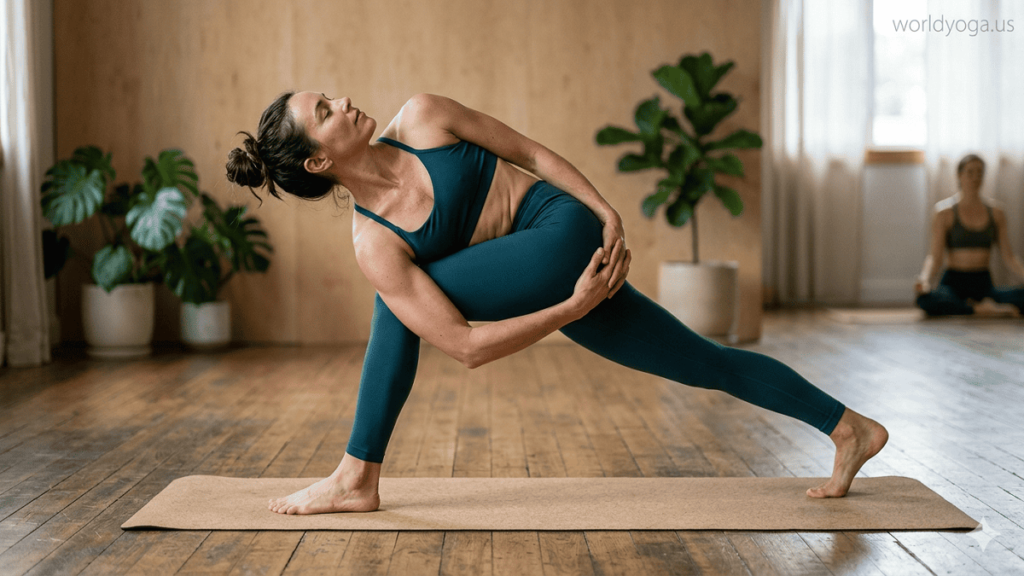
Triangle Pose: Binding (Utthita Trikonasana Variation) is an advanced extension of the classic standing yoga posture that deepens flexibility, improves spinal mobility, and challenges balance and coordination. The bound variation integrates a shoulder bind with the traditional Triangle Pose, creating a more intense opening across the chest, hips, and hamstrings while requiring greater awareness of alignment and breath control.
The foundational posture, Triangle Pose (Utthita Trikonasana), is widely practiced in modern yoga for building strength in the legs and improving lateral flexibility. In the binding variation, one arm reaches behind the back while the other reaches forward or upward, and the hands clasp or interlock, forming a bind that intensifies the stretch and engagement of the upper body. This variation is often introduced in intermediate to advanced yoga practices.
Triangle Pose (Trikonasana Binding) enhances both physical and neurological coordination. The posture demands stability in the lower body while simultaneously opening the shoulders and chest. This dual action improves proprioception and encourages a balanced distribution of effort throughout the body rather than overloading a single muscle group.
Key benefits of Triangle Pose Binding include improved spinal flexibility, deeper shoulder opening, enhanced hamstring stretch, and increased core engagement. The bind also stimulates the thoracic spine, which can help counteract postural imbalances caused by prolonged sitting. Additionally, the posture encourages mindful breathing, which supports relaxation even in physically demanding positions.
To practice safely, begin in a standard Triangle Pose with feet grounded firmly and legs straight but not locked. Rotate the torso upward and gradually introduce the bind by reaching the top arm behind the back while the bottom arm reaches forward. If hands do not meet, use a yoga strap as a modification. It is important to maintain alignment in the hips and avoid collapsing the chest forward. The gaze can be directed upward or downward depending on neck comfort.
Common mistakes include overstretching the hamstrings, forcing the bind, or allowing the torso to collapse forward. Practitioners should prioritize length in the spine over depth in the bind. Engaging the core muscles helps maintain stability and prevents strain on the lower back.
This posture is not recommended for individuals with severe shoulder injuries, recent hip surgery, or uncontrolled lower back pain. Modifications and props should always be used when necessary.
For further reference on alignment and benefits, you may explore:
- Yoga Journal Triangle Pose Guide
- Verywell Fit Triangle Pose Overview
- YogaBasics Triangle Pose Instructions
Overall, Triangle Pose Binding is a powerful progression that blends strength, flexibility, and mindfulness. When practiced with control and awareness, it becomes an effective posture for advancing physical capability while maintaining internal balance.
#Triangle Pose: Binding in India
How is Bound Triangle Pose performed correctly?
Bound Triangle Pose (Utthita Trikonasana Bind) is an advanced variation of the traditional Triangle Pose that combines lateral spinal extension with a shoulder bind. When performed correctly, it improves flexibility in the hips, hamstrings, spine, and shoulders while also demanding strong core engagement and precise alignment. Because of its complexity, it should be approached gradually, ideally after mastering the standard Triangle Pose.
The practice begins from a stable foundation. Stand with the feet wide apart, typically around one leg-length distance. Turn the right foot outward at 90 degrees and slightly turn the left foot inward for stability. Keep both legs straight but not locked, engaging the quadriceps to protect the knees. This grounding foundation is essential before introducing any bind, as it ensures balance throughout the posture.
From here, extend the arms parallel to the floor and lengthen the torso forward over the right leg. The spine should remain long rather than collapsing downward. Lower the right hand toward the shin, ankle, or floor depending on flexibility, while the left arm extends upward. This is the classical Triangle Pose alignment, where the body forms a lateral line of extension.
To transition into the bound variation, the chest begins to rotate slightly upward. The top arm (left arm in this case) moves behind the back, while the bottom arm threads forward under the front thigh or alongside the shin. The hands then attempt to clasp or interlock, forming the bind. If full contact is not possible, a yoga strap can be used as a modification to bridge the gap safely.
Proper execution of Bound Triangle Pose requires maintaining length in the spine even after the bind is established. The most common mistake is collapsing the torso forward or forcing the bind at the expense of alignment. Instead, practitioners should prioritize expansion of the chest and rotation from the mid-spine rather than strain in the shoulders or lower back.
Breathing remains steady and controlled throughout the posture. Inhale to create space in the body, and exhale to deepen the rotation or settle into the stretch. The gaze can be directed upward for an added balance challenge or downward for stability, depending on neck comfort and experience level.
The posture should be held for several breaths before gently releasing the bind and returning to a neutral standing position. Repeating on both sides ensures balanced development.
Bound Triangle Pose should not be rushed. It is best practiced under the guidance of a qualified instructor, especially for those with shoulder, hip, or spinal concerns.
For additional guidance on alignment and progression, you may refer to:
- Yoga Journal Triangle Pose Guide
- Yoga Basics Triangle Pose Instructions
- Ekhart Yoga Triangle Pose Tutorial
When performed correctly, Bound Triangle Pose becomes more than a physical stretch. It integrates stability, mobility, and awareness into a single controlled movement, making it a valuable progression in an intermediate to advanced yoga practice.
#Triangle Pose: Binding in Maharashtra
What is the proper alignment in the binding variation of Trikonasana?
The proper alignment in the binding variation of Trikonasana (Bound Triangle Pose) is built on the same structural principles as the classical Triangle Pose, but with additional emphasis on spinal length, shoulder integration, and controlled rotation. Because the bind adds complexity, alignment becomes even more critical to avoid strain and maintain stability.
The starting foundation is a wide stance with both legs firmly grounded. The front foot is turned outward at approximately 90 degrees, while the back foot is slightly angled inward. The arches of both feet should remain active, with weight distributed evenly across the soles rather than collapsing into the inner or outer edges. The front knee remains straight but never locked, supported by engaged quadriceps to protect the joint.
The pelvis should stay neutral rather than excessively tilting forward or backward. One of the most important alignment cues is maintaining hip stacking. In a correct Triangle alignment, the hips are gently drawn back so that the torso can extend over the front leg without collapsing forward. This creates space along the side body and protects the lower spine.
Bound Triangle Pose (Utthita Trikonasana Bind) requires a long, extended spine before any bind is introduced. The torso lengthens forward over the front leg, then opens laterally so that the chest rotates upward. The top shoulder stacks directly above the bottom shoulder when possible, forming a vertical alignment line through the arms and chest.
In the bound variation, the top arm moves behind the back while the bottom arm threads forward under the front thigh or along the shin. Proper alignment does not prioritize how tightly the hands connect; instead, it emphasizes shoulder positioning and spinal extension. The shoulders should remain drawn back and down, avoiding any rounding or compression of the chest.
The head and neck follow the natural extension of the spine. Depending on flexibility, the gaze may be directed upward toward the top hand or downward toward the floor for balance. The neck should remain relaxed without strain.
A key alignment principle is maintaining openness in the chest even while bound. Many practitioners mistakenly collapse forward in an attempt to deepen the bind. Instead, the sternum should stay lifted, and the rotation should originate from the mid-spine rather than the lower back.
Core engagement is essential to stabilize the posture. The abdominal muscles support the spine, preventing excessive pressure on the lumbar region. At the same time, the legs remain actively engaged to anchor the pose.
The most effective alignment approach is to prioritize extension over depth. A smaller, well-aligned bind is far more beneficial than forcing the hands together at the expense of posture integrity.
For additional technical guidance, you may refer to:
- Yoga Journal Triangle Pose Alignment Guide
- Yoga Basics Trikonasana Instructions
- Verywell Fit Triangle Pose Breakdown
When aligned correctly, Bound Trikonasana becomes a balanced integration of strength, flexibility, and controlled spinal rotation, rather than a purely deep stretch.
#Triangle Pose: Binding in Ahemadabad

Which muscles and joints are engaged during this bound triangle variation?
The bound variation of Triangle Pose (Bound Trikonasana) is a full-body posture that simultaneously engages multiple muscle groups and requires coordinated movement across several major joints. Unlike the basic Triangle Pose, the binding action increases activation in the upper body while maintaining strong lower-body stability, making it a highly integrated asana for strength, flexibility, and mobility development.
Bound Triangle Pose (Utthita Trikonasana Bind) primarily engages the lower limb muscles to establish a stable base. The quadriceps in the front and back legs work to keep the knees extended and stable without hyperextension. The hamstrings of the front leg are significantly stretched, especially during the lateral fold. The gluteus medius and minimus play a key role in stabilizing the pelvis and preventing excessive hip collapse. The adductor muscles of both legs also engage to maintain balance and control the wide stance.
In the core region, the obliques are highly activated due to the rotational component of the pose. The rectus abdominis provides stability and supports spinal length, while the transverse abdominis acts as a deep stabilizer, helping maintain balance during the bind and preventing excessive lumbar compression. The spinal erectors along the back are engaged isometrically to support upright alignment and controlled extension.
The upper body experiences increased demand in the bound variation. The latissimus dorsi and rhomboids engage to facilitate the shoulder bind and maintain scapular stability. The deltoid muscles, particularly the posterior deltoids, assist in shoulder extension and rotation. The rotator cuff muscles are actively involved in stabilizing the shoulder joint during the bind, which is one of the most technically demanding aspects of the posture. The pectoralis muscles are stretched as the chest opens and rotates upward.
The arms also contribute significantly. The biceps and triceps assist in maintaining the bind position, while the forearm flexors support grip strength when the hands clasp or when using a strap.
From a joint perspective, several major articulations are involved. The hip joints perform a combination of flexion and slight external rotation, especially in the front leg. The knee joints remain in extension while absorbing stabilizing forces. The ankle joints are actively engaged in dorsiflexion and subtle pronation/supination adjustments for balance.
The spine undergoes lateral flexion combined with axial rotation, particularly in the thoracic region. This combination is what makes Triangle Pose and its bound variation unique among standing postures, as it simultaneously mobilizes multiple planes of spinal movement.
The shoulder joints are the most dynamically engaged in the bound variation. They undergo extension, internal rotation, and adduction as the bind is established. The scapulothoracic joint also plays a critical role in maintaining shoulder stability and preventing impingement.
The wrist and elbow joints assist in maintaining the bind without excessive strain, particularly when modifications such as straps are used.
Overall, Bound Triangle Pose is a complex kinetic chain movement involving the integration of lower-body stability, core control, spinal mobility, and upper-body binding mechanics. When practiced with correct alignment, it enhances functional strength and mobility across nearly every major joint system in the body while improving neuromuscular coordination and balance.
#Triangle Pose: Binding in Hyderabad
What preparatory poses are recommended before attempting the bind?
Before attempting the bind in Triangle Pose, it is important to prepare the body with postures that build hamstring flexibility, hip stability, spinal rotation, and shoulder mobility. The bound variation of Trikonasana is demanding because it combines lateral extension with deep shoulder rotation, so preparatory work should target both lower- and upper-body readiness.
Bound Triangle Pose (Utthita Trikonasana Bind) should ideally be approached only after the practitioner is comfortable holding the standard Triangle Pose with steady alignment and breath control. The first and most essential preparatory posture is the classical Triangle Pose (Utthita Trikonasana), which teaches correct foot grounding, hip stacking, and spinal length. Without this foundation, adding a bind can lead to collapse in the torso or strain in the lower back.
Another key preparatory pose is Extended Side Angle Pose (Utthita Parsvakonasana). This posture deepens lateral body opening while strengthening the legs and preparing the hips for sustained weight-bearing in a wide stance. It also introduces a mild spinal rotation, which is essential for transitioning safely into bound variations.
Half Moon Pose (Ardha Chandrasana) is also highly beneficial. It develops balance, strengthens the standing leg, and improves awareness of hip alignment in asymmetrical standing postures. This stability is critical when the upper body begins to rotate and bind in Triangle variations.
For hamstring preparation, Standing Forward Fold (Uttanasana) is an important foundational posture. It lengthens the posterior chain and reduces tension in the hamstrings, making the lateral extension in Triangle Pose more accessible and safer.
On the upper-body side, Shoulder Opener variations using a strap or Gomukhasana arms (Cow Face Arms) help prepare the shoulders for the internal rotation and extension required in the bind. These movements increase range of motion in the rotator cuff and reduce the risk of impingement during binding.
Revolved Triangle Pose (Parivrtta Trikonasana) is another advanced preparatory posture that introduces controlled spinal rotation while maintaining a strong lower-body foundation. This helps the practitioner understand how to rotate from the thoracic spine rather than collapsing into the lumbar region.
Low Lunge (Anjaneyasana) variations are also useful for opening the hip flexors, which often restrict movement in wide-stance standing postures. Tight hip flexors can prevent proper pelvic alignment in Triangle Pose and make the bind more difficult to maintain.
Finally, gentle supine spinal twists can be used to prepare the body for rotation without load-bearing stress. These help improve thoracic mobility, which is essential for achieving a safe and effective bind.
In summary, preparation for Bound Triangle Pose should follow a progression: build stability in standing poses, increase hamstring and hip flexibility, improve thoracic rotation, and open the shoulders. This layered approach ensures that the bind is achieved through mobility and control rather than force.
For further reference on preparatory sequencing, you may explore:
- Yoga Journal Triangle Pose Guide
- Yoga Basics Standing Poses Overview
- Ekhart Yoga Triangle Pose Tutorial
With consistent preparation, the transition into Bound Triangle Pose becomes safer, more stable, and significantly more sustainable for long-term practice.
#Triangle Pose: Binding in Kolkata
What are the benefits and precautions of practicing Bound Triangle Pose?
Bound Triangle Pose (Utthita Trikonasana Bind) is an advanced standing yoga variation that combines lateral extension, spinal rotation, and a deep shoulder bind. Because it integrates multiple movement patterns at once, it offers significant physical and neuromuscular benefits, but it also requires careful attention to safety and alignment to avoid strain.
Bound Triangle Pose (Utthita Trikonasana Bind) provides a strong combination of flexibility, strength, and coordination benefits. One of its primary advantages is improved full-body flexibility, particularly in the hamstrings, hips, spine, and shoulders. The lateral extension deeply stretches the side body, while the bind enhances shoulder mobility and chest opening.
Another key benefit is spinal mobility and rotational strength. The posture engages the thoracic spine through controlled rotation, which helps improve posture and counteracts stiffness caused by prolonged sitting. Over time, this can support a healthier spinal alignment and reduce upper-back tightness.
The pose also strengthens stabilizing muscles throughout the body. The legs, especially the quadriceps and gluteal muscles, work continuously to maintain a stable foundation. The core muscles—particularly the obliques and transverse abdominis—are heavily engaged to support balance during rotation and binding. This improves overall functional strength and body awareness.
In addition, Bound Triangle Pose enhances shoulder stability and joint integrity when practiced correctly. The rotator cuff muscles and upper back are activated to maintain the bind safely, which can contribute to improved shoulder control and range of motion. It also encourages mindful breathing under moderate physical challenge, supporting improved breath-body coordination.
Despite these benefits, there are important precautions to consider. This posture places significant demand on the hamstrings, lower back, and shoulders, so it should not be rushed. Forcing the bind is one of the most common mistakes and can lead to shoulder impingement or lower-back strain. The bind should always be achieved through gradual mobility, not force.
Individuals with recent or chronic shoulder injuries should avoid or modify this posture, as the internal rotation and extension required in the bind can aggravate the rotator cuff. Similarly, those with lower back pain, herniated discs, or severe sciatica should approach the posture cautiously or avoid deep variations.
Knee instability or hyperextension is another concern. Because the pose is performed in a wide stance, improper alignment can place stress on the knee joints. Engaging the quadriceps and avoiding locked knees is essential for protection.
Balance can also be challenging in this posture, increasing the risk of falling or overextending into the floor or bind. Using props such as yoga straps or blocks is recommended for beginners or those with limited flexibility.
Breath control is equally important. Holding the breath or straining during the bind can create unnecessary tension in the body. Smooth, steady breathing helps maintain stability and prevents overexertion.
In summary, Bound Triangle Pose offers deep benefits for flexibility, strength, and postural awareness, but it must be approached with progressive preparation, proper alignment, and respect for individual limitations.
For additional guidance, you may refer to:
- Yoga Journal Triangle Pose Guide
- Yoga Basics Standing Poses Overview
- Verywell Fit Triangle Pose Breakdown
When practiced mindfully, the posture becomes a balanced integration of mobility and strength rather than a test of flexibility alone.
#Triangle Pose: Binding in Delhi
Case Study of Triangle Pose: Binding
Introduction
Bound Triangle Pose (Utthita Trikonasana Bind) is an advanced progression of the classical Triangle Pose used in modern Hatha and Vinyasa yoga systems. This case study examines how the posture is integrated into a structured practice sequence, its effects on mobility and stability, and the outcomes observed in intermediate-level practitioners over a consistent training period.
Bound Triangle Pose (Utthita Trikonasana Bind) is typically introduced only after foundational mastery of standing asanas such as Triangle Pose and Extended Side Angle Pose. In a controlled learning environment, practitioners are gradually exposed to the bind to minimize injury risk and improve neuromuscular control.
Methodology and Practice Structure
In a typical 6–8 week progression model, practitioners practiced three sessions per week under guided instruction. Each session included preparatory poses such as Utthita Trikonasana, Parsvakonasana, low lunges, and shoulder-opening drills using straps. The bind was introduced only after stable alignment in Triangle Pose could be maintained for at least 30–45 seconds without strain.
The transition into Bound Triangle was performed progressively:
- Establish strong foundation in wide-legged stance
- Achieve lateral extension in Triangle Pose
- Introduce thoracic rotation without collapsing the spine
- Add arm reach behind the back and partial bind
- Progress to full bind using hands or strap assistance
Observed Physical Outcomes
Across the training period, practitioners demonstrated measurable improvements in hamstring flexibility and hip mobility. The lateral chain of the body—including obliques and intercostal muscles—showed increased elasticity and control. Shoulder range of motion improved notably, particularly in internal rotation and extension required for the bind.
Core stability also showed consistent development. The engagement of the transverse abdominis and obliques increased significantly during the rotational phase, improving balance in asymmetrical standing positions. Many participants reported improved postural awareness in daily activities, especially reduced forward shoulder rounding.
Alignment and Technical Findings
A key observation was that success in the bind was not dependent on flexibility alone, but on thoracic spine mobility and scapular control. Practitioners who focused on spinal extension rather than depth of the fold achieved more stable binds with less strain.
Common alignment errors included collapsing into the lower back, overreaching the bind at the expense of chest opening, and hyperextending the front knee. Correcting these issues through cueing such as “length before depth” significantly improved safety and effectiveness.
Limitations and Risk Factors
Participants with pre-existing shoulder impingement or lumbar sensitivity required modifications. Use of yoga straps and block support was essential for maintaining safe alignment. Overemphasis on achieving the full bind too early was identified as the primary risk factor for strain.
Conclusion
This case study highlights that Bound Triangle Pose is most effectively learned through a structured progression emphasizing stability, spinal mobility, and shoulder preparation rather than forceful flexibility. When introduced systematically, it enhances full-body coordination, improves postural alignment, and deepens functional mobility across multiple joint systems.
For further reference on foundational alignment principles, see:
- Yoga Journal Triangle Pose Guide
- Yoga Basics Standing Poses Overview
- Ekhart Yoga Triangle Pose Tutorial
Overall, the findings reinforce that Bound Triangle Pose is a skill-building posture where anatomical awareness and progressive training are more important than achieving the final expression of the bind.
#Triangle Pose: Binding in Pune
White Paper of Triangle Pose: Binding
Abstract
Bound Triangle Pose, a variation of the classical Triangle Pose, is an advanced standing yoga posture that integrates lateral spinal flexion, axial rotation, lower-limb stability, and upper-body binding mechanics. This white paper analyzes its biomechanical structure, functional benefits, risk considerations, and application within contemporary yoga practice. The objective is to provide a structured understanding of the posture for practitioners, teachers, and movement specialists.
Bound Triangle Pose (Utthita Trikonasana Bind) is increasingly incorporated into intermediate-to-advanced yoga sequencing due to its ability to develop multi-planar mobility and neuromuscular coordination.
1. Introduction
Triangle Pose (Trikonasana) is a foundational standing posture in Hatha and Vinyasa yoga traditions. The bound variation extends this base by introducing shoulder internal rotation and posterior arm linkage, increasing both physical demand and proprioceptive complexity. This makes it a valuable but technically sensitive posture requiring structured progression.
2. Biomechanical Framework
The posture operates across three primary movement planes:
- Frontal plane: Lateral spinal flexion during the side stretch
- Transverse plane: Thoracic rotation during chest opening and bind
- Sagittal stabilization: Isometric engagement of lower limbs for balance
Lower limb engagement is dominated by the quadriceps, hamstrings, and gluteus medius, which stabilize the wide stance. The core system—especially the obliques and transverse abdominis—manages rotational control and prevents lumbar collapse.
Upper-body binding involves the latissimus dorsi, posterior deltoids, and rotator cuff complex. Scapular stabilization is critical to prevent impingement during internal rotation and extension of the shoulder joint.
3. Functional Benefits
The primary benefits of Bound Triangle Pose include:
- Enhanced hamstring and adductor flexibility
- Improved thoracic spine rotation and extension
- Increased shoulder mobility and scapular control
- Strengthening of deep core stabilizers
- Improved balance and proprioceptive awareness
These adaptations contribute to improved functional movement patterns, particularly in activities requiring lateral flexion and rotational stability.
4. Clinical and Movement Considerations
While beneficial, the posture presents several mechanical stress points:
- Shoulder impingement risk due to deep internal rotation
- Lumbar strain if spinal extension is compromised
- Knee stress if hyperextension occurs in the front leg
- Overstretching of hamstrings in unprepared practitioners
Proper sequencing is essential. The posture should only be introduced after competency in foundational standing poses such as Triangle Pose and Extended Side Angle Pose.
5. Progressive Training Model
A structured approach is recommended:
- Foundational alignment in Triangle Pose
- Development of hip and hamstring flexibility
- Introduction of thoracic rotation drills
- Shoulder mobility work (strap-assisted)
- Partial bind integration
- Full bound expression under supervision
6. Risk Mitigation Strategies
Key safety protocols include:
- Maintaining spinal length before depth of fold
- Avoiding forced hand connection in the bind
- Using props such as straps or blocks
- Prioritizing breath stability over range of motion
- Monitoring shoulder positioning to avoid compression
7. Conclusion
Bound Triangle Pose represents a complex integration of flexibility, strength, and coordination across multiple joint systems. When applied within a structured progression model, it enhances functional mobility and neuromuscular control. However, improper execution significantly increases the risk of shoulder and lumbar injury, underscoring the importance of technical precision and preparatory conditioning.
For foundational reference materials:
- Yoga Journal Triangle Pose Guide
- Yoga Basics Standing Poses Overview
- Ekhart Yoga Triangle Pose Resource
This analysis positions Bound Triangle Pose not merely as a flexibility exercise but as an integrated biomechanical system requiring progressive training, anatomical awareness, and controlled execution.
#Triangle Pose: Binding in Banglore
Industry Application of Triangle Pose: Binding
Overview
Bound Triangle Pose (Utthita Trikonasana Bind) is an advanced yoga posture derived from the classical Triangle Pose, integrating lateral spinal flexion, thoracic rotation, and shoulder binding mechanics. Beyond traditional yoga practice, this posture has gained relevance in multiple modern industries including fitness training, physiotherapy, sports conditioning, corporate wellness, and movement-based rehabilitation systems.
Bound Triangle Pose (Utthita Trikonasana Bind) is valued not only as a flexibility posture but also as a functional movement pattern that supports mobility, postural correction, and neuromuscular integration.
1. Fitness and Yoga Training Industry
In the fitness and yoga sector, Bound Triangle Pose is used as a progression tool for intermediate-to-advanced practitioners. It is commonly included in Hatha, Vinyasa, and mobility-focused programs to develop full-body coordination.
Fitness professionals use the posture to:
- Improve lateral chain flexibility (obliques, intercostals, hamstrings)
- Develop shoulder mobility and scapular control
- Enhance balance and proprioception in asymmetrical stances
- Progress clients toward advanced binding and twisting postures
It is also frequently used in yoga teacher training curricula as an assessment posture for alignment awareness and anatomical understanding.
2. Physiotherapy and Rehabilitation
In physiotherapy settings, modified versions of Triangle Pose and its bound variation are applied for non-clinical mobility rehabilitation under supervision. While the full bind is not always prescribed, the movement pattern is valuable for:
- Restoring thoracic spine rotation
- Improving hip joint mobility
- Addressing postural imbalances caused by sedentary behavior
- Enhancing shoulder range of motion (with precautions)
Clinicians often emphasize partial ranges and assisted variations using straps or wall support to reduce strain while maintaining therapeutic benefits.
3. Sports Performance and Athletic Conditioning
Athletes in sports requiring rotational power and lateral movement—such as tennis, cricket, golf, and martial arts—benefit from the movement mechanics of Bound Triangle Pose. The posture helps in:
- Developing rotational stability through the core
- Improving hamstring and adductor flexibility for dynamic movement
- Enhancing shoulder control in overhead and cross-body actions
- Supporting injury prevention through improved joint mobility balance
Strength and conditioning coaches may integrate simplified versions into mobility circuits or warm-up protocols.
4. Corporate Wellness and Ergonomics
In corporate wellness programs, simplified Triangle Pose variations (and occasionally bound progressions for advanced participants) are used to counteract prolonged sitting and poor posture.
Benefits in this context include:
- Reducing thoracic stiffness from desk work
- Improving shoulder alignment and reducing rounded posture
- Enhancing circulation through full-body stretching
- Supporting stress reduction via breath-focused movement
It is often included in desk yoga programs and workplace mobility breaks.
5. Movement Therapy and Mind-Body Education
In somatic practices, dance therapy, and embodied movement education, Bound Triangle Pose is used to explore spatial awareness and cross-body coordination. It supports:
- Interoceptive awareness (internal body sensing)
- Controlled movement transitions across planes
- Integration of breath with complex motor patterns
Conclusion
Bound Triangle Pose has evolved from a traditional yoga posture into a multifunctional movement tool with applications across fitness, rehabilitation, sports performance, and workplace wellness. Its value lies in its ability to integrate flexibility, strength, and coordination in a single structured movement pattern.
When appropriately modified and applied within professional guidelines, it serves as a versatile exercise for improving functional mobility and postural efficiency across diverse industries.
For foundational alignment reference:
- Yoga Journal Triangle Pose Guide
- Yoga Basics Standing Poses Overview
- Verywell Fit Triangle Pose Explanation
Overall, its industry relevance continues to expand as movement science increasingly emphasizes multi-planar training and integrated mobility systems.
#Triangle Pose: Binding in Mumbai
Ask FAQs
What is Bound Triangle Pose and how is it different from regular Triangle Pose?
Bound Triangle Pose is an advanced variation of Triangle Pose where the arms are taken into a bind behind the back or under the front thigh. Unlike the regular Triangle Pose, which focuses mainly on lateral extension and alignment, the bound version adds shoulder rotation, deeper chest opening, and increased core engagement. This makes it more complex and physically demanding.
Who should avoid practicing Bound Triangle Pose?
Individuals with shoulder injuries, rotator cuff issues, severe lower back pain, or recent hip or spinal injuries should avoid or modify this pose. It is also not recommended for beginners without prior experience in foundational standing postures. Proper preparation and guidance are essential to prevent strain.
What are the main benefits of Bound Triangle Pose?
This posture improves hamstring flexibility, hip mobility, spinal rotation, and shoulder range of motion. It also strengthens the core, enhances balance, and improves postural awareness. Over time, it can help reduce stiffness caused by prolonged sitting and support better functional movement patterns.
What are the common mistakes in Bound Triangle Pose?
Common mistakes include forcing the bind, collapsing the chest forward, locking the front knee, and rotating from the lower back instead of the thoracic spine. Another frequent error is prioritizing hand connection over proper spinal alignment, which can increase the risk of injury.
How can beginners prepare for Bound Triangle Pose?
Beginners should first master foundational poses like Triangle Pose, Extended Side Angle Pose, and simple spinal twists. Shoulder-opening exercises using straps and hamstring stretches such as Forward Fold are also helpful. Using props and focusing on gradual progression ensures safe preparation for the bind.
Table of Contents
Disclaimer:
This content is for informational and educational purposes only and should not be considered medical advice. Bound Triangle Pose (Utthita Trikonasana Bind) is an advanced yoga posture and should be practiced under the guidance of a qualified instructor. Individuals with injuries, medical conditions, or physical limitations should consult a healthcare professional before attempting this pose.