Triangle Pose: Revolved & Binding
Triangle Pose and its advanced variations, including Revolved Triangle and Bound Triangle, are powerful yoga postures that combine flexibility, balance, strength, and mindful breathing. These poses are widely practiced in modern yoga because they engage multiple muscle groups while improving focus and body awareness. Whether practiced in a beginner-friendly sequence or an advanced flow, these variations offer significant physical and mental benefits.
Understanding Revolved Triangle Pose
Revolved Triangle Pose, commonly known as Parivrtta Trikonasana, is a twisting variation of the traditional Triangle Pose. This posture requires stability, spinal mobility, and core engagement. The pose is typically performed by placing one hand on the floor or a yoga block while rotating the torso toward the opposite side and extending the upper arm upward.
This twisting action helps stimulate digestion, improve spinal flexibility, and strengthen the legs and abdominal muscles. Since the body is balancing while rotating, the posture also enhances coordination and concentration. Practicing Revolved Triangle regularly can improve posture and help release tension from the lower back and hips.
Yoga practitioners often use props such as blocks to maintain alignment and reduce strain, especially when flexibility is limited. Proper breathing is essential during the pose because controlled inhalation and exhalation support spinal lengthening and deeper twists.
Exploring the Bound Triangle Variation
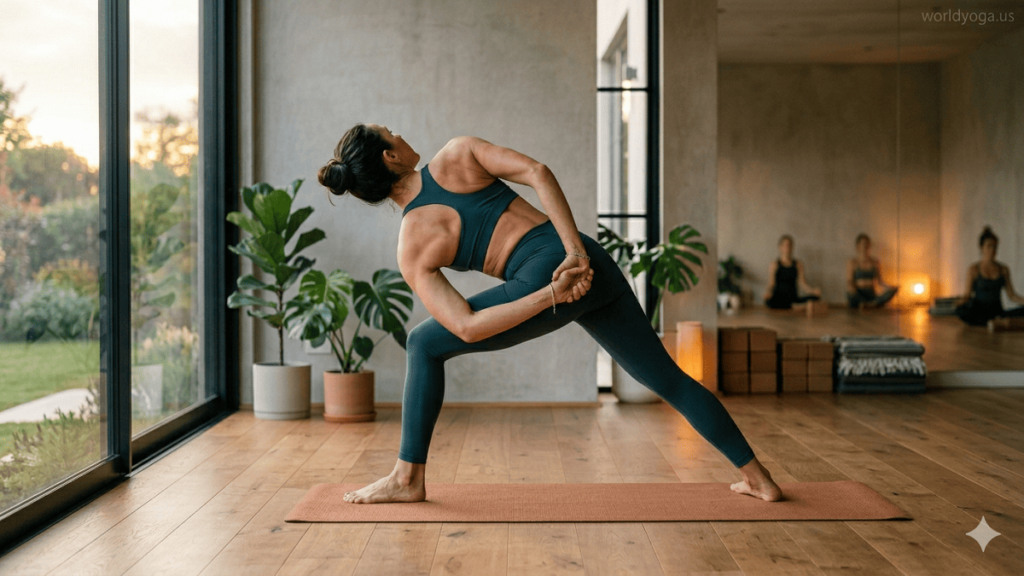
The Bound Triangle Pose is a more advanced variation that incorporates a bind by wrapping one arm around the leg and connecting the hands behind the body. This variation requires greater shoulder mobility, hip flexibility, and balance.
Binding techniques in yoga are designed to deepen stretches and create stronger body awareness. In the Bound Triangle variation, practitioners experience an intense opening through the chest, shoulders, and hamstrings. At the same time, the bind encourages stability through the legs and core.
Because this variation is physically demanding, yoga instructors often recommend mastering the foundational Triangle Pose and Revolved Triangle before attempting the bind. Slow transitions and proper alignment are essential to avoid unnecessary strain on the knees, spine, or shoulders.
Benefits of Practicing These Variations
Both Revolved and Bound Triangle variations offer a wide range of benefits, including:
- Improved spinal mobility and posture
- Increased hamstring and hip flexibility
- Enhanced balance and concentration
- Strengthening of the legs, core, and back muscles
- Better body awareness and breath control
Additionally, twisting poses are commonly associated with stress relief and mental clarity, making them valuable additions to mindful yoga routines.
Final Thoughts
Triangle Pose variations challenge both the body and mind, making them highly rewarding for yoga practitioners seeking growth in flexibility, stability, and focus. Consistent practice with proper guidance can help develop strength, improve alignment, and deepen overall yoga performance.
For detailed pose tutorials and alignment guidance, visit Yoga Journal and DoYogaWithMe.
#Triangle Pose: Revolved & Binding in India
How is Revolved Bound Triangle Pose performed correctly?
Revolved Bound Triangle Pose is an advanced yoga posture that combines the twisting action of Revolved Triangle Pose with a deep binding movement. Known in Sanskrit as Baddha Parivrtta Trikonasana, this pose demands balance, flexibility, spinal mobility, and strong body awareness. Practicing the posture correctly is essential to avoid strain and to gain the full physical and mental benefits associated with advanced yoga techniques.
Preparing for the Pose
Before attempting Revolved Bound Triangle Pose, practitioners should warm up the hamstrings, hips, shoulders, and spine. Foundational poses such as Triangle Pose, Revolved Triangle, and Extended Side Angle Pose help prepare the body for the deeper twist and bind.
Maintaining steady breathing throughout the pose is equally important. Deep inhalations help lengthen the spine, while controlled exhalations allow the body to twist more safely and effectively.
Step-by-Step Instructions
1. Begin in a Standing Position
Start in a wide-legged stance with your feet approximately three to four feet apart. Turn the right foot forward and angle the left foot slightly inward. Keep both legs strong and grounded.
2. Lengthen the Spine
Raise both arms to shoulder height and inhale deeply to create length through the torso. Proper spinal alignment is critical before entering the twist.
3. Rotate the Torso
Exhale and rotate the torso toward the right leg. Bring the left hand toward the outside of the right foot or onto a yoga block if flexibility is limited. Keep the hips as level as possible.
4. Enter the Bind
Once stable in the twist, slide the left arm around the outside of the right leg. Simultaneously bring the right arm behind the back and attempt to clasp the hands or wrists together. The bind should feel secure but not forced.
5. Open the Chest
Lift the chest upward while continuing to rotate through the spine. Avoid collapsing into the front leg. The neck should remain relaxed, and the gaze can move upward if balance allows.
6. Hold and Breathe
Maintain the posture for several breaths while engaging the core muscles and keeping the legs active. Slow breathing helps deepen the stretch and maintain stability.
7. Release Carefully
To exit the pose, slowly release the bind, return the torso upright, and repeat the posture on the opposite side.
Common Mistakes to Avoid
Many practitioners attempt to force the bind without proper flexibility, which can strain the shoulders or lower back. Rounding the spine, locking the knees, or collapsing the chest are also common alignment errors. Using props and progressing gradually can significantly improve safety and posture quality.
Benefits of the Pose
Practicing Revolved Bound Triangle Pose can improve spinal flexibility, strengthen the legs and core, enhance balance, and increase shoulder and hip mobility. The twisting action may also support digestion and encourage mental focus during yoga practice.
For detailed yoga alignment tutorials and pose demonstrations, visit Yoga International and Yoga Journal.
#Triangle Pose: Revolved & Binding in Maharashtra

What is the proper alignment in this bound variation of Parivritta Trikonasana?
Parivritta Trikonasana in its bound variation is an advanced yoga posture that combines twisting, balance, and deep shoulder opening. Proper alignment is essential for maintaining stability, preventing injury, and maximizing the physical benefits of the pose. Because the posture involves a rotational movement with a binding action, even small alignment adjustments can significantly improve comfort and effectiveness.
Establishing a Stable Foundation
The alignment of the feet and legs creates the foundation for the entire posture. Begin with the feet placed wide apart, typically three to four feet depending on height and flexibility. The front foot should point straight forward, while the back foot turns slightly inward at approximately 45 degrees.
Both legs should remain active and engaged throughout the pose. The front knee must stay straight without locking, while the back leg presses firmly into the ground for stability. Distributing weight evenly through both feet helps maintain balance during the twist and bind.
Aligning the Hips and Spine
One of the most important aspects of proper alignment in Bound Revolved Triangle is keeping the hips as square as possible toward the front leg. Many practitioners allow the hips to rotate excessively, which can reduce spinal engagement and place unnecessary strain on the lower back.
Before deepening the twist, lengthen the spine on every inhalation. A long spine creates space between the vertebrae and allows for safer rotation. The twist should originate from the torso and upper back rather than forcing movement through the neck or lower spine.
Avoid rounding the back or collapsing the chest toward the thigh. Instead, maintain an open chest and lifted sternum to support healthy posture and breathing.
Correct Arm and Shoulder Positioning
In the bound variation, the lower arm wraps around the outside of the front leg while the upper arm reaches behind the back to create the bind. The shoulders should remain broad and relaxed rather than hunched toward the ears.
The bind should never be forced. If the hands do not comfortably connect, using a yoga strap is recommended to maintain proper alignment without compromising safety. Overreaching for the bind often causes spinal collapse and shoulder strain.
The top shoulder should continue rotating upward to encourage chest expansion and improve thoracic mobility.
Maintaining Head and Neck Alignment
The neck should remain neutral and aligned with the spine. Practitioners may gaze upward only if balance and neck comfort allow. Otherwise, looking sideways or downward is completely acceptable and often safer for maintaining stability.
Breathing and Core Engagement
Steady breathing is crucial in this posture. Engaging the core muscles supports spinal stability and prevents excessive pressure on the lower back. Deep, controlled breaths also help practitioners maintain balance while gradually deepening the twist.
Final Thoughts
Proper alignment in the bound variation of Parivritta Trikonasana focuses on spinal length, balanced hips, engaged legs, and controlled twisting. Moving gradually and prioritizing stability over depth allows practitioners to experience the full benefits of the pose safely and effectively.
For professional alignment guidance and advanced yoga tutorials, visit Yoga Journal and Yoga International.
#Triangle Pose: Revolved & Binding in Ahemadabad
Which muscles and joints are engaged during the twisting posture?
Revolved Triangle Pose and its bound variations engage multiple muscle groups and joints throughout the body. Twisting yoga postures are highly effective because they combine balance, flexibility, strength, and mobility in a single movement. Understanding which muscles and joints are activated during the posture can help practitioners improve alignment, avoid injury, and deepen their overall yoga practice.
Core Muscles and Spinal Engagement
The core muscles play a major role in stabilizing the body during twisting poses. The obliques, located along the sides of the abdomen, are especially active because they help rotate the torso and maintain balance. The transverse abdominis, often referred to as the body’s deep core stabilizer, supports spinal protection and posture throughout the twist.
The erector spinae muscles, which run along the spine, help maintain spinal extension and prevent collapsing during the posture. At the same time, smaller stabilizing muscles surrounding the vertebrae assist with controlled spinal rotation and alignment.
Twisting postures also activate the multifidus muscles, which contribute to spinal stability and coordinated movement.
Leg Muscles Supporting Stability
Strong engagement of the legs is essential for maintaining balance and grounding in the posture. The quadriceps work to stabilize and straighten the front leg, while the hamstrings lengthen and support hip alignment.
The gluteal muscles help stabilize the pelvis and maintain balance during the twist. In addition, the calf muscles and muscles surrounding the ankles remain active to support standing stability and weight distribution.
Because the pose requires a wide stance and controlled rotation, the inner thigh muscles, or adductors, also contribute to maintaining alignment and preventing excessive movement of the hips.
Shoulder and Upper Body Activation
In bound variations of twisting poses, the shoulders and upper back muscles become highly engaged. The deltoids, trapezius, and rhomboids assist in maintaining the arm position and opening the chest during the bind.
The rotator cuff muscles help stabilize the shoulder joints while the arms extend and rotate. Proper shoulder engagement is important for preventing strain, especially in advanced bound postures.
The chest muscles, including the pectorals, may experience stretching while the upper back muscles work to maintain posture and control.
Joints Involved in the Twist
Several major joints are involved during twisting yoga postures. The spinal joints are the primary focus, particularly in the thoracic spine where rotational mobility is greatest. Controlled spinal rotation helps improve flexibility and posture when practiced correctly.
The hip joints support pelvic alignment and balance, while the knee joints help stabilize the legs throughout the pose. The ankle joints contribute to grounding and maintaining even weight distribution.
In bound variations, the shoulder joints experience deep rotational movement and increased mobility demands. Maintaining joint stability while avoiding overextension is essential for safe practice.
Final Thoughts
Twisting yoga postures engage the entire body through coordinated muscular activation and joint stability. From the core and spine to the shoulders, hips, and legs, every area contributes to maintaining balance and alignment. Consistent practice with proper technique can improve flexibility, strengthen muscles, and enhance overall body awareness.
For anatomy-focused yoga resources and alignment education, visit Yoga International and Yoga Anatomy.
#Triangle Pose: Revolved & Binding in Hyderabad
What preparatory poses are recommended before attempting this advanced variation?
Revolved Triangle Pose in its bound variation demands significant hamstring flexibility, spinal rotation, shoulder mobility, and hip stability. Because of these combined requirements, preparing the body through targeted foundational poses is essential. Proper preparation reduces injury risk and allows practitioners to access the pose with greater control rather than force.
Foundational Standing Poses for Stability
Before attempting advanced twisting and binding, the body should be grounded through basic standing postures. These build strength in the legs and establish balance awareness.
A strong starting point is Warrior II, which helps develop leg endurance, hip opening, and stable alignment in a wide stance. Holding Warrior II builds the foundational strength required to maintain the extended-leg position in Revolved Triangle variations.
Extended Side Angle Pose is another key preparatory pose that lengthens the side body and opens the hips and chest. It also begins to introduce gentle spinal extension and lateral engagement, which is essential for deeper twists later.
Hamstring and Hip Opening Poses
Tight hamstrings are one of the most common limitations in Revolved Triangle variations. Preparing them properly allows for safer spinal length and better alignment.
Forward-folding postures such as Standing Forward Bend help lengthen the hamstrings while encouraging spinal decompression. Practicing this pose slowly with bent knees if needed ensures safe stretching without strain.
Half Split Pose is especially effective for isolating hamstring flexibility. It trains the body to extend one leg while maintaining a long spine, which directly translates into safer alignment in the final pose.
Spinal Twisting Preparations
Since the advanced variation involves deep rotation, the spine must be gradually conditioned for twisting.
Seated Spinal Twist is one of the most important preparatory poses. It introduces controlled spinal rotation while keeping the pelvis stable, helping practitioners understand how to initiate the twist from the torso rather than the lower back.
Gentle supine twists can also be used to warm up the spine and reduce stiffness before standing twists.
Shoulder and Binding Preparation
The binding component requires significant shoulder mobility and chest opening. Without preparation, the bind may cause strain or misalignment.
Cow Face Pose is highly effective for improving shoulder flexibility and external rotation. It helps prepare the arms for reaching behind the back in a safe and controlled manner.
Final Thoughts
Preparing for Revolved Bound Triangle Pose is not about rushing into depth but building layered mobility across the legs, hips, spine, and shoulders. A structured sequence of standing strength poses, hamstring stretches, spinal twists, and shoulder openers creates the foundation needed for safe and effective practice.
For additional structured yoga sequencing and anatomy-based guidance, you can refer to Yoga Journal Pose Library and Yoga International Practice Guides.
#Triangle Pose: Revolved & Binding in Delhi
What are the benefits and precautions of Revolved Bound Triangle Pose?
Revolved Bound Triangle Pose is a complex standing yoga posture that combines spinal rotation, hamstring stretching, balance, and a deep arm bind. Because it integrates multiple layers of movement, it delivers significant physical and mental benefits when practiced correctly. However, due to its intensity, it also requires careful attention to alignment and safety precautions.
Benefits of Revolved Bound Triangle Pose
One of the primary benefits of this posture is improved spinal mobility. The twisting action encourages controlled rotation through the thoracic spine, which helps maintain healthy spinal function and can reduce stiffness caused by prolonged sitting or poor posture.
The pose also significantly enhances flexibility in the hamstrings, hips, and shoulders. The wide-legged stance stretches the inner thighs and posterior chain, while the bind opens the chest and shoulder joints. Over time, consistent practice increases overall range of motion and joint health.
Core strength is another key benefit. The obliques and deep abdominal muscles engage continuously to stabilize the torso during the twist. This helps improve balance, posture, and functional strength in everyday movements.
In addition, Revolved Bound Triangle Pose supports digestive stimulation due to the compressive and releasing action of the abdominal organs during the twist. Many practitioners also report improved circulation and a sense of internal detoxification, although this should be understood as a supportive wellness effect rather than a medical outcome.
Mentally, the posture requires focus and controlled breathing, which helps develop concentration, mindfulness, and stress reduction.
Precautions to Consider
Despite its benefits, this pose should be approached with caution, especially for beginners or individuals with physical limitations. One of the most common risks is strain on the lower back. Over-rotating the spine or forcing the twist instead of maintaining length can lead to discomfort or injury.
Individuals with hamstring injuries or tight hips should avoid forcing the forward fold. Using a yoga block under the hand can help maintain proper alignment and reduce strain.
Because the pose involves a deep bind, shoulder injuries or limited mobility should be taken seriously. Forcing the bind can overstretch the rotator cuff muscles and lead to long-term discomfort. A strap can be used as a safe modification to gradually build flexibility.
People with spinal conditions such as herniated discs, severe scoliosis, or recent back injuries should consult a qualified yoga instructor or healthcare professional before attempting this posture.
Balance is another important consideration. Since the pose requires a wide stance and torso rotation, loss of stability can increase the risk of falling. Practicing near a wall or under supervision is recommended for beginners.
Breathing should never be restricted. Holding the breath or straining to deepen the twist is a common mistake that can reduce safety and effectiveness.
Final Thoughts
Revolved Bound Triangle Pose offers a powerful combination of strength, flexibility, and mental focus when practiced correctly. However, it requires respect for the body’s limits and gradual progression. Emphasizing alignment, controlled breathing, and appropriate modifications ensures that practitioners can safely enjoy its full range of benefits.
For further safety guidance and detailed yoga alignment resources, visit Yoga Journal and Yoga International.
#Triangle Pose: Revolved & Binding in Pune
Case Study of Triangle Pose: Revolved & Binding
Revolved Bound Triangle Pose is a complex standing yoga variation that combines spinal rotation, hamstring lengthening, and shoulder binding. This case study examines how structured progression into this pose can improve flexibility, balance, and functional strength while highlighting the importance of alignment-based practice.
Case Overview
The subject in this case study is an intermediate yoga practitioner with approximately 12 months of consistent Hatha and Vinyasa yoga experience. The primary goals were to improve hamstring flexibility, develop spinal mobility, and achieve a stable bound twist without strain in the lower back or shoulders.
Initially, the practitioner could perform basic standing poses such as Triangle Pose and Revolved Triangle with moderate stability but struggled with maintaining alignment while attempting deeper rotation and binding. The main limitations observed were tight hamstrings, restricted thoracic mobility, and limited shoulder internal rotation.
Methodology and Practice Structure
A structured 6-week progression was designed focusing on preparatory and progressive overload principles.
The foundation phase included regular practice of Triangle Pose and Extended Side Angle Pose to build lower body strength and side-body length.
The mobility phase introduced Standing Forward Bend and Seated Spinal Twist to improve flexibility in hamstrings and thoracic spine rotation. Props such as yoga blocks were used to maintain spinal neutrality.
In the integration phase, the practitioner progressed to Revolved Triangle Pose with emphasis on spinal elongation before rotation. A yoga strap was introduced to assist with the bind and prevent shoulder overextension.
Finally, the advanced phase incorporated full Revolved Bound Triangle attempts, focusing on breath control, core engagement, and gradual deepening of the bind without forcing range.
Outcomes and Observations
After six weeks, measurable improvements were observed in hamstring flexibility, allowing a deeper forward hinge with reduced knee strain. Spinal rotation improved significantly, particularly in the thoracic region, resulting in smoother transitions into twisted positions.
The practitioner achieved a partial bind in Revolved Bound Triangle Pose with improved shoulder comfort and reduced compensatory rounding in the upper back. Balance stability also improved due to enhanced core engagement and better weight distribution across both legs.
Mentally, the practitioner reported increased concentration and reduced tension during practice, particularly when focusing on breath synchronization with movement.
Key Insights
The case highlights that progression into advanced yoga postures should prioritize preparatory strength and mobility over immediate depth. Attempting binding without adequate shoulder and spinal preparation often leads to misalignment and strain.
The use of props such as blocks and straps significantly improved safety and accessibility, reinforcing the importance of adaptive practice rather than forced flexibility.
Conclusion
Revolved Bound Triangle Pose demonstrates how integrated movement patterns in yoga can enhance full-body coordination when approached systematically. With structured progression, mindful breathing, and alignment awareness, practitioners can safely develop toward advanced variations while minimizing injury risk.
For further reference on alignment and yoga progression methodologies, visit Yoga Journal and Yoga International.
#Triangle Pose: Revolved & Binding in Banglore
White Paper of Triangle Pose: Revolved & Binding
Revolved Bound Triangle Pose represents a highly integrated standing yoga posture that combines lateral flexion, spinal rotation, hamstring extension, and upper-limb binding mechanics. This white paper examines its biomechanical structure, physiological effects, progression methodology, and safety considerations within a modern yoga practice framework.
1. Introduction
Standing yoga postures that combine rotation and binding are considered advanced due to their demand on multiple kinetic chains simultaneously. The Revolved Bound Triangle variation builds upon foundational asanas such as Triangle Pose and Revolved Triangle, introducing a closed-chain bind that increases neuromuscular engagement and joint articulation complexity.
This posture is commonly used in intermediate-to-advanced yoga sequencing to develop strength, mobility, and proprioception.
2. Biomechanical Structure
The pose involves a multi-planar movement pattern:
- Sagittal plane: hamstring lengthening and hip hinging
- Frontal plane: lateral spinal extension and stabilization
- Transverse plane: spinal rotation and shoulder twisting
Primary load distribution occurs through the lower extremities, while rotational torque is managed through the thoracic spine and oblique musculature.
The binding component introduces additional demand on the glenohumeral joint and scapular stabilizers, requiring controlled internal and external rotation balance.
3. Musculoskeletal Engagement
Key muscle groups activated include:
- Core: obliques, transverse abdominis, and spinal stabilizers
- Lower body: hamstrings, quadriceps, gluteus medius, and adductors
- Upper body: deltoids, trapezius, rhomboids, and rotator cuff muscles
Joint involvement includes the hips (acetabulofemoral joint), spine (thoracic dominance in rotation), knees (stability under load), and shoulders (high mobility demand in binding).
4. Physiological Effects
Regular practice may contribute to:
- Improved spinal mobility and segmental control
- Enhanced hamstring and posterior chain flexibility
- Increased shoulder range of motion and scapular stability
- Improved neuromuscular coordination and balance control
- Support for digestive motility through abdominal compression and release cycles
Twisting mechanics may also stimulate parasympathetic activation when combined with controlled breathing patterns.
5. Progression Framework
A safe progression model includes:
- Foundational standing poses (Triangle Pose, Warrior II)
- Hamstring conditioning (Forward Bend variations)
- Rotational control training (Seated Spinal Twist)
- Partial revolved triangle with props
- Strap-assisted binding integration
- Full Revolved Bound Triangle execution
This staged approach reduces injury risk and improves long-term adaptability.
6. Safety and Contraindications
Precautions are essential due to the combined demands of rotation and binding:
- Avoid forcing spinal twist beyond natural thoracic range
- Use props for hamstring limitations
- Modify or avoid binding in shoulder impingement cases
- Maintain micro-bend in the front knee to prevent joint stress
- Individuals with spinal disc pathology should seek professional guidance
7. Conclusion
Revolved Bound Triangle Pose is a high-complexity asana that integrates strength, flexibility, and neuromotor control. When practiced with structured progression and alignment awareness, it offers significant functional benefits across multiple anatomical systems. However, its advanced nature requires disciplined preparation and respect for individual mobility constraints.
For further technical yoga anatomy and sequencing frameworks, refer to Yoga Journal Pose Library and Yoga International Practice Resources.
#Triangle Pose: Revolved & Binding in Kolkata
Industry Application of Triangle Pose: Revolved & Binding
Revolved Bound Triangle Pose is traditionally viewed as a complex yoga asana, but its principles extend far beyond the mat. The biomechanics of rotation, balance, and controlled binding have meaningful applications across fitness, rehabilitation, sports science, corporate wellness, and movement-based therapy industries. Understanding these applications helps position yoga not only as a wellness practice but also as a functional movement system with cross-industry relevance.
1. Application in Fitness and Strength Training
In modern fitness programming, rotational strength and multi-planar movement are essential for building functional capacity. The Revolved Bound Triangle Pose trains the body in exactly these patterns by combining spinal rotation, unilateral loading, and isometric stability.
Fitness professionals integrate similar movement mechanics into functional training systems to improve core endurance, hip stability, and posterior chain flexibility. This makes the pose conceptually valuable for athletes and general fitness clients who require improved movement efficiency in sports and daily activities.
2. Role in Physiotherapy and Rehabilitation
In rehabilitation settings, controlled twisting movements are used to restore spinal mobility and improve neuromuscular coordination. The pose’s progressive structure—especially when modified with props—makes it useful for addressing restricted thoracic rotation and mild postural imbalances.
Therapists often use principles similar to Revolved Bound Triangle mechanics to help patients recover from sedentary lifestyle stiffness, particularly in the lower back and hips. However, in clinical environments, the full bind variation is typically avoided until adequate mobility and stability are restored.
3. Sports Performance Enhancement
Athletes in sports such as tennis, cricket, golf, and martial arts rely heavily on rotational power. The pose’s emphasis on controlled spinal torque and lower body stability mirrors movement patterns required for swinging, throwing, and directional changes.
Training inspired by this posture can contribute to improved kinetic chain efficiency, allowing force to transfer more effectively from the ground through the torso and into the upper limbs. This reduces injury risk and enhances performance consistency.
4. Corporate Wellness and Ergonomics
In corporate environments, prolonged sitting often leads to spinal compression, reduced mobility, and postural fatigue. Incorporating yoga-based movement patterns like Revolved Bound Triangle principles into workplace wellness programs can help counteract these effects.
The pose’s twisting mechanism supports spinal decompression and encourages improved posture awareness, making it a valuable component of desk-based mobility routines. Even simplified versions can be used during breaks to improve circulation and reduce musculoskeletal discomfort.
5. Mind-Body and Mental Wellness Industry
Within the broader wellness industry, this posture is used as a tool for improving focus, stress regulation, and breath control. The combination of balance and deep concentration required in the pose makes it relevant for mindfulness-based movement therapies and stress management programs.
Many modern yoga-based wellness platforms integrate such advanced postures into structured programs aimed at improving cognitive focus and emotional regulation through embodied movement practices.
Conclusion
The Revolved Bound Triangle Pose demonstrates how a single advanced yoga posture can influence multiple industries through its foundational movement principles. From rehabilitation and athletic performance to workplace wellness and fitness training, its value extends well beyond traditional yoga practice.
For further reading on yoga applications in sports science and rehabilitation, visit Yoga Journal Anatomy & Alignment and Yoga International Therapeutics.
#Triangle Pose: Revolved & Binding in Mumbai
Ask FAQs
What is Revolved Bound Triangle Pose?
Revolved Bound Triangle Pose is an advanced yoga posture that combines the twisting action of Revolved Triangle with a binding element where the arms are interlocked behind or around the body. It requires strong balance, hamstring flexibility, spinal mobility, and shoulder openness.
Who should practice this pose?
This pose is best suited for intermediate to advanced yoga practitioners who already have a stable foundation in standing poses and basic twists such as Triangle Pose and Revolved Triangle. Beginners should first build flexibility and strength before attempting the bound variation.
What are the main benefits of this posture?
The pose helps improve spinal rotation, strengthens the core, enhances hamstring and hip flexibility, and increases shoulder mobility. It also supports better posture, balance, and body awareness through controlled movement and breath coordination.
What are common mistakes to avoid?
Common mistakes include forcing the bind, collapsing the chest, over-rotating the spine from the lower back, and locking the front knee. These errors can lead to strain in the shoulders, hamstrings, or lower back. Using props like blocks or straps can help maintain proper alignment.
Are there any precautions for this pose?
Yes, individuals with back injuries, herniated discs, shoulder problems, or hamstring tightness should approach this pose carefully or avoid it without professional guidance. It is important to warm up properly and never force depth in the twist or bind.
Table of Contents
Disclaimer
The information provided about yoga poses, including Revolved Bound Triangle Pose and its variations, is intended for general educational and informational purposes only. It is not a substitute for professional medical advice, diagnosis, or treatment. Always consult a qualified healthcare provider or certified yoga instructor before beginning any new exercise program, especially if you have existing injuries, medical conditions, or physical limitations. Practice yoga mindfully and within your personal comfort and ability level.