Horse Pose: Forward Bend, Binding & Twist
Horse Pose is a dynamic and functionally rich yoga position that integrates forward bending, binding, and twisting elements into a single movement framework. While interpretations of Horse Pose vary across yoga styles and movement disciplines, its combined variations are widely used to develop lower-body strength, hip mobility, spinal flexibility, and coordinated breath control.
Understanding the Structure of the Pose
In its forward bend variation, Horse Pose emphasizes grounding through a wide stance with deeply engaged legs and controlled folding from the hips. This helps lengthen the posterior chain, particularly the hamstrings and lower back, while encouraging stability through the feet and ankles. The forward bend element also promotes a calming effect on the nervous system when practiced with steady breathing.
The binding variation introduces upper-body integration, requiring shoulder mobility and chest opening. By wrapping or connecting the arms behind the body, practitioners enhance scapular stability and improve postural awareness. This element also strengthens the connection between upper and lower body movement patterns.
The twisting variation adds spinal rotation, engaging the obliques and deep core stabilizers. This movement improves thoracic mobility and encourages healthy spinal articulation, which is essential for functional movement in daily life.
Physical and Functional Benefits
Horse Pose variations offer a wide range of benefits across strength, flexibility, and mobility domains. The lower body develops endurance through sustained engagement of the quadriceps, glutes, and adductors. At the same time, the forward bend and twist components improve spinal decompression and rotational capacity.
The binding aspect enhances shoulder flexibility and improves upper back strength, supporting better posture and reducing tension from sedentary habits. Together, these elements create a full-body integration that improves coordination and balance.
Mind-Body Connection
Beyond physical conditioning, Horse Pose encourages mental focus through controlled breathing and sustained posture holds. The combination of grounding and movement awareness helps cultivate concentration and emotional stability. Practitioners often experience improved mindfulness due to the demand for steady alignment and breath synchronization.
Practical Application in Yoga Practice
Horse Pose and its variations are commonly used in intermediate and advanced yoga sequencing to prepare the body for deeper standing poses and transitions. It can also serve as a functional mobility drill in fitness and movement training systems.
When practiced correctly, with gradual progression and attention to alignment, Horse Pose becomes a powerful tool for building strength, mobility, and integrated body awareness.
For further anatomical and sequencing references, visit Yoga Journal Pose Library and Yoga International Practice Guides.
#Horse Pose: Forward Bend, Binding & Twist in Banglore
How is Horse Pose with forward bend, binding, and twist performed correctly?
Horse Pose in its forward bend, binding, and twist combination is an advanced, multi-layered movement that requires coordinated strength, flexibility, and breath control. Because it integrates three distinct actions—folding, binding, and rotation—correct execution depends heavily on alignment and gradual progression rather than depth or intensity.
1. Establishing a Stable Horse Stance
Begin in a wide stance with feet placed comfortably apart. Turn the toes slightly outward and ensure weight is evenly distributed across both feet. The knees should track in line with the toes and remain softly engaged rather than locked.
The pelvis should stay neutral, avoiding excessive tilting forward or backward. This stable base is essential before introducing forward bending or twisting elements.
2. Forward Bend Alignment
Inhale to lengthen the spine, then exhale as you hinge forward from the hips. The movement should originate from the pelvis rather than rounding the lower back. The spine must remain elongated throughout the descent.
The chest should move forward and down in a controlled manner, keeping the core lightly engaged to support the lower back. Depending on flexibility, the hands may rest on the floor, thighs, or yoga blocks to maintain proper alignment.
Avoid collapsing into the shoulders or forcing depth, as this can strain the hamstrings and lumbar region.
3. Binding Mechanics
Once stable in the forward fold, the binding action begins. The arms may wrap behind the legs or around the lower body depending on variation and flexibility level. The goal of the bind is not restriction but integration of the upper body with the lower structure.
Shoulders should remain relaxed and not forced into extreme internal rotation. If the bind cannot be completed comfortably, a yoga strap can be used to maintain safe connection without strain.
The chest should remain open rather than compressed, even in a folded position.
4. Adding the Twist
From the stable forward fold and bind, initiate a gentle spinal rotation. The twist should begin in the thoracic spine, not the lower back. One shoulder may rotate upward slightly while maintaining grounding through the legs.
The neck should follow the spine naturally, avoiding sudden or forced movement. The gaze can remain neutral or follow the direction of the twist if balance allows.
It is important to maintain length in the spine before deepening rotation. Compression should be avoided at all stages.
5. Breath and Core Engagement
Breathing plays a central role in maintaining safety and control. Inhale to lengthen and create space in the spine, and exhale to deepen the fold or twist gently. The core muscles, especially the obliques and transverse abdominis, should remain engaged to stabilize movement.
6. Exit and Transition
To release the pose, slowly unwind the twist, release the bind, and return the hands to the support surface. Inhale as you lift the torso back to standing, stacking the spine gradually.
Final Thoughts
Proper execution of Horse Pose with forward bend, binding, and twist depends on controlled progression, spinal length, and mindful integration of movement. Avoid forcing depth in any component and prioritize alignment over intensity.
For further structured yoga alignment guidance, refer to Yoga Journal and Yoga International.
#Horse Pose: Forward Bend, Binding & Twist in India

What is the proper alignment in this multi-action Horse Pose variation?
Horse Pose in its forward bend, binding, and twist combination requires precise alignment across the feet, hips, spine, shoulders, and neck to ensure safety and effectiveness. Because this variation involves multiple movement layers, proper alignment is more important than depth or range of motion.
1. Foot and Leg Alignment (Foundation)
The stance begins with a wide, stable base. Feet should be placed slightly wider than hip-width, with toes turned out only as much as the knees can comfortably track in the same direction. The knees must remain aligned with the toes throughout the practice to protect the joints.
Weight should be evenly distributed across the heels and the balls of the feet. Avoid rolling inward or outward on the feet, as this can destabilize the entire posture. The thighs should remain active, with the quadriceps engaged to support knee stability and maintain control during forward bending and twisting.
2. Hip and Pelvic Alignment
The pelvis should stay neutral rather than excessively tilted forward or tucked under. In the forward bend, the movement originates from the hip joints rather than the lower back. This ensures that the hamstrings are lengthened without compressing the lumbar spine.
During binding and twisting, the hips should remain as level as possible. Excessive shifting or collapsing of one hip can reduce stability and increase strain on the lower back and knees.
3. Spinal Alignment
The spine must remain long and decompressed throughout all phases of the pose. Before folding, the practitioner should actively lengthen the spine on an inhale. During the forward bend, the back should stay flat rather than rounded.
In the twisting phase, rotation should occur primarily in the thoracic spine (upper and mid-back), while the lumbar spine remains stable. This prevents unnecessary pressure on the lower back and supports safer spinal mobility.
Avoid collapsing the chest toward the thighs; instead, maintain space between the torso and legs even in deeper variations.
4. Shoulder and Arm Alignment (Binding Phase)
During the binding component, the shoulders should remain relaxed and not elevated toward the ears. The scapulae (shoulder blades) should gently draw back and down to support an open chest position.
If the arms wrap around the legs or interlock behind the body, the bind should feel supportive rather than restrictive. The elbows should not lock aggressively, and overextension should be avoided. If full binding is not accessible, using a strap is recommended to maintain correct alignment without strain.
5. Head and Neck Alignment
The neck should remain in line with the spine at all times. In the forward bend, the gaze can be directed toward the floor without compressing the cervical spine. During the twist, the head should follow the natural rotation of the spine rather than leading the movement independently.
Avoid sudden or forceful neck rotation, especially in deeper binding positions.
6. Breath and Core Engagement
Proper alignment is supported by controlled breathing. Inhalation should lengthen the spine and create space, while exhalation supports folding and gentle twisting. The core muscles, particularly the transverse abdominis and obliques, should remain lightly engaged to stabilize the torso throughout the movement.
Final Thoughts
Correct alignment in this multi-action Horse Pose variation depends on maintaining a strong base, a neutral pelvis, a long spine, stable shoulders, and controlled breathing. Each component—forward bend, bind, and twist—should be layered gradually rather than forced simultaneously.
For additional alignment-focused yoga education, visit Yoga Journal and Yoga International.
#Horse Pose: Forward Bend, Binding & Twist in Maharashtra
Which muscles and joints are engaged during the posture?
Horse Pose with forward bend, binding, and twist is a full-body, multi-planar movement that recruits nearly every major muscle group while mobilizing several key joints simultaneously. Because it combines flexion, rotation, and binding, the posture creates both strength activation and deep mobility demands across the kinetic chain.
1. Core and Spinal Muscles
The core plays a central stabilizing role throughout the posture. The rectus abdominis, transverse abdominis, and obliques are heavily engaged to control the forward fold and support spinal rotation during the twist. The obliques are especially active in managing rotational control and preventing excessive collapse.
The erector spinae and smaller spinal stabilizers (multifidus) help maintain spinal length and prevent rounding, particularly in the forward bend phase. These muscles work isometrically to support posture integrity.
2. Lower Body Muscles
The lower body provides the foundation of stability and strength:
- Quadriceps: Maintain knee extension and support upright stability in the wide stance
- Hamstrings: Lengthen during forward folding and control hip hinge mechanics
- Gluteus maximus and medius: Stabilize the pelvis and support hip alignment
- Adductors (inner thighs): Assist in maintaining balance and preventing leg collapse
- Calves (gastrocnemius and soleus): Support grounding and ankle stability
These muscle groups work together to maintain a strong, grounded base throughout all movement phases.
3. Upper Body and Shoulder Muscles (Binding Phase)
The binding component significantly activates the upper body:
- Deltoids: Assist in arm positioning and stabilization
- Rotator cuff muscles: Provide shoulder joint stability during internal and external rotation
- Trapezius and rhomboids: Support scapular retraction and postural control
- Pectoral muscles: Stretch during chest opening in the bind
- Latissimus dorsi: Engaged in arm wrapping and shoulder extension control
These muscles coordinate to create a safe and stable bind without compressing the shoulder joint.
4. Joints Involved in the Posture
Several major joints are actively engaged:
Spine (especially thoracic region)
The primary site of rotation during the twist. The thoracic spine allows controlled mobility, while the lumbar spine remains more stable.
Hip joints (acetabulofemoral joints)
Responsible for the forward hinge movement and pelvic stability during folding.
Knee joints
Maintain structural alignment in the wide stance and require controlled engagement to avoid valgus collapse.
Ankle joints
Provide grounding and balance support throughout the posture.
Shoulder joints (glenohumeral joints)
Highly active during binding, requiring coordinated rotation and stabilization.
5. Integrated Movement Effect
What makes this posture unique is not just individual muscle engagement but how all systems work together. The lower body stabilizes, the core controls rotation, and the upper body integrates through binding. This creates a coordinated kinetic chain that enhances functional movement efficiency.
Final Thoughts
Horse Pose with forward bend, binding, and twist is a highly integrated posture that engages the entire musculoskeletal system. It strengthens stabilizers, improves joint mobility, and enhances neuromuscular coordination across multiple planes of movement.
For more anatomy-based yoga education, visit Yoga Journal Anatomy Section and Yoga International Anatomy Resources.
#Horse Pose: Forward Bend, Binding & Twist in Ahemadabad
What preparatory poses are recommended before practicing it?
Horse Pose with forward bend, binding, and twist is an advanced multi-action posture that requires preparation across hamstrings, hips, spine, and shoulders. Proper preparatory poses help reduce injury risk, improve mobility, and ensure that each layer of the pose—fold, bind, and rotation—can be performed with control rather than force.
1. Foundational Standing Strength Poses
Building stability in the legs and hips is essential before adding forward folding or twisting.
Warrior II is one of the most important preparatory poses. It strengthens the quadriceps, opens the hips, and trains proper knee alignment in a wide stance, which directly supports Horse Pose mechanics.
Extended Side Angle Pose further develops side-body engagement, hip opening, and lower-body endurance while introducing gentle spinal extension and balance control.
2. Hamstring and Forward Fold Preparation
Since the pose includes a deep forward bend, hamstring flexibility is critical.
Standing Forward Bend helps lengthen the posterior chain, decompress the spine, and teach safe hip hinging mechanics. Practicing with bent knees initially ensures the lower back is protected.
Half Split Pose isolates one leg at a time, making it highly effective for improving hamstring length while maintaining spinal alignment.
3. Spinal Rotation Preparation (Twist Training)
Twisting is a key component of the final posture, so controlled spinal rotation must be developed gradually.
Seated Spinal Twist is one of the best preparatory poses. It trains thoracic rotation while keeping the pelvis grounded, helping isolate safe twisting mechanics.
Gentle supine twists can also be used to warm up the spine and reduce stiffness before standing rotations.
4. Shoulder and Binding Preparation
The binding element requires shoulder mobility, chest opening, and scapular control.
Cow Face Pose is highly effective for improving shoulder internal and external rotation, preparing the arms for safe binding without strain.
Gomukhasana Arms (arm variation of Cow Face Pose) further enhances flexibility in the upper back and rotator cuff, which is essential for safe integration of the bind.
5. Integrated Mobility Poses
Triangle Pose and gentle revolved variations help connect hamstring flexibility with spinal rotation in a controlled environment, acting as a bridge toward the full posture.
Final Thoughts
Effective preparation for Horse Pose with forward bend, binding, and twist requires a structured progression: build leg strength, improve hamstring flexibility, develop spinal rotation, and open the shoulders. Each preparatory pose contributes to safer alignment and smoother transitions into the final posture.
For additional sequencing and anatomy-based guidance, refer to Yoga Journal Pose Library and Yoga International Practice Guides.
#Horse Pose: Forward Bend, Binding & Twist in Hyderabad
What are the benefits and precautions of this advanced Horse Pose variation?
Horse Pose with forward bend, binding, and twist is an advanced, multi-dimensional posture that combines strength, flexibility, and spinal mobility. Because it integrates three demanding movement patterns in one sequence, it offers significant benefits but also requires careful attention to safety and alignment.
Benefits of the Posture
One of the primary benefits is improved full-body mobility. The forward bend lengthens the hamstrings and decompresses the spine, while the twist enhances thoracic mobility and spinal rotation. Together, these actions improve overall flexibility and functional movement efficiency.
The posture also builds lower-body strength and endurance. The quadriceps, glutes, and adductors remain continuously engaged to support the wide stance, improving stability and leg control over time. This makes the pose useful for developing foundational strength for other standing balances.
The binding element significantly improves shoulder mobility and upper-back flexibility. It strengthens the scapular stabilizers and enhances chest opening, which can help counteract poor posture caused by prolonged sitting or desk work.
Core engagement is another major benefit. The obliques and deep abdominal muscles are activated to stabilize the torso during both the forward fold and twisting phases. This improves balance, coordination, and spinal control.
Additionally, the coordinated movement of fold, bind, and twist enhances neuromuscular awareness. Practitioners often experience improved focus, breath control, and body awareness due to the complexity of maintaining alignment through multiple planes of motion.
Precautions to Consider
Despite its benefits, this variation carries a higher risk of strain if performed incorrectly.
One of the main risks is lower back injury. Over-rotating the spine or initiating the twist from the lumbar region instead of the thoracic spine can create unnecessary compression and discomfort. Maintaining spinal length is essential.
Hamstring strain is another common concern. Forcing the forward bend without adequate flexibility can overstretch the posterior chain. Slight knee bending or using props like blocks is recommended when needed.
Shoulder injuries may occur if the bind is forced. The rotator cuff and surrounding muscles should never be pushed beyond comfortable range. If binding is not accessible, a strap should be used to maintain safe alignment.
Individuals with knee instability should be cautious, as the wide stance places continuous load on the joints. Proper alignment of knees over toes is critical to avoid strain.
Those with spinal conditions, recent injuries, or limited mobility should avoid deep variations or practice only under professional guidance.
Breathing should remain steady throughout. Holding the breath or straining to deepen the pose reduces stability and increases the risk of injury.
Final Thoughts
This advanced Horse Pose variation offers a powerful combination of strength, flexibility, and mental focus when practiced with proper alignment and progression. However, it demands respect for anatomical limits and should be approached gradually with attention to breath, stability, and controlled movement.
For further anatomy-based yoga safety and alignment resources, visit Yoga Journal and Yoga International.
#Horse Pose: Forward Bend, Binding & Twist in Delhi
Case Study of Horse Pose: Forward Bend, Binding & Twist
Horse Pose with forward bend, binding, and twist is a complex, multi-planar yoga posture used in advanced mobility training to develop integrated strength, flexibility, and neuromuscular control. This case study examines a structured progression model applied to an intermediate practitioner over a six-week training period, focusing on outcomes in mobility, stability, and movement coordination.
Case Profile
The subject is an intermediate yoga practitioner with 18 months of consistent practice in Hatha and Vinyasa styles. The primary limitations at baseline included restricted hamstring flexibility, moderate thoracic stiffness, and limited shoulder internal rotation affecting binding capability.
The goal was to safely achieve a controlled version of Horse Pose combining forward bend, bind, and twist without compromising spinal alignment or joint stability.
Methodology and Progression Strategy
A phased approach was implemented to ensure safe adaptation.
Phase 1: Foundational Stability
The practitioner focused on building lower-body strength and hip stability through Warrior II and related wide-stance holds. Emphasis was placed on knee tracking, pelvic neutrality, and breath control under static load.
Phase 2: Flexibility Development
Hamstring and posterior chain mobility were addressed using Standing Forward Bend and Half Split Pose. These poses helped improve spinal length and reduce compensatory rounding during forward folding.
Phase 3: Spinal Rotation Training
Controlled twisting was introduced through Seated Spinal Twist to isolate thoracic rotation while maintaining pelvic stability. This improved rotational awareness and reduced lumbar overuse.
Phase 4: Shoulder and Binding Preparation
Shoulder mobility was developed using Cow Face Pose and strap-assisted binding drills. This phase focused on scapular control and gradual increase in internal rotation range.
Phase 5: Integrated Pose Execution
The final phase combined all elements into Horse Pose with forward bend, bind, and twist. Props such as blocks and straps were used to maintain alignment integrity and prevent excessive strain during integration.
Outcomes and Observations
After six weeks, significant improvements were observed in hamstring flexibility and spinal extension capacity. The practitioner achieved a stable forward fold with reduced lumbar rounding and demonstrated improved thoracic rotation control during twisting phases.
Shoulder mobility increased moderately, allowing partial binding without pain or compensation. Core engagement improved noticeably, contributing to better balance and reduced wobbling in the wide stance.
From a neuromuscular perspective, movement coordination improved, particularly in sequencing breath with transitions between fold, bind, and twist.
Key Insights
The case highlights that successful execution of complex yoga postures depends more on progressive adaptation than on flexibility alone. Each component—lower-body stability, spinal mobility, and shoulder openness—must be trained independently before integration.
Use of props and controlled progression significantly reduced injury risk and improved learning efficiency.
Conclusion
Horse Pose with forward bend, binding, and twist demonstrates how layered movement patterns can enhance functional mobility when approached systematically. With structured progression and alignment-focused training, practitioners can safely develop toward advanced variations while improving overall body awareness and control.
For further yoga anatomy and sequencing references, visit Yoga Journal and Yoga International.
#Horse Pose: Forward Bend, Binding & Twist in Pune
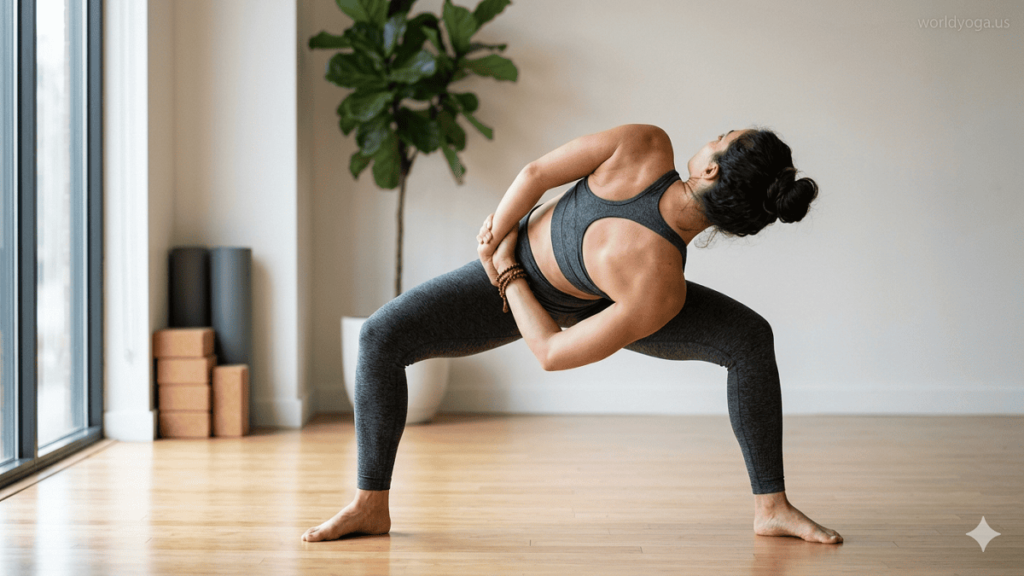
White Paper of Horse Pose: Forward Bend, Binding & Twist
Horse Pose with forward bend, binding, and twist is a multi-planar advanced movement pattern that integrates lower-body strength, spinal flexion, thoracic rotation, and upper-limb binding mechanics. This white paper examines its biomechanical structure, physiological impact, training methodology, and safety considerations within a functional movement and yoga-based framework.
1. Introduction
Multi-action yoga postures such as this variation of Horse Pose are increasingly recognized for their contribution to functional mobility training. By combining hip hinging, rotational control, and shoulder binding in a single sequence, the posture challenges neuromuscular coordination across multiple kinetic chains simultaneously.
This makes it relevant not only in traditional yoga systems but also in fitness conditioning, mobility training, and rehabilitative movement design.
2. Biomechanical Structure
The posture operates across three primary planes of motion:
- Sagittal plane: forward hip flexion and posterior chain elongation
- Frontal plane: lateral stability through wide stance grounding
- Transverse plane: spinal rotation and controlled twisting mechanics
Load distribution is primarily through the lower extremities, while rotational forces are managed through the thoracic spine and core stabilizers. The binding component introduces additional tension vectors across the shoulder girdle, requiring coordinated scapular stabilization.
3. Musculoskeletal Activation
Core System
The obliques, transverse abdominis, and spinal stabilizers control rotation and maintain structural integrity during forward folding and twisting.
Lower Body
The quadriceps, hamstrings, gluteal muscles, and adductors provide stability, eccentric control, and postural endurance in the wide stance position.
Upper Body
The deltoids, rotator cuff muscles, trapezius, rhomboids, and latissimus dorsi coordinate during binding to maintain shoulder alignment and chest openness.
4. Joint Mechanics
Key joints involved include:
- Hip joints: primary hinge for forward flexion
- Knee joints: stability under wide stance loading
- Ankle joints: balance and ground reaction force absorption
- Spinal joints (thoracic focus): controlled rotational mobility
- Shoulder joints: high-demand internal and external rotation during binding
Proper joint sequencing is essential to prevent compensatory stress in the lumbar spine and knees.
5. Physiological and Functional Effects
Regular, well-aligned practice may contribute to:
- Improved posterior chain flexibility and hamstring extensibility
- Enhanced thoracic spine rotation and postural alignment
- Increased shoulder mobility and scapular control
- Greater core endurance and rotational stability
- Improved proprioception and movement coordination
Breath-driven engagement also supports autonomic regulation and improves movement efficiency.
6. Training and Progression Model
A structured progression approach is recommended:
- Foundational stance training (Horse Pose base)
- Hamstring conditioning (forward fold variations)
- Thoracic rotation drills (seated and standing twists)
- Shoulder mobility development (bind preparation work)
- Assisted integration (props such as blocks/straps)
- Full pose execution with controlled breath sequencing
This phased approach reduces injury risk and improves motor learning.
7. Safety Considerations
Key precautions include:
- Avoid lumbar-driven twisting; rotation should originate in the thoracic spine
- Maintain neutral pelvis during forward folding
- Use props when hamstring or shoulder mobility is limited
- Avoid forced binding in cases of shoulder impingement
- Ensure knee alignment over toes to prevent joint stress
- Maintain continuous breath; avoid breath-holding during effort
8. Conclusion
Horse Pose with forward bend, binding, and twist is a highly integrated movement system that develops strength, flexibility, and neuromuscular control across multiple planes. When practiced with structured progression and alignment awareness, it serves as an effective tool for functional mobility enhancement and advanced movement training.
For further anatomical and sequencing references, visit Yoga Journal Pose Library and Yoga International Practice Resources.
#Horse Pose: Forward Bend, Binding & Twist in Kolkata
Industry Application of Horse Pose: Forward Bend, Binding & Twist
Horse Pose with forward bend, binding, and twist is more than a traditional yoga posture—it represents a multi-planar movement system that has strong relevance across fitness, rehabilitation, sports performance, corporate wellness, and movement science industries. Its combined actions of hip hinging, spinal rotation, and upper-body binding make it a valuable model for functional movement training.
1. Application in Fitness and Functional Training
In modern fitness programming, multi-planar movement is essential for developing real-world strength and coordination. This Horse Pose variation trains the body through sagittal (forward bend), transverse (twist), and integrated upper-body engagement (bind), making it highly applicable for functional fitness systems.
Personal trainers and movement coaches often draw from similar mechanics to improve core stability, hip mobility, and posterior chain strength. The pose’s wide stance and controlled loading also enhance lower-body endurance, which is beneficial for athletic conditioning programs.
2. Role in Physiotherapy and Rehabilitation
In rehabilitation contexts, controlled forward bending and rotational movement are used to restore spinal mobility and improve neuromuscular coordination. The principles behind this Horse Pose variation are particularly useful for addressing stiffness in the thoracic spine and hips caused by sedentary lifestyles.
Therapists may adapt elements of the pose—especially the forward fold and gentle twist—to improve functional range of motion. However, full binding is typically avoided in clinical settings until adequate shoulder stability and mobility are restored.
3. Sports Performance and Athletic Training
Athletes in rotational sports such as cricket, tennis, baseball, golf, and martial arts benefit from movement patterns similar to this pose. The combination of lower-body grounding, spinal rotation, and upper-body engagement mirrors real athletic actions such as swinging, throwing, and directional changes.
Training based on this structure improves kinetic chain efficiency, allowing force to transfer more effectively from the ground through the core to the upper limbs. This reduces injury risk while enhancing rotational power and coordination.
4. Corporate Wellness and Ergonomic Health
In corporate environments, prolonged sitting leads to reduced spinal mobility, tight hamstrings, and shoulder stiffness. This Horse Pose variation, or its simplified adaptations, can be integrated into workplace wellness programs to counteract these effects.
The forward bend supports spinal decompression, the twist enhances mobility, and the wide stance improves lower-body activation. Even modified versions practiced during breaks can improve circulation, posture awareness, and musculoskeletal comfort.
5. Mind-Body and Stress Management Applications
Within the wellness industry, this posture is used to support mindfulness, breath control, and stress regulation. The complexity of maintaining balance while integrating fold, bind, and twist requires focused attention, making it effective for enhancing concentration and reducing mental fatigue.
Breath-synchronized movement also supports parasympathetic activation, contributing to relaxation and emotional balance when practiced at moderate intensity.
Conclusion
Horse Pose with forward bend, binding, and twist demonstrates strong cross-industry relevance due to its integrated movement mechanics. From athletic training and rehabilitation to workplace wellness and fitness programming, it serves as a functional model for improving strength, mobility, and coordination across multiple systems.
For further research on yoga in applied movement science, visit Yoga Journal Anatomy & Movement and Yoga International Therapeutics.
#Horse Pose: Forward Bend, Binding & Twist in Mumbai
Ask FAQs
What is Horse Pose with forward bend, binding, and twist?
Horse Pose with forward bend, binding, and twist is an advanced yoga variation that combines a wide-legged stance, hip hinging forward fold, spinal rotation, and an arm bind. It is designed to improve strength, flexibility, and full-body coordination.
Who can practice this advanced variation?
This pose is best suited for intermediate to advanced yoga practitioners who already have good hamstring flexibility, stable balance in wide-stance poses, and basic familiarity with spinal twists and shoulder-opening exercises.
What are the main benefits of this pose?
It helps improve hamstring flexibility, spinal mobility, and shoulder range of motion. It also strengthens the core, legs, and back muscles while enhancing balance, posture, and body awareness through multi-directional movement.
What are the most common mistakes to avoid?
Common mistakes include rounding the lower back, forcing the bind, collapsing the chest in the forward fold, and twisting from the lumbar spine instead of the thoracic spine. These errors can increase the risk of strain in the back, shoulders, or knees.
Are there any precautions before practicing it?
Yes. People with back injuries, hamstring strains, knee issues, or shoulder impingement should avoid deep variations or practice only under supervision. Using props like blocks or straps is recommended to maintain safe alignment and reduce strain.
Table of Contents
Disclaimer
The information provided about yoga postures, including Horse Pose and its variations, is for educational and informational purposes only. It is not intended as medical advice or a substitute for professional healthcare guidance. Always consult a qualified healthcare provider or certified yoga instructor before attempting advanced yoga practices, especially if you have injuries, medical conditions, or physical limitations. Practice within your comfort level and avoid forcing any movement beyond safe alignment.