
Legs Wide: Full Forward Bend-Hands to the Floor
The Legs Wide Full Forward Bend, commonly known in yoga as Prasarita Padottanasana, is a foundational standing posture that emphasizes flexibility, balance, and calm focus. It involves standing with the legs spread wide apart and folding the torso forward to bring the hands toward or onto the floor. This pose is widely practiced in Hatha and Vinyasa yoga sequences due to its ability to stretch multiple muscle groups while also promoting mental relaxation.
Benefits of the Pose
This posture primarily targets the hamstrings, calves, hips, and lower back. The wide stance creates a deeper stretch in the inner thighs and groin area, Legs Wide Full Forward Bend
which is often difficult to access in standard forward bends. Regular practice improves flexibility in the posterior chain of the body, which includes the muscles along the back of the legs and spine.
In addition to physical benefits, this pose has a calming effect on the nervous system. The forward folding position encourages blood flow toward the head, which can help reduce mild fatigue and stress. Many practitioners report a sense of grounding and mental clarity after holding this pose for several breaths.
It also supports improved posture and spinal decompression. By lengthening the spine under controlled conditions, it may help relieve tension caused by prolonged sitting or poor ergonomic habits.
How to Perform the Pose
Begin by standing upright in Tadasana (Mountain Pose). Step your feet wide apart, ensuring they are aligned and stable. Inhale deeply, Legs Wide Full Forward Bend
lengthening the spine, and place your hands on your hips for support. As you exhale, hinge forward from the hips rather than rounding the back.
Gradually lower your torso toward the floor. Depending on your flexibility, place your hands on the floor directly under your shoulders or hold onto your ankles or shins. Keep the legs active, with knees slightly engaged to avoid hyperextension. The crown of the head should move toward the floor, maintaining a long spine as much as possible.
Hold the position for 20–60 seconds while breathing steadily. To release, engage the core, Legs Wide Full Forward Bend
slowly lift the torso back up, and return to a standing position.
Precautions
Individuals with lower back injuries, high blood pressure, or severe hamstring tightness should approach this pose with caution. It is advisable to avoid forcing the stretch and instead use props such as yoga blocks for support.
Learn More
- https://www.yogajournal.com/poses/wide-legged-forward-bend/
- https://www.verywellfit.com/prasarita-padottanasana-3567110
- https://www.yogabasics.com/asana/wide-legged-forward-fold/
Practiced consistently, this pose can become a powerful tool for improving flexibility, Legs Wide Full Forward Bend
reducing stress, and enhancing overall body awareness.
#Legs Wide: Full Forward Bend-Hands to the Floor in India
How is Legs Wide Full Forward Bend with hands to the floor performed correctly?
The Legs Wide Full Forward Bend with hands to the floor, commonly known in yoga as Prasarita Padottanasana, is a standing forward fold that requires attention to alignment, Legs Wide Full Forward Bend
controlled movement, and mindful breathing. When performed correctly, it provides a deep stretch to the hamstrings, inner thighs, calves, and lower back while also promoting relaxation and mental clarity.
Starting Position and Setup
Begin by standing upright in Mountain Pose (Tadasana). Step your feet wide apart—typically about one leg-length distance, though beginners may start slightly narrower for better control. Ensure your feet are parallel or slightly turned inward, Legs Wide Full Forward Bend
depending on comfort and hip structure. Ground evenly through all four corners of each foot to establish stability.
Place your hands on your hips and take a slow inhalation to lengthen the spine upward. Engage your thigh muscles gently without locking the knees. This activation is essential to protect the joints and maintain balance throughout the movement.
Entering the Forward Fold
On an exhale, initiate the movement from the hips rather than rounding the spine. This hip hinge is the most critical aspect of correct execution. Keep the spine long as you fold forward, Legs Wide Full Forward Bend
leading with the chest.
As your torso lowers, bring your fingertips toward the floor. If flexibility allows, place your palms flat on the ground directly beneath your shoulders. Legs Wide Full Forward Bend
If not, use fingertips, yoga blocks, or shins for support. The goal is not depth but alignment.
Ensure that the weight is distributed evenly between both feet. Avoid collapsing into the inner or outer edges of the feet. The legs should remain active, with quadriceps engaged to support the hamstrings.
Refining Alignment
Once in the full expression of the pose, adjust for spinal length. The crown of the head should point toward the floor without forcing the neck. The elbows can gently bend if needed to allow deeper release, but avoid locking or collapsing the upper body.
Keep the hips aligned with the ankles, resisting the urge to shift weight too far forward. A common mistake is over-rounding the back; instead, prioritize a long spine even if the hands do not reach the floor.
Breathing should remain steady and controlled. With each exhale, Legs Wide Full Forward Bend
allow the body to soften slightly deeper into the fold without strain.
Exiting the Pose Safely
To come out of the pose, press firmly through the feet, engage the core muscles, Legs Wide Full Forward Bend
and slowly lift the torso back up while maintaining spinal length. Avoid rising abruptly to prevent dizziness.
Key Precautions
This pose should be practiced cautiously by individuals with hamstring injuries, lower back issues, or high blood pressure. Using props such as blocks can help maintain proper alignment without overstretching.
Learn More
- https://www.yogajournal.com/poses/wide-legged-forward-bend/
- https://www.yogabasics.com/asana/wide-legged-forward-fold/
- https://www.verywellfit.com/prasarita-padottanasana-3567110
When performed with correct alignment and mindful awareness, this pose becomes a powerful tool for improving flexibility, calming the nervous system, and enhancing overall body balance.
#Legs Wide: Full Forward Bend-Hands to the Floor in Maharashtra
What is the proper alignment in this wide-legged forward fold variation?
The proper alignment in the wide-legged forward fold variation (Prasarita Padottanasana) is primarily about maintaining spinal length, stable grounding through the feet, Legs Wide Full Forward Bend
and controlled hip hinging rather than collapsing into flexibility. Even though it is a deep stretch, the goal is structural integrity first, depth second.
Foot and Leg Alignment
Begin by placing the feet wide apart, typically around 3 to 4 feet depending on body height and comfort. The feet should be parallel or very slightly turned inward. A common alignment error is letting the feet turn outward, Legs Wide Full Forward Bend
which can strain the knees and reduce hamstring engagement.
Weight should be distributed evenly across the four corners of each foot: big toe mound, Legs Wide Full Forward Bend
little toe mound, inner heel, and outer heel. The knees remain straight but not locked. Engaging the quadriceps gently helps stabilize the legs and protects the hamstrings from overstretching.
Hip Positioning
The hips should remain level and aligned over the ankles. One of the most important alignment cues is initiating the fold from the hip joints rather than the lower back. This hip hinge ensures that the spine stays long instead of rounding prematurely.
As you fold forward, Legs Wide Full Forward Bend
imagine sending the tailbone slightly upward while the chest moves forward and down. This creates a balanced counteraction that protects the lumbar spine.
Spinal Alignment
The spine should remain elongated throughout the movement. Even when fully folded, Legs Wide Full Forward Bend
the emphasis is on a “flat back” rather than a deep collapse. The crown of the head naturally reaches toward the floor without forcing the neck.
Shoulders should stay relaxed and away from the ears. If the hands reach the floor, Legs Wide Full Forward Bend
they should be placed directly under the shoulders, not too far forward or behind, Legs Wide Full Forward Bend
to maintain structural balance.
Arm and Hand Placement
Depending on flexibility, the hands may rest on the floor, yoga blocks, shins, or ankles. Regardless of placement, arms should not carry excessive body weight. Instead, Legs Wide Full Forward Bend
they act as light support while the legs and core remain active.
Elbows may bend slightly if needed, but avoid dumping weight into the joints.
Core Engagement and Breath
A subtle engagement of the abdominal muscles supports spinal alignment and prevents over-compression in the lower back. Breathing should remain smooth and steady, Legs Wide Full Forward Bend
with each exhale encouraging gentle deepening rather than forceful stretching.
Common Misalignments to Avoid
One of the most frequent mistakes is rounding the spine to reach the floor. Another is shifting weight too far forward into the toes, Legs Wide Full Forward Bend
which destabilizes the pose. Locking the knees or allowing the feet to splay outward also compromises alignment and increases strain risk.
Key References
- https://www.yogajournal.com/poses/wide-legged-forward-bend/
- https://www.yogabasics.com/asana/wide-legged-forward-fold/
- https://www.verywellfit.com/prasarita-padottanasana-3567110
When these alignment principles are followed, the pose becomes not only more effective but also safer, allowing deeper flexibility development and improved postural awareness over time.
#Legs Wide: Full Forward Bend-Hands to the Floor in Ahemadabad
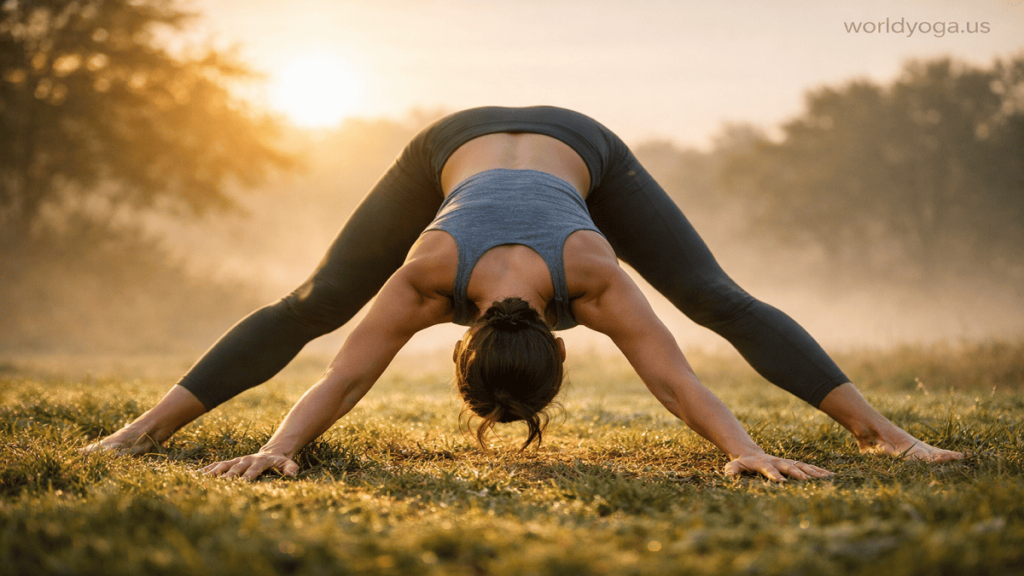
Which muscles and joints are engaged during the posture?
The Legs Wide Full Forward Bend (Prasarita Padottanasana) engages a combination of major muscle groups and key joints across the lower body, spine, Legs Wide Full Forward Bend
and shoulders. Although it appears passive, the posture is structurally active, requiring controlled engagement to maintain alignment and stability while moving into a deep stretch.
Primary Muscle Groups Engaged
The most prominent muscle engagement occurs in the posterior chain of the body. The hamstrings are heavily involved as they lengthen under controlled tension during the forward fold. The degree of engagement increases depending on flexibility and depth of the posture.
The adductor muscles of the inner thighs are significantly activated due to the wide stance. These muscles help stabilize the legs and maintain control over hip positioning. At the same time, Legs Wide Full Forward Bend
the quadriceps engage isometrically to support knee extension and prevent hyperextension.
The gluteal muscles, particularly the gluteus maximus, play a stabilizing role by supporting hip alignment and assisting in controlling the hinge movement. However, they remain moderately engaged rather than fully contracted.
In the upper body, Legs Wide Full Forward Bend
the spinal erectors work eccentrically to control the descent into the fold and help maintain spinal length. The abdominal muscles also engage lightly to support the lower back and prevent excessive rounding.
The shoulder stabilizers, Legs Wide Full Forward Bend
including the trapezius and rhomboids, help maintain shoulder positioning, especially when the hands are placed on the floor or used for light support.
Joint Involvement
Several major joints are actively involved in this posture:
The hip joints are the primary movement centers. The pose requires a deep hip flexion, Legs Wide Full Forward Bend
initiated through a controlled hinge movement. This is one of the key functional aspects of the posture.
The knee joints remain in extension, though not locked. They are stabilized by balanced engagement of the quadriceps and hamstrings, which helps protect the joint structure.
The ankle joints are in a neutral, weight-bearing position. Proper grounding through the ankles is essential for balance and stability in the wide stance.
The spinal joints, including the lumbar, thoracic, and cervical regions, move into controlled flexion. However, the emphasis is on maintaining elongation rather than collapsing into spinal flexion.
The shoulder joints are lightly engaged, especially if the hands are placed on the floor, shins, or blocks. They assist in balance and help distribute weight away from the lower back.
Functional Integration
What makes this posture effective is not isolated muscle action but coordinated engagement. The lower body stabilizes while the spine lengthens, and the upper body releases into gravity without losing structural control. This balance between effort and release is what allows the posture to improve flexibility while maintaining safety.
Reference Sources
- https://www.yogajournal.com/poses/wide-legged-forward-bend/
- https://www.yogabasics.com/asana/wide-legged-forward-fold/
- https://www.verywellfit.com/prasarita-padottanasana-3567110
When practiced correctly, this posture strengthens stabilizing muscles while lengthening key muscle chains, improving both mobility and joint health over time.
#Legs Wide: Full Forward Bend-Hands to the Floor in Hyderabad
What preparatory poses are recommended before practicing it?
Preparing for Legs Wide Full Forward Bend (Prasarita Padottanasana) is important because the posture demands a combination of hamstring flexibility, hip mobility, spinal control, and inner thigh openness. Without proper preparation, practitioners may compensate by rounding the back or straining the hamstrings. A structured warm-up helps create both safety and depth in the pose.
1. Gentle Spinal Warm-Up
Before moving into any deep forward fold, the spine should be mobilized. Simple movements such as Cat-Cow (Marjaryasana-Bitilasana) help warm the entire vertebral column, improving awareness of spinal flexion and extension. This prepares the back muscles to support controlled lengthening in the fold.
Standing forward half folds (Ardha Uttanasana) are also useful for teaching proper hip hinging mechanics, which are essential for maintaining spinal alignment in Prasarita Padottanasana.
2. Hamstring Preparation
Since the hamstrings are deeply stretched in this posture, preparatory poses that gently lengthen them are essential. Downward-Facing Dog (Adho Mukha Svanasana) is one of the most effective preparatory poses, as it introduces controlled hamstring lengthening while building shoulder and core stability.
Seated forward bends such as Paschimottanasana also help condition the hamstrings gradually. Practicing these with a slight bend in the knees ensures safe progression without overstretching.
3. Hip and Inner Thigh Opening
The wide-legged stance requires flexibility in the adductor muscles of the inner thighs. Bound Angle Pose (Baddha Konasana) is highly effective for opening the hips and groin area. It gently encourages external hip rotation and prepares the inner thigh muscles for the wide stance.
Another useful preparation is Goddess Pose (Utkata Konasana), which builds strength and mobility in both the hips and thighs while also engaging the core for stability.
4. Standing Stability and Alignment Work
To support balance and proper alignment in the final pose, standing preparatory postures are valuable. Mountain Pose (Tadasana) with hip hinging practice helps reinforce correct posture mechanics. Practicing wide-legged stance with hands on hips allows the practitioner to understand pelvic alignment before folding forward.
Warrior II (Virabhadrasana II) is also beneficial, as it strengthens the legs, opens the hips, and trains stability in a wide stance similar to the final pose.
5. Gentle Inversions and Release
In some cases, mild inversions such as Legs-Up-The-Wall (Viparita Karani) can help relax the hamstrings and calm the nervous system before deeper forward folds. This helps reduce tension and improves overall flexibility readiness.
Key Preparation Principles
The main goal of preparatory work is not maximum stretching but controlled activation and gradual opening. Muscles should feel warm, not fatigued or overstretched. Breath awareness should be steady, supporting gradual expansion rather than forcing depth.
Reference Sources
- https://www.yogajournal.com/poses/downward-facing-dog/
- https://www.yogabasics.com/asana/bound-angle-pose/
- https://www.yogajournal.com/poses/wide-legged-forward-bend/
With consistent preparation, the body becomes more responsive, allowing the forward fold to develop safely, with better alignment, deeper range of motion, and reduced risk of strain.
#Legs Wide: Full Forward Bend-Hands to the Floor in Delhi
What are the benefits and precautions of this deep forward bending variation?
The Legs Wide Full Forward Bend (Prasarita Padottanasana) is a deep forward bending posture that offers a combination of physical, physiological, and mental benefits when practiced correctly. However, because it involves strong hamstring lengthening and spinal flexion, it also requires awareness of key precautions to avoid strain or injury.
Key Benefits of the Pose
One of the primary benefits of this posture is improved flexibility in the posterior chain, particularly the hamstrings, calves, and lower back. The wide-legged stance intensifies the stretch in the inner thighs (adductors), which are often underused in daily movement. Over time, this can improve hip mobility and overall lower body range of motion.
The posture also promotes spinal decompression. As the torso folds forward under controlled alignment, the vertebrae are gently lengthened, which may help relieve tension caused by prolonged sitting or poor posture habits. This can contribute to a feeling of lightness in the back and improved postural awareness.
From a circulatory perspective, the inverted nature of the pose encourages blood flow toward the head. This mild inversion can help reduce fatigue and support mental clarity. Many practitioners experience a calming effect on the nervous system, making it beneficial for stress relief and anxiety reduction.
Additionally, the pose strengthens stabilizing muscles in the legs and core. While it is primarily a stretching posture, the quadriceps, hip stabilizers, and abdominal muscles work isometrically to maintain alignment and balance. This improves functional strength and body control over time.
Precautions and Contraindications
Despite its benefits, this pose should be approached with caution, especially for individuals with certain conditions. People with hamstring injuries or acute lower back pain should avoid deep forward folding, as excessive stretching may worsen the condition. Modifications such as bending the knees or using yoga blocks are strongly recommended.
Those with high blood pressure or glaucoma should be careful with the inverted position, as increased blood flow to the head may not be appropriate. In such cases, the depth of the fold should be reduced, or the pose should be practiced under professional guidance.
Another common risk is rounding the spine excessively in an attempt to reach the floor. This misalignment places unnecessary stress on the lumbar region and reduces the intended benefits of the posture. Maintaining a hip hinge and long spine is essential for safety.
Overstretching the knees is also a concern. Locking the knee joints can strain ligaments and reduce muscular support. The quadriceps should remain gently engaged to protect the joints throughout the pose.
Beginners should avoid forcing depth. Flexibility develops gradually, and pushing too far too quickly can lead to micro-tears in muscles or connective tissue.
Balanced Practice Approach
To maximize benefits while minimizing risk, the pose should be entered slowly with proper warm-up and controlled breathing. Props such as blocks or bolsters can help maintain alignment without compromising depth. Holding the posture for shorter durations initially and gradually increasing time is also recommended.
Reference Sources
- https://www.yogajournal.com/poses/wide-legged-forward-bend/
- https://www.yogabasics.com/asana/wide-legged-forward-fold/
- https://www.verywellfit.com/prasarita-padottanasana-3567110
When practiced mindfully, this deep forward bend becomes a powerful tool for flexibility, relaxation, and postural improvement while maintaining joint safety and muscular balance.
#Legs Wide: Full Forward Bend-Hands to the Floor in Pune
Case Study of Legs Wide: Full Forward Bend-Hands to the Floor
Introduction
Prasarita Padottanasana, commonly known as Legs Wide Full Forward Bend with hands to the floor, is a foundational yoga posture used in many Hatha and Vinyasa practices. This case study examines its application in a structured yoga program, focusing on a practitioner’s progression in flexibility, alignment, and musculoskeletal adaptation over a 6-week period. The objective was to improve hamstring flexibility, hip mobility, and postural control while reducing lower back stiffness caused by prolonged sitting.
Subject Profile and Initial Assessment
The subject was a 32-year-old office professional with a sedentary lifestyle and moderate physical activity levels. Initial assessment revealed tight hamstrings, limited hip mobility, and mild lower back discomfort after long sitting hours. The subject was unable to place palms on the floor during the forward fold and tended to round the spine significantly when attempting deeper flexion.
Intervention Strategy
The intervention focused on progressive adaptation rather than forcing depth. The subject practiced preparatory poses such as Downward-Facing Dog (Adho Mukha Svanasana), Bound Angle Pose (Baddha Konasana), and Standing Forward Half Fold (Ardha Uttanasana) to improve posterior chain flexibility and hip hinge awareness.
The primary posture, Prasarita Padottanasana, was introduced in stages:
- Week 1–2: Hands on shins or yoga blocks with bent knees to prioritize spinal length
- Week 3–4: Gradual knee extension with fingertips reaching the floor
- Week 5–6: Full expression with palms grounded and improved spinal alignment
Breath control and core engagement were emphasized throughout to support lumbar stability.
Observed Progress and Outcomes
By the end of the 6-week period, significant improvements were recorded. Hamstring flexibility increased, allowing deeper hip flexion without spinal collapse. The subject demonstrated improved ability to maintain a neutral pelvis and longer spinal alignment during the forward fold.
Lower back discomfort reduced noticeably due to better load distribution across the posterior chain. The subject also reported improved relaxation response after practice sessions, indicating a positive effect on the parasympathetic nervous system.
From a functional perspective, the subject showed better posture during sitting and standing tasks, with reduced forward shoulder rounding and improved pelvic awareness.
Biomechanical Analysis
The progression highlighted gradual adaptation in key muscle groups, particularly the hamstrings, adductors, and spinal extensors. Early stages relied heavily on eccentric control of the spinal erectors, while later stages showed improved passive flexibility in the posterior chain. The hip joints became the primary movement drivers instead of the lumbar spine, indicating improved movement mechanics.
Joint loading shifted from compensatory spinal flexion to controlled hip flexion, reducing strain on the lumbar vertebrae.
Conclusion
This case study demonstrates that Prasarita Padottanasana, when introduced progressively with proper alignment cues and preparatory work, can significantly improve flexibility, posture, and musculoskeletal balance. The key success factor was gradual exposure combined with mindful alignment rather than forcing depth.
Reference Sources
- https://www.yogajournal.com/poses/wide-legged-forward-bend/
- https://www.yogabasics.com/asana/wide-legged-forward-fold/
- https://www.verywellfit.com/prasarita-padottanasana-3567110
This posture is highly effective in both therapeutic and performance-based yoga settings when practiced with structured progression and biomechanical awareness.
#Legs Wide: Full Forward Bend-Hands to the Floor in Banglore
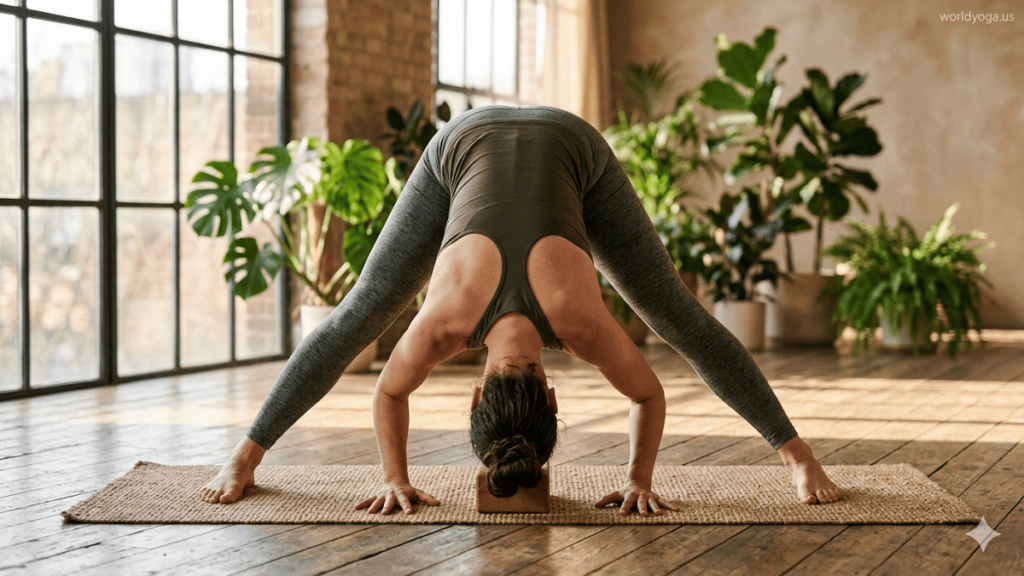
White Paper of Legs Wide: Full Forward Bend-Hands to the Floor
Abstract
Prasarita Padottanasana, commonly referred to as the Legs Wide Full Forward Bend with hands to the floor, is a foundational yoga asana characterized by wide-stance hip flexion and controlled spinal elongation. This white paper evaluates its biomechanical structure, physiological effects, therapeutic applications, and safety considerations. The posture is widely used in modern yoga systems for improving posterior chain flexibility, hip mobility, and neuromuscular control, while also contributing to stress reduction through parasympathetic activation.
1. Introduction
Forward bending postures are central to yoga practice due to their combined musculoskeletal and neurological benefits. Prasarita Padottanasana differs from standard forward folds by incorporating a wide stance, which increases emphasis on the adductor muscle group and hip joint mobility. The “hands to the floor” variation introduces additional demand on spinal alignment, hamstring flexibility, and shoulder stabilization.
2. Biomechanical Framework
The posture is primarily defined by hip flexion with controlled spinal lengthening. Movement originates at the hip joints, requiring eccentric engagement of the spinal extensors to prevent excessive lumbar flexion.
Key biomechanical components include:
- Hip joints: Deep flexion under controlled load
- Knee joints: Extension with stabilizing quadriceps engagement
- Ankle joints: Closed-chain weight-bearing stability
- Spine: Controlled flexion with emphasis on elongation over compression
- Shoulder girdle: Low-load stabilization when hands contact the floor
The wide stance increases adductor activation while reducing direct load concentration on the lumbar spine compared to narrow forward bends, provided alignment is maintained.
3. Muscular and Fascial Engagement
Primary muscle groups include:
- Hamstrings: Eccentric lengthening under tension
- Adductors: Isometric stabilization due to wide stance
- Quadriceps: Knee stabilization and anti-hyperextension control
- Spinal erectors: Controlled eccentric support during descent
- Core musculature: Transverse abdominis engagement for lumbar protection
Fascial lines, particularly the posterior kinetic chain, are significantly involved, contributing to long-range flexibility adaptation and postural integration.
4. Physiological Effects
The posture produces both mechanical and systemic effects:
- Improved venous return and mild inversion benefits
- Increased parasympathetic nervous system activation
- Reduced perceived stress through forward folding position
- Enhanced proprioceptive awareness in lower extremities
Sustained practice is associated with improved flexibility and reduced musculoskeletal stiffness, particularly in sedentary populations.
5. Therapeutic Applications
Prasarita Padottanasana is frequently applied in:
- Rehabilitation of mild hamstring tightness (non-acute cases)
- Postural correction programs for prolonged sitting
- Stress management protocols in yoga therapy
- Functional mobility training for lower body range of motion
When modified appropriately, it can serve as a low-impact intervention for improving posterior chain extensibility.
6. Risk Factors and Contraindications
Despite its benefits, the posture carries risks if improperly executed:
- Lumbar strain due to spinal rounding instead of hip hinging
- Hamstring overextension in hypermobile individuals
- Knee stress from locked hyperextension
- Dizziness or discomfort in individuals with unmanaged hypertension
Modifications such as bent knees, elevated hand support, and reduced stance width are recommended for beginners or at-risk populations.
7. Best Practice Guidelines
Evidence-informed practice emphasizes:
- Initiating movement from the hip joint (not the spine)
- Maintaining quadriceps engagement for knee protection
- Prioritizing spinal elongation over depth
- Using props for alignment support when needed
- Progressing gradually over time rather than forcing range
8. Conclusion
Prasarita Padottanasana (Hands to the Floor variation) is a biomechanically efficient posture for improving posterior chain flexibility, hip mobility, and neuromuscular coordination when practiced with correct alignment principles. Its effectiveness is maximized through gradual progression, structural awareness, and integration into a broader movement system.
References
- https://www.yogajournal.com/poses/wide-legged-forward-bend/
- https://www.yogabasics.com/asana/wide-legged-forward-fold/
- https://www.verywellfit.com/prasarita-padottanasana-3567110
#Legs Wide: Full Forward Bend-Hands to the Floor in Kolkata
Industry Application of Legs Wide: Full Forward Bend-Hands to the Floor
Overview
Prasarita Padottanasana, commonly known as the Legs Wide Full Forward Bend with hands to the floor, is traditionally a yoga posture, but its biomechanical and physiological principles have found meaningful applications across multiple modern industries. These include fitness training, physiotherapy, sports performance, corporate wellness, rehabilitation sciences, and mental health programs. The posture’s combination of hip flexion, posterior chain engagement, and parasympathetic activation makes it functionally relevant beyond yoga practice alone.
1. Fitness and Functional Training Industry
In fitness systems, this posture is used as a mobility and flexibility development tool. Personal trainers incorporate it into warm-up and cool-down routines to improve hamstring and adductor flexibility. The wide stance variation is particularly valuable for athletes who require lower-body mobility, such as runners, cyclists, and dancers.
It is also used to teach hip hinge mechanics, a foundational movement pattern in strength training exercises like deadlifts and kettlebell swings. By reinforcing spinal alignment and hip-driven movement, it reduces injury risk during loaded exercises.
2. Physiotherapy and Rehabilitation
In physiotherapy settings, Prasarita Padottanasana is adapted for restoring functional range of motion in the posterior chain. It is commonly included in rehabilitation programs for patients with mild hamstring tightness, lower back stiffness, and postural imbalances caused by sedentary lifestyles.
Therapists often modify the posture using props such as blocks or chairs to ensure safe spinal alignment. The controlled forward fold helps retrain neuromuscular coordination between the hips and spine, which is critical for long-term recovery and movement efficiency.
3. Sports Performance and Athletic Conditioning
Athletic conditioning programs use this posture to enhance flexibility and reduce muscular tightness that can limit performance. Sports such as football, athletics, martial arts, and gymnastics benefit from improved hamstring elasticity and hip mobility.
The posture also contributes to recovery protocols, as its mild inversion and forward fold characteristics support circulation and reduce post-exercise muscle stiffness. It is often included in cooldown sequences to promote faster recovery and reduce delayed onset muscle soreness (DOMS).
4. Corporate Wellness and Occupational Health
In corporate wellness programs, this posture is widely used to counteract the effects of prolonged sitting. Office workers frequently experience tight hamstrings, compressed hip flexors, and lower back strain, all of which can be addressed through regular practice.
Short guided sessions of Prasarita Padottanasana help improve posture, reduce musculoskeletal discomfort, and enhance mental clarity. Its calming effect also makes it useful in stress management initiatives within high-pressure work environments.
5. Mental Health and Stress Management
In mindfulness and mental health programs, the posture is used as a grounding technique. The forward folding position promotes parasympathetic nervous system activation, which helps reduce stress, anxiety, and mental fatigue.
It is often integrated into yoga therapy for individuals dealing with mild anxiety or sleep disturbances, as it encourages introspection and nervous system downregulation.
6. Dance, Performing Arts, and Movement Education
In dance and performing arts training, the posture is used to enhance flexibility, balance, and body awareness. It supports wider range movements required in choreography and improves control over lower body alignment during dynamic sequences.
Movement educators also use it as a foundational stretch to develop kinesthetic awareness and prevent overuse injuries.
Conclusion
Prasarita Padottanasana (Hands to the Floor variation) has evolved from a traditional yoga posture into a multi-industry functional movement tool. Its applications span physical conditioning, rehabilitation, workplace wellness, and mental health support. The posture’s adaptability makes it valuable across populations ranging from athletes to office workers, provided it is practiced with correct alignment principles and appropriate modifications.
Reference Links
- https://www.yogajournal.com/poses/wide-legged-forward-bend/
- https://www.yogabasics.com/asana/wide-legged-forward-fold/
- https://www.verywellfit.com/prasarita-padottanasana-3567110
#Legs Wide: Full Forward Bend-Hands to the Floor in Mumbai
Ask FAQs
What is the main purpose of Legs Wide Full Forward Bend?
The main purpose of this posture is to stretch and lengthen the hamstrings, calves, inner thighs, and lower back while improving hip mobility and spinal alignment. It also promotes relaxation by calming the nervous system and encouraging controlled breathing. Over time, it supports better posture and functional flexibility for daily movements.
Who can practice this pose safely?
Most healthy individuals can practice this pose with proper alignment. Beginners, office workers, and athletes often benefit from it. However, people with hamstring injuries, severe lower back pain, uncontrolled high blood pressure, or glaucoma should modify the pose or avoid deep forward folding. Using props like yoga blocks or keeping the knees slightly bent can make it safer.
What are the most common mistakes in this posture?
A common mistake is rounding the spine excessively to reach the floor instead of hinging from the hips. Other errors include locking the knees, placing uneven weight on the feet, and letting the feet turn outward. These misalignments reduce effectiveness and can increase strain on the lower back and knees.
How long should the pose be held?
For beginners, holding the posture for 20–30 seconds is sufficient. Intermediate practitioners may hold it for 1–2 minutes with steady breathing. The key is not duration but maintaining correct alignment and comfort. The pose should never be held to the point of pain or breath restriction.
What are the key benefits of regular practice?
Regular practice improves flexibility in the hamstrings, hips, and inner thighs while strengthening postural awareness. It helps reduce lower back stiffness caused by prolonged sitting and supports stress relief through nervous system relaxation. It also enhances circulation and promotes a sense of grounding and mental clarity.
Table of Contents
Disclaimer: This content is for educational and informational purposes only and is not a substitute for professional medical or fitness advice. Practice yoga postures within your comfort level and avoid strain. If you have any medical conditions, injuries, or health concerns, consult a qualified healthcare professional or certified yoga instructor before attempting this pose.