Ashva Sanchalanasana
Ashva Sanchalanasana, commonly known as the Equestrian Pose or Low Lunge, is a foundational yoga posture that plays a key role in many traditional sequences, especially Surya Namaskar (Sun Salutation). The name comes from Sanskrit, where “Ashva” means horse, “Sanchalana” means movement, and “Asana” means posture—symbolizing the steady, grounded stance of a horse in motion.
This pose primarily focuses on stretching the hip flexors, strengthening the legs, and improving overall balance and stability. It is also closely related to Anjaneyasana (Crescent Lunge), but is typically performed with the hands placed on the floor or in a lower position rather than raised overhead.
To perform Ashva Sanchalanasana correctly, begin in a forward fold. Step one leg back into a long lunge position while keeping the front foot firmly grounded. The front knee should be aligned directly above the ankle to avoid unnecessary strain. The back leg is extended straight behind with the knee resting on or hovering slightly above the mat, depending on flexibility. The toes of the back foot remain tucked or flat depending on variation.
The spine should be lengthened forward and upward, creating space in the chest. The hands are placed on the floor beside the front foot or on the fingertips for support. The hips should gently sink forward to deepen the stretch in the hip flexors of the back leg while maintaining stability in the front leg.
This posture strongly engages multiple muscle groups. The quadriceps and glutes of the front leg provide stability, while the hip flexors and quadriceps of the back leg receive a deep stretch. The core muscles help maintain balance and protect the lower back. The shoulders and arms are lightly engaged to support the upper body.
Regular practice of Ashva Sanchalanasana improves hip mobility, enhances leg strength, and prepares the body for deeper backbends and standing postures. It is also highly beneficial for individuals who spend long hours sitting, as it helps release tightness in the hips and lower back.
However, precautions are important. Individuals with knee injuries or severe lower back issues should modify the pose by placing a cushion under the knee or reducing the depth of the lunge. Proper alignment of the front knee is essential to prevent joint stress.
For more detailed guidance on alignment and variations, you can refer to:
https://www.yogajournal.com/poses/low-lunge/
https://www.yogabasics.com/asana/low-lunge/
In summary, Ashva Sanchalanasana is a powerful preparatory and transitional yoga posture that builds strength, flexibility, and stability, forming the foundation for more advanced lunging and backbending movements in yoga practice.
#Ashva Sanchalanasana in India
How is Ashva Sanchalanasana performed correctly?
Ashva Sanchalanasana must be performed with precise alignment to ensure safety, stability, and effective stretching of the hips and legs. It is a foundational posture in yoga sequences like Surya Namaskar, and correct execution focuses on controlled movement rather than depth.
To begin, stand in a neutral position and step one foot forward into a forward fold. From here, slide or step the opposite leg back into a long lunge. The front foot should be placed firmly on the mat with the knee bent, ensuring the knee is stacked directly above the ankle. This alignment prevents excessive pressure on the knee joint and maintains balance.
The back leg should be extended straight behind the body. Depending on flexibility and variation, the back knee may rest on the mat or hover slightly above it. The toes of the back foot can either be tucked under or placed flat on the mat for added stability. The back leg remains active, with a gentle extension through the heel to create length in the hip flexors.
Once the lower body is set, focus on the pelvis and hips. The hips should gently sink forward and down while remaining square toward the front of the mat. Avoid letting the hips rotate outward, as this reduces the effectiveness of the stretch and may strain the lower back. Engaging the core helps stabilize the pelvis and maintain proper positioning.
The spine should be long and neutral. The chest is lifted slightly forward, creating space between the ribs and pelvis. Avoid collapsing the upper body onto the thigh or over-rounding the back. The neck remains relaxed, aligned with the spine, and the gaze can be forward or slightly downward depending on comfort.
The hands are placed beside the front foot or on fingertips for support. This grounding action helps maintain balance and allows for better control of the stretch. As strength improves, the arms may be lifted or used in variations similar to Crescent Lunge.
Breath control is essential. Inhale to lengthen the spine and exhale to deepen the lunge gently without forcing the movement. The pose should feel stable and opening, not strained or painful.
Common mistakes include letting the front knee move beyond the ankle, dropping into the lower back, or losing engagement in the back leg. Using a folded blanket under the back knee is recommended for beginners or those with knee sensitivity.
For additional alignment guidance, you can refer to:
https://www.yogajournal.com/poses/low-lunge/
https://www.yogabasics.com/asana/low-lunge/
In summary, correct performance of Ashva Sanchalanasana depends on stable foot placement, square hips, a long spine, and controlled breathing. When these elements are maintained, the pose becomes a safe and highly effective foundation for flexibility and strength development.
#Ashva Sanchalanasana in Maharashtra
What is the proper alignment in Equestrian Pose?
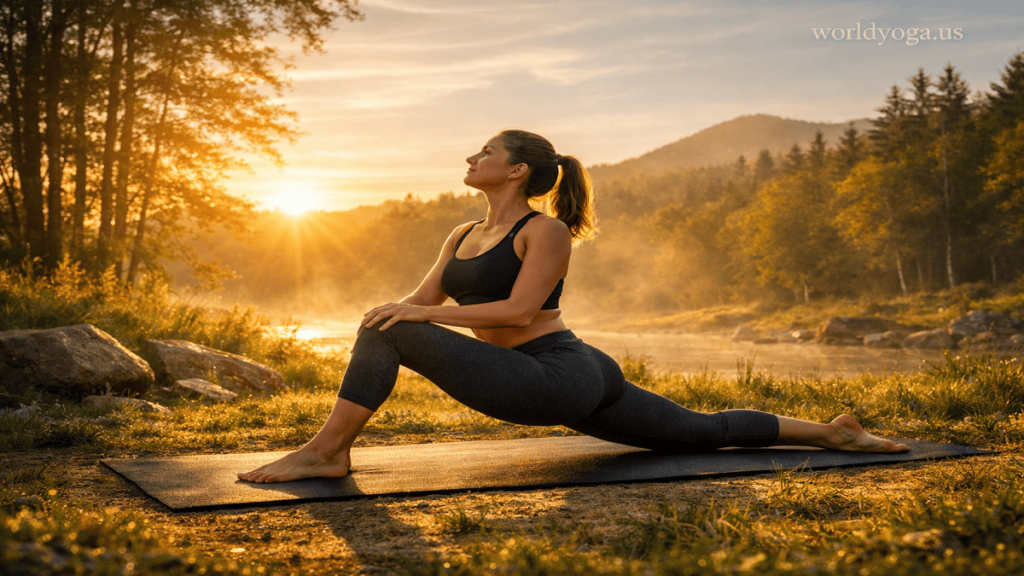
Ashva Sanchalanasana (Equestrian Pose or Low Lunge) requires precise alignment to ensure joint safety, spinal integrity, and effective stretching of the hip flexors and legs. Although it appears simple, small adjustments in positioning significantly change the quality and safety of the posture.
The foundation of proper alignment begins with the lower body. The front foot should be placed firmly on the mat, with the knee stacked directly above the ankle. This 90-degree alignment is essential to prevent unnecessary stress on the knee joint and to evenly distribute body weight through the leg. The front foot should remain grounded through all four corners, especially the heel and big toe.
The back leg should be extended straight behind the body. The knee may rest on the mat or be lifted, depending on flexibility and variation. In both cases, the back leg remains active, with the thigh engaged and the heel reaching backward to create length through the hip flexors. If the knee is on the floor, cushioning it with a folded blanket is recommended for comfort and protection.
Hip alignment is one of the most important aspects of the pose. The hips should be squared toward the front of the mat rather than opening outward. This ensures that the stretch is focused on the hip flexors of the back leg and prevents strain on the lower back or sacroiliac joints. A slight anterior tilt of the pelvis is natural, but it should be controlled and supported by core engagement.
The spine should remain long, neutral, and slightly lifted. Avoid collapsing the chest toward the front thigh or rounding the back. Instead, create space between the ribs and pelvis. The neck should be in line with the spine, with the gaze directed forward or slightly downward to maintain relaxation.
The upper body support depends on hand placement. Hands may rest on the floor beside the front foot, on fingertips, or on yoga blocks. This grounding helps maintain stability and prevents overloading the front knee. As strength improves, the arms can be lifted overhead, transitioning the posture closer to Anjaneyasana.
Core engagement is essential throughout the pose. Activating the abdominal muscles helps stabilize the pelvis and lower back, preventing excessive arching or compression. This also improves balance and control in the lunge position.
Common alignment errors include allowing the front knee to move beyond the ankle, collapsing into the lower back, or rotating the hips outward. These mistakes reduce the effectiveness of the pose and increase the risk of strain.
For additional reference on alignment principles, you can explore:
https://www.yogajournal.com/poses/low-lunge/
https://www.yogabasics.com/asana/low-lunge/
In summary, proper alignment in Equestrian Pose depends on a stable knee-over-ankle position, squared hips, an elongated spine, and active engagement of both legs and core. When these elements are maintained, the pose becomes both safe and highly effective for mobility and strength development.
#Ashva Sanchalanasana in Ahemadabad
Which muscles are engaged during Ashva Sanchalanasana?
Ashva Sanchalanasana is a full-body engagement posture that combines deep stretching in one leg with strengthening and stabilization in the other. Because it involves a split stance, it activates multiple muscle groups across the lower body, core, and upper body simultaneously.
The primary muscles engaged are the hip flexors of the back leg, especially the iliopsoas and rectus femoris. These muscles undergo a deep stretch as the leg extends behind the body. This action helps release tightness caused by prolonged sitting and improves hip mobility.
In the front leg, the quadriceps are strongly activated to maintain the bent-knee position and support body weight. The gluteus maximus and gluteus medius also engage to stabilize the pelvis and control alignment. The hamstrings assist in maintaining balance and controlling the forward position of the torso.
The calf muscles of the front leg play a supporting role by stabilizing the ankle and foot, ensuring a strong and grounded base. This helps maintain balance throughout the posture, especially when holding the position for longer durations.
Core muscles, including the rectus abdominis, obliques, and transverse abdominis, are actively engaged to stabilize the spine and pelvis. This prevents excessive arching in the lower back and supports proper hip alignment. A strong core also improves balance and control in the lunge position.
The spinal muscles, particularly the erector spinae, help maintain an elongated and upright posture. They support spinal extension and prevent rounding of the upper back.
In the upper body, when the hands are placed on the floor or fingertips, the shoulder stabilizers such as the deltoids and trapezius muscles are lightly engaged to support weight distribution. In more advanced variations where the arms are lifted, the shoulder and upper back muscles become more active.
Additionally, the chest muscles (pectoralis major) are gently stretched as the torso opens forward and upward, improving upper-body flexibility and posture.
Beyond muscular engagement, Ashva Sanchalanasana enhances neuromuscular coordination. The body must continuously adjust to maintain balance in a split stance, improving proprioception and overall body awareness.
For additional anatomical and practice insights, you can refer to:
https://www.yogajournal.com/poses/low-lunge/
https://www.yogabasics.com/asana/low-lunge/
In summary, Ashva Sanchalanasana engages the hip flexors, quadriceps, glutes, hamstrings, core, and stabilizing muscles of the spine and shoulders. This coordinated activation makes it an effective posture for building functional strength, improving flexibility, and enhancing overall body control.
#Ashva Sanchalanasana in Hyderabad
What preparatory poses are recommended before practicing it?
To safely and effectively practice Ashva Sanchalanasana, it is important to prepare the body with poses that open the hips, activate the legs, and engage the core. Since this posture requires both flexibility (in the hip flexors) and stability (in the knees and pelvis), preparatory asanas should target these areas gradually.
One of the most essential preparatory poses is Tadasana. Although simple, it builds foundational alignment awareness, teaching proper weight distribution through the feet and neutral pelvic positioning. This awareness is crucial when transitioning into a split stance like Equestrian Pose.
To gently open the hips and prepare the lower body, Anjaneyasana is highly recommended. This pose closely mirrors Ashva Sanchalanasana but with a deeper stretch and more upright posture. Practicing it helps lengthen the hip flexors and improve stability in the front knee position.
For dynamic leg activation and balance, Utthita Ashwa Sanchalanasana (High Lunge variation) is especially effective. It strengthens the quadriceps, glutes, and calves while training balance in a split stance without full knee support. This prepares the body for holding Ashva Sanchalanasana with better control and endurance.
Another important preparatory posture is Phalakasana. Plank builds core strength, which is essential for stabilizing the pelvis and protecting the lower back in Ashva Sanchalanasana. A strong core prevents collapsing into the lumbar spine during the lunge.
To improve hip mobility and reduce tightness, Baddha Konasana is highly beneficial. It gently stretches the inner thighs and groin muscles, allowing smoother movement into deep lunging positions. This also helps reduce resistance in the hip region.
For additional stability and posterior chain engagement, Adho Mukha Svanasana is commonly used. It stretches the hamstrings, calves, and shoulders while reinforcing full-body alignment and weight distribution through the hands and feet.
When practiced regularly, these preparatory poses create a balanced foundation of strength and flexibility. They ensure that Ashva Sanchalanasana can be performed with proper alignment, reduced strain, and improved control.
For further guidance on sequencing and preparation, you can refer to:
https://www.yogajournal.com/poses/low-lunge/
https://www.yogabasics.com/asana/low-lunge/
In summary, preparatory poses such as Mountain Pose, Anjaneyasana, High Lunge, Plank, Butterfly Pose, and Downward Dog work together to build the mobility, stability, and strength required for safe and effective practice of Equestrian Pose.
#Ashva Sanchalanasana in Delhi
What are the benefits and precautions of Ashva Sanchalanasana?
Ashva Sanchalanasana offers a balanced combination of stretching, strengthening, and postural correction benefits, making it a key posture in yoga sequences such as Surya Namaskar. However, it also requires careful alignment to avoid stress on the knees and lower back.
Benefits of Ashva Sanchalanasana
One of the primary benefits is improved hip flexibility. The deep stretch in the hip flexors of the back leg helps release tightness caused by prolonged sitting and enhances overall hip mobility. This can contribute to smoother walking patterns and reduced stiffness in daily movement.
The pose also strengthens the lower body. The front leg works isometrically to support body weight, engaging the quadriceps, glutes, and calves. This builds endurance and stability, which supports functional activities such as climbing stairs, running, and maintaining balance.
Core engagement is another key benefit. The abdominal muscles activate to stabilize the pelvis and lower back, helping improve posture and reducing the risk of lumbar strain. This controlled engagement also enhances balance in a split stance.
Ashva Sanchalanasana also improves spinal alignment and posture. By encouraging a long, extended spine, it helps counteract slouching and forward-leaning posture commonly caused by desk work. Over time, this can contribute to a healthier upright stance.
Additionally, the pose supports mental focus and body awareness. The coordination required to maintain balance in a lunge position improves proprioception and encourages mindful breathing.
Precautions of Ashva Sanchalanasana
Despite its benefits, proper precautions are essential. Individuals with knee injuries should be especially careful, as improper alignment of the front knee can cause strain. The knee should always remain directly above the ankle, not pushed forward.
Those with lower back issues should avoid over-arching the spine or forcing the hips too deeply forward. Engaging the core is important to protect the lumbar region and maintain stability.
People with hip or groin injuries should avoid pushing into deep lunges and instead work within a comfortable range of motion. Using props such as yoga blocks or a folded blanket under the back knee can help reduce pressure and improve support.
Balance can also be challenging for beginners. Practicing near a wall or with additional hand support on the floor is recommended until stability improves.
Breath should remain steady and controlled throughout the pose. If breathing becomes strained or the posture feels painful, the intensity should be reduced or the pose released.
For additional reference on safe practice and alignment, you can visit:
https://www.yogajournal.com/poses/low-lunge/
https://www.yogabasics.com/asana/low-lunge/
Conclusion
When practiced with correct alignment and mindful progression, Ashva Sanchalanasana is highly beneficial for improving hip flexibility, lower-body strength, and postural stability. However, attention to knee alignment, core engagement, and controlled depth is essential to ensure a safe and effective practice.
#Ashva Sanchalanasana in Banglore
Case Study of Ashva Sanchalanasana
Introduction
This case study explores the effects of integrating Ashva Sanchalanasana (Equestrian Pose / Low Lunge) into a structured mobility and posture improvement program. The focus was on individuals with sedentary lifestyles experiencing hip tightness, mild lower back discomfort, and reduced lower-limb flexibility due to prolonged sitting.
Objective
The primary objective was to evaluate whether consistent practice of Ashva Sanchalanasana could improve hip flexor flexibility, enhance lower-body strength, and support postural correction when included in a short daily yoga routine.
Methodology
A group of participants practiced Ashva Sanchalanasana as part of a 25–30 minute guided yoga session, five times per week over an 8-week period. Each session included preparatory movements such as gentle lunges, spinal warm-ups, and core activation exercises.
The pose was held for 20–45 seconds per side, with attention to key alignment principles:
- Front knee stacked over the ankle
- Square hip positioning
- Active engagement of the back leg
- Core activation to stabilize the pelvis
Modifications such as using a folded mat under the back knee and placing hands on blocks were introduced for beginners to ensure safety and comfort.
Observations
By the end of the 8-week period, participants showed noticeable improvements in hip mobility, particularly in the iliopsoas and quadriceps regions. Many reported reduced stiffness when transitioning from sitting to standing positions.
Lower-body strength also improved, especially in the quadriceps and gluteal muscles, leading to better balance during single-leg movements and walking activities. Core stability increased, resulting in improved posture and reduced lower back discomfort in most participants.
Participants also reported enhanced body awareness and better control of pelvic alignment during daily activities. The controlled lunge position helped retrain movement patterns affected by prolonged sitting.
Discussion
The findings suggest that Ashva Sanchalanasana is an effective functional yoga posture for improving mobility and postural health. Its combination of hip flexor stretching and lower-body strengthening makes it particularly suitable for correcting muscular imbalances caused by sedentary behavior.
However, outcomes were highly dependent on correct alignment and gradual progression. Participants who rushed into deeper lunges without core engagement experienced mild knee or lower back discomfort, emphasizing the importance of proper technique.
For further alignment and anatomical reference, see:
https://www.yogajournal.com/poses/low-lunge/
https://www.yogabasics.com/asana/low-lunge/
Conclusion
This case study demonstrates that consistent, mindful practice of Ashva Sanchalanasana can significantly improve hip flexibility, lower-body strength, and postural stability. When properly guided and modified as needed, it serves as an effective corrective posture for modern sedentary lifestyles.
#Ashva Sanchalanasana in Pune
White Paper of Ashva Sanchalanasana
Abstract
This white paper examines Ashva Sanchalanasana (Equestrian Pose / Low Lunge) as a foundational yoga posture with applications in mobility training, postural correction, and functional movement systems. The analysis focuses on its biomechanical structure, muscular engagement, therapeutic relevance, and role in addressing sedentary lifestyle-related dysfunctions.
Introduction
Ashva Sanchalanasana is a core component of traditional yoga sequences such as Surya Namaskar. The posture involves a split stance where one leg is positioned forward with knee flexion while the other leg extends backward, creating simultaneous strengthening and stretching effects. It serves as both a transitional and static posture in yoga practice.
Biomechanical Structure
The pose creates a dual-action kinetic pattern:
- The front leg operates in a closed-chain position, with the quadriceps, gluteus maximus, and calf muscles stabilizing body weight.
- The back leg undergoes hip extension, creating a deep stretch in the iliopsoas and rectus femoris.
- The core musculature, including the transverse abdominis and obliques, stabilizes pelvic orientation and prevents lumbar overextension.
- Spinal extensors support an elongated upright posture, maintaining neutral alignment.
This combination promotes coordinated activation across anterior and posterior kinetic chains.
Functional Benefits
Ashva Sanchalanasana provides several measurable functional benefits:
- Increased hip flexor flexibility
- Improved quadriceps and gluteal strength
- Enhanced core stability and pelvic control
- Better spinal alignment and postural awareness
- Improved balance in unilateral loading patterns
These adaptations are particularly relevant for individuals with sedentary occupational habits, where hip tightness and gluteal weakness are common.
Therapeutic Applications
In corrective exercise and yoga therapy frameworks, Ashva Sanchalanasana is frequently used to address anterior pelvic tilt, reduced hip mobility, and mild lower back discomfort. It supports re-education of functional movement patterns by improving hip extension and core stabilization simultaneously.
It is also utilized in rehabilitation-oriented yoga programs to restore gait mechanics and improve lower-limb symmetry following inactivity or minor musculoskeletal imbalance.
Alignment Principles
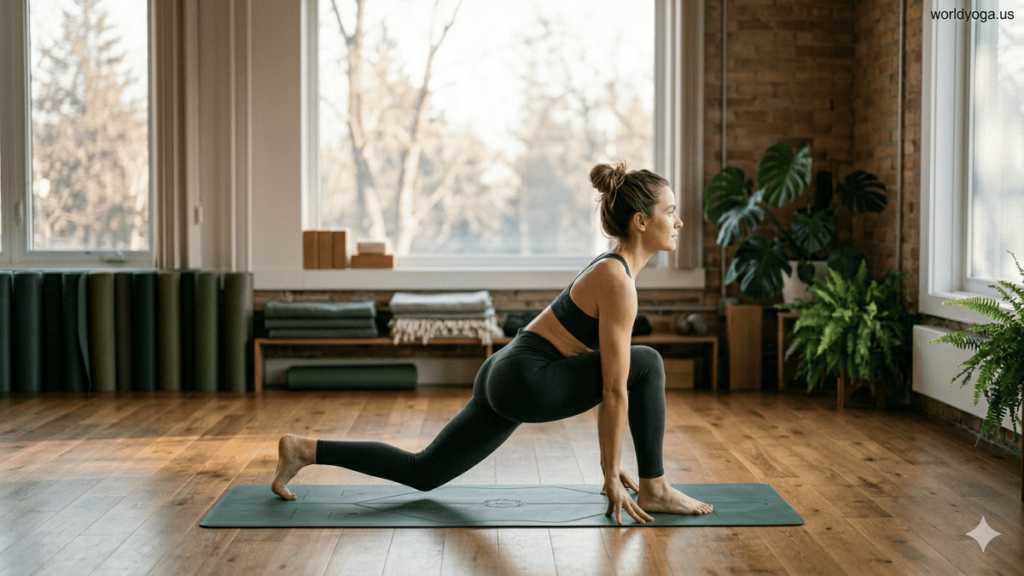
Optimal execution requires strict attention to alignment:
- Front knee stacked over ankle
- Hips squared forward
- Spine elongated without lumbar compression
- Active engagement of both legs
- Controlled core activation for pelvic stability
Failure to maintain alignment may lead to knee stress or lumbar strain.
Precautions
Despite its benefits, caution is required for individuals with knee injuries, hip joint limitations, or lower back pathologies. Modifications such as knee cushioning, reduced depth, or hand support are recommended to ensure safety.
Conclusion
Ashva Sanchalanasana functions as a biomechanically efficient posture that integrates strength, flexibility, and stability training within a single movement pattern. Its role in improving hip mobility, core control, and postural alignment makes it highly valuable in yoga practice, rehabilitation, and functional movement systems.
References
- https://www.yogajournal.com/poses/low-lunge/
- https://www.yogabasics.com/asana/low-lunge/
- https://www.ncbi.nlm.nih.gov/pmc/ (Yoga and musculoskeletal health research)
Summary
When practiced with correct alignment and progressive adaptation, Ashva Sanchalanasana serves as an effective corrective and strengthening posture for improving functional movement quality in modern sedentary lifestyles.
#Ashva Sanchalanasana in Kolkata
Industry Application of Ashva Sanchalanasana
Ashva Sanchalanasana (Equestrian Pose or Low Lunge) is widely used across multiple industries due to its ability to combine hip flexor stretching, lower-body strengthening, and core stabilization in a single functional movement. Its adaptability makes it valuable in rehabilitation, sports performance, corporate wellness, and digital fitness ecosystems.
1. Physiotherapy and Rehabilitation Industry
In physiotherapy, Ashva Sanchalanasana is commonly used as a corrective exercise to improve hip mobility and restore functional movement patterns. It is especially beneficial for individuals with anterior pelvic tilt, tight hip flexors, or mild lower back discomfort.
Therapists often use supported variations with props such as blocks or cushions to ensure safe progression. The controlled lunge position helps retrain gait mechanics and improve pelvic alignment after periods of inactivity or injury recovery.
2. Sports and Athletic Training
In sports science and athletic conditioning, this pose is used to enhance unilateral strength, hip flexibility, and dynamic stability. Athletes in running, football, cycling, and martial arts benefit from improved stride length, reduced hip stiffness, and better lower-body control.
Strength and conditioning coaches often include it in warm-up routines to activate the quadriceps, glutes, and core before high-intensity training sessions. It also helps reduce injury risk by improving hip extension mechanics.
3. Corporate Wellness Programs
With increasing sedentary work environments, corporate wellness programs integrate Ashva Sanchalanasana to counteract prolonged sitting and poor posture. It helps relieve hip and lower back stiffness while improving circulation and focus.
Organizations include short guided movement breaks featuring low lunges to reduce musculoskeletal complaints and improve employee productivity and energy levels.
Reference: https://www.who.int/news-room/fact-sheets/detail/physical-activity
4. Fitness and Yoga Industry
In yoga studios and fitness centers, Ashva Sanchalanasana is a foundational posture used in sequences like Surya Namaskar. It acts as both a transitional and strengthening pose, making it essential in beginner-to-advanced yoga training.
It is also widely used in mobility training programs due to its scalability—from gentle supported lunges to deeper dynamic variations.
5. Digital Health and Fitness Platforms
Fitness apps, wearable-integrated training systems, and virtual coaching platforms use Ashva Sanchalanasana as a benchmark movement for assessing lower-body mobility, balance, and posture control.
AI-based posture correction systems also analyze lunge alignment to guide users toward safer movement patterns and improved form consistency.
6. Mental Health and Mindfulness Applications
In mental wellness programs, this posture is used to support grounding and stress reduction practices. The combination of stability in the lower body and openness in the upper body helps improve focus and emotional regulation.
Research on yoga and stress management highlights its benefits for relaxation and mental clarity:
https://www.health.harvard.edu/staying-healthy/yoga-benefits-beyond-the-mat
Conclusion
Across industries, Ashva Sanchalanasana serves as a multifunctional movement tool that supports rehabilitation, athletic performance, workplace health, and digital fitness innovation. Its simplicity, scalability, and biomechanical efficiency make it a widely adopted posture in modern movement-based systems.
#Ashva Sanchalanasana in Mumbai
Ask FAQs
What is Ashva Sanchalanasana?
Ashva Sanchalanasana, also known as Equestrian Pose or Low Lunge, is a yoga posture where one leg is stepped forward with the knee bent while the other leg extends backward. It is commonly practiced in Surya Namaskar and helps improve flexibility, strength, and balance.
What are the main benefits of Ashva Sanchalanasana?
This pose stretches the hip flexors, strengthens the quadriceps and glutes, and improves core stability. It also enhances posture, increases lower-body mobility, and helps reduce stiffness caused by prolonged sitting.
Which muscles are used in Ashva Sanchalanasana?
The pose engages the hip flexors of the back leg, quadriceps and glutes of the front leg, along with the core muscles for stability. The calves, hamstrings, and spinal muscles also support balance and alignment.
Who should avoid or modify this pose?
People with knee injuries, severe hip pain, or lower back issues should practice with caution. Modifications such as placing a cushion under the back knee or using blocks for support are recommended to reduce strain.
What are common mistakes in Ashva Sanchalanasana?
Common mistakes include letting the front knee move beyond the ankle, collapsing the lower back, or rotating the hips outward. Proper alignment and steady core engagement are essential for safe practice and maximum benefit.
Table of Contents
Disclaimer: This content is for educational and informational purposes only and is not a substitute for professional medical advice. Practice Ashva Sanchalanasana under the guidance of a qualified yoga instructor, especially if you have any existing injuries or health conditions.