
Eka Hasta Utthita Stiti Valakhilyasana
Eka Hasta Utthita Stiti Valakhilyasana is a highly advanced standing balancing yoga posture that requires significant strength, stability, flexibility, and deep body awareness. The name comes from Sanskrit: “Eka Hasta” means one hand, “Utthita” means extended, “Stiti” refers to standing stability, and “Valakhilya” refers to a group of sages in yogic tradition, symbolizing discipline and spiritual focus.
This posture is considered an advanced variation in the standing balance category and is typically practiced by experienced yoga practitioners. It integrates elements of balance, core engagement, spinal alignment, and controlled breath, making it both physically demanding and mentally grounding.
To perform Eka Hasta Utthita Stiti Valakhilyasana, the practitioner begins in a strong standing position with feet grounded evenly. The core is engaged, and the spine is elongated. Slowly, one leg is lifted while maintaining balance on the standing leg. The torso remains upright, requiring strong activation of the stabilizing muscles in the lower body and core.
As the body stabilizes, one arm is extended upward or outward depending on variation, while the opposite hand may either remain grounded, rest on the hip, or assist in maintaining balance. The lifted leg is extended with control, requiring flexibility in the hamstrings and hip flexors. The gaze is fixed on a steady point (drishti) to enhance concentration and balance.
This posture primarily engages the quadriceps, glutes, hamstrings, calves, and deep core muscles such as the transverse abdominis. The stabilizing muscles around the ankles and hips are also highly activated. The shoulders, deltoids, and upper back muscles contribute to maintaining arm extension and postural alignment.
Regular practice of this asana enhances neuromuscular coordination, improves single-leg balance, strengthens stabilizing muscles, and increases overall body control. It is particularly beneficial for athletes, dancers, and advanced yoga practitioners who require refined balance and control.
However, due to its complexity, precautions are essential. Individuals with knee injuries, ankle instability, or lower back issues should avoid or modify the pose. Beginners should first master foundational balancing postures such as Tree Pose and Warrior III before attempting this variation.
For alignment and progression guidance, refer to:
https://www.yogajournal.com/poses/tree-pose/
https://www.yogabasics.com/asana/warrior-3-pose/
In summary, Eka Hasta Utthita Stiti Valakhilyasana is an advanced balancing posture that develops strength, stability, concentration, and full-body coordination, making it a refined practice for experienced yoga practitioners seeking higher levels of control and awareness.
#Eka Hasta Utthita Stiti Valakhilyasana in India
How is Eka Hasta Utthita Stiti Valakhilyasana performed correctly?
Eka Hasta Utthita Stiti Valakhilyasana is an advanced balancing posture, and correct execution depends on controlled progression, precise alignment, and strong focus. Because it combines single-leg balance, core engagement, and one-arm extension, even small misalignments can affect stability.
To begin, stand in a neutral position with both feet grounded evenly. Establish a steady breath and engage the core muscles to stabilize the pelvis. The spine should be elongated, with the shoulders relaxed and not elevated toward the ears. This foundational alignment is essential before any movement begins.
Shift the weight onto one leg gradually. The standing leg should be strong and active, with the quadriceps engaged and the foot firmly rooted into the ground. Avoid locking the knee; instead, maintain a micro-bend to support joint stability. The arch of the foot should remain lifted and active to improve balance.
Once stable, slowly lift the opposite leg with control. The movement should come from the hip joint rather than momentum. Depending on flexibility and variation, the lifted leg may be extended forward, backward, or slightly to the side. The goal is not height but controlled alignment and stability.
At this stage, the torso must remain upright and steady. The core plays a crucial role in preventing leaning or collapsing to one side. The hips should remain level, avoiding rotation or tilting. This alignment ensures even distribution of weight and reduces strain on the lower back.
Next, extend one arm upward or outward depending on the variation. In Eka Hasta Utthita Stiti Valakhilyasana, the “Eka Hasta” (one-hand) component requires strong shoulder stability. The raised arm should remain active but not tense, with fingers extended and shoulder relaxed. The opposite arm may rest on the hip or assist with balance in earlier stages.
The gaze (drishti) should be fixed on a single stable point. This is one of the most important elements for maintaining balance, as it helps reduce body sway and improves concentration.
Breathing should remain slow and controlled. Inhale to lengthen the spine and exhale to stabilize the posture. The pose should never feel forced; instead, stability should be built gradually over time.
Common mistakes include locking the standing knee, overextending the lifted leg without control, or allowing the torso to tilt. Practicing near a wall for support is highly recommended for beginners.
For additional guidance on balance progression, you can refer to:
https://www.yogajournal.com/poses/tree-pose/
https://www.yogabasics.com/asana/warrior-3-pose/
In summary, correct performance of Eka Hasta Utthita Stiti Valakhilyasana requires a strong grounded standing leg, controlled leg lift, stable core engagement, proper spinal alignment, and focused gaze. When these elements work together, the posture becomes stable, efficient, and safe even at an advanced level.
#Eka Hasta Utthita Stiti Valakhilyasana in Maharashtra
What is the proper alignment in this one-hand standing balance variation?
Eka Hasta Utthita Stiti Valakhilyasana requires very precise alignment because it combines single-leg stability with unilateral upper-body extension. The goal is not height or expression, but controlled structural balance from the ground up.
Proper alignment begins at the feet. The entire weight should be centered over the standing foot, which remains firmly rooted into the mat through all four corners—big toe mound, little toe mound, inner heel, and outer heel. The arch of the foot should stay active to prevent collapse inward. The standing knee should be aligned directly over the ankle and remain slightly soft (not locked), allowing micro-adjustments for balance.
The hips are the foundation of stability in this posture. They must remain level and squared forward, avoiding any tilt or rotation toward the lifted leg side. A common error is letting one hip drop, which destabilizes the spine and shifts weight unevenly. Engaging the glutes of the standing leg helps maintain pelvic neutrality.
The spine should be long, upright, and neutrally aligned. There should be no excessive arching in the lower back or rounding in the upper back. The rib cage should stay gently contained rather than flaring outward, allowing the core to support spinal integrity. This is essential for maintaining balance in Eka Hasta Utthita Stiti Valakhilyasana.
Core engagement is critical. The transverse abdominis and obliques stabilize the pelvis and prevent lateral shifting. This internal support system reduces dependency on the arms for balance and improves overall control.
The lifted leg should extend from the hip joint with controlled activation. Whether it is held forward, backward, or to the side, the alignment must remain intentional rather than forced. The knee of the lifted leg should be either slightly bent or fully extended depending on flexibility, but never locked or uncontrolled. The hip of the lifted leg must remain level with the standing hip.
The upper body alignment depends on the “Eka Hasta” (one-hand) variation. The supporting arm or raised arm should be fully active but not tense. If the arm is lifted, it should align with the shoulder, not drift forward or backward. If it is used for balance, it should provide light contact only, not full body weight support.
The gaze (drishti) is fixed on a single unmoving point to stabilize the nervous system and reduce postural sway. This is a key alignment principle in all balancing postures.
Finally, breathing must remain steady and unforced. Any disruption in breath usually indicates misalignment or excessive muscular strain.
In summary, proper alignment in Eka Hasta Utthita Stiti Valakhilyasana depends on a grounded standing foot, level hips, a neutral spine, controlled core engagement, and a stable gaze. When these elements are maintained together, the posture becomes stable, efficient, and safe even in its advanced form.
#Eka Hasta Utthita Stiti Valakhilyasana in Ahemadabad
Which muscles and joints are engaged during the posture?
Eka Hasta Utthita Stiti Valakhilyasana is a high-level balance posture that demands coordinated activation across the lower body, core, and upper body, along with strong joint stabilization. Because it is performed on a single leg with one-hand extension, the body works as an integrated kinetic chain rather than isolated muscle groups.
Muscles Engaged
The primary muscle group is the standing leg complex. The quadriceps are strongly activated to maintain knee extension and support body weight. The gluteus maximus and gluteus medius play a key role in stabilizing the pelvis and preventing hip drop. The hamstrings assist in maintaining control and preventing overextension of the knee.
The calf muscles (gastrocnemius and soleus) are highly engaged to stabilize the ankle and maintain balance. The intrinsic foot muscles also activate to support the arch and distribute weight evenly across the foot.
The core muscles—including the transverse abdominis, rectus abdominis, and obliques—are essential for maintaining spinal alignment and preventing lateral sway. These muscles provide deep internal stability, especially during the one-hand extension phase of Eka Hasta Utthita Stiti Valakhilyasana.
The hip flexors and extensors of the lifted leg engage depending on whether the leg is extended forward, backward, or laterally. This requires controlled activation of the iliopsoas, gluteal muscles, and adductors for precise positioning.
The upper body muscles, particularly the deltoids, trapezius, and rotator cuff group, are engaged when one arm is extended or lifted. The latissimus dorsi and scapular stabilizers help maintain shoulder alignment and prevent collapse or strain.
Joints Engaged
The ankle joint of the standing leg undergoes constant micro-adjustments for balance, requiring both stability and mobility. The knee joint is in a semi-stabilized position, relying on muscular support to avoid hyperextension or collapse.
The hip joint is the central control point of the posture, managing balance between the standing and lifted leg. It must maintain neutral alignment while allowing controlled movement of the lifted limb.
The spine (vertebral joints) remain in a neutral-to-elongated position, with minimal flexion or extension. This alignment is critical for maintaining balance and preventing compensatory strain.
The shoulder joint is actively engaged in the one-hand variation, requiring stability through controlled muscular support rather than passive hanging.
Functional Integration
What makes Eka Hasta Utthita Stiti Valakhilyasana unique is not just muscle activation but neuromuscular coordination. The nervous system continuously adjusts micro-movements in the ankle, hip, and core to maintain equilibrium. This improves proprioception, balance control, and inter-muscular coordination over time.
In summary, this posture engages the quadriceps, glutes, hamstrings, calves, core stabilizers, hip flexors, and shoulder stabilizers, while challenging the ankle, knee, hip, spine, and shoulder joints in a controlled, integrated balance system.
#Eka Hasta Utthita Stiti Valakhilyasana in Hyderabad
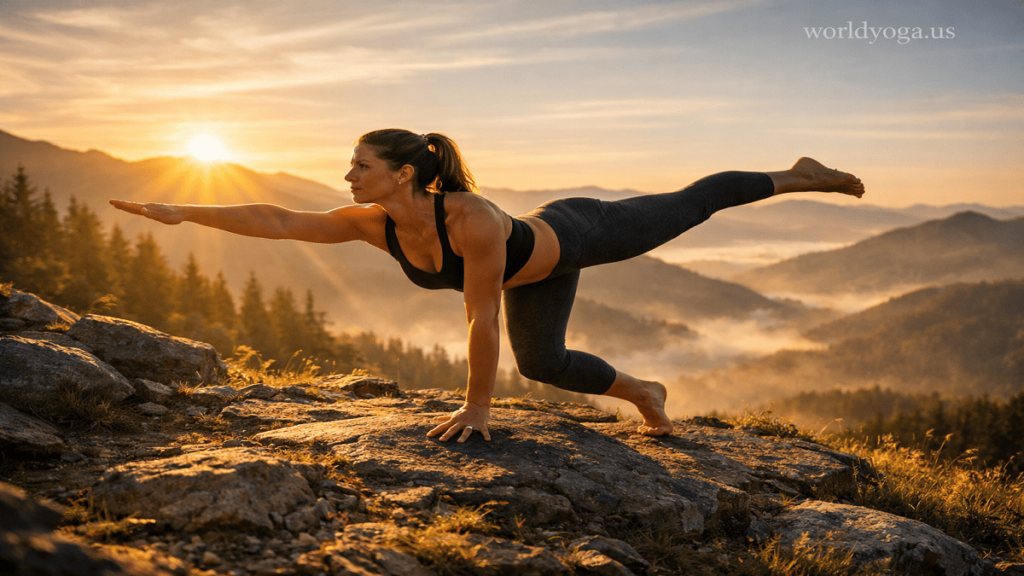
What preparatory poses are recommended before practicing it?
To safely prepare for Eka Hasta Utthita Stiti Valakhilyasana, the body needs progressive training in balance, hip stability, core control, and single-leg strength. Since this is an advanced posture, preparatory asanas should build stability first, then gradually introduce coordination and one-sided loading.
One of the most important foundational poses is Tadasana. It teaches correct weight distribution through the feet, neutral pelvic alignment, and spinal stacking. Without this awareness, maintaining stability in any standing balance becomes difficult.
To develop basic single-leg balance, Vrksasana is essential. It strengthens the standing leg, activates the core, and trains focus (drishti), which is critical for controlling body sway in advanced variations. Tree Pose also introduces gentle hip opening needed for controlled leg positioning.
For dynamic balance and hip stability, Virabhadrasana III is highly effective. It closely mimics the full-body engagement of Eka Hasta Utthita Stiti Valakhilyasana by requiring a single-leg stance, strong core activation, and controlled extension of the lifted leg. It also strengthens the posterior chain, including glutes and hamstrings.
To improve core strength and spinal control, Phalakasana is highly recommended. A strong core reduces wobbling and prevents collapse in advanced balance poses. Side plank variations further enhance oblique strength, which is essential for maintaining lateral stability.
For ankle and foot stability, Garudasana is very useful. It challenges balance on one leg while strengthening stabilizing muscles around the ankles and knees, improving control during weight shifts.
To support hip flexibility and controlled leg extension, poses like Utthita Hasta Padangusthasana are beneficial. This posture develops hamstring flexibility and teaches controlled leg lifting without losing spinal alignment.
Finally, gentle breath and focus training in seated meditation or simple standing drishti practice helps develop the concentration required for maintaining stability in Eka Hasta Utthita Stiti Valakhilyasana.
In summary, preparatory poses such as Mountain Pose, Tree Pose, Warrior III, Plank, Eagle Pose, and Extended Hand-to-Big-Toe Pose collectively build the strength, balance, flexibility, and focus needed to safely progress into this advanced one-hand standing balance variation.
#Eka Hasta Utthita Stiti Valakhilyasana in Banglore
What are the benefits and precautions of Eka Hasta Utthita Stiti Valakhilyasana?
Eka Hasta Utthita Stiti Valakhilyasana is an advanced standing balance posture that develops strength, stability, coordination, and deep mental focus. Because it challenges both the musculoskeletal and nervous systems, it offers significant benefits but also requires careful practice and preparation.
Benefits
One of the primary benefits of this posture is improved balance and proprioception. Standing on one leg while coordinating a one-hand extension forces the body to constantly make micro-adjustments, strengthening neuromuscular control and overall stability.
It also builds lower-body strength, particularly in the quadriceps, glutes, hamstrings, and calves of the standing leg. These muscles work continuously to support body weight and maintain alignment, improving functional strength used in walking, running, and climbing.
The pose significantly enhances core stability. The transverse abdominis, obliques, and deep spinal muscles activate to keep the pelvis and spine aligned, reducing unnecessary sway and improving postural control over time.
Another key benefit is hip and joint coordination. The hip of the standing leg becomes more stable, while the lifted leg improves controlled mobility and flexibility depending on variation. This helps improve overall joint awareness and movement efficiency.
The posture also supports mental focus and concentration (drishti practice). Maintaining a fixed gaze while balancing improves attention span, reduces mental distraction, and encourages a calm, steady mind.
Precautions
Despite its benefits, Eka Hasta Utthita Stiti Valakhilyasana should be practiced with caution due to its advanced nature.
Individuals with ankle instability, knee injuries, or hip joint issues should avoid or modify this pose, as single-leg loading can increase joint stress if alignment is not controlled.
Those with lower back problems should be careful not to over-arch or twist the spine during balancing, as this may lead to compression or strain.
Beginners should avoid attempting the full variation without first mastering foundational poses such as Tree Pose or Warrior III. Lack of preparation may result in loss of balance and injury.
Using a wall or support surface is recommended during early practice to reduce fall risk and build confidence gradually.
It is also important to avoid holding the breath or forcing balance. Breath should remain steady and natural, as breath disruption is often a sign of instability or excessive muscular tension.
Conclusion
When practiced with proper preparation and alignment, Eka Hasta Utthita Stiti Valakhilyasana offers strong benefits in balance, strength, coordination, and mental focus. However, due to its complexity, it should be approached progressively with awareness of joint safety, core engagement, and controlled movement.
#Eka Hasta Utthita Stiti Valakhilyasana in Delhi
Case Study of Eka Hasta Utthita Stiti Valakhilyasana
Introduction
This case study evaluates the effects of integrating Eka Hasta Utthita Stiti Valakhilyasana, an advanced one-hand standing balance posture, into a structured yoga training program. The focus was on experienced yoga practitioners seeking improvements in balance control, core stability, and neuromuscular coordination.
Objective
The primary objective was to assess whether progressive training in this posture could enhance single-leg stability, improve proprioception, and strengthen deep core engagement while maintaining safe joint alignment.
Methodology
A group of intermediate-to-advanced practitioners followed a 10-week progressive training protocol. Sessions were conducted five times per week, with each session lasting approximately 40 minutes.
Training included:
- Foundational balance poses (Tree Pose, Warrior III)
- Core strengthening drills (Plank variations)
- Hip mobility sequences
- Gradual introduction to Eka Hasta Utthita Stiti Valakhilyasana with wall support
Each participant practiced holding the posture for 10–30 seconds per side, gradually reducing external support over time.
Observations
By week 4, participants showed noticeable improvement in single-leg balance duration and reduced postural sway. Core engagement became more consistent, particularly in the transverse abdominis and oblique muscles.
By week 8, most participants demonstrated improved pelvic stability and better control of hip alignment during the lifted-leg variation. The ability to maintain a steady gaze (drishti) significantly improved concentration and reduced balance loss.
By the end of week 10, advanced participants were able to hold Eka Hasta Utthita Stiti Valakhilyasana for longer durations with minimal wobble and improved spinal neutrality.
Discussion
The results indicate that this posture is highly effective for developing neuromuscular coordination, core stability, and balance control. However, progression speed varied significantly between individuals, highlighting the importance of preparatory training.
Participants who skipped foundational poses experienced quicker fatigue and minor instability in ankle and hip joints, reinforcing the need for structured progression.
The integration of wall support in early stages proved essential in reducing fear of falling and improving confidence during balance training.
Conclusion
This case study demonstrates that consistent, progressive practice of Eka Hasta Utthita Stiti Valakhilyasana can significantly enhance balance, core strength, and body coordination. However, success is strongly dependent on preparatory training, alignment awareness, and gradual reduction of support.
#Eka Hasta Utthita Stiti Valakhilyasana in Pune
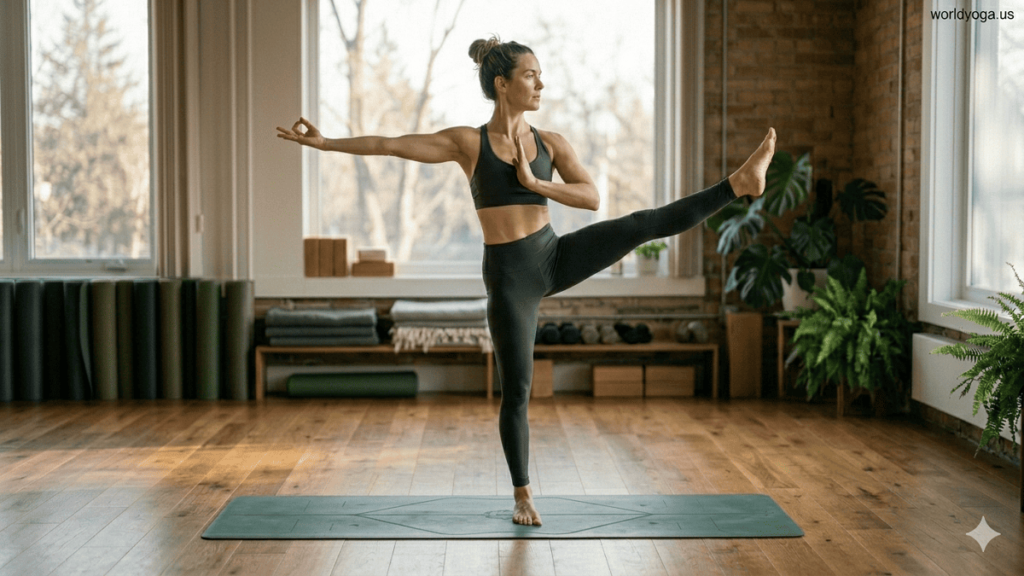
White Paper of Eka Hasta Utthita Stiti Valakhilyasana
Abstract
This white paper presents a biomechanical and functional analysis of Eka Hasta Utthita Stiti Valakhilyasana, an advanced one-hand standing balance posture. It examines its role in neuromuscular coordination, core stabilization, and single-leg strength development. The analysis highlights its applications in advanced yoga practice, athletic conditioning, and balance training systems.
Introduction
Eka Hasta Utthita Stiti Valakhilyasana is a highly advanced standing posture characterized by single-leg balance combined with unilateral arm extension. It demands integration of strength, flexibility, proprioception, and mental focus. The posture is typically practiced by experienced yoga practitioners as part of advanced balance training sequences.
Biomechanical Structure
The posture creates a complex kinetic chain involving multiple systems:
- Lower limb (standing leg): Quadriceps, gluteus medius, gluteus maximus, and calf muscles provide primary support.
- Core system: Transverse abdominis, rectus abdominis, and obliques stabilize the pelvis and spine.
- Lifted limb: Hip flexors, hamstrings, and adductors coordinate controlled extension or elevation.
- Upper body: Deltoids, trapezius, and rotator cuff muscles stabilize the shoulder during one-hand extension.
The posture relies heavily on neuromuscular micro-adjustments at the ankle, knee, and hip joints to maintain equilibrium.
Functional Benefits
Regular practice of Eka Hasta Utthita Stiti Valakhilyasana offers the following benefits:
- Enhanced single-leg balance and proprioception
- Increased lower-body muscular endurance
- Improved core stability and spinal control
- Better hip joint coordination and mobility control
- Strengthened shoulder stability in unilateral loading conditions
These benefits make the posture relevant for advanced movement training and functional athletic conditioning.
Neuromuscular and Cognitive Impact
The posture significantly enhances brain-body coordination by improving the vestibular system’s response to imbalance. Continuous micro-corrections improve reaction time, spatial awareness, and movement precision. The required drishti (focused gaze) strengthens cognitive concentration and reduces external distraction.
Applications
This posture is applied in:
- Advanced yoga sequencing and training programs
- Athletic balance and coordination drills
- Dance and performance movement training
- Rehabilitation progression phases for balance restoration (under supervision)
- Functional fitness systems emphasizing unilateral strength
Alignment Considerations
Proper alignment is critical for safe execution:
- Standing foot fully grounded with active arch
- Hips level and squared
- Spine neutral and elongated
- Core actively engaged to prevent sway
- Shoulder aligned with controlled one-hand extension
Misalignment may result in ankle strain, knee stress, or lumbar compression.
Precautions
Due to its complexity, this posture is not recommended for beginners. Individuals with ankle instability, knee injuries, or lower back conditions should avoid or modify the practice. Wall support is recommended during early training stages.
Conclusion
Eka Hasta Utthita Stiti Valakhilyasana is a high-level balance posture that integrates strength, coordination, and cognitive focus. When practiced progressively and with proper alignment, it enhances neuromuscular efficiency, core stability, and full-body control.
References
- https://www.yogajournal.com/poses/tree-pose/
- https://www.yogabasics.com/asana/warrior-3-pose/
- https://www.ncbi.nlm.nih.gov/pmc/ (Yoga and balance training research)
Summary
This posture represents an advanced integration of physical stability and mental focus, making it a valuable tool in elite yoga practice and functional movement training systems when approached with structured progression.
#Eka Hasta Utthita Stiti Valakhilyasana in Kolkata
Industry Application of Eka Hasta Utthita Stiti Valakhilyasana
Eka Hasta Utthita Stiti Valakhilyasana is an advanced balance and neuromuscular control posture that extends beyond traditional yoga practice into multiple modern industries. Its emphasis on single-leg stability, core activation, proprioception, and unilateral coordination makes it highly valuable in performance training, rehabilitation, wellness, and digital health systems.
1. Sports Science and Athletic Performance
In sports conditioning, this posture is used to develop elite-level balance, ankle stability, and hip control. Athletes in disciplines such as athletics, football, martial arts, gymnastics, and dance benefit from improved single-leg strength and reaction control.
Strength and conditioning coaches use similar balance progressions to improve agility, reduce injury risk, and enhance movement efficiency during dynamic actions like sprinting, jumping, and directional changes.
2. Physiotherapy and Rehabilitation
In rehabilitation settings, this posture is applied in advanced recovery phases for patients regaining balance and lower-limb control. It helps retrain neuromuscular pathways after injuries affecting the ankle, knee, or hip.
Therapists may introduce modified versions using wall support or partial weight-bearing to improve proprioception and restore functional stability. However, it is only used in later-stage rehabilitation due to its complexity.
3. Dance and Performance Arts
In dance training, Eka Hasta Utthita Stiti Valakhilyasana supports improved control of posture transitions, single-leg stability, and expressive balance work. It enhances the ability to maintain stability while performing upper-body choreography or directional changes.
Classical, contemporary, and aerial dance disciplines use similar balance-based conditioning to refine precision and fluidity of movement.
4. Yoga and Fitness Industry
In advanced yoga training programs, this posture is used as a peak balance challenge. It is often included in progression sequences following foundational poses like Tree Pose and Warrior III.
Fitness studios incorporate it into functional mobility and balance classes to improve core strength, ankle stability, and full-body coordination.
5. Corporate Wellness and Cognitive Training
Although rarely used in full form, simplified variations are applied in workplace wellness programs to improve focus, reduce stress, and enhance mind-body awareness. Balance-based micro-movements derived from this posture are used in short movement breaks.
Such practices support improved concentration, posture correction, and reduced fatigue from prolonged sitting.
Reference: https://www.who.int/news-room/fact-sheets/detail/physical-activity
6. Digital Health, AI, and Wearable Technology
In digital fitness platforms, advanced balance postures like this are used as assessment benchmarks for stability, coordination, and mobility tracking.
AI-based posture correction systems and motion analysis tools evaluate joint alignment, sway patterns, and balance efficiency to guide personalized training programs.
Wearable sensors also use similar movements to measure gait stability and neuromuscular performance.
Conclusion
Eka Hasta Utthita Stiti Valakhilyasana serves as a high-value movement pattern across industries focused on human performance, rehabilitation, and digital health. Its integration into structured training systems enhances balance, coordination, and functional stability, making it a valuable tool in both physical and technological wellness ecosystems.
#Eka Hasta Utthita Stiti Valakhilyasana in Mumbai
Ask FAQs
What is Eka Hasta Utthita Stiti Valakhilyasana?
It is an advanced standing balance yoga posture where the practitioner stands on one leg while extending one hand and maintaining full-body stability. It focuses on strength, balance, and coordination.
What are the main benefits of this pose?
This posture improves single-leg balance, strengthens the core and lower body, enhances posture, and develops neuromuscular coordination. It also improves focus and mental stability through steady gaze practice.
Which muscles are involved in this pose?
The quadriceps, glutes, hamstrings, and calves of the standing leg are heavily engaged. The core muscles stabilize the spine, while the shoulder and arm muscles support the one-hand extension. The hip muscles of the lifted leg also activate for control.
Who should avoid this pose?
Beginners, and individuals with ankle instability, knee injuries, hip issues, or lower back pain should avoid or modify this pose. It is best practiced under expert guidance with proper progression.
What are common mistakes in this posture?
Common mistakes include locking the standing knee, losing hip alignment, over-arching the back, and relying too much on the extended arm for balance. Lack of core engagement can also lead to instability and poor form.
Table of Contents
Disclaimer: This content is for educational and informational purposes only and is not a substitute for medical advice. Practice Eka Hasta Utthita Stiti Valakhilyasana under the guidance of a qualified yoga instructor, especially if you have injuries, balance issues, or any medical conditions.