Ardha Padma Uttana Pristhasana
Ardha Padma Uttana Pristhasana is a deep hip-opening yoga variation that combines elements of lunge positioning, forward extension, and half lotus leg placement. This advanced posture is often used in modern yoga sequencing to develop flexibility in the hips, groin, hamstrings, and lower back while also improving balance, focus, and controlled breath awareness.
Understanding the Structure of the Pose
The pose is built upon a low lunge foundation, where one leg is placed forward in a stable grounded position while the other leg extends backward for support and hip opening. The defining feature of this posture is the half lotus position of the rear leg, where the foot is gently placed near the opposite hip crease or upper thigh, depending on flexibility and joint capacity.
The torso extends forward in a controlled manner, often bringing the chest closer to the ground while maintaining spinal length. This forward extension deepens the stretch in the hips and inner thighs while encouraging decompression of the lower spine.
Physical and Functional Benefits
Ardha Padma Uttana Pristhasana is highly effective for improving hip mobility, especially in the external rotation of the hip joint. It helps open tight hip flexors, groin muscles, and hamstrings, which are commonly restricted due to prolonged sitting or sedentary lifestyles.
The posture also strengthens the lower body by engaging the quadriceps, glutes, and stabilizing muscles of the standing leg. The core muscles remain active to support balance and maintain spinal alignment during the forward extension.
In addition, the half lotus position enhances joint awareness and encourages mindful placement of the lower limbs, improving coordination and proprioception over time.
Mind-Body Connection
This posture requires a high level of concentration and controlled breathing. The combination of balance, deep stretching, and spinal extension encourages mental focus and emotional grounding. Practitioners often experience a calming effect as the pose promotes both physical release and mindful awareness.
Practical Application in Yoga Practice
Ardha Padma Uttana Pristhasana is commonly included in intermediate and advanced yoga sequences as part of hip-opening or flexibility-focused flows. It serves as a preparatory posture for deeper seated lotus positions and advanced forward bends.
Because of its intensity, it should be practiced with proper warm-ups and gradual progression to avoid strain in the knees, hips, or lower back.
For further anatomical guidance and yoga sequencing references, visit Yoga Journal Pose Library and Yoga International Practice Resources.
#Ardha Padma Uttana Pristhasana in India
How is Ardha Padma Uttana Pristhasana performed correctly?
Ardha Padma Uttana Pristhasana is an advanced hip-opening and forward-extending yoga posture that requires careful alignment, joint awareness, and gradual progression. Correct execution depends more on safe positioning and controlled depth than on how low the body can go.
1. Begin in a Stable Lunge Foundation
Start in a low lunge position with one foot forward and the opposite leg extended back. The front knee should be directly above the ankle, not collapsing inward or pushing too far forward.
The back leg should remain active, with the knee lifted or gently resting depending on the variation. The hips should face forward as much as possible to maintain structural balance.
This base is essential before introducing the half lotus variation.
2. Enter the Half Lotus Position Safely
From the stable lunge, carefully begin to externally rotate the back hip. Slowly guide the back foot toward the opposite hip crease or upper thigh area, depending on flexibility.
This movement must be slow and controlled. The knee should never be forced or pressed into position, as this can create stress in the knee joint.
If half lotus placement is not accessible, the back foot should remain grounded or supported instead of forcing the position.
3. Align the Hips and Pelvis
Once the back leg is positioned, focus on leveling the hips. The pelvis should remain as square as possible toward the front of the mat.
Avoid excessive tilting or collapsing into one side. Engaging the core helps stabilize the pelvis and supports safe alignment in the hip joints.
4. Extend Into the Forward Bend
On an inhale, lengthen the spine forward. On the exhale, begin to fold from the hips, not the lower back.
The chest should move forward first, maintaining a long spine as the torso lowers. The goal is to create space in the spine while deepening the hip stretch.
Hands may rest on the floor, blocks, or forearms depending on flexibility.
5. Maintain Shoulder and Upper Body Alignment
The shoulders should remain relaxed and away from the ears. The chest should stay open even as the torso moves closer to the ground.
Avoid collapsing the upper back or rounding excessively. Instead, maintain a sense of extension through the spine.
6. Engage Breath and Core Control
Breathing plays a key role in maintaining stability. Inhale to lengthen the spine and exhale to deepen the fold gradually.
The core muscles should remain lightly engaged to support balance and prevent strain in the lower back and hips.
7. Exit the Pose Safely
To release, slowly lift the torso back up using the breath. Carefully remove the back foot from the half lotus position first, then return to a neutral lunge before transitioning out of the posture.
Movements should always be slow to protect the knee and hip joints.
Final Thoughts
Correct performance of Ardha Padma Uttana Pristhasana depends on controlled hip opening, safe knee alignment, spinal length, and mindful progression. The pose should never be forced, especially in the half lotus position, and props or modifications should be used when needed.
For further guidance on alignment and hip-opening sequences, visit Yoga Journal and Yoga International.
#Ardha Padma Uttana Pristhasana in Maharashtra
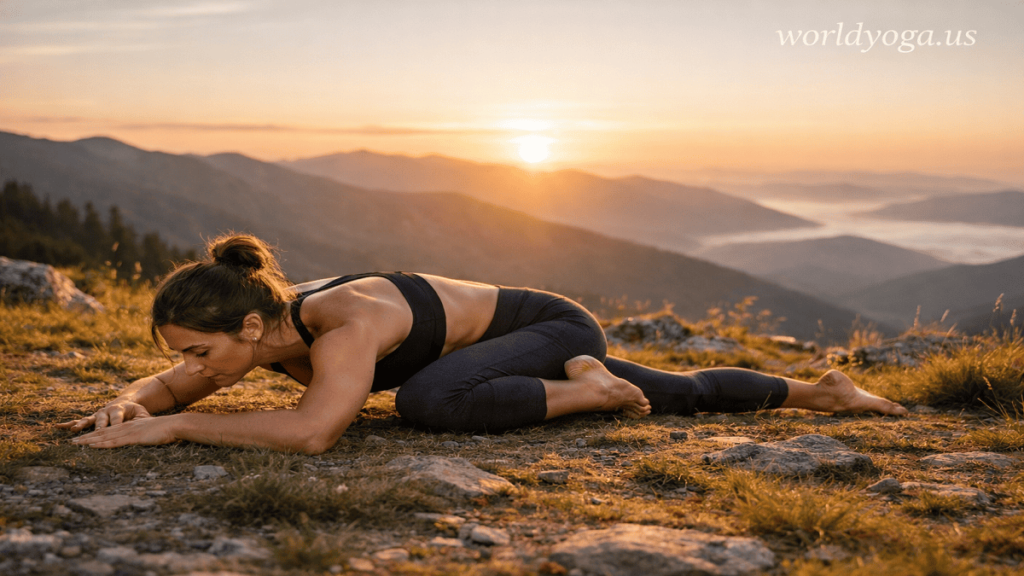
What is the proper alignment in this half-lotus lizard pose variation?
Ardha Padma Uttana Pristhasana requires precise alignment because it combines deep hip external rotation with a forward-extending lunge. The posture places stress on the hips, knees, spine, and shoulders simultaneously, so correct structure is essential for safety and effectiveness.
1. Foundation: Front Leg and Lunge Base
The front foot should be placed firmly under the front knee, with the shin vertical or nearly vertical. The knee must track in line with the second and third toes to avoid inward collapse.
Weight should be evenly distributed between the front foot and the supporting back leg. The front heel stays grounded to ensure stability. The back leg should remain active, either extended or lightly engaged depending on flexibility level.
2. Half-Lotus Back Leg Alignment
The defining feature of this variation is the half-lotus placement of the back leg. The hip must externally rotate slowly and gradually, allowing the foot to move toward the opposite hip crease or upper thigh.
The most important alignment rule is that the knee must never be forced. It should remain pain-free, tracking naturally in line with the hip joint. If resistance is felt in the knee rather than the hip, the position should be modified immediately.
The rotation should originate from the hip socket, not the knee joint.
3. Pelvis and Hip Alignment
The pelvis should remain as square as possible toward the front of the mat. While slight asymmetry is natural due to the half-lotus shape, excessive tilting or twisting of the hips should be avoided.
Engaging the lower abdomen helps stabilize the pelvis and prevents collapsing into one hip. This alignment ensures that the stretch is distributed through the hips rather than concentrated in the lower back or knees.
4. Spinal Alignment
The spine should remain long and extended throughout the posture. Before folding, the practitioner should actively lengthen upward through the crown of the head.
During the forward extension, the movement should originate from the hip joints rather than rounding the lumbar spine. The chest should move forward first, maintaining spinal length as the torso lowers.
Avoid collapsing the upper back or rounding excessively, as this reduces space in the spine and increases strain.
5. Shoulder and Upper Body Alignment
The shoulders should stay relaxed, broad, and away from the ears. The chest should remain open even in the deeper fold.
If forearms or hands are placed on the floor, they should support the posture without causing compression in the shoulders. Blocks may be used to maintain alignment and prevent overreach.
6. Neck and Head Position
The neck should remain in a neutral extension of the spine. The gaze can be directed slightly forward or downward without compressing the cervical spine.
Avoid dropping the head heavily or straining the neck into extension.
7. Breath and Stability
Breathing should be steady and controlled. Inhale to lengthen the spine and create space in the hips; exhale to gently deepen the forward extension.
The core should remain lightly engaged to stabilize the pelvis and protect the lower back during the forward movement.
Final Thoughts
Proper alignment in Ardha Padma Uttana Pristhasana depends on safe hip rotation, stable lunge positioning, neutral pelvis control, and a long spine. The most critical principle is avoiding force in the knee joint while allowing mobility to come from the hips.
For additional alignment education and hip-opening practice guidance, visit Yoga Journal Pose Library and Yoga International Practice Resources.
#Ardha Padma Uttana Pristhasana in Ahemadabad
Which muscles and joints are engaged during the posture?
Ardha Padma Uttana Pristhasana is a high-intensity hip-opening and forward-extending yoga posture that recruits multiple muscle groups and joint systems simultaneously. Because it combines a lunge, deep hip external rotation, and forward fold, it creates layered engagement across the lower body, core, spine, and shoulders.
1. Lower Body Muscles (Primary Activation)
The lower body carries most of the load in this posture.
- Quadriceps: Stabilize the front knee and control the lunge position
- Gluteus maximus and medius: Support hip extension and pelvic stability
- Hamstrings: Lengthen during forward folding and assist in hip hinge control
- Hip external rotators (piriformis, deep rotators): Actively engaged in half-lotus positioning of the back leg
- Adductors (inner thighs): Help maintain balance and control pelvic alignment
- Calves: Assist in grounding and ankle stability in the front leg
2. Core and Spinal Muscles
The core plays a major stabilizing role throughout the posture.
- Transverse abdominis: Provides deep core stability and protects the spine
- Obliques: Assist in maintaining balance and preventing rotational collapse
- Erector spinae: Support spinal extension and prevent rounding during the forward fold
- Multifidus: Stabilize vertebral segments during controlled movement
These muscles work together to maintain spinal length and pelvic control.
3. Upper Body and Shoulder Muscles
While not the primary focus, the upper body remains engaged for support.
- Deltoids: Assist in arm positioning and weight support
- Trapezius and rhomboids: Stabilize the shoulder blades
- Latissimus dorsi: Supports controlled extension of the upper body
- Pectorals: Lightly stretched during chest opening in the forward extension
4. Joint Engagement and Mechanics
Several major joints are actively involved:
Hip joints (acetabulofemoral joints)
Primary site of movement. Responsible for deep external rotation (half lotus leg) and flexion during forward fold.
Knee joints
Front knee supports lunge alignment. The back knee is particularly vulnerable if half lotus is forced, making controlled hip rotation essential.
Ankle joints
Provide grounding and balance in the front leg, supporting stability under load.
Spinal joints (especially thoracic spine)
Allow controlled forward flexion and extension while maintaining length.
Shoulder joints (glenohumeral joints)
Assist in balance and support during forward reach and weight distribution.
5. Integrated Functional Engagement
What makes this posture unique is the simultaneous activation of mobility and stability systems. One side of the body may be in deep external rotation while the other supports dynamic loading in a lunge, requiring continuous neuromuscular coordination.
This integration improves proprioception, balance, and full-body movement efficiency when practiced consistently.
Final Thoughts
Ardha Padma Uttana Pristhasana engages nearly every major muscle group and multiple joint systems, with emphasis on hips, core stability, and spinal control. Safe execution depends on hip-driven movement, not knee force, and balanced muscular activation throughout the posture.
For further anatomy-based yoga learning, visit Yoga Journal Anatomy Section and Yoga International Anatomy Resources.
#Ardha Padma Uttana Pristhasana in Hyderabad
What preparatory poses are recommended before attempting it?
Ardha Padma Uttana Pristhasana is an advanced hip-opening posture that combines deep external hip rotation, a low lunge foundation, and forward extension. Because it places significant demand on the hips, knees, hamstrings, and spine, a structured preparation sequence is essential to ensure safety and effective alignment.
1. Foundational Lunge Strength and Stability
Before attempting the half-lotus variation, the body should be comfortable in stable lunge patterns.
Low Lunge is one of the most important preparatory poses. It builds strength in the quadriceps and hip flexors while teaching proper pelvic alignment and spinal lift in a split-leg stance.
High Lunge further develops balance, leg endurance, and core engagement, which are necessary for maintaining stability during the forward extension phase.
2. Hip Opening and External Rotation Preparation
Since the back leg moves into a half-lotus position, deep hip external rotation is required.
Pigeon Pose is highly effective for opening the hip rotators, glutes, and piriformis. It prepares the hip joint for safe rotational movement without forcing the knee.
Figure Four Stretch is a gentler alternative that safely improves external rotation while reducing strain on the knee joint.
3. Hamstring and Posterior Chain Flexibility
The forward extension component requires hamstring length and spinal control.
Standing Forward Bend helps lengthen the posterior chain and teaches safe hip hinging mechanics without collapsing the spine.
Half Split Pose isolates one leg at a time, making it particularly effective for improving hamstring flexibility while maintaining spinal alignment.
4. Spinal Extension and Core Control
Controlled spinal length is essential before adding rotation and folding.
Downward Facing Dog strengthens the shoulders, lengthens the spine, and activates the core while introducing mild inversion and decompression.
Gentle twists in seated or supine positions can also prepare the thoracic spine for controlled rotation in the final posture.
5. Integrated Hip–Spine Coordination
Lizard Pose is the most direct preparatory posture. It closely mimics the final shape without the half-lotus complexity, allowing practitioners to develop stability, hip opening, and spinal extension safely.
Final Thoughts
Preparation for Ardha Padma Uttana Pristhasana should focus on building stability in lunges, opening the hips gradually, improving hamstring flexibility, and developing controlled spinal extension. Each preparatory pose contributes to reducing joint stress and improving movement efficiency in the final posture.
For additional sequencing and anatomy-based yoga guidance, visit Yoga Journal Pose Library and Yoga International Practice Resources.
#Ardha Padma Uttana Pristhasana in Delhi
What are the benefits and precautions of Ardha Padma Uttana Pristhasana?
Ardha Padma Uttana Pristhasana is an advanced hip-opening yoga variation that combines a low lunge, forward extension, and half-lotus leg position. Because it blends deep hip rotation with spinal lengthening and weight-bearing support, it offers significant physical benefits but also requires careful attention to joint safety and alignment.
Benefits of Ardha Padma Uttana Pristhasana
One of the primary benefits of this posture is deep hip opening, especially in external rotation. It targets the hip rotators, glutes, and groin muscles, helping improve mobility in the hip joint and reducing stiffness caused by prolonged sitting.
The pose also enhances hamstring flexibility and posterior chain length through its forward extension component. This helps improve overall movement efficiency, posture, and spinal decompression.
Another key benefit is strength development in the lower body. The front leg supports body weight in a lunge position, activating the quadriceps, glutes, and stabilizing muscles of the hips and knees. This builds endurance and functional strength.
The posture also improves core stability and spinal control. The abdominal muscles engage to maintain balance and prevent collapse during the forward extension, while the spine remains elongated and active.
Additionally, the half-lotus variation enhances body awareness and neuromuscular coordination, as practitioners must carefully control hip rotation, balance, and breath simultaneously.
Precautions and Safety Considerations
Despite its benefits, this pose carries a higher risk profile due to the inclusion of a half-lotus leg position.
The most important precaution is to avoid forcing the knee into rotation. The back leg should enter the half-lotus position only through safe hip external rotation. If there is any knee discomfort, the variation should be modified immediately.
Individuals with knee injuries, hip impingement, or limited external rotation should avoid the full variation or use supportive modifications such as keeping the back foot grounded.
The lower back should not be compressed or rounded excessively during the forward extension. Movement must originate from the hips, not the lumbar spine.
Practitioners should also be cautious of overstretching the hamstrings. Using blocks or keeping a slight bend in the front knee can help maintain safe alignment.
Balance can be challenging in this posture, so practicing near a wall or under guidance is recommended for beginners transitioning into advanced variations.
Finally, breath should remain steady. Holding or straining the breath can increase tension and reduce stability in the pose.
Final Thoughts
Ardha Padma Uttana Pristhasana is a powerful posture that enhances hip mobility, lower-body strength, and spinal awareness when practiced correctly. However, its advanced nature requires patience, controlled progression, and respect for joint limitations—especially in the knees and hips.
For additional anatomical guidance and safe yoga progression, visit Yoga Journal and Yoga International.
#Ardha Padma Uttana Pristhasana in Pune
Case Study of Ardha Padma Uttana Pristhasana
Ardha Padma Uttana Pristhasana is an advanced hip-opening and forward-extending yoga posture that integrates a low lunge base, deep hip external rotation, and controlled spinal lengthening. This case study examines its application in a structured yoga training environment, focusing on progression, adaptation, and functional outcomes over a 6–8 week period.
1. Participant Profile and Baseline Assessment
The subject is an intermediate-level yoga practitioner with consistent experience in foundational poses such as lunges, forward folds, and basic hip openers. Initial limitations included tight hip external rotators, moderate hamstring stiffness, and restricted balance stability in split-leg positions.
The primary objective was to safely develop the capacity to perform a modified version of Ardha Padma Uttana Pristhasana without knee strain or lumbar compression.
2. Methodology and Progression Strategy
A phased training model was used to ensure safe adaptation:
Phase 1: Foundational Stability Training
The practitioner focused on strengthening lower-body alignment through Low Lunge and High Lunge. Emphasis was placed on knee tracking, pelvic neutrality, and core engagement under load.
Phase 2: Hip Mobility Development
To improve external rotation capacity, preparatory work included Pigeon Pose and Figure Four Stretch. These helped release tension in the gluteal muscles and deep hip rotators while reducing knee stress risk.
Phase 3: Posterior Chain Flexibility
Hamstring length and spinal control were addressed using Standing Forward Bend and Half Split Pose. This phase improved hip hinging mechanics and reduced lumbar rounding during forward extension.
Phase 4: Integrated Movement Introduction
The practitioner progressed to Lizard Pose to simulate the lunge-to-extension pattern without half-lotus complexity. Props such as blocks and a yoga strap were introduced to maintain alignment integrity.
Phase 5: Full Pose Attempt (Modified Variation)
The final stage introduced a supported version of Ardha Padma Uttana Pristhasana, with partial half-lotus positioning and elevated hand support. Emphasis remained on hip-driven movement and spinal length rather than depth.
3. Outcomes and Observations
After the structured progression period, notable improvements were observed:
- Increased hip external rotation and reduced stiffness in deep gluteal muscles
- Improved hamstring flexibility and reduced compensatory lumbar rounding
- Enhanced balance stability in split-leg postures
- Greater core engagement during forward extension phases
- Improved neuromuscular coordination between hip rotation and spinal control
The practitioner achieved a controlled modified version of the posture without knee discomfort or spinal strain.
4. Key Insights
The case highlights that successful progression into Ardha Padma Uttana Pristhasana depends on isolating and training individual movement components before integration. Hip mobility, hamstring flexibility, and core stability must be developed separately before combining them into a complex posture.
It also reinforces that props and modifications are essential tools, not limitations, in advanced yoga training.
5. Conclusion
Ardha Padma Uttana Pristhasana demonstrates how advanced yoga postures require structured progression and anatomical awareness. When approached methodically, it enhances mobility, stability, and coordination while minimizing injury risk.
For further educational references on yoga anatomy and sequencing, visit Yoga Journal and Yoga International.
#Ardha Padma Uttana Pristhasana in Banglore
White Paper of Ardha Padma Uttana Pristhasana
Ardha Padma Uttana Pristhasana is an advanced, multi-component yoga posture that integrates a low lunge foundation, deep hip external rotation (half lotus variation), and forward spinal extension. This white paper presents its biomechanical structure, neuromuscular demands, physiological effects, progression framework, and safety considerations from a movement science and yoga anatomy perspective.
1. Introduction
Ardha Padma Uttana Pristhasana represents a complex movement integration model within modern yoga practice. It combines sagittal plane loading (forward lunge and fold), transverse plane mobility (hip external rotation), and spinal extension mechanics into a single coordinated posture.
Due to its complexity, it is commonly used in advanced yoga sequencing, mobility training systems, and functional movement development programs rather than beginner-level practice.
2. Biomechanical Structure
The posture operates through three primary mechanical layers:
- Sagittal plane: forward lunge and hip flexion during extension
- Transverse plane: deep external rotation of the back hip into half lotus
- Frontal stabilization: balance control across a wide base of support
Load distribution is primarily borne by the front leg and supporting core system, while the back hip is placed under controlled rotational stress. The spine acts as a dynamic stabilizer during forward extension.
3. Musculoskeletal Engagement
Lower Body
The posture heavily recruits:
- Quadriceps (front leg stabilization)
- Gluteus maximus and medius (pelvic control and hip extension)
- Hamstrings (eccentric lengthening during forward fold)
- Deep hip external rotators (piriformis and surrounding muscles)
- Adductors (balance and pelvic stability support)
Core and Spine
- Transverse abdominis (deep core stabilization)
- Obliques (anti-rotational control)
- Erector spinae (spinal length and extension support)
- Multifidus (segmental spinal stability)
Upper Body
- Deltoids and rotator cuff (support and alignment control)
- Latissimus dorsi and rhomboids (postural stability in extension)
4. Joint Mechanics
Key joints involved include:
- Hip joints: primary site of external rotation and flexion control
- Knee joints: high sensitivity area requiring strict alignment control
- Ankle joints: stabilization in front-leg weight-bearing
- Spinal joints (lumbar and thoracic): controlled extension and lengthening
- Shoulder joints: passive support and alignment stabilization
Improper sequencing can shift stress from hips to knees or lumbar spine, increasing injury risk.
5. Physiological and Functional Outcomes
When performed correctly and progressively, the posture may support:
- Improved hip external rotation and mobility
- Increased hamstring flexibility and posterior chain length
- Enhanced core stability and anti-rotational strength
- Greater spinal decompression and postural awareness
- Improved neuromuscular coordination across lower and upper body
Breath synchronization further enhances movement efficiency and nervous system regulation.
6. Training and Progression Model
A structured progression is essential for safe adaptation:
- Foundational lunge stability training
- Hip opening and external rotation preparation
- Hamstring flexibility development
- Spinal extension and core control drills
- Lizard pose integration (non-lotus variation)
- Assisted half-lotus progression with props
- Full pose refinement under controlled conditions
This staged model reduces joint overload and improves motor learning efficiency.
7. Safety Considerations and Contraindications
Key precautions include:
- Never force the knee into half-lotus rotation
- Hip joint must initiate rotation, not the knee
- Avoid lumbar compression during forward extension
- Use props for hamstring or hip limitations
- Individuals with knee or hip injuries should avoid full variation
- Maintain steady breathing to prevent muscular tension spikes
8. Conclusion
Ardha Padma Uttana Pristhasana is a highly integrated posture that develops strength, flexibility, and neuromuscular coordination across multiple planes of movement. When practiced with structured progression and anatomical awareness, it serves as an advanced tool for functional mobility and movement refinement.
For further anatomical and sequencing references, visit Yoga Journal Pose Library and Yoga International Practice Resources.
#Ardha Padma Uttana Pristhasana in Kolkata
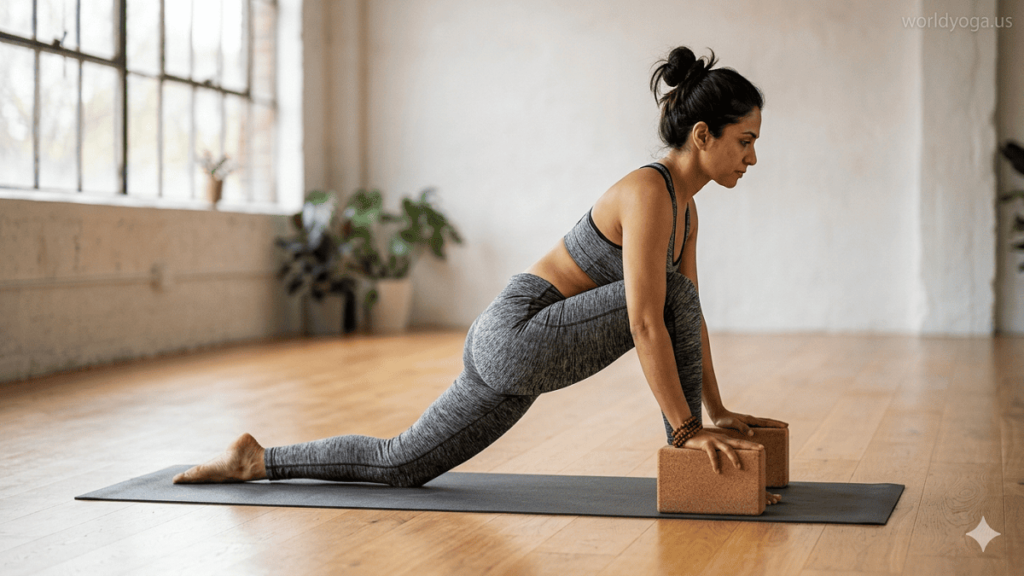
Industry Application of Ardha Padma Uttana Pristhasana
Ardha Padma Uttana Pristhasana is an advanced multi-planar yoga posture that combines hip external rotation, forward extension, and lunge-based stability. Beyond traditional yoga practice, its movement principles are increasingly applied across fitness training, physiotherapy, sports conditioning, workplace wellness, and movement science.
1. Application in Fitness and Functional Training
In the fitness industry, this posture is valued for its ability to train multi-directional movement control. The combination of lunge stability, hip opening, and forward folding reflects real-world movement patterns such as stepping, reaching, and rotational transitions.
Trainers use its foundational mechanics to develop:
- Lower-body strength and endurance
- Core stability under dynamic load
- Hip mobility and flexibility balance
It is often integrated into functional mobility circuits for intermediate and advanced clients.
2. Physiotherapy and Rehabilitation Use
In rehabilitation settings, modified versions of Ardha Padma Uttana Pristhasana are used to restore hip mobility and movement symmetry. The posture helps address stiffness in the hip rotators, glutes, and hamstrings, which are commonly restricted due to sedentary lifestyles.
However, the half-lotus component is typically avoided in clinical environments unless the patient has sufficient joint stability. Therapists often replace it with safer hip-opening alternatives while maintaining the lunge and forward extension structure.
3. Sports Performance and Athletic Conditioning
Athletes benefit from the posture’s ability to develop hip-driven power and controlled mobility. Sports involving running, jumping, and directional changes—such as cricket, football, tennis, and martial arts—require similar biomechanical patterns.
Key performance benefits include:
- Improved hip external rotation for stride efficiency
- Enhanced core stability for rotational sports actions
- Better posterior chain flexibility for injury prevention
The posture supports smoother kinetic chain transfer from lower body to upper body during dynamic movements.
4. Workplace Wellness and Ergonomic Health
In corporate wellness programs, simplified versions of this posture help counteract the effects of prolonged sitting. It addresses common issues such as tight hip flexors, restricted hamstrings, and poor spinal mobility.
Adapted movements based on this posture are used to:
- Improve posture and spinal alignment
- Reduce stiffness in hips and lower back
- Increase circulation and movement awareness during work breaks
Even short-duration practice can help reduce musculoskeletal discomfort in desk-based professionals.
5. Movement Science and Mobility Training Systems
In modern movement science, Ardha Padma Uttana Pristhasana is studied as a complex coordination model. It demonstrates how the body manages simultaneous demands of stability (lunge), mobility (hip rotation), and extension (forward fold).
This makes it useful in:
- Athletic mobility programming
- Neuromuscular control training
- Biomechanics-based movement education
It is often used as a reference pattern for understanding integrated human movement.
Conclusion
Ardha Padma Uttana Pristhasana has strong cross-industry relevance due to its integration of strength, mobility, and coordination. While it remains an advanced yoga posture, its principles are widely applied in fitness training, rehabilitation, sports conditioning, and workplace wellness programs to enhance functional movement capacity and reduce injury risk.
For further movement science and yoga anatomy references, visit Yoga Journal and Yoga International.
#Ardha Padma Uttana Pristhasana in Mumbai
Ask FAQs
What is Ardha Padma Uttana Pristhasana?
Ardha Padma Uttana Pristhasana is an advanced yoga posture that combines a low lunge, forward extension, and a half-lotus leg position to create deep hip opening, spinal lengthening, and full-body coordination.
Who can practice this pose safely?
It is best suited for intermediate to advanced yoga practitioners who already have good hip flexibility, hamstring mobility, and knee stability. Beginners should practice modified versions under guidance.
What are the main benefits of this posture?
This pose improves hip external rotation, increases hamstring flexibility, strengthens the lower body, enhances core stability, and promotes better spinal alignment and posture awareness.
What are the common mistakes to avoid?
Common mistakes include forcing the knee into half lotus, collapsing the lower back during forward bending, misaligning the front knee, and pushing beyond hip flexibility limits instead of using controlled movement.
Are there any precautions for this pose?
Yes. People with knee injuries, hip impingement, or lower back issues should avoid the full variation. It is important to use props, maintain hip-driven movement, and never force the half-lotus position.
Table of Contents
Disclaimer
The information provided about Ardha Padma Uttana Pristhasana is for educational purposes only and should not be considered medical advice. This is an advanced posture that may place stress on the knees, hips, and lower back if performed incorrectly. Practice only under the guidance of a qualified yoga instructor and avoid forcing any position beyond your comfortable range of motion. Individuals with existing injuries or medical conditions should consult a healthcare professional before attempting this pose.