ARM BALANCE: BOTH LEGS TO THE SIDE
An arm balance with both legs extended to one side refers to a group of advanced yoga postures where the entire body is supported on the hands while both legs are lifted and shifted laterally, creating an asymmetrical center of gravity. This category includes advanced variations of poses such as Ashtavakrasana and similar side-loaded balancing postures found in modern Vinyasa and Hatha yoga systems.
In this type of arm balance, the practitioner typically begins in a seated or squatting position before placing the hands firmly on the ground. The core is engaged strongly as the body weight is gradually transferred into the arms. Both legs are then lifted together and extended to one side of the body, often resting on or around one arm in more advanced variations. This creates a strong lateral shift that challenges balance, coordination, and structural alignment.
The key feature of this posture category is the sideways distribution of weight. Unlike central arm balances where the legs extend forward or upward, both-leg-to-the-side variations require the practitioner to resist rotational collapse. The shoulders must remain stable and slightly protracted, while the wrists bear significant compressive force. The core muscles, especially the obliques, play a critical role in preventing the body from tipping sideways.
One of the primary physical demands is hip mobility. The practitioner must have sufficient external rotation and flexibility to allow both legs to extend or bind on one side without strain. At the same time, hamstring flexibility and spinal control help maintain alignment and prevent excessive twisting.
The benefits of practicing both-leg-to-the-side arm balances include improved upper-body strength, enhanced core stability, and greater proprioceptive awareness. These poses also develop advanced neuromuscular coordination because the body must constantly make fine adjustments to maintain equilibrium in an unstable position. Additionally, they build mental focus, patience, and confidence due to their high difficulty level.
However, these postures also carry risks if attempted prematurely. Common issues include wrist strain, shoulder overload, and loss of balance leading to falls. Practitioners with insufficient preparation in foundational arm balances such as Crow Pose or Side Plank should avoid attempting these variations.
Proper progression is essential. Preparatory exercises include Plank Pose, Chaturanga Dandasana, Side Plank, and hip-opening poses such as Pigeon Pose. These help build the strength and flexibility required for safe execution.
For further study on foundational arm balances and alignment principles, you may refer to:
https://www.yogajournal.com/poses/ashtavakrasana-eight-angle-pose/
https://www.ekhartyoga.com/resources/yoga-poses/ashtavakrasana
https://www.verywellfit.com/ashtavakrasana-eight-angle-pose-3567150
#ARM BALANCE: BOTH LEGS TO THE SIDE in Maharashtra
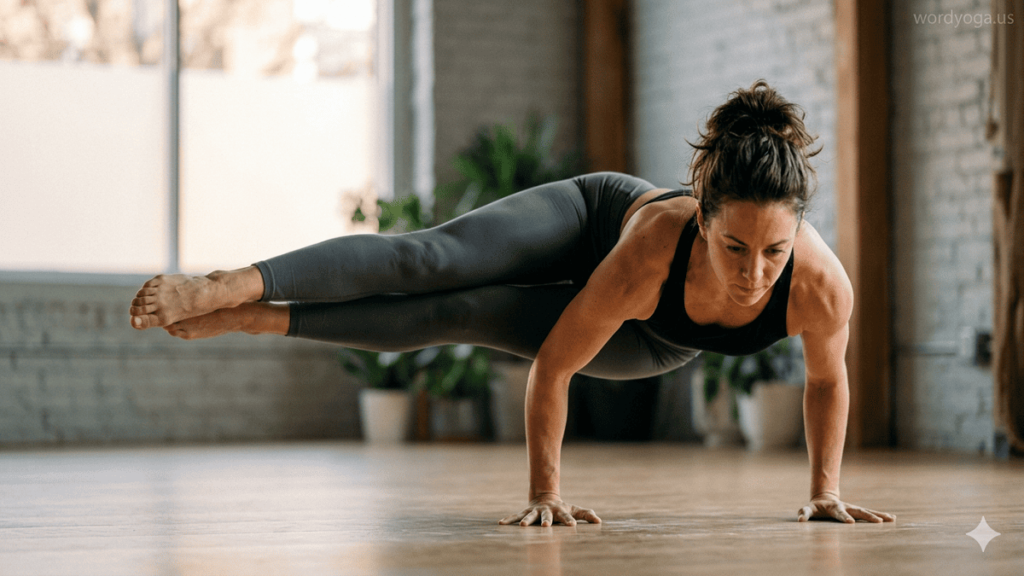
What is the name and meaning of this arm balance pose?
The arm balance where both legs are extended to one side while the body is supported on the hands is most commonly associated with the yoga posture called Ashtavakrasana and its advanced variations, including forms sometimes referred to as Vishama Ashtavakrasana.
The name Ashtavakrasana comes from Sanskrit:
- “Ashta” = eight
- “Vakra” = bent or curved
- “Asana” = posture or seat
So, Ashtavakrasana is often translated as the “Eight-Angle Pose” or “Eight-Curves Pose.”
Meaning of the Pose
The name is inspired by the sage Ashtavakra, a revered figure in Indian philosophy who, according to tradition, had a body bent in eight places due to a physical condition from birth. Despite his physical challenges, he is known for his deep wisdom, symbolizing that inner strength and intelligence are more important than external form.
Why “Both Legs to the Side”
In this arm balance, both legs are lifted and extended to one side of the body while the practitioner balances entirely on the hands. This creates an “angled” or twisted body shape, reflecting the meaning of vakra (curved or bent). The asymmetrical positioning increases the difficulty and is what makes the posture both physically and symbolically significant.
Summary
The pose represents more than physical strength—it symbolizes balance, resilience, and control over instability, both in body and mind. It teaches the practitioner to maintain calm focus even when the body is in an uneven and challenging position.
For reference:
https://www.yogajournal.com/poses/ashtavakrasana-eight-angle-pose/
https://www.ekhartyoga.com/resources/yoga-poses/ashtavakrasana
https://www.verywellfit.com/ashtavakrasana-eight-angle-pose-3567150
#ARM BALANCE: BOTH LEGS TO THE SIDE in Ahemdabad
How is the pose performed step by step?
1. Starting Position
Begin seated on a yoga mat with both legs extended forward and spine upright. Engage the core lightly and maintain steady breathing to prepare for the transition.
2. Leg Hook Setup
Bend one knee and draw it toward the chest. Then thread that leg over the corresponding upper arm, placing the knee high near the shoulder. This creates the initial anchor point for the arm balance.
3. Second Leg Placement
Extend the second leg forward and then begin to cross it over the first leg (depending on the variation, the legs may interlock or stack asymmetrically). The goal is to secure both legs so they can shift together to one side of the body.
4. Hand Placement
Place both palms firmly on the floor beside the hips, shoulder-width apart. Spread the fingers wide for stability. Press evenly through the palms and actively engage the fingertips for balance control.
5. Weight Shift Forward
Lean the torso forward slowly, shifting body weight onto the hands. Engage the core strongly and keep the elbows slightly bent but stable. Avoid collapsing into the shoulders.
6. Lift Phase
With controlled breath, press into the palms and begin lifting the hips off the ground. As the body becomes lighter, both legs move together to one side while remaining bound around the arm.
7. Full Balance Position
Once lifted, stabilize the posture by:
- Engaging the core deeply
- Keeping shoulders active and lifted
- Maintaining steady breathing
- Holding both legs extended to one side
This is the full expression of the arm balance.
8. Exit the Pose
Slowly lower the body back to the ground with control. Release the leg bind first, then return to a seated position without collapsing abruptly.
Important Notes
- Proper warm-up is essential before attempting this pose
- Wrist and shoulder engagement must be active throughout
- Beginners should first master foundational arm balances like Crow Pose and Side Plank
For reference and deeper learning:
https://www.yogajournal.com/poses/ashtavakrasana-eight-angle-pose/
https://www.ekhartyoga.com/resources/yoga-poses/ashtavakrasana
https://www.verywellfit.com/ashtavakrasana-eight-angle-pose-3567150
#ARM BALANCE: BOTH LEGS TO THE SIDE in Hyderabad
What strength and flexibility are required?
1. Upper Body Strength
Strong wrists, forearms, shoulders, and chest muscles are essential. The wrists must support full body weight in deep extension, while the shoulders stabilize and prevent collapse. Scapular strength (especially protraction and depression control) is critical for maintaining lift.
2. Core Strength
The core is the primary stabilizer in this posture. The rectus abdominis, obliques, and transverse abdominis must work together to:
- Lift the hips off the ground
- Maintain balance during asymmetrical leg positioning
- Prevent twisting collapse
Without strong core engagement, the body will drop or rotate uncontrollably.
3. Arm Balance Endurance
Sustained isometric strength in the arms is required to hold the body weight steadily. This includes endurance in the triceps and stabilizing shoulder muscles.
Flexibility Requirements
1. Hip Flexibility
Deep hip opening is essential. The legs must be able to wrap, cross, or extend to one side without strain. External rotation of the hip joint is particularly important for securing the leg bind.
2. Hamstring Flexibility
Adequate hamstring length allows the legs to extend fully while maintaining alignment. Tight hamstrings can restrict leg placement and destabilize the pose.
3. Spinal Mobility
Controlled spinal rotation and flexibility help accommodate the twist created by shifting both legs to one side. However, the movement must remain stable, not forced.
Mobility and Coordination
Beyond strength and flexibility, the pose requires:
- High proprioceptive awareness (body position control in space)
- Coordinated breath control under load
- Ability to shift weight gradually without sudden movement
Summary
To safely perform this arm balance, a practitioner needs:
- Strong wrists, shoulders, and core
- Open hips and flexible hamstrings
- Controlled spinal rotation
- Advanced balance and neuromuscular coordination
Preparation Practices
Helpful preparatory poses include:
- Plank Pose
- Side Plank
- Chaturanga Dandasana
- Pigeon Pose (for hip opening)
- Crow Pose (for arm balance foundation)
For reference:
https://www.yogajournal.com/poses/ashtavakrasana-eight-angle-pose/
https://www.ekhartyoga.com/resources/yoga-poses/ashtavakrasana
https://www.verywellfit.com/ashtavakrasana-eight-angle-pose-3567150
#ARM BALANCE: BOTH LEGS TO THE SIDE in Hariyana
What are the key benefits of this arm balance?
1. Upper Body Strength Development
One of the primary benefits is significant strengthening of the wrists, forearms, shoulders, and chest. Since the entire body weight is supported on the hands, the pose builds:
- Wrist stability and endurance
- Shoulder girdle strength and control
- Triceps and arm endurance
This makes it highly effective for improving functional upper-body strength.
2. Core Stability and Control
The posture demands deep engagement of the abdominal muscles, especially the obliques and transverse abdominis. Benefits include:
- Improved core stability
- Stronger trunk control under asymmetrical load
- Better ability to stabilize the spine during movement
A strong core is essential to lift and maintain the body in balance.
3. Hip Mobility and Flexibility
Because both legs are bound and extended to one side, the hips must be highly mobile. Regular practice helps:
- Increase hip external rotation
- Improve flexibility in the groin and inner thighs
- Reduce stiffness from prolonged sitting
This contributes to overall lower-body freedom of movement.
4. Enhanced Balance and Coordination
The asymmetrical nature of the pose challenges the nervous system to constantly adjust body position. This improves:
- Proprioception (body awareness in space)
- Neuromuscular coordination
- Fine motor control in balance transitions
It trains the body to remain stable under uneven force distribution.
5. Mental Focus and Stress Control
Maintaining this arm balance requires concentration, steady breathing, and calmness under physical challenge. Over time, it helps develop:
- Improved focus and attention control
- Greater patience during difficulty
- Stress tolerance and emotional steadiness
The mental discipline gained often transfers to other areas of practice and daily life.
6. Spinal Awareness and Functional Movement
The controlled twist and stabilization improve awareness of spinal alignment and movement efficiency, contributing to better posture control.
Summary
This arm balance develops:
- Strong upper body
- Powerful core
- Flexible hips
- High balance and coordination
- Strong mental focus
Reference Links
https://www.yogajournal.com/poses/ashtavakrasana-eight-angle-pose/
https://www.ekhartyoga.com/resources/yoga-poses/ashtavakrasana
https://www.verywellfit.com/ashtavakrasana-eight-angle-pose-3567150
#ARM BALANCE: BOTH LEGS TO THE SIDE in Surat
Case Study of ARM BALANCE: BOTH LEGS TO THE SIDE
1. Subject Profile
Practitioner A (Intermediate Level)
- Age: 30
- Yoga experience: 2 years (Vinyasa-based practice)
- Strength level: Moderate upper-body strength
- Flexibility: Good hamstrings, limited hip external rotation
- Goal: Achieve advanced arm balance progression
2. Objective
To evaluate the practitioner’s ability to safely perform a both-legs-to-the-side arm balance, focusing on:
- Load-bearing capacity of wrists and shoulders
- Core stability under asymmetrical conditions
- Hip mobility for secure leg placement
- Balance control during lift-off phase
3. Preparation Protocol
The practitioner completed a structured warm-up sequence:
- Plank Pose (core activation)
- Side Plank (lateral stability training)
- Chaturanga Dandasana (upper-body conditioning)
- Pigeon Pose (hip opening)
Despite preparation, hip external rotation remained limited.
4. Execution Attempt
Phase 1: Entry Position
The practitioner successfully established seated setup and initial leg hook over the arm.
Phase 2: Leg Binding
Difficulty observed in securely stacking both legs to one side due to restricted hip flexibility. Minor compensations occurred through spinal twisting.
Phase 3: Weight Transfer
Weight shift onto hands initiated correctly, but instability appeared in wrist extension due to uneven pressure distribution.
Phase 4: Lift Attempt
Partial lift achieved for 2–3 seconds before collapse due to:
- Insufficient core compression
- Incomplete leg lock stability
- Shoulder fatigue during stabilization phase
5. Observations
Strength Factors
- Upper-body strength was adequate for partial lift
- Core endurance was insufficient for sustained hold
Flexibility Factors
- Hip external rotation was the primary limiting factor
- Leg binding lacked structural security
Coordination Factors
- Timing of breath and lift was inconsistent
- Weight transfer was rushed instead of gradual
6. Outcome
- Pose was not fully achieved
- No injury reported
- Practitioner experienced mild wrist strain and shoulder fatigue
- Session was safely terminated with controlled exit
7. Key Learnings
- Hip mobility is a critical limiting factor in lateral arm balances
- Core engagement must precede weight transfer
- Asymmetrical poses require slower transition than central arm balances
- Leg binding stability determines success more than arm strength alone
8. Training Recommendations
To progress safely toward full expression:
- Increase hip external rotation training (Pigeon Pose, lizard variations)
- Strengthen obliques and transverse abdominis
- Practice controlled arm balance foundations (Crow Pose, Side Plank)
- Emphasize slow weight shift drills
9. Conclusion
This case study demonstrates that successful execution of a both-legs-to-the-side arm balance depends on integrated development of strength, mobility, and coordination. Failure is most commonly linked to hip restriction and premature weight transfer rather than insufficient arm strength alone.
References
https://www.yogajournal.com/poses/ashtavakrasana-eight-angle-pose/
https://www.ekhartyoga.com/resources/yoga-poses/ashtavakrasana
https://www.verywellfit.com/ashtavakrasana-eight-angle-pose-3567150
#ARM BALANCE: BOTH LEGS TO THE SIDE in Banglore
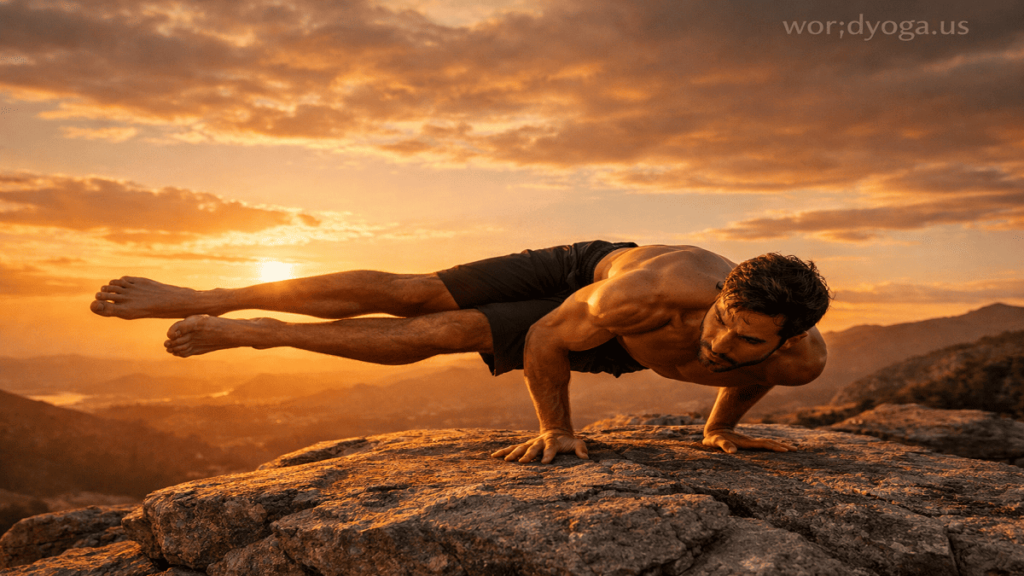
White Paper of ARM BALANCE: BOTH LEGS TO THE SIDE
1. Abstract
This white paper examines the biomechanical, physiological, and training principles of lateral arm balances where both legs extend to one side of the body. The movement pattern is most closely represented in Ashtavakrasana and its variations. These postures are characterized by asymmetrical load distribution, high core activation, and full upper-limb weight bearing. The paper explores performance structure, risk factors, progression models, and applications in movement science and physical training systems.
2. Introduction
Arm balances with both legs to one side represent an advanced category of closed-chain kinetic movements in yoga and bodyweight training systems. Unlike symmetrical arm balances, these postures introduce lateral torque, requiring the body to stabilize against rotational collapse while maintaining elevation from the ground.
They are widely used in advanced yoga, gymnastics-based conditioning, and functional movement training due to their high neuromuscular demand.
3. Biomechanical Structure
3.1 Load Distribution
- Primary load: wrists, forearms, shoulders
- Secondary load: core stabilizers and hip flexors
- Asymmetry creates lateral torque forces across the trunk
3.2 Joint Mechanics
- Wrist: deep extension under compressive force
- Shoulder: scapular protraction and stabilization
- Spine: controlled rotation with isometric stabilization
- Hip: external rotation and flexion for leg placement
3.3 Kinetic Chain
The movement relies on an integrated kinetic chain where failure in one segment (hips or core) disrupts full-body balance.
4. Physiological Demands
- High isometric strength requirement in upper limbs
- Strong activation of obliques and transverse abdominis
- Neuromuscular coordination under instability
- Breath control under load-induced stress
Energy demand is moderate-to-high due to sustained stabilization effort.
5. Movement Phases
- Setup Phase – seated entry and hand placement
- Binding Phase – leg engagement and lateral positioning
- Load Transfer Phase – gradual forward weight shift
- Lift Phase – elevation of hips and legs
- Stabilization Phase – maintenance of lateral balance
- Exit Phase – controlled descent and release
6. Training Progression Model
Foundational Level
- Plank Pose
- Chaturanga Dandasana
- Side Plank
Intermediate Level
- Crow Pose
- Hip-opening sequences (Pigeon Pose, Lizard Pose)
- Core compression drills
Advanced Level
- Standard Ashtavakrasana
- Assisted lateral arm balance holds
- Full both-legs-to-side expression
7. Benefits
- Increased upper-body strength and endurance
- Enhanced core stability and rotational control
- Improved hip mobility and flexibility
- Advanced proprioception and balance control
- Mental focus, stress regulation, and cognitive endurance
8. Risk Assessment
Common Risks
- Wrist compression injuries
- Shoulder instability or overload
- Lumbar strain due to poor core engagement
- Falls due to premature weight shift
Contraindications
- Wrist or shoulder injuries
- Spinal disc conditions
- Pregnancy
- Beginner-level practitioners without foundational strength
9. Application Domains
- Advanced yoga training systems
- Functional fitness and calisthenics
- Athletic conditioning (gymnastics, climbing, martial arts)
- Movement therapy (modified variations only)
- Biomechanics and motor control research
10. Conclusion
Arm balances with both legs to one side represent a high-complexity movement category requiring integrated strength, flexibility, and neuromuscular precision. While physically demanding, they offer significant benefits in functional strength and motor control when introduced progressively and practiced with proper alignment principles.
References
https://www.yogajournal.com/poses/ashtavakrasana-eight-angle-pose/
https://www.ekhartyoga.com/resources/yoga-poses/ashtavakrasana
https://www.verywellfit.com/ashtavakrasana-eight-angle-pose/
#ARM BALANCE: BOTH LEGS TO THE SIDE in Chennai
Industry Application of ARM BALANCE: BOTH LEGS TO THE SIDE
1. Fitness and Functional Training Industry
In modern fitness systems, this category of arm balance is used as an advanced bodyweight strength benchmark. Trainers incorporate progressions of lateral arm balances to develop:
- Upper-body pushing strength (wrists, triceps, shoulders)
- Core compression strength and anti-rotation control
- Isometric endurance under unstable conditions
It is especially common in calisthenics and advanced mobility programs, where athletes aim to progress from basic holds (plank, L-sit) to complex asymmetrical balances.
2. Sports Performance and Athletic Training
Sports science uses these movements to enhance:
- Unilateral strength and coordination
- Dynamic balance under asymmetric load
- Core stability during rotational stress
Athletes in gymnastics, martial arts, climbing, and parkour benefit directly from the neuromuscular patterns trained by these poses. The lateral load pattern closely mimics real-world athletic movements involving sudden direction changes and body repositioning.
3. Physiotherapy and Rehabilitation (Adapted Use Only)
In clinical movement therapy, full expressions of these arm balances are not used directly. However, simplified components are applied for rehabilitation purposes:
- Wrist loading progression drills for recovery
- Shoulder stabilization exercises in closed-chain positions
- Core activation training without full lift
These adaptations help restore functional movement patterns after injury, particularly in upper-limb rehabilitation protocols.
4. Biomechanics and Movement Science Research
In academic and sports science settings, lateral arm balances are analyzed to study:
- Load distribution across wrist and shoulder joints
- Scapular stability under compressive force
- Core activation patterns in asymmetrical positions
- Motor control and balance correction mechanisms
These insights contribute to injury prevention models and improved athletic training methodologies.
5. Yoga Education and Teacher Training
In advanced yoga certification programs, this category is used as a performance and assessment tool. Trainees are evaluated on:
- Alignment precision under instability
- Breath control during high-load transitions
- Safe progression sequencing
- Understanding of contraindications and modifications
It serves as a capstone skill in many advanced yoga curricula.
6. Wellness and Corporate Training
In corporate wellness programs, simplified versions of lateral arm balance progressions are used to develop:
- Focus under physical stress
- Mental resilience and concentration
- Stress management through controlled movement challenges
These programs emphasize mindfulness and nervous system regulation rather than full pose execution.
Conclusion
Arm balances with both legs to one side are valuable across multiple industries due to their integration of strength, balance, and motor control. While full expressions remain limited to advanced practitioners, their principles are widely applied in fitness training, sports performance, rehabilitation adaptations, biomechanics research, and professional yoga education.
References
https://www.yogajournal.com/poses/ashtavakrasana-eight-angle-pose/
https://www.ekhartyoga.com/resources/yoga-poses/ashtavakrasana
https://www.verywellfit.com/ashtavakrasana-eight-angle-pose/
#ARM BALANCE: BOTH LEGS TO THE SIDE in Mumbai
Ask FAQs
What is an arm balance with both legs to the side?
It is an advanced yoga movement pattern where the entire body is supported on the hands while both legs extend together to one side of the body. It is most commonly seen in Ashtavakrasana and similar asymmetrical arm balance variations that require core strength, hip mobility, and shoulder stability.
What level of practice is required for this arm balance?
This category of arm balance is considered advanced. Practitioners should already have experience with foundational poses such as Plank Pose, Side Plank, and basic arm balances like Crow Pose. Strong core engagement, wrist conditioning, and hip flexibility are essential prerequisites.
What are the main benefits of this arm balance?
Key benefits include improved upper-body strength, enhanced core stability, increased hip flexibility, and better balance control. It also develops mental focus, body awareness, and the ability to maintain calm under physically challenging conditions.
What are the common risks or mistakes?
Common risks include wrist strain, shoulder overload, and loss of balance due to improper weight distribution. Mistakes often involve rushing into the lift, weak core engagement, and insufficient hip flexibility, which can lead to instability or falls.
How can beginners safely progress toward this pose?
Beginners should build strength gradually through preparatory exercises such as Plank Pose, Chaturanga Dandasana, and Side Plank. Hip-opening poses like Pigeon Pose are also important. Progression should be slow, controlled, and ideally guided by an experienced instructor to ensure safety and proper alignment.
Table of Contents
Disclaimer:
The arm balance described (both legs to the side variations such as Ashtavakrasana) is an advanced yoga posture and should only be attempted with proper training and supervision. Individuals with wrist, shoulder, spine, or joint injuries, as well as beginners or pregnant practitioners, should avoid this pose or consult a qualified professional before practice. This content is for educational purposes only and does not replace medical or professional fitness advice.