Arm Balance: Sitting Bones & Feet off the Floor
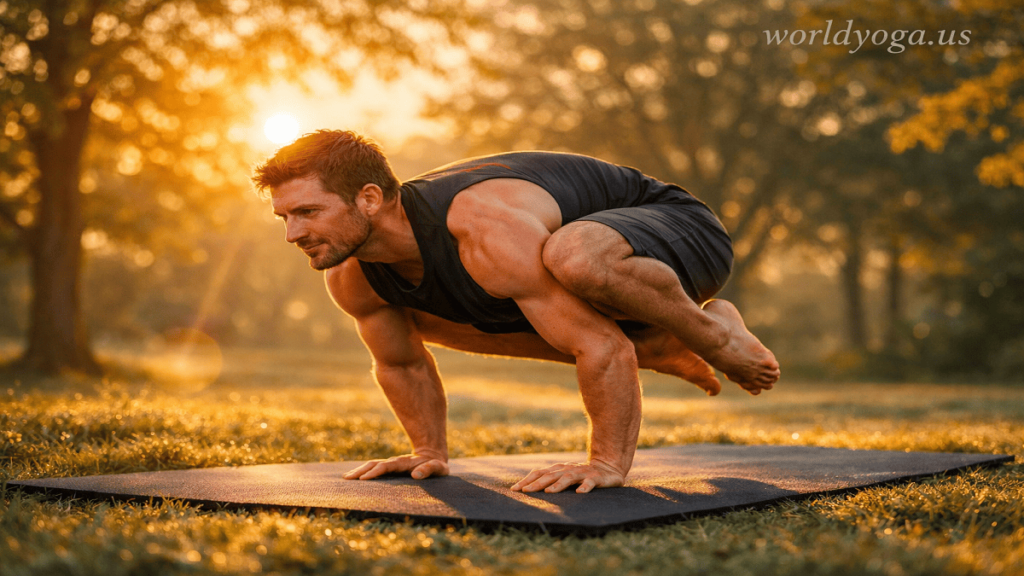
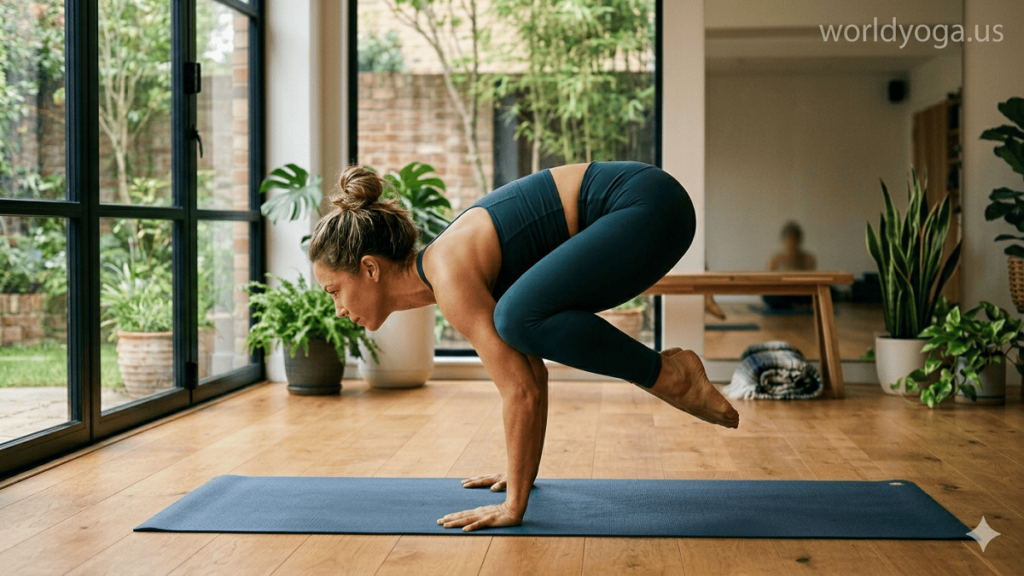
Arm Balance involving lifting the sitting bones and feet off the floor refers to a foundational category of yoga strength poses where the practitioner supports the body partially or fully on the hands while both the pelvis (sitting bones) and feet are elevated. This style of arm balance is designed to develop upper-body strength, core stability, and full-body coordination while challenging balance and mental focus.
In these postures, the practitioner shifts body weight into the palms, actively engaging the shoulders, chest, triceps, and forearms to create a stable base of support. At the same time, the abdominal muscles, hip flexors, and deep stabilizers work intensively to lift and hold the pelvis and legs off the ground. The key principle is creating a strong “floating” sensation where the body is fully supported by controlled muscular engagement rather than passive joint loading.
A major benefit of this category is core integration under load. Unlike basic floor-based core exercises, arm balances require the core to coordinate with the upper body in real time, improving functional strength and neuromuscular control. This enhances performance in advanced yoga transitions and athletic movements.
These postures also significantly improve shoulder stability and wrist strength. Since the entire body weight is supported through the hands, the stabilizing muscles of the shoulders and forearms must work continuously to maintain alignment and prevent collapse. Over time, this builds resilience and joint control.
From a technical standpoint, maintaining proper alignment is critical. The spine should remain active and elongated, the shoulders should avoid collapsing inward, and the gaze (drishti) should stay steady to support balance. Breath control is equally important, as holding tension without steady breathing can lead to fatigue and loss of stability.
Common examples of this category include poses like Crow Pose progression work, floating variations of plank-based arm balances, and advanced transitions from seated lifts. Beginners often practice preparatory drills such as plank holds and knee-to-chest lifts before attempting full lift-offs.
Safety considerations include avoiding wrist strain, warming up the shoulders properly, and progressing gradually to prevent overload. Individuals with wrist, shoulder, or lower back injuries should approach these poses cautiously or under guidance.
#Arm Balance: Sitting Bones & Feet off the Floor in Delhi
How is Arm Balance with sitting bones and feet off the floor performed correctly?
A correct performance of an Arm Balance where both the sitting bones and feet lift off the floor depends on controlled weight transfer, strong core engagement, and precise alignment between the shoulders, spine, and hips. Although variations differ, the fundamental mechanics remain consistent across most beginner-to-intermediate arm balances.
1. Starting Position and Setup
Begin in a stable seated or low squat position with hands placed firmly on the mat, shoulder-width apart. Fingers should be spread wide to distribute pressure evenly across the palms. The wrists are stacked directly under the shoulders or slightly ahead, depending on the variation. This setup creates a stable foundation for lifting the body.
2. Weight Transfer into the Hands
Shift the body weight gradually forward into the palms. The elbows remain slightly bent but active, not locked. The shoulders engage by gently protracting (moving forward around the ribcage), creating a stable “rounded upper back” support structure. This engagement is essential for preventing collapse.
3. Core Engagement and Lift Initiation
Before lifting, the core must activate strongly. The rectus abdominis and transverse abdominis draw inward to stabilize the spine. From here, begin lifting the feet first, followed by the sitting bones. The movement is slow and controlled rather than forceful.
In many variations, the knees may initially bend and stay close to the chest to reduce leverage. As strength improves, the legs may extend further while maintaining lift.
4. Full Float Position
Once both the sitting bones and feet are off the floor, the body is fully supported by the hands. The spine stays slightly rounded but strong, avoiding collapse in the lower back. The gaze remains steady forward or slightly downward to help maintain balance.
Key alignment points include:
- Shoulders engaged and not sinking
- Core actively drawing inward
- Hips lifted and stable
- Legs either tucked or extended depending on strength level
- Breath steady and controlled
5. Breathing and Stability
Breathing must remain smooth and continuous. Holding the breath reduces core efficiency and can destabilize the posture. Each exhale can be used to deepen core engagement and maintain lift.
6. Common Mistakes to Avoid
- Collapsing weight into the wrists instead of distributing through fingers
- Lifting without core engagement (causes sudden drop)
- Locking elbows or sinking shoulders
- Rushing into full extension before building strength
- Looking down excessively, which can disrupt balance
7. Progression Strategy
Most practitioners build toward this lift through preparatory drills such as plank holds, knee-to-chest lifts, and controlled core activations before attempting full float.
For foundational strength support, poses like Plank Pose are commonly used to develop shoulder and core stability before progressing to full arm balances.
Conclusion
Correct execution of this arm balance relies on synchronized upper-body strength and deep core activation. When performed with proper alignment and gradual progression, it develops advanced stability, coordination, and full-body control while reducing risk of wrist or shoulder strain.
#Arm Balance: Sitting Bones & Feet off the Floor in India
What is the proper alignment in this core arm balance variation?
Proper alignment in an Arm Balance where both the sitting bones and feet lift off the floor is built around three key structural principles: a stable shoulder base, an engaged core cylinder, and a controlled pelvic lift. The goal is not just lifting, but maintaining a compact, balanced shape where weight is evenly distributed through the hands rather than collapsing into joints.
1. Hand and Wrist Alignment
The hands form the foundation. Place them shoulder-width apart with fingers spread wide to maximize surface contact. The middle finger typically points forward. Wrists should be stacked under or slightly in front of the shoulders, depending on the variation. Pressure is distributed evenly across the fingers and base of the palm, with active “gripping” of the floor to reduce wrist strain.
2. Shoulder Position
Shoulders are the most critical alignment point in arm balances. They should be protracted and engaged, meaning they wrap slightly forward around the ribcage. This creates a strong upper-back support structure. At the same time, the shoulders should not collapse downward. Instead, they remain lifted and stable, forming a protective “shelf” for the torso.
3. Core and Spine Alignment
The spine maintains a controlled rounded or neutral curve, depending on the variation, but never collapses. The core—especially the transverse abdominis—must actively draw inward to support the lift of the pelvis and legs. The ribcage stays contained rather than flaring outward. This internal engagement is what allows the sitting bones to float off the floor.
4. Pelvic Position
The pelvis lifts upward and slightly forward as the sitting bones leave the ground. It should remain stable, not tilted excessively forward or backward. A common mistake is allowing the hips to drop, which immediately breaks balance and load distribution.
5. Leg Position
Beginners often keep the knees bent close to the chest to shorten the lever arm. In more advanced control, legs may extend forward, but only if the pelvis and core remain fully engaged. The legs should feel light, not heavy or dragging the posture downward.
6. Neck and Gaze
The neck remains neutral with the gaze slightly forward or downward on the mat. Looking too far up or tucking the chin excessively can disrupt spinal alignment and balance.
7. Breath Control
Steady breathing supports stability. Inhale to create length through the spine and exhale to deepen core engagement. Breath should never be held, as this reduces control and increases tension in the shoulders and wrists.
Summary
Correct alignment in this arm balance is a coordinated system:
- Strong, grounded hands
- Engaged and lifted shoulders
- Deep core activation holding the spine stable
- Floating pelvis with controlled hip position
- Balanced, supported leg positioning
#Arm Balance: Sitting Bones & Feet off the Floor in Maharashtra
Which muscles are engaged during the pose?
In an Arm Balance where both the sitting bones and feet lift off the floor, the body relies on a coordinated full-chain muscular effort rather than isolated muscle work. The posture demands simultaneous activation of the upper body, core, and lower body stabilizers to maintain a controlled “floating” position.
1. Primary Core Muscles
The core is the central driver of the lift. Key muscles include:
- Rectus abdominis: Helps flex the spine and bring the torso into a compact shape.
- Transverse abdominis: Acts as a deep stabilizing corset, keeping the spine and pelvis secure.
- Internal and external obliques: Assist in stabilization and prevent unwanted rotation during balance.
These muscles work together to control the pelvis and maintain the lifted position of the sitting bones.
2. Hip Flexors and Lower Body Muscles
- Iliopsoas (primary hip flexor group): Essential for lifting and holding the legs off the floor.
- Rectus femoris (part of quadriceps): Assists in maintaining leg position, especially when knees are bent.
- Adductors: Help stabilize the inner thighs and maintain midline control.
These muscles ensure the lower body remains light and controlled rather than collapsing downward.
3. Upper Body and Shoulder Muscles
Since the entire body weight is supported by the hands, the upper body is highly engaged:
- Deltoids (especially anterior fibers): Support shoulder flexion and stability.
- Pectoralis major: Helps stabilize the chest and assist in forward weight distribution.
- Serratus anterior: Crucial for scapular protraction, creating a strong rounded upper back shape.
- Triceps brachii: Maintain elbow stability and prevent collapse.
These muscles create the structural “base” that supports the lift.
4. Back and Spinal Stabilizers
- Erector spinae: Maintains spinal length and prevents collapse into excessive rounding.
- Multifidus muscles: Provide deep segmental spinal stability during balance.
They work in opposition to the abdominal muscles to maintain controlled spinal alignment.
5. Wrist and Forearm Muscles
- Forearm flexors and extensors: Stabilize wrist position and control pressure distribution.
- Intrinsic hand muscles: Help grip the floor and fine-tune balance through finger engagement.
These muscles are constantly active to protect the wrists and maintain equilibrium.
6. Breathing and Core Support
- Diaphragm: Works in coordination with the deep core to regulate intra-abdominal pressure, which is essential for stability and endurance.
Summary
This arm balance requires integrated activation of:
- Deep core stabilizers for control
- Hip flexors for leg lift
- Shoulder and scapular muscles for weight support
- Back muscles for spinal integrity
- Forearms and hands for balance control
The result is a full-body kinetic chain where strength, stability, and coordination must work together continuously to maintain both sitting bones and feet lifted off the floor without collapse.
#Arm Balance: Sitting Bones & Feet off the Floor in Ahemadabad
What preparatory poses are recommended before attempting it?
Before attempting an Arm Balance where both the sitting bones and feet lift off the floor, it is important to build a strong foundation of core strength, wrist stability, and shoulder control. Preparatory poses help condition the body for load-bearing on the hands while developing the neuromuscular coordination required for lift and balance.
1. Plank Pose
Plank Pose is one of the most essential preparatory postures. It strengthens the entire core, shoulders, and wrists in a straight-line load-bearing position. It teaches proper stacking of shoulders over wrists and develops the endurance needed to support body weight in arm balances.
2. Forearm Plank
Forearm plank reduces wrist load while increasing core demand. It strengthens the transverse abdominis and improves scapular stability. This variation is especially useful for building endurance before progressing to full hand-supported balances.
3. Knee-to-Chest Core Drills
Bringing the knees toward the chest while in a supported plank position trains the exact compression pattern needed for lifting both the sitting bones and feet. This drill develops control over hip flexion and abdominal engagement simultaneously.
4. Crow Pose Preparations
Crow Pose is a direct progression toward more advanced arm balances. It teaches forward weight shift, elbow engagement, and balance on the hands. Practicing lifting one foot at a time before full lift helps build confidence and control.
5. Boat Pose
Bent-knee Boat Pose develops seated core strength, which is essential for controlling pelvic lift before transitioning into arm-supported balance. It strengthens the abdominal wall and hip flexors in a compact position similar to early stages of arm balances.
6. Wrist Conditioning Exercises
Since arm balances place significant load on the wrists, preparatory wrist circles, palm presses, and fingertip weight shifts help build joint resilience and reduce injury risk.
7. Shoulder Engagement Drills
Scapular push-ups and controlled protraction/retraction exercises prepare the serratus anterior and stabilizing muscles needed to support body weight in a lifted position.
Conclusion
A structured progression toward arm balances should combine core compression training, shoulder stability work, and wrist conditioning. When poses like Plank, Crow preparation, and Boat Pose are practiced consistently, they build the strength and coordination required to safely lift both the sitting bones and feet off the floor with control and stability.
#Arm Balance: Sitting Bones & Feet off the Floor in Hyderabad
What are the benefits and precautions of this arm balance pose?
Benefits
1. Full-Core Strength Development
This variation strongly activates the rectus abdominis, transverse abdominis, and obliques. The requirement to lift and hold both the pelvis and legs creates intense core compression strength, improving overall abdominal endurance and spinal control.
2. Upper Body Strength and Stability
Because the entire body weight is supported through the hands, the shoulders, triceps, chest, and serratus anterior are heavily engaged. Over time, this builds functional pushing strength and improves scapular stability.
3. Improved Balance and Body Awareness
Maintaining a floating position requires precise neuromuscular coordination. Practitioners develop better proprioception, or awareness of body position in space, which enhances overall movement efficiency.
4. Hip Flexor and Lower Body Activation
The iliopsoas and quadriceps work continuously to lift and stabilize the legs. This improves hip flexor strength and contributes to better control in running, jumping, and transitional movements.
5. Mental Focus and Breath Control
Arm balances require concentration and calm breathing under physical stress. This improves mental discipline and teaches practitioners to maintain focus during challenging physical effort.
Precautions
1. Wrist Strain Risk
Since the full body weight is placed on the hands, improper alignment or weak wrists can lead to discomfort or injury. Proper warm-ups and gradual progression are essential.
2. Shoulder Overload
Without proper scapular engagement, the shoulders may collapse, increasing risk of strain. The serratus anterior must remain active to support safe positioning.
3. Lower Back Stress
If core engagement is insufficient, the lumbar spine may overarch or collapse, leading to discomfort. Maintaining abdominal compression is critical for spinal protection.
4. Neck Tension
Looking too far forward or straining the neck to maintain balance can create cervical tension. The gaze should remain steady and neutral.
5. Overexertion
Attempting full lift before adequate preparation can cause fatigue and loss of form. Progression should be gradual, starting with foundational poses like Plank Pose and Crow Pose.
Conclusion
When practiced with proper preparation and alignment, this arm balance builds exceptional core strength, upper-body stability, and mental focus. However, it must be approached progressively, with attention to wrist health, shoulder control, and core engagement to ensure safe and sustainable practice.
#Arm Balance: Sitting Bones & Feet off the Floor in Pune
Case Study of Arm Balance: Sitting Bones & Feet Off the Floor
1. Background
This case study examines a structured 6-week training intervention focused on developing a full-body arm balance in which both the sitting bones and feet lift off the floor. The program was designed for intermediate yoga practitioners with prior experience in core training and basic arm balances such as Plank variations and preparatory Crow Pose work.
The primary objective was to evaluate improvements in core compression strength, shoulder stability, balance control, and neuromuscular coordination.
2. Methodology
Participants followed a progressive training protocol 4 times per week, including:
- Core activation drills (knee-to-chest compressions, hollow-body holds)
- Strength foundations using Plank Pose
- Arm balance entry work with weight-shifting exercises
- Preparatory balance progression toward lift-off positions
- Short duration holds of the full floating position (3–10 seconds initially)
Breathing control and alignment cues were emphasized throughout, particularly scapular engagement and abdominal compression.
3. Observations and Results
3.1 Core Compression Strength
By week 3, participants showed significant improvement in the ability to draw the knees toward the chest while maintaining spinal control. The rectus abdominis and transverse abdominis demonstrated increased endurance under load.
3.2 Upper Body Adaptation
Shoulder stability improved notably, with increased serratus anterior activation leading to better scapular control during weight-bearing. Wrist tolerance also improved gradually with consistent conditioning.
3.3 Balance and Lift Efficiency
Initial attempts showed frequent loss of balance due to premature leg extension or weak core engagement. By week 5–6, most participants achieved controlled lift where both sitting bones and feet briefly floated with stable alignment.
3.4 Neuromuscular Coordination
Participants developed improved timing between core engagement and weight transfer into the hands. This coordination was identified as a key factor in achieving stable lift-off.
4. Challenges Identified
- Wrist fatigue during early stages due to insufficient conditioning
- Shoulder collapse when serratus anterior engagement was inconsistent
- Breath holding under effort, reducing stability
- Overextension of legs before core was fully engaged
- Fear response during lift-off attempts, affecting coordination
5. Safety Considerations
To reduce risk and improve performance quality, the following strategies were implemented:
- Gradual progression from plank to partial lift drills
- Use of bent-knee variations similar to Boat Pose for core compression training
- Wrist warm-up sequences before every session
- Emphasis on short holds rather than long duration fatigue training
- Continuous reminder of neutral neck alignment and steady gaze
6. Key Findings
The study concluded that successful execution of this arm balance depends on three integrated systems:
- Core compression strength (primary driver of lift)
- Shoulder stability and scapular control (structural support base)
- Timing and neuromuscular coordination (execution efficiency)
When these systems were trained progressively, participants achieved measurable improvements in both lift capacity and stability.
7. Conclusion
The arm balance requiring both sitting bones and feet to lift off the floor is an advanced movement pattern that integrates strength, balance, and coordination. With structured progression and foundational training such as Plank Pose and Boat Pose variations, practitioners can safely develop the required control for stable lift-off and sustained hold.
#Arm Balance: Sitting Bones & Feet off the Floor in Kolkata
White Paper of Arm Balance: Sitting Bones & Feet Off the Floor
1. Executive Summary
This white paper analyzes advanced arm balance mechanics in which both the sitting bones and feet are lifted off the floor, requiring full-body integration of core compression, shoulder stability, and neuromuscular coordination. The movement is widely used in yoga, functional fitness, and athletic conditioning to develop closed-chain strength, balance control, and postural integrity. Its effectiveness lies in the coordinated engagement of multiple muscle systems under load, rather than isolated strength output.
2. Introduction
Arm balances represent a high-level category of bodyweight training where the upper limbs function as the primary support structure. In this variation, the practitioner fully unloads the pelvis and lower limbs from the ground, creating a suspended position supported only by the hands. This requires precise alignment, progressive conditioning, and strong proprioceptive control.
3. Biomechanical Analysis
The posture is governed by three primary mechanical systems:
3.1 Upper Limb Load-Bearing System
The hands, wrists, elbows, and shoulders form a kinetic chain responsible for supporting total body weight. Key contributors include the deltoids, triceps brachii, pectoralis major, and serratus anterior. Scapular protraction is essential for structural stability.
3.2 Core Compression System
The rectus abdominis, transverse abdominis, and obliques generate internal pressure to lift and stabilize the pelvis. This compression reduces lumbar strain and enables controlled elevation of both sitting bones and feet.
3.3 Hip Flexion and Lower Body Control
The iliopsoas, rectus femoris, and adductors maintain leg positioning during lift-off. These muscles work in synergy with the core to reduce gravitational drag on the lower extremities.
4. Functional Applications
This arm balance pattern is applied across multiple domains:
- Yoga systems: Advanced progression beyond foundational poses such as Plank Pose
- Strength training: Development of closed-chain upper-body strength
- Athletic conditioning: Enhancement of core stiffness and dynamic control
- Movement therapy: Improvement of neuromuscular coordination and body awareness
5. Performance Benefits
5.1 Integrated Core Strength
The posture develops anti-extension and compression strength simultaneously, improving spinal stability under load.
5.2 Shoulder and Wrist Resilience
Sustained weight-bearing enhances scapular stability and strengthens wrist joint structures through progressive adaptation.
5.3 Balance and Proprioception
The suspended position requires continuous micro-adjustments, improving spatial awareness and motor control efficiency.
5.4 Progression Toward Advanced Movement
Foundational poses such as Boat Pose support early-stage compression strength required for safe entry into full arm balance mechanics.
6. Risk Factors and Limitations
- Wrist overload: High compressive force may cause strain without proper conditioning
- Shoulder instability: Poor scapular engagement increases collapse risk
- Lumbar compensation: Weak core activation may lead to spinal hyperextension or rounding
- Fatigue failure: Loss of neuromuscular control under extended holds increases injury risk
- Skill gap dependency: Requires progressive preparation; not suitable for untrained practitioners
7. Training Recommendations
A structured progression model is recommended:
- Core stabilization training (planks, hollow holds)
- Compression drills (knee-to-chest activation)
- Assisted balance work (partial weight shifts)
- Short-duration lift attempts (3–10 seconds)
- Gradual hold extension with full control
8. Conclusion
The arm balance involving both sitting bones and feet off the floor represents an advanced integrative movement requiring synchronized activation of core, shoulder, and hip systems. When trained progressively, it enhances functional strength, joint resilience, and neuromuscular coordination. Its value lies not in static strength alone, but in the dynamic integration of multiple body systems under controlled load conditions.
9. References and Further Reading
- Yoga Journal Pose Library — alignment and progression frameworks
- ACE Fitness Exercise Library — evidence-based strength principles
- Verywell Fit Yoga Guides — beginner-to-advanced modifications and safety guidelines
#Arm Balance: Sitting Bones & Feet off the Floor in Banglore
Industry Application of Arm Balance: Sitting Bones & Feet Off the Floor
1. Overview
Arm balances in which both the sitting bones and feet lift off the floor represent advanced bodyweight conditioning patterns widely used across yoga, fitness, rehabilitation, and athletic performance industries. These movements combine core compression strength, upper-body load-bearing capacity, and neuromuscular coordination, making them valuable for both performance enhancement and movement education systems.
2. Yoga and Mind-Body Training Industry
In modern yoga systems, this arm balance category is used as a peak expression of strength and control within advanced sequencing. It typically appears after foundational preparation through poses such as Plank Pose and compression-focused work like Boat Pose.
Applications include:
- Advanced asana classes
- Teacher training certifications
- Skill-based progression workshops
- Strength-focused vinyasa sequencing
Yoga educators use these poses to assess student readiness for advanced transitions and core integration.
3. Fitness and Strength Training Industry
In functional fitness and calisthenics programs, this movement is treated as a closed-chain bodyweight strength benchmark. It is used to develop:
- Core compression strength
- Shoulder and triceps endurance
- Wrist conditioning and load tolerance
- Total-body coordination under instability
Personal trainers often integrate progressive drills leading to full lift-off positions in advanced core circuits and bodyweight conditioning programs.
4. Sports Performance and Athletic Conditioning
Athletic trainers use arm balances as a neuromuscular control and core stiffness tool. Sports requiring explosive movement, mid-air control, or rotational stability benefit significantly, including gymnastics, martial arts, climbing, and field sports.
Key performance outcomes include:
- Improved anti-extension core strength
- Better force transfer between upper and lower body
- Enhanced proprioception during dynamic movement
- Increased joint resilience under load
5. Rehabilitation and Corrective Exercise
In clinical and rehabilitation environments, simplified progressions of this arm balance are used for graded upper-body weight-bearing therapy. These regressions help rebuild:
- Shoulder stability after injury
- Core engagement in postural dysfunction
- Wrist and forearm strength for daily function
Therapists typically begin with static holds and partial weight shifts before introducing full lift attempts.
6. Corporate Wellness and Lifestyle Programs
In workplace wellness settings, modified versions of arm balance training are used to counteract the effects of prolonged sitting. While full lift variations are not commonly practiced in office environments, preparatory drills help improve:
- Core activation awareness
- Postural correction
- Upper-back engagement
- Stress reduction through focused breathing
7. Movement Education and Skill Development
Movement schools and functional training systems use arm balances as a motor control development tool. They teach sequencing between breath, stability, and force generation, improving overall movement intelligence.
These systems emphasize progression through foundational patterns like plank holds and compression drills before advancing to full floating positions.
8. Conclusion
The arm balance involving both sitting bones and feet off the floor is a high-value movement pattern across multiple industries. In yoga, it represents advanced control and mastery; in fitness, it is a strength benchmark; in rehabilitation, it is a progressive loading tool; and in athletic training, it enhances neuromuscular efficiency and core stiffness.
#Arm Balance: Sitting Bones & Feet off the Floor in Mumbai
Ask FAQs
What is this arm balance variation?
This arm balance is a yoga-based strength posture where both the sitting bones and feet lift off the floor while the body is supported only by the hands. It requires strong core compression, shoulder stability, and controlled balance to maintain a floating position.
Which muscles are most important for this pose?
The primary muscles include the rectus abdominis, transverse abdominis, and obliques for core compression. The shoulders, triceps, and serratus anterior support body weight, while the hip flexors (iliopsoas) help lift and hold the legs in position.
What are the main benefits of practicing it?
This pose builds advanced core strength, improves upper-body stability, enhances balance and coordination, and develops full-body neuromuscular control. It also improves focus and breath awareness under physical effort.
Who should avoid or modify this pose?
Beginners without core or wrist strength, or individuals with wrist, shoulder, or lower back injuries, should avoid full attempts. They should instead practice preparatory exercises like Plank Pose and controlled core drills before progressing.
What are common mistakes to avoid?
Common mistakes include collapsing into the shoulders, rounding the lower back excessively, holding the breath, and attempting full lift without adequate core engagement. Poor weight distribution in the hands can also lead to wrist strain and loss of balance.
Table of Contents
Disclaimer: This content is for educational and informational purposes only and is not a substitute for professional medical or fitness advice. Practice Arm Balance only after proper preparation and, if needed, under the guidance of a qualified instructor. Individuals with injuries or medical conditions should consult a healthcare professional before attempting this or any advanced physical exercise.