Boat Pose: Both Knees Bent
Boat Pose is a foundational core-strengthening yoga posture often used in beginner and intermediate practices to develop stability, balance, and controlled breathing. The bent-knee variation makes the pose more accessible while still delivering significant benefits for abdominal strength, hip flexor engagement, and spinal awareness. It is commonly taught in modern yoga systems as a stepping-stone toward the full extension version of Boat Pose.
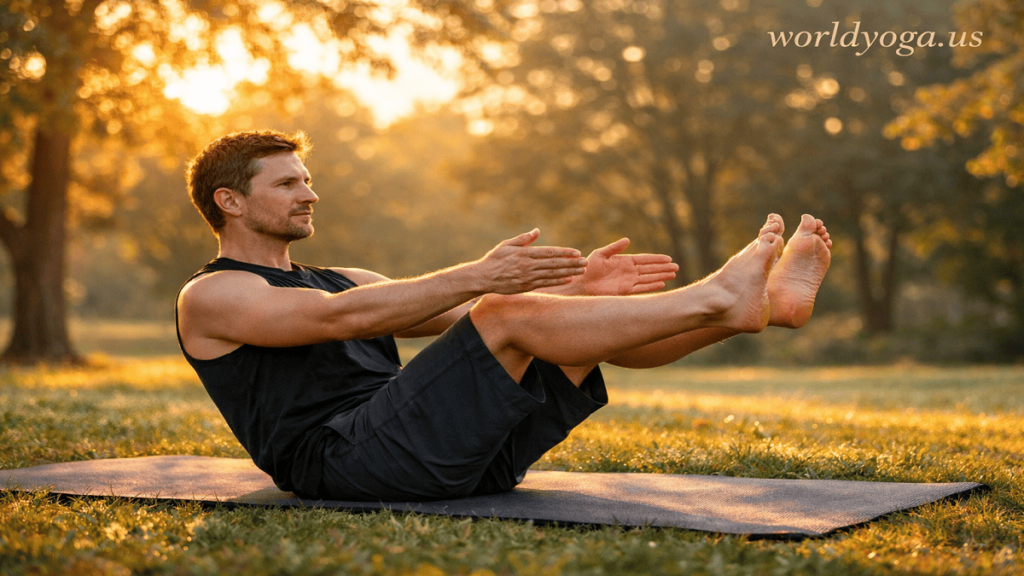
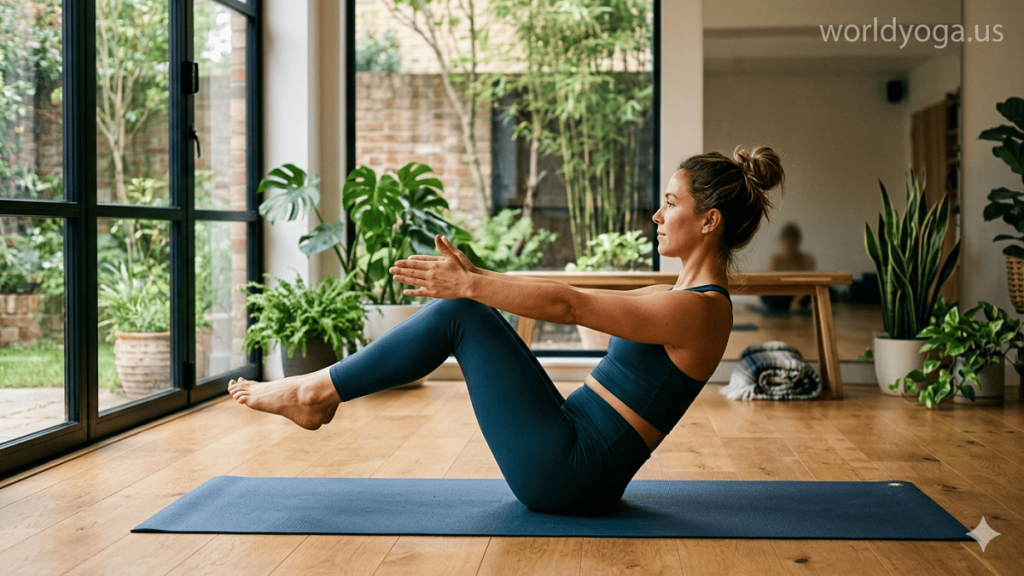
In this variation, the practitioner sits on the mat with knees bent and feet lifted off the ground, shins roughly parallel to the floor. The spine remains long and slightly reclined without collapsing into the lower back. Arms may extend forward at shoulder height to assist with balance, or they can be placed behind the thighs for additional support. Unlike the full expression of the pose, keeping the knees bent reduces strain on the lower back and hamstrings, making it more suitable for those building core endurance.
One of the key benefits of bent-knee Boat Pose is improved core activation. The rectus abdominis and deep stabilizing muscles such as the transverse abdominis are engaged to maintain the lifted position. Over time, this strengthens the midsection, which supports better posture and reduces the risk of lower back discomfort in daily activities. The hip flexors also play a crucial role, helping lift and stabilize the legs.
Another important advantage is enhanced balance and concentration. Holding the posture requires focus on breath control and micro-adjustments in body alignment. This cultivates mental discipline, which is a core principle in yoga practice. Beginners often find that even a few seconds of holding the pose can feel challenging, but gradual practice improves endurance and steadiness.
Breath coordination is essential. Practitioners are encouraged to maintain slow, steady breathing rather than holding the breath. Inhale to prepare and lengthen the spine, and exhale while engaging the core more deeply. This rhythm helps sustain the posture and prevents unnecessary tension.
Common mistakes include rounding the spine excessively, dropping the chest, or straining the neck. These issues can be avoided by focusing on lifting through the sternum and keeping the gaze forward rather than downward. Using props such as a yoga strap behind the thighs can also assist beginners in maintaining alignment.
For further reading on yoga alignment principles and core engagement, reputable resources include Yoga Journal Yoga Pose Library, which offers detailed pose breakdowns and variations. Additional guidance on fitness and core training can be found at Verywell Fit Yoga Guides, which explains modifications and safety tips. Strength and conditioning perspectives on core stability are also available from ACE Fitness Exercise Library.
#Boat Pose: Both Knees Bent in India
How is Boat Pose with both knees bent performed correctly?
Boat Pose (both knees bent) is performed by focusing on controlled core engagement, a stable spine, and balanced weight distribution on the sitting bones. This variation is commonly used to build foundational abdominal strength while reducing strain on the lower back compared to the full leg-extended version.
Begin by sitting on the floor with your knees bent and feet flat. Place your hands slightly behind your hips for support, fingers pointing toward your feet. Sit tall through the spine, lifting through the chest while gently engaging your abdominal muscles. The goal is to maintain an elongated spine rather than collapsing backward.
Next, lean your torso slightly back while keeping the chest open. As you shift your weight onto your sitting bones, lift both feet off the ground. Keep your knees bent at roughly a 90-degree angle, bringing the shins parallel to the floor. The thighs should be angled upward, not collapsing toward the chest or dropping too low.
Once balanced, release your hands from the floor and extend them forward at shoulder height, palms facing inward. This increases the demand on your core and helps stabilize the posture. The shoulders should stay relaxed and away from the ears, while the neck remains neutral with the gaze forward rather than downward.
Breathing is essential for maintaining stability. Inhale to lengthen the spine and prepare, then exhale to deepen core engagement and hold the position. Avoid holding your breath, as this increases tension and reduces endurance. Aim for steady, controlled breathing throughout the hold.
Proper alignment is critical. The most common mistake is rounding the lower back excessively, which places unnecessary stress on the spine. Instead, maintain a slight lift through the chest and a strong engagement of the abdominal muscles. Another frequent error is letting the knees drop too low or pulling them too close to the chest, both of which reduce effectiveness. The ideal position keeps the shins lifted and the torso balanced.
For beginners, holding the pose for 10–20 seconds is sufficient, gradually increasing duration as strength improves. Over time, this variation helps develop the core stability needed for more advanced yoga postures, including full Boat Pose with straight legs.
To deepen understanding of alignment and safe progression, you can refer to instructional resources such as Yoga Journal Pose Guide, which provides detailed breakdowns of yoga postures and modifications. For additional fitness-based guidance on core engagement and stability training, ACE Fitness Exercise Library offers professional exercise explanations. You may also explore Verywell Fit Yoga Resources for practical tips on safe practice and variations.
#Boat Pose: Both Knees Bent in Maharashtra
What is the proper alignment in this beginner variation of Navasana?
In the beginner variation of Boat Pose, proper alignment is centered on maintaining a stable, lengthened spine while the core supports the lifted legs. The pose should feel active but controlled, with minimal strain on the lower back or neck.
Start by sitting on the floor with knees bent and feet flat. The spine should be upright, with the chest lifted and shoulders relaxed down and slightly back. This initial posture establishes a neutral, elongated spine before any lifting begins. Avoid rounding the back at this stage, as it can carry into the lifted position and reduce stability.
As you lean back slightly, the weight should shift onto the sitting bones (ischial tuberosities), not the tailbone. This distinction is important because balancing on the tailbone often leads to collapsing the lower back. The torso remains long, and the chest stays open rather than caving inward.
When lifting the feet, the knees stay bent at roughly a right angle. The shins should be parallel to the floor, forming a tabletop-like position with the lower legs. The thighs angle upward, but the knees should not be pulled excessively toward the chest. At the same time, they should not drop too low, which would reduce core engagement.
The arms extend forward at shoulder height, parallel to the floor. Palms may face each other or slightly inward. The shoulders remain relaxed and away from the ears. The arms act as a counterbalance, helping stabilize the posture without creating tension in the neck or upper back.
The core is the primary stabilizer. The abdominal muscles engage inward and upward to support the spine. This engagement should feel firm but not restrictive. The lower back remains long rather than deeply arched or overly rounded. A slight natural curve is acceptable, but collapse should be avoided.
The neck stays neutral, with the gaze directed forward or slightly upward. Looking down often encourages rounding through the upper spine, which disrupts alignment. The chin should remain level, not tucked aggressively or lifted excessively.
Breathing should remain smooth and steady. Inhale to lengthen the spine and prepare, exhale to deepen core engagement and maintain balance. Breath control is essential for sustaining alignment without tension.
For deeper guidance on safe alignment principles and progression in yoga, you can refer to instructional resources such as Yoga Journal Pose Library, which offers detailed breakdowns of posture mechanics. Additional fitness-oriented explanations of core stability can be found at ACE Fitness Exercise Library. You may also explore Verywell Fit Yoga Guides for practical tips on form and modifications.
#Boat Pose: Both Knees Bent in Ahemadabad
Which core muscles are engaged during the pose?
In the beginner variation of Boat Pose, multiple core muscles work together to stabilize the spine, control balance, and maintain the lifted position of the legs. Although it appears simple, the posture activates both superficial “six-pack” muscles and deeper stabilizing muscles that support posture and movement control.
The primary muscle engaged is the rectus abdominis, the long vertical muscle running along the front of the abdomen. It is responsible for spinal flexion and plays a key role in holding the torso in a slightly reclined but stable position. In this pose, it prevents the lower back from collapsing and helps maintain the lifted chest.
Alongside it, the transverse abdominis is heavily engaged. This is the deepest abdominal muscle layer, acting like a natural corset around the midsection. It stabilizes the spine and pelvis by drawing the abdominal wall inward. In Boat Pose, this muscle is essential for maintaining balance and protecting the lower back from strain.
The internal and external obliques, located on the sides of the abdomen, assist in stabilizing the torso and preventing unwanted rotation or side-to-side wobbling. These muscles help you stay centered while balancing on the sitting bones, especially when the arms are extended forward.
The hip flexors, including the iliopsoas group, are also strongly activated. They are responsible for lifting and holding the thighs in position. In the bent-knee variation, these muscles work in coordination with the abdominals to keep the legs elevated without collapsing toward the floor.
The pelvic floor muscles contribute subtle but important support by helping stabilize the pelvis and maintain internal pressure within the core system. While not always consciously engaged, they naturally activate during controlled balance work like this.
In addition, the erector spinae muscles along the back play a supportive role. Rather than driving the movement, they help maintain an upright and lengthened spine, working in opposition to the abdominal muscles to create balance and control.
Finally, stabilizing muscles in the diaphragm contribute through breath control. Controlled breathing helps regulate core engagement and prevents excessive tension during the hold.
Together, these muscle groups create a coordinated “core system” that supports both strength and stability. Over time, regular practice of Boat Pose improves not only abdominal strength but also postural control, balance, and functional movement efficiency.
#Boat Pose: Both Knees Bent in Hyderabad
What preparatory poses help build strength for this variation?
Several preparatory poses help build the core strength, hip flexor control, and spinal stability needed for the beginner variation of Boat Pose. These poses gradually condition the abdominal muscles and improve balance so the posture feels more controlled and sustainable.
One of the most effective foundations is Plank Pose. This pose builds isometric core strength by training the rectus abdominis, transverse abdominis, and shoulder stabilizers simultaneously. Holding plank with a neutral spine teaches the body how to resist gravity without collapsing through the lower back, which directly transfers to Boat Pose stability.
Another important preparatory posture is Low Boat Pose. This variation brings the torso closer to the ground while keeping the legs active, increasing abdominal intensity and improving endurance. Practicing this pose helps strengthen the deep core muscles needed to maintain balance when the legs are lifted in bent-knee Boat Pose.
Bridge Pose is also highly beneficial. While it appears to focus on the back, it actually activates the glutes, hamstrings, and lower back muscles while gently engaging the core. This creates better posterior chain support, which helps stabilize the pelvis during Boat Pose.
For improving hip flexor strength, Leg Raises (lying on the back) are extremely useful. They train the iliopsoas and lower abdominal connection needed to lift and hold the knees in a bent position without strain. Slow, controlled repetitions are more effective than fast movements.
Another supportive pose is Seated Forward Bend. While primarily a flexibility posture, it gently stretches the hamstrings and teaches pelvic control. Better hamstring flexibility makes it easier to maintain an upright seated position before lifting into Boat Pose.
Chair Pose is also valuable for building overall lower-body endurance and core engagement. Holding this posture strengthens the quadriceps and deep core stabilizers, reinforcing the ability to maintain balance under sustained muscular effort.
Finally, breath-focused core activation in simple seated positions helps prepare the nervous system for stability work. Learning to engage the abdomen without tension is essential before attempting longer holds in Boat Pose.
For additional structured guidance on yoga preparation and progression, resources such as Yoga Journal Pose Library provide detailed pose sequences, while ACE Fitness Exercise Library offers strength-based explanations of core training principles. You may also find practical modifications at Verywell Fit Yoga Guides useful for gradual progression.
#Boat Pose: Both Knees Bent in Delhi
What are the benefits and precautions of practicing bent-knee Boat Pose?
Practicing the bent-knee variation of Boat Pose offers a balanced combination of core strengthening, postural improvement, and body awareness, while also requiring attention to alignment and safety to avoid strain.
Benefits
One of the primary benefits is core strengthening. This pose activates the rectus abdominis, transverse abdominis, and obliques, helping build overall abdominal endurance. Because the knees are bent, the load is reduced compared to the full variation, making it ideal for beginners while still effectively training the midsection.
It also improves hip flexor strength and control. The iliopsoas and surrounding muscles work to hold the legs in a lifted position, which translates into better functional movement in daily activities like walking, climbing stairs, and maintaining upright posture.
Another important benefit is postural support. Regular practice helps strengthen the muscles that stabilize the spine, reducing tendencies toward slouching and improving seated and standing alignment. This is especially useful for people who spend long hours sitting.
The pose also enhances balance and coordination. Since the body is supported only by the sitting bones, it requires fine neuromuscular control to maintain stability. This improves overall body awareness and concentration.
Additionally, it supports breath control and mental focus. Coordinating steady breathing with muscular engagement helps calm the nervous system while building endurance under controlled effort.
Precautions
Despite its benefits, there are important precautions to consider. People with lower back issues or spinal disc problems should be cautious, as improper rounding of the spine can increase pressure on the lumbar region. Maintaining a long, neutral spine is essential.
Those with hip flexor tightness or hamstring restrictions may find the posture challenging. Forcing the legs higher than their natural range can lead to strain, so modifications such as keeping the feet slightly lower or using hand support behind the thighs are recommended.
It is also important to avoid neck tension. Many practitioners unknowingly strain the neck by looking downward or tucking the chin excessively. The gaze should remain forward with a relaxed cervical spine.
Another precaution is breath holding, which often occurs when the core becomes fatigued. Holding the breath increases internal pressure and reduces stability. Continuous, even breathing is essential for safe practice.
Finally, beginners should avoid holding the pose for too long initially. Overexertion can lead to fatigue and loss of form, increasing injury risk. Short, controlled holds with gradual progression are more effective.
For more detailed guidance on safe yoga practice and modifications, you can refer to Yoga Journal Pose Library, which provides alignment tips and variations. Additional exercise safety and core training insights are available at ACE Fitness Exercise Library, while Verywell Fit Yoga Guides offers practical beginner-friendly advice.
#Boat Pose: Both Knees Bent in Banglore
Case Study of Boat Pose: Both Knees Bent
1. Background and Objective
A 6-week beginner yoga intervention was designed to evaluate the effects of the bent-knee variation of Boat Pose on core strength, postural control, and perceived lower back comfort. The participant group consisted of early-stage yoga practitioners with limited prior core training experience. The primary objective was to determine whether a simplified Navasana variation could safely improve core stability without aggravating lumbar strain.
2. Methodology
Participants practiced bent-knee Boat Pose 3–4 times per week as part of a structured 20-minute core-focused sequence. Each hold began at 10–15 seconds, gradually progressing to 30–40 seconds per set. The posture emphasized neutral spinal alignment, engagement of the transverse abdominis, and controlled breathing.
Sessions were paired with preparatory poses such as Plank Pose and Bridge Pose to build foundational strength. Participants were instructed to avoid spinal rounding and to maintain shins parallel to the floor throughout the hold.
3. Observations and Results
Core Strength Improvement
After 6 weeks, most participants demonstrated improved abdominal endurance, particularly in isometric holds. The rectus abdominis and transverse abdominis showed increased activation tolerance, allowing longer and more stable holds in Boat Pose.
Postural Control
Participants reported better seated posture and reduced slouching during daily activities. This improvement was attributed to enhanced spinal awareness and improved engagement of deep stabilizing muscles.
Lower Back Comfort
A key finding was a reduction in mild non-specific lower back discomfort among participants who previously experienced fatigue from prolonged sitting. The bent-knee variation allowed safe strengthening without excessive spinal load.
Balance and Coordination
Participants initially struggled with maintaining steady balance when lifting both feet. However, by week 4, neuromuscular control improved significantly, especially when combining breath awareness with core engagement.
4. Challenges Identified
The most common challenge was loss of spinal neutrality, where participants either rounded the lower back or leaned too far back onto the tailbone. Another issue was breath holding under effort, which reduced stability and increased fatigue. Tight hip flexors also limited the ability to hold the shins parallel in some individuals.
5. Safety Considerations
The study emphasized strict alignment cues:
- Maintain a long spine rather than collapsing backward
- Keep knees bent at approximately 90 degrees
- Avoid straining the neck by keeping a forward gaze
- Use regression (hands behind thighs) when fatigue occurs
These modifications significantly reduced discomfort and improved adherence.
6. Conclusion
The bent-knee variation of Boat Pose proved to be an effective introductory core stability exercise. When paired with foundational postures like Plank Pose and Bridge Pose, it enhanced abdominal endurance, improved posture, and supported safer spinal loading patterns. The case study suggests that this variation is particularly suitable for beginners, rehabilitation-focused movement programs, and individuals transitioning into more advanced core yoga practices.
7. Reference Resources
For deeper anatomical and training insights, see:
- Yoga Journal Pose Library — alignment and yoga progression guidance
- ACE Fitness Core Training Resources — evidence-based core strength principles
- Verywell Fit Yoga Guides — beginner modifications and safety practices
#Boat Pose: Both Knees Bent in Pune
White Paper of Boat Pose: Both Knees Bent
1. Executive Summary
The bent-knee variation of Boat Pose (Navasana) is a foundational isometric yoga posture designed to develop core stability, hip flexor strength, and postural control with reduced spinal load. This white paper evaluates its biomechanics, neuromuscular activation patterns, training applications, and safety considerations. It is widely applicable in beginner yoga, corrective exercise, and general fitness conditioning due to its scalability and low equipment requirement.
2. Introduction
Core stability is a critical component of functional movement, influencing posture, balance, and injury prevention. The bent-knee Boat Pose serves as a regression of full Navasana, allowing practitioners to build strength while maintaining spinal neutrality. Unlike dynamic abdominal exercises, it emphasizes sustained isometric contraction under controlled breathing.
3. Biomechanics and Muscle Activation
The posture involves seated balance on the ischial tuberosities while maintaining a reclined torso and elevated lower limbs with knees bent.
Primary muscle groups engaged include:
- Rectus abdominis (spinal flexion control)
- Transverse abdominis (deep core stabilization)
- Internal and external obliques (anti-rotation stability)
- Iliopsoas complex (hip flexion and leg elevation)
- Erector spinae (postural support and spinal alignment)
- Diaphragm (respiratory stabilization synergy)
The bent-knee position reduces lever length compared to full extension, decreasing torque on the lumbar spine while maintaining significant core demand.
4. Functional Benefits
4.1 Core Strength Development
The posture enhances isometric endurance of abdominal musculature, particularly the deep stabilizers responsible for spinal integrity.
4.2 Postural Optimization
Regular practice improves thoracic lift and pelvic control, reducing compensatory slouching patterns associated with prolonged sitting.
4.3 Motor Control and Balance
Maintaining a stable base on the sitting bones while managing limb elevation improves neuromuscular coordination and proprioception.
4.4 Scalable Progression Model
The bent-knee version acts as a transitional stage toward full Boat Pose, allowing gradual load progression without abrupt increases in spinal stress.
5. Training Applications
This variation is commonly integrated into:
- Beginner yoga sequencing
- Rehabilitation-oriented core programs
- Athletic conditioning warm-ups
- Postural correction routines
It pairs effectively with preparatory movements such as Plank Pose and Bridge Pose to reinforce anterior and posterior chain balance.
6. Safety and Risk Management
While generally safe, the posture requires attention to the following:
- Lumbar control: Avoid excessive spinal rounding, which increases disc compression risk
- Neck neutrality: Prevent cervical strain by maintaining a forward gaze
- Hip flexor limitation: Tight iliopsoas may restrict safe leg elevation
- Breath regulation: Breath-holding reduces stability and increases intra-abdominal pressure unpredictably
- Fatigue management: Overextension of hold duration can degrade alignment quality
Regression strategies include hand support behind thighs or reduced hold duration.
7. Implementation Guidelines
Recommended dosage for beginners:
- 3–5 sets per session
- 10–30 seconds per hold
- 30–60 seconds rest between sets
- 3–4 sessions per week
Progression should prioritize form quality over duration increases.
8. Conclusion
The bent-knee Boat Pose is an efficient, low-barrier entry point for developing core stability and postural control. Its reduced lever mechanics make it suitable for beginners while still providing meaningful neuromuscular demand. When integrated into structured progression models, it supports safe advancement toward more complex core balancing postures.
9. References and Further Reading
- Yoga Journal Pose Library — alignment principles and variations
- ACE Fitness Exercise Library — evidence-based exercise science guidance
- Verywell Fit Yoga Guides — beginner modifications and safety education
#Boat Pose: Both Knees Bent in Kolkata
Industry Application of Boat Pose: Both Knees Bent
1. Overview
The bent-knee variation of Boat Pose (Navasana) has evolved from a traditional yoga posture into a widely applicable movement tool across multiple industries, including fitness training, rehabilitation, corporate wellness, sports conditioning, and mind-body therapy. Its scalability, low equipment requirement, and strong emphasis on core stabilization make it a versatile exercise for both preventive and performance-based programs.
2. Fitness and Gym Training Industry
In commercial fitness environments, the bent-knee Boat Pose is commonly used as a foundational core training exercise. Personal trainers incorporate it into beginner programs due to its controlled intensity and reduced spinal load compared to full Boat Pose.
It is frequently programmed in:
- Core stability circuits
- Bodyweight conditioning sessions
- Functional training warm-ups
The pose helps clients develop abdominal endurance before progressing to higher-load movements such as hanging leg raises or advanced isometric holds.
3. Yoga and Mind-Body Industry
Within yoga studios and teacher training programs, this variation is used as a regression tool for students unable to maintain full Navasana alignment. It allows instructors to emphasize spinal neutrality, breath coordination, and gradual strength building.
It is often sequenced with preparatory postures like Plank Pose and hip-opening work to create balanced class progression structures.
4. Rehabilitation and Physiotherapy
In physiotherapy and corrective exercise settings, bent-knee Boat Pose is applied as a low-load core stabilization exercise. It is particularly useful for individuals recovering from:
- Non-specific lower back pain
- Postural imbalances due to prolonged sitting
- Mild core deconditioning
Clinicians value its ability to activate deep stabilizers such as the transverse abdominis without excessive lumbar compression. It is often integrated into mat-based rehabilitation protocols alongside controlled bridge variations and breathing retraining.
5. Sports Performance and Athletic Conditioning
In athletic training environments, the posture is used as an isometric core endurance drill. Sports requiring rotational control and trunk stability—such as running, martial arts, gymnastics, and field sports—benefit from its ability to improve anti-extension strength.
Athletic trainers often use it as a bridge exercise before introducing dynamic core movements or loaded compound lifts.
6. Corporate Wellness and Ergonomics Programs
Corporate wellness initiatives increasingly include bent-knee Boat Pose as part of desk-worker mobility and posture correction routines. It directly addresses issues related to prolonged sitting, such as weakened hip flexors and reduced core engagement.
Short sessions of 20–30 seconds are often used during breaks to improve spinal awareness and reduce fatigue from sedentary work environments.
7. Mental Health and Stress-Reduction Applications
In mind-body therapy and stress-management programs, the posture is used to combine controlled breathing with core engagement, supporting nervous system regulation. The sustained isometric hold encourages focus and body awareness, making it useful in mindfulness-based movement sessions.
8. Conclusion
The bent-knee Boat Pose functions as a multi-industry movement tool that bridges fitness, rehabilitation, performance training, and wellness applications. Its adaptability and scalability make it particularly valuable as both an entry-level strength builder and a corrective exercise for postural health.
9. Reference Resources
- ACE Fitness Exercise Library — applied exercise science and programming guidance
- Yoga Journal Pose Library — structured yoga progression and alignment references
- Verywell Fit Yoga Guides — beginner-friendly modifications and safety applications
#Boat Pose: Both Knees Bent in Mumbai
Ask FAQs
What is Boat Pose with both knees bent?
Boat Pose with both knees bent is a beginner-friendly variation of Navasana where the practitioner balances on the sitting bones with the knees flexed and shins lifted parallel to the floor. It focuses on core engagement while reducing strain on the lower back compared to the full leg-extended version.
Which muscles are mainly worked in this variation?
This pose primarily activates the rectus abdominis, transverse abdominis, and obliques. It also engages the hip flexors (iliopsoas) to lift and hold the legs, while supporting muscles like the erector spinae and diaphragm help maintain posture and breathing control.
How long should beginners hold this pose?
Beginners typically start with 10–20 second holds per set and gradually increase to 30–40 seconds as strength improves. Multiple short sets with rest in between are more effective and safer than one long hold, especially in early practice.
What are common mistakes to avoid?
Common mistakes include rounding the lower back, collapsing the chest, holding the breath, and letting the knees drop too low. Another frequent issue is tensing the neck instead of keeping a neutral gaze forward. Proper alignment and steady breathing are essential.
Who should avoid or modify this pose?
Individuals with severe lower back pain, recent abdominal surgery, or significant hip flexor strain should modify or avoid the pose unless guided by a professional. A safer modification includes keeping the feet closer to the floor or using hand support behind the thighs.
Table of Contents
Disclaimer: The information provided is for educational and general fitness purposes only and should not be considered medical advice. Practice Boat Pose under proper guidance, especially if you are a beginner or have any existing medical conditions. Consult a qualified healthcare professional or certified yoga instructor before starting or modifying any exercise routine.