Galavasana
Galavasana (Flying Pigeon Pose) is an advanced yoga posture that belongs to the category of arm-balancing asanas. The name originates from Sanskrit, where “Galava” refers to a revered sage in ancient Indian tradition, and “asana” means posture or pose. It is widely practiced in dynamic yoga styles such as Vinyasa and Power Yoga due to its combination of strength, flexibility, and balance.
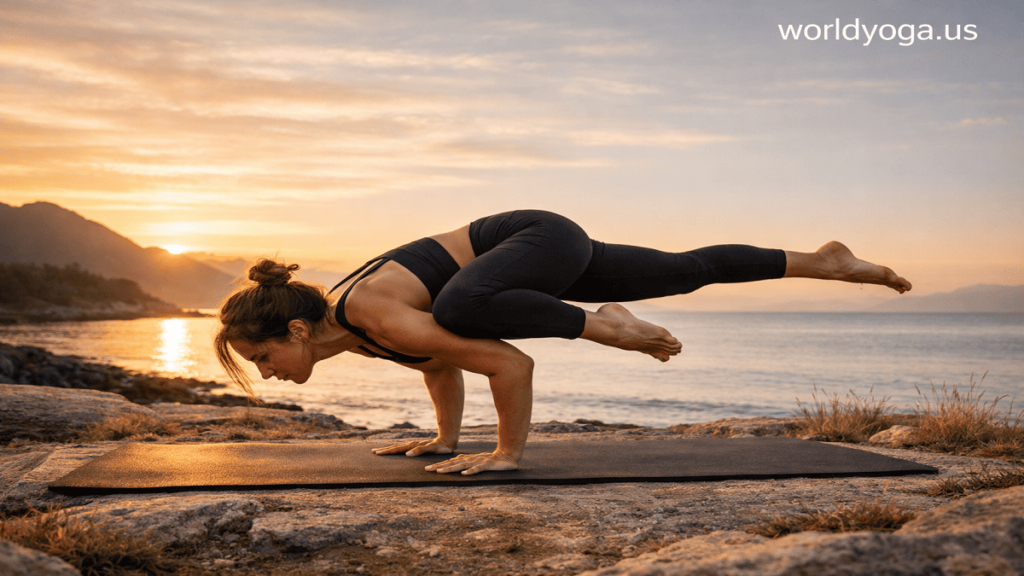
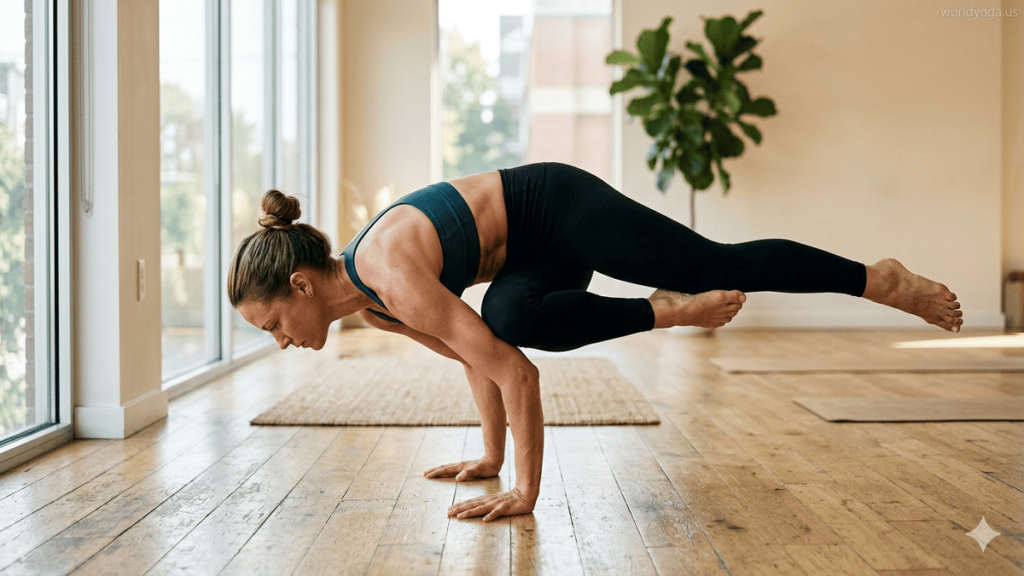
In Galavasana, the practitioner balances the body on the hands while one leg is bent and placed across the upper arms in a figure-four position, similar to Pigeon Pose. The other leg extends straight backward, parallel to the ground. This creates a visually striking posture that resembles a pigeon in flight, which is why it is commonly called Flying Pigeon Pose.
This asana primarily engages the upper body and core muscles. The arms, shoulders, and wrists bear the body’s weight, making strength in these areas essential. Simultaneously, the core muscles stabilize the body and help maintain balance. The pose also requires significant hip flexibility, particularly in the outer hips, as the bent leg must externally rotate deeply. Because of this, preparatory poses like Crow Pose and hip-opening stretches are often recommended before attempting Galavasana.
Galavasana is considered an intermediate to advanced pose due to its technical demands. It requires coordination, body awareness, and controlled breathing. Practitioners must carefully shift their center of gravity forward to lift the back leg off the ground while maintaining stability in the arms. This balance between strength and flexibility makes the pose both physically challenging and mentally engaging.
The benefits of Galavasana extend beyond physical fitness. It helps build upper body strength, enhances core stability, and improves hip mobility. Additionally, the balancing aspect of the pose sharpens concentration and focus, contributing to better mental clarity. Regular practice can also foster confidence and resilience, as mastering the pose often involves overcoming fear of falling and developing trust in one’s abilities.
However, Galavasana should be practiced with caution. It is not suitable for beginners or individuals with wrist, shoulder, or hip injuries. Proper warm-up and gradual progression are essential to prevent strain or injury. Practicing under the guidance of a qualified yoga instructor is highly recommended, especially for those attempting the pose for the first time.
In summary, Galavasana is a sophisticated yoga posture that integrates strength, flexibility, and balance. It is both a physical and mental challenge, offering significant benefits when approached with patience, preparation, and proper technique.
#Galavasana in India
How is this pose performed step by step?
1. Begin in a Stable Standing Position
Start in an upright stance such as Mountain Pose (Tadasana). Ensure your weight is evenly distributed and your breathing is steady. This establishes balance and focus before transitioning.
2. Move into a Figure-Four Position
Bend your knees slightly and shift into Chair Pose (Utkatasana). Cross your right ankle over your left thigh, just above the knee, forming a figure-four shape. Flex the foot of the lifted leg to protect the knee joint.
3. Lower Your Torso Forward
Gently hinge forward from the hips while keeping your spine relatively straight. Maintain the figure-four shape as you bring your torso closer to your standing leg. This deepens the hip opening.
4. Place Your Hands on the Floor
Carefully lower your hands to the ground in front of you, shoulder-width apart. Spread your fingers wide to create a stable base. At this stage, your position will resemble a preparation for Crow Pose (Bakasana).
5. Position the Bent Leg on Your Arms
Rest your right shin across your upper arms, as high as possible toward the armpits. The foot should remain flexed, and the shin should feel secure against the arms to prevent slipping.
6. Shift Your Weight Forward
Slowly lean your body weight forward into your hands. Bend your elbows slightly, creating a shelf with your upper arms. Engage your core to maintain control and stability.
7. Lift the Back Foot Off the Ground
With a controlled shift of weight, begin to lift your left foot off the floor. Initially, you may keep it slightly bent. Focus on balance and avoid rushing this step.
8. Extend the Back Leg
Once stable, extend your left leg straight back behind you, keeping it parallel to the floor. Engage the leg muscles and point or flex the toes, depending on comfort and stability.
9. Hold the Pose with Controlled Breathing
Maintain steady breathing while holding the posture. Keep your gaze slightly forward to help with balance. Engage your core and arms continuously to sustain the position.
10. Exit the Pose Safely
To release, gently lower your back foot to the ground and return to the figure-four position. Then slowly rise back to standing.
Important Considerations
Warm up thoroughly with hip openers and arm balances before attempting Galavasana. Avoid the pose if you have wrist, shoulder, or hip injuries. Practicing preparatory poses and using props can significantly improve safety and alignment.
#Galavasana in Maharashtra
What strength and flexibility are required?
1. Strength Requirements
Upper Body Strength
A significant portion of body weight is supported by the arms, making strong shoulders, triceps, and chest essential. The muscles must not only lift the body but also stabilize it. Foundational poses like Chaturanga Dandasana help build this strength.
Wrist Strength and Stability
Since the wrists bear direct pressure, they must be conditioned to handle load in a flexed position. Weak wrists can lead to discomfort or injury, so preparatory strengthening exercises are important.
Core Strength
The core plays a central role in maintaining balance and preventing collapse. Deep abdominal engagement keeps the pelvis lifted and aligned. Without sufficient core activation, it becomes difficult to lift the back leg or hold the posture steadily.
Hip Stabilizers and Glutes
The extended leg must remain lifted and aligned, requiring activation of the glutes and hamstrings. These muscles help maintain control and prevent the leg from dropping.
2. Flexibility Requirements
Hip Flexibility (External Rotation)
One of the most critical elements is the ability to externally rotate the hip of the bent leg. The ankle must comfortably rest across the opposite thigh without strain. This mobility is developed through poses like Pigeon Pose.
Outer Hip and Glute Flexibility
Tightness in the glutes and outer hips can restrict the figure-four position, making it difficult to place the leg securely on the arms.
Hamstring Flexibility
The standing leg (before lift-off) and later the extended leg benefit from flexible hamstrings, allowing smoother transitions and better alignment.
Lower Back and Spinal Mobility
While Galavasana primarily relies on hip movement, a certain degree of spinal mobility helps maintain proper posture when leaning forward into the arm balance.
3. Balance and Coordination
Beyond pure strength and flexibility, Galavasana demands refined body awareness. The practitioner must coordinate multiple muscle groups while shifting their center of gravity forward. Practicing balancing poses such as Crow Pose improves this neuromuscular control.
Conclusion
To perform Galavasana effectively, practitioners need strong arms, stable wrists, an engaged core, and open hips—particularly in external rotation. It is not enough to be flexible or strong in isolation; the pose requires an integrated approach where strength supports flexibility and vice versa. Consistent preparation through targeted poses and conditioning exercises is essential for safe and successful practice.
#Galavasana in Pune
What are the key benefits of this pose?
1. Builds Upper Body Strength
One of the most prominent benefits of Galavasana is the development of upper body strength. The arms, shoulders, chest, and wrists تحمل the body’s weight throughout the pose. Regular practice strengthens these muscle groups significantly, similar to foundational poses like Chaturanga Dandasana. Over time, this leads to improved muscular endurance and joint stability.
2. Enhances Core Stability
The core muscles are deeply engaged to maintain balance and control. This continuous activation strengthens the abdominal muscles and improves overall core stability. A strong core not only supports yoga practice but also contributes to better posture and reduced risk of lower back pain in daily life.
3. Improves Hip Flexibility
Galavasana requires deep external rotation of the hip, particularly in the bent leg. This promotes increased flexibility in the hips, glutes, and surrounding muscles. Practicing hip-opening poses such as Pigeon Pose alongside Galavasana can further enhance mobility and reduce stiffness in the lower body.
4. Develops Balance and Coordination
As an arm balance, the pose challenges the practitioner’s sense of equilibrium. It requires precise weight shifting and body awareness to maintain stability. Regular practice improves coordination and proprioception, which are essential for both athletic performance and injury prevention.
5. Strengthens Mental Focus and Discipline
Galavasana demands concentration and controlled breathing. Maintaining the pose requires the mind to stay present and focused, helping to improve mental clarity and mindfulness. The process of learning and mastering the pose also builds patience, resilience, and self-discipline.
6. Boosts Confidence
Achieving Galavasana can be a significant milestone in a yoga practice. Overcoming the physical and mental challenges associated with the pose fosters a sense of accomplishment and self-confidence. This psychological benefit often extends beyond the mat into other areas of life.
7. Engages Full-Body Integration
Unlike isolated exercises, Galavasana requires multiple muscle groups to work together simultaneously. From the arms and core to the hips and legs, the pose promotes functional strength and coordinated movement patterns. Preparatory arm balances like Crow Pose help develop this integration.
Conclusion
Galavasana is a comprehensive posture that strengthens the upper body, enhances core stability, increases hip flexibility, and improves balance and focus. Beyond its physical advantages, it cultivates mental discipline and confidence. When practiced consistently and with proper technique, it becomes a powerful tool for both physical conditioning and mindful awareness.
#Galavasana in Ahemadabad
What common mistakes should be avoided?
1. Insufficient Warm-Up
One of the most frequent mistakes is attempting the pose without proper preparation. Tight hips or unprepared wrists can make the posture difficult and unsafe. Skipping preparatory poses such as Pigeon Pose or wrist mobilization exercises increases the risk of strain.
2. Poor Hip Positioning
If the bent leg is not properly externally rotated, the shin may slip off the arms. This often happens when the hips are tight or not fully engaged. The ankle should be flexed and securely placed across the upper arms to maintain stability.
3. Lack of Core Engagement
Failing to engage the core leads to a collapse in the posture. Without core support, it becomes difficult to lift the back leg or maintain balance. This results in excessive pressure on the wrists and shoulders.
4. Incorrect Weight Distribution
Many practitioners hesitate to shift their weight forward מספיק, keeping too much weight in the grounded foot. Proper balance requires a deliberate forward lean, similar to Crow Pose. Without this shift, lifting into the pose becomes nearly impossible.
5. Overloading the Wrists
Placing too much pressure directly into the wrists without distributing weight through the fingers can cause discomfort or injury. The fingers should be actively spread and pressing into the ground to create a balanced foundation.
6. Rounding or Collapsing the Upper Body
A collapsed chest or rounded shoulders reduces stability and control. Instead, the practitioner should keep the chest slightly lifted and shoulders engaged to support the body effectively.
7. Forcing the Leg Extension
Trying to extend the back leg too quickly can disrupt balance. It is important to first establish stability with the lifted foot bent, then gradually extend the leg once control is achieved.
8. Holding the Breath
Breath control is often overlooked. Holding the breath creates tension and reduces focus. Maintaining steady, controlled breathing helps stabilize both the body and mind during the pose.
9. Skipping Progressive Practice
Attempting Galavasana without mastering foundational poses can hinder progress. Building strength through poses like Chaturanga Dandasana is essential for safe execution.
Conclusion
Avoiding these common mistakes—such as inadequate warm-up, poor alignment, weak core engagement, and improper weight distribution—can significantly improve both safety and performance in Galavasana. A mindful, step-by-step approach ensures steady progress and reduces the likelihood of injury while mastering this advanced posture.
#Galavasana in Hyderabad
Case Study of Galavasana
Background
The subject, a 32-year-old practitioner with two years of consistent yoga experience, demonstrated moderate upper body strength but limited hip flexibility. While comfortable in foundational poses such as Crow Pose and Chaturanga Dandasana, they struggled with deep hip external rotation required for Galavasana.
Initial Assessment
Key limitations identified:
- Restricted hip mobility, particularly in external rotation
- Inconsistent core engagement during arm balances
- Hesitation in shifting weight forward due to fear of falling
Despite adequate arm strength, the practitioner was unable to lift the back leg or maintain balance in the pose.
Intervention Plan
A structured 8-week program was designed, focusing on three primary areas:
1. Hip Flexibility Training
Daily practice included hip-opening postures such as Pigeon Pose and figure-four stretches. These improved joint mobility and reduced resistance in the gluteal muscles.
2. Strength Development
Core and upper body strength were enhanced through targeted exercises, including plank variations and controlled transitions into Crow Pose. Emphasis was placed on maintaining stability and proper alignment.
3. Balance and Technique Refinement
The practitioner practiced weight-shifting drills and used yoga blocks for support. Gradual exposure to forward leaning helped build confidence and reduce fear.
Progress and Observations
By week four, noticeable improvements in hip flexibility allowed better positioning of the bent leg on the arms. Core engagement also improved, enabling brief lift-off attempts.
By week eight:
- The practitioner successfully achieved full Galavasana with proper alignment
- Balance was maintained for 5–7 breaths
- Transitions in and out of the pose became controlled and stable
The integration of strength and flexibility training proved essential in achieving the posture.
Challenges Encountered
- Initial wrist discomfort due to improper weight distribution
- Mental resistance and fear of falling forward
- Over-reliance on arm strength instead of full-body coordination
These challenges were addressed through technique correction, gradual progression, and consistent practice.
Outcome and Benefits
The practitioner reported:
- Increased upper body and core strength
- Enhanced hip mobility
- Improved confidence in arm balances
- Greater body awareness and control
Conclusion
This case study highlights that mastering Galavasana requires an integrated approach combining flexibility, strength, and mental focus. Even for practitioners with partial readiness, targeted training and progressive techniques can lead to successful execution. Consistency, proper guidance, and attention to limitations are key factors in safely achieving this advanced posture.
#Galavasana in Banglore
White Paper of Galavasana
Abstract
Galavasana, or Flying Pigeon Pose, is an advanced arm-balancing posture in modern yoga practice that integrates upper body strength, hip mobility, and neuromuscular coordination. This white paper examines the biomechanical principles, physiological benefits, risk factors, and structured training approaches associated with the pose. It aims to provide a professional, evidence-informed overview for practitioners, instructors, and fitness specialists.
1. Introduction
Galavasana is derived from traditional Hatha Yoga but is more commonly practiced in contemporary styles such as Vinyasa Yoga. The posture combines elements of hip opening, forward flexion, and arm balancing. It is often approached after mastering preparatory poses such as Crow Pose and Pigeon Pose, which develop the foundational strength and flexibility required.
2. Biomechanical Analysis
Galavasana involves a closed kinetic chain where the hands act as the primary base of support. The center of gravity shifts anteriorly, requiring precise control to maintain equilibrium.
Key biomechanical components include:
- Upper Limb Load Bearing: The wrists, elbows, and shoulders تحمل compressive and stabilizing forces. Proper joint stacking reduces strain.
- Core Stabilization: The abdominal muscles maintain pelvic lift and prevent excessive lumbar flexion.
- Hip External Rotation: The bent leg requires significant external rotation, placing demand on the gluteus maximus and deep rotator muscles.
- Posterior Chain Engagement: The extended leg activates the glutes and hamstrings to maintain alignment.
3. Physiological Benefits
Musculoskeletal Development
Galavasana strengthens the upper body, particularly the deltoids, triceps, and pectoral muscles. It also enhances core endurance and hip flexibility.
Neuromuscular Coordination
Balancing on the hands improves proprioception and motor control, contributing to better coordination.
Postural Improvement
Strengthening stabilizing muscles supports spinal alignment and reduces the risk of postural imbalances.
Psychological Impact
The pose encourages focus, discipline, and confidence. Mastery often leads to improved mental resilience and concentration.
4. Risk Factors and Contraindications
Despite its benefits, Galavasana presents certain risks if performed incorrectly:
- Wrist and Shoulder Strain: نتيجة improper weight distribution or ضعف muscular support
- Hip Joint Stress: Due to insufficient flexibility or forced external rotation
- Loss of Balance: Increasing the likelihood of falls or abrupt loading
Individuals with pre-existing injuries in the wrists, shoulders, or hips should avoid or modify the pose. تدريجي progression and supervision are strongly recommended.
5. Training and Implementation Framework
A structured approach enhances safety and effectiveness:
Phase 1: Preparation
Focus on mobility and foundational strength through poses like hip openers and arm balances.
Phase 2: Skill Development
Practice weight shifting, core engagement, and controlled lift-off techniques using props if necessary.
Phase 3: Integration
Incorporate Galavasana into flow sequences, maintaining alignment and breath control.
Phase 4: Mastery
Refine endurance, stability, and transitions in and out of the posture.
6. Conclusion
Galavasana represents a synthesis of strength, flexibility, and balance within yoga practice. Its successful execution depends on a progressive training model and an understanding of underlying biomechanics. When practiced correctly, it offers substantial physical and psychological benefits while enhancing overall movement efficiency.
References
- Yoga Journal. Flying Pigeon Pose: https://www.yogajournal.com/poses/flying-pigeon-pose/
- DoYou Yoga. How to Do Galavasana: https://www.doyou.com/how-to-do-flying-pigeon-pose-galavasana-81541/
#Galavasana in Kolkata
Industry Application of Galavasana
1. Fitness and Wellness Industry
In the modern fitness sector, Galavasana is widely integrated into advanced yoga and functional training programs. Studios offering Vinyasa, Power Yoga, and hybrid fitness classes use this posture to enhance upper body strength, core stability, and mobility. It is often introduced after foundational poses such as Crow Pose to progressively build arm-balancing capabilities.
Fitness professionals incorporate Galavasana into strength-conditioning routines because it mimics bodyweight resistance training. It is particularly valuable in boutique fitness studios and premium wellness centers, where clients seek challenging, skill-based exercises that combine aesthetics with performance.
2. Physiotherapy and Rehabilitation
Although Galavasana itself is not typically prescribed in early rehabilitation, its components are highly relevant in physiotherapy. Elements such as hip external rotation (trained through Pigeon Pose) and controlled weight-bearing through the upper limbs are used in recovery programs.
Advanced rehabilitation settings may introduce modified versions of arm balances to restore proprioception, joint stability, and neuromuscular coordination. This is especially useful for patients recovering from shoulder or core-related injuries, under professional supervision.
3. Sports Performance and Athletic Training
Athletic training programs increasingly adopt yoga-based movements to improve performance. Galavasana contributes to:
- Core strength essential for sports like gymnastics and martial arts
- Balance and coordination required in activities such as surfing and skating
- Hip mobility, which enhances stride efficiency in running and agility-based sports
Strength and conditioning coaches may use progressions of Galavasana to develop functional strength and body control without relying on heavy equipment.
4. Corporate Wellness Programs
Organizations investing in employee wellness often include yoga sessions to reduce stress and improve physical health. While Galavasana is an advanced pose, its preparatory stages are used in structured programs to:
- Improve posture among desk-bound employees
- Enhance focus and mental clarity
- Reduce musculoskeletal discomfort
Corporate wellness trainers typically adapt the pose into accessible variations suitable for different fitness levels.
5. Yoga Education and Teacher Training
In yoga teacher training programs, Galavasana is studied as part of advanced asana practice. Trainees learn not only how to perform the pose but also how to teach it safely. This includes understanding alignment, contraindications, and step-by-step progressions.
It is often taught alongside foundational arm balances like Chaturanga Dandasana to demonstrate the progression from basic strength to complex postures.
6. Digital Fitness and Content Creation
With the rise of online fitness platforms, Galavasana has become a popular pose in digital yoga content. Influencers and instructors showcase it to demonstrate advanced skill levels, attract audiences, and promote structured programs.
It is frequently featured in:
- Online yoga classes and subscriptions
- Social media fitness tutorials
- Mobile fitness applications
Conclusion
Galavasana has diverse applications across multiple industries, including fitness, rehabilitation, sports performance, corporate wellness, education, and digital media. Its value lies not only in the pose itself but in the functional components it develops—strength, flexibility, and balance. When adapted appropriately, it serves as a versatile tool for both physical conditioning and holistic well-being.
#Galavasana in Mumbai
Ask FAQs
What is Galavasana and why is it considered advanced?
Galavasana, or Flying Pigeon Pose, is an advanced arm-balancing yoga posture that requires a combination of upper body strength, core stability, and hip flexibility. It is considered advanced because the practitioner must support their entire body weight on the hands while maintaining balance and proper alignment. Foundational poses like Crow Pose are usually mastered before attempting it.
Can beginners practice Galavasana?
Galavasana is not recommended for complete beginners. However, beginners can work toward it by practicing preparatory poses and building strength and flexibility gradually. Hip openers such as Pigeon Pose and arm-strengthening poses help create a safe progression path.
What are the main physical benefits of Galavasana?
The pose strengthens the arms, shoulders, wrists, and core while improving hip mobility and balance. It also enhances coordination and body awareness. Regular practice can contribute to better posture and functional strength, similar to conditioning exercises like Chaturanga Dandasana.
Is Galavasana safe for everyone?
No, Galavasana is not suitable for individuals with wrist, shoulder, or hip injuries. It should be practiced with caution and proper guidance. Those with limited flexibility or strength should avoid forcing the pose and instead focus on preparatory exercises to reduce the risk of injury.
How long does it take to learn Galavasana?
The time required varies depending on an individual’s strength, flexibility, and consistency in practice. Some practitioners may achieve the pose within a few weeks of focused training, while others may take several months. Regular practice, proper technique, and gradual progression are key factors in successfully mastering Galavasana.
Table of Contents
Disclaimer:
This information is for educational purposes only and does not substitute professional medical or fitness advice. Practice Galavasana only within your physical limits and preferably under the guidance of a qualified instructor. Individuals with injuries or medical conditions should consult a healthcare professional before attempting advanced poses such as Crow Pose or Galavasana.