Easy Noose Pose
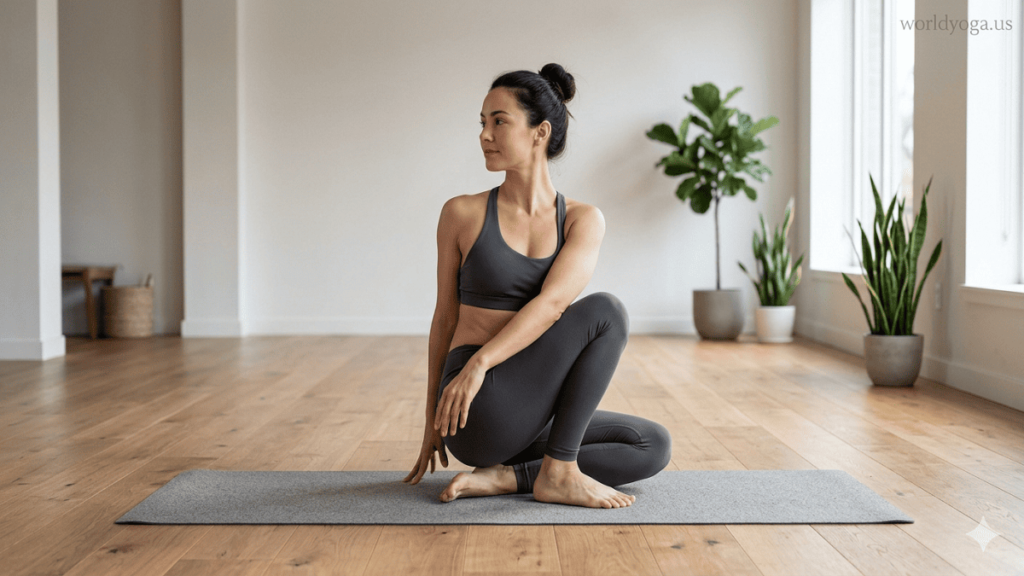
Easy Noose Pose is a gentler, modified version of Pasasana (Noose Pose) designed to make the traditional deep twisting squat more accessible. While the classical posture involves a full squat with a bound twist and arm wrap, the “easy” variation reduces intensity by lowering depth requirements and simplifying the bind, making it suitable for beginners or individuals with limited mobility.
To perform Easy Noose Pose, begin in a comfortable standing position. Slowly transition into a partial squat rather than a full deep squat. The feet should remain flat or supported, slightly wider than hip-width apart. Instead of forcing a full heel-down squat, you may use a folded blanket or yoga block under the heels or hips for stability.
Once stable, initiate a gentle spinal twist toward one side. The opposite arm reaches across the body while the back arm may rest on the thigh, knee, or lightly wrap around the back depending on flexibility. Unlike the traditional Pasasana, there is no requirement for a deep bind or full arm wrap around the legs. The focus is on controlled rotation rather than intensity.
The spine should remain elongated throughout the twist, avoiding collapse or rounding. The chest should stay open, and the gaze can follow the direction of the twist if comfortable for the neck. Breathing is essential—inhale to lengthen the spine and exhale to gently deepen the rotation.
This variation primarily targets the spinal rotators, obliques, hips, and quadriceps, while also engaging the core stabilizers for balance. It helps improve spinal mobility, digestion-related movement, and postural awareness without placing excessive stress on the knees or lower back.
From a therapeutic perspective, Easy Noose Pose is often used in preparatory yoga sequences to build the flexibility required for deeper twisting postures like Pasasana. It is particularly beneficial for beginners, older adults, or individuals recovering from stiffness in the spine and hips.
Precautions include avoiding excessive twisting in the lumbar spine, not forcing the squat depth, and ensuring knee alignment remains stable to prevent joint strain. Individuals with spinal injuries or severe disc issues should practice only under guidance.
For reference on the traditional posture and its mechanics, you can review Yoga Journal – Pasasana (Noose Pose) Guide and anatomical context at Pasasana Overview.
In summary, Easy Noose Pose is a simplified twisting squat that builds spinal mobility, core strength, and joint awareness while reducing the intensity of the traditional bound posture, making it more accessible and safer for gradual progression.
#Easy Noose Pose in India
How is Easy Noose Pose performed correctly?
Easy Noose Pose is a modified version of Pasasana (Noose Pose) designed to introduce spinal twisting and squat mechanics in a safer, more accessible way. Correct performance depends on controlled movement, stable support, and proper spinal alignment rather than depth or intensity.
To begin, stand tall with feet slightly wider than hip-width apart. Slowly lower into a partial squat, not a full deep squat. The hips should descend only as far as is comfortable while keeping the spine long. If balance or ankle flexibility is limited, a yoga block or folded blanket can be placed under the heels or hips for support.
Once stable in the squat, ensure that the knees track in line with the toes and do not collapse inward. The weight should be evenly distributed across both feet to maintain balance.
Next, initiate a gentle spinal twist. Turn the torso to one side while keeping the hips as stable as possible. One arm reaches across the front of the body, while the opposite arm moves behind the back or rests on the outer thigh, depending on flexibility. In this simplified version, a full arm bind is not required. The focus is on rotation, not depth of the bind.
The spine should remain long and upright, avoiding rounding or collapsing forward. The chest stays open, and the shoulders remain relaxed rather than forced into position. The neck follows the twist only if comfortable, without strain.
Breathing plays an important role in maintaining correct form. Inhale to lengthen the spine and create space between vertebrae. Exhale slowly to gently deepen the twist without forcing it. The movement should feel smooth and controlled, not abrupt or strained.
Common alignment mistakes include twisting from the lower back only, collapsing the chest, forcing a deep squat, or overreaching the arms. Instead, the rotation should originate evenly from the thoracic spine with support from the core muscles.
Muscular engagement includes the obliques and spinal rotators for twisting, the quadriceps and glutes for squat stability, and the core stabilizers for balance control. The shoulders and upper back remain active but relaxed.
For foundational understanding of the full posture, refer to detailed guidance on Pasasana at Yoga Journal – Noose Pose (Pasasana) Guide and anatomical reference at Pasasana Overview.
In summary, Easy Noose Pose is performed correctly when the practitioner maintains a supported partial squat, performs a controlled spinal twist, keeps the spine elongated, and avoids forcing depth or binding.
#Easy Noose Pose in Maharashtra
What is the proper alignment in this variation?
Proper alignment in Easy Noose Pose focuses on maintaining spinal integrity, stable lower-body positioning, and a controlled, non-forced twist. Since this is a modified version of Pasasana (Noose Pose), the emphasis is on accessibility and safety rather than depth or binding.
1. Lower body alignment
The foundation begins with the legs. The feet should be placed slightly wider than hip-width apart, with toes pointing forward or slightly outward depending on natural hip structure. The knees must track in line with the toes and remain stable, avoiding inward collapse.
Instead of a full squat, the hips lower only into a partial squat, allowing the heels to stay grounded or supported. If balance is difficult, a yoga block or folded blanket can be placed under the hips or heels. Weight should be evenly distributed across both feet to maintain stability and prevent strain on the knees.
2. Pelvis and spine alignment
The pelvis should remain neutral—not excessively tucked or arched. The spine is kept long and upright, extending from the tailbone to the crown of the head. A common mistake is rounding the lower back during the twist, which should be avoided. The goal is axial length before rotation.
The twist originates from the mid and upper spine (thoracic region), not just the lower back. This ensures safe rotational movement without compressing the lumbar region.
3. Upper body and shoulder alignment
As the twist is introduced, one arm reaches across the body while the opposite arm moves behind or rests gently on the leg or lower back. In this simplified variation, there is no requirement for a full bind or arm wrap.
The shoulders should remain relaxed and level, avoiding elevation toward the ears. The chest stays open rather than collapsed inward, supporting proper breathing and spinal extension.
4. Neck and head alignment
The neck follows the natural line of the spine. The gaze may turn slightly in the direction of the twist if comfortable, but there should be no strain or forced rotation in the cervical spine.
5. Core and breath engagement
The core muscles (abdominals and obliques) should be gently engaged to support the twist and maintain balance. Breathing is essential: inhale to lengthen the spine, exhale to deepen the rotation without forcing it.
6. Key alignment principles summary
- Stable partial squat, not forced depth
- Knees aligned with toes
- Neutral pelvis and elongated spine
- Twist initiated from thoracic spine
- Relaxed shoulders, open chest
- No forced binding
- Smooth, controlled breathing
For reference on the traditional posture and alignment principles, see Yoga Journal – Noose Pose (Pasasana) Guide and anatomical overview at Pasasana Overview.
In summary, proper alignment in Easy Noose Pose is achieved when the body maintains a stable base, a lengthened spine, and a gentle, controlled twist without compromising joint safety or posture integrity.
#Easy Noose Pose in Ahemadabad

Which muscles are engaged during the posture?
Easy Noose Pose is a modified twisting squat based on Pasasana (Noose Pose). Even in its simplified form, it activates multiple muscle groups across the lower body, core, and upper body due to the combined demands of squatting, stabilization, and spinal rotation.
1. Lower body muscles
The lower body provides the base of support in the partial squat position.
- Quadriceps: Actively engaged to control knee flexion and maintain stability in the squat position.
- Gluteus maximus and medius: Support hip stability and help control pelvic alignment during the twist.
- Hamstrings: Assist in controlling descent into the squat and maintaining balance.
- Adductor muscles (inner thighs): Stabilize the legs and help prevent the knees from collapsing inward.
- Calf muscles (gastrocnemius and soleus): Engage isometrically to support ankle stability, especially if heels remain grounded.
2. Core and spinal muscles
The twist component significantly activates the core musculature.
- Obliques (internal and external): Primary muscles responsible for spinal rotation and controlled twisting.
- Rectus abdominis: Supports trunk stability and prevents excessive arching or collapsing of the spine.
- Transverse abdominis: Provides deep core stabilization, helping maintain balance during rotation.
- Erector spinae: Supports spinal extension and helps maintain an upright posture while twisting.
These muscles work together to ensure the twist originates safely from the thoracic spine rather than overloading the lower back.
3. Upper body muscles
Even in the simplified version (without full binding), the upper body remains engaged for control and positioning.
- Deltoids: Assist in arm positioning and controlled reach across or behind the body.
- Trapezius and rhomboids: Stabilize the shoulder blades and maintain upper-back posture.
- Latissimus dorsi: Provides support during rotational movement and arm extension.
- Forearm muscles: Lightly engaged depending on hand placement (thigh, floor, or behind back).
4. Stabilizing and supporting muscles
- Foot intrinsic muscles: Help maintain balance and grounding through the feet.
- Hip stabilizers: Coordinate pelvic control during rotation and squatting.
- Deep spinal stabilizers (multifidus): Assist in segmental spinal control during twisting.
Functional summary
Easy Noose Pose is a multi-muscle integration posture, combining:
- Lower-body isometric strength (squat control)
- Core rotational strength (twisting stability)
- Upper-body postural engagement (alignment and balance)
This coordinated activation improves functional movement efficiency, spinal mobility, and joint stability.
For foundational reference on the full posture and its biomechanics, see Yoga Journal – Noose Pose (Pasasana) Guide and anatomical context at Pasasana Overview.
In summary, Easy Noose Pose engages a full-body network of stabilizing, rotational, and supporting muscles, with emphasis on the core and lower body for safe and controlled movement.
#Easy Noose Pose in Hyderabad
What preparatory poses are recommended?
Easy Noose Pose is a gentle introduction to Pasasana (Noose Pose), combining a partial squat with a controlled spinal twist. To perform it safely and effectively, the body should be prepared through targeted mobility and strengthening exercises for the hips, spine, ankles, and shoulders.
1. Hip-opening preparatory poses
Since Easy Noose Pose requires a stable squat position, hip mobility is essential.
- Malasana (Garland Pose) with support: Builds familiarity with squatting mechanics while reducing strain on knees and ankles.
- Bound Angle Pose (Baddha Konasana): Opens the inner thighs and improves external hip rotation.
- Low Lunge (Anjaneyasana): Stretches hip flexors and improves pelvic mobility for easier squatting and twisting.
These poses help reduce tightness in the groin and hips, which is crucial for safe squat depth.
Reference for foundational squat mechanics: Yoga Journal – Garland Pose Guide
2. Spinal twisting preparatory poses
Twisting mobility is essential for proper execution of the pose.
- Seated Spinal Twist (Ardha Matsyendrasana): Develops controlled thoracic rotation.
- Supine Twist (Supta Matsyendrasana): Gently releases tension in the spine without load.
- Cat-Cow Pose (Marjaryasana–Bitilasana): Improves segmental spinal mobility and awareness.
These poses help ensure the twist comes from the mid-spine rather than the lower back.
3. Ankle and lower-body mobility
Stable squatting requires flexible ankles and strong leg engagement.
- Heel lifts and calf stretches: Improve dorsiflexion and reduce heel lift during squats.
- Downward-Facing Dog (Adho Mukha Svanasana): Stretches calves and hamstrings.
- Supported squat holds: Train endurance in the quadriceps and glutes for deeper squat control.
4. Core strengthening preparatory poses
Core stability is essential for safe twisting and balance.
- Plank Pose (Phalakasana): Builds overall core and shoulder stability.
- Boat Pose (Navasana): Strengthens abdominal control for spinal support.
- Bridge Pose (Setu Bandhasana): Activates posterior chain and pelvic stability.
A strong core ensures the twist remains controlled and does not strain the lower back.
5. Shoulder and upper-body preparation
Since the pose includes arm positioning across the body, shoulder mobility is important.
- Eagle Arms (Garudasana arms): Improves scapular mobility and upper-back flexibility.
- Thread the Needle Pose: Releases tension in the posterior shoulder.
- Arm circles and shoulder rolls: Improve joint readiness and circulation.
Conclusion
A well-rounded preparation for Easy Noose Pose includes hip opening, spinal twisting, ankle mobility, core strengthening, and shoulder activation. This progression ensures safe movement into the pose while improving stability and control.
#Easy Noose Pose in Delhi
What are the benefits and precautions of this pose?
Easy Noose Pose is a modified version of Pasasana (Noose Pose) that combines a partial squat with a gentle spinal twist. Because it reduces depth and removes the full bind, it is more accessible while still offering meaningful mobility and strength benefits. However, like all twisting squat variations, it requires careful attention to alignment and joint safety.
Benefits
1. Improved spinal mobility
The controlled twist helps increase thoracic spine rotation, improving overall spinal flexibility. This can support better posture and reduce stiffness caused by prolonged sitting.
2. Hip and lower-body flexibility
The partial squat position gently opens the hips, glutes, and adductors, improving functional movement patterns like bending and squatting. It also helps gradually build comfort in deeper squat positions.
Reference for squat mechanics and hip engagement: Yoga Journal – Noose Pose Guide
3. Core strengthening and stability
The twist activates the obliques, transverse abdominis, and spinal stabilizers, improving core control and balance. This helps protect the lower back during rotational movements.
4. Improved posture and alignment awareness
The pose encourages an upright spine and open chest, which can help counteract slouching and rounded shoulders from sedentary habits. The gentle twist also enhances body awareness and coordination.
5. Digestive stimulation and circulation
Twisting movements are traditionally associated with stimulating abdominal organs and improving circulation in the trunk, which may support digestive comfort and mobility.
Precautions
1. Knee strain risk
Individuals with knee injuries or instability should avoid deep squatting or use props for support. Misalignment (knees collapsing inward) can increase joint stress.
2. Lower back sensitivity
Avoid forcing the twist from the lumbar spine. Over-rotation or rounding the lower back can lead to discomfort or strain.
3. Hip or spinal conditions
People with hip impingement, herniated discs, or chronic back pain should practice only under supervision or use gentler alternatives like supine twists.
Reference on spinal structure and safety: Pasasana Overview
4. Balance limitations
Since the pose involves a partial squat, balance may be challenging for beginners. Using a wall or yoga block for support is recommended.
5. Shoulder overreach
Forcing the arm wrap or excessive reach can strain the shoulders and upper back. The movement should remain relaxed and non-binding in this variation.
Safe practice guidelines
- Use props (blocks or folded blankets) if needed
- Keep spine long before twisting
- Move slowly with breath control
- Avoid depth over comfort
- Focus on controlled rotation, not intensity
Conclusion
Easy Noose Pose offers a safe introduction to twisting squat mechanics, improving spinal mobility, hip flexibility, and core stability. When practiced with proper alignment and modifications, it becomes a valuable preparatory posture for deeper yoga twists while minimizing injury risk.
#Easy Noose Pose in Pune
Case Study of Easy Noose Pose
1. Background
This case study examines the application of Easy Noose Pose, a modified version of Pasasana (Noose Pose), within a beginner-level mobility and corrective movement program. The subject is a 38-year-old desk-based professional experiencing reduced spinal mobility, hip stiffness, and limited squatting ability due to prolonged sitting (8–9 hours daily). The primary goal was to improve spinal rotation, lower-body flexibility, and core stability over a 6-week structured intervention.
Reference for traditional posture mechanics: Yoga Journal – Noose Pose (Pasasana) Guide
2. Initial Assessment
At baseline, the subject demonstrated:
- Limited thoracic spine rotation
- Tight hip flexors and adductors
- Difficulty maintaining a stable squat position
- Weak core engagement during rotational movement
- Mild discomfort in lower back during twisting actions
The subject was unable to perform full Pasasana safely, making a simplified variation necessary.
3. Intervention Protocol
A progressive movement plan was introduced:
Weeks 1–2: Foundational Mobility
- Cat-Cow (spinal articulation training)
- Supine spinal twist for safe rotation
- Supported squat holds using a chair
Weeks 3–4: Assisted Integration
- Partial squat practice with block support
- Gentle seated spinal twists (Ardha Matsyendrasana)
- Core activation drills (plank holds and breathing control)
Weeks 5–6: Easy Noose Pose Introduction
- Partial squat with stable foot grounding
- Controlled spinal twist without deep binding
- Arm placement across body or light support on thigh
- Emphasis on breath-led rotation and spinal elongation
Reference on anatomical structure and alignment principles: Pasasana Overview
4. Observations and Outcomes
After 6 weeks, the following improvements were recorded:
- Spinal mobility increased significantly, with improved ability to rotate both sides without discomfort
- Hip flexibility improved, allowing deeper and more stable squat positioning
- Core activation improved, resulting in better postural control during seated work
- Reduced lower back stiffness, especially after prolonged sitting
- Improved movement confidence, particularly in twisting and bending actions
The subject reported that Easy Noose Pose felt more accessible and less intimidating compared to traditional twisting squats.
5. Discussion
The case highlights the effectiveness of Easy Noose Pose as a progressive regression tool for individuals unable to perform full Pasasana. By removing deep squat and binding requirements, the variation allows safe introduction of spinal rotation and lower-body engagement without excessive joint stress.
The structured progression—from supine twists to supported squats—was critical in preventing strain and ensuring neuromuscular adaptation.
6. Conclusion
Easy Noose Pose proved to be an effective transitional posture for improving spinal rotation, hip mobility, and core stability in a sedentary individual. When introduced progressively and with proper alignment, it serves as a safe bridge toward more advanced twisting squat postures while reducing injury risk and improving functional movement capacity.
#Easy Noose Pose in Banglore
White Paper of Easy Noose Pose
1. Executive Summary
Easy Noose Pose is a modified, accessible variation of Pasasana (Noose Pose) designed to introduce spinal twisting and squat mechanics with reduced joint load and simplified alignment demands. It is primarily used in beginner yoga, mobility training, and rehabilitation contexts. This white paper outlines its biomechanics, functional benefits, applications, and safety considerations for structured movement practice.
2. Background and Context
Traditional Pasasana is an advanced twisting squat requiring deep knee flexion, ankle mobility, and a full arm bind. Due to its intensity, many practitioners are unable to perform it safely without progression. Easy Noose Pose was developed as a scaled variation that removes binding complexity and reduces squat depth while preserving the core rotational movement pattern.
The foundational posture is documented in yoga literature as a deep spinal twist integrated with squat mechanics Yoga Journal – Noose Pose Guide and anatomically classified under twisting squat biomechanics Pasasana Overview.
3. Biomechanical Analysis
Easy Noose Pose involves coordinated multi-joint engagement:
- Lower body: Quadriceps control knee flexion in a partial squat; gluteus maximus stabilizes hip position; adductors maintain knee alignment; calves assist ankle stabilization.
- Core system: Obliques and transverse abdominis generate controlled spinal rotation and trunk stability; erector spinae maintains upright posture.
- Upper body: Deltoids and trapezius assist in arm positioning; scapular stabilizers maintain shoulder alignment during rotational movement.
The movement functions as a low-load rotational squat pattern, emphasizing control rather than depth.
4. Functional Benefits
4.1 Spinal Mobility
Improves thoracic rotation and segmental spinal movement, supporting better posture and reduced stiffness from sedentary behavior.
4.2 Hip and Lower-Body Flexibility
Enhances hip external rotation and adductor flexibility through controlled squat positioning.
4.3 Core Stability
Strengthens deep abdominal muscles responsible for trunk control during rotation and functional movement.
4.4 Postural Re-education
Encourages upright alignment and scapular awareness, reducing rounded shoulder posture.
4.5 Movement Accessibility
Provides a safe entry point for beginners unable to perform full twisting squat postures.
5. Applications
Easy Noose Pose is widely applied in:
- Beginner yoga sequencing and progression systems
- Physical therapy and corrective movement programs
- Workplace mobility and sedentary recovery routines
- Athletic warm-up and rotational mobility drills
Its reduced complexity makes it suitable for populations with limited mobility or joint sensitivity.
6. Risk Factors and Precautions
Despite its accessibility, certain precautions are necessary:
- Avoid excessive lumbar twisting to prevent lower-back strain
- Do not force squat depth beyond comfort level
- Maintain knee alignment to prevent joint stress
- Use props for stability when balance is limited
- Avoid in acute spinal or knee injuries without professional guidance
7. Methodological Progression
A structured approach is recommended:
- Supine and seated spinal twists
- Supported squat holds
- Partial squat with controlled rotation
- Full Easy Noose Pose integration
This progression ensures neuromuscular adaptation and joint safety.
8. Conclusion
Easy Noose Pose is a scalable functional movement that bridges the gap between basic mobility work and advanced twisting squat postures. It enhances spinal rotation, hip flexibility, and core stability while maintaining a low-risk profile. When integrated progressively, it serves as an effective preparatory and rehabilitative tool within yoga, fitness, and therapeutic movement systems.
#Easy Noose Pose in Kolkata
Industry Application of Easy Noose Pose
Easy Noose Pose, a modified form of Pasasana (Noose Pose), is increasingly used across multiple industries that focus on mobility, rehabilitation, posture correction, and functional movement training. Its value comes from combining a partial squat with controlled spinal rotation, making it adaptable for beginners and individuals with movement limitations.
1. Fitness and Functional Training Industry
In fitness systems, Easy Noose Pose is used as a foundational mobility and activation drill.
- Prepares the body for deeper squatting and twisting movements
- Improves thoracic rotation and hip stability
- Used in warm-ups, cooldowns, and corrective exercise circuits
- Helps develop coordination between lower body stability and core rotation
Fitness professionals use it as a regression tool before progressing clients toward advanced movements like full twisting squats or loaded rotational exercises.
2. Physiotherapy and Rehabilitation
In rehabilitation environments, Easy Noose Pose is applied as a low-load mobility restoration exercise.
- Supports recovery of spinal rotation after stiffness or sedentary habits
- Helps restore hip flexibility without deep joint compression
- Used in early-stage functional rehabilitation programs
- Assists in retraining safe movement patterns for bending and twisting
Its simplified structure makes it suitable for controlled therapeutic progression when full Pasasana is not appropriate.
Reference on foundational posture mechanics: Yoga Journal – Noose Pose Guide
3. Sports Performance and Athletic Training
Athletes use Easy Noose Pose as part of mobility and injury-prevention systems.
- Enhances rotational mobility for sports requiring twisting (e.g., cricket, tennis, martial arts)
- Improves core stability during directional changes
- Supports hip and spinal coordination under dynamic conditions
- Reduces stiffness from repetitive training loads
It is commonly integrated into warm-up routines and movement preparation sequences.
4. Corporate Wellness and Occupational Health
In workplace wellness programs, Easy Noose Pose is used to counteract sedentary lifestyle effects.
- Reduces stiffness from prolonged sitting
- Improves spinal mobility and posture awareness
- Can be performed in short movement breaks without equipment
- Supports stress relief through controlled breathing and movement
This aligns with ergonomic health strategies aimed at reducing musculoskeletal strain in office environments.
5. Yoga and Mind-Body Training Industry
Within yoga systems, Easy Noose Pose is used as a progression and preparatory posture.
- Bridges basic mobility poses and advanced twisting squats
- Builds confidence for deeper poses like Pasasana
- Enhances body awareness and controlled movement flow
- Supports safe sequencing in beginner-to-intermediate classes
Its alignment principles remain consistent with traditional twisting squat mechanics Pasasana Overview
Conclusion
Easy Noose Pose has strong cross-industry relevance due to its adaptability and low-risk structure. It is widely used in fitness, rehabilitation, sports performance, corporate wellness, and yoga training systems. Its ability to safely develop spinal rotation, hip mobility, and core stability makes it a valuable foundational movement for improving functional human biomechanics across populations.
#Easy Noose Pose in Mumbai
Ask FAQs
What is Easy Noose Pose?
Easy Noose Pose is a beginner-friendly variation of Pasasana (Noose Pose) that combines a partial squat with a gentle spinal twist. Unlike the traditional version, it does not require a deep squat or full arm binding, making it safer and more accessible for beginners and individuals with limited mobility.
Who can practice Easy Noose Pose?
It is suitable for beginners, office workers with stiffness, and individuals recovering mobility in the hips or spine. It is also commonly used in yoga foundations and rehabilitation programs. However, people with severe knee, hip, or spinal injuries should consult a healthcare professional before practicing.
What are the main benefits of this pose?
Easy Noose Pose improves spinal rotation, enhances hip flexibility, strengthens the core, and supports better posture. It also helps reduce stiffness caused by prolonged sitting and improves coordination between the upper and lower body through controlled twisting movements.
What are common mistakes to avoid?
Common mistakes include forcing a deep squat, twisting only from the lower back, collapsing the chest, and misaligning the knees inward. Overreaching the arms or straining the shoulders can also reduce safety. The movement should always be slow, controlled, and pain-free.
How should beginners modify this pose safely?
Beginners can perform a partial squat using a yoga block or chair for support. The twist should be gentle, with no requirement for a full arm bind. Keeping the spine upright and focusing on breath control helps maintain stability and prevents strain.
Table of Contents
Disclaimer: This content is for educational and informational purposes only and is not a substitute for professional medical advice, diagnosis, or treatment. Practice Easy Noose Pose only within your comfort and mobility limits. Consult a qualified healthcare professional or certified yoga instructor before attempting this pose, especially if you have existing injuries or medical conditions.