
Backbend: Forearms on the Floor, Bound Hands
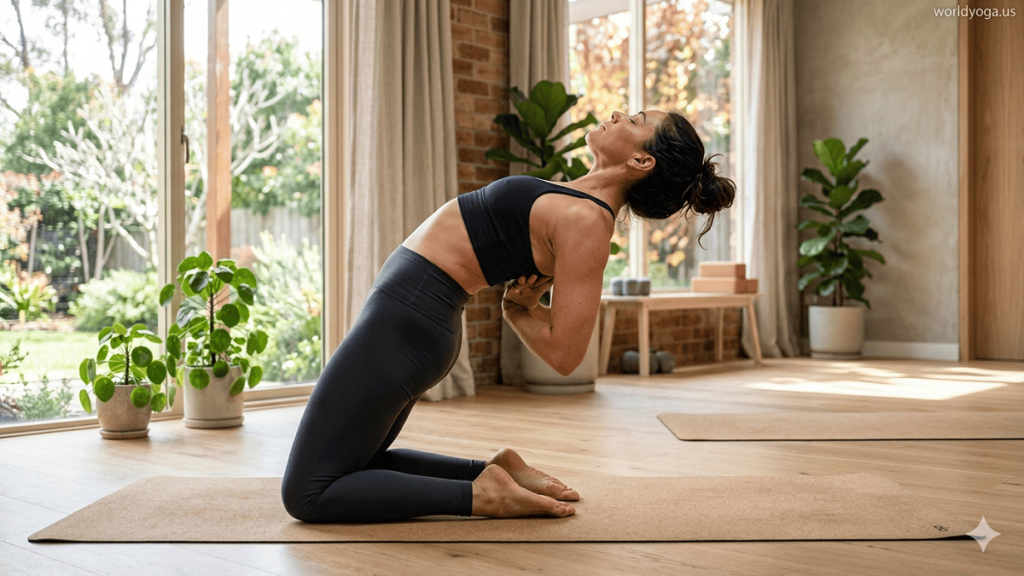
Backbend: Forearms on the Floor, Bound Hands is an advanced variation of a reclined backbend derived from Paryankasana, emphasizing deeper chest opening, shoulder flexibility, and controlled spinal extension. This variation introduces an arm bind, increasing the intensity of the posture while requiring greater awareness of alignment and stability.
Overview
In this variation, the practitioner begins in a kneeling position similar to Vajrasana and gradually reclines backward. Instead of fully resting on the floor, the body is supported on the forearms, creating a lifted chest and a more active backbend. The hands are then bound—either by clasping opposite elbows or interlacing fingers beneath the head or upper back—depending on flexibility.
Key Elements of the Pose
- Forearm Support:
The forearms press firmly into the ground, helping to lift the chest and distribute weight evenly. This reduces strain on the lower back and enhances stability. - Bound Hands:
Binding the hands increases the stretch across the shoulders, chest, and upper arms. It also encourages better posture by drawing the shoulder blades inward. - Spinal Extension:
The backbend should be evenly distributed along the spine, with emphasis on opening the chest rather than compressing the lumbar region. - Knee and Leg Position:
Knees remain together and grounded, maintaining alignment and protecting the joints.
Benefits
- Deepens the stretch in the chest, shoulders, and hip flexors
- Strengthens the arms, shoulders, and upper back
- Improves spinal flexibility and posture
- Enhances breathing capacity through chest expansion
- Builds body awareness and control in advanced backbends
Safety Considerations
This variation is more demanding than the traditional pose and should be attempted only after mastering basic backbends. Avoid forcing the bind if shoulder mobility is limited. Individuals with knee, shoulder, or lower back issues should practice with caution or under professional guidance.
Conclusion
Backbend with forearms on the floor and bound hands is a powerful progression of Paryankasana that combines strength, flexibility, and balance. When practiced mindfully, it offers enhanced physical benefits while deepening one’s overall yoga practice.
#Backbend: Forearms on the Floor, Bound Hands in India
What is this forearm-supported bound backbend?
The forearm-supported bound backbend is an advanced yoga posture derived from Paryankasana, where the body is reclined backward while being supported on the forearms, and the hands are bound to deepen the stretch and engagement.
In this variation, the practitioner typically begins in a kneeling position similar to Vajrasana. Instead of lowering fully onto the back, the torso is held above the ground with the forearms pressing into the floor. This creates a lifted, active backbend rather than a passive recline. The chest opens upward, and the spine extends in a controlled arch.
The defining feature of this posture is the hand bind. The practitioner may clasp opposite elbows, interlace fingers, or hold the upper arms behind the head or back. This binding action increases the stretch across the shoulders, chest, and upper arms while encouraging the shoulder blades to draw inward, enhancing posture and stability.
Unlike basic reclining poses, this variation requires greater strength and flexibility. The forearms provide structural support, engaging the arms and shoulders, while the core helps stabilize the spine. At the same time, the knees remain grounded and close together, ensuring proper alignment and protecting the joints.
Overall, the forearm-supported bound backbend is a dynamic and controlled posture that combines elements of strength, flexibility, and balance. It is typically practiced by intermediate to advanced practitioners looking to deepen their backbending practice and improve chest opening, spinal mobility, and upper-body engagement.
#Backbend: Forearms on the Floor, Bound Hands in Maharashtra
How is the pose performed step by step?
1. Begin in a Stable Base
Start seated in Vajrasana with knees together and feet tucked under the hips. Keep your spine upright and shoulders relaxed.
2. Prepare with Breath and Alignment
Place your hands on your thighs and take a few slow, deep breaths. Engage your core slightly and lengthen your spine to prepare for the backbend.
3. Lean Back with Support
Gently lean your torso backward. Place your hands on the floor behind you for initial support. Keep your knees grounded and close together.
4. Lower Onto the Forearms
Carefully bend your elbows and lower your body onto your forearms. Position your elbows shoulder-width apart, pressing firmly into the ground. This creates a stable base and lifts the chest upward.
5. Lift and Open the Chest
Press through your forearms to elevate your chest and create a smooth arch along the spine. Focus on opening the chest rather than collapsing into the lower back.
6. Add the Hand Bind
Once stable, bring your arms into a bind:
- Clasp opposite elbows, or
- Interlace your fingers behind the head or upper back
Choose a bind that feels accessible without strain. Keep the shoulders drawing inward to enhance the stretch.
7. Maintain the Pose
Hold the position for 15–30 seconds. Breathe slowly and evenly, keeping the neck relaxed and the knees grounded. Maintain steady engagement in the arms and core.
8. Release the Bind
Gently release your hands and place them back on the floor for support.
9. Return to Upright
Press into your forearms and hands to lift your torso gradually. Come back to a seated position in Vajrasana with control.
10. Rest and Neutralize
Sit upright or move into a neutral pose to relax the spine and normalize your breathing.
Important Tips
- Move slowly and avoid forcing the backbend
- Keep the knees together to protect the joints
- Use a cushion under the forearms if needed
- Stop immediately if you feel pain in the knees, shoulders, or lower back
#Backbend: Forearms on the Floor, Bound Hands in Delhi

What strength and flexibility are required?
1. Flexibility Requirements
a. Quadriceps and Hip Flexors
Deep flexibility in the front thighs and hip flexors is essential. Since the legs remain folded as in Vajrasana, tightness here can pull the pelvis out of alignment and increase pressure on the knees.
b. Thoracic Spine (Upper Back)
Adequate extension in the thoracic spine allows the chest to open fully. Limited mobility in this area often leads to overcompensation in the lower back, increasing injury risk.
c. Shoulders and Chest
The bound-hand position requires open shoulders and chest. Flexibility in the deltoids, pectorals, and upper arms is necessary to comfortably clasp the arms without strain.
d. Ankles and Knees
The ankles must allow full plantar flexion (tops of the feet on the floor), and the knees must tolerate deep flexion. Restricted mobility can lead to discomfort or instability.
2. Strength Requirements
a. Arms and Forearms
Strong forearms and triceps are critical, as they support body weight and help lift the chest. Without sufficient strength, the pose may collapse into the lower back.
b. Core Muscles
The abdominal muscles stabilize the spine and prevent excessive compression in the lumbar region. A weak core can lead to poor control and misalignment.
c. Back Muscles
The erector spinae and upper back muscles help maintain the arch and keep the chest lifted. Strength here ensures the backbend is evenly distributed.
d. Shoulder Stabilizers
Muscles around the shoulder blades (such as the rhomboids and trapezius) are engaged to support the bind and maintain proper shoulder alignment.
3. Balance Between Strength and Flexibility
This pose is not just about being flexible—it requires active engagement. Flexibility allows you to enter the position, while strength enables you to hold it safely and with control.
4. Signs You’re Ready for the Pose
- You can comfortably hold supported backbends without lower back strain
- Your thighs and hip flexors allow a deep kneeling position without pain
- You can support your weight on your forearms steadily
- You have sufficient shoulder mobility to attempt a gentle bind
#Backbend: Forearms on the Floor, Bound Hands in Ahemadabad
What are the benefits of this deep backbend?
1. Intensifies Chest and Shoulder Opening
The bound-hand position significantly increases the stretch across the chest, shoulders, and upper arms. This helps counteract rounded shoulders and tightness caused by prolonged sitting or screen use, promoting a more open and upright posture.
2. Improves Spinal Flexibility and Strength
By maintaining a lifted position on the forearms, the pose encourages active engagement of the back muscles. It enhances spinal mobility—especially in the thoracic region—while strengthening the muscles that support the spine, leading to better posture and reduced stiffness.
3. Strengthens Arms and Upper Body
Unlike passive backbends, this variation requires the forearms and shoulders to bear weight. This builds strength in the triceps, shoulders, and upper back, improving overall upper-body stability.
4. Deep Stretch for Hip Flexors and Thighs
Similar to practicing from Vajrasana, the legs remain folded, creating a strong stretch through the quadriceps and hip flexors. This is especially beneficial for those with tight hips due to sedentary lifestyles or athletic training.
5. Enhances Breathing Capacity
The lifted chest and expanded rib cage allow for deeper inhalation, improving lung capacity and respiratory efficiency. This can support pranayama practices and promote better oxygen flow throughout the body.
6. Develops Body Control and Awareness
Balancing strength and flexibility in this pose requires focus and coordination. It improves proprioception (body awareness) and teaches controlled movement, which is valuable for advancing in yoga practice.
7. Stimulates Energy and Reduces Fatigue
Backbends are often energizing. This deeper variation can help combat fatigue, increase alertness, and uplift mood by stimulating the nervous system.
8. Promotes Mental Focus and Calmness
Despite its intensity, maintaining steady breathing in the pose encourages concentration and mental clarity. Over time, it can contribute to stress reduction and emotional balance.
#Backbend: Forearms on the Floor, Bound Hands in Hyderabad
What common mistakes or safety risks should be avoided?
1. Forcing the Hand Bind
Trying to bind the hands without sufficient shoulder mobility is a common error. This can strain the shoulders, neck, or upper back. The bind should be gradual—use a partial bind or skip it entirely if it feels restrictive.
2. Collapsing into the Lower Back
Many practitioners rely too much on the lumbar spine instead of distributing the backbend evenly. This creates compression in the lower back and increases injury risk. The focus should be on lifting the chest and engaging the core.
3. Weak Forearm Support
If the forearms are not actively pressing into the ground, the body may sink, placing strain on the spine and knees. Strong, stable forearm engagement is essential to maintain lift and control.
4. Knee Strain from Poor Alignment
Since the pose begins in a position similar to Vajrasana, the knees are deeply flexed. Letting them spread apart or forcing the position can stress ligaments and joints. Keep the knees together and grounded.
5. Dropping Back Too Quickly
Moving into the pose without control can lead to sudden pressure on the spine and joints. Always lower gradually—hands to forearms—maintaining awareness throughout the movement.
6. Ignoring Pain Signals
Sharp or persistent pain in the knees, shoulders, or back is a clear warning. Continuing despite discomfort can worsen injuries. The pose should create a stretch, not pain.
7. Tight Thighs and Hip Flexors
Attempting the pose without adequate flexibility in the quadriceps and hip flexors pulls the pelvis out of alignment and increases strain on the knees and lower back.
8. Neck Misalignment
Letting the head hang unsupported or overextending the neck can cause strain. The neck should remain long and relaxed, with proper support if needed.
9. Skipping Warm-Up
Going directly into this deep backbend without preparing the body increases the risk of injury. Warm-up poses that open the thighs, hips, shoulders, and spine are essential.
10. Overholding the Pose
Staying too long in the posture can lead to fatigue and loss of alignment. It’s better to hold for a shorter duration with proper form than to push beyond your limits.
#Backbend: Forearms on the Floor, Bound Hands in Banglore
Case Study of Backbend: Forearms on the Floor, Bound Hands
Background
A 32-year-old yoga practitioner with an intermediate level of experience reported stiffness in the upper back, limited shoulder mobility, and mild postural imbalance due to prolonged desk work. The individual had prior experience with foundational backbends, including Paryankasana, but had not attempted advanced variations involving arm binds.
Objective
To evaluate the effects of a structured 8-week program incorporating the forearm-supported bound backbend on spinal flexibility, shoulder mobility, posture, and overall body awareness.
Methodology
Program Duration: 8 weeks
Frequency: 4 sessions per week (35–45 minutes each)
Phase 1 (Weeks 1–2): Preparation
- Focus on mobility drills for shoulders and thoracic spine
- Gentle quadriceps and hip flexor stretching
- Practice of foundational poses such as Vajrasana and supported backbends
Phase 2 (Weeks 3–5): Introduction to Forearm Support
- Gradual transition into forearm-supported backbends without binding
- Emphasis on chest lifting, core engagement, and controlled breathing
Phase 3 (Weeks 6–8): Incorporation of Hand Bind
- Introduction of partial binds (holding elbows) progressing to full bind
- Increased hold duration (20–30 seconds) with focus on alignment and stability
Observations and Results
1. Improved Shoulder Mobility
By week 6, the practitioner demonstrated increased range of motion in the shoulders, allowing a comfortable partial bind and eventual full bind without strain.
2. Enhanced Thoracic Extension
There was a noticeable improvement in upper back flexibility, with better chest opening and reduced reliance on the lower back.
3. Postural Correction
The subject showed reduced forward rounding of the shoulders and improved upright posture during daily activities.
4. Increased Strength and Stability
Forearm and upper-body strength improved, enabling better support and control in the pose.
5. Reduced Muscular Stiffness
The practitioner reported less stiffness in the back and hips, especially after long hours of sitting.
6. Improved Mind-Body Awareness
Greater control over breathing and alignment led to improved focus and safer execution of advanced poses.
Challenges
- Initial difficulty in maintaining stability on the forearms
- Mild discomfort in the knees during early stages, managed through props
- Gradual adaptation required for shoulder binding
#Backbend: Forearms on the Floor, Bound Hands in Kolkata
White Paper of Backbend: Forearms on the Floor, Bound Hands
Abstract
The forearm-supported bound backbend is an advanced yoga posture derived from Paryankasana. It integrates spinal extension, shoulder binding, and upper-body support to create a dynamic balance between flexibility and strength. This white paper explores its biomechanics, physiological benefits, safety considerations, and relevance in modern wellness and therapeutic practices.
1. Introduction
Backbends play a critical role in counteracting sedentary lifestyles and improving spinal health. This variation, performed from a kneeling base similar to Vajrasana, elevates the traditional reclining posture by introducing forearm support and a hand bind. The result is a more active and controlled backbend that requires greater muscular engagement and mobility.
2. Biomechanical Analysis
a. Joint Mechanics
- Knees: Deep flexion requires stability and tolerance in the joint structures
- Hips: Extension lengthens the hip flexors, particularly the iliopsoas
- Spine: Controlled extension distributed across the thoracic and lumbar regions
- Shoulders: Binding introduces extension and internal rotation demands
b. Muscle Engagement
- Primary Stretch: Quadriceps, hip flexors, chest, and shoulders
- Primary Activation: Forearms, triceps, erector spinae, and core stabilizers
The forearms act as a load-bearing base, reducing passive compression and promoting active lift through the chest.
3. Physiological Benefits
a. Musculoskeletal Enhancement
Improves flexibility in the front body while strengthening the posterior chain. It supports postural correction by opening the chest and aligning the spine.
b. Respiratory Efficiency
Chest expansion increases lung capacity and encourages deeper breathing patterns.
c. Neuromuscular Coordination
The combination of binding and balance enhances proprioception and motor control.
d. Circulatory and Digestive Support
The posture may stimulate blood flow and gently activate abdominal organs.
4. Applications Across Sectors
- Yoga and Fitness Industry: Advanced training for flexibility and strength
- Rehabilitation Programs: Modified use for posture correction and mobility improvement
- Corporate Wellness: Counteracts prolonged sitting and postural fatigue
- Athletic Conditioning: Enhances hip mobility and spinal resilience
5. Safety Considerations
- Avoid forcing the hand bind without adequate shoulder mobility
- Maintain even spinal distribution to prevent lumbar compression
- Keep knees aligned and grounded to reduce joint strain
- Use props (bolsters, cushions) for support when needed
- Not recommended for individuals with knee injuries, severe back pain, or shoulder instability
6. Limitations and Research Gaps
Scientific literature specifically addressing this variation is limited. Most insights are extrapolated from general studies on backbends and flexibility training. Further empirical research is needed to validate long-term therapeutic outcomes and quantify benefits.
7. Conclusion
The forearm-supported bound backbend represents a sophisticated integration of strength, flexibility, and control. As an evolution of traditional backbends like Paryankasana, it offers significant benefits for posture, mobility, and overall physical performance. With proper guidance and gradual progression, it can be a valuable addition to advanced yoga and wellness practices.
References and Further Reading
- Yoga Alliance – Yoga standards and resources: https://www.yogaalliance.org
- Hatha Yoga Pradipika – Classical yoga reference: https://www.sacred-texts.com/hin/hyp/index.htm
- Yoga Journal Asana Library: https://www.yogajournal.com
#Backbend: Forearms on the Floor, Bound Hands in Pune
Industry Application of Backbend: Forearms on the Floor, Bound Hands
1. Fitness and Yoga Industry
In yoga studios and fitness centers, this pose is used in advanced classes to develop spinal mobility and upper-body strength.
- Integrated into backbend sequences and mobility training
- Enhances shoulder flexibility and chest expansion
- Builds strength in forearms, shoulders, and core
It is particularly emphasized in advanced Hatha Yoga and flexibility-focused programs.
2. Rehabilitation and Physiotherapy
Modified versions of this posture are applied in therapeutic settings to address postural imbalances and mobility restrictions.
- Helps improve thoracic spine extension
- Assists in opening tight chest and shoulder muscles
- Supports gradual recovery from sedentary lifestyle-related stiffness
Physiotherapists often adapt the pose using props to ensure safety and controlled progression.
3. Corporate Wellness Programs
With the rise of desk-based work, organizations are incorporating yoga-based interventions to improve employee health.
- Counteracts forward head posture and rounded shoulders
- Reduces back and hip stiffness from prolonged sitting
- Promotes relaxation and stress management
This pose, when simplified, is included in guided sessions that often begin with foundational positions like Vajrasana.
4. Sports and Athletic Training
Athletes benefit from this deep backbend as part of mobility and recovery routines.
- Improves hip flexor and quadriceps flexibility
- Enhances spinal resilience and range of motion
- Supports better posture and movement efficiency
It is particularly useful for runners, cyclists, and strength athletes who experience tightness in the front body.
5. Mental Wellness and Mindfulness Programs
The posture’s chest-opening and breath-enhancing qualities make it valuable in stress-reduction programs.
- Encourages deeper breathing and relaxation
- Helps regulate the nervous system
- Supports mindfulness and body awareness practices
Wellness retreats and therapy-based programs often include such poses to promote holistic well-being.
6. Ergonomics and Lifestyle Coaching
Experts in ergonomics recommend yoga-based corrections to address the effects of sedentary habits.
- Improves posture awareness and spinal alignment
- Encourages regular stretching routines
- Helps clients adopt healthier movement patterns
Conclusion
The forearm-supported bound backbend demonstrates strong cross-industry applicability, from fitness and rehabilitation to corporate wellness and mental health programs. When adapted appropriately and practiced safely, it serves as a powerful tool for improving physical performance, reducing lifestyle-related discomfort, and enhancing overall well-being.
#Backbend: Forearms on the Floor, Bound Hands in Mumbai
Ask FAQs
What is the forearm-supported bound backbend?
It is an advanced yoga posture derived from Paryankasana, where the body is supported on the forearms while the hands are bound. This creates a deeper chest opening and a more active, controlled backbend.
Who can practice this pose?
This pose is best suited for intermediate to advanced practitioners who already have good flexibility in the thighs, spine, and shoulders. Beginners should first master foundational poses like Vajrasana and basic backbends before attempting it.
What are the main benefits of this variation?
The pose improves spinal flexibility, strengthens the arms and upper body, and deeply stretches the chest, shoulders, and hip flexors. It also enhances posture and supports better breathing capacity.
Is it safe for people with injuries?
Individuals with knee, shoulder, or lower back injuries should avoid this pose or practice only under professional guidance. Modifications and props can be used to reduce strain and improve safety.
What are the most common mistakes to avoid?
Common mistakes include forcing the hand bind, collapsing into the lower back, and not engaging the forearms properly. Maintaining alignment, moving slowly, and respecting physical limits are essential for safe practice.
Table of Contents
Desclaimer:
This content is for informational purposes only and is not a substitute for professional medical or fitness advice. Practice the forearm-supported bound backbend under proper guidance, especially if you have existing injuries or health conditions. Always listen to your body and avoid pushing beyond your limits.