
Backbend: Forearms on the Floor, Heels Down
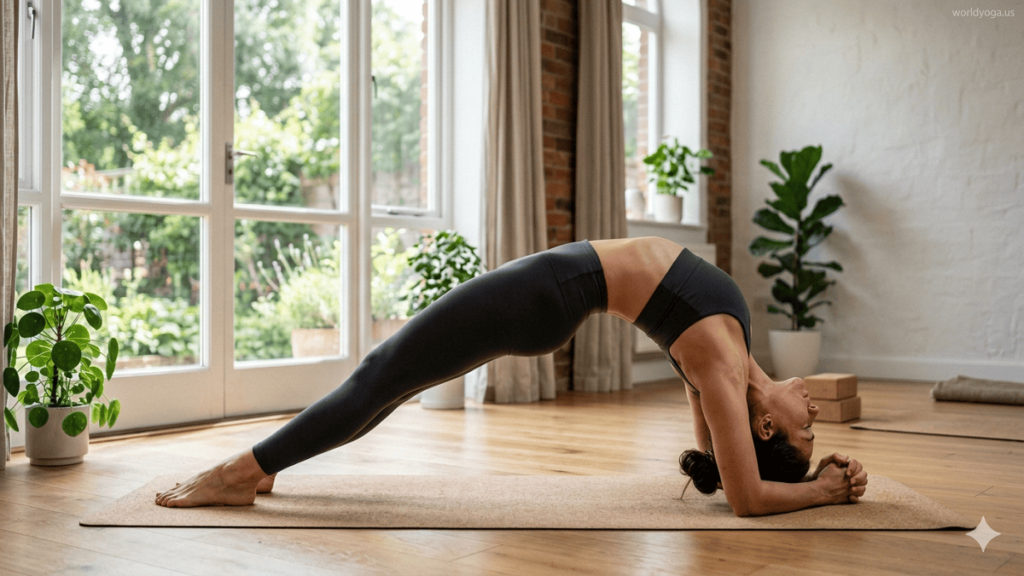
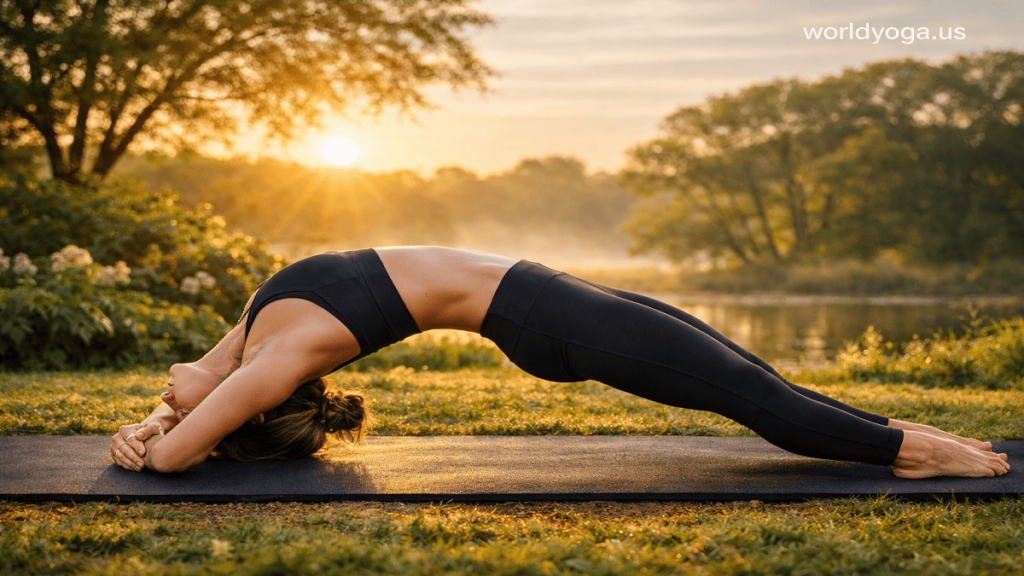
Backbend: Forearms on the Floor, Heels Down is a grounded, stability-focused backbend variation in Hatha Yoga where the practitioner maintains forearm support while keeping the heels actively pressing toward or touching the floor. This modification emphasizes lower-body engagement and spinal control rather than deep collapse into flexibility.
In this posture, the body typically begins from a kneeling or semi-reclined position similar to Paryankasana. As the practitioner lowers backward, the forearms are placed firmly on the floor to create a stable base. Unlike deeper reclined variations, the legs are extended with the feet actively engaged, and the heels are directed downward to maintain length through the back line of the body.
The key distinguishing feature is the active heel grounding, which introduces a strong engagement of the posterior chain. The calves, hamstrings, and glutes remain active, helping stabilize the pelvis and preventing excessive compression in the lower back. This makes the pose more strength-oriented compared to fully passive backbends.
The forearms continue to provide essential support, lifting the chest and distributing weight evenly across the upper body. This encourages a controlled spinal extension, primarily in the thoracic region, while maintaining safety in the lumbar spine. The shoulders remain open, and the chest is gently lifted to support improved breathing capacity.
From a functional perspective, this variation helps improve postural alignment, lower-body strength, and spinal awareness. It is often used as a preparatory or conditioning pose for deeper backbends because it teaches practitioners how to maintain active engagement rather than relying solely on flexibility.
However, proper alignment is crucial. The heels should not be forced flat if flexibility is limited, and the lower back should not be compressed. Practitioners should focus on lengthening through the spine and keeping the breath steady.
#Backbend: Forearms on the Floor, Heels Down in India
What is this forearm-supported backbend with heels grounded?
The forearm-supported backbend with heels grounded is a modified yoga backbend where the practitioner uses the forearms for support while actively keeping the heels pressing toward or resting on the floor. It is a more strength-oriented variation of deep backbending practices derived from Paryankasana.
In this posture, the body is typically set up from a kneeling or semi-reclined base similar to Vajrasana before transitioning into a backbend. The forearms are placed firmly on the ground, creating a stable foundation that helps lift and support the chest. Instead of allowing the legs to remain folded, the practitioner extends or partially extends them so that the heels actively move downward or stay grounded.
The defining characteristic of this variation is the active engagement of the legs through the heels. This grounding action lengthens the posterior chain of the body—calves, hamstrings, and glutes—while also stabilizing the pelvis. Unlike passive backbends where the body relaxes deeply into the spine, this version requires continuous muscular activation.
At the same time, the forearms help distribute weight and reduce pressure on the lower back. The chest is lifted upward, encouraging thoracic extension, while the spine maintains a controlled and even arch. The neck remains relaxed and neutral.
This variation is often considered a preparatory or conditioning backbend, helping practitioners build strength and control before attempting deeper or more flexible poses. It emphasizes alignment, stability, and active engagement rather than maximum range of motion.
#Backbend: Forearms on the Floor, Heels Down in Maharashtra
How is the pose performed step by step?
1. Start in a Kneeling Base
Begin in Vajrasana with knees together, spine upright, and hands resting on the thighs. Take a few steady breaths to center your body.
2. Engage the Core and Lengthen the Spine
Gently activate your abdominal muscles and elongate your spine upward. This prepares the body for a controlled backbend without collapsing into the lower back.
3. Lean Back Slowly with Support
Place your hands behind you on the floor and begin leaning backward in a controlled motion. Keep your movements slow and stable.
4. Lower Onto the Forearms
Bend your elbows and come down onto your forearms. Position them shoulder-width apart, pressing firmly into the ground to create a strong base of support.
5. Extend the Legs and Ground the Heels
Carefully extend your legs forward or partially straighten them, depending on flexibility. Actively press the heels toward or into the floor. This engagement helps stabilize the pelvis and lengthen the back line of the body.
6. Lift the Chest into the Backbend
Press through the forearms to elevate the chest upward. Focus on creating space in the upper back rather than compressing the lower spine. The arch should feel even and controlled.
7. Maintain Alignment and Breathe
Keep the neck relaxed, shoulders open, and core gently engaged. Breathe slowly and deeply, maintaining steady control throughout the posture.
8. Hold the Position
Stay in the pose for 15–30 seconds (or as comfortable), ensuring that the heels remain active and the chest remains lifted.
9. Release the Pose Safely
Lower the chest slightly, bend the knees if needed, and slowly bring the torso back to an upright seated position using the forearms and hands for support.
10. Rest and Recover
Sit quietly in a neutral position and allow the spine and legs to relax before continuing practice.
#Backbend: Forearms on the Floor, Heels Down in Chennai
What strength and flexibility are required?
1. Flexibility Requirements
a. Hamstrings and Calves (Posterior Chain)
Good flexibility in the hamstrings and calves is essential to allow the heels to ground comfortably. Tightness here can prevent proper leg extension and disrupt alignment.
b. Hip Flexors
The hip flexors must allow smooth transition from a kneeling base like Vajrasana into a more open, extended position. Limited flexibility may restrict pelvic alignment.
c. Thoracic Spine (Upper Back)
Adequate mobility in the upper and mid-spine is required to create the backbend safely. The movement should come from the thoracic region rather than overloading the lower back.
d. Shoulders and Chest
Open shoulders and chest are important for lifting the torso while supporting weight on the forearms. Restricted shoulder mobility can limit chest expansion.
2. Strength Requirements
a. Forearms and Triceps
Strong forearms are crucial because they act as the primary support system. They help lift the chest and stabilize the upper body throughout the pose.
b. Core Muscles
A stable core prevents excessive arching in the lumbar spine. It helps maintain control and protects the lower back during the backbend.
c. Back Muscles
The erector spinae and upper back muscles must be strong enough to maintain spinal extension without collapsing. This ensures a controlled and even arch.
d. Glutes and Hamstrings
Unlike passive backbends, this variation requires active engagement of the glutes and hamstrings to keep the heels grounded and stabilize the pelvis.
3. Balance Between Strength and Flexibility
This pose is not about maximum flexibility—it is about controlled extension with active engagement. Flexibility allows you to enter the pose, while strength ensures stability and safety.
4. Readiness Indicators
You may be ready for this pose if:
- You can comfortably support weight on your forearms
- You can extend your legs without strain
- Your heels can stay grounded or close to the floor
- You can maintain a lifted chest without collapsing the lower back
#Backbend: Forearms on the Floor, Heels Down in Kolkata
What are the benefits of this backbend variation?
1. Improves Spinal Alignment and Posture
The pose encourages a balanced extension through the spine, especially the thoracic region. By lifting the chest while keeping the lower body active, it helps reduce rounded shoulders and forward head posture, which are common in sedentary lifestyles.
2. Strengthens the Posterior Chain
Keeping the heels grounded activates the calves, hamstrings, and glutes. This builds functional strength in the back line of the body, improving stability in daily movements like walking, lifting, and standing posture.
3. Enhances Core Stability
Maintaining the backbend with forearm support requires continuous core engagement. This helps protect the lower back by preventing excessive compression and improving overall trunk control.
4. Opens the Chest and Improves Breathing
The lifted chest position expands the rib cage, allowing deeper and more efficient breathing. This can support lung capacity and is beneficial for breath-focused practices in Hatha Yoga.
5. Increases Hip and Leg Flexibility
The active extension of the legs stretches the hamstrings and hip flexors. Over time, this improves lower-body mobility and reduces stiffness caused by prolonged sitting.
6. Builds Upper Body Endurance
Forearm support strengthens the arms, shoulders, and upper back. This improves endurance and stability in other yoga postures and functional activities.
7. Encourages Body Awareness and Control
Because the pose requires coordination between the upper and lower body, it improves proprioception (body awareness) and teaches controlled movement rather than passive stretching.
8. Supports Stress Reduction and Focus
Steady breathing in a supported backbend can calm the nervous system, reduce mental fatigue, and improve concentration.
#Backbend: Forearms on the Floor, Heels Down in Ahemadabad
What common mistakes or safety risks should be avoided?
1. Overarching the Lower Back
One of the most common mistakes is dumping the backbend into the lumbar spine instead of distributing it evenly. This can cause compression and discomfort in the lower back. The lift should come from the chest and upper back, not the lumbar region.
2. Collapsing into the Forearms
If the forearms are not actively engaged, the chest may drop, increasing spinal pressure. Weak forearm engagement reduces stability and shifts excessive load to the shoulders and lower back.
3. Forcing Heels to the Floor
In this variation, the heels should be grounded only as far as flexibility allows. Forcing them flat can overstretch the calves and hamstrings, leading to strain or loss of balance.
4. Locked or Overstressed Knees
Since the pose transitions from a kneeling base like Vajrasana, improper extension or misalignment of the knees can cause joint stress. Knees should remain stable and not be forced into painful positions.
5. Neglecting Core Engagement
A weak or inactive core allows the spine to collapse into unsafe compression. Without core support, the lower back takes excessive load, increasing injury risk.
6. Holding the Breath
Breath-holding is a subtle but common mistake. It increases tension in the body and reduces control. Smooth, steady breathing helps maintain stability and safety.
7. Misaligned Shoulder Position
Shoulders that collapse inward or elevate toward the ears can strain the neck and upper back. Proper alignment requires shoulders to stay open and relaxed while supporting the chest lift.
8. Moving Too Quickly into the Pose
Rushing into the backbend without gradual preparation can shock the spine and overstretch muscles. Controlled transitions are essential for safety.
9. Skipping Warm-Up
Attempting this pose with tight hamstrings, hips, or shoulders increases injury risk. Proper warm-up is necessary to prepare the body for controlled extension.
10. Ignoring Pain Signals
Sharp pain in the back, knees, or shoulders is a warning sign. Continuing through pain can lead to injury. The posture should feel like a controlled stretch, not strain.
#Backbend: Forearms on the Floor, Heels Down in Hyderabad
Case Study of Backbend: Forearms on the Floor, Heels Down
1. Background
A 29-year-old office-based professional with a sedentary lifestyle reported chronic lower back stiffness, tight hamstrings, and reduced postural awareness. The individual had basic yoga experience, including foundational postures from Hatha Yoga, but limited exposure to controlled backbend variations. The goal was to improve spinal mobility, lower-body flexibility, and postural strength.
2. Objective
To assess the impact of a structured 6-week progressive program incorporating the forearm-supported backbend with heels grounded on:
- Spinal alignment
- Hamstring and calf flexibility
- Core and posterior chain strength
- Overall posture and mobility
3. Methodology
Phase 1 (Weeks 1–2): Foundation Building
- Gentle mobility drills for hips, hamstrings, and shoulders
- Practice of preparatory poses including Vajrasana
- Introduction to supported backbends with minimal depth
Phase 2 (Weeks 3–4): Forearm Support Integration
- Transition into forearm-supported backbends
- Focus on chest lifting and spinal elongation
- Controlled engagement of core and glutes
Phase 3 (Weeks 5–6): Heels-Down Activation
- Gradual extension of legs with active heel grounding
- Emphasis on posterior chain engagement (calves, hamstrings, glutes)
- Increased hold time with steady breathing
4. Observations and Outcomes
a. Improved Postural Alignment
The subject demonstrated reduced forward shoulder rounding and improved upright posture during daily activities.
b. Increased Hamstring and Calf Flexibility
Noticeable improvement in lower-body flexibility allowed easier heel grounding without strain.
c. Enhanced Core Stability
Better engagement of abdominal muscles reduced lower back discomfort during and after practice.
d. Reduced Lower Back Stiffness
Regular controlled extension led to decreased stiffness and improved spinal mobility.
e. Improved Body Awareness
The combination of forearm support and heel activation enhanced proprioception and movement control.
5. Challenges Faced
- Initial difficulty maintaining heel contact due to tight hamstrings
- Mild forearm fatigue during early sessions
- Need for frequent modifications to avoid lumbar compression
6. Limitations
This case represents a single participant and may not be generalizable. Progression speed varied depending on flexibility and prior activity levels. No external clinical measurements were used beyond self-reported outcomes and instructor observation.
7. Conclusion
The forearm-supported backbend with heels grounded proved effective in improving posture, flexibility, and core strength when introduced progressively. The integration of active lower-body engagement with controlled spinal extension made it a safe and functional approach for addressing sedentary lifestyle-related stiffness. Regular practice, proper alignment, and gradual progression were key factors in achieving positive outcomes.
#Backbend: Forearms on the Floor, Heels Down in Delhi
White Paper of Backbend: Forearms on the Floor, Heels Down
1. Abstract
The forearm-supported backbend with heels grounded is a functional yoga variation derived from principles of Paryankasana. It integrates controlled spinal extension with active lower-body engagement, making it a hybrid posture that develops both strength and mobility. This white paper examines its biomechanics, physiological effects, safety considerations, and applications in modern wellness and movement-based disciplines.
2. Introduction
Backbends are essential components of Hatha Yoga practice, offering benefits such as improved posture, spinal mobility, and chest opening. This variation emphasizes forearm support and heel grounding, shifting the focus from passive flexibility to active stabilization. It is often used as a preparatory or conditioning posture for deeper backbends.
3. Biomechanical Analysis
3.1 Joint Involvement
- Spine: Controlled extension primarily in the thoracic region
- Hips: Extension with stabilization from glutes and core
- Knees: Maintained in alignment with controlled flexion or extension depending on variation
- Ankles: Active dorsiflexion or neutral positioning with heel grounding
3.2 Muscle Activation
- Primary Strength Engagement: Core, forearms, glutes, hamstrings
- Primary Stretch: Hip flexors, quadriceps, chest, and anterior shoulders
The forearms act as a load-bearing support system, while the heels grounding activates the posterior kinetic chain.
4. Physiological Benefits
4.1 Musculoskeletal Health
Improves spinal alignment, strengthens posterior chain muscles, and enhances functional mobility in the hips and legs.
4.2 Postural Correction
Encourages reversal of forward head posture and rounded shoulders by opening the anterior body.
4.3 Respiratory Function
Chest expansion improves rib cage mobility and supports deeper breathing patterns.
4.4 Neuromuscular Coordination
Enhances proprioception through coordinated activation of upper and lower body systems.
5. Applications Across Industries
- Fitness & Yoga Training: Used in mobility and advanced conditioning programs
- Rehabilitation: Supports postural correction and controlled spinal extension therapy
- Corporate Wellness: Counters prolonged sitting and musculoskeletal fatigue
- Sports Conditioning: Improves posterior chain strength and flexibility
6. Safety and Risk Management
- Avoid excessive lumbar compression during extension
- Do not force heels to the ground beyond natural range
- Maintain active core engagement to stabilize the spine
- Ensure proper warm-up before practice
- Individuals with knee, spinal, or shoulder injuries should modify or avoid
7. Limitations and Research Gaps
There is limited direct scientific literature specifically addressing this variation. Current understanding is derived from broader research on backbends, spinal biomechanics, and yoga-based movement therapy. Further empirical studies are needed to quantify long-term clinical outcomes.
8. Conclusion
The forearm-supported backbend with heels grounded represents a balanced integration of strength, flexibility, and controlled spinal extension. It offers significant benefits for posture, mobility, and functional movement when practiced with proper alignment. Its adaptability makes it valuable across fitness, therapeutic, and wellness applications.
9. References
- Yoga Alliance – Standards and training resources: https://www.yogaalliance.org
- Hatha Yoga Pradipika – Classical foundation of yoga postures: https://www.sacred-texts.com/hin/hyp/index.htm
- Yoga Journal Asana Library: https://www.yogajournal.com
#Backbend: Forearms on the Floor, Heels Down in Pune
Industry Application of Backbend: Forearms on the Floor, Heels Down
1. Fitness & Yoga Industry
In modern yoga studios and mobility training programs, this pose is used as a conditioning backbend.
- Builds strength in the core, glutes, hamstrings, and forearms
- Improves thoracic spine mobility without excessive lumbar compression
- Used in progressive backbend sequencing in Hatha Yoga classes
- Prepares practitioners for deeper wheel and bridge variations
It is especially valuable in functional movement and flexibility-focused training.
2. Physiotherapy & Rehabilitation
In rehabilitation settings, this variation is adapted as a controlled spinal extension exercise.
- Helps restore spinal alignment in mild postural dysfunction
- Supports gradual hamstring and calf lengthening
- Improves core activation for lumbar stability
- Used in modified form for sedentary lifestyle-related stiffness
Therapists often incorporate props to ensure safe progression and reduce joint stress.
3. Corporate Wellness Programs
This posture is increasingly included in workplace wellness routines.
- Counters effects of prolonged sitting and screen posture
- Reduces stiffness in lower back, hips, and shoulders
- Improves energy levels and focus through chest opening
- Often introduced after foundational poses like Vajrasana
It is commonly used in short guided stretch breaks.
4. Sports & Athletic Training
Athletes use this variation as part of mobility and recovery protocols.
- Enhances hamstring and calf flexibility for running and jumping
- Strengthens posterior chain for better performance efficiency
- Improves spinal resilience under dynamic movement loads
- Supports recovery after intense lower-body training
It is especially beneficial for runners, cyclists, and strength athletes.
5. Mental Wellness & Stress Management
The controlled breathing and chest expansion make it useful in mental health applications.
- Promotes parasympathetic nervous system activation
- Helps reduce physical tension linked to stress
- Improves breath awareness and relaxation capacity
- Used in mindfulness-based movement sessions
6. Ergonomics & Lifestyle Coaching
Ergonomics specialists use this pose as a corrective movement tool.
- Reverses forward-slouch posture patterns
- Improves awareness of spinal alignment
- Encourages regular mobility breaks in sedentary routines
- Supports long-term musculoskeletal health
Conclusion
The forearm-supported backbend with heels grounded is a versatile functional posture with applications in fitness, rehabilitation, corporate wellness, sports performance, and mental health. Its balance of strength and controlled mobility makes it a valuable tool for modern movement-based industries.
#Backbend: Forearms on the Floor, Heels Down in Mumbai
Ask FAQs
What is the forearm-supported backbend with heels down?
It is a controlled yoga backbend derived from Paryankasana where the practitioner supports the body on the forearms while actively grounding or extending the heels. This creates a balance of spinal extension, lower-body engagement, and upper-body stability.
Who can practice this pose safely?
This posture is suitable for intermediate practitioners who already have basic flexibility and body control from practices like Hatha Yoga. Beginners can attempt a modified version under guidance, especially if they have tight hamstrings or limited spinal mobility.
What are the main benefits of this variation?
It improves posture, strengthens the core and posterior chain, enhances spinal mobility, and stretches the hip flexors, hamstrings, and chest. It also promotes better breathing by opening the rib cage.
Is this pose safe for people with back or knee issues?
Individuals with knee, shoulder, or lower back injuries should avoid or modify the pose. Since it involves spinal extension and knee involvement, proper alignment and professional guidance are important to prevent strain.
What are the most common mistakes to avoid?
Common mistakes include over-arching the lower back, forcing the heels flat, collapsing into the forearms, and skipping core engagement. The pose should always feel controlled, with even spinal distribution and steady breathing.
Table of Contents
Desclaimer:
This content is for educational and informational purposes only and is not a substitute for medical or professional fitness advice. Practice the forearm-supported backbend with heels grounded only under proper guidance, especially if you have any existing injuries or health conditions. Always move within your comfortable range and avoid forcing the posture.