
Boat Pose: Twist
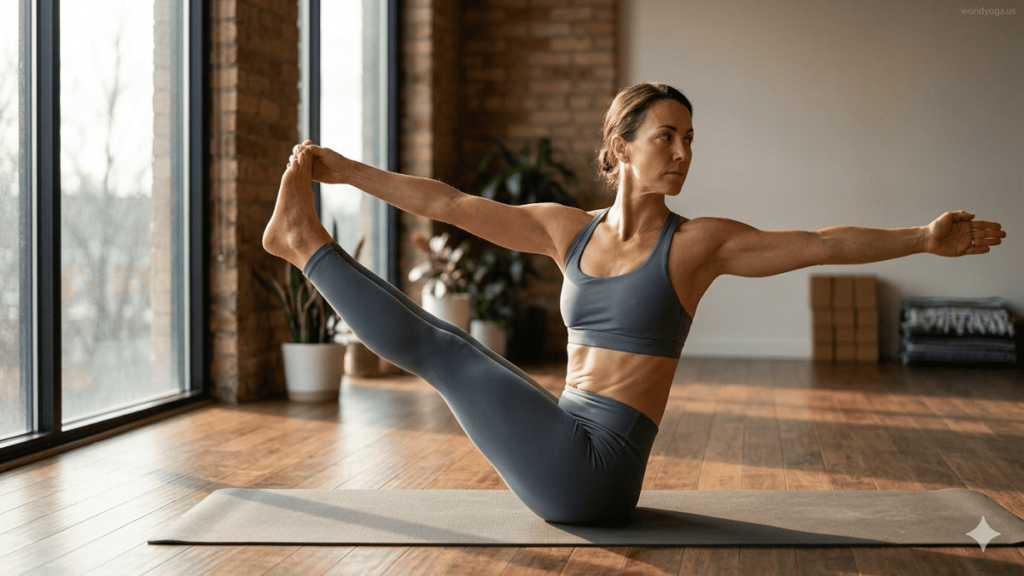
Boat Pose Twist, often referred to as a twisting variation of Navasana, is a dynamic yoga posture that combines balance, rotational movement, and core activation. This advanced variation intensifies the traditional Boat Pose by adding controlled spinal rotation, which increases engagement of the oblique muscles and enhances overall body coordination. The pose is commonly included in core-focused yoga sequences, athletic conditioning routines, and functional movement training programs.
The posture begins from the foundational position of Navasana. Practitioners sit on the floor with the knees bent and feet grounded while maintaining an upright spine. The torso is then slightly reclined as the feet lift from the floor, balancing the body on the sitting bones. Once stability is established, the hands are brought together near the chest or extended outward, and the torso rotates gently from side to side in a controlled twisting motion.
The primary focus of Boat Pose Twist is core strengthening. The rotational movement strongly activates the oblique muscles, transverse abdominis, and rectus abdominis. At the same time, the hip flexors, spinal stabilizers, and lower back muscles work continuously to maintain balance and posture. This integrated muscular engagement makes the pose highly effective for developing functional core stability and endurance.
In addition to physical strength, the pose improves coordination and balance. Because the body must remain stable while rotating, practitioners develop greater neuromuscular control and body awareness. The twisting action also encourages spinal mobility and may help reduce stiffness caused by prolonged sitting or inactivity.
Proper alignment is essential to perform the pose safely. The spine should remain elongated throughout the movement, with the chest lifted and shoulders relaxed. Twisting should originate from the torso rather than the shoulders alone, and the lower back should remain supported by active core engagement. Rapid or forceful twisting should be avoided, as it may strain the spine or compromise balance.
Breathing plays an important role in maintaining control during the posture. Practitioners typically inhale to lengthen the spine and exhale while rotating. Controlled breathing helps stabilize the core and enhances concentration during movement.
Boat Pose Twist offers several benefits beyond muscular strengthening. Regular practice may improve posture, enhance spinal support, increase balance, and develop mental focus. The posture is also frequently incorporated into yoga-based athletic training because of its ability to build rotational strength and stability.
However, individuals with lower back injuries, spinal disc issues, or severe hip discomfort should approach the posture cautiously and practice under professional guidance if necessary. Beginners can modify the pose by keeping the feet on the floor or reducing the range of twisting movement.
For additional posture guidance and instructional resources, platforms such as Yoga Journal and Yoga International provide expert tutorials and alignment advice. More anatomy-focused insights can also be explored through Anatomy Trains.
Boat Pose Twist is a powerful yoga variation that combines strength, balance, and mobility into a single practice. When performed mindfully and with proper technique, it becomes an effective posture for enhancing both physical conditioning and body awareness.
#Boat Pose: Twist in India
How is Boat Pose with a twist performed correctly?
Boat Pose with a twist is a dynamic yoga variation that combines balance, core stabilization, and spinal rotation. Often practiced in advanced yoga and core-conditioning routines, this posture strengthens the abdominal muscles while improving coordination, flexibility, and body control. Proper technique is essential to maximize benefits and avoid unnecessary strain on the spine or lower back.
To begin the posture, sit comfortably on the floor with the knees bent and feet flat on the mat. Lengthen the spine and lift the chest while relaxing the shoulders away from the ears. Place the hands beside the hips for support if needed. Slowly lean the torso slightly backward while keeping the back straight and the abdominal muscles engaged.
Next, lift both feet from the floor so the shins become parallel to the ground. This creates the foundational position of Navasana. More advanced practitioners may extend the legs fully at an upward angle while maintaining balance on the sitting bones.
Once stable, bring the palms together at the center of the chest or extend the arms forward. Begin the twisting movement by rotating the torso gently to one side while keeping the spine long and the chest open. Return to the center and rotate to the opposite side in a slow and controlled motion. The movement should originate from the core and ribcage rather than the shoulders alone.
Maintaining proper alignment is crucial throughout the posture. The spine should remain elongated without collapsing into the lower back. The chest stays lifted, and the neck remains neutral with the gaze directed forward or slightly toward the twisting side. Practitioners should avoid rounding the shoulders or holding tension in the neck.
Core engagement is the key element of the pose. The abdominal muscles, particularly the obliques and transverse abdominis, stabilize the torso during rotation. The hip flexors and lower back muscles also work continuously to support balance and posture.
Breathing should remain smooth and controlled during movement. Typically, practitioners inhale while returning to the center and exhale during the twist. Coordinating breath with movement improves stability and encourages mindful control throughout the exercise.
This variation provides several physical benefits. It strengthens the core, improves spinal mobility, enhances balance, and increases muscular endurance. The twisting motion also stimulates the muscles surrounding the spine and may help improve posture and body awareness.
Beginners may modify the pose by keeping the feet on the floor or reducing the range of motion during twisting. Individuals with lower back injuries, spinal conditions, or hip discomfort should practice cautiously and seek guidance from a qualified yoga instructor if necessary.
For detailed tutorials and alignment guidance, resources such as Yoga Journal and Yoga International provide expert instruction. Additional anatomy-focused yoga education is available through Anatomy Trains.
Boat Pose with a twist is an effective yoga posture for developing strength, balance, and rotational stability. Practiced mindfully and with correct alignment, it becomes a valuable addition to both yoga and functional fitness routines.
#Boat Pose: Twist in Maharashtra

What is the proper alignment in this twisting Navasana variation?
Proper alignment in a twisting variation of Navasana is essential for maintaining spinal safety, improving balance, and maximizing core engagement. Because this posture combines balancing with rotational movement, practitioners must stabilize the body carefully while maintaining controlled spinal alignment throughout the twist.
The posture begins with a stable foundation on the sitting bones. The pelvis should remain balanced evenly without collapsing backward into the sacrum. A slight forward tilt of the pelvis helps maintain the natural curve of the spine and prevents unnecessary pressure on the lower back.
The spine should stay long and upright during the entire movement. One of the most common mistakes in twisting Navasana variations is rounding the back while rotating. Instead, practitioners should focus on lifting through the chest and elongating the torso before initiating the twist. Maintaining spinal length allows the rotation to occur safely through the thoracic spine rather than compressing the lumbar region.
Core engagement is the primary support mechanism in this posture. The abdominal muscles, especially the obliques and transverse abdominis, stabilize the torso and control rotational movement. The navel should remain gently drawn inward to support the spine and maintain balance during twisting transitions.
Leg positioning also contributes significantly to alignment. The legs may remain bent or extended depending on the practitioner’s strength and flexibility. Regardless of the variation, the thighs should stay active and aligned while the feet remain lifted at a controlled angle. Excessive leg movement or instability can disrupt pelvic balance and compromise spinal positioning.
The twisting action should originate from the ribcage and torso rather than from the arms or shoulders alone. Practitioners should avoid forcing the twist with momentum. Controlled rotation ensures that the movement remains supported by muscular engagement rather than passive spinal stress.
The shoulders should stay relaxed and level throughout the pose. Avoid lifting the shoulders toward the ears or collapsing the chest inward. The neck should remain neutral with the gaze softly directed toward the twisting side or forward, depending on comfort and stability.
Breathing coordination is another important aspect of alignment. Inhaling helps lengthen the spine, while exhaling supports deeper yet controlled rotation. Smooth breathing patterns enhance stability and reduce muscular tension during the posture.
Proper alignment in this variation offers several benefits, including improved core strength, enhanced spinal mobility, better posture, and increased body awareness. The pose also develops rotational stability and neuromuscular coordination, making it valuable for yoga practitioners and functional fitness training.
Beginners may benefit from modifying the pose by keeping the feet on the floor or reducing the range of twisting motion. Individuals with lower back injuries, spinal disc conditions, or severe hip discomfort should practice under professional supervision.
For professional instruction and detailed alignment guidance, resources such as Yoga Journal and Yoga International provide expert tutorials. Additional anatomy-based education can be explored through Anatomy Trains.
Mastering alignment in twisting Navasana variations allows practitioners to move safely and efficiently while building strength, balance, and controlled mobility through mindful yoga practice.
#Boat Pose: Twist in Ahemadabad
Which muscles are engaged during the pose?
Boat Pose with a twist is a highly effective yoga posture that activates multiple muscle groups simultaneously. Because the pose combines balancing, core stabilization, and rotational movement, it requires coordinated engagement from the abdominal muscles, spinal stabilizers, hips, legs, and upper body. This integrated muscular activation makes twisting Navasana variations valuable for strength development, posture improvement, and functional movement training.
The primary muscles engaged during the pose are the abdominal muscles. The rectus abdominis supports the lifted torso position, while the transverse abdominis acts as a deep stabilizer that protects the spine and maintains balance. The internal and external obliques are especially active during the twisting movement, helping rotate the torso while controlling spinal alignment and stability.
The hip flexors, particularly the iliopsoas and rectus femoris, are heavily engaged to lift and stabilize the legs. These muscles help maintain the V-shaped position characteristic of Navasana. Because the legs remain elevated throughout the posture, the hip flexors work continuously to support balance and muscular endurance.
The quadriceps are activated to keep the legs extended and stable. At the same time, the inner thigh muscles, or adductors, assist in maintaining leg alignment and pelvic stability during rotational movement. Dynamic twisting variations further challenge these muscles by requiring controlled lower-body stabilization.
The spinal stabilizers and lower back muscles also play a critical role. The erector spinae muscles help maintain an upright spine and prevent the torso from collapsing backward. Proper activation of these muscles is essential for reducing stress on the lumbar spine and maintaining safe alignment during twisting motions.
Shoulder and upper-body muscles contribute to balance and posture as well. The deltoids, trapezius, and muscles surrounding the shoulder blades help stabilize the upper body when the arms are extended or held in prayer position during rotation. These muscles also assist in maintaining an open chest and proper posture.
The twisting action additionally engages smaller stabilizing muscles around the pelvis and spine. These muscles support neuromuscular coordination and help control the movement smoothly without relying on momentum. Because of this, the posture improves both muscular strength and movement awareness.
Breathing muscles also become involved during the pose. Controlled diaphragmatic breathing helps stabilize the core and maintain rhythmic movement throughout the twisting sequence. Coordinated breathing patterns improve endurance and support deeper muscular activation.
Regular practice of twisting Boat Pose variations can improve core strength, balance, spinal mobility, posture, and rotational stability. The posture is particularly effective for developing functional fitness because it trains the body to stabilize while moving dynamically.
However, practitioners should avoid forcing the twist or collapsing the lower back, as improper alignment may create unnecessary spinal strain. Beginners may modify the pose by bending the knees or reducing the range of twisting motion until adequate strength is developed.
For anatomy-focused yoga instruction and posture guidance, trusted resources such as Yoga Journal and Yoga International provide detailed tutorials. Additional information on muscular function and movement mechanics can be explored through Anatomy Trains.
#Boat Pose: Twist in Hyderabad
What preparatory poses are recommended before practicing it?
Preparing for a twisting variation of Navasana requires developing core strength, spinal stability, hip mobility, and controlled rotational movement. Because the posture combines balance with twisting mechanics, proper preparation is essential for improving performance and reducing the risk of strain on the lower back or hips. Several foundational yoga poses can help practitioners safely build the strength and flexibility needed for this advanced variation.
One of the most effective preparatory postures is Plank Pose. Plank strengthens the abdominal muscles, shoulders, wrists, and spinal stabilizers while teaching proper core engagement. Maintaining alignment in Plank helps practitioners develop the stability needed to support rotational movement in twisting Navasana.
Forearm Plank is another valuable preparation exercise. This variation intensifies deep core activation while reducing pressure on the wrists. It helps improve endurance in the abdominal muscles and supports better spinal control during balancing postures.
To specifically prepare for the balancing aspect of the pose, practitioners often practice Low Boat Pose. This posture strengthens the lower abdominal muscles and hip flexors while teaching pelvic stabilization. It closely mimics the body mechanics required in twisting Boat Pose variations.
Spinal mobility and rotational flexibility are equally important. Seated Spinal Twist helps improve thoracic spine mobility and teaches controlled twisting movement. Practicing seated twists before dynamic Navasana variations allows the spine to rotate more safely and efficiently.
Hip and hamstring flexibility can be improved through poses such as Seated Forward Bend. Flexible hamstrings support leg extension and reduce excessive tension in the lower back during balancing postures.
To strengthen the posterior chain and support spinal alignment, Bridge Pose is highly recommended. This pose activates the glutes, hamstrings, and lower back muscles, creating muscular balance around the pelvis and reducing overdependence on the hip flexors.
Balancing postures such as Warrior III are also useful for developing coordination and neuromuscular control. These poses strengthen stabilizing muscles throughout the body while improving focus and balance awareness.
Breathwork and mindful movement should be incorporated into preparation as well. Controlled breathing supports core engagement and helps maintain stability during twisting and balancing transitions.
Practitioners should progress gradually into twisting Navasana variations rather than forcing deep rotations or full leg extensions too early. Beginners may keep the knees bent or feet lightly grounded while developing sufficient strength and mobility.
For professional tutorials and posture preparation guidance, resources such as Yoga Journal and Yoga International offer detailed instruction. Additional anatomy-based movement education is available through Anatomy Trains.
Consistent practice of preparatory poses builds the foundation necessary for safely performing twisting Navasana variations with proper alignment, balance, and muscular control.
#Boat Pose: Twist in Pune
What are the benefits and precautions of this core-twisting posture?
Boat Pose with a twist is a dynamic yoga posture that combines balance, rotational movement, and deep core engagement. This advanced variation of Navasana is widely practiced for strengthening the abdominal muscles, improving spinal mobility, and enhancing overall body coordination. While the posture offers numerous physical and mental benefits, proper alignment and mindful progression are essential to practice it safely.
One of the primary benefits of this core-twisting posture is improved abdominal strength. The twisting movement strongly activates the oblique muscles, while the balancing component engages the rectus abdominis and transverse abdominis. These muscles work together to stabilize the spine, improve posture, and support functional movement patterns in daily life.
The posture also enhances balance and coordination. Maintaining stability while rotating the torso requires continuous neuromuscular engagement, which improves body awareness and movement control. This makes the pose valuable not only in yoga practice but also in athletic conditioning and functional fitness training.
Another important benefit is increased spinal mobility. Controlled twisting actions help mobilize the thoracic spine and may reduce stiffness caused by sedentary habits or poor posture. Improved spinal mobility can contribute to greater flexibility and more efficient movement mechanics throughout the body.
The posture additionally strengthens the hip flexors, quadriceps, lower back muscles, and pelvic stabilizers. Because the legs remain elevated during the pose, these muscles develop endurance and support better lower-body control. Regular practice may also improve muscular symmetry and postural alignment.
Mentally, the pose encourages concentration and mindful breathing. The combination of balancing and twisting requires sustained focus, which can help calm mental distractions and improve mindfulness during practice. Coordinated breathing patterns also support muscular control and reduce unnecessary tension.
Despite these benefits, several precautions should be considered. Individuals with lower back injuries, spinal disc problems, hip discomfort, or neck strain should practice cautiously and seek guidance from a qualified yoga instructor or healthcare professional. Twisting movements performed with poor alignment may place excessive pressure on the lumbar spine and surrounding tissues.
One common mistake is rounding the back while twisting. Proper alignment requires maintaining a long spine, lifted chest, and engaged core throughout the movement. Practitioners should avoid forcing the twist beyond their comfortable range of motion, as excessive rotation may lead to muscular strain or instability.
Beginners should modify the posture if necessary by keeping the knees bent or placing the feet lightly on the floor. Gradual progression allows the body to build sufficient strength and flexibility before attempting more advanced variations.
Breath retention should also be avoided during the pose. Smooth, controlled breathing helps stabilize the core and maintain safe movement mechanics throughout the twisting action.
For detailed alignment instruction and professional yoga guidance, trusted resources such as Yoga Journal and Yoga International offer expert tutorials. Additional anatomy and movement insights can be explored through Anatomy Trains.
When practiced mindfully and progressively, this core-twisting posture becomes a powerful tool for improving strength, mobility, balance, and body awareness while supporting overall physical wellness.
#Boat Pose: Twist in Banglore
Case Study of Boat Pose: Twist
Introduction
Boat Pose Twist is a dynamic variation of Navasana that integrates balance, rotational movement, and deep core activation. The posture is frequently used in yoga, fitness, and functional movement training programs to improve abdominal strength, spinal mobility, coordination, and postural stability.
This case study evaluates the physical and functional effects of practicing Boat Pose Twist over an eight-week structured yoga training program focused on improving core strength and spinal control.
Background of the Practitioner
The subject was a 35-year-old office professional with approximately two years of recreational yoga experience. The practitioner reported reduced core endurance, mild postural imbalance from prolonged sitting, and occasional lower back stiffness. The primary objectives of the program were:
- Strengthening the core muscles
- Improving spinal mobility
- Enhancing balance and coordination
- Reducing lower back discomfort
- Increasing postural awareness
Before beginning the program, the practitioner could hold a standard seated Boat Pose for only 15 seconds with moderate instability during twisting movements.
Training Methodology
The practitioner participated in a structured yoga routine five days per week for eight weeks. Sessions included preparatory postures and mobility exercises such as:
- Plank Pose
- Low Boat Pose
- Seated Spinal Twist
- Bridge Pose
Boat Pose Twist was introduced gradually during the second week. Early sessions focused on controlled movement, breathing coordination, and maintaining spinal alignment with bent knees. As strength improved, the practitioner progressed toward longer holds and deeper rotational control.
Observations and Results
By the end of the training period, several improvements were observed. The practitioner increased hold time in twisting Boat Pose from 10 seconds to nearly 40 seconds while maintaining better stability and posture.
Core endurance improved significantly, especially in the oblique muscles and lower abdominal region. Improved spinal mobility and rotational control were also noted, with reduced stiffness in the thoracic and lumbar regions during daily activities.
Additional observed improvements included:
- Better postural alignment
- Enhanced balance and coordination
- Increased abdominal strength
- Improved pelvic stability
- Greater body awareness during movement
The practitioner also reported improved concentration and breathing control during yoga sessions. Rotational stability improved noticeably, especially during dynamic movements and transitions.
Challenges Encountered
During the early stages of practice, the practitioner experienced difficulty maintaining an upright spine while twisting. Excessive hip flexor tension and fatigue in the lower abdominal muscles were also observed. These challenges were addressed through gradual progression, core activation drills, and reduced twisting intensity during initial sessions.
Another challenge involved over-rotating from the shoulders instead of initiating movement from the torso and ribcage. Alignment corrections and breathing coordination helped improve movement efficiency and stability.
Conclusion
This case study demonstrates that consistent practice of Boat Pose Twist can significantly improve core strength, spinal mobility, balance, and postural control when performed progressively and with proper alignment. The posture proved effective for enhancing rotational stability and neuromuscular coordination while supporting overall functional movement quality.
#Boat Pose: Twist in Kolkata
White Paper of Boat Pose: Twist
Abstract
Boat Pose Twist is a dynamic variation of Navasana that combines balance, rotational movement, and deep core stabilization. The posture is widely utilized in yoga, fitness conditioning, rehabilitation programs, and athletic performance training due to its ability to strengthen the abdominal muscles, improve spinal mobility, and enhance neuromuscular coordination.
This white paper examines the biomechanical structure, muscular engagement, physiological benefits, therapeutic applications, training methodology, and safety considerations associated with Boat Pose Twist within modern movement and wellness systems.
Introduction
Core stability and spinal mobility are essential components of functional movement and musculoskeletal health. Yoga-based movement practices increasingly emphasize integrated postures that strengthen the body while improving coordination and balance. Boat Pose Twist represents a progression from static core stabilization into controlled rotational movement.
The posture requires practitioners to maintain balance on the sitting bones while rotating the torso from side to side in a controlled manner. This combination of stabilization and movement creates significant activation of the abdominal muscles, spinal stabilizers, and hip flexors.
With growing awareness of posture-related dysfunction caused by sedentary lifestyles, exercises emphasizing spinal support and rotational stability have become increasingly relevant across health and wellness industries.
Biomechanical Analysis
Boat Pose Twist involves coordinated muscular activation and dynamic stabilization throughout the body. The primary biomechanical actions include:
- Spinal stabilization
- Controlled thoracic rotation
- Hip flexion
- Pelvic stabilization
- Isometric abdominal engagement
The pose heavily activates the following muscle groups:
- Rectus abdominis
- Transverse abdominis
- Internal and external obliques
- Iliopsoas and hip flexors
- Quadriceps
- Erector spinae muscles
- Pelvic stabilizers
The rotational component particularly increases engagement of the oblique muscles and improves rotational control of the trunk. Simultaneously, the lower body remains stabilized to maintain balance and proper alignment.
Physiological Benefits
Core Strength Enhancement
The posture significantly strengthens the abdominal wall and deep stabilizing muscles. This contributes to improved spinal support, posture, and functional movement capacity.
Improved Rotational Stability
The twisting movement trains the body to stabilize during rotational activity, improving neuromuscular efficiency and movement coordination.
Enhanced Spinal Mobility
Controlled spinal rotation helps maintain thoracic mobility and may reduce stiffness associated with prolonged sitting and reduced physical activity.
Postural Improvement
Strengthening the trunk and spinal stabilizers supports upright posture and may reduce muscular fatigue in sedentary individuals.
Balance and Coordination Development
Balancing during rotational movement improves proprioception and body awareness, which are essential for athletic performance and injury prevention.
Applications Across Industries
Boat Pose Twist is increasingly utilized across multiple sectors including:
Fitness and Conditioning
Fitness professionals integrate the posture into core-training routines, Pilates-inspired programs, and mobility-focused classes.
Sports Performance
Athletes use rotational core training to improve movement efficiency, agility, and balance. The pose is particularly useful for sports involving rotational mechanics such as tennis, martial arts, swimming, and golf.
Rehabilitation and Physiotherapy
Modified variations may assist in postural rehabilitation, pelvic stabilization, and spinal support training when supervised by qualified professionals.
Corporate Wellness
Yoga-based wellness programs use Boat Pose Twist to address posture-related issues, improve focus, and reduce muscular tension associated with desk-based work environments.
Risks and Precautions
Despite its benefits, improper execution may create excessive strain on the lumbar spine, hips, or neck. Common risks include:
- Lower back compression
- Excessive spinal rotation
- Hip flexor overuse
- Pelvic instability
- Shoulder tension
Individuals with spinal disc issues, severe lower back pain, or abdominal injuries should practice cautiously and seek professional guidance before attempting advanced variations.
Important alignment principles include:
- Maintaining spinal length
- Engaging the deep core muscles
- Twisting from the torso rather than the shoulders
- Avoiding collapse in the chest
- Coordinating movement with controlled breathing
Training Recommendations
Preparatory postures are strongly recommended before practicing Boat Pose Twist. Effective foundational exercises include:
- Plank Pose
- Low Boat Pose
- Seated Spinal Twist
- Bridge Pose
Gradual progression, mobility training, and proper breath control are essential for safe and effective practice.
Conclusion
Boat Pose Twist is a sophisticated yoga posture that integrates strength, balance, rotational stability, and coordinated movement into a single practice. Its applications extend beyond traditional yoga into rehabilitation, athletic conditioning, fitness training, and workplace wellness programs.
#Boat Pose: Twist in Delhi
Industry Application of Boat Pose: Twist
Introduction
Boat Pose Twist is an advanced yoga posture that combines core stabilization, spinal rotation, balance, and muscular endurance. This twisting variation of Navasana has evolved beyond traditional yoga practice and is now widely utilized across multiple industries including fitness, sports conditioning, rehabilitation, physiotherapy, corporate wellness, and digital wellness platforms.
As industries increasingly prioritize functional movement, posture correction, injury prevention, and holistic health, Boat Pose Twist has become an effective exercise for improving core strength, coordination, and mobility.
Application in the Fitness Industry
The fitness industry extensively incorporates yoga-based movements into strength and conditioning programs. Boat Pose Twist is commonly included in:
- Core-training workouts
- Functional fitness programs
- Pilates-inspired sessions
- Mobility and flexibility routines
- Group wellness classes
The posture is particularly effective because it combines isometric abdominal engagement with controlled rotational movement. Fitness professionals use this pose to strengthen the obliques, improve spinal stability, and enhance muscular endurance.
Boutique fitness studios and wellness centers often integrate twisting Navasana variations into hybrid yoga-strength classes designed to improve both mobility and athletic performance.
Role in Sports Performance Training
Sports performance specialists increasingly use rotational core exercises to improve balance, agility, and movement efficiency. Boat Pose Twist develops neuromuscular coordination and rotational stability, which are essential in sports involving directional changes and torso rotation.
Applications in athletic training include:
- Rotational strength development for golfers and tennis players
- Core stabilization for swimmers and runners
- Balance training for martial artists and dancers
- Mobility enhancement for team sports athletes
The posture also helps improve proprioception, or body awareness, which supports injury prevention and efficient movement mechanics.
Application in Rehabilitation and Physiotherapy
The rehabilitation industry has increasingly adopted yoga-based movement practices as complementary therapeutic tools. Modified forms of Boat Pose Twist may assist with:
- Postural correction
- Spinal stabilization
- Pelvic control
- Lower back strengthening
- Functional mobility training
Physiotherapists sometimes integrate controlled rotational exercises into rehabilitation programs for improving trunk stability and restoring coordinated movement patterns. However, advanced twisting variations should only be practiced under professional supervision.
Corporate Wellness and Workplace Health
Sedentary work environments have significantly increased the prevalence of posture-related discomfort, muscular imbalances, and lower back pain. Corporate wellness programs increasingly incorporate yoga practices to improve employee health and productivity.
Boat Pose Twist supports workplace wellness initiatives by helping improve:
- Core stability during prolonged sitting
- Spinal mobility
- Postural awareness
- Mental focus and concentration
- Stress management through breath control
Organizations implementing wellness programs often collaborate with yoga instructors and movement specialists to reduce workplace fatigue and support employee well-being.
Integration in Digital Wellness Platforms
The digital wellness industry has rapidly expanded the accessibility of yoga instruction through online classes, mobile applications, and virtual coaching platforms. Boat Pose Twist is commonly featured in:
- Core-strength yoga programs
- Home workout routines
- Guided mobility sessions
- Online yoga teacher training courses
- Personalized fitness subscriptions
The demand for home-based wellness solutions has increased the commercial relevance of advanced yoga postures across digital learning and fitness platforms.
Challenges and Safety Considerations
Despite its advantages, improper practice of Boat Pose Twist may create excessive strain on the spine or hip flexors. Common concerns include:
- Lower back compression
- Over-rotation of the spine
- Neck tension
- Hip flexor fatigue
- Poor pelvic alignment
Industries utilizing this posture in training programs should prioritize certified instruction, progressive movement education, and individualized modifications to ensure safety and long-term effectiveness.
Conclusion
Boat Pose Twist has become a valuable movement tool across fitness, sports, rehabilitation, and workplace wellness industries. Its ability to improve core strength, rotational stability, posture, balance, and body awareness makes it highly adaptable within modern health and performance programs.
#Boat Pose: Twist in Mumbai
Ask FAQs
What is Boat Pose Twist in yoga?
Boat Pose Twist is an advanced variation of Navasana that combines balance, core stabilization, and controlled spinal rotation. The posture is designed to strengthen the abdominal muscles, improve coordination, and enhance spinal mobility.
Which muscles are mainly engaged during Boat Pose Twist?
The posture primarily activates the rectus abdominis, transverse abdominis, and oblique muscles. It also engages the hip flexors, quadriceps, spinal stabilizers, and pelvic muscles to maintain balance and support rotational movement.
What are the benefits of practicing Boat Pose Twist?
Boat Pose Twist helps improve core strength, posture, balance, rotational stability, and spinal mobility. It also enhances body awareness, coordination, and concentration while supporting overall muscular endurance and functional movement.
Is Boat Pose Twist suitable for beginners?
This posture is generally more suitable for intermediate practitioners because it requires balance, abdominal strength, and controlled twisting. Beginners can modify the pose by keeping the knees bent or placing the feet on the floor while gradually building core stability and mobility.
What precautions should be taken while practicing this pose?
Practitioners should avoid rounding the lower back or forcing excessive spinal rotation. Individuals with lower back injuries, spinal disc conditions, neck pain, or hip discomfort should practice cautiously and seek guidance from a qualified yoga instructor or healthcare professional before attempting advanced variations.
Table of Contents
Desclaimer
The information provided in this article is for educational purposes only and is not intended as medical or professional health advice. Always practice yoga under the guidance of a qualified instructor and consult a healthcare professional before attempting advanced postures, especially if you have any injuries or medical conditions.