Chakra Bandhasana
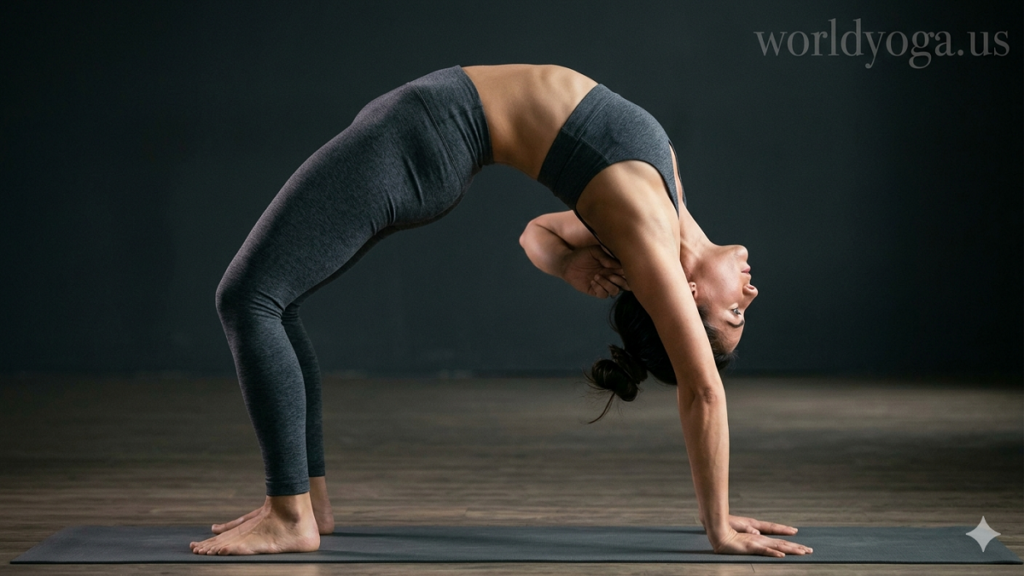
Chakra Bandhasana, often translated as “Wheel Lock Pose,” is an advanced backbending yoga posture that combines a deep spinal arch with a strong arm bind. It is closely related to the classical Wheel Pose and is considered a more intense variation due to the additional shoulder engagement and chest opening required.
Meaning and Origin
The Sanskrit name breaks down as:
- Chakra = wheel
- Bandha = lock or bind
- Asana = posture
Together, it refers to a “locked wheel” position, symbolizing a controlled and stabilized backbend. The pose is traditionally associated with advanced Hatha yoga practices that emphasize energy flow, spinal flexibility, and internal strength.
How It Is Performed
Chakra Bandhasana begins from a full Wheel Pose foundation:
- The practitioner lies on their back and lifts into Wheel Pose, placing hands and feet firmly on the ground.
- Once stable, the chest is lifted further while maintaining strong leg engagement.
- The elbows are bent deeply, and the arms are brought into a bind behind the head or upper back.
- The chest remains open while the spine forms a strong, continuous arch.
- The pose is held with controlled breathing and careful alignment.
Key Benefits
Chakra Bandhasana offers multiple physical and energetic benefits:
- Spinal flexibility: Improves mobility of the entire spine, especially thoracic extension
- Shoulder opening: Deepens range of motion in shoulder joints
- Chest expansion: Enhances breathing capacity and rib cage mobility
- Postural correction: Helps counter forward-rounded posture
- Strength development: Engages back, core, arms, and legs simultaneously
Common Challenges
This posture is demanding and requires preparation. Common difficulties include:
- Limited shoulder flexibility preventing the bind
- Overuse of the lower back instead of balanced spinal extension
- Wrist strain due to weight-bearing pressure
- Breath restriction under deep backbend intensity
Without proper preparation, these challenges can increase the risk of injury.
Precautions
Chakra Bandhasana should be avoided or modified in cases of:
- Wrist, shoulder, or spinal injuries
- Severe lower back pain
- Lack of foundational backbend strength
Proper warm-up and progression through simpler backbends like Bridge Pose and Wheel Pose are essential.
Conclusion
Chakra Bandhasana is a powerful and advanced yoga posture that combines strength, flexibility, and control. It is not just a physical shape but a disciplined integration of breath, alignment, and awareness, making it suitable only for experienced practitioners under proper guidance.
#Chakra Bandhasana in India
What is Chakra Bandhasana (Bound Wheel Pose)?
Chakra Bandhasana, commonly referred to as Bound Wheel Pose or Wheel Lock Pose, is an advanced yoga backbend that combines deep spinal extension with a strong arm bind. It is considered a progression of the traditional Wheel Pose, where the practitioner not only lifts into a full backbend but also increases shoulder opening by binding the arms behind or around the upper back.
The name comes from Sanskrit: “Chakra” meaning wheel, “Bandha” meaning lock or bind, and “Asana” meaning posture. Together, it describes a “locked wheel,” symbolizing a stabilized and intensified version of a wheel-shaped backbend.
Core Concept of the Pose
Chakra Bandhasana is built on the foundation of Urdhva Dhanurasana, where the body forms a strong arch supported by hands and feet. In this variation, the practitioner bends the elbows deeply and attempts to bring the arms into a bind while maintaining the lift of the chest and spine.
Unlike a standard backbend, this pose requires:
- Maximum spinal extension without collapsing the lower back
- Deep shoulder mobility for arm binding
- Strong core and leg engagement for stability
Physical Structure
In its full expression, the pose involves:
- Hands and feet grounded firmly on the mat
- Chest lifted into a strong, continuous arch
- Elbows bending toward each other
- Arms moving into a bind behind the head or upper back
The goal is not just flexibility, but controlled strength while maintaining alignment and breath stability.
Purpose and Benefits
Chakra Bandhasana is practiced to develop both mobility and strength. Key benefits include:
- Improved spinal flexibility, especially in the thoracic region
- Deep opening of the chest and shoulders
- Enhanced breathing capacity due to rib cage expansion
- Strengthening of back, core, and upper body muscles
- Improved posture by counteracting forward-shoulder habits
Level of Difficulty
This is an advanced-level posture. It requires prior mastery of foundational backbends such as Bridge Pose and standard Wheel Pose. Without adequate preparation, attempting the bind can lead to strain in the lower back or shoulders.
Safety Considerations
Practitioners should avoid forcing the bind or over-compressing the spine. Proper warm-up, gradual progression, and controlled breathing are essential. Individuals with wrist, shoulder, or spinal conditions should approach this pose only under expert supervision.
Summary
Chakra Bandhasana is a powerful, advanced backbend that combines strength, flexibility, and control. It is not just a physical posture but a coordinated movement pattern that demands awareness, stability, and disciplined progression.
#Chakra Bandhasana in Maharashtra

How is this deep backbend performed step by step?
Chakra Bandhasana is an advanced backbend built on the foundation of Urdhva Dhanurasana. It combines a full wheel position with a deep shoulder bind, so the key is control, alignment, and gradual depth—not forcing the shape.
1. Prepare the Body (Warm-Up Phase)
Start with thorough preparation to open the spine and shoulders.
- Practice Bridge Pose and gentle backbends
- Open shoulders using chest stretches and wall-supported drills
- Activate core and glutes to support the lower back
- Warm wrists with light weight-bearing movements
This step reduces risk and improves accessibility in the full pose.
2. Set the Foundation on the Mat
- Lie flat on your back
- Bend your knees, placing feet hip-width apart
- Bring heels close enough so fingertips can reach them
- Bend elbows and place palms beside your ears, fingers pointing toward shoulders
Ensure your feet and hands are firmly grounded before lifting.
3. Lift into Wheel Pose
- Press into palms and feet simultaneously
- Inhale and lift hips, chest, and head off the floor
- Straighten arms and legs as much as your body allows
- Establish a stable, even arch through the spine
At this stage, you are in a controlled full Wheel Pose.
4. Stabilize the Backbend
Before attempting the bind:
- Engage glutes and thighs to support the pelvis
- Lift the chest upward rather than collapsing into the lower back
- Maintain steady, calm breathing
- Ensure weight is evenly distributed between hands and feet
Stability here is essential before progressing further.
5. Initiate the Arm Bind
This is the defining step of Chakra Bandhasana.
- Slowly bend the elbows without dropping the chest
- Begin drawing forearms toward each other behind the head
- Depending on flexibility, you may:
- Interlace fingers
- Hold opposite wrists
- Bring forearms into contact
Do not force the bind—only go as far as your shoulders comfortably allow.
6. Hold the Pose
- Maintain chest lift while keeping the bind
- Keep spine long and evenly extended
- Breathe slowly and steadily without strain
- Hold for a few controlled breaths based on comfort
The focus is stability, not maximum depth.
7. Exit Safely
- First release the arm bind gently
- Return hands to standard Wheel Pose position
- Slowly bend elbows and lower the spine down segment by segment
- Rest on your back in a neutral position
Key Principle
In this pose, depth comes from control, not force. A safe Chakra Bandhasana is one where the spine is evenly supported, the breath remains steady, and the shoulders are not overstressed.
Further Reading
- https://www.yogajournal.com/poses/wheel-pose/
- https://www.verywellfit.com/upward-bow-wheel-pose-3567113
- https://www.yogapedia.com/definition/5245/bound-wheel-pose
#Chakra Bandhasana in Ahemadabad
What strength and flexibility are required?
Flexibility Requirements
1. Spinal Flexibility (Primary Requirement)
A highly mobile spine is essential, particularly in the thoracic region (upper back). This allows the chest to lift without overloading the lower back. Good spinal extension ensures the curve is evenly distributed rather than concentrated in the lumbar spine.
2. Shoulder Flexibility (Critical for the Bind)
Deep shoulder extension is one of the most limiting factors. The shoulders must move far behind the body while still supporting weight.
Key areas needing flexibility:
- Pectoralis major and minor (chest opening)
- Anterior deltoids
- Rotator cuff mobility
Without this, the arm bind cannot be achieved safely or comfortably.
3. Hip Flexor and Quadriceps Flexibility
Tight hip flexors restrict pelvic tilt, which reduces spinal freedom. Flexible hip flexors allow:
- Better lift of the pelvis
- Reduced compression in the lower back
- More even spinal arch
4. Wrist Mobility
Since wrists bear significant load, sufficient extension flexibility is required to avoid strain during prolonged support.
Strength Requirements
1. Back Extensor Strength
The erector spinae muscles must be strong enough to hold the spine in deep extension without collapsing. This prevents compression in the lumbar region and supports a controlled arch.
2. Shoulder and Arm Strength
Strong deltoids, triceps, and stabilizing scapular muscles are essential for:
- Supporting body weight in deep extension
- Controlling elbow bending during the bind
- Maintaining stability while the chest stays lifted
3. Core Strength
Core muscles act as stabilizers, not movers, in this pose. They help:
- Prevent over-arching in the lower back
- Maintain spinal alignment
- Control entry and exit from the pose
4. Glute and Hamstring Activation
Strong glutes and hamstrings support pelvic lift, reducing stress on the spine and improving overall balance in the posture.
Balance Between Strength and Flexibility
The key requirement in Chakra Bandhasana is balance, not extremes.
- Flexibility provides range of motion for the backbend and bind
- Strength controls that range and protects the joints
Without strength, flexibility becomes unstable. Without flexibility, strength cannot express the pose.
Summary
To safely approach Chakra Bandhasana, a practitioner must develop:
- Deep thoracic and shoulder flexibility
- Strong spinal and shoulder stabilizers
- Core control for spinal protection
- Balanced posterior chain strength
#Chakra Bandhasana in Hyderabad
What are the benefits of this pose?
1. Deep Spinal Mobility and Health
One of the primary benefits is improved flexibility and mobility of the entire spine, especially the thoracic region (upper back). This helps:
- Reduce stiffness from prolonged sitting
- Improve segmental spinal movement
- Maintain healthy extension capacity in the back
Unlike shallow backbends, this pose encourages even spinal distribution, reducing over-reliance on the lower back.
2. Powerful Chest and Shoulder Opening
The binding action intensifies the stretch across the chest and shoulders. This helps:
- Open tight pectoral muscles
- Improve shoulder joint range of motion
- Counteract rounded shoulders and forward-head posture
Over time, this can significantly improve upper-body alignment and posture.
3. Improved Respiratory Capacity
The deep chest expansion increases rib cage mobility, allowing:
- Greater lung expansion
- More efficient breathing patterns
- Improved breath awareness under physical stress
This makes the pose valuable for enhancing respiratory control and stamina.
4. Full-Body Strength Development
Chakra Bandhasana is not just a flexibility posture—it builds strength across multiple muscle groups:
- Back muscles: support spinal extension
- Core muscles: stabilize the lower back
- Shoulders and arms: control weight-bearing and bind
- Glutes and legs: assist pelvic lift and stability
This creates balanced strength across the posterior chain.
5. Postural Correction
Regular practice (at an appropriate level) helps counteract modern postural issues such as:
- Slouched shoulders
- Forward chest collapse
- Reduced spinal mobility
By actively training spinal extension, it restores more upright and open posture habits.
6. Neuromuscular Control and Body Awareness
Because the pose requires coordination between flexibility and strength, it enhances:
- Proprioception (body awareness in space)
- Controlled movement under load
- Breath synchronization with effort
This improves overall movement efficiency in other physical activities.
7. Energetic and Mental Effects
In traditional yoga frameworks, deep backbends are associated with increased energy and emotional openness. Practitioners often report:
- Elevated alertness
- Reduced mental fatigue
- A sense of expansion and emotional release
Important Note
Despite its benefits, Chakra Bandhasana is an advanced posture and should be approached gradually. Overstretching or forcing the bind can lead to shoulder or lower back strain.
Further Reading
- https://www.yogajournal.com/poses/wheel-pose/
- https://www.verywellfit.com/upward-bow-wheel-pose-3567113
- https://www.yogapedia.com/definition/5245/bound-wheel-pose
#Chakra Bandhasana in Kolkata
What common mistakes or risks should be avoided?
1. Overloading the Lower Back
One of the biggest mistakes is letting the lumbar spine do most of the work instead of distributing the backbend through the whole spine.
Risk:
This can cause compression in the lower back, leading to discomfort, muscle strain, or long-term spinal stress.
Avoid it by:
Engaging glutes and core, and lifting through the chest rather than collapsing into the lower spine.
2. Forcing the Arm Bind
Attempting to achieve the bind before the shoulders are ready is a frequent error.
Risk:
May lead to shoulder impingement, rotator cuff strain, or elbow stress.
Avoid it by:
Only going as far as the shoulders comfortably allow. The bind should never be forced.
3. Collapsing the Chest During the Bind
As practitioners bend the elbows, the chest often drops unintentionally.
Risk:
This reduces spinal support and increases pressure on the lumbar region.
Avoid it by:
Continuously lifting the sternum upward while entering or holding the bind.
4. Poor Shoulder Preparation
Entering the pose without adequate shoulder mobility is a major contributing factor to injury.
Risk:
Can cause tightness, inflammation, or restricted joint movement over time.
Avoid it by:
Building shoulder flexibility gradually through preparatory poses before attempting full backbends.
5. Wrist Strain from Improper Alignment
Since the wrists support significant body weight, incorrect placement is common.
Risk:
Wrist pain, overuse injuries, or joint stress.
Avoid it by:
Spreading fingers wide, pressing evenly through palms, and avoiding collapsing into the wrists.
6. Breath Holding Under Effort
Holding the breath during deep extension is another common mistake.
Risk:
Increases muscle tension and reduces stability, making the pose harder to control.
Avoid it by:
Maintaining slow, steady breathing throughout the posture.
7. Skipping Progressions
Jumping directly into Chakra Bandhasana without mastering foundational backbends is risky.
Risk:
Increases chance of injury due to lack of strength and mobility.
Avoid it by:
Progressing through Bridge Pose and standard Wheel Pose before attempting deeper variations.
Key Safety Principle
In Chakra Bandhasana, control always comes before depth. A smaller, well-aligned backbend is far safer and more beneficial than forcing a deeper but unstable shape.
Further Reading
- https://www.yogajournal.com/poses/wheel-pose/
- https://www.verywellfit.com/upward-bow-wheel-pose-3567113
- https://www.yogapedia.com/definition/5245/bound-wheel-pose
#Chakra Bandhasana in Banglore
Case Study of Chakra Bandhasana
1. Subject Overview
The subject is an experienced yoga practitioner with approximately 4 years of consistent training in Hatha and Vinyasa styles. They had already achieved:
- Stable 30–45 second hold in standard Wheel Pose
- Moderate thoracic spine mobility
- Good lower body strength and balance
However, limitations were identified in:
- Deep shoulder extension
- Controlled arm binding ability
- Thoracic opening under load
The goal was to safely progress toward a partial expression of Chakra Bandhasana.
2. Assessment Phase
Initial movement screening showed:
- Adequate spinal extension but lumbar over-reliance
- Restricted shoulder internal rotation and extension
- Core strength sufficient but not fully integrated in backbends
- Wrist tolerance moderate under prolonged pressure
Based on this, a structured progressive training plan was designed.
3. Training Protocol (8 Weeks)
Phase 1: Mobility Foundation (Weeks 1–2)
- Bridge Pose variations for spinal segmentation
- Chest and shoulder opening drills using straps
- Thoracic extension over props
- Gentle wrist conditioning exercises
Phase 2: Strength Integration (Weeks 3–5)
- Glute activation training during backbends
- Core stabilization (plank and hollow body holds)
- Controlled Wheel Pose holds with alignment cues
- Breath regulation under mild extension stress
Phase 3: Advanced Preparation (Weeks 6–7)
- Deep Wheel Pose refinement
- Elbow bending practice without binding
- Assisted shoulder bind attempts using wall support
- Emphasis on chest lift during elbow flexion
Phase 4: Controlled Expression (Week 8)
- Entry into full Wheel Pose with stable alignment
- Partial bind achieved (forearms approximated, no full wrist grip)
- Short holds of 10–20 seconds with controlled breathing
4. Observations
Positive Outcomes:
- Noticeable improvement in thoracic spine mobility
- Better shoulder awareness and controlled extension
- Reduced lumbar compression during backbends
- Improved breath stability under load
Persistent Limitations:
- Full arm bind still restricted by shoulder tightness
- Fatigue in wrists during repeated attempts
- Need for further scapular stability development
5. Key Insights
- Progression into Chakra Bandhasana depends more on shoulder mobility and control than spinal flexibility alone
- Partial expressions of the pose still provide significant functional benefits
- Controlled progression reduces risk of lumbar and shoulder injury
6. Conclusion
This case study demonstrates that Chakra Bandhasana is best approached as a long-term developmental posture, not a short-term goal. Structured progression, rather than forced achievement, allows practitioners to safely build the strength, mobility, and neuromuscular control required for deeper backbending work.
Even incomplete versions of the pose delivered meaningful improvements in posture, mobility, and body awareness.
Further Reading
- https://www.yogajournal.com/poses/wheel-pose/
- https://www.verywellfit.com/upward-bow-wheel-pose-3567113
- https://www.yogapedia.com/definition/5245/bound-wheel-pose
#Chakra Bandhasana in Pune
White Paper of Chakra Bandhasana
1. Abstract
Chakra Bandhasana is a high-intensity backbend requiring integrated flexibility, strength, and neuromuscular control. Unlike standard wheel pose variations, it introduces a binding component that significantly increases shoulder extension demand and spinal load distribution complexity. The posture serves as both a mobility and strength benchmark in advanced yoga training systems.
2. Biomechanical Framework
2.1 Spinal Mechanics
The spine operates in global extension across cervical, thoracic, and lumbar regions. However:
- Thoracic extension is the primary mobility driver
- Lumbar spine must remain controlled to prevent compression
- Cervical spine maintains neutral extension alignment
Uneven distribution increases risk of localized spinal stress.
2.2 Shoulder Kinetics
The shoulder joint undergoes extreme extension combined with internal rotation during the bind phase. This requires:
- High pectoral muscle flexibility
- Anterior deltoid lengthening
- Scapular stabilization under load
Restricted mobility often prevents safe full expression.
2.3 Load Distribution
Body weight is distributed across:
- Upper limbs (hands and shoulders)
- Lower limbs (feet and legs)
- Posterior chain musculature for stabilization
Balanced distribution is critical to avoid joint overload.
3. Physiological Requirements
Flexibility Demands
- Thoracic spine extension capacity
- Shoulder extension and rotation range
- Hip flexor length for pelvic tilt
- Wrist extension tolerance
Strength Demands
- Erector spinae endurance for spinal support
- Core anti-extension stability
- Gluteal activation for pelvic lift
- Shoulder stabilizer strength (deltoids, rotator cuff, scapular muscles)
Neuromuscular Control
- Breath regulation under high effort
- Joint alignment awareness during dynamic entry
- Symmetrical load distribution between limbs
4. Benefits
When practiced correctly, Chakra Bandhasana contributes to:
- Enhanced spinal mobility and postural correction
- Deep chest and shoulder opening
- Improved respiratory expansion and rib mobility
- Strength development across posterior chain and core
- Increased neuromuscular coordination in extension patterns
5. Risk Profile
Primary risks include:
- Lumbar spine compression due to overextension dominance
- Shoulder impingement from forced binding
- Wrist strain from prolonged load-bearing
- Loss of breath control under deep backbend stress
Risk increases significantly without progressive conditioning.
6. Progressive Training Model
A structured pathway is recommended:
- Foundational mobility (Bridge Pose, thoracic drills)
- Standard Wheel Pose stabilization
- Controlled spinal extension training
- Shoulder bind preparation without load
- Assisted or partial bind integration
- Full expression only under stable control conditions
7. Conclusion
Chakra Bandhasana is not merely a flexibility milestone but a complex integrated movement requiring balanced development of mobility, strength, and control systems. Safe execution depends on progressive adaptation, not structural forcing. When approached correctly, it serves as a high-level indicator of spinal health, shoulder mobility, and full-body coordination.
References
- https://www.yogajournal.com/poses/wheel-pose/
- https://www.verywellfit.com/upward-bow-wheel-pose-3567113
- https://www.yogapedia.com/definition/5245/bound-wheel-pose
#Chakra Bandhasana in Delhi
Industry Application of Chakra Bandhasana
1. Fitness and Advanced Yoga Training
In the fitness and yoga industry, Chakra Bandhasana is used as a peak-level flexibility and strength benchmark. It is typically included in:
- Advanced yoga workshops and teacher training programs
- Backbend-focused mobility classes
- Performance-based flexibility assessments
Instructors use it to evaluate:
- Thoracic spine mobility
- Shoulder extension capacity
- Core stability under extreme extension
It is often considered a “mastery pose” in backbend progression systems.
2. Sports Science and Athletic Conditioning
In sports performance training, the movement principles behind the pose are adapted (often in modified form) to enhance athletic capability in disciplines requiring spinal extension and shoulder mobility.
Applications include:
- Improving overhead range of motion for gymnasts and swimmers
- Enhancing shoulder flexibility for throwing athletes
- Developing posterior chain strength for explosive movements
Strength and conditioning coaches may use simplified bridge or wheel variations instead of the full pose for safety.
3. Physiotherapy and Rehabilitation
In clinical rehabilitation settings, controlled elements of the posture are used for mobility restoration.
Applications include:
- Improving thoracic spine stiffness caused by sedentary lifestyles
- Supporting shoulder mobility recovery (non-acute cases)
- Gradual reintroduction of spinal extension after postural dysfunction
However, full Chakra Bandhasana is generally avoided in early rehabilitation due to its intensity.
4. Dance, Circus, and Performing Arts
Performing artists use similar movement patterns for expressive and aesthetic purposes.
Applications include:
- Enhancing flexibility for backbend-heavy choreography
- Increasing spinal articulation in contemporary dance
- Supporting contortion and acrobatic performance training
It contributes to both functional mobility and visual stage expression.
5. Wellness and Mind–Body Industry
In wellness programs, especially yoga retreats and holistic training systems, the posture is used to support:
- Breath expansion and respiratory awareness
- Emotional release through deep chest opening
- Energy activation and mental focus
It is often included in advanced experiential workshops focused on transformation and resilience.
6. Emerging Technology and Movement Analytics
With the rise of wearable sensors and AI-based movement tracking, Chakra Bandhasana is being analyzed for:
- Joint load distribution mapping
- Spinal curvature analytics under extreme extension
- Injury risk prediction in flexibility training
This supports data-driven approaches in elite yoga and movement science.
Conclusion
Chakra Bandhasana has evolved beyond a traditional yoga posture into a multi-industry reference movement for spinal extension, shoulder mobility, and full-body coordination. While its full expression remains limited to advanced practitioners, its principles are widely applied in fitness, rehabilitation, sports science, performing arts, and emerging movement technologies.
References
- https://www.yogajournal.com/poses/wheel-pose/
- https://www.verywellfit.com/upward-bow-wheel-pose-3567113
- https://www.yogapedia.com/definition/5245/bound-wheel-pose
#Chakra Bandhasana in Mumbai
Ask FAQs
What is Chakra Bandhasana?
Chakra Bandhasana, also known as Bound Wheel Pose or Wheel Lock Pose, is an advanced yoga posture where the practitioner performs a full wheel backbend and then deepens it by bending the elbows and attempting a shoulder bind. It is designed to increase spinal extension and shoulder mobility.
Who can practice this pose?
This pose is intended for advanced practitioners who already have strong control in Wheel Pose. It requires developed spinal flexibility, shoulder mobility, core strength, and wrist stability. Beginners should not attempt it without proper progression and supervision.
What are the main benefits?
Key benefits include improved spinal flexibility, deeper chest and shoulder opening, better posture alignment, enhanced breathing capacity, and overall strengthening of the back, core, and upper body muscles.
What are the common risks?
Common risks include lower back compression, shoulder impingement, wrist strain, and loss of control during the bind. These risks increase when the pose is forced or attempted without adequate preparation.
How should beginners prepare for it?
Beginners should first master Bridge Pose and standard Wheel Pose. They should also focus on improving shoulder flexibility, core stability, and thoracic spine mobility. Gradual progression and consistent practice are essential before attempting any binding variation.
Table of Contents
Disclaimer
Chakra Bandhasana is an advanced yoga posture and should only be practiced after proper preparation and under qualified guidance. It involves deep spinal extension and shoulder loading, which may lead to injury if performed incorrectly or without adequate strength and flexibility. Individuals with back, shoulder, wrist, or cardiovascular conditions should avoid this pose unless cleared by a healthcare professional. Always practice mindfully and prioritize safety over depth.