Pada Gomukhasana in Ushtrasana*
Pada Gomukhasana in Ushtrasana is an advanced yoga posture that integrates elements of Gomukhasana (Cow Face Pose) and Ushtrasana (Camel Pose). This hybrid asana combines deep spinal extension with intense hip and shoulder opening, making it particularly beneficial for experienced practitioners seeking to enhance flexibility, balance, and postural awareness.
In its execution, the practitioner typically begins in a kneeling position, similar to the base of Ushtrasana. The legs are then arranged in the Gomukhasana configuration, where one knee stacks over the other while the feet are placed beside the hips. From this foundation, the practitioner moves into a backbend, placing the hands on the heels or reaching backward, thus entering the Ushtrasana component. This integration requires careful alignment and controlled breathing to avoid strain, especially in the lumbar spine and knees.
From an anatomical perspective, Pada Gomukhasana in Ushtrasana offers a comprehensive stretch. The hip joints undergo deep external rotation and adduction, while the shoulders are extended and opened. Simultaneously, the thoracic spine experiences significant extension, which can help counteract the effects of prolonged sitting and poor posture. The pose also stimulates the chest and abdominal regions, potentially aiding in improved respiratory capacity and digestion.
One of the key benefits of this posture lies in its ability to improve spinal flexibility and strengthen the back muscles. The backbend component encourages activation of the erector spinae muscles, while the leg positioning enhances mobility in the hips and thighs. Additionally, the pose can contribute to improved circulation and energy flow, aligning with principles found in traditional yoga practices.
However, due to its complexity, this asana is not recommended for beginners. Individuals with knee injuries, lower back issues, or shoulder limitations should approach it with caution or avoid it altogether. Proper warm-up sequences, including preparatory poses such as Bhujangasana (Cobra Pose) and basic Gomukhasana, are essential to safely attempt this posture. Guidance from a qualified yoga instructor is highly advisable to ensure correct technique and prevent injury.
Breathing plays a crucial role in maintaining stability and comfort in the pose. Slow, controlled inhalations can deepen the backbend, while exhalations help release tension in the hips and shoulders. Holding the pose for several breaths allows the practitioner to gradually expand their range of motion while maintaining mindfulness.
For further reading and visual guidance, you can explore these resources:
- Yoga Journal: https://www.yogajournal.com/poses/camel-pose/
- DoYogaWithMe: https://www.doyogawithme.com/content/cow-face-pose
- Yoga International: https://yogainternational.com/article/view/how-to-practice-ustrasana
#Pada Gomukhasana in Ushtrasana* in India
How is Pada Gomukhasana in Ushtrasana performed correctly?
1. Preparation and Starting Position
Begin in a kneeling position on a yoga mat, with the knees hip-width apart and thighs perpendicular to the floor. Ensure the spine is neutral and the shoulders are relaxed. Engage the core gently to support the lower back. A brief warm-up, including hip openers and mild backbends, is recommended before attempting this posture.
2. Leg Placement (Pada Gomukhasana Component)
Shift your weight slightly and bring one knee over the other so that both knees are stacked centrally. Position the feet beside the hips, with the soles facing outward. Sit back between the heels if flexibility allows. Both sitting bones should ideally be grounded evenly, although minor adjustments may be needed based on individual anatomy.
3. Transition into the Backbend (Ushtrasana Component)
From the seated Gomukhasana leg position, rise up onto your knees while maintaining the stacked knee alignment. Place your hands on your hips or sacrum for support. Begin to gently press the hips forward while lifting the chest upward. Gradually arch the spine backward, initiating the movement from the upper back rather than collapsing into the lower back.
4. Hand Placement and Full Expression
Once stable in the backbend, reach your hands backward to hold your heels, one at a time. Keep the thighs vertical and avoid letting the hips drop backward. The chest should remain lifted, Pada Gomukhasana in Ushtrasana and the shoulder blades should draw together to open the front body. If reaching the heels is not accessible, keep the hands on the lower back for support.
5. Head and Neck Alignment
Allow the head to drop back only if there is no discomfort in the neck. Otherwise, keep the chin slightly tucked to maintain cervical spine safety. The gaze can be directed upward or backward depending on comfort.
6. Breathing and Holding the Pose
Maintain slow, steady breathing throughout. Inhale to expand the chest and deepen the backbend; exhale to relax tension in the hips and shoulders. Hold the posture for 15–30 seconds or 3–5 breaths, Pada Gomukhasana in Ushtrasana depending on experience level.
7. Exiting the Pose Safely
To come out, bring your hands back to your hips, engage the core, and slowly lift the torso upright. Carefully release the legs and return to a neutral kneeling or seated position. A gentle forward fold, such as Child’s Pose, is recommended afterward to counterbalance the backbend.
For further reference, consult:
- Yoga Journal: https://www.yogajournal.com/poses/camel-pose/
- DoYogaWithMe: https://www.doyogawithme.com/content/cow-face-pose
- Yoga International: https://yogainternational.com/article/view/how-to-practice-ustrasana
#Pada Gomukhasana in Ushtrasana* in Maharashtra
What is the proper alignment in this pose variation?
1. Foundation: Knees, Legs, and Feet
The alignment begins with the lower body. The knees should be stacked directly on top of each other along the midline, Pada Gomukhasana in UshtrasanaPada forming the characteristic Gomukhasana position. Both feet are placed beside the hips, with the soles facing outward. It is important to distribute weight evenly across both sitting bones when initially seated, and then maintain balanced pressure through the knees when rising into the backbend. Avoid excessive strain on either knee by ensuring that the legs are not forced into position; flexibility should dictate depth.
2. Pelvis and Hips
The pelvis plays a critical role in stabilizing the posture. As you transition into the Ushtrasana component, the hips should press forward without flaring outward. The goal is to create a neutral yet slightly anteriorly tilted pelvis that supports the spinal extension. Engaging the gluteal muscles gently helps maintain hip extension, Pada Gomukhasana in Ushtrasana but over-clenching should be avoided as it can compress the lower back.
3. Spine and Core Engagement
The spine should lengthen upward before moving into extension. Rather than collapsing into the lumbar spine, the backbend must be evenly distributed along the entire позвоночник (spinal column), with emphasis on opening the thoracic region. Core engagement is essential to protect the lower back; the abdominal muscles should remain active to provide support and prevent over-arching.
4. Chest and Shoulders
Lift the sternum upward to create space in the chest. The shoulders should roll back and down, with the shoulder blades (scapulae) drawing toward each other. This action facilitates a broader chest opening and prevents the shoulders from collapsing forward. When reaching for the heels, ensure that the arms extend without locking the elbows or straining the shoulder joints.
5. Neck and Head Position
The cervical spine should follow the natural curve of the backbend. If flexibility allows, the head can gently drop backward; however, there should be no compression in the neck. Practitioners with limited neck mobility should keep the chin slightly tucked and the gaze forward or upward to maintain alignment.
6. Breath and Stability
Consistent, controlled breathing supports alignment. Inhalation helps lengthen and expand the torso, while exhalation stabilizes the posture. The breath should remain smooth and uninterrupted, Pada Gomukhasana in Ushtrasana, indicating that the body is not under excessive strain.
7. Common Alignment Errors to Avoid
Frequent mistakes include splaying the knees apart, collapsing into the lower back, and letting the hips drift backward. Additionally, forcing the hands to reach the heels without sufficient flexibility can compromise shoulder and spinal alignment.
For further study, refer to:
- Yoga Journal: https://www.yogajournal.com/poses/camel-pose/
- Yoga International: https://yogainternational.com/article/view/how-to-practice-ustrasana
- DoYogaWithMe: https://www.doyogawithme.com/content/cow-face-pose
#Pada Gomukhasana in Ushtrasana* in De;hi
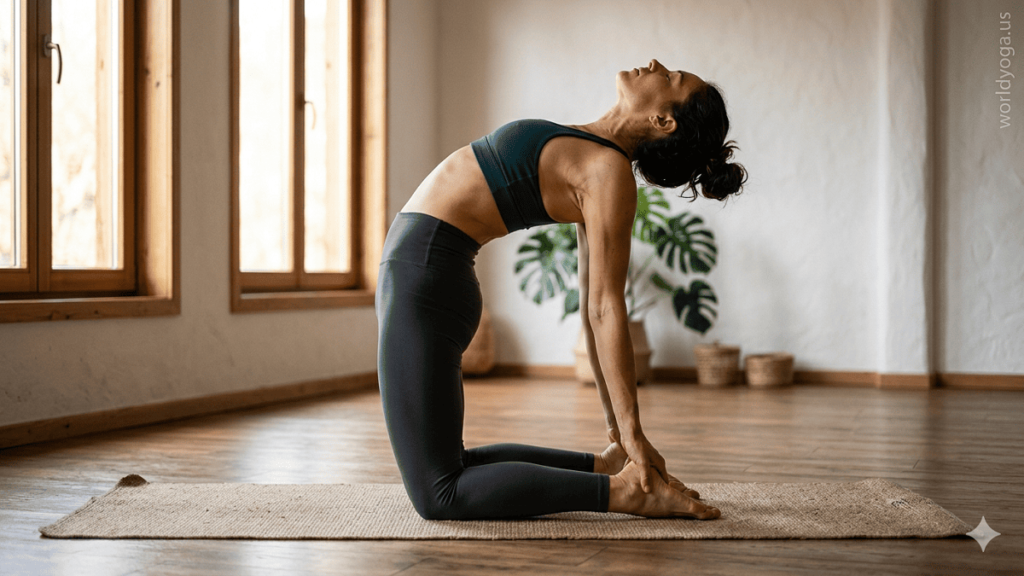
Which muscles are engaged during the posture?
1. Spinal Extensors (Back Muscles)
The primary muscles engaged during the backbend component are the erector spinae group, which run along the позвоночник (spine). These muscles are responsible for extending and stabilizing the spine as you move into and hold the posture. Additionally, Pada Gomukhasana in Ushtrasana the multifidus muscles provide deep stabilization, helping maintain controlled extension and preventing excessive compression in the lumbar region.
2. Gluteal Muscles and Hip Stabilizers
The gluteus maximus plays a key role in extending the hips and supporting the forward thrust of the pelvis in the Ushtrasana phase. The gluteus medius and minimus contribute to pelvic stability, ensuring that the hips remain aligned despite the asymmetrical leg position of Gomukhasana. Pada Gomukhasana in Ushtrasana. These muscles work in conjunction with the deep hip rotators to maintain balance and control.
3. Quadriceps and Thigh Muscles
The quadriceps, particularly the rectus femoris, are actively engaged to stabilize the knees and support the upright kneeling position. Pada Gomukhasana in Ushtrasana. Because the knees are stacked in the Gomukhasana configuration, the inner thigh muscles (adductors) are also activated to maintain alignment and prevent the legs from drifting apart.
4. Core Muscles
The abdominal muscles, including the rectus abdominis and transverse abdominis, play a crucial stabilizing role. While the posture emphasizes spinal extension, Pada Gomukhasana in Ushtrasana, the core must remain engaged to protect the lower back and distribute the backbend evenly לאורך the spine. This engagement helps prevent over-arching and maintains structural integrity.
5. Chest and Shoulder Muscles
As the chest opens in the backbend, the pectoralis major and minor are stretched, while the muscles of the upper back—such as the trapezius and rhomboids—are engaged to retract the shoulder blades. The deltoids (particularly the posterior fibers) assist in shoulder extension as the arms reach toward the heels. This coordinated action creates a stable and open upper body.
6. Hip Rotators and External Rotators
Due to the Gomukhasana leg position, the deep external rotators of the hips (such as the piriformis) are actively involved. These muscles help maintain the stacked knee alignment and allow for the necessary rotation in the hip joints.
7. Neck Muscles
If the head is allowed to drop back, the cervical extensors are engaged to support the neck. However, Pada Gomukhasana in Ushtrasana this engagement should remain gentle to avoid strain.
Conclusion
This posture is a full-body engagement that combines strength and flexibility. While the back and hips provide the primary القوة (force) for the pose, the core and stabilizing muscles ensure safety and alignment. Understanding these muscular dynamics allows practitioners to perform the posture more effectively and reduce the risk of injury.
For further anatomical insights, consult:
- Yoga Journal: https://www.yogajournal.com/poses/camel-pose/
- Yoga International: https://yogainternational.com/article/view/how-to-practice-ustrasana
- DoYogaWithMe: https://www.doyogawithme.com/content/cow-face-pose
#Pada Gomukhasana in Ushtrasana* in Pune
What preparatory poses are recommended?
1. Hip Openers
Since the pose involves a deep Gomukhasana leg configuration, hip mobility is critical.
- Baddha Konasana (Bound Angle Pose): Opens the inner thighs and improves external rotation in the hips.
- Eka Pada Rajakapotasana (Pigeon Pose): Targets the glutes and deep hip rotators, preparing for knee stacking.
- Ardha Matsyendrasana: Enhances hip and spinal mobility simultaneously.
2. Shoulder and Chest Openers
The Ushtrasana component requires strong shoulder extension and chest expansion.
- Gomukhasana Arms: Prepares the shoulders for reaching back and improves flexibility in the triceps and upper back.
- Anahatasana: Deeply opens the chest and shoulders while maintaining spinal length.
- Garudasana Arms: Increases mobility in the shoulder joints and upper back.
3. Spinal Extension (Backbend Preparation)
Gradual spinal extension is essential before attempting a deep backbend.
- Bhujangasana (Cobra Pose): Activates the back muscles and introduces gentle extension.
- Salabhasana (Locust Pose): Strengthens the posterior chain, particularly the lower back and glutes.
- Setu Bandhasana (Bridge Pose): Develops strength and flexibility in the spine and hips.
- Ustrasana Prep: A modified version of Camel Pose with hands on the hips to build confidence and alignment awareness.
4. Quadriceps and Thigh Stretching
Tight quadriceps can restrict the depth of the backbend.
- Virasana (Hero Pose): Stretches the thighs and ankles while improving knee flexibility.
- Supta Virasana: Provides a deeper stretch for the quadriceps and hip flexors.
5. Core Activation and Stability
A strong core supports the spine and prevents over-compression in the lower back.
- Phalakasana (Plank Pose): Builds overall core strength and stability.
- Navasana (Boat Pose): Engages the abdominal muscles and improves balance.
Conclusion
These preparatory poses collectively enhance the flexibility of the hips and shoulders, strengthen the back and core, Pada Gomukhasana in Ushtrasana and gradually introduce spinal extension. Practicing them consistently reduces the risk of injury and allows for a smoother transition into Pada Gomukhasana in Ushtrasana. For additional guidance, refer to:
- Yoga Journal: https://www.yogajournal.com/poses/camel-pose/
- Yoga International: https://yogainternational.com/article/view/how-to-practice-ustrasana
- DoYogaWithMe: https://www.doyogawithme.com/content/cow-face-pose
#Pada Gomukhasana in Ushtrasana* in Kolkata
What are the benefits and precautions of this pose?
Benefits
1. Enhanced Spinal Flexibility and Strength
The backbend component significantly improves spinal extension, particularly in the thoracic region. It strengthens the erector spinae muscles while promoting mobility לאורך the spine, helping counteract stiffness caused by sedentary lifestyles.
2. Deep Hip Opening
The Gomukhasana leg position provides an intense stretch to the hips, glutes, and outer thighs. This improves joint mobility and can reduce tightness in the lower body, which is especially beneficial for individuals who sit for prolonged periods.
3. Chest Expansion and Improved Breathing
By opening the chest and ribcage, the posture enhances lung capacity and encourages deeper breathing. This can contribute to better oxygen intake and overall respiratory efficiency.
4. Strengthening of Lower Body and Core
The quadriceps, gluteal muscles, and core are actively engaged to maintain stability. This strengthens the lower body while also improving balance and posture.
5. Postural Correction
The pose helps counteract rounded shoulders and forward head posture by encouraging proper alignment of the spine and shoulders. Over time, this can lead to improved overall posture.
6. Increased Energy and Circulation
Backbends are often associated with increased ऊर्जा (energy) and improved blood circulation. The pose stimulates the front body, including abdominal organs, which may support digestion and vitality.
Precautions
1. Not Suitable for Beginners
This is an advanced posture and should only be attempted after mastering foundational poses. Beginners may lack the flexibility and strength required for safe execution.
2. Knee Sensitivity and Injury Risk
The stacked knee position can place pressure on the joints. Individuals with knee pain, ligament injuries, or limited mobility should avoid this pose or modify it under professional guidance.
3. Lower Back Compression
Improper technique can lead to excessive الضغط (pressure) on the lumbar spine. It is essential to engage the core and distribute the backbend evenly rather than collapsing into the lower back.
4. Shoulder and Neck Strain
Reaching for the heels and dropping the head back may strain the shoulders and cervical spine if flexibility is limited. Modifications, such as keeping hands on the hips, are recommended when needed.
5. Contraindications
Avoid this posture if you have:
- Chronic back pain or spinal injuries
- Severe hip or knee issues
- Recent abdominal surgery
- Uncontrolled high or low blood pressure
6. Importance of Warm-Up and Supervision
Adequate warm-up with hip openers and gentle backbends is essential. Practicing under the supervision of a qualified yoga instructor reduces the risk of injury and ensures correct alignment.
Further Reading
- Yoga Journal: https://www.yogajournal.com/poses/camel-pose/
- Yoga International: https://yogainternational.com/article/view/how-to-practice-ustrasana
- DoYogaWithMe: https://www.doyogawithme.com/content/cow-face-pose
#Pada Gomukhasana in Ushtrasana* in Banglore
Case Study of Pada Gomukhasana in Ushtrasana*
Subject Profile
The subject was a 32-year-old office professional with a sedentary lifestyle, presenting with mild lower back stiffness, tight hip abductors, and rounded shoulder posture. The individual had approximately one year of consistent yoga practice but limited exposure to deep backbends and advanced hip-opening poses.
Intervention Plan
A structured 8-week yoga program was designed, focusing on gradual preparation for the target posture. Initial sessions emphasized foundational poses such as hip openers, spinal extensions, and shoulder mobility exercises. Preparatory asanas included Bhujangasana (Cobra Pose), Setu Bandhasana (Bridge Pose), and seated Gomukhasana. Core strengthening and breath awareness techniques were also incorporated to enhance stability and control.
From week 5 onward, modified versions of Ushtrasana were introduced, with hands supported on the lower back instead of the heels. Gradual progression involved increasing hold duration and improving thoracic extension. By week 7, the subject began practicing the combined posture under supervision, using props such as yoga blocks for support.
Observations and Outcomes
By the end of the program, the subject demonstrated noticeable improvements in hip mobility and spinal flexibility. The ability to maintain the Gomukhasana leg position without discomfort increased significantly. Additionally, the subject achieved a stable backbend in the Ushtrasana component, with reduced reliance on lumbar compression and better engagement of the thoracic spine.
Postural assessment revealed improved shoulder alignment and reduced forward head posture. The subject also reported decreased lower back stiffness and enhanced ease in daily movements such as sitting and standing for extended periods.
From a physiological perspective, the integrated posture facilitated activation of key muscle groups, including the erector spinae, gluteals, quadriceps, and core stabilizers. The chest-opening aspect contributed to improved breathing patterns, with the subject noting deeper and more controlled inhalation क्षमता (capacity).
Challenges and Modifications
The primary challenge encountered was knee discomfort during the Gomukhasana leg arrangement. This was addressed by using cushioning and adjusting the depth of the pose. Additionally, initial attempts at the backbend resulted in excessive lumbar strain, which was corrected through guided alignment cues and core engagement.
Conclusion
This case study highlights the effectiveness of a progressive and well-supervised approach in mastering Pada Gomukhasana in Ushtrasana. The posture, when introduced systematically, can significantly enhance flexibility, strength, and postural alignment. However, its complexity necessitates careful preparation, individualized modifications, and professional guidance.
Further Reading
- Yoga Journal: https://www.yogajournal.com/poses/camel-pose/
- Yoga International: https://yogainternational.com/article/view/how-to-practice-ustrasana
- DoYogaWithMe: https://www.doyogawithme.com/content/cow-face-pose
#Pada Gomukhasana in Ushtrasana* in Ahemadabad
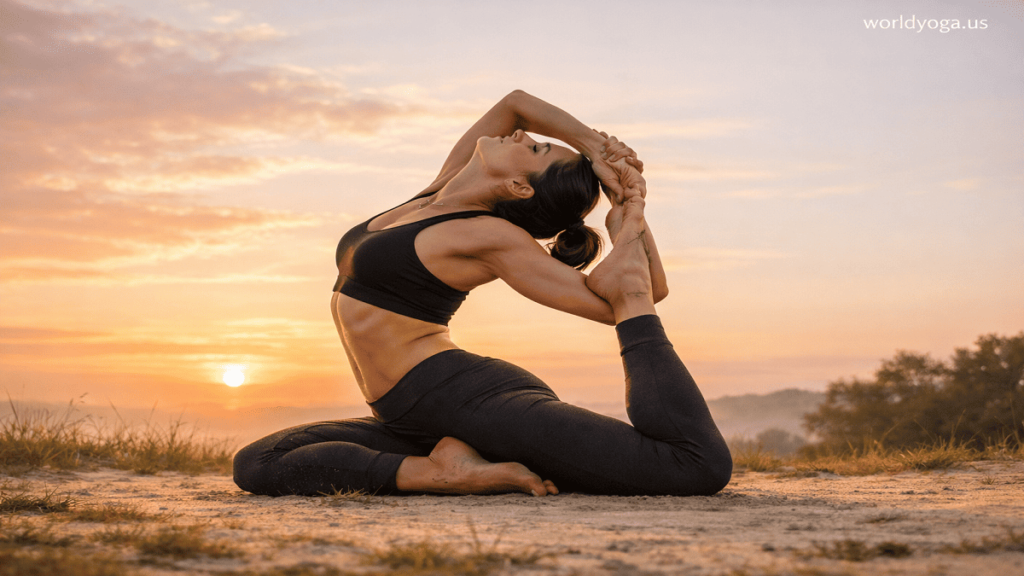
White Paper of Pada Gomukhasana in Ushtrasana*
Abstract
Pada Gomukhasana in Ushtrasana is an advanced composite yoga posture integrating the lower-body configuration of Gomukhasana and the spinal extension of Ushtrasana. This white paper examines its biomechanical characteristics, physiological effects, benefits, risks, and applications within modern yoga practice and therapeutic settings. The objective is to provide a structured, evidence-informed overview for practitioners, instructors, and wellness professionals.
Introduction
With the evolution of yoga into contemporary wellness systems, hybrid postures have emerged to combine multiple functional benefits. Pada Gomukhasana in Ushtrasana exemplifies this integration by simultaneously targeting hip mobility, spinal flexibility, and shoulder extension. Its complexity requires a high degree of neuromuscular coordination and controlled breathing.
Biomechanical Analysis
The posture involves multi-joint engagement across the kinetic chain. The hips are positioned in deep adduction and external rotation, characteristic of Gomukhasana, while the spine undergoes controlled extension as seen in Ushtrasana. The thoracic spine plays a central role in achieving a balanced backbend, while the lumbar region must remain supported through core engagement to avoid excessive compression. The shoulders move into extension and slight external rotation, requiring adequate flexibility in the anterior deltoids and pectoral muscles.
Muscular Engagement
Primary muscle groups involved include the erector spinae (spinal extension), gluteus maximus (hip extension), quadriceps (knee stabilization), and core stabilizers such as the transverse abdominis. Secondary engagement occurs in the rhomboids and trapezius for scapular retraction, and in the hip rotators for maintaining leg alignment. This coordinated activation enhances both strength and flexibility.
Physiological and Functional Benefits
Regular practice of this posture may improve spinal mobility, particularly in the thoracic region, and counteract postural imbalances الناتجة (resulting) from prolonged sitting. The chest-opening component supports improved respiratory function by increasing lung विस्तार (expansion). Additionally, the hip-opening aspect can reduce muscular tightness and improve lower-body mobility. From a functional standpoint, the posture enhances balance, proprioception, and body awareness.
Applications in Practice
Pada Gomukhasana in Ushtrasana is most suitable for intermediate to advanced practitioners. It can be incorporated into sequences focused on backbends, hip openers, or posture correction. In therapeutic contexts, it may be adapted to address mild postural deviations, provided that modifications are applied and contraindications are respected.
Risk Assessment and Precautions
Due to its advanced nature, the posture carries risks if performed incorrectly. Potential issues include lumbar spine compression, knee strain, and shoulder तनाव (strain). It is contraindicated for individuals with acute back injuries, severe joint limitations, or uncontrolled cardiovascular conditions. Proper warm-up, alignment awareness, and supervision are essential for safe practice.
Conclusion
Pada Gomukhasana in Ushtrasana represents a sophisticated integration of flexibility and strength. When practiced with precision, it offers significant physical and functional benefits. However, its complexity necessitates a structured approach emphasizing preparation, alignment, and safety.
Further Reading
- Yoga Journal: https://www.yogajournal.com/poses/camel-pose/
- Yoga International: https://yogainternational.com/article/view/how-to-practice-ustrasana
- DoYogaWithMe: https://www.doyogawithme.com/content/cow-face-pose
#Pada Gomukhasana in Ushtrasana* in Hyderabad
Industry Application of Pada Gomukhasana in Ushtrasana*
Pada Gomukhasana in Ushtrasana, an advanced integration of Gomukhasana and Ushtrasana, has evolved beyond traditional yoga settings into a variety of professional and industry applications. Its unique combination of spinal extension, hip opening, and postural correction makes it relevant across wellness, healthcare, corporate, and fitness sectors.
1. Corporate Wellness Programs
In modern corporate environments, prolonged sitting and screen exposure contribute to musculoskeletal issues such as poor posture, lower back pain, and tight hips. This posture, when appropriately modified, is incorporated into advanced corporate yoga modules to address these concerns. It helps counteract forward head posture and rounded shoulders by promoting thoracic extension and chest opening. While the full expression may not be suitable for all employees, preparatory variations derived from this pose are increasingly used in workplace wellness initiatives.
2. Physiotherapy and Rehabilitation
In physiotherapy settings, elements of this posture are adapted for rehabilitation programs targeting postural imbalances and reduced spinal mobility. The backbend component derived from Ushtrasana is used to improve thoracic विस्तार (expansion) and spinal flexibility, while the Gomukhasana leg position aids in restoring hip joint mobility. Therapists often break down the posture into isolated components to ensure safety, particularly for patients recovering from mild musculoskeletal conditions.
3. Fitness and Functional Training Industry
The fitness industry has integrated yoga-based movements into functional training systems. Pada Gomukhasana in Ushtrasana contributes to mobility training by enhancing flexibility in the hips, quadriceps, and shoulders. It is particularly valuable in programs focused on movement quality, injury prevention, and recovery. Trainers may include modified versions in cool-down routines or mobility sessions for athletes and gym clients.
4. Sports Performance and Athletic Conditioning
Athletes, especially those in disciplines requiring spinal mobility and hip flexibility (such as gymnastics, dance, and martial arts), benefit from the biomechanical demands of this posture. It improves range of motion, जिससे (thereby) enhancing performance efficiency and reducing the risk of strain. Coaches often integrate preparatory components of the pose into stretching and recovery protocols.
5. Yoga Therapy and Holistic Health
Within yoga therapy, this posture is used selectively for clients with specific needs related to posture correction and ऊर्जा (energy) balance. It is believed to stimulate the front body and improve дыхание (breathing patterns), contributing to overall well-being. However, therapeutic use requires careful assessment and customization.
6. Wellness and Spa Industry
Luxury wellness centers and retreats incorporate advanced yoga practices, including variations of this posture, into specialized programs. It is often featured in advanced-level sessions aimed at enhancing flexibility, relaxation, and body awareness. The pose aligns with the growing demand for holistic and experiential wellness services.
7. Education and Professional Training
Yoga teacher training programs include this posture as part of advanced curriculum modules. It serves as a case study for teaching alignment, sequencing, and risk management. Trainees learn how to safely guide students through preparatory stages and modifications.
Conclusion
The industry relevance of Pada Gomukhasana in Ushtrasana lies in its adaptability. While the full posture is suited for advanced practitioners, its components are widely applied across sectors to improve mobility, posture, and overall physical health. Its integration into diverse industries reflects the growing recognition of yoga as both a therapeutic and performance-enhancing discipline.
Further Reading
- Yoga Journal: https://www.yogajournal.com/poses/camel-pose/
- Yoga International: https://yogainternational.com/article/view/how-to-practice-ustrasana
- DoYogaWithMe: https://www.doyogawithme.com/content/cow-face-pose
#Pada Gomukhasana in Ushtrasana* in Mumbai
Ask FAQs
What is Pada Gomukhasana in Ushtrasana?
Pada Gomukhasana in Ushtrasana is an advanced yoga posture that combines the leg positioning of Gomukhasana with the deep backbend of Ushtrasana. It integrates hip opening with spinal extension, requiring flexibility, strength, and balance. This pose is typically practiced by intermediate to advanced practitioners due to its complexity and physical demands.
Who should practice this pose?
This posture is best suited for experienced yoga practitioners who have already developed sufficient hip mobility, spinal flexibility, and core strength. It is commonly included in advanced yoga sequences or teacher training programs. Beginners should avoid attempting the full expression and instead focus on preparatory poses that build the necessary foundation.
What are the key benefits of this posture?
Pada Gomukhasana in Ushtrasana offers multiple benefits, including improved spinal flexibility, enhanced hip mobility, and better posture. The chest-opening aspect promotes deeper breathing and lung capacity, while the engagement of the back and core muscles supports overall strength and stability. It can also help counteract the effects of prolonged sitting and poor posture.
Are there any risks or contraindications?
Yes, this is a high-intensity posture that carries certain risks if performed incorrectly. Individuals with knee injuries, lower back مشاكل (issues), or shoulder limitations should avoid it or practice only under professional supervision. Improper alignment may lead to lumbar compression or joint strain. Adequate warm-up and gradual progression are essential to minimize the risk of injury.
How can beginners safely progress toward this pose?
Beginners should start with foundational poses such as hip openers, gentle backbends, and shoulder stretches. Practicing modified versions of Gomukhasana and Ushtrasana separately helps build the required flexibility and strength. Using props like yoga blocks or bolsters, and working under the guidance of a qualified instructor, can further support safe progression.
Table of Contents
Disclaimer
The information provided about Pada Gomukhasana in Ushtrasana, including its relation to Gomukhasana and Ushtrasana, is intended for educational purposes only. This advanced posture should be practiced under the guidance of a qualified yoga instructor. Individuals with pre-existing medical conditions, injuries, or physical limitations should consult a healthcare professional before attempting it. Improper practice may result in injury; therefore, proper alignment, warm-up, and gradual progression are essential.