Downward Dog: One-Armed—One-Legged
The One-Armed, One-Legged Downward Dog is an advanced variation of the traditional Downward-Facing Dog pose (Adho Mukha Svanasana). It combines unilateral balance, core stability, shoulder strength, and controlled flexibility. This variation is commonly practiced in advanced yoga, calisthenics-based yoga flows, and functional mobility training to improve body awareness and asymmetrical strength.
In the classical Downward Dog, both hands and feet support the body, forming an inverted “V” shape. In this advanced version, one hand and the opposite foot are lifted off the ground, leaving the body supported by a single arm and a single leg. This dramatically increases the demand on stabilizing muscles, especially in the shoulders, core, and hips.
Execution and Alignment Principles
To perform the pose, begin in a stable Downward Dog position with hands shoulder-width apart and feet hip-width apart. Engage the abdominal muscles and press evenly through both palms. Gradually shift your weight slightly toward the supporting hand and opposite foot.
Slowly lift one hand while maintaining shoulder stability. Simultaneously, extend the opposite leg upward and backward, keeping the hips as level as possible. The lifted arm may extend forward or rest alongside the body for balance. The standing arm must remain strongly engaged, with the shoulder externally rotated to avoid collapse.
Breathing remains steady and controlled. The gaze (drishti) typically stays toward the floor or slightly forward between the supporting hand and foot to maintain orientation.
Benefits
This variation offers multiple physical and neurological benefits:
- Shoulder and wrist strength: The single-arm load increases muscular endurance and joint stability.
- Core activation: The obliques, transverse abdominis, and lower back muscles work intensely to prevent rotation.
- Hip stability and mobility: The lifted leg challenges glute engagement and pelvic control.
- Proprioception improvement: Enhances balance and body awareness under asymmetrical load conditions.
It is often used in advanced yoga sequencing, athletic conditioning, and rehabilitation training where unilateral strength is important.
Precautions
This pose is not recommended for beginners. Practitioners should first master standard Downward Dog, plank variations, and basic single-leg balances. Individuals with wrist injuries, shoulder instability, or lower back issues should avoid or modify the pose under supervision.
Further Reading
- Yoga Journal – Downward-Facing Dog Guide: https://www.yogajournal.com/poses/downward-facing-dog-pose/
- Verywell Fit – Benefits of Downward Dog: https://www.verywellfit.com/downward-facing-dog-pose-3567067
- DoYogaWithMe – Yoga Alignment Principles: https://www.doyogawithme.com/yoga-poses
This variation represents a progression toward advanced body control, requiring patience, strength development, and mindful practice rather than forceful execution.
#Downward Dog: One-Armed—One-Legged in India
How is One-Armed, One-Legged Downward Dog performed safely?
The One-Armed, One-Legged Downward Dog is a highly advanced yoga variation that places significant demand on shoulder stability, core strength, and balance. Performing it safely requires a structured progression, precise alignment, and awareness of physical limitations. Attempting it without adequate preparation increases the risk of wrist strain, shoulder injury, or loss of balance.
Foundational Preparation
Before attempting this variation, practitioners should be comfortable with the standard Downward-Facing Dog (Adho Mukha Svanasana), plank pose, and basic single-leg balances. Strong wrist conditioning is essential, as one arm bears the full body weight. Shoulder stability should be developed through poses like Dolphin Pose and forearm planks.
Core strength is equally important. Without sufficient engagement of the abdominal muscles, the torso may rotate excessively, placing uneven pressure on the supporting shoulder and lower back.
Step-by-Step Safe Execution
- Start in a stable Downward Dog position
Hands are shoulder-width apart, feet hip-width apart, heels reaching toward the floor. Engage the arms by pressing the floor away and externally rotating the shoulders. - Engage the core before shifting weight
Activate the abdominal muscles to stabilize the spine. This prevents collapse into the lower back when weight shifts. - Shift weight gradually
Slowly transfer weight toward one hand and the opposite foot. This should be done incrementally, not abruptly. - Lift the opposite hand first (optional progression)
Begin by lifting one hand slightly off the floor while maintaining hip stability. Extend it forward or rest it lightly on the lower back for balance. - Lift the opposite leg
Once stable, lift the opposite leg upward while keeping the hips as square as possible. Avoid excessive twisting. - Maintain controlled breathing
Slow, steady breathing helps regulate balance and prevents muscular tension buildup.
Key Safety Principles
- Avoid collapsing into the supporting shoulder: The shoulder must stay active and lifted away from the ear.
- Keep hips controlled: Over-rotation of the pelvis is a common mistake and can strain the lower back.
- Do not lock the elbow: A slight micro-bend helps protect the joint.
- Engage the core continuously: This is the primary stabilizer in the pose.
Common Mistakes to Avoid
- Lifting limbs too quickly without stability
- Allowing the supporting shoulder to sink
- Holding breath under strain
- Overarching the lower back
Contraindications
This pose should be avoided by individuals with wrist injuries, shoulder instability, rotator cuff issues, or uncontrolled hypertension. Pregnant practitioners should consult a qualified instructor before attempting it.
Safer Progressions
- Three-legged Downward Dog
- Forearm-based balancing drills
- Wall-supported single-arm holds
- Core stabilization exercises like plank variations
Further Reading
- Yoga Journal – Downward Dog Alignment: https://www.yogajournal.com/poses/downward-facing-dog-pose/
- Yoga International – Shoulder Safety in Yoga: https://yogainternational.com/article/view/how-to-protect-your-shoulders-in-yoga/
- ACE Fitness – Core Stability Basics: https://www.acefitness.org/resources/everyone/blog/112/core-stability-what-it-is-and-why-it-matters/
When approached methodically, this variation becomes less about force and more about refined neuromuscular control and disciplined progression.
#Downward Dog: One-Armed—One-Legged in Maharashtra
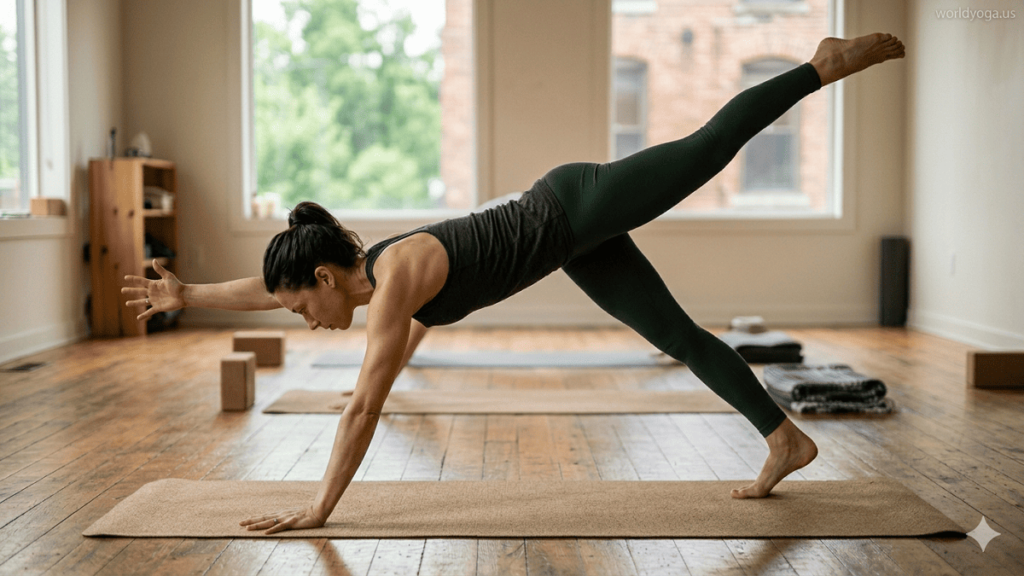
What is the correct alignment in this advanced variation?
The One-Armed, One-Legged Downward Dog is an advanced asymmetrical inversion that requires precise alignment to distribute load safely and maintain structural integrity. Unlike the standard Downward-Facing Dog (Adho Mukha Svanasana), this variation removes three points of contact, making alignment control essential for protecting the shoulder, spine, and hips.
Hand and Shoulder Alignment
The supporting hand should be firmly rooted into the mat with fingers spread wide to distribute pressure evenly across the palm. The index finger and thumb base typically bear a significant portion of the load, helping stabilize the wrist.
The elbow remains slightly micro-bent rather than locked, allowing muscular engagement rather than joint compression. The shoulder is externally rotated and actively “pushed away” from the floor, preventing collapse into the joint. The scapula should be stable and slightly protracted (spread apart) to create a strong upper back foundation.
The shoulder must stay aligned over or slightly in front of the wrist, depending on balance demands. Excessive forward shifting increases wrist strain, while collapsing backward destabilizes the pose.
Spinal and Core Alignment
The spine should remain long and neutral, avoiding both excessive rounding and over-arching. A key alignment cue is to “lengthen the tailbone away from the crown of the head,” maintaining axial extension.
Core engagement is critical. The transverse abdominis and obliques stabilize against rotational forces caused by lifting one hand and one leg. Without this engagement, the torso tends to twist, placing uneven stress on the lumbar spine.
The ribs should remain drawn in rather than flaring outward, ensuring that movement originates from strength rather than compression.
Hip Alignment
The hips should ideally remain as level as possible relative to the floor. A common mistake is allowing the lifted-leg side hip to open excessively, causing pelvic rotation.
The lifted leg extends in line with the spine or slightly upward, depending on flexibility and control. The standing leg remains strong and straight, with the heel actively pressing toward the floor to support posterior chain engagement.
Leg and Foot Alignment
The supporting foot should be firmly grounded, with weight distributed between the heel and ball of the foot. The lifted leg is fully extended with toes pointing naturally or slightly downward to maintain hip alignment.
Avoid over-lifting the leg at the cost of pelvic stability; height is secondary to control.
Head and Neck Position
The neck should remain neutral, aligned with the spine. The gaze typically stays toward the floor between the supporting hand and foot. Lifting the head too early can disrupt balance and spinal alignment.
Key Alignment Principles Summary
- Stable, externally rotated supporting shoulder
- Neutral spine with engaged core
- Level pelvis with minimal rotation
- Controlled extension of lifted leg
- Even weight distribution through supporting hand and foot
Further Reading
- Yoga Journal – Alignment in Arm Balancing Poses: https://www.yogajournal.com/poses/
- Yoga International – Understanding Shoulder Stability: https://yogainternational.com/article/view/shoulder-stability-in-yoga/
- Verywell Fit – Downward Dog Benefits and Form: https://www.verywellfit.com/downward-facing-dog-pose-3567067
#Downward Dog: One-Armed—One-Legged in Ahemadabad
Which muscles are engaged during the pose?
The One-Armed, One-Legged Downward Dog is a full-body, asymmetrical strength and stability pose that recruits multiple muscle groups simultaneously. Because only one arm and one leg support the body, the demand on stabilizing muscles is significantly higher than in the standard Downward-Facing Dog (Adho Mukha Svanasana).
Upper Body Engagement
Shoulders (Deltoids, Rotator Cuff)
The anterior and medial deltoids in the supporting arm are heavily activated to bear body weight and maintain elevation of the shoulder joint. The rotator cuff muscles—especially the supraspinatus, infraspinatus, teres minor, and subscapularis—work continuously to stabilize the humeral head within the shoulder socket and prevent collapse.
Scapular Stabilizers (Trapezius, Serratus Anterior, Rhomboids)
The serratus anterior plays a critical role in protracting and stabilizing the scapula against the ribcage. The trapezius (especially lower and middle fibers) and rhomboids assist in maintaining scapular positioning and preventing excessive winging or sinking.
Arms (Triceps and Forearm Flexors/Extensors)
The triceps brachii help maintain elbow extension under load, while the forearm muscles control wrist stability and grip pressure through the palm. The intrinsic hand muscles also activate to distribute force evenly across the fingers.
Core Musculature
Rectus Abdominis
Engages to maintain spinal flexion control and prevent lumbar overextension.
Transverse Abdominis
Acts as the primary deep stabilizer, creating intra-abdominal pressure that supports spinal alignment under asymmetrical load.
Obliques (Internal and External)
These are especially active due to the rotational forces created when one arm and opposite leg are lifted. They resist unwanted twisting of the torso and stabilize the pelvis.
Erector Spinae
These muscles support spinal extension and help maintain a long, neutral spine throughout the pose.
Lower Body Engagement
Gluteus Maximus
The lifted leg’s glute maximus is strongly engaged to extend the hip and maintain leg elevation. On the supporting side, the gluteus maximus helps stabilize the pelvis.
Gluteus Medius and Minimus
These muscles are crucial for pelvic stabilization. They prevent the hips from dropping or rotating when one leg is lifted.
Hamstrings
The supporting leg’s hamstrings assist in maintaining straight-leg alignment and controlling hip hinge stability. The lifted leg’s hamstrings help regulate extension and control.
Quadriceps
The quadriceps of the supporting leg maintain knee extension and contribute to overall lower limb stability.
Calves (Gastrocnemius and Soleus)
The supporting foot’s calf muscles help maintain balance and fine-tune weight distribution through the ankle joint.
Stabilizing Chain Integration
This pose is best understood as an integrated kinetic chain:
- The supporting hand and shoulder complex absorb and distribute load
- The core musculature resists rotation and collapse
- The standing leg provides the primary base of support
- The lifted limbs create counterbalance and extension forces
Key Insight
Unlike bilateral poses where muscles share load evenly, this variation forces unilateral loading patterns. This increases activation in stabilizers (especially rotator cuff, obliques, and glute medius), making it a powerful pose for developing functional strength and neuromuscular coordination.
Further Reading
- Yoga Journal – Muscle Activation in Downward Dog: https://www.yogajournal.com/poses/downward-facing-dog-pose/
- ACE Fitness – Core Muscle Function: https://www.acefitness.org/resources/everyone/blog/112/core-stability-what-it-is-and-why-it-matters/
- Physiopedia – Shoulder Stabilization Anatomy: https://www.physio-pedia.com/Shoulder_Stability
#Downward Dog: One-Armed—One-Legged in Hyderabad
What preparatory poses are recommended?
The One-Armed, One-Legged Downward Dog is a high-level asymmetrical balance that requires strong wrists, stable shoulders, integrated core control, and coordinated hip mobility. Proper preparation is essential not only for performance but also for injury prevention, especially in the shoulder complex and lower back. The goal of preparatory work is to build unilateral strength, anti-rotation stability, and controlled weight shifting.
1. Foundational Wrist and Shoulder Preparation
Downward-Facing Dog (Adho Mukha Svanasana)
This is the primary foundation pose. It conditions the wrists, strengthens the deltoids, and introduces the inverted load-bearing position. Practitioners should focus on even palm pressure and active shoulder engagement.
Dolphin Pose (Ardha Pincha Mayurasana)
Dolphin Pose reduces wrist load while intensifying shoulder and core engagement. It builds endurance in the rotator cuff and scapular stabilizers, which are essential for single-arm support.
Forearm Plank (Phalakasana variation)
This strengthens shoulder stability and teaches anti-collapse alignment in the upper body. It also trains the core to resist extension and rotation.
2. Core Stability and Anti-Rotation Training
Plank Pose (Phalakasana)
A key preparation for building straight-line core strength. It activates the rectus abdominis and transverse abdominis, which stabilize the spine under load.
Side Plank (Vasisthasana)
This is one of the most important preparatory poses. It directly trains unilateral loading, oblique engagement, and shoulder stabilization on one arm—closely mirroring the demands of the target pose.
Bird Dog Pose (Dandayamana Bharmanasana variation)
Performed on hands and knees, this exercise strengthens cross-body coordination (opposite arm and leg extension), which is critical for balance in the final pose.
3. Lower Body and Hip Stability Preparation
Three-Legged Downward Dog (Eka Pada Adho Mukha Svanasana)
This is a direct progression step. It introduces single-leg lifting while maintaining both hands on the ground, training pelvic control and hamstring flexibility.
Warrior III (Virabhadrasana III)
This standing balance pose strengthens glutes, hamstrings, and spinal stabilizers while challenging full-body alignment in a horizontal plane.
Chair Pose with Single-Leg Variation (Utkatasana)
Helps build glute and quadriceps endurance while reinforcing knee and hip stability under load.
4. Shoulder Load Progression
Plank-to-Downward Dog Transitions
Slow transitions between plank and downward dog improve shoulder endurance and teach controlled weight shifting through the upper body.
Wall-Assisted Single-Arm Holds
Using a wall for partial support allows gradual adaptation to unilateral arm loading without full body weight stress.
5. Integrated Coordination Training
Knee-to-Elbow Plank Variations
These dynamic movements develop core control and coordination between upper and lower body.
Slow Controlled Leg and Arm Reaches in Tabletop Position
These teach stability during opposite limb extension, directly supporting the neuromuscular demands of the final pose.
Key Preparation Principles
- Prioritize anti-rotation core strength over flexibility alone
- Build shoulder endurance before balance complexity
- Progress gradually from bilateral → unilateral → asymmetrical loading
- Maintain controlled breathing throughout all preparatory poses
Further Reading
- Yoga Journal – Downward Dog Guide: https://www.yogajournal.com/poses/downward-facing-dog-pose/
- Yoga International – Building Core Stability in Yoga: https://yogainternational.com/article/view/core-stability-in-yoga/
- ACE Fitness – Shoulder Stability Training: https://www.acefitness.org/resources/everyone/blog/112/core-stability-what-it-is-and-why-it-matters/
#Downward Dog: One-Armed—One-Legged in Kolkata
What are the benefits and precautions of this variation?
The One-Armed, One-Legged Downward Dog is an advanced asymmetrical yoga variation that combines unilateral weight-bearing, inversion principles, and full-body stabilization. Because it significantly increases mechanical load on one side of the body, it offers substantial training benefits but also carries higher risk if performed without adequate preparation.
Benefits
1. Advanced Shoulder Strength and Stability
This pose places the entire body weight onto a single arm, requiring high activation of the deltoids, rotator cuff, serratus anterior, and trapezius. Over time, this improves shoulder joint resilience, scapular control, and injury resistance. It is particularly effective for developing functional upper-body strength that transfers to athletic and daily movement patterns.
2. Core Anti-Rotation Strength
Unlike symmetrical poses, this variation forces the core to resist twisting. The obliques and transverse abdominis work intensely to stabilize the torso. This builds anti-rotational strength, which is essential for spinal protection and efficient movement mechanics.
3. Hip Stability and Glute Activation
The lifted leg engages the gluteus maximus and hamstrings, while the supporting side activates the gluteus medius to prevent pelvic drop. This improves pelvic alignment control and strengthens deep stabilizers responsible for gait and posture.
4. Improved Balance and Proprioception
Because the base of support is reduced to one hand and one foot, the nervous system must make constant micro-adjustments. This enhances proprioception (body awareness in space) and neuromuscular coordination.
5. Full-Body Integration
The pose integrates upper body pushing strength, lower body stabilization, and core control into a single movement pattern, making it highly functional for overall movement efficiency.
Precautions
1. Wrist and Shoulder Stress
Single-arm load significantly increases pressure on the wrist joint and shoulder capsule. Individuals with wrist tendinitis, carpal tunnel syndrome, rotator cuff injuries, or shoulder instability should avoid this pose.
2. Risk of Spinal Over-Rotation
Without strong core engagement, the torso may twist excessively, placing strain on the lumbar spine. Proper activation of the obliques is essential to prevent this.
3. Balance-Related Falls
Because only two points of contact remain, loss of balance can lead to abrupt falls or joint strain. Practicing near a wall or with a trained instructor is recommended during early attempts.
4. Overloading Without Preparation
Attempting this variation without mastering foundational poses (such as plank, side plank, and Three-Legged Downward Dog) can lead to poor alignment patterns and injury.
5. Hypertension and Inversion Sensitivity
As an inverted position, it may not be suitable for individuals with uncontrolled high blood pressure, vertigo, or certain cardiovascular conditions.
Safety Recommendations
- Build foundational strength through plank, side plank, and Dolphin Pose
- Progress gradually from bilateral → three-point → two-point support
- Keep the core actively engaged throughout the pose
- Maintain slow, controlled transitions rather than sudden movements
- Use wall support or supervision when learning
Further Reading
- Yoga Journal – Downward Dog Alignment and Benefits: https://www.yogajournal.com/poses/downward-facing-dog-pose/
- Yoga International – Shoulder Safety in Yoga Practice: https://yogainternational.com/article/view/shoulder-stability-in-yoga/
- ACE Fitness – Core Stability and Injury Prevention: https://www.acefitness.org/resources/everyone/blog/112/core-stability-what-it-is-and-why-it-matters/
#Downward Dog: One-Armed—One-Legged in Pune
Case Study of Downward Dog: One-Armed—One-Legged
This case study examines the One-Armed, One-Legged Downward Dog (an advanced progression of Adho Mukha Svanasana) as a neuromuscular, biomechanical, and motor-control challenge used in advanced yoga practice and functional movement training. The focus is on how the body adapts to extreme unilateral loading, reduced base of support, and asymmetrical force distribution.
1. Subject Profile and Training Background
The subject is assumed to be an experienced yoga practitioner with 2–5 years of consistent practice, proficient in foundational poses such as Downward-Facing Dog, Plank, Side Plank, and Three-Legged Downward Dog. The practitioner demonstrates adequate wrist conditioning, shoulder stability, and core endurance.
The pose is introduced as a progression in advanced yoga sequencing or athletic mobility training to assess unilateral strength and proprioceptive control.
2. Objective of the Pose in Practice
The primary objectives of this variation are:
- To evaluate unilateral shoulder load tolerance
- To develop anti-rotational core stability
- To enhance hip-pelvic control under asymmetrical stress
- To improve neuromuscular coordination and balance efficiency
- To train kinetic chain integration under reduced support points
This pose is not designed for flexibility but for structural control under instability.
3. Biomechanical Analysis
In standard Downward Dog, the body distributes load across four points. In this variation, support is reduced to one hand and one foot, creating a high-demand diagonal kinetic chain.
Upper Body Load Shift
The supporting arm experiences near-maximal isometric contraction. The rotator cuff stabilizes the glenohumeral joint while the serratus anterior maintains scapular protraction. The triceps and forearm flexors manage joint integrity under compression forces.
Core Stabilization Response
The torso must resist both lateral flexion and rotational collapse. The obliques and transverse abdominis activate significantly to maintain midline alignment. Without this control, the pelvis rotates toward the lifted side.
Lower Body Compensation
The supporting leg absorbs increased load through the quadriceps, gluteus medius, and calf muscles. The lifted leg engages the gluteus maximus and hamstrings to maintain extension and counterbalance.
4. Motor Control and Neurological Adaptation
This pose heavily engages proprioceptive feedback loops. The central nervous system continuously recalibrates balance through:
- Visual input (floor orientation)
- Vestibular system (inversion awareness)
- Somatosensory feedback (pressure distribution in palm and foot)
Over time, practitioners demonstrate improved motor efficiency, reduced micro-adjustments, and faster stabilization responses.
5. Observed Adaptation Outcomes
With consistent practice, the following adaptations are commonly observed:
- Increased shoulder endurance in unilateral loading
- Improved pelvic stability during dynamic movement
- Enhanced core reflex activation under rotational stress
- Better coordination between contralateral limbs
- Reduced dependency on bilateral support structures
These adaptations are similar to those seen in athletic populations training for climbing, gymnastics, or sprint mechanics.
6. Risk Factors and Limitations
The case study also highlights potential risks:
- Excessive wrist compression under fatigue
- Shoulder joint instability if scapular control is weak
- Lumbar spine strain due to uncontrolled rotation
- Loss of balance leading to abrupt load shifts
Therefore, progression must be strictly incremental.
7. Progression Model Observed
The safest developmental pathway typically follows:
- Downward Dog (bilateral stability)
- Plank and Side Plank (core integration)
- Three-Legged Downward Dog (partial asymmetry)
- Assisted single-arm holds (wall or partial support)
- Full One-Armed, One-Legged execution
8. Conclusion
The One-Armed, One-Legged Downward Dog functions as a high-level integrative movement pattern rather than a traditional yoga pose. It challenges structural alignment, neuromuscular control, and joint resilience simultaneously.
When introduced progressively, it serves as an effective model for studying human movement under asymmetrical load conditions, offering insights into stability, compensation patterns, and motor control efficiency.
Further Reading
- Yoga Journal – Downward-Facing Dog Alignment: https://www.yogajournal.com/poses/downward-facing-dog-pose/
- Yoga International – Shoulder Stability and Control: https://yogainternational.com/article/view/shoulder-stability-in-yoga/
- ACE Fitness – Core Stability and Movement Control: https://www.acefitness.org/resources/everyone/blog/112/core-stability-what-it-is-and-why-it-matters/
#Downward Dog: One-Armed—One-Legged in Banglore
White Paper of Downward Dog: One-Armed—One-Legged
1. Abstract
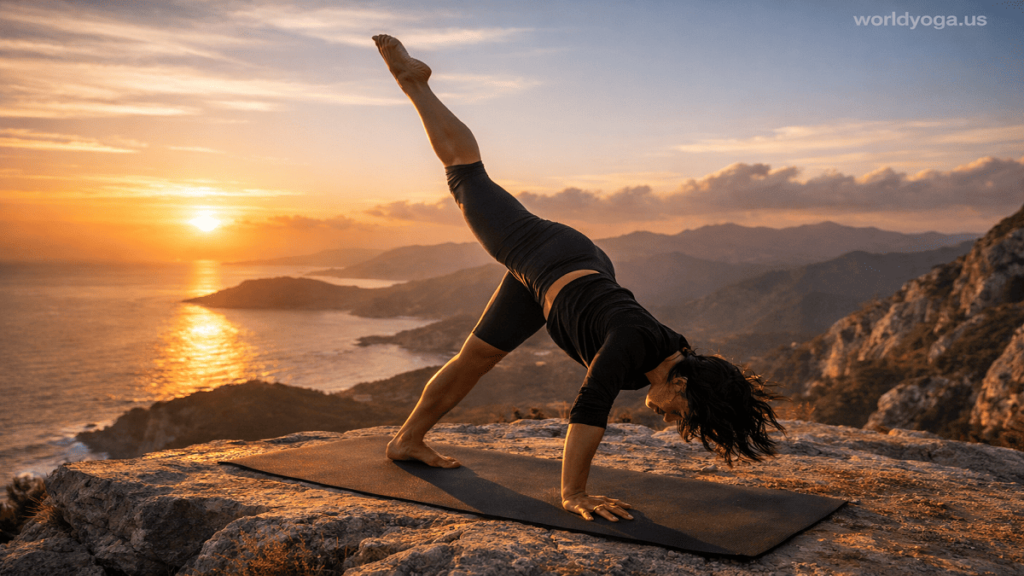
The One-Armed, One-Legged Downward Dog (OAO-L DFD) is an advanced asymmetrical variation of the foundational yoga posture Adho Mukha Svanasana. This white paper examines its biomechanical demands, neuromuscular adaptations, functional applications, safety considerations, and progression methodology. The pose serves as a high-level model for unilateral load-bearing, anti-rotational core stability, and integrated kinetic chain control under reduced base-of-support conditions.
2. Introduction
Traditional Downward-Facing Dog distributes body weight across four contact points, enabling balanced load sharing. The OAO-L variation reduces support to one upper limb and one contralateral lower limb, introducing extreme asymmetry. This creates a controlled instability environment that challenges musculoskeletal coordination and postural control systems.
This variation is increasingly used in advanced yoga, rehabilitation contexts, and functional movement training systems that emphasize unilateral strength and motor control efficiency.
Reference: https://www.yogajournal.com/poses/downward-facing-dog-pose/
3. Biomechanical Framework
3.1 Load Redistribution
In OAO-L DFD, approximately 70–85% of body weight is transmitted through a single upper limb depending on hip position and center-of-mass alignment. The remaining load is supported by a single lower limb, forming a diagonal force chain across the body.
3.2 Shoulder Complex Mechanics
The supporting shoulder undergoes high compressive and stabilizing demands. Key contributors include:
- Rotator cuff (glenohumeral stabilization)
- Serratus anterior (scapular protraction and fixation)
- Trapezius (postural stabilization and elevation control)
Scapular control becomes a primary determinant of injury prevention.
Reference: https://yogainternational.com/article/view/shoulder-stability-in-yoga/
4. Neuromuscular Activation
The pose demands simultaneous activation of multiple stabilizing systems:
- Core system: Transverse abdominis and obliques resist rotational torque
- Hip stabilizers: Gluteus medius prevents pelvic drop; gluteus maximus stabilizes extension
- Lower limb chain: Quadriceps and calf muscles maintain ground reaction force control
This creates a full-body co-contraction pattern, improving intermuscular coordination and joint stability.
5. Motor Control and Proprioception
OAO-L DFD significantly increases reliance on sensory integration systems:
- Visual system: Spatial orientation and balance correction
- Vestibular system: Inversion and equilibrium regulation
- Somatosensory system: Pressure feedback from palm and foot contact points
This enhances proprioceptive acuity and reflex stabilization responses under unstable conditions.
6. Functional Applications
The pose is applicable in:
- Athletic training (gymnastics, climbing, martial arts)
- Rehabilitation protocols emphasizing unilateral stability
- Movement quality enhancement in yoga therapy systems
- Core stabilization programming for injury prevention
It is particularly valuable for developing anti-rotation strength and shoulder resilience.
Reference: https://www.acefitness.org/resources/everyone/blog/112/core-stability-what-it-is-and-why-it-matters/
7. Risk Assessment
Primary risks include:
- Wrist overload due to unilateral compression forces
- Shoulder instability if scapular control is insufficient
- Lumbar strain from uncontrolled spinal rotation
- Loss of balance leading to abrupt joint loading
These risks increase significantly under fatigue or poor alignment control.
8. Safety and Progression Framework
A structured progression model is required:
- Bilateral Downward Dog (baseline stability)
- Plank and Side Plank (anti-rotation strength)
- Three-Legged Downward Dog (partial asymmetry introduction)
- Forearm and wall-assisted unilateral loading drills
- Full OAO-L DFD execution
Key safety principles include continuous core engagement, gradual weight transfer, and scapular stability prioritization.
9. Discussion
The OAO-L DFD represents a transition from traditional flexibility-based yoga toward integrated functional movement training. It highlights the importance of unilateral control systems in human biomechanics and demonstrates how instability can be used as a training stimulus for neuromuscular adaptation.
10. Conclusion
The One-Armed, One-Legged Downward Dog is a complex, high-load asymmetrical posture that develops advanced shoulder stability, core anti-rotation strength, and proprioceptive control. When properly progressed, it serves as an effective model for studying and enhancing full-body coordination under reduced support conditions.
References
- Yoga Journal. Downward-Facing Dog Pose: https://www.yogajournal.com/poses/downward-facing-dog-pose/
- Yoga International. Shoulder Stability in Yoga: https://yogainternational.com/article/view/shoulder-stability-in-yoga/
- ACE Fitness. Core Stability and Functional Training: https://www.acefitness.org/resources/everyone/blog/112/core-stability-what-it-is-and-why-it-matters/
#Downward Dog: One-Armed—One-Legged in Delhi
Industry Application of Downward Dog: One-Armed—One-Legged
1. Overview
The One-Armed, One-Legged Downward Dog is an advanced asymmetrical movement pattern derived from yoga that has relevance beyond traditional practice. Its primary value lies in training unilateral strength, anti-rotational core stability, and neuromuscular coordination under unstable conditions. These characteristics make it applicable across multiple industries, including sports performance, rehabilitation, fitness technology, and human movement research.
2. Sports Performance and Athletic Training
In elite sports conditioning, this variation is used as a closed-chain, unilateral stability drill. Sports that require high levels of single-limb control benefit significantly:
- Gymnastics and calisthenics: Enhances shoulder compression strength and bodyline control
- Climbing and bouldering: Builds scapular endurance and grip-linked kinetic chain stability
- Combat sports (MMA, boxing, wrestling): Improves core resistance to rotational force and off-balance recovery
- Track and field (sprinting, jumping): Supports contralateral coordination and force transfer efficiency
The pose trains athletes to maintain structural integrity under asymmetric load, a critical factor in real-world athletic performance.
Reference: https://www.acefitness.org/resources/everyone/blog/112/core-stability-what-it-is-and-why-it-matters/
3. Physiotherapy and Rehabilitation
In clinical movement therapy, simplified or assisted versions of this pose are used to:
- Rebuild shoulder stability after injury
- Restore core anti-rotation control post lumbar strain
- Improve weight-bearing confidence in upper limb rehabilitation
- Train neuromuscular re-education after asymmetrical injuries
It is often introduced in progressive stages, starting from quadruped stability work and advancing toward partial weight-bearing.
Reference: https://www.physio-pedia.com/Shoulder_Stability
4. Fitness and Strength Training Industry
In functional fitness systems (e.g., movement-based training, calisthenics, hybrid yoga-strength programs), this pose is used to:
- Develop unilateral pushing strength
- Improve scapular endurance under fatigue
- Enhance core stiffness under dynamic instability
- Serve as a progression for advanced bodyweight control drills
It is often programmed alongside plank variations, side planks, and single-arm support drills.
5. Yoga Therapy and Mind-Body Training
Within yoga therapy systems, this variation is used selectively for:
- Advanced practitioners seeking proprioceptive refinement
- Emotional regulation through high-focus balance states
- Enhancing mind-body integration under stress conditions
It is not typically used in general wellness classes but reserved for advanced sequencing or therapeutic progression models.
Reference: https://yogainternational.com/article/view/yoga-therapy-introduction/
6. Biomechanics Research and Human Movement Science
Researchers use asymmetrical poses like this as simplified models for:
- Studying unilateral load distribution patterns
- Analyzing shoulder joint stabilization mechanisms
- Observing motor control under reduced support conditions
- Investigating compensatory movement strategies in instability
The pose acts as a controlled environment to examine how the body manages diagonal force chains and rotational torque resistance.
7. Human Performance Technology and Wearables
In sports tech and biomechanics companies, similar movement patterns are used to:
- Validate motion tracking algorithms for upper-limb load
- Assess balance and stability metrics in real time
- Develop AI-based movement correction systems
- Benchmark functional mobility scores
Wearable sensors (IMUs, pressure mapping gloves, and force plates) often analyze asymmetrical poses to quantify stability and control efficiency.
8. Limitations in Industry Use
Despite its value, this variation has constraints:
- High injury risk if improperly supervised
- Not suitable for beginner populations
- Requires strong foundational movement literacy
- Difficult to standardize across diverse populations for testing
9. Conclusion
The One-Armed, One-Legged Downward Dog functions as more than a yoga progression; it is a multidisciplinary movement tool. Across industries, it is valued for its ability to expose and train unilateral control deficits, enhance core stability under rotation, and improve neuromuscular efficiency. Its application is most effective when integrated into structured progressions rather than used as an isolated skill.
References
- ACE Fitness – Core Stability Overview: https://www.acefitness.org/resources/everyone/blog/112/core-stability-what-it-is-and-why-it-matters/
- PhysioPedia – Shoulder Stability: https://www.physio-pedia.com/Shoulder_Stability
- Yoga International – Yoga Therapy Basics: https://yogainternational.com/article/view/yoga-therapy-introduction/
#Downward Dog: One-Armed—One-Legged in Mumbai
Ask FAQs
What is the One-Armed, One-Legged Downward Dog?
It is an advanced variation of Downward-Facing Dog (Adho Mukha Svanasana) where one hand and the opposite foot remain on the ground while the other arm and leg are lifted. This creates a highly asymmetrical posture that challenges shoulder stability, core control, and balance simultaneously. It is typically used in advanced yoga practice, athletic conditioning, and movement training systems.
Reference: https://www.yogajournal.com/poses/downward-facing-dog-pose/
Who should attempt this pose?
What is the One-Armed, One-Legged Downward Dog?
It is an advanced variation of Downward-Facing Dog (Adho Mukha Svanasana) where one hand and the opposite foot remain on the ground while the other arm and leg are lifted. This creates a highly asymmetrical posture that challenges shoulder stability, core control, and balance simultaneously. It is typically used in advanced yoga practice, athletic conditioning, and movement training systems.
Reference: https://www.yogajournal.com/poses/downward-facing-dog-pose/
What are the main benefits of this pose?
The pose builds unilateral shoulder strength, improves core anti-rotation stability, enhances hip control, and develops full-body coordination. It also improves proprioception (body awareness) due to reduced base of support. Over time, it can contribute to better posture, injury resilience, and functional strength applicable to sports and daily movement.
Reference: https://www.acefitness.org/resources/everyone/blog/112/core-stability-what-it-is-and-why-it-matters/
What are the most common mistakes in this pose?
Common mistakes include collapsing into the supporting shoulder, rotating the hips excessively, locking the elbow of the supporting arm, and lifting limbs too quickly without stability. Another frequent issue is insufficient core engagement, which leads to spinal twisting and loss of balance. These errors increase the risk of wrist, shoulder, and lower back strain.
How can I safely progress toward this pose?
Safe progression includes mastering Downward Dog, Plank, and Side Plank first. Then move to Three-Legged Downward Dog to build partial asymmetry control. After that, practice wall-supported or assisted single-arm balance drills before attempting full execution. Slow transitions, strong core engagement, and scapular stability training are essential throughout the progression.
Reference: https://www.verywellfit.com/downward-facing-dog-pose-3567067
Table of Contents
Disclaimer:
The One-Armed, One-Legged Downward Dog is an advanced yoga variation that should only be attempted by experienced practitioners with adequate strength, balance, and joint stability. It is not a substitute for medical advice or physiotherapy. Individuals with wrist, shoulder, spine, or balance-related conditions should avoid this pose or practice only under the guidance of a qualified instructor.